
Will a Pancake Air Compressor Run an Impact Wrench? Explained
Yes, a pancake air compressor can run an impact wrench for short, intermittent jobs, but most pancake compressors cannot supply enough continuous airflow for reliable or sustained impact-wrench use. A typical 6-gallon pancake compressor produces around 2.6–2.8 CFM at 90 PSI, while many 1/2-inch impact wrenches can consume roughly 4–5 CFM on average and considerably more airflow while working under load.
That does not mean your impact wrench simply will not work. A fully charged pancake tank can store enough compressed air to deliver a few useful bursts. You may be able to loosen several lug nuts, remove a moderately tight fastener, or perform occasional light automotive work before the pressure begins dropping and the compressor needs time to recover.
The important distinction is between stored air and continuous compressor output. A pancake compressor may have enough pressure and stored air to start an impact wrench, yet still have too little CFM to keep it operating at full power.
In this guide, I’ll explain when a pancake compressor can run an impact wrench, how much CFM and PSI you actually need, what happens with a 6-gallon compressor, how drive size affects air demand, and what compressor size makes more sense if you plan to use pneumatic impact tools regularly.
Will a Pancake Air Compressor Run an Impact Wrench Successfully?
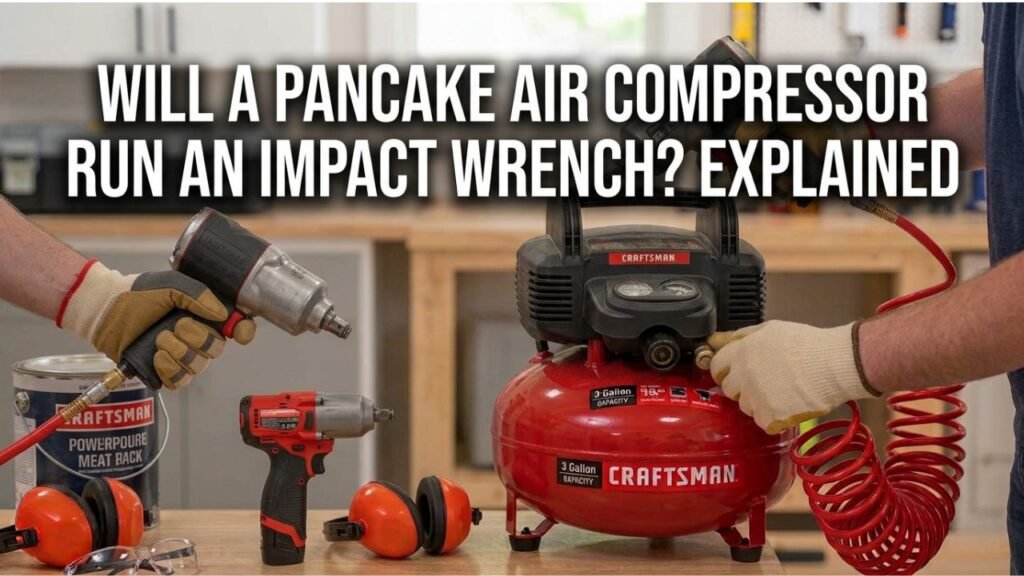
A pancake air compressor can operate many impact wrenches, but whether it operates one successfully depends on what you expect the tool to do.
For occasional short bursts, a common 6-gallon pancake compressor may be adequate. For continuous professional automotive work, stubborn suspension bolts, repeated tire changes, or high-torque fastening, it usually is not.
The compressor and wrench need to match in three important areas:
• PSI: The compressor must provide the operating pressure required by the wrench, commonly around 90 PSI.
• CFM or SCFM: The compressor must move enough air per minute to support the wrench.
• Tank capacity: The tank determines how much compressed air you have available before the pump must replace it.
Most pancake compressors have no problem producing sufficient pressure. Many have maximum tank pressures of 150 PSI or more. Airflow is usually the limiting factor, not maximum PSI.
For example, popular 6-gallon pancake-style compressors commonly provide approximately 2.6–2.8 CFM at 90 PSI. By comparison, some common 1/2-inch pneumatic impact wrenches list average air consumption around 4–5 CFM, while actual airflow under load can be dramatically higher.
As soon as the impact wrench consumes air faster than the compressor produces it, tank pressure begins dropping.
You can continue working until the available pressure becomes too low to maintain satisfactory wrench performance. Then you have to stop and allow the compressor to recover.
Key Takeaways:
• A pancake compressor can power an impact wrench in short bursts.
• Most 6-gallon pancake compressors do not produce enough CFM for sustained impact-wrench operation.
• PSI is rarely the main problem; available airflow at operating pressure is more important.
• Light, occasional use is much more realistic than continuous automotive work.
Why CFM Matters More Than Tank Pressure
One of the most common mistakes is choosing a compressor based mainly on its maximum PSI.
You might see a pancake compressor rated for 150 or 165 PSI and assume it has more than enough power for a 90-PSI impact wrench.
Technically, it has enough pressure. That does not mean it has enough airflow.
What PSI Means
PSI stands for pounds per square inch. It measures air pressure.
A pneumatic impact wrench commonly operates around 90 PSI, although you should always follow the specification for your particular tool.
If your compressor tank reaches 150 PSI, you normally use the regulator to reduce the outlet pressure to the appropriate level for the wrench.
What CFM Means
CFM stands for cubic feet per minute and describes airflow volume.
SCFM, or standard cubic feet per minute, is a standardized airflow measurement commonly used on compressor specifications.
An impact wrench can consume a substantial volume of compressed air while its motor and hammer mechanism are operating. If it needs more air than the compressor pump can supply, it begins drawing down the air stored in the tank.
That is why a small compressor can initially make an impact wrench sound powerful but gradually lose performance.
Average Air Consumption vs. Air Consumption Under Load
This distinction matters especially with impact wrenches.
An impact wrench is normally used intermittently. You pull the trigger for a few seconds, release it, reposition the tool, and use it again. Manufacturers may therefore publish an average air-consumption figure based on an assumed duty cycle.
The wrench can require far more airflow during the moments when the trigger is actually held.
As one real-world example, some 1/2-inch professional impact wrenches have average-air figures around 4–5 CFM but airflow under load exceeding 20 CFM.
That does not automatically mean you need a 20+ CFM compressor for occasional impact work. It does explain why a 2.6 CFM pancake compressor drains its reserve quickly when the wrench is working hard.
How to Compare Your Compressor and Impact Wrench
Check the compressor’s specification for:
SCFM or CFM at 90 PSI
Then check the impact wrench manual or specification sheet for:
Required or average CFM at its recommended operating pressure
A useful guideline is to choose a compressor with some airflow reserve rather than matching the tool’s stated CFM exactly. For frequent pneumatic-tool use, I prefer approximately 25–50% more compressor airflow than the tool’s stated average demand when practical.
For example, if a tool lists 5 CFM at 90 PSI, a compressor producing around 6.25–7.5 CFM at 90 PSI gives you substantially more breathing room than a 5-CFM compressor.
That margin becomes even more useful if you have pressure losses through fittings and hoses or intend to use the wrench frequently.
Pro Tip: Ignore the compressor’s displacement or marketing airflow figure if a more useful rated output is available. Compare the tool requirement with the compressor’s delivered CFM or SCFM at 90 PSI.
Can a 6-Gallon Pancake Air Compressor Run a 1/2-Inch Impact Wrench?
Yes, a 6-gallon pancake air compressor can run many 1/2-inch impact wrenches intermittently, but it normally cannot keep up with one continuously.
This is probably the most relevant combination because 6-gallon pancake compressors and 1/2-inch impact wrenches are extremely common among homeowners and DIY mechanics.
A typical setup looks something like this:
| Specification | Typical 6-Gallon Pancake Compressor | Typical 1/2-Inch Impact Wrench |
| Operating pressure | Capable of 90 PSI | Often about 90 PSI |
| Maximum tank pressure | Often 150–165 PSI | Not the relevant comparison |
| Airflow | About 2.6–2.8 CFM at 90 PSI | Often around 4–5 CFM average |
| Tank capacity | 6 gallons | Uses stored compressor air |
| Best use | Nailers, inflation, intermittent air tools | Lug nuts and automotive fasteners |
The compressor can charge its tank, shut off, and give you a reserve of compressed air. When you pull the impact-wrench trigger, the wrench uses that stored air faster than the small pump can replace it.
For one stubborn nut, that may not matter.
For removing 20 lug nuts from four wheels, the difference becomes obvious.
What You Can Realistically Expect
A properly set up 6-gallon pancake compressor may be practical for:
• Removing a few lug nuts at a time.
• Occasional tire rotations at home.
• Loosening ordinary automotive fasteners.
• Short assembly or disassembly jobs.
• Emergency or infrequent impact-wrench use.
It becomes frustrating for:
• Continuous shop work.
• Repeated tire changes.
• Rusted or seized suspension hardware.
• High-torque truck fasteners.
• Long trigger pulls.
• Large 3/4-inch or 1-inch impacts.
The exact number of fasteners you can remove before noticeable pressure loss cannot be predicted universally. It depends on the wrench, tank pressure, fastener torque, trigger duration, hose setup, compressor recovery rate, and how long you pause between fasteners.
Key Takeaways:
• A 6-gallon pancake compressor is usable with many 1/2-inch impact wrenches for occasional work.
• Expect the compressor to cycle frequently and require recovery time.
• It is much better suited to short trigger bursts than sustained operation.
• For regular automotive work, a larger, higher-CFM compressor is the better choice.
How Long Can You Run an Impact Wrench on a Pancake Compressor?
There is no universal runtime because an impact wrench does not consume air at a perfectly constant rate.
Several factors determine how quickly the tank runs down.
Tank Size
A larger tank stores more usable compressed air.
A 6-gallon tank gives you substantially more reserve than a tiny 1- or 2-gallon portable compressor, but much less than a 20-, 30-, or 60-gallon shop compressor.
Tank size does not increase the pump’s CFM. It simply gives you a larger buffer.
Compressor Recovery Rate
Once tank pressure falls to the compressor’s cut-in point, the motor starts and begins replenishing the tank.
If the compressor produces only 2.6 CFM while the tool is consuming significantly more air, the compressor cannot catch up while you keep using the wrench heavily.
Fastener Resistance
A loose nut might require only a brief trigger pull.
A heavily torqued or corroded fastener may keep the wrench hammering for several seconds. That dramatically increases air consumption.
Impact Wrench Efficiency
Two 1/2-inch impact wrenches can have very different air demands.
A modern, efficient impact may accomplish the same work faster than an older or less efficient design, reducing the amount of air used per fastener.
Your Working Pattern
If you use the impact for three seconds and then spend 15 or 30 seconds moving between fasteners, the compressor gets time to recover.
If you hold the trigger continuously, the available air disappears much faster.
That is why pancake compressors work much better for typical stop-and-start DIY jobs than the numbers alone might suggest.
Impact Wrench Size Makes a Major Difference
Not all impact wrenches have the same air requirements.
Drive size is not a perfect predictor of CFM because individual designs vary, but larger impact wrenches generally demand more air.
| Impact Wrench Size | Pancake Compressor Suitability | Practical Recommendation |
| 1/4-inch | Often workable | Good for intermittent light-duty use |
| 3/8-inch | Usually workable intermittently | Reasonable DIY pairing |
| 1/2-inch | Marginal but usable in short bursts | Fine occasionally; larger compressor preferred |
| 3/4-inch | Generally poor match | Use a higher-CFM compressor |
| 1-inch | Not recommended | Requires substantially greater airflow |
1/4-Inch and 3/8-Inch Impact Wrenches
Smaller pneumatic impacts tend to be the easiest match for a pancake compressor.
If the tool’s rated airflow falls close to your compressor’s output and you use it intermittently, performance can be acceptable.
1/2-Inch Impact Wrenches
This is the borderline category.
A pancake compressor may work well enough to remove passenger-car lug nuts and tackle short DIY repairs, but you should expect limited runtime.
For someone who already owns a pancake compressor and needs an impact wrench occasionally, I would try the combination before buying another compressor.
For someone buying a compressor specifically to run a 1/2-inch pneumatic impact, I would choose something larger.
3/4-Inch Impact Wrenches
A typical pancake compressor is too small for sensible regular use with most 3/4-inch impact wrenches.
Even if the tool turns, the available airflow can limit its performance severely.
1-Inch Impact Wrenches
A 1-inch pneumatic impact is well outside what a conventional pancake compressor is designed to support.
Heavy-duty 1-inch impacts can require extremely high airflow, with some professional models consuming several dozen CFM under load.
A pancake compressor is not an appropriate air source for this class of tool.
Key Takeaways:
• Smaller 1/4-inch and 3/8-inch impacts are easier for a pancake compressor to support.
• A 1/2-inch impact can work intermittently but is near the practical limit for most pancake units.
• 3/4-inch and especially 1-inch pneumatic impacts should generally be paired with substantially higher-CFM compressors.
What Size Air Compressor Is Better for an Impact Wrench?
If you are choosing a compressor specifically for an impact wrench, CFM should drive the decision before gallons.
A larger tank makes operation more comfortable, but the pump still needs enough airflow to replenish the air you consume.
Occasional DIY Use
For occasional work with a 1/2-inch impact wrench, a small compressor can be acceptable if:
• It reaches the wrench’s required PSI.
• You only use the trigger for short bursts.
• You do not mind waiting for recovery.
• You are removing normal passenger-vehicle fasteners rather than tackling constant heavy work.
A 6-gallon pancake model falls into this category.
Regular Home-Garage Automotive Work
For repeated tire rotations, brake work, suspension jobs, and general automotive repair, I would prefer a compressor in roughly the 15- to 30-gallon range with at least about 5–7 CFM at 90 PSI, depending on the wrench.
The airflow specification is more important than simply finding a compressor that says “20 gallon” on the tank.
A high-output 20-gallon compressor may outperform a larger tank connected to a weak pump.
Frequent or Professional Use
For sustained pneumatic-tool operation, a larger shop compressor becomes much more practical.
A 30- to 60-gallon compressor with adequate CFM gives you:
• Longer uninterrupted operation.
• Faster recovery.
• Less dramatic pressure drop.
• Better support for additional pneumatic tools.
• Less waiting between demanding jobs.
If several people will use air simultaneously or you plan to operate high-demand tools such as grinders, sanders, large impacts, or spray equipment, calculate the actual combined airflow requirements rather than choosing by tank capacity alone.
A Simple Sizing Rule
Find the impact wrench’s specified CFM at its operating PSI.
Then aim for a compressor that can provide approximately:
Tool CFM × 1.25 to 1.5
For a 5-CFM impact wrench:
5 × 1.25 = 6.25 CFM
5 × 1.5 = 7.5 CFM
A compressor delivering around 6.25–7.5 CFM at 90 PSI would therefore provide a healthier margin than a 2.6-CFM pancake unit.
This is a practical sizing guideline rather than a universal manufacturer requirement. Always prioritize the specifications provided for your actual tool.
Why Your Impact Wrench May Feel Weak on a Pancake Compressor
If the wrench runs but does not seem powerful enough, do not automatically assume the impact wrench is defective.
Air-supply restrictions are extremely common.
Outlet Pressure Is Too Low
Check the regulated pressure while air is actually flowing.
Static pressure can appear correct when the trigger is released but drop significantly while the wrench is operating.
Set pressure according to the tool manufacturer’s recommendation rather than simply turning the regulator to the compressor’s maximum.
The Hose Is Too Small
Pneumatic tools need adequate airflow through the entire system.
A narrow hose can create a restriction even if the compressor itself is producing enough air.
Many common 1/2-inch impact wrenches specify a 3/8-inch minimum hose size.
Check your tool manual instead of assuming a small coiled hose is sufficient.
Quick-Connect Fittings Restrict Airflow
Fittings with small internal passages create pressure drop.
One restrictive fitting may not look important, but several restrictions in series can noticeably reduce wrench performance.
High-flow fittings can help where the tool and compressor support them.
The Hose Is Too Long
Pressure loss increases as air travels through a hose, particularly if the hose is narrow.
Keep the hose reasonably short when maximum impact performance matters.
The Compressor Tank Is Already Low
An impact wrench may feel strong immediately after the compressor reaches cut-out pressure and much weaker after repeated use.
That is a classic sign that you are exhausting the stored-air reserve faster than the pump can replace it.
The Impact Wrench Needs Lubrication
Many pneumatic impact wrenches require periodic lubrication according to the manufacturer’s instructions.
Insufficient lubrication can contribute to poor performance and premature wear.
Do not assume a compressor problem until you have checked the tool’s maintenance requirements.
The Fastener Is Simply Too Tight
Impact-wrench torque ratings are not guarantees that every fastener at or below that number will come loose.
Corrosion, thread damage, overtightening, thread-locking compound, socket fit, and actual air pressure at the tool can all affect the result.
Important Tip: Use impact-rated sockets with an impact wrench. Ordinary chrome hand-tool sockets are not designed for repeated impact loading and may crack or shatter.
Key Takeaways:
• Weak impact performance can result from pressure drop, restricted fittings, undersized hoses, or low tank pressure.
• A 3/8-inch hose is commonly specified for many 1/2-inch pneumatic impacts, but verify your particular tool.
• Proper lubrication and impact-rated sockets are important for performance and safety.
How to Get the Best Performance From a Pancake Compressor
If a pancake compressor is all you have, you can make the combination much more usable by reducing unnecessary airflow losses.
1. Charge the Tank Fully
Allow the compressor to reach its normal cut-out pressure before beginning a demanding fastener.
This gives you the largest available stored-air reserve.
2. Set the Correct Regulated Pressure
Adjust the regulator to the pressure specified by the impact-wrench manufacturer.
Do not exceed the tool’s maximum recommended pressure in an attempt to gain more torque.
Excess pressure can damage the tool and create unnecessary safety risks.
3. Use an Adequately Sized Hose
Use the minimum hose diameter recommended for the wrench. A 3/8-inch hose is common for 1/2-inch impacts.
4. Minimize Restrictions
Avoid unnecessary adapters and undersized couplers.
A simple, appropriately sized airflow path allows more of the compressor’s available performance to reach the tool.
5. Use Short Trigger Bursts
An impact wrench normally works best with deliberate bursts rather than holding the trigger indefinitely.
If a fastener refuses to move after repeated reasonable attempts, continuing to hammer it while tank pressure falls may accomplish very little.
6. Give the Compressor Time to Recover
When you hear the compressor start, allow it time to rebuild pressure when practical.
This is especially useful between wheels during a tire rotation.
7. Maintain the Impact Wrench
Follow the manufacturer’s instructions for air-tool oil, grease, and other maintenance.
A poorly maintained wrench wastes the limited air supply you have available.
8. Drain Compressor Moisture
Compressed air causes moisture to accumulate in the tank.
Follow the compressor manufacturer’s drainage instructions. Regular draining helps reduce internal corrosion and prevents excess moisture from reaching pneumatic tools.
Is a Pancake Compressor Good for Removing Lug Nuts?
A 6-gallon pancake compressor and a properly sized 1/2-inch pneumatic impact wrench can be useful for removing ordinary passenger-car lug nuts.
The job naturally involves short bursts. You loosen one lug nut, reposition the wrench, loosen another, and eventually move to another wheel. Those pauses give the compressor opportunities to recover.
However, do not expect the combination to behave like a large shop compressor.
Heavily corroded lug nuts, overtightened wheel hardware, trucks, and high-torque applications can expose the limitations quickly.
There is another important point: an impact wrench should normally be used primarily for removal and initial run-down, not as the final authority for wheel-nut tightening.
Use a properly calibrated torque wrench to finish tightening lug nuts to the vehicle manufacturer’s specified torque.
That protects the wheel, studs, brake components, and clamping force far better than guessing based on impact-wrench hammering time.
Pancake Compressor vs. Larger Compressor for Impact Wrenches
| Feature | Pancake Compressor | Larger Shop Compressor |
| Portability | Excellent | Lower |
| Storage space required | Minimal | Moderate to high |
| Typical tank reserve | Small | Much larger |
| CFM output | Usually relatively low | Often substantially higher |
| Short impact bursts | Usually possible | Easy |
| Continuous impact use | Poor | Much better |
| Tire rotations at home | Possible with pauses | Well suited |
| Large pneumatic impacts | Poor choice | Depends on CFM |
| Cost | Usually lower | Usually higher |
| Best user | DIYer with occasional air-tool needs | Frequent automotive/pneumatic-tool user |
For nail guns, tire inflation, blowing dust, and light intermittent tools, a pancake compressor is extremely convenient.
For an air impact wrench, however, portability comes with an airflow compromise.
If impact-wrench use is one small part of what you do, keeping the pancake compressor can make sense.
If the impact wrench is one of your primary tools, I would invest in a larger compressor instead of constantly working around the limitations of a small tank and low-output pump.
Would a Cordless Impact Wrench Be Better?
For someone who already owns a pancake compressor but does not want to buy a larger compressor, a modern cordless impact wrench is worth considering.
A cordless impact wrench eliminates:
• Compressor recovery time.
• Air hoses.
• Pneumatic fittings.
• Airflow limitations.
• Compressor noise while working.
• Air-tool lubrication requirements associated with many pneumatic designs.
A pneumatic impact can still make excellent sense in a shop that already has a capable air system.
But for a home garage where you mainly need to rotate tires or perform occasional automotive repairs, I would generally choose a cordless impact wrench over buying a large compressor solely to power one pneumatic impact wrench.
The exception is when you also plan to run several other air tools. In that situation, investing in a capable compressor can support an entire pneumatic-tool setup rather than just one wrench.
Safety When Running an Impact Wrench From a Pancake Compressor
Both compressed-air equipment and impact tools deserve careful handling.
Before operating the wrench:
• Wear appropriate eye protection.
• Use hearing protection where needed.
• Use impact-rated sockets and accessories.
• Inspect the hose and fittings for damage.
• Keep the compressor within its rated pressure limits.
• Never modify, drill, or weld the air tank.
• Drain accumulated tank moisture according to the manufacturer’s instructions.
• Do not exceed the impact wrench’s rated inlet pressure.
• Disconnect the air supply before servicing the tool or changing certain accessories when required by its manual.
Also remember that compressor components and discharge tubing can become hot during operation. Avoid touching hot surfaces immediately after extended compressor cycling.
FAQs about Will a Pancake Air Compressor Run an Impact Wrench
Can a 6-gallon pancake compressor run an impact wrench?
Yes. A 6-gallon pancake compressor can run many impact wrenches for short periods. A common pancake unit produces roughly 2.6–2.8 CFM at 90 PSI, so it typically cannot keep up continuously with a 1/2-inch impact wrench that demands more airflow.
Will a 6-gallon compressor run a 1/2-inch impact wrench?
Yes, for intermittent use. It can be adequate for occasional lug-nut removal or light automotive repair, but expect frequent compressor cycling and pauses for recovery.
How many CFM does an impact wrench need?
It depends on the wrench. Many common 1/2-inch pneumatic impact wrenches list average air consumption around 4–5 CFM, while some consume far more airflow under actual load. Smaller and larger impact models can vary considerably, so check the specification for your particular wrench.
Is 2.6 CFM enough for an impact wrench?
It can be enough to operate an impact wrench intermittently when you have stored air in the tank, but 2.6 CFM is below the average-air requirement of many 1/2-inch impact wrenches. It is therefore not ideal for sustained use.
Is 90 PSI enough for an impact wrench?
Around 90 PSI is a common recommended operating pressure for pneumatic impact wrenches, but you should use the pressure specified by your tool’s manufacturer. More pressure is not automatically better and can exceed the wrench’s safe operating limit.
Can a 3-gallon pancake compressor run an impact wrench?
Possibly for very brief bursts, depending on its CFM output and the wrench. The smaller tank provides less stored air than a 6-gallon compressor, so performance usually falls off sooner. I would not choose a 3-gallon compressor specifically for a 1/2-inch impact wrench.
Can a pancake compressor remove lug nuts?
Yes, a typical 6-gallon pancake compressor can often provide enough stored air for a compatible impact wrench to remove normal passenger-car lug nuts. Results depend on fastener condition, actual torque, wrench performance, air hose size, and available pressure.
What size hose should I use for a 1/2-inch impact wrench?
Many 1/2-inch pneumatic impact wrenches specify at least a 3/8-inch air hose. Always check the manual for your particular model because inlet and hose requirements vary.
Does a bigger air tank make an impact wrench stronger?
Not directly. A larger tank stores more compressed air and lets the wrench operate longer before pressure falls, but the compressor pump’s CFM determines how quickly the air supply can be replenished. A larger tank does not compensate indefinitely for insufficient airflow.
Is a 20-gallon compressor better than a pancake compressor for an impact wrench?
Usually, but tank capacity alone does not guarantee better performance. A 20-gallon compressor with sufficient CFM at 90 PSI generally gives you longer runtime and fewer interruptions than a 6-gallon pancake compressor. Compare CFM ratings before buying.
Can I turn the compressor pressure above 90 PSI to make the impact wrench stronger?
Do not exceed the impact wrench manufacturer’s rated operating pressure. Increasing pressure beyond the tool’s specification can damage the wrench and increase safety risks. Correct hose sizing and adequate CFM are safer ways to improve performance.
Should I buy a larger compressor just for an impact wrench?
For occasional tire changes or DIY repairs, probably not. A cordless impact wrench may be more practical. If you also intend to run grinders, sanders, air ratchets, spray equipment, or several pneumatic tools, a higher-CFM compressor becomes a much more worthwhile investment.
Conclusion
Will a pancake air compressor run an impact wrench? Yes, but usually only for short, intermittent operation rather than continuous high-demand work. A standard 6-gallon pancake compressor commonly produces about 2.6–2.8 CFM at 90 PSI, which is below the average airflow requirement of many 1/2-inch pneumatic impact wrenches.
The stored air in the tank can still provide several useful bursts, making the combination reasonable for occasional lug-nut removal, tire rotations, and light DIY automotive repairs. The compressor simply needs recovery time because the wrench can consume air faster than the pump replaces it.
For occasional home use, I would keep the pancake compressor if you already own one and see whether its performance meets your needs. Use a properly sized hose, minimize restrictive fittings, let the tank fully charge, and operate the impact in short bursts.
If you plan to use a pneumatic impact wrench regularly, I would move to a compressor capable of delivering the wrench’s required CFM with approximately 25–50% additional airflow capacity where practical. For many home users who only need an impact wrench occasionally, a capable cordless impact may be an even simpler solution than buying a larger compressor.