What Size Air Compressor Do I Need for Tires? Complete Guide
If you are wondering what size air compressor do I need for tires, a compact compressor capable of about 100–150 PSI is enough for most passenger-car tires, and even a small 1–3 gallon compressor can handle routine inflation. For faster inflation, several tires at once, larger SUV or truck tires, or general garage use, a 6-gallon or larger compressor is more convenient.
The most important thing to understand is that tank size alone does not determine whether an air compressor can inflate a tire. Maximum PSI, airflow in CFM, pump output, duty cycle, starting tire pressure, and tire volume all affect performance.
A 150 PSI compressor, for example, has far more pressure capability than a typical passenger-car tire requires. A 3-gallon compressor can fill a car tire. A 6-gallon compressor can do the same job with more stored air and usually less frequent cycling. Even a small tankless portable tire inflator can work very well if tire inflation is its only job.
In this guide, I’ll explain exactly what size air compressor makes sense for passenger cars, SUVs, pickups, larger tires, and routine garage use. I’ll also cover PSI, CFM, tank size, 3-gallon and 6-gallon compressors, 150 PSI models, inflation speed, safety, and how to choose the right compressor without paying for capacity you do not need.
What Size Air Compressor Do I Need for Tires?
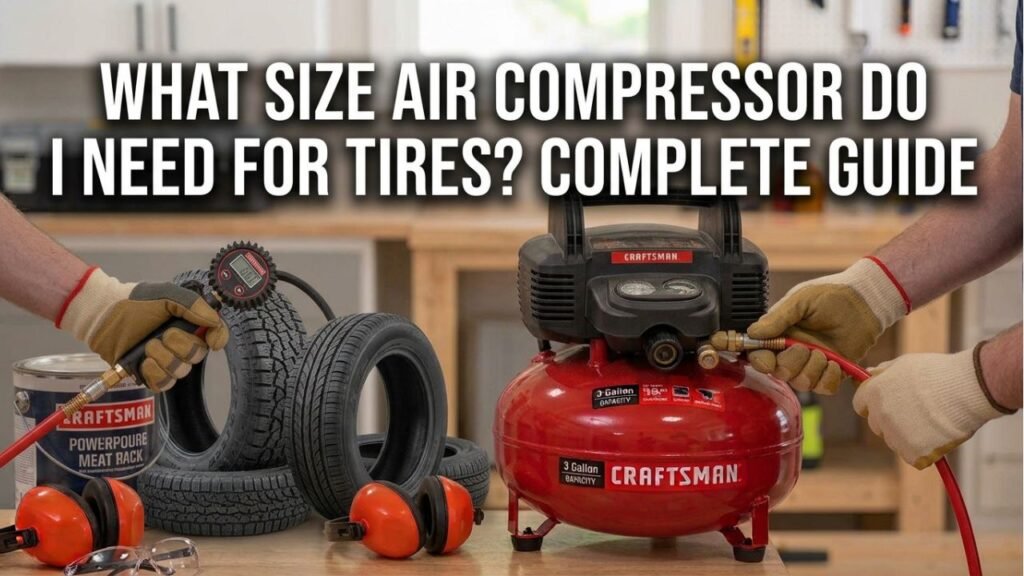
For ordinary passenger-car tire inflation, you do not need a large shop compressor. A compact compressor that can comfortably produce at least 90–100 PSI can handle many common automotive tire-inflation jobs, although a unit rated around 125–150 PSI gives you more useful pressure reserve.
For tank-style compressors, this is a practical sizing guide:
| Tire Inflation Use | Suggested Compressor Size | Practical Recommendation |
| Occasional car tire top-offs | Tankless or 1–3 gallon | Usually enough |
| Regular passenger-car tire inflation | 2–6 gallon | Excellent range |
| Filling several car tires | 6 gallon | More convenient |
| SUVs and light pickups | 6–10 gallon | Better for frequent use |
| Large truck or off-road tires | 10–20+ gallon or high-output inflator | Prioritize airflow |
| Home garage plus air tools | 20+ gallon depending on tools | Size mainly for the tools |
A larger tank gives you more stored compressed air. It does not automatically mean the compressor produces higher pressure or delivers more airflow.
A 3-gallon unit with adequate PSI can inflate a car tire. A 6-gallon compressor simply stores more compressed air and can usually work longer before the motor needs to replenish the tank.
If your only goal is maintaining passenger-car tire pressure, I would not buy a large stationary compressor. A portable 1–6 gallon compressor or a purpose-built tire inflator is usually the more practical choice.
Tank Size, PSI, and CFM Do Different Jobs
These three specifications are often confused, but each describes something different.
Tank size tells you how much compressed air the receiver can store.
PSI, or pounds per square inch, measures pressure.
CFM, or cubic feet per minute, describes airflow volume.
Think of PSI as the compressor’s ability to push air against the pressure already inside the tire. CFM determines how quickly it can move enough air into the tire. Tank capacity determines how much compressed air is available before the pump has to replenish it.
For tire inflation, you generally need moderate pressure and relatively modest airflow. That is why car tires are much easier for a compressor to handle than continuous-use pneumatic tools such as grinders or sanders.
The Best General-Purpose Size for Car Tires
If you want a conventional garage compressor rather than a dedicated tire inflator, a 3–6 gallon portable compressor rated around 125–150 PSI is an excellent range for most passenger vehicles.
A 3-gallon unit is smaller and easier to carry.
A 6-gallon model gives you more stored air and is usually more useful if you also plan to use blow guns, nailers, or other intermittent pneumatic tools.
If portability matters more than versatility, a tankless tire inflator may be the better choice.
Key Takeaways:
- A large compressor is not necessary for ordinary passenger-car tires.
- A 1–3 gallon compressor can handle routine inflation.
- A 6-gallon model provides more stored air and greater versatility.
- PSI, CFM, tank size, and tire volume all affect performance.
What Size Air Compressor Do I Need for Car Tires?
For most passenger cars, a small portable air compressor is sufficient.
Many passenger vehicles use recommended cold tire pressures in roughly the 30–40 PSI range, although the correct pressure varies by vehicle. Always use the value specified by the vehicle manufacturer rather than assuming one number works for every car.
Because the compressor needs to produce pressure higher than the pressure already inside the tire, some pressure reserve is useful.
A compressor with a 100 PSI maximum can often handle ordinary car tires, but I would prefer a unit rated for 125 PSI or more. A 150 PSI compressor gives you plenty of reserve and is common among portable garage compressors and tire inflators.
Recommended Specifications for Typical Car Tires
For routine car tire inflation, these specifications are practical:
| Specification | Practical Target |
| Maximum pressure | 100 PSI minimum; 125–150 PSI preferred |
| Tank size | 1–6 gallons |
| Airflow | Around 1 CFM or more is generally usable |
| Hose length | Long enough to reach all four wheels |
| Gauge | Easy to read and reasonably accurate |
| Regulator | Useful on tank-style compressors |
| Duty cycle | Appropriate for expected runtime |
These are general buying guidelines rather than universal minimum requirements.
A purpose-built automotive inflator may have no air tank at all and still work perfectly because it feeds compressed air directly into the tire.
Do You Need a Tank for Car Tires?
No. A storage tank is useful, but it is not required to inflate a tire.
Tankless Tire Inflator
A tankless inflator runs while supplying air directly to the tire. These are compact and convenient for keeping in a vehicle.
Small Tank Compressor
A 1–6 gallon compressor stores compressed air and gives you more flexibility around a garage.
Large Garage Compressor
A larger compressor makes sense when tire inflation is only one of several jobs you perform. High-air-demand tools, spray equipment, grinders, sanders, and some impact tools can require much more compressor capacity than tire inflation.
Buying a 20- or 30-gallon compressor solely for passenger-car tires is usually unnecessary.
Is a 150 PSI Air Compressor Good for Car Tires?
Yes. A 150 PSI air compressor is more than adequate for most car tires, assuming the unit has reasonable airflow and is used properly.
That does not mean you should inflate a tire to 150 PSI.
The compressor’s 150 PSI rating indicates its maximum pressure capability or maximum tank pressure. It does not tell you what pressure belongs in the tire.
The tire should be inflated to the vehicle manufacturer’s specified cold inflation pressure.
Why a 150 PSI Compressor Works Well
A compressor works more comfortably when it does not need to operate at its maximum pressure just to complete the job.
If a tire needs 35 PSI, for example, a compressor capable of 150 PSI has plenty of pressure reserve available to move air into the tire.
A 150 PSI compressor is also versatile enough for many other inflation jobs, including:
- Passenger-car tires
- Crossovers
- Many SUV tires
- Pickup tires
- Motorcycle tires
- Lawn equipment tires
- Some bicycle tires when used carefully and with an accurate regulator or gauge
The overall usefulness of the compressor still depends on airflow, tank capacity, pump design, duty cycle, hose restriction, and the size of the tire.
Do Not Set the Tire Pressure to the Compressor’s Maximum PSI
This is one of the most important distinctions in tire inflation.
If a compressor is labeled 150 PSI, that does not mean a tire should contain 150 PSI.
Likewise, the maximum pressure printed on a tire sidewall is not automatically the normal operating pressure the vehicle manufacturer recommends.
Use the vehicle manufacturer’s specified cold tire pressure, normally found on the tire-information placard around the driver’s door area or in the owner’s manual.
Important Tip: Check tire pressure when the tires are cold whenever practical. Driving heats the tires and raises pressure, which can make the reading higher than the cold-pressure specification.
Key Takeaways:
- A 150 PSI compressor has plenty of pressure capability for most car tires.
- Compressor maximum PSI and correct tire PSI are different things.
- Never inflate a tire to 150 PSI simply because the compressor is rated for 150 PSI.
- Follow the vehicle manufacturer’s recommended cold tire pressure.
Will a 3 Gallon Air Compressor Fill a Car Tire?
Yes. A 3-gallon air compressor can fill a car tire as long as it can produce pressure comfortably above the required tire pressure.
For ordinary top-offs, such as bringing a slightly low tire back to its specified pressure, a 3-gallon compressor is usually more than adequate.
It can also inflate a much lower tire, although the compressor motor may need to start and refill the tank during the process.
Is a 3 Gallon Air Compressor Good for Inflating Tires?
Yes. A 3-gallon compressor is a very practical size for home tire maintenance.
It gives you a useful balance between portability and stored-air capacity. It is small enough to move around easily while holding enough compressed air for ordinary automotive inflation.
A 3-gallon compressor is a good choice if you mainly want to:
- Check and top off car tires
- Inflate motorcycle tires
- Inflate lawn equipment tires
- Use a blow gun occasionally
- Operate low-air-demand pneumatic equipment intermittently
If you routinely inflate large truck tires or several tires from very low pressure, I would prefer a larger compressor or a high-output dedicated tire inflator.
What Happens When the 3-Gallon Tank Runs Low?
Nothing unusual happens.
As compressed air leaves the tank, tank pressure falls. When pressure reaches the compressor’s cut-in setting, the motor starts and the pump replenishes the tank.
Once the tank reaches its cut-out pressure, the motor stops.
This cycling is normal compressor operation.
Smaller tanks usually cycle more frequently because they store less air.
That is why tank capacity affects convenience and cycling frequency more than whether tire inflation is possible.
How Fast Will a 3-Gallon Compressor Inflate a Tire?
There is no universal inflation time because several factors affect it:
- Tire size
- Starting tire pressure
- Target tire pressure
- Compressor airflow
- Tank starting pressure
- Hose restriction
- Ambient temperature
- Compressor condition
- Whether the tire is slightly low or almost empty
A 3-gallon compressor may top off a passenger-car tire very quickly, while filling a large truck tire from near zero pressure will take much longer.
Do not judge a compressor’s inflation speed from tank size alone.
Will a 6 Gallon Air Compressor Fill a Car Tire?
Absolutely. A 6-gallon air compressor can easily fill ordinary car tires when it provides appropriate pressure and airflow.
In fact, a common 6-gallon pancake compressor offers more air-storage capacity than most people need strictly for passenger-car tire top-offs.
Its main benefit over a smaller compressor is convenience.
With a larger tank, you have more compressed air available before the compressor must recover.
3 Gallon vs. 6 Gallon Compressor for Tires
| Feature | 3-Gallon Compressor | 6-Gallon Compressor |
| Passenger-car tire top-offs | Excellent | Excellent |
| Filling multiple tires | Good | Better |
| Portability | Better | Good |
| Storage space required | Less | More |
| Compressor cycling | More frequent | Usually less frequent |
| Garage versatility | Good | Better |
| Larger tire inflation | Usable | More convenient |
| Best for tire-only use | Often enough | More than necessary for many users |
If I were choosing between these two sizes purely for passenger-car tire maintenance, I would choose the 3-gallon unit for easier portability and the 6-gallon unit for greater garage versatility.
Neither size is actually required for a car tire because much smaller tankless inflators can also do the job.
Key Takeaways:
- A 3-gallon compressor can easily handle normal car tire inflation.
- A 6-gallon compressor provides more stored air and usually cycles less.
- Larger tanks improve convenience more than basic inflation capability.
- For normal car tires, either size is sufficient.
Can a Small Air Compressor Fill Car Tires?
Yes. A small air compressor can fill car tires as long as it can reach the required pressure and run long enough to supply the necessary volume of air.
That includes many:
- 12-volt automotive tire inflators
- Cordless battery inflators
- Compact 120-volt inflators
- 1-gallon compressors
- 2-gallon compressors
- 3-gallon compressors
You do not need an air tank at all.
Modern portable tire inflators are specifically designed for this job and can be better than a tank compressor for roadside use.
When a Small Compressor Is the Better Choice
A small inflator makes the most sense when portability is the priority.
For example, a compact inflator can stay in your trunk and run from a 12-volt power source or cordless battery.
It is ideal for:
- Emergency inflation
- Routine pressure adjustments
- Seasonal tire-pressure changes
- Checking tires before a road trip
- Topping off a low tire before getting it inspected
A small compressor becomes less convenient when you need to inflate several large tires from very low pressure because runtime and heat buildup become more important.
Small Does Not Automatically Mean Slow
Physical size alone does not tell you how quickly a compressor will inflate a tire.
A purpose-built compact inflator with a strong pump can be very effective because the machine is designed specifically around tire inflation.
Compare actual output specifications instead of assuming the larger-looking unit must be faster.
How Much PSI Do You Need to Inflate Car Tires?
For the compressor itself, you want enough maximum pressure to provide comfortable reserve above the tire’s required pressure.
For ordinary passenger-car use, a compressor capable of 100 PSI can often do the job, while 125–150 PSI is a more versatile and comfortable range.
The actual tire pressure, however, will normally be much lower than the compressor’s maximum rating.
Compressor PSI vs. Tire PSI
Suppose your compressor tank is charged to 150 PSI but your car requires 35 PSI cold tire pressure.
You do not put 150 PSI into the tire.
The regulator, tire chuck, inflator, and pressure gauge allow you to control airflow and stop when the tire reaches its specified pressure.
The higher compressor pressure simply gives you enough pressure differential to move air into the tire efficiently.
Where to Find the Correct Tire Pressure
The vehicle’s tire-information placard is the best place to check.
It is commonly located on or around the driver’s door jamb or door frame.
You can also check the owner’s manual.
Do not guess tire pressure from:
- The compressor’s pressure gauge
- The tire’s appearance
- A generic internet recommendation
- Another vehicle with similar-looking tires
- The tire sidewall’s maximum-pressure marking
Some vehicles also specify different pressures for the front and rear tires.
How Much CFM Do You Need to Inflate Tires?
Tire inflation is not normally a high-CFM application compared with tools such as grinders, sanders, and spray equipment.
For passenger-car tire inflation, even a compressor delivering around 1 CFM can be usable.
Higher airflow primarily improves inflation speed.
A compressor delivering 2–3 CFM will generally move more air than a very low-output inflator and can be more convenient when filling larger tires or several tires in one session.
Why CFM Still Matters
Imagine two compressors that both reach 150 PSI.
One produces a small amount of airflow.
The other delivers several times as much air per minute.
Both can potentially reach the same final tire pressure, but the higher-output compressor can move the required volume of air faster.
The difference becomes more noticeable when:
- The tire is nearly flat
- The tire has a large internal volume
- You need to inflate four tires
- You are making a large pressure increase
- You regularly service SUVs or trucks
Do Not Judge Tire Compressors by PSI Alone
A large maximum-PSI number looks impressive, but it does not guarantee fast inflation.
For tire inflation, consider both:
Pressure capability: Can the compressor exceed the required tire pressure comfortably?
Airflow capability: Can it move enough air at a useful rate?
For ordinary passenger cars, reaching the necessary PSI is easy for most compressors. Inflation speed is often where better airflow makes the biggest difference.
Does Tank Size Matter for Tire Inflation?
Tank size matters, but less than many buyers assume.
The tank serves as a reservoir of compressed air.
A larger tank allows you to withdraw more compressed air before the pump needs to replenish it.
It does not produce air by itself.
What a Larger Tank Improves
A larger tank can provide:
- Longer bursts before the motor starts
- Less frequent compressor cycling
- More stored air for multiple tires
- Greater flexibility for pneumatic tools
- More convenient garage use
However, a large tank connected to a low-output pump can still recover slowly.
That is why tank size should always be considered together with compressor airflow.
What Size Tank Do I Recommend?
For tire-only use:
Tankless: Completely acceptable with a quality portable inflator.
1–3 gallons: Excellent for compact home-garage tire inflation.
6 gallons: Excellent if you also want a versatile portable compressor.
10–20 gallons: Useful for frequent garage work, larger tires, or additional pneumatic equipment.
20+ gallons: Usually unnecessary for tire inflation alone.
Pro Tip: If your only goal is maintaining tire pressure, I would prioritize a reliable inflator, accurate gauge, good hose, practical power source, and appropriate duty cycle before spending extra money on a huge air tank.
What Size Air Compressor Do I Need to Inflate Different Types of Tires?
The ideal compressor changes as tire volume and required pressure increase.
Passenger-Car Tires
For sedans, hatchbacks, coupes, and similar passenger vehicles, a compact inflator or 1–6 gallon compressor is usually plenty.
A maximum pressure rating around 125–150 PSI provides comfortable capability.
Crossover and SUV Tires
Most crossover and SUV tires can still be handled by small compressors.
Larger SUV tires contain more air, however, so they may take longer to inflate.
For frequent SUV tire maintenance, a 3–6 gallon compressor or high-output portable inflator is a good choice.
Pickup Truck Tires
Light-duty pickup tires can also be serviced by small compressors, but larger tire volume increases air demand.
A 6–10 gallon compressor becomes more convenient if you frequently adjust several truck tires.
Heavy-duty pickups may use much higher specified pressures depending on tire type, axle load, and vehicle configuration, so checking actual pressure requirements becomes especially important.
Large Off-Road Tires
Large off-road tires can require considerably more air volume.
Off-road drivers also sometimes lower tire pressures intentionally for certain terrain and then reinflate the tires before normal road use.
For this application, high airflow matters more than simply having a large tank.
I would prioritize a dedicated high-output inflation system rather than choosing a compressor solely by tank gallons.
RV and Trailer Tires
RV and trailer tire requirements vary widely.
Some require pressures well above those used in normal passenger-car tires.
Before purchasing a compressor for an RV or trailer, check the actual required cold tire pressure and select a compressor that can comfortably exceed it.
I would not choose a compressor that barely reaches the target pressure.
You want both adequate pressure reserve and useful airflow.
Key Takeaways:
- Passenger-car tires have relatively modest compressor requirements.
- SUVs and pickups benefit from more airflow because their tires often contain more air.
- Large off-road tires make airflow particularly important.
- RV and trailer owners should verify required tire pressure before choosing a compressor.
What Determines How Long It Takes to Fill a Tire?
Inflation time depends on much more than tank size.
Starting Tire Pressure
Topping a tire from 31 PSI to 35 PSI requires much less air than filling a tire that is nearly empty.
Tire Volume
A large pickup or off-road tire holds considerably more air than a small passenger-car tire.
The larger tire therefore takes longer to inflate with the same compressor.
Compressor Airflow
Higher airflow generally means faster inflation.
This becomes particularly important with large tires.
Stored Tank Air
A fully charged tank can provide a quick initial supply of air.
Once tank pressure drops, the compressor pump’s output becomes more important.
Hose and Fittings
Leaks or restrictive fittings can reduce useful airflow.
Very small, damaged, excessively long, or poorly connected hoses may slow inflation.
Compressor Duty Cycle
Duty cycle describes how long a compressor is designed to run compared with how long it should rest or cool.
Small tire inflators may not be designed to run continuously for extended periods.
Follow the manufacturer’s runtime and cooling instructions.
If an inflator becomes excessively hot or reaches its recommended continuous operating limit, allow it to cool before continuing.
How to Inflate a Car Tire With an Air Compressor
Inflating a tire is straightforward, but pressure should be measured carefully instead of guessed.
1. Find the Vehicle’s Recommended Tire Pressure
Check the tire-information placard around the driver’s door area or the owner’s manual.
Use the specified cold tire pressure.
Do not automatically use the maximum pressure printed on the tire sidewall.
2. Check the Tire While It Is Cold
Whenever practical, check pressure before substantial driving.
Driving heats the tire and the air inside it, raising the measured pressure.
3. Inspect the Tire Before Adding Air
Look for visible damage before inflation.
Pay attention to:
- Serious cuts
- Sidewall bulges
- Exposed cords
- Damaged valve stems
- Bent or damaged wheels
- Evidence the tire has been driven while severely flat
If the tire appears structurally damaged, professional inspection is safer than simply adding air and driving.
4. Connect and Charge the Compressor
For a tank-style compressor, connect the power supply and allow the tank to reach its normal operating pressure.
Make sure the hose, fittings, chuck, and gauge are properly connected.
5. Attach the Tire Chuck
Remove the valve-stem cap and connect the chuck firmly.
A poor connection may leak air and produce inconsistent pressure readings.
6. Add Air in Controlled Bursts
Inflate gradually toward the vehicle manufacturer’s specified pressure.
If you have a digital inflator with automatic shutoff, set the proper target according to the manufacturer’s instructions.
7. Recheck With a Reliable Gauge
Confirm the final pressure after inflation.
If you overshoot, release a small amount of air and check again.
8. Replace the Valve Cap
Reinstall the valve-stem cap to help keep dirt and moisture away from the valve.
9. Check the Other Tires
Check all four tires rather than assuming only one needs attention.
If the vehicle has a spare tire, inspect its pressure periodically as well.
Important Tip: A tire that repeatedly loses pressure needs diagnosis. Continually adding air is not a proper repair for a puncture, leaking valve, damaged wheel, bead leak, or structural tire damage.
Air Compressor vs. Portable Tire Inflator
Both can inflate tires, but they suit different users.
| Feature | Portable Tire Inflator | Tank Air Compressor |
| Tire inflation | Excellent | Excellent |
| Vehicle storage | Excellent | Poor to moderate |
| Portability | Excellent | Moderate |
| Air-tool capability | Very limited or none | Much better |
| Stored compressed air | No | Yes |
| Garage versatility | Limited | Excellent |
| Roadside use | Excellent | Less convenient |
| Multiple pneumatic tasks | Poor | Better |
Choose a Portable Inflator If…
Your main goal is maintaining tires.
A compact inflator can remain in the vehicle, making it very convenient for emergencies, routine pressure adjustments, and travel.
Many modern inflators also include digital gauges and automatic shutoff.
Choose a Tank Compressor If…
You want one machine for tires and other garage jobs.
A 3- or 6-gallon compressor provides significantly more flexibility for blow guns, nailers, and various intermittent pneumatic tasks.
Choose a Large Compressor If…
You also need to run demanding pneumatic tools, paint equipment, or other high-air-consumption devices.
Do not buy a large compressor simply because you think ordinary car tires require one.
They usually do not.
12-Volt, Cordless, or 120-Volt Compressor: Which Is Better?
The best power source depends on where and how you plan to use the inflator.
12-Volt Inflator
A 12-volt inflator is excellent for emergency vehicle use because it can run from a suitable vehicle electrical connection.
Its main strengths are portability and roadside convenience.
Its main weakness is that small 12-volt units may inflate slowly.
Cordless Battery Inflator
Cordless inflators are very convenient for quick pressure adjustments.
They make especially good sense if you already use a compatible cordless-tool battery platform.
If the inflator is part of your roadside kit, remember to keep the battery charged.
120-Volt Compressor
A corded household compressor is ideal for garage use.
A compact tank compressor running on standard household power provides strong performance and excellent versatility for home maintenance.
If I wanted one compressor for tire inflation plus occasional pneumatic tasks, this is the type I would choose.
Common Mistakes When Using an Air Compressor for Tires
Using the wrong compressor size is rarely the biggest tire-inflation problem. Incorrect pressure and poor procedure matter much more.
Inflating to the Number on the Tire Sidewall
The tire’s maximum-pressure marking is not automatically the vehicle manufacturer’s recommended operating pressure.
Use the vehicle placard or owner’s manual.
Assuming More PSI Is Always Better
It is not.
A 200 PSI compressor is not automatically better for car tires than a suitable 150 PSI compressor.
Once you have enough pressure capability, airflow, reliability, gauge accuracy, portability, hose length, and duty cycle often become more important.
Buying Based Only on Tank Size
A 20-gallon tank does not guarantee fast tire inflation.
Pump output still matters.
Ignoring CFM
Airflow becomes increasingly important as tire size increases.
Two compressors with the same maximum PSI can inflate tires at very different speeds.
Ignoring Duty Cycle
Compact inflators can become hot during prolonged operation.
Always follow the manufacturer’s recommended operating and cooling intervals.
Trying to Inflate a Damaged Tire
A visibly damaged tire should not simply be filled and driven on.
Sidewall bulges, major cuts, exposed cords, severe wheel damage, or evidence of driving while flat are reasons to stop and inspect the tire professionally.
Trusting Only the Dashboard Tire-Pressure Warning
A tire-pressure monitoring system is useful, but it does not replace checking actual tire pressure periodically with a reliable gauge.
How Often Should You Check Car Tire Pressure?
A good general habit is to check tire pressure about once a month and before long trips.
Tire pressure can change because of:
- Normal air loss over time
- Seasonal temperature changes
- Small punctures
- Valve leakage
- Wheel or bead leaks
- Tire damage
You should also check pressure when the TPMS warning light appears or when a tire looks or feels unusual.
Cold Weather Can Lower Tire Pressure
Air pressure changes with temperature.
When outside temperatures fall, tire pressure generally falls as well.
This is one reason tire-pressure warning lights often appear during the first major cold spell.
Do not compensate by guessing.
Check the tires with a gauge and adjust them to the vehicle manufacturer’s recommended cold pressure.
Should You Buy a 150 PSI or 200 PSI Compressor for Tires?
For ordinary car tires, 150 PSI is already more than enough.
A 200 PSI compressor can offer advantages in some systems, such as greater stored-air density or suitability for higher-pressure applications, but passenger-car tire inflation alone does not justify choosing 200 PSI.
If I were comparing two tire compressors, I would pay more attention to:
- Airflow
- Inflation speed
- Duty cycle
- Gauge accuracy
- Build quality
- Noise
- Hose length
- Portability
- Power source
- Automatic shutoff
- Warranty support
A well-designed 150 PSI compressor with strong airflow is a better tire inflator than a poor-quality unit that simply advertises a higher pressure number.
Is a 20 Gallon Air Compressor Better for Tires?
A 20-gallon compressor gives you far more stored air than a small unit, but that does not automatically make it the better choice.
It can inflate car tires easily, but it is also larger, heavier, and less portable.
If you already own a 20-gallon compressor in your garage, it is excellent for tire inflation.
If you are purchasing a compressor only for tires, however, I would consider that size unnecessary.
A 20-gallon or larger compressor makes more sense when you also run pneumatic tools or perform other workshop tasks.
What Compressor Size Is Best for Filling Four Car Tires?
For routine adjustments on four passenger-car tires, a 3–6 gallon compressor is an excellent choice.
A smaller tankless inflator can also handle all four tires, but it may need to run continuously.
A 6-gallon compressor provides more stored air and can feel more convenient when moving around an entire vehicle.
If each tire only needs a few PSI, even a small inflator will usually be adequate.
If all four tires are nearly flat, expect much longer compressor runtime regardless of tank size.
What If the Car Tire Is Completely Flat?
A compressor may be able to inflate a completely flat tire, but you should first consider why the tire lost all of its air.
Possible causes include:
- Puncture
- Valve-stem failure
- Bead leak
- Bent or cracked wheel
- Tread damage
- Sidewall damage
If the tire was driven while flat, internal structural damage may have occurred even if the outside does not look severe.
Successful inflation does not prove that the tire is safe.
If it quickly loses pressure again, has visible damage, or was driven for a significant distance while flat, have it inspected before normal driving.
What to Look for When Buying an Air Compressor for Tires
If tire inflation is your main purpose, focus on practical specifications rather than buying the largest machine available.
Adequate Maximum PSI
For ordinary automotive use, a compressor rated around 125–150 PSI offers plenty of pressure capability.
Useful Airflow
Higher airflow generally means faster inflation.
This becomes increasingly important for SUVs, trucks, and large off-road tires.
Appropriate Duty Cycle
Choose a compressor that can operate long enough for your expected workload without excessive overheating.
Accurate Pressure Gauge
A good gauge helps you stop at the correct pressure.
I still recommend keeping a separate quality tire-pressure gauge for verification.
Automatic Shutoff
Automatic shutoff is especially convenient on portable digital inflators.
You select the desired pressure and the compressor stops once the target is reached.
Suitable Hose Length
Make sure the hose can comfortably reach all four wheels.
Convenient Power Source
Choose between 12-volt, cordless battery, household AC, or conventional garage-compressor power based on where you plan to use the unit.
Portability
If the compressor will remain in the trunk, compact size and low weight matter more than having a large storage tank.
Noise
Traditional portable air compressors can be loud.
If you inflate tires indoors, early in the morning, or close to neighbors, a quieter model may be worth paying extra for.
Other Planned Uses
This is often the factor that changes compressor size the most.
Tire inflation requires relatively little air compared with many pneumatic tools.
If you plan to run impact wrenches, grinders, sanders, or spray guns, size the compressor for the most demanding tool rather than for the tires.
My Recommended Compressor Sizes by Use Case
This table provides a simple starting point:
| User Type | Recommended Compressor |
| Emergency roadside inflation | Compact 12V or cordless inflator |
| Occasional car tire top-offs | Tankless or 1–3 gallon |
| Regular home tire maintenance | 3–6 gallon |
| Several household vehicles | 6 gallon |
| SUVs and light pickups | 6–10 gallon or high-output inflator |
| Large off-road tires | High-flow dedicated inflator |
| Larger truck or RV applications | Verify PSI; prioritize airflow and pressure capability |
| Tires plus light pneumatic tools | 6–10+ gallon depending on tools |
| Tires plus demanding air tools | Often 20+ gallons, depending on CFM demand |
For most homeowners who want a conventional tank-style compressor, 6 gallons is a very practical sweet spot because it remains reasonably portable while offering useful reserve for other garage work.
For tire inflation alone, however, a 6-gallon tank is not necessary.
A quality compact tire inflator may be the smarter purchase.
FAQs about what size air compressor do I need for tires
What size air compressor do I need for car tires?
A small portable compressor is enough for most car tires. A tankless automotive inflator or 1–3 gallon compressor can handle routine pressure adjustments, while a 3–6 gallon compressor gives you more versatility and stored-air capacity.
For a conventional compressor, I generally prefer a maximum pressure rating around 125–150 PSI.
What size air compressor do I need to inflate tires?
For ordinary passenger tires, you can use anything from a tankless inflator to a 6-gallon portable compressor.
The required capacity increases when you routinely inflate larger SUV, pickup, RV, or off-road tires.
Do not choose by gallons alone. Maximum PSI, airflow, duty cycle, and tire volume also matter.
What size air compressor is best for filling car tires?
A 1–3 gallon compressor is sufficient for basic tire maintenance, while a 3–6 gallon model is an excellent home-garage choice.
If you want something to carry in the vehicle, I would choose a compact tankless inflator instead.
Is a 150 PSI air compressor good for car tires?
Yes. A 150 PSI compressor provides far more pressure capability than a normal passenger-car tire requires.
The tire should still be inflated only to the vehicle manufacturer’s recommended pressure.
Will a 3 gallon air compressor fill a car tire?
Yes. A 3-gallon compressor can fill a normal car tire as long as it produces adequate pressure.
It may cycle on during larger inflation jobs, but that is normal.
Is a 3 gallon air compressor good for inflating tires?
Yes. A 3-gallon compressor is a very practical size for passenger-car tire inflation.
It offers more stored air than a tankless inflator while remaining relatively portable.
Will a 6 gallon air compressor fill a car tire?
Yes. A 6-gallon compressor can easily inflate ordinary car tires.
It also gives you more stored-air reserve than a 3-gallon compressor and is useful for many additional garage jobs.
Can a small air compressor fill car tires?
Yes. Even compact tankless inflators can fill car tires.
The differences between small and large compressors are primarily inflation speed, runtime, stored-air capacity, and versatility.
Is a 1 gallon air compressor enough for car tires?
Usually, yes.
A 1-gallon compressor stores less air, so the motor may run more frequently, but it can still inflate normal passenger-car tires if its pressure capability is adequate.
Do I need a 6 gallon air compressor for tires?
No.
A 6-gallon compressor is convenient but not necessary for normal passenger-car tire inflation.
Smaller compressors and tankless inflators can do the same basic job.
Is 100 PSI enough for car tires?
For many passenger cars, yes. A 100 PSI compressor can usually exceed the pressure required by the tire.
However, I prefer 125–150 PSI for greater pressure reserve and versatility.
Is 150 PSI too much for tires?
A compressor capable of 150 PSI is not too powerful for tire inflation.
The important thing is to stop inflating when the tire reaches the vehicle manufacturer’s specified pressure.
Is 2 CFM enough to inflate tires?
Yes. Around 2 CFM is more than adequate for routine passenger-car tire inflation.
Higher airflow can reduce inflation time, particularly with larger tires.
Does a bigger air compressor fill tires faster?
Not necessarily.
A larger tank gives you more stored air, but pump CFM determines how quickly the compressor can replace that air.
Inflation speed depends on airflow, tank pressure, tire volume, starting pressure, hose restriction, and other factors.
Can I use an air compressor without a tank to fill tires?
Yes.
Tankless tire inflators are specifically designed to supply air directly to the tire.
A storage tank is helpful but not required.
How much PSI should I put in my tires?
Use the vehicle manufacturer’s recommended cold tire pressure.
Check the tire-information placard near the driver’s door or the owner’s manual.
Do not automatically use the compressor’s maximum PSI or the tire sidewall’s maximum-pressure rating.
Should tires be inflated when hot or cold?
Cold pressure is the preferred reference.
Whenever practical, check the tires before substantial driving rather than immediately after they have heated up on the road.
Can I fill an SUV tire with a 3 gallon compressor?
Yes, in many cases.
A 3-gallon compressor can inflate SUV tires, although larger tires may require more compressor runtime.
For frequent SUV use, a 6-gallon compressor or high-output inflator can be more convenient.
What compressor should I use for truck tires?
For light pickup tires, a 6-gallon portable compressor or capable high-output inflator is often practical.
For larger trucks or higher-pressure tires, verify the vehicle’s actual PSI requirement and prioritize both pressure capability and airflow.
Can I fill a completely flat tire with a small compressor?
Potentially, yes.
However, a completely flat tire may have a puncture or structural damage. If it has been driven while flat or shows visible damage, do not assume it is safe simply because it holds air again.
Is a pancake compressor good for filling tires?
Yes.
Portable pancake compressors are well suited to tire inflation because they combine good pressure capability, moderate air storage, and reasonable portability.
A common 6-gallon pancake compressor is more than adequate for normal passenger-car tires.
Is a larger compressor worth buying just for tires?
Usually not.
For tire-only use, a high-quality portable inflator or small compressor is easier to store, transport, and operate.
A larger compressor becomes worthwhile when you also need significant air capacity for pneumatic tools or workshop equipment.
Conclusion
If you are asking what size air compressor do i need for tires, the practical answer is that you need much less compressor capacity than many people expect. A compact tankless inflator can maintain ordinary passenger-car tires, a 1–3 gallon compressor is enough for most routine car tire inflation, and a 6-gallon compressor provides extra reserve and greater garage versatility.
A 150 PSI compressor is excellent for passenger-car tires, but remember that maximum compressor pressure is not the pressure you should put in the tire. Always follow the vehicle manufacturer’s recommended cold tire pressure.
A 3-gallon compressor will fill a car tire. A 6-gallon compressor will also do it easily and may cycle less while you work. Even a small portable compressor can fill car tires when it provides adequate pressure, useful airflow, and an appropriate duty cycle.
For tire-only use, my recommendation is a quality portable inflator or compact 1–3 gallon compressor. For a home garage where you also want to use blow guns, nailers, or other intermittent pneumatic equipment, I would choose a 6-gallon portable compressor. If you plan to run demanding air tools, size the compressor for those tools rather than for tire inflation.
Most importantly, do not choose an air compressor based on tank gallons or maximum PSI alone. Consider pressure capability, CFM, tire volume, duty cycle, inflation speed, power source, gauge accuracy, hose length, and portability. Matching those factors to the vehicles you actually maintain will give you a compressor that fills tires efficiently without forcing you to pay for unnecessary capacity.