Which Type Air Compressor Is Best for Car Tires? Buying Guide
For most drivers wondering which type air compressor is best for car tires, a portable electric tire inflator is the best choice. A compact 12V or cordless inflator that can deliver at least 100–150 PSI, has a built-in pressure gauge, and provides automatic shutoff is more practical for car tires than a large tank-style shop compressor.
You do not need a huge air compressor simply to inflate passenger-car tires. Most cars use tire pressures somewhere around the 30–40 PSI range, although the correct pressure depends on the vehicle. What matters is whether the compressor can comfortably reach the required pressure and deliver enough airflow to inflate the tire without taking an unreasonable amount of time.
The best compressor also depends on how you plan to use it. Someone who only needs emergency roadside inflation has different requirements from a home mechanic who regularly services several vehicles. SUVs, pickup trucks, and large off-road tires can also benefit from more airflow and a heavier-duty compressor.
In this guide, I’ll explain what is a good air compressor for inflating car tires, which compressor types make the most sense, how much PSI and CFM you actually need, whether a tank is necessary, and what features are worth paying for.
Which Type Air Compressor Is Best for Car Tires?
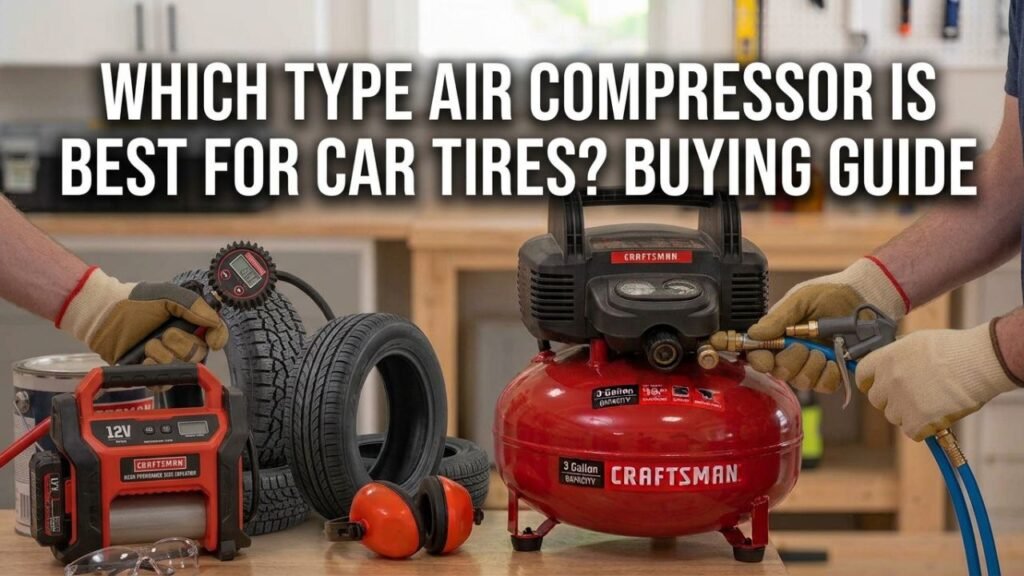
For a typical sedan, hatchback, crossover, or small SUV, I recommend a portable electric tire inflator designed specifically for automotive tires.
These units are essentially small air compressors optimized for tire inflation. Unlike conventional tank compressors, they are compact enough to keep in your trunk and normally connect directly to a 12V vehicle outlet, the battery, or a rechargeable power-tool-style battery.
A good portable tire inflator offers several advantages:
- Compact enough to carry in the vehicle
- No large storage tank required
- Easy connection to a tire valve
- Built-in pressure gauge
- Available with automatic shutoff
- Suitable for routine pressure adjustments
- Useful during roadside emergencies
- Generally easier for beginners than a shop compressor
For ordinary car tires, this is usually a much better solution than buying a 6-, 10-, or 20-gallon compressor solely for inflation.
However, a portable inflator is not automatically the best option for everyone. A tank-style compressor becomes more useful if you also plan to run pneumatic tools, use a blow gun, perform automotive repairs, or inflate multiple tires frequently.
Best Compressor Type by Use
| Use | Best Compressor Type | Why |
| Normal passenger car | Portable 12V or cordless tire inflator | Compact, convenient, sufficient pressure |
| Emergency trunk use | 12V portable inflator | Runs from the vehicle |
| Home garage | 3–6 gallon tank compressor | Fast inflation and greater versatility |
| Multiple vehicles | 6–10+ gallon compressor | Better reserve air and quicker repeated use |
| Pickup/SUV tires | Heavy-duty portable compressor | Higher airflow is useful |
| Large off-road tires | High-CFM 12V compressor | Faster recovery from low pressure |
| Air tools plus tires | 20+ gallon shop compressor | Provides airflow for pneumatic tools |
The distinction is important because maximum PSI alone does not tell you how good a compressor is at inflating tires. Airflow, duty cycle, tire size, hose design, and power source also affect performance.
Key Takeaways:
- A portable electric tire inflator is the best overall type for most car owners.
- A tank compressor makes more sense if you need compressed air for jobs beyond tire inflation.
- Larger SUV, truck, and off-road tires benefit from greater airflow and a heavier-duty design.
- Do not choose a compressor based only on its advertised maximum PSI.
What Is a Good Air Compressor for Inflating Car Tires?
A good car-tire compressor should comfortably exceed your vehicle’s required tire pressure while remaining quick, portable, and easy to operate.
For most passenger vehicles, I would look for these characteristics:
| Feature | Good Starting Point for Car Tires |
| Maximum pressure | 100–150 PSI |
| Power | 12V, rechargeable battery, or dual-power |
| Gauge | Digital or easy-to-read analog gauge |
| Automatic shutoff | Highly recommended |
| Hose reach | Long enough to reach every tire comfortably |
| Power-cord reach | Must reach from the power source to all four tires |
| Duty cycle | Long enough for several tires without overheating |
| Tire chuck | Secure screw-on or clamp-on connection |
| Light | Helpful for roadside use at night |
You will see many small inflators advertised at 150 PSI or even higher. That does not mean your tire should ever be inflated anywhere near that pressure.
The compressor’s maximum rating tells you what pressure the unit is capable of producing under appropriate conditions. Your actual tire pressure should be based on the vehicle manufacturer’s recommendation.
You can normally find the recommended cold tire pressure on the placard located on the driver’s door jamb or in the owner’s manual.
Do You Need a 150 PSI Air Compressor for Car Tires?
No. A 150 PSI compressor is useful, but 150 PSI is not necessary just because you are inflating a car tire.
If your tires require around 35 PSI, even a compressor with a much lower maximum pressure can theoretically inflate them.
The reason I like a compressor rated around 100–150 PSI is that it provides plenty of pressure capability without operating near its maximum just to inflate an ordinary passenger tire.
Maximum PSI should therefore be treated as a capability rating rather than your target inflation pressure.
Important Tip: Never inflate a tire to the compressor’s maximum PSI rating. Set tire pressure according to the vehicle manufacturer’s recommended cold pressure, not the number printed as the compressor’s maximum output.
PSI vs CFM: Which Matters More for Tire Inflation?
Both matter, but they affect inflation differently.
PSI Determines Whether the Compressor Can Reach the Required Pressure
PSI means pounds per square inch. It measures pressure.
Your compressor needs enough pressure capability to overcome the existing pressure inside the tire and bring it to the desired level.
Ordinary passenger-car tire pressures generally do not challenge even moderately capable tire inflators.
CFM Determines How Quickly Air Can Be Delivered
CFM means cubic feet per minute. It measures airflow.
Higher airflow generally means faster inflation.
This becomes especially important when:
- A tire is nearly flat
- You have large SUV or truck tires
- You need to inflate all four tires
- You regularly air tires down and back up
- You want shorter inflation times
Two compressors can both be rated for 150 PSI but perform very differently. One may take several minutes to add substantial pressure to a tire while another may do the same job much faster.
That is why I would prioritize adequate pressure plus useful airflow, rather than buying whichever inflator has the largest PSI number on the box.
How Much CFM Do Car Tires Need?
Tire inflation does not have a rigid CFM requirement in the same way continuous-use pneumatic tools do.
For simple topping off, even a relatively low-airflow inflator can work.
For faster inflation, however, more airflow is preferable. Portable automotive compressors commonly produce roughly around 1 CFM or more, while stronger units may provide considerably more depending on how airflow is measured and at what pressure.
Be careful when comparing specifications. Compressor airflow usually decreases as pressure increases, so a manufacturer’s airflow figure measured at zero pressure does not necessarily represent airflow while filling a tire at 30 or 40 PSI.
Key Takeaways:
- PSI tells you whether a compressor can reach the required tire pressure.
- CFM has a major effect on how quickly a tire fills.
- A huge PSI rating does not automatically mean fast inflation.
- Large tires benefit more from additional airflow than ordinary car tires do.
Portable Tire Inflator vs Tank Air Compressor
Both can inflate car tires very well, but they serve different purposes.
Portable Tire Inflator
A portable inflator is the option I recommend to most drivers.
It does not normally have a conventional compressed-air storage tank. The motor drives a small compressor that sends air directly into the tire.
Its biggest advantage is convenience.
You can carry one in your trunk and use it at home, at work, or on the side of the road.
Portable Inflator Advantages
- Small and lightweight
- Easy to store
- Designed specifically for tires
- Usually includes a tire gauge
- Often includes automatic shutoff
- No tank to drain
- Available in 12V and cordless versions
- Ideal for roadside emergencies
Portable Inflator Limitations
Small units can be slower, especially when filling a nearly empty tire.
They can also have limited duty cycles, meaning the compressor may need to cool down after operating continuously for a certain period.
Cheap compact inflators may struggle with large truck or off-road tires.
Tank-Style Air Compressor
A conventional compressor stores compressed air in a tank.
For a home garage, even a small pancake or hot-dog-style compressor can make tire inflation extremely easy.
The tank provides an immediate supply of compressed air, so adding a few PSI to a tire can be very quick.
A tank compressor is particularly attractive if you already use compressed air for jobs such as:
- Blowing dust or debris
- Operating nailers
- Cleaning components
- Using some pneumatic tools
- Inflating sports equipment
- Maintaining multiple vehicles
Its disadvantages are size, weight, noise, maintenance, and the need for household electrical power in most cases.
For someone buying a compressor strictly for car tires, I normally would not spend the extra money or sacrifice garage space for a tank compressor.
12V vs Cordless Tire Inflators
The next decision is how the compressor receives power.
12V Tire Inflator
A 12V inflator usually receives power from the vehicle’s accessory socket or directly from the battery.
This is one of the safest choices for an emergency kit because you do not have to remember to keep a separate rechargeable battery charged.
Some more powerful compressors connect directly to the battery with clamps because their electrical demand can exceed what a standard accessory outlet is designed to supply.
Always follow the compressor manufacturer’s connection instructions and confirm that a plug-in inflator does not exceed your vehicle’s power-outlet rating.
Cordless Tire Inflator
Cordless inflators use rechargeable batteries.
They are extremely convenient because there is no cable running from the vehicle to the compressor.
They make particular sense if you already own compatible batteries from the same power-tool platform.
The downside is straightforward: a cordless inflator is only useful if the battery has sufficient charge.
For that reason, a dual-power unit that supports both battery operation and another power source can be attractive for emergency use.
Which One Would I Choose?
For a vehicle emergency kit, I prefer a quality 12V inflator or dual-power inflator because the car itself provides a readily available power source.
For regular use around a garage, cordless operation is extremely convenient.
Key Takeaways:
- 12V inflators are excellent for emergency use because the vehicle provides power.
- Cordless inflators are convenient but depend on battery charge.
- Direct-to-battery compressors can support higher electrical demand than many accessory outlets.
- Check the electrical requirements before plugging a powerful compressor into a vehicle outlet.
Do You Need an Air Tank for Inflating Car Tires?
No. An air tank is not necessary for inflating car tires.
Tankless portable inflators work perfectly well because tire inflation does not require a large instantaneous burst of compressed air.
A tank does offer some advantages.
If you already have a tank compressor charged to operating pressure, topping a tire from 31 PSI to 35 PSI can be very fast.
The compressor also has stored air available before its motor needs to replenish the tank.
But for someone keeping an inflator inside a vehicle, a tank would add unnecessary weight and bulk.
What Tank Size Is Good for Car Tires?
If you want a conventional garage compressor, approximately 3–6 gallons is already plenty for routine passenger-car tire inflation.
A larger tank does not increase the pressure your tire requires. It simply stores more compressed air.
A 6-gallon compressor may be more convenient if you frequently inflate several tires, but even a small 1- or 2-gallon unit can handle ordinary tire topping if it provides adequate pressure.
Twenty-gallon and larger compressors make sense when you have additional workshop needs, particularly higher-air-demand tools. They are unnecessary for car tires alone.
Does Compressor Horsepower Matter for Car Tires?
Not very much for a typical car owner.
Horsepower affects compressor capability, but it should not be the primary specification you use when choosing a tire inflator.
For tire inflation, pay more attention to:
- Appropriate working pressure
- Inflation speed
- CFM or airflow data
- Tire-size compatibility
- Duty cycle
- Power requirements
- Hose and cable length
- Gauge accuracy and usability
A small motor paired with a well-designed compressor can be perfectly adequate for passenger tires.
Why Duty Cycle Matters
Duty cycle tells you how long a compressor can operate before it needs a cooling period.
This specification becomes much more important if you plan to inflate multiple tires from low pressure.
Imagine that you intentionally lower all four off-road tires for driving on sand or trails. Bringing four large tires back to highway pressure places far more demand on a compressor than adding 3 PSI to one sedan tire.
A compressor with a limited duty cycle may require breaks between tires.
For normal passenger-car pressure maintenance, this often is not a major issue. For trucks, SUVs, RVs, and off-road vehicles, I would pay close attention to it.
Best Air Compressor Type for Different Vehicles
Vehicle type has a major impact on how much airflow you will appreciate.
Sedans and Hatchbacks
A compact 12V or cordless tire inflator is usually ideal.
These vehicles normally have relatively modest tire volumes, so there is little reason to carry a bulky compressor.
Crossovers and Small SUVs
A quality portable inflator is still a very good choice.
I would lean toward a stronger model with decent airflow, particularly if the vehicle uses larger wheels and higher-volume tires.
Pickup Trucks and Full-Size SUVs
This is where I would move away from the smallest budget inflators.
A heavy-duty 12V compressor, especially one designed for larger tires, is a better choice.
The issue is not necessarily pressure. It is the larger amount of air required to fill a bigger tire.
Off-Road Vehicles
Off-road driving often involves intentionally lowering tire pressure for terrain and then reinflating before returning to normal road speeds.
For this use, inflation speed and duty cycle become major priorities.
I recommend a high-output portable compressor intended for repeated inflation of large tires rather than an inexpensive emergency inflator.
RVs and High-Pressure Applications
Some RV, trailer, and specialty tires require pressures considerably higher than ordinary passenger-car tires.
In these situations, you must choose a compressor based on the actual required tire pressure and tire size, not generic passenger-car advice.
Make sure the compressor has sufficient pressure capability at the pressure you need and is suitable for the size of tire you are filling.
Features Worth Paying For
Not every extra feature matters, but several can make tire inflation much easier.
Automatic Shutoff
This is one of my favorite features for beginners.
You enter the desired pressure, start the compressor, and the unit stops when the target is reached.
You should still verify pressure with a reliable gauge, especially when accurate inflation is important.
Digital Pressure Gauge
A large digital gauge can be much easier to read than a small analog dial, particularly at night.
Long Air Hose and Power Cord
Do not overlook reach.
A compressor is frustrating if the cord barely reaches the rear tires from the vehicle’s power socket.
For direct-to-battery compressors, make sure the combined hose and cable arrangement can comfortably reach every wheel.
LED Work Light
A built-in light is genuinely useful during nighttime roadside situations.
Secure Tire Chuck
A screw-on or quality locking chuck can minimize air leakage while you inflate the tire.
Preset Memory
Some digital inflators remember previously selected pressure settings. It is convenient but not essential.
Carrying Case
A case keeps the compressor, cable, hose, adapters, and accessories together instead of loose in the trunk.
Pro Tip: Before buying a portable inflator, check not only its pressure rating but also its power-cord length and air-hose length. A powerful inflator is still inconvenient if it cannot reach all four tires easily.
How to Properly Inflate Car Tires With an Air Compressor
Tire inflation is straightforward, but using the correct pressure matters.
First, determine the vehicle manufacturer’s recommended pressure.
Do not automatically use the maximum pressure molded onto the tire sidewall as your inflation target. That number serves a different purpose and is not the normal recommended operating pressure for your specific vehicle.
Whenever possible, check pressure when the tires are cold.
- Find the recommended cold tire pressure. Check the driver’s door-jamb placard or owner’s manual.
- Measure the current pressure. Use the inflator’s gauge or a separate tire-pressure gauge.
- Connect the compressor to its power source. Follow the manufacturer’s instructions for 12V outlets, battery clamps, AC power, or rechargeable batteries.
- Attach the chuck securely to the valve stem. Make sure you do not hear continuous air leakage.
- Set the desired pressure if your inflator has a preset function.
- Start the compressor. Monitor the pressure if the unit does not shut off automatically.
- Stop at the recommended pressure.
- Remove the chuck and recheck the pressure. A small amount of air may escape while disconnecting.
- Replace the valve cap.
- Repeat for the remaining tires.
Remember that front and rear tire pressures are not necessarily identical. Follow the pressure values specified for each axle.
Common Mistakes When Choosing a Tire Compressor
Choosing by Maximum PSI Alone
A 150 PSI label does not tell you how quickly the compressor will inflate a tire.
Airflow and real-world tire compatibility matter.
Buying the Smallest Compressor for Large Tires
Tiny emergency inflators can be perfectly adequate for a compact car but frustratingly slow on large pickup or off-road tires.
Match compressor capacity to your tire size.
Ignoring Duty Cycle
If you regularly fill several large tires, a compressor that overheats quickly becomes inconvenient.
Ignoring Electrical Demand
Do not assume every 12V compressor can safely be plugged into every accessory socket.
Some high-output units require direct battery connection.
Inflating to the Tire Sidewall Number
This is one of the most important mistakes to avoid.
Use the vehicle manufacturer’s recommended cold pressure unless a qualified source specifies otherwise for your particular application.
Assuming a Bigger Tank Means Better Tire Inflation
Tank capacity can make repeated inflation more convenient, but it does not automatically mean the compressor is better for your needs.
For portable use, a tank is usually unnecessary.
Key Takeaways:
- Match the compressor to tire volume, not just pressure.
- Do not use maximum compressor PSI or tire-sidewall pressure as your inflation target.
- Heavy-duty use requires attention to airflow and duty cycle.
- Make sure the power source can safely support the compressor.
What I Recommend for Most Car Owners
If you have a normal passenger car, I would buy a portable digital tire inflator rather than a conventional tank compressor.
My ideal everyday unit would have:
- 12V or dual-power operation
- Around 100–150 PSI maximum capability
- A clear digital pressure display
- Preset pressure
- Automatic shutoff
- Enough hose and cable length for all four tires
- A built-in light
- A good carrying case
- Enough airflow for your tire size
For larger SUVs and pickups, I would move toward a higher-airflow model, potentially one that connects directly to the battery.
If you are building a home garage and also want compressed air for other jobs, a 3–6 gallon tank compressor is an excellent starting point for tires and light-duty work.
If your plans include demanding pneumatic tools, choose the compressor based on the tools’ CFM requirements rather than the tires. Any compressor large enough for serious air tools will normally have more than enough capability for routine tire inflation.
FAQs about Which Type Air Compressor Is Best for Car Tires
What is a good air compressor for inflating car tires?
For most cars, a good choice is a portable 12V or cordless inflator with adequate airflow, a built-in gauge, automatic shutoff, and roughly 100–150 PSI of maximum capability. You do not need a large tank compressor solely for tire inflation.
Is a portable air compressor good for car tires?
Yes. Portable automotive compressors are specifically designed for this job and are usually the most convenient option for passenger cars.
They are particularly useful because you can keep one inside the vehicle for routine pressure adjustments and roadside emergencies.
Is a 150 PSI air compressor good for car tires?
Yes, provided the compressor is designed for tire inflation and has adequate airflow.
The 150 PSI rating simply gives the compressor plenty of pressure capability. You should still inflate your tires only to the vehicle manufacturer’s recommended pressure.
Is 100 PSI enough for car tires?
For normal passenger-car tires, a compressor capable of 100 PSI generally has more than enough pressure capability.
However, inflation speed and compressor quality also matter, so maximum PSI should not be your only selection criterion.
Do I need a 6-gallon compressor to inflate car tires?
No. A 6-gallon compressor works very well, but the tank size is unnecessary if tire inflation is your only goal.
A tankless portable inflator can do the same basic job while taking up far less space.
Will a 3-gallon air compressor fill car tires?
Yes. A 3-gallon compressor with sufficient working pressure can easily handle routine passenger-car tire inflation.
You may need to allow the compressor to cycle if you are filling multiple large or nearly empty tires.
Is a pancake compressor good for car tires?
Yes. A pancake compressor is very effective for tire inflation in a garage.
Its main disadvantage compared with a portable tire inflator is portability. Most pancake compressors require AC power and are too bulky to keep conveniently in a vehicle.
Is CFM important when choosing a tire inflator?
Yes, particularly for inflation speed.
Higher airflow generally fills a tire faster. CFM becomes increasingly important with larger truck, SUV, and off-road tires.
Do I need an air compressor with a tank for car tires?
No. A tankless electric tire inflator can inflate car tires perfectly well.
A tank is useful when you also need compressed air for workshop tasks.
Is a cordless air compressor good for car tires?
Yes. Cordless inflators are convenient and easy to move around the vehicle.
Just keep the battery charged, especially if you depend on the inflator for emergencies.
Should I buy a 12V or 120V compressor for car tires?
For something you intend to keep in the vehicle, 12V is generally more practical because it can operate from the vehicle’s electrical system.
For a permanent garage setup, a 120V tank compressor can provide faster inflation and more versatility.
What PSI should I set my air compressor to for car tires?
Inflate the tire to the vehicle manufacturer’s recommended cold tire pressure. You can usually find it on the driver’s door-jamb placard or in the owner’s manual.
Do not simply inflate the tire to the maximum PSI shown on the tire sidewall.
Can a small air compressor fill a completely flat car tire?
Usually, yes, if the tire and valve are intact and the tire bead remains properly seated.
However, a tire that has gone completely flat may have a puncture, structural damage, or a bead-seating problem. Inflation alone does not make a damaged tire safe to drive.
If the tire will not hold pressure or shows visible damage, have it inspected rather than repeatedly adding air.
Conclusion
For most motorists asking which type air compressor is best for car tires, the answer is a portable electric tire inflator, preferably a quality 12V, cordless, or dual-power unit with a built-in pressure gauge and automatic shutoff.
You generally do not need a tank, high horsepower, or an oversized shop compressor. A unit with roughly 100–150 PSI maximum capability and suitable airflow for your tire size is more than adequate for typical passenger-car pressure maintenance.
For sedans and crossovers, I would choose a compact digital inflator. For pickups, full-size SUVs, and off-road vehicles, I recommend stepping up to a heavier-duty portable compressor with more airflow and a longer duty cycle. If you already need compressed air for garage projects or pneumatic tools, a 3–6 gallon or larger tank compressor can handle tire inflation easily as an additional job.
Most importantly, choose a compressor that matches your tire size and intended use, and always inflate the tires according to the vehicle manufacturer’s recommended cold pressure rather than chasing the highest PSI number advertised on the compressor.