
Do Portable Air Compressors Work for Car Tires? Complete Guide
Yes, portable air compressors work for car tires, and a properly sized portable tire inflator is one of the easiest ways to maintain correct tire pressure at home or on the road. You do not need a large shop compressor or an air tank simply to top off normal passenger-car tires. A compact 12-volt or cordless compressor can usually provide all the pressure required.
The important distinction is that not every portable compressor performs equally well. A tiny inflator may handle a slightly underinflated sedan tire without trouble but take much longer to inflate a large SUV or truck tire. Compressor airflow, maximum working pressure, duty cycle, power source, and recommended tire size all affect real-world performance.
You also need to inflate tires to the pressure specified by the vehicle manufacturer—not automatically to the maximum PSI printed on the tire sidewall. Using the correct pressure improves predictable handling, tire life, and overall tire safety.
In this guide, I’ll explain how portable air compressors work for car tires, what specifications actually matter, how long inflation typically takes, how to use one correctly, what type I recommend, and when a small portable compressor may not be enough.
Do Portable Air Compressors Work for Car Tires Effectively?
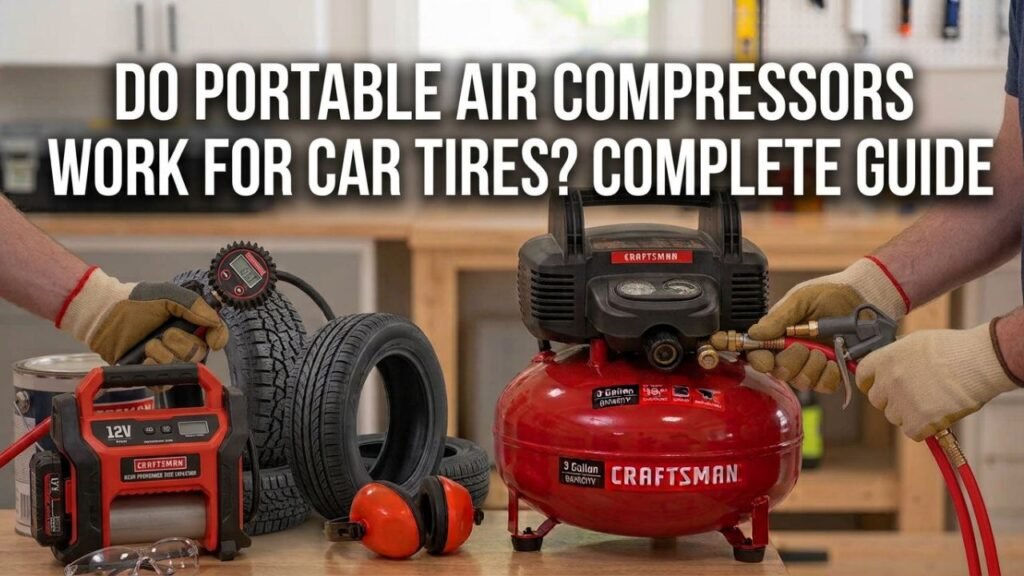
For ordinary passenger vehicles, portable air compressors can work extremely well.
Most passenger-car tires operate at pressures that are easily within the capabilities of modern portable tire inflators. Many compact compressors are specifically designed for vehicle tires and connect directly to a tire’s Schrader valve.
A portable compressor is particularly useful for:
- Topping off a tire that has gradually lost a few PSI
- Adjusting pressure after major temperature changes
- Inflating a spare tire
- Correcting low tire pressure before a road trip
- Restoring pressure after repairing a minor puncture
- Keeping tires properly inflated when a service station is unavailable
However, the compressor must be capable of reaching the required pressure while delivering enough airflow to do the job in a reasonable amount of time.
Portable Tire Inflator vs. Traditional Air Compressor
A portable tire inflator is technically a small air compressor, but its design is different from the larger compressors commonly found in garages.
| Feature | Portable Tire Inflator | Tank Air Compressor |
| Primary purpose | Tire inflation | Tires, air tools, shop work |
| Air tank | Usually none | Usually included |
| Portability | Excellent | Varies |
| Typical power | 12V, battery, or AC | AC electricity |
| Tire inflation | Very good | Very good |
| High-demand air tools | Usually unsuitable | Often suitable |
| Storage space | Minimal | More space required |
| Best use | Vehicle emergency kit and maintenance | Garage or workshop |
For car tires alone, I generally recommend a purpose-built portable tire inflator rather than buying a large tank compressor. It is easier to store, easier to carry, and does not require a reservoir of compressed air to inflate a tire.
A traditional compressor becomes more useful if you also intend to operate pneumatic tools, blow guns, spray equipment, or other high-air-demand equipment.
Key Takeaways:
- Portable compressors are fully capable of inflating normal car tires when properly sized.
- A large air tank is unnecessary for ordinary tire inflation.
- Portable tire inflators are usually the most convenient choice for drivers.
- Large tires require more airflow and can expose the limitations of very small compressors.
How Does a Portable Air Compressor Inflate a Car Tire?
A portable compressor uses an electric motor to drive a small compression mechanism. It draws in atmospheric air, compresses it, and sends that compressed air through a hose into the tire.
Unlike a tank-style compressor, most tire inflators deliver air directly to the tire rather than filling a storage tank first.
The basic process is simple:
- The compressor receives power from a vehicle outlet, battery, internal rechargeable battery, or household outlet.
- The motor operates the compressor mechanism.
- Atmospheric air enters the compressor.
- The compressor raises the pressure of the air.
- Compressed air travels through the hose and tire chuck.
- Air enters the tire until the desired pressure is reached.
Some modern models allow you to enter a target PSI before inflation. The compressor then shuts off automatically when that pressure is reached.
That automatic shutoff feature is one of the most useful features I would look for if convenience is important.
How Much PSI Does a Portable Compressor Need for Car Tires?
The compressor needs to be capable of producing pressure above the pressure required by the tire.
For many passenger vehicles, recommended cold tire pressure is somewhere around the 30- to 40-PSI range, although there are plenty of exceptions. The correct figure is vehicle-specific.
You should find the recommended pressure on the:
- Driver-side doorjamb tire placard
- Tire and Loading Information label
- Vehicle owner’s manual
Do not automatically use the PSI number molded into the tire sidewall as your target.
That sidewall number generally represents the tire’s maximum inflation pressure associated with its rated load conditions, not the vehicle manufacturer’s recommended everyday inflation pressure.
Is a 100 PSI Portable Compressor Enough for Car Tires?
Yes. A portable compressor rated for 100 PSI has far more pressure capability than most passenger-car tires require.
In fact, maximum PSI alone is a poor way to judge tire-inflator performance.
A compressor advertised as “150 PSI” is not automatically better or faster than one rated at 100 PSI. For normal car tires, both may provide more than enough pressure.
Is a 150 PSI Portable Compressor Better?
Not necessarily.
A 150-PSI rating can be useful for specialized high-pressure applications, but normal passenger-car tire inflation does not usually require anything close to 150 PSI.
For car tires, I would pay more attention to:
Airflow: Determines how quickly the compressor can move air.
Duty cycle: Determines how long it can operate before requiring a cooling period.
Tire-size rating: Helps indicate whether the compressor is designed for your tires.
Power connection: Determines whether the vehicle can safely supply the required current.
Gauge accuracy: Helps you achieve the desired tire pressure.
Automatic shutoff: Makes inflation easier and reduces the chance of accidentally continuing past your target.
Maximum PSI vs. Airflow
This distinction causes a lot of confusion.
PSI describes pressure. CFM describes airflow volume.
A compressor can theoretically reach a very high pressure yet move relatively little air. That unit may eventually inflate a tire but do it slowly.
For tire inflation, you need enough pressure and reasonable airflow.
For example, current purpose-built portable automotive compressors can vary substantially in airflow despite all being capable of normal tire pressures. This is one reason two compressors with apparently similar PSI ratings can have noticeably different inflation times.
Key Takeaways:
- Most cars do not need an extremely high-pressure compressor.
- A 100-PSI unit is generally more than capable of ordinary passenger-tire inflation.
- A 150-PSI label does not automatically mean faster inflation.
- Airflow, duty cycle, and tire-size capability often matter more than maximum PSI.
What Size Portable Air Compressor Do You Need for Car Tires?
There is no single required compressor size because vehicle tires vary substantially.
A compact sedan tire contains considerably less air than an oversized pickup or off-road tire. As tire volume increases, the compressor has to move more air to raise the pressure by the same amount.
A practical way to choose is by vehicle type.
| Vehicle Type | Practical Portable Compressor Choice | What to Prioritize |
| Compact car | Small portable inflator | Convenience and accurate gauge |
| Sedan | Small to medium inflator | Good airflow and auto shutoff |
| Crossover | Medium-duty inflator | Higher airflow |
| SUV | Medium-duty inflator | Tire-size compatibility and duty cycle |
| Pickup truck | Medium to heavy-duty inflator | Higher airflow and durable power connection |
| Large off-road tires | Heavy-duty compressor | High airflow and long duty cycle |
These are general guidelines rather than fixed technical requirements. Always check the compressor manufacturer’s maximum recommended tire size and your vehicle’s actual tire dimensions.
Do You Need a Tank?
No. A tank is not required to inflate a car tire.
Tankless compressors work by continuously pumping air directly into the tire. This makes them smaller and easier to transport.
An air tank can make stored compressed air immediately available, but that advantage is generally unnecessary for routine vehicle tire inflation.
Does Gallon Size Matter?
For tank-style compressors, tank capacity is measured in gallons. However, gallons are not a meaningful specification for most purpose-built portable tire inflators because they normally do not have tanks.
If your goal is simply filling car tires, I would not select a compressor based primarily on tank capacity.
Airflow and operating capability matter more.
How Fast Can a Portable Air Compressor Inflate a Car Tire?
Inflation time varies substantially.
A tire that is only 3 PSI below its recommended pressure might need very little time. A nearly flat tire can take several minutes. A large truck tire may take substantially longer with the same compressor.
Inflation speed depends on:
- Tire volume
- Starting PSI
- Target PSI
- Compressor airflow
- Compressor design
- Power supply voltage
- Ambient temperature
- Hose and fitting restrictions
- Compressor temperature
This is why a manufacturer’s real inflation-time testing or tire-size recommendation can be more useful than a large maximum-PSI number printed on the box.
Topping Off vs. Filling a Flat Tire
There is an important difference between adding a few pounds of pressure and inflating a severely underinflated tire.
Suppose your recommended cold pressure is 35 PSI.
Raising a tire from 32 PSI to 35 PSI is an easy job for almost any decent automotive inflator.
Raising the same tire from nearly empty to 35 PSI requires far more operating time and puts more thermal stress on the compressor.
Large SUVs and pickups magnify this difference because their tires contain more air.
Pro Tip: If you regularly inflate large truck or SUV tires rather than merely topping them off, choose a higher-airflow compressor specifically rated for your tire diameter. You will spend much less time waiting for inflation.
What Is Compressor Duty Cycle, and Why Does It Matter?
Duty cycle describes how long a compressor can operate within a specified period and under specified conditions before it needs to rest or cool.
This is important because compression generates heat.
A light-duty inflator may be perfectly adequate for topping off four passenger-car tires but become too hot if asked to run continuously while inflating multiple large tires from very low pressures.
Manufacturers express duty cycle in different ways, so read the specification carefully. You may see ratings such as a certain number of continuous minutes at a specified pressure or a percentage measured over a defined cycle.
Do not assume that every compressor can run continuously simply because the motor is still capable of turning.
Why Overheating Matters
Excessive heat can shorten compressor life and may activate a thermal protection system if one is fitted.
During extended inflation:
- Follow the manufacturer’s maximum continuous-run instructions.
- Allow the compressor to cool when required.
- Keep ventilation openings unobstructed.
- Avoid touching compressor components that have become hot.
- Do not place a hot compressor immediately against materials that could be damaged by heat.
For routine topping-off work, duty-cycle limitations may rarely become an issue. They become far more important when inflating big tires, multiple vehicles, or tires that are substantially deflated.
Key Takeaways:
- Inflation time depends heavily on tire volume and compressor airflow.
- Topping off a tire is much easier than filling one from nearly empty.
- Duty cycle determines how long the compressor can safely continue operating.
- Larger tires justify buying a higher-airflow, longer-duty-cycle compressor.
What Type of Portable Air Compressor Is Best for Car Tires?
You have several practical choices.
12-Volt Plug-In Tire Inflator
These models connect to a vehicle’s 12-volt accessory power outlet.
They are compact, affordable, and convenient for ordinary passenger vehicles.
Their biggest limitation is electrical current. Some compressors can draw more current than a particular accessory socket is designed to supply.
Check both the compressor’s electrical requirement and the vehicle owner’s manual before use.
I recommend this type for drivers who want a simple emergency compressor for a sedan or crossover and whose vehicle outlet supports the required load.
Battery-Clamp Portable Compressor
Higher-output 12-volt compressors may connect directly to the vehicle battery with clamps instead of drawing power through an accessory outlet.
This allows the compressor to handle higher current without relying on a relatively low-capacity cabin socket.
For SUVs, pickups, and larger tires, I generally prefer a good battery-clamp compressor because the higher available electrical capacity can support a more capable pump.
Follow the manufacturer’s instructions carefully when connecting to a vehicle battery.
Cordless Battery Tire Inflator
Cordless inflators contain or use rechargeable tool-style batteries.
Their main advantage is convenience. There is no long power cable to route through the vehicle.
They work very well for routine pressure adjustments, especially if you already own compatible batteries from the same tool platform.
The tradeoff is runtime. A discharged battery makes the compressor unusable until it is recharged or replaced with another charged pack.
Household AC Portable Compressor
Some portable compressors operate from a standard household outlet.
These are useful for garage use but less convenient for roadside emergencies unless another power source is available.
Dual-Power Inflator
A dual-power model can operate using more than one source, such as household AC power and vehicle DC power.
This can be an excellent all-purpose option because you can use it conveniently in the garage while retaining roadside capability.
Features I Recommend Looking For
For a typical U.S. driver shopping for a tire inflator, I would prioritize practical features rather than simply choosing the model with the largest PSI number.
Accurate Pressure Gauge
A readable built-in gauge saves time, although keeping a separate quality tire-pressure gauge is still useful for verification.
Automatic Shutoff
You select the desired pressure and the machine stops at that setting.
For beginners, I consider this one of the most useful convenience features.
Adequate Hose Length
The hose must comfortably reach the valve stem regardless of its position on the wheel.
Sufficient Power-Cord Length
If the compressor uses vehicle power, make sure its cable can reach every tire from the intended connection point.
Suitable Tire-Size Rating
If the manufacturer provides a maximum tire diameter or vehicle category, use it.
A compressor intended for passenger tires should not automatically be assumed suitable for oversized off-road tires.
Good Duty Cycle
This becomes increasingly important as tire size increases or when several tires need substantial inflation.
Useful Airflow
Higher airflow generally reduces inflation time, particularly for large tires.
Portable Storage
A case or compact cord-and-hose storage system makes a major difference when the unit lives in your trunk.
LED Work Light
This is not essential, but it can be genuinely useful during a nighttime roadside situation.
How to Use a Portable Air Compressor on a Car Tire
Before inflating anything, inspect the tire.
If you see a sidewall bulge, exposed cords, severe cut, damaged wheel, separated tread, or other major structural damage, do not treat inflation as the solution. Have the tire inspected or replaced appropriately.
A rapidly deflating tire may also have a significant puncture or damaged valve that requires repair.
For normal pressure adjustment, use this process.
1. Find the Correct Tire Pressure
Look at the tire-pressure placard on the driver’s doorjamb or consult the vehicle owner’s manual.
Front and rear pressures are not necessarily identical.
2. Check the Tires When Cold
For the most meaningful reading, check inflation when the tires are cold—generally before substantial driving.
Driving heats the tires and increases pressure, so a warm reading does not directly represent the specified cold inflation pressure.
3. Position the Compressor Safely
Park on a stable surface away from moving traffic when possible.
Set the parking brake.
Keep the compressor where its cooling vents remain unobstructed.
4. Connect the Power Supply
Connect the compressor according to its design.
That may mean:
- Plugging it into a compatible 12-volt outlet
- Connecting clamps to the vehicle battery
- Installing a charged battery pack
- Connecting to household AC power
Never exceed the electrical rating of a vehicle accessory outlet.
5. Remove the Valve Cap
Remove the valve-stem cap and put it somewhere safe.
6. Connect the Air Hose
Attach the chuck securely to the valve stem.
A poor seal can allow air to escape and make the compressor appear less effective.
7. Set the Desired Pressure
If the compressor has automatic preset capability, enter the vehicle manufacturer’s recommended PSI.
Otherwise, watch the pressure gauge during inflation.
8. Turn on the Compressor
Allow it to inflate the tire.
Do not exceed the compressor’s permitted continuous operating time.
9. Check the Final Pressure
Once inflation is complete, check the tire pressure again.
A separate pressure gauge can be helpful if you want to confirm the compressor’s built-in reading.
10. Disconnect and Reinstall the Cap
Remove the chuck, reinstall the valve cap, and store the compressor after it has cooled if necessary.
Important Tip: Never intentionally inflate a normal car tire to the compressor’s advertised maximum PSI. The compressor’s pressure capability and your vehicle’s required tire pressure are completely different specifications.
What PSI Should You Put in Your Car Tires?
Use the vehicle manufacturer’s specified cold tire inflation pressure.
The driver’s doorjamb is the best first place to look. Depending on the vehicle, the label may specify different pressures for:
- Front tires
- Rear tires
- Different load conditions
- Spare tire
Do not assume that “35 PSI” is correct simply because it is common on passenger vehicles.
Different cars can require different pressures even when equipped with tires that appear similar.
Should You Use the PSI Written on the Tire?
Not as your normal inflation target.
The pressure marked on the tire sidewall should not replace the vehicle manufacturer’s specified cold pressure.
For routine road use, follow the pressure specified for the vehicle and approved tire setup.
What If the Tire Is Warm?
Tire pressure naturally increases as driving generates heat.
Do not automatically bleed air from a warm tire merely because the measurement is higher than the cold specification.
For the most accurate adjustment, let the tires cool and recheck them against the vehicle’s cold-pressure recommendation.
Key Takeaways:
- Use the pressure listed by the vehicle manufacturer.
- Do not use the tire sidewall’s maximum PSI as your normal target.
- Measure pressure when tires are cold whenever practical.
- Front and rear tires may have different specified pressures.
Can a Small Portable Air Compressor Fill a Completely Flat Tire?
Sometimes—but the cause of the flat matters more than the compressor.
A portable compressor can put air back into an intact tire that has simply lost pressure. But if the tire is flat because air is escaping faster than the compressor can replace it, inflation will not solve the problem.
Examples include:
- Large puncture
- Torn sidewall
- Tire separated from the wheel bead
- Damaged valve stem
- Cracked or badly damaged wheel
- Severe tire structural failure
A tire that has been driven while completely flat may also have hidden internal damage even if it later accepts air.
If a tire suddenly becomes completely flat, inspect it carefully and use roadside assistance or a qualified tire service when the condition is uncertain.
Can You Inflate a Tire After Using a Puncture Repair Kit?
Often yes, depending on the repair system and type of damage.
Some emergency tire-repair kits are specifically designed to seal certain tread-area punctures temporarily and then reinflate the tire.
However, temporary sealants and plugs have limitations. Sidewall damage, large holes, wheel damage, and many other failures are not safely resolved by simply adding sealant and air.
Follow the repair-kit manufacturer’s instructions and arrange proper inspection or repair afterward.
Can You Use a Portable Compressor With the Engine Running?
This depends on the compressor and its instructions.
Some 12-volt compressors are designed to operate with the engine running so the charging system can support the electrical load and maintain voltage.
However, never run a vehicle engine inside an enclosed garage or other poorly ventilated space because exhaust gases can contain deadly carbon monoxide.
Follow the compressor manufacturer’s operating instructions and your vehicle manufacturer’s electrical guidance.
For battery-clamp models, follow the specified connection and disconnection procedure.
Will a Portable Compressor Drain the Car Battery?
It can if it draws power for long enough while the engine is off.
Portable automotive compressors can consume significant electrical current, particularly more powerful models.
How quickly battery state of charge is affected depends on:
- Compressor current draw
- Operating time
- Battery capacity
- Battery condition
- Battery temperature
- Whether the charging system is operating
A healthy battery may easily handle a short inflation job, but extended compressor operation with the engine off is a different situation.
Always follow the inflator manufacturer’s power recommendations.
Can You Leave a Portable Air Compressor in Your Car?
Generally, a portable tire inflator is an excellent item to keep in a vehicle, provided you follow its storage requirements.
Keep it:
- Securely stored so it cannot move around
- Protected from water unless rated for exposure
- Away from leaking chemicals
- Within the manufacturer’s storage-temperature limits
- With cords and hoses protected from damage
Rechargeable battery models deserve extra attention because battery packs can have storage-temperature restrictions.
Extreme vehicle-interior temperatures can be significantly harsher than normal indoor storage conditions.
Are Portable Compressors Good for SUVs and Trucks?
Yes, but compressor selection becomes more important.
A compressor that feels fast on a compact-car tire can feel painfully slow on a large pickup tire because the truck tire contains much more air.
For an SUV or truck, I would prioritize:
- Manufacturer approval for the actual tire size
- Higher airflow
- Longer duty cycle
- Durable hose and chuck
- Adequate cord length
- Direct battery connection when required
- Thermal protection
- Reliable pressure gauge
For large off-road tires, airflow becomes especially important.
Off-road drivers who deliberately air tires down for trail use may need to reinflate four large tires substantially at the end of every trip. That is a much heavier workload than adding 2 PSI to four sedan tires.
In that situation, I would avoid the smallest emergency-only inflators and buy a compressor designed specifically for larger tires and repeated operation.
Advantages and Limitations of Portable Tire Compressors
Portable compressors offer substantial practical benefits, but they are not replacements for every type of compressor.
| Advantages | Limitations |
| Compact and easy to store | Small units may inflate slowly |
| Excellent for roadside use | Limited duty cycle on some models |
| No large tank required | Some cannot handle oversized tires efficiently |
| Simple to operate | Electrical requirements vary |
| Useful for regular pressure maintenance | Not generally suited to high-demand air tools |
| Many include built-in gauges | Gauge accuracy varies |
| Some offer automatic shutoff | Battery models require charging |
For maintaining passenger-car tires, the advantages generally outweigh the limitations.
Common Portable Tire Inflator Mistakes to Avoid
Buying Based Only on Maximum PSI
The biggest PSI number on the packaging does not necessarily identify the best inflator.
Look at airflow, tire-size recommendation, duty cycle, and power requirements.
Inflating to the Tire Sidewall Pressure
Use the vehicle’s recommended cold pressure instead.
Ignoring the Accessory Outlet Rating
A compressor can draw more current than some vehicle outlets are designed to supply.
Check compatibility before plugging it in.
Running the Compressor Too Long
Respect its duty-cycle limitations.
If the manual calls for cooling time, give it cooling time.
Assuming Air Will Fix Every Flat
A compressor supplies air; it does not repair structural tire damage.
If pressure drops again rapidly, identify the leak.
Relying Only on the TPMS Warning Light
A tire-pressure monitoring system is an important safety feature, but routine pressure checks are still worthwhile.
The warning threshold is not a replacement for maintaining the manufacturer’s recommended pressure.
Ignoring the Spare Tire
If your vehicle has an inflatable spare, check it periodically too.
A spare that has slowly lost pressure may not be useful when you finally need it.
Is a Portable Air Compressor Worth Keeping in Your Car?
For most drivers, yes.
A tire inflator solves one of the most common minor vehicle-maintenance problems without requiring a visit to a gas station or tire shop.
It is especially useful when temperature changes cause pressure to fall. Tire pressure typically changes with tire temperature, which is why low-pressure warnings often appear during colder weather.
A portable compressor also pairs well with:
- A quality tire-pressure gauge
- Flashlight
- Emergency warning devices
- Appropriate spare-tire equipment
- Manufacturer-approved puncture kit when applicable
- Roadside assistance coverage
I would consider a portable inflator basic vehicle equipment, especially for cars that do not carry a conventional spare tire.
It will not solve every tire emergency, but for ordinary low-pressure situations, it can save considerable inconvenience.
FAQs about Do Portable Air Compressors Work for Car Tires
Can any portable air compressor inflate a car tire?
No. The compressor needs sufficient pressure capability, airflow, operating time, and appropriate tire-size compatibility. Most purpose-built automotive inflators can handle passenger-car tires, but extremely small pumps may struggle with larger SUV and truck tires.
What size portable air compressor is best for car tires?
For normal passenger cars, you usually do not need a tank-style compressor at all. A compact automotive tire inflator rated for your tire size is typically sufficient. For SUVs and pickups, choose higher airflow and a stronger duty cycle.
Is a 12V portable air compressor good for car tires?
Yes. A properly sized 12V compressor is one of the most practical choices for vehicle tire inflation. Just make sure the compressor’s electrical demand is compatible with the power outlet or connection method you plan to use.
Is a 100 PSI air compressor enough for car tires?
Yes. A 100-PSI compressor provides more pressure capability than most passenger-car tires require. Airflow and duty cycle are generally more important once the compressor can comfortably reach the required pressure.
Is a 150 PSI air compressor good for car tires?
Yes, but you do not need 150 PSI simply to inflate ordinary car tires. A 150-PSI maximum rating does not mean you should inflate the tire anywhere near 150 PSI.
Can a portable compressor fill a completely flat car tire?
It may be able to inflate the tire if the tire is still properly seated on the wheel and does not have a major leak. It cannot compensate for serious sidewall damage, a large puncture, bead separation, or substantial wheel damage.
How long does a portable air compressor take to inflate a car tire?
It can range from a short top-off to several minutes or more. Tire size, starting pressure, target pressure, compressor airflow, and temperature all influence inflation time.
Can a small air compressor fill car tires?
Yes. Even relatively small compressors can fill ordinary car tires if they can achieve the required pressure and are designed for the tire’s volume. Smaller compressors generally take longer, particularly when a tire is severely underinflated.
Do I need a gallon air compressor for car tires?
No. A tank measured in gallons is not necessary for tire inflation. Tankless portable inflators pump air directly into the tire and are usually more convenient for this job.
Does CFM matter when inflating car tires?
Yes. CFM is a measure of airflow, and more airflow generally means faster inflation. Be careful when comparing specifications, however, because airflow changes with pressure and manufacturers may report CFM under different test conditions.
Can a cordless tire inflator fill a car tire?
Yes. Many cordless inflators work very well for passenger-car tires. Their main limitation is battery capacity, so keep the battery charged if the inflator is part of your emergency equipment.
Should I inflate my tires to 35 PSI?
Only if your vehicle specifies 35 PSI for those tires under the applicable conditions. Check the driver’s doorjamb label or owner’s manual rather than assuming a universal number.
Should I inflate my tire to the maximum PSI printed on the sidewall?
No. For normal vehicle use, follow the vehicle manufacturer’s specified cold tire pressure. The sidewall’s maximum pressure information is not your standard inflation target.
Can portable air compressors overinflate tires?
Yes. A compressor can continue adding air beyond the correct pressure if it is not stopped. Monitor the gauge carefully or use an automatic-shutoff model set to the proper PSI.
Why does my portable compressor get hot?
Compressing air generates heat. Small compressors can become particularly hot during continuous operation. Follow the specified duty cycle and cooling instructions and avoid touching hot components.
Can I use the same portable compressor for bicycle tires?
Often, yes, but valve compatibility and pressure requirements matter. Car tires commonly use Schrader valves, while many bicycles use Presta valves and may require an adapter. High-pressure bicycle tires can also have different compressor requirements.
Will a portable air compressor fix a tire-pressure warning light?
If the warning is caused solely by low tire pressure, correcting all tires to the manufacturer’s specified pressure may resolve the warning after the vehicle’s TPMS updates. If the warning remains, there may be another pressure issue, sensor issue, or model-specific reset procedure.
What should I do if the tire loses pressure again after inflation?
Treat repeated pressure loss as a leak until proven otherwise. The cause could be a puncture, valve problem, wheel issue, bead leak, or tire damage. Have the tire inspected instead of repeatedly adding air indefinitely.
Conclusion
Do portable air compressors work for car tires? Yes. For normal passenger cars, a good portable tire inflator can be an effective, convenient, and practical alternative to using a large garage compressor or visiting a service station every time a tire needs air.
You do not need an enormous PSI rating or an air tank. What matters is choosing a compressor with enough working pressure, airflow, duty cycle, electrical capacity, and tire-size compatibility for your vehicle.
For a typical sedan or crossover, I recommend a compact automotive inflator with a clear pressure gauge and automatic shutoff. For pickups, large SUVs, and oversized tires, I would step up to a higher-airflow compressor with a stronger duty cycle and an appropriate power connection.
Most importantly, inflate each tire according to the vehicle manufacturer’s specified cold tire pressure, not the maximum PSI printed on the tire and not the maximum pressure advertised on the compressor.
A portable compressor cannot repair serious tire damage, but for routine pressure maintenance and many minor roadside inflation needs, it is one of the most useful pieces of equipment you can keep in your vehicle.