
What Size Air Compressor Do I Need to Change Tires? Complete Guide
If you’re asking what size air compressor do I need to change tires, a 20-gallon compressor delivering about 4–5 CFM or more at 90 PSI is a practical choice for most home garages using a 1/2-inch air impact wrench. A 6-gallon compressor can handle occasional wheel changes, while a 30–60-gallon compressor is better for frequent automotive work or a professional tire-changing setup.
The exact size depends on what you mean by “change tires.” Removing and reinstalling a wheel with an air impact wrench has very different air requirements from simply inflating the tire. A professional tire-changing machine, bead breaker, and multiple pneumatic tools can require considerably more air again.
Tank capacity is important, but CFM is usually the specification that determines whether your compressor can actually keep up with your tools. PSI tells you the pressure available, while CFM tells you how much air the compressor can deliver.
In this guide, I’ll explain the right compressor size for changing car tires, how many gallons you need, how much CFM and PSI an impact wrench requires, whether 3-, 6-, and 20-gallon compressors are enough, and what I recommend for home and professional tire work.
What Size Air Compressor Do I Need to Change Tires?
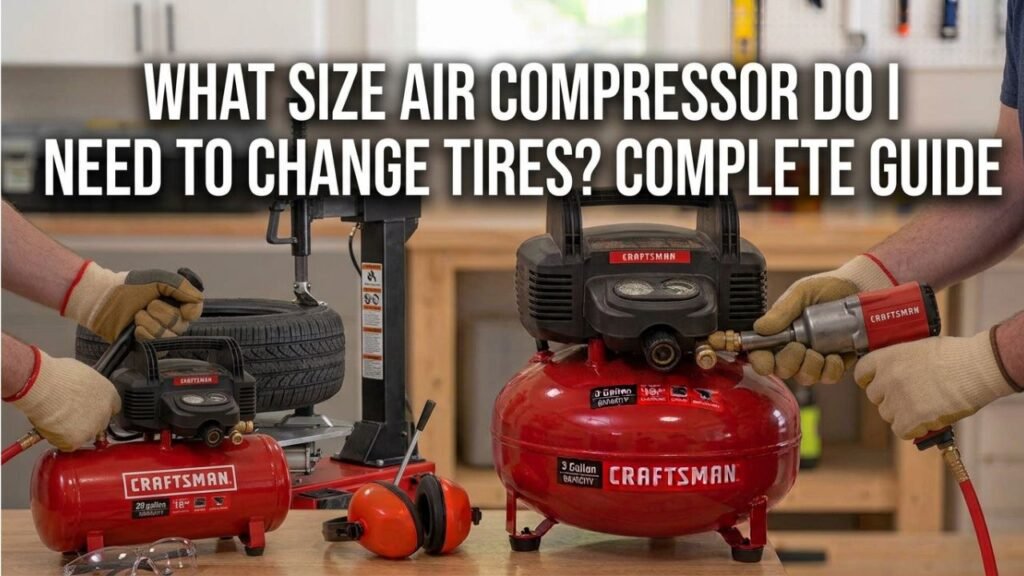
For a typical homeowner using a pneumatic impact wrench to remove lug nuts and an inflator to refill tires, I recommend a 20-gallon compressor with at least about 4–5 CFM at 90 PSI.
That combination gives you enough stored air to run a common 1/2-inch impact wrench in short bursts without constantly waiting for the compressor to recover.
Here is a practical starting point:
| Tire Work | Recommended Tank Size | Suggested Airflow | Typical Use |
| Tire inflation only | 1–6 gallons | 1–3 CFM | Cars and light trucks |
| Occasional wheel changes | 6 gallons | Around 2.5–4 CFM at 90 PSI | DIY use |
| Regular home-garage tire changes | 15–20 gallons | 4–6+ CFM at 90 PSI | Recommended |
| Frequent automotive repair | 20–30+ gallons | 5–8+ CFM at 90 PSI | Serious DIY/shop use |
| Tire shop or multiple air tools | 60+ gallons | 10+ CFM depending on equipment | Professional use |
These are general recommendations rather than universal requirements. Always compare your compressor with the specifications of the particular impact wrench, tire changer, bead breaker, or other pneumatic equipment you plan to use.
My Recommendation for Most Home Garages
If you are buying one compressor primarily for automotive tire work, 20 gallons is my preferred starting point.
It is large enough to provide a useful air reserve while still being available in relatively portable designs.
A good 20-gallon compressor can also handle many other garage jobs, including:
- Tire inflation
- Blow guns
- Ratchets
- Some impact wrenches
- Occasional pneumatic fastening
- Light automotive air-tool work
If you only remove wheels occasionally, a 6-gallon compressor can still get the job done.
Key Takeaways:
- Around 20 gallons and 4–5+ CFM at 90 PSI is a strong home-garage target.
- A 6-gallon compressor can work for occasional tire changes.
- Tire inflation alone requires much less compressor capacity.
- Professional tire equipment usually benefits from substantially more airflow.
CFM Matters More Than Gallon Size for Changing Tires
Compressor tank capacity is measured in gallons, but gallons alone do not tell you how well an air compressor will operate an impact wrench.
The more important specification is CFM, or cubic feet per minute.
CFM describes how quickly the compressor can deliver air.
A 20-gallon tank can store significantly more compressed air than a 6-gallon tank, but if both compressors have weak pumps, neither may provide enough sustained airflow for a demanding pneumatic tool.
Typical CFM for an Air Impact Wrench
A common 1/2-inch automotive impact wrench may average around 4 CFM at 90 PSI, although actual consumption varies considerably between tools.
Some models require less, while powerful impact wrenches can demand substantially more airflow while operating under load.
For example, pneumatic impact wrenches used in automotive service can range from only a few CFM for smaller models to much higher airflow requirements for heavy-duty 3/4- and 1-inch tools.
That is why the impact wrench manufacturer’s specification should always be your primary reference.
Average CFM vs. Air Consumption Under Load
This distinction is important.
A manufacturer may list:
Average air consumption: 4 CFM
But the tool’s actual airflow while the trigger is continuously held can be considerably higher.
An impact wrench normally operates in short bursts, so average CFM ratings can still be useful for ordinary lug-nut work.
However, if you continuously hold the trigger or use the wrench for more demanding automotive jobs, the compressor will need substantially more reserve and recovery capacity.
Give Yourself Some Extra Airflow
I would avoid choosing a compressor whose airflow rating barely matches the wrench.
If your impact wrench calls for approximately 4 CFM at 90 PSI, I would prefer a compressor supplying 5–6 CFM or more at 90 PSI.
That extra capacity provides useful headroom for:
- Compressor recovery
- Hose losses
- Coupler restrictions
- Pressure drops
- Longer tool operation
- Future pneumatic tools
Pro Tip: Always compare compressor and tool CFM figures at the same pressure whenever possible. A compressor rated at 5 CFM at 40 PSI does not necessarily deliver 5 CFM at 90 PSI.
How Many Gallon Air Compressor Do You Need to Change Tires?
The best tank size depends mainly on how frequently you change wheels and what pneumatic equipment you use.
3-Gallon Compressor
A 3-gallon compressor is useful for inflating tires but is generally not my first choice for a pneumatic 1/2-inch impact wrench.
It may run the wrench for a very short burst if the compressor supplies adequate pressure, but its small air reserve disappears quickly.
Expect frequent compressor cycling and recovery pauses.
6-Gallon Compressor
A 6-gallon compressor can run many 1/2-inch impact wrenches for occasional wheel changes.
This size works because an impact wrench usually operates for only a few seconds at a time.
You can remove one lug nut, reposition the tool, and continue while the compressor replenishes air.
However, rapid use can empty the tank faster than the pump can recover.
10-Gallon Compressor
A 10-gallon compressor gives you more air reserve and can be a good compromise when portability matters.
With adequate CFM output, it can handle occasional automotive impact-wrench use more comfortably than a small pancake compressor.
20-Gallon Compressor
For the average home garage, 20 gallons is the size I recommend most often for changing tires with pneumatic tools.
You receive substantially more stored air while the compressor remains small enough to move around in many garage environments.
Pair it with approximately 4–6 CFM or more at 90 PSI, depending on your impact wrench.
30-Gallon Compressor
A 30-gallon compressor is even more comfortable for frequent automotive work.
It offers longer tool runtime, fewer interruptions, and more versatility if you plan to use additional air tools.
60-Gallon Compressor
A 60-gallon compressor makes sense for:
- Tire shops
- Repair garages
- Frequent automotive service
- Multiple technicians
- Multiple pneumatic tools
- High-CFM impact wrenches
- Pneumatic tire-changing equipment
For someone who only changes the wheels on a personal vehicle several times per year, a 60-gallon compressor is generally unnecessary.
Key Takeaways:
- 3 gallons is primarily suitable for inflation rather than serious impact-wrench use.
- 6 gallons can handle occasional wheel changes.
- 20 gallons is my preferred home-garage size.
- 30–60+ gallons makes more sense as air-tool usage becomes frequent or professional.
Can a 6 Gallon Air Compressor Change Tires?
Yes, a 6-gallon air compressor can change tires when paired with a compatible pneumatic impact wrench.
A typical 6-gallon pancake compressor may deliver around 2.5–3 CFM at 90 PSI, although specifications vary by model.
That is below the average consumption of some full-size 1/2-inch impact wrenches.
However, because you normally operate an impact wrench in short bursts, the compressor can use stored tank air to temporarily satisfy a higher demand.
This makes a 6-gallon compressor workable for:
- Removing wheels occasionally
- Rotating tires
- Seasonal wheel swaps
- Changing a flat at home
- Basic DIY automotive maintenance
Where a 6-Gallon Compressor Struggles
The limitations become more noticeable when:
- Lug nuts are extremely tight
- You run the impact wrench continuously
- You change several vehicles consecutively
- The impact wrench has high airflow requirements
- You operate multiple pneumatic tools
- The compressor has low CFM output
You may have to stop periodically while tank pressure recovers.
If I already owned a 6-gallon compressor, I would try it before buying another compressor solely for occasional tire changes.
If I were buying specifically for regular automotive impact-wrench use, however, I would choose a 15- or 20-gallon model with stronger CFM output.
Can a 3 Gallon Air Compressor Change Tires?
A 3-gallon compressor can inflate tires easily, but using one with a pneumatic impact wrench is more restrictive.
The tank may contain enough air for several short impact-wrench bursts, but it will drain quickly.
Whether it works depends on:
- Impact-wrench CFM
- Compressor CFM
- Tank pressure
- Lug-nut torque
- Number of lug nuts
- How long you hold the trigger
For a single emergency wheel change or very occasional garage use, a capable 3-gallon compressor may technically work.
I would not buy a 3-gallon compressor specifically for pneumatic tire-changing work, though.
A 6-gallon compressor is a more practical minimum, and a 20-gallon compressor is a much better long-term choice.
Can a 20 Gallon Air Compressor Change Tires?
Yes. A 20-gallon air compressor is an excellent size for changing tires in a home garage.
With enough CFM, it can comfortably support a typical 1/2-inch pneumatic impact wrench used intermittently for wheel removal.
The larger tank also means you can usually remove multiple lug nuts before the compressor requires significant recovery.
A 20-gallon unit is especially useful if you perform:
- Tire rotations
- Brake jobs
- Seasonal wheel swaps
- Suspension work
- General automotive repairs
- Regular tire inflation
For one-person DIY use, I consider a good 20-gallon compressor one of the best compromises between capability, cost, and garage space.
How Much PSI Do You Need to Change Tires?
For an air impact wrench, around 90 PSI at the tool is extremely common, although the correct pressure depends on the particular wrench.
Many pneumatic impact wrenches are rated for approximately 90 PSI operating pressure.
Do not confuse this with compressor maximum tank pressure.
Your compressor might store air at:
- 125 PSI
- 150 PSI
- 175 PSI
- 200 PSI
The regulator reduces that tank pressure to the working pressure required by your tool.
For example:
Tank pressure: 150 PSI
Regulated tool pressure: 90 PSI
A compressor capable of 175 PSI is not automatically better for an impact wrench than a 150-PSI compressor.
Airflow at the required working pressure matters more.
Why Pressure Can Drop at the Tool
Even if your regulator shows 90 PSI, the impact wrench may receive less pressure while running because of restrictions in the air system.
Common causes include:
- Small-diameter hose
- Long hose
- Restrictive quick couplers
- Dirty filters
- Undersized fittings
- Leaks
- Inadequate compressor airflow
For a full-size automotive impact wrench, a 3/8-inch air hose is commonly a better choice than a restrictive small hose.
Always follow the impact-wrench manufacturer’s minimum hose-size recommendation.
What Size Compressor Do You Need Just to Inflate Car Tires?
If you only want to inflate tires rather than remove the wheels with pneumatic tools, your compressor requirements are much smaller.
A 1- to 6-gallon portable compressor is usually plenty for normal passenger-car tire inflation.
You do not need a 20-gallon tank just to add air to car tires.
The compressor needs to be capable of producing pressure higher than your tire’s required inflation pressure.
Most passenger-vehicle tires are normally inflated somewhere around the low-to-mid 30 PSI range, although the correct pressure varies by vehicle.
Always use the pressure listed on the vehicle’s tire-information placard, commonly located on the driver’s door jamb.
Do not use the maximum pressure molded into the tire sidewall as the normal vehicle inflation target.
What About Truck Tires?
Light-truck tires can require substantially higher pressure than passenger-car tires.
For these applications, verify that the compressor can comfortably exceed the required tire pressure and has enough airflow to avoid excessively long fill times.
A larger tank and stronger pump become more useful as tire volume and required pressure increase.
Important Tip: Check tire pressure when the tires are cold whenever the vehicle manufacturer recommends cold inflation pressure. Driving heats the tires and temporarily increases pressure.
What If You Mean a Pneumatic Tire-Changing Machine?
If “change tires” means actually removing the tire from the wheel using a pneumatic tire changer rather than simply removing the wheel from the vehicle, compressor requirements change considerably.
Professional tire equipment may include:
- Tire changer
- Pneumatic bead breaker
- Air impact wrench
- Inflation system
- Air-operated lifts
- Blow guns
A pneumatic bead breaker can have a substantially higher instantaneous airflow requirement than an ordinary 1/2-inch impact wrench.
For a tire shop, I would generally look toward a 60-gallon or larger compressor with roughly 10–15+ CFM available, depending on the equipment specifications and how many tools will operate at once.
The correct approach is to check the CFM requirement of every pneumatic machine and size the compressor for the combined demand that may occur simultaneously.
Home Tire Changer vs. Professional Tire Shop
A home user operating one tire-changing machine intermittently may get by with a smaller compressor if the machine’s requirements permit it.
A commercial shop should have additional airflow capacity because several air-consuming operations can overlap.
Undersizing the compressor can lead to:
- Slow bead-breaker operation
- Pressure loss
- Weak impact-wrench performance
- Long compressor recovery periods
- Excessive compressor runtime
- Reduced shop productivity
What Size Air Compressor for a 1/2-Inch Impact Wrench?
A 1/2-inch impact wrench is the most relevant size for ordinary passenger-vehicle lug nuts.
For occasional wheel removal, a 6-gallon compressor can work.
For regular use, I recommend:
15–20+ gallons
4–6+ CFM at 90 PSI
Approximately 90 PSI working pressure
These are general targets rather than requirements for every 1/2-inch wrench.
Some efficient impact wrenches have modest average airflow consumption, while others use considerably more air under load.
Always check your tool’s specification.
What About a 3/4-Inch Impact Wrench?
A 3/4-inch pneumatic impact wrench usually requires significantly more air.
These tools are commonly used for:
- Heavy trucks
- Large suspension fasteners
- Commercial vehicles
- Heavy equipment
Air consumption may be around 8 CFM or higher depending on the wrench.
For these tools, I would generally move toward a 30–60-gallon compressor with substantially higher CFM output.
What About a 1-Inch Impact Wrench?
Large 1-inch impact wrenches can require very high airflow, especially while operating under load.
These tools belong in a completely different category from a typical home-garage 1/2-inch impact.
A professional-grade, high-CFM compressor and appropriately sized hose and fittings are usually necessary.
Key Takeaways:
- A 1/2-inch impact wrench is normally appropriate for passenger-car wheel changes.
- A 6-gallon compressor can work for occasional use.
- A 20-gallon, 4–6+ CFM setup is much more comfortable for regular use.
- 3/4- and 1-inch impact wrenches may require dramatically more airflow.
Why Your Impact Wrench Feels Weak Even With a Large Compressor
A large compressor does not guarantee full impact-wrench performance.
Several other parts of the air system can restrict airflow.
Air Hose Is Too Small
An undersized hose creates pressure loss.
A 3/8-inch hose is common for many full-size automotive impact wrenches, but always check the manufacturer’s recommendation.
Quick Couplers Are Restrictive
Small fittings can become airflow bottlenecks.
High-flow fittings can help when a powerful wrench requires substantial air.
Regulator Is Too Restrictive
Not all regulators flow the same amount of air.
A small regulator may cause a noticeable pressure drop while the impact wrench is running.
Air Filter Is Clogged
Dirty air filters can restrict airflow.
Check and maintain the compressor’s filtration system according to manufacturer instructions.
Hose Is Too Long
Long air hoses create additional pressure loss, particularly when the hose diameter is small.
Use the shortest practical hose size for demanding pneumatic tools.
Tank Pressure Is Too Low
If the compressor is near its cut-in point, less pressure may be available to maintain proper tool performance.
Allow the tank to recover and test again.
Is Maximum PSI or CFM More Important?
For tire-changing tools, CFM is generally the more important compressor-selection specification once you have enough PSI.
Imagine two compressors:
| Compressor | Maximum Pressure | Output at 90 PSI | Better for Impact Wrench? |
| Compressor A | 200 PSI | 2.5 CFM | More limited |
| Compressor B | 150 PSI | 6 CFM | Usually better |
Assuming both meet the tool’s pressure requirement, Compressor B will usually support a demanding impact wrench more comfortably because it replaces consumed air much faster.
High maximum PSI can increase the amount of usable compressed air stored in a tank, but it does not replace the need for sufficient pump airflow.
Do You Even Need an Air Compressor to Change Tires?
Not necessarily.
If your only goal is removing and installing wheels, a modern cordless electric impact wrench can eliminate the need for a compressor entirely.
You would still need a separate inflator if you want to adjust tire pressure.
For a homeowner who does not already own pneumatic tools, a cordless impact wrench plus a compact tire inflator can be simpler than purchasing:
- Compressor
- Air hose
- Air fittings
- Pneumatic impact wrench
- Air-tool oil and accessories
However, a compressor remains valuable if you already have or plan to use several pneumatic tools.
Air Impact vs. Cordless Impact for Home Tire Changes
| Feature | Pneumatic Impact | Cordless Impact |
| Compressor required | Yes | No |
| Hose required | Yes | No |
| Tool weight | Often relatively light | Battery adds weight |
| Continuous shop use | Excellent | Battery dependent |
| Home convenience | Good if compressor already owned | Excellent |
| Additional air-tool capability | Yes | No |
| Tire inflation capability | Compressor can inflate | Separate inflator needed |
If tire changing is your only reason for buying a compressor, I would seriously consider a cordless impact wrench instead.
If you want a compressor for several automotive jobs, a 20-gallon unit becomes much easier to justify.
How to Use an Air Compressor When Changing a Wheel
Before working on the vehicle, park it on a firm, level surface and follow the vehicle manufacturer’s lifting instructions.
Never rely on a hydraulic jack alone while working around or underneath a raised vehicle.
- Confirm that the compressor and impact wrench are compatible.
- Connect an appropriately sized air hose and fittings.
- Allow the compressor tank to fully charge.
- Adjust the regulator to the impact wrench manufacturer’s specified pressure, commonly around 90 PSI.
- Securely lift the vehicle according to the manufacturer’s recommended procedure.
- Use the impact wrench with the correct impact-rated socket to remove the lug nuts.
- Remove and replace the wheel.
- Thread the lug nuts by hand first to reduce the risk of cross-threading.
- Snug the fasteners in the recommended sequence.
- Lower the vehicle as appropriate for the manufacturer’s torque procedure.
- Use a calibrated torque wrench to tighten the lug nuts to the vehicle manufacturer’s specified torque.
Important Tip: Do not use an impact wrench as the final method of determining lug-nut torque. An impact wrench can easily over-tighten fasteners. Final tightening should be verified with a torque wrench according to the vehicle manufacturer’s specification.
Common Mistakes When Choosing an Air Compressor for Tire Work
Choosing Only by Gallon Size
A large tank with poor CFM output can still struggle with an impact wrench.
Always compare airflow.
Assuming 150 PSI Means Plenty of Power
Maximum PSI does not tell you how quickly the compressor can supply air.
Check CFM at 90 PSI.
Buying Too Small for Future Tools
A 6-gallon compressor may handle occasional wheel changes, but it can quickly become limiting if you later add grinders, sanders, or spray guns.
If you expect to expand your pneumatic-tool collection, buying more compressor capacity now can make sense.
Ignoring Hose Size
A powerful compressor can still produce weak tool performance through an undersized hose.
Using the Impact Wrench to Tighten Lug Nuts Completely
This can over-tighten the fasteners.
Use a torque wrench for final tightening.
Best Compressor Size for Different Tire-Changing Situations
Occasional DIY Tire Changes
Recommended: 6–10 gallons
A capable small compressor works if you only rotate tires or remove wheels occasionally.
Expect some recovery time.
Regular Home-Garage Tire Work
Recommended: 15–20 gallons
This is the range I would choose for most automotive enthusiasts.
Look for approximately 4–6+ CFM at 90 PSI.
Serious Automotive DIY Work
Recommended: 20–30+ gallons
The extra capacity provides better performance for impact wrenches and gives you room to use additional air tools.
Professional Tire Shop
Recommended: 60+ gallons
Choose CFM based on the tire changer, bead breaker, impact wrenches, inflation equipment, and any other pneumatic tools that may run simultaneously.
The required airflow matters more than the tank number itself.
FAQs about What Size Air Compressor Do I Need to Change Tires
What gallon air compressor do I need to change tires?
For most home garages, a 15- to 20-gallon compressor is a practical choice. A 6-gallon compressor can handle occasional wheel changes, while professional tire work may justify 60 gallons or more.
Can a 6 gallon air compressor run an impact wrench for tires?
Yes. A 6-gallon compressor can run many 1/2-inch impact wrenches in short bursts. You may need to pause for recovery during repeated use.
Is a 3 gallon air compressor enough to change a tire?
It is plenty for tire inflation but limited for operating a pneumatic impact wrench. It may work for very occasional short bursts but is not my preferred size for regular wheel changes.
Is a 20 gallon air compressor enough to change tires?
Yes. A good 20-gallon compressor with around 4–6 CFM or more at 90 PSI is an excellent choice for regular home-garage tire changes.
How much CFM do I need for changing tires?
A typical 1/2-inch impact wrench may average around 4 CFM at 90 PSI, but requirements vary considerably. I would generally target at least around 5–6 CFM at 90 PSI for comfortable regular use when the tool’s specifications support that recommendation.
How much PSI do I need for an impact wrench?
Many pneumatic automotive impact wrenches are designed around approximately 90 PSI operating pressure. Check your particular tool’s specifications before setting the regulator.
What size compressor do I need to inflate car tires?
A small 1- to 6-gallon compressor is generally sufficient for passenger-car tire inflation. You do not need a large garage compressor solely for adding air to tires.
Can a pancake compressor remove lug nuts?
Yes, a 6-gallon pancake compressor can operate many pneumatic impact wrenches in short bursts. Whether it can remove stubborn lug nuts depends on the wrench, available airflow, air system, and how tightly the fasteners were installed.
Do I need a 60 gallon compressor to change car tires?
No. A 60-gallon compressor is unnecessary for occasional home wheel changes. It becomes useful for professional or high-volume work involving several pneumatic tools.
What size air compressor do tire shops use?
Many professional shops use 60-gallon or larger compressors with high CFM ratings. Actual requirements depend on the number of work bays, tire-changing machines, impact wrenches, bead breakers, and other pneumatic equipment.
Is a 10 gallon compressor enough for an impact wrench?
It can be. Tank size alone does not determine compatibility. If a 10-gallon compressor delivers adequate CFM at the wrench’s specified pressure, it can work well for intermittent wheel removal.
Is 150 PSI enough to change tires?
Yes, in the sense that a 150-PSI compressor has more than enough maximum pressure for most automotive impact wrenches and tire inflation. However, the compressor must also provide sufficient CFM. Maximum pressure by itself does not guarantee good impact-wrench performance.
Can I use an impact wrench to tighten lug nuts?
You can use one carefully to run the lug nuts down or lightly snug them, but final tightening should be completed with a calibrated torque wrench to the vehicle manufacturer’s specified torque.
Conclusion
If you are asking what size air compressor do I need to change tires, my recommendation for most home garages is a 15- to 20-gallon compressor capable of roughly 4–6 CFM or more at 90 PSI when using a typical 1/2-inch pneumatic impact wrench.
A 6-gallon compressor can absolutely work for occasional tire rotations and wheel changes because an impact wrench uses air in short bursts. A 3-gallon compressor is much better suited to tire inflation and only very limited impact-wrench use.
If you regularly work on vehicles, a 20- to 30-gallon compressor provides more comfortable recovery and gives you room to run additional automotive air tools. A professional tire shop using pneumatic tire-changing equipment and several tools should normally consider a 60-gallon or larger high-CFM system sized to the combined equipment demand.
Most importantly, do not choose your compressor based on gallons or maximum PSI alone. Check the impact wrench’s CFM requirement, compare it with the compressor’s output at the correct pressure, and make sure your hose and fittings can deliver that airflow.
For the average DIY vehicle owner who wants reliable pneumatic tire-changing capability without buying an oversized shop compressor, a good 20-gallon compressor is the most balanced choice.