
Drill Speed and Feed Calculator
Estimate rotational speed and axial feed rate using drill diameter, cutting speed and feed per revolution.
Loading calculator… If it does not appear, please enable JavaScript.
How the calculation works
Formula: RPM = (1000 × cutting speed in m/min) ÷ (π × drill diameter in mm). Axial feed (mm/min) = RPM × feed per revolution (mm/rev).
Important: Feed in mm/min is intended primarily for machine-controlled drilling. Handheld drilling has variable manual feed; verify drill, material and machine limits.
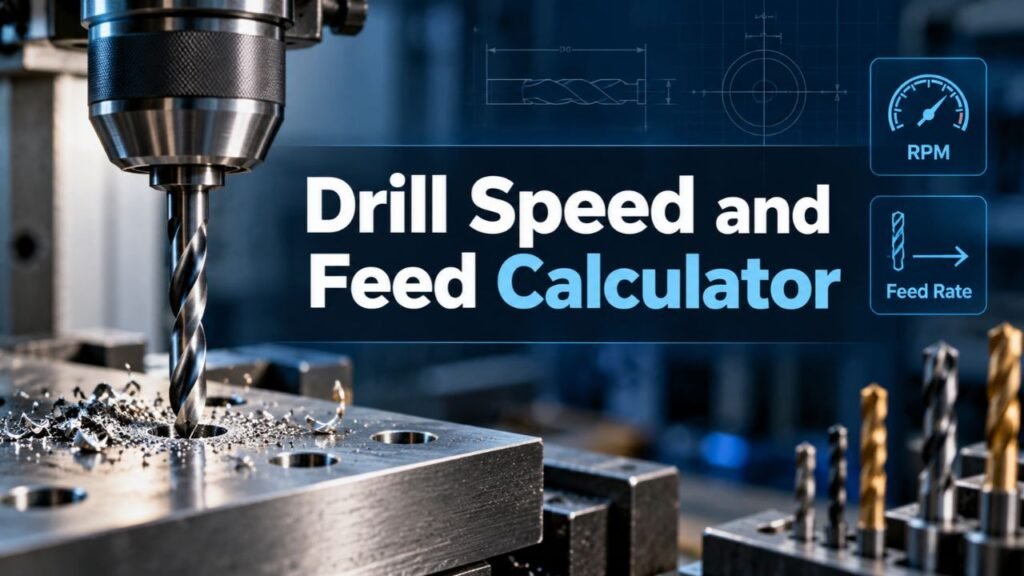
A Drill Speed and Feed Calculator helps you calculate drilling spindle speed (RPM) and axial feed rate based on drill bit diameter, cutting speed, and feed per revolution.
Whether you’re operating a drill press, setting up a CNC drilling operation, or learning about machining parameters, understanding the relationship between speed and feed is essential for planning a drilling operation.
Our free online calculator makes these calculations straightforward. Enter your drilling parameters, choose metric or imperial units, and view the calculated results without manually working through multiple formulas.
The calculator is designed primarily for machine-controlled drilling. Its calculated values are theoretical and should be checked against your drill manufacturer’s cutting-data recommendations and machine operating limits.
How to Use the Drill Speed and Feed Calculator
Using our online drilling calculator requires three main inputs: drill bit diameter, cutting speed, and feed per revolution.
Follow these steps to calculate spindle RPM and drilling feed rate.
Step 1: Enter the Drill Bit Diameter
Start by entering the diameter of your drill bit.
For example, you might use a 10 mm twist drill or a 1/4-inch drill bit.
Select the appropriate measurement system so the diameter is entered in the correct units.
The drill diameter affects the relationship between cutting speed and RPM. At a constant cutting speed, a larger diameter requires a lower spindle RPM.
Step 2: Enter the Cutting Speed
Next, enter the cutting speed for your drilling operation.
Cutting speed is the surface speed of the drill’s outer cutting edge relative to the workpiece.
It is commonly expressed in:
- Meters per minute (m/min) for metric calculations.
- Surface feet per minute (SFM) for imperial calculations.
The appropriate cutting speed depends on the workpiece material, drill material, coating, cutting conditions, and manufacturer’s recommendations.
If you’re unsure which value to use, consult the cutting-data chart for your specific drill and material instead of selecting a number at random.
Step 3: Enter the Feed per Revolution
Feed per revolution describes how far the drill advances into the workpiece during one complete spindle rotation.
It is measured in millimeters per revolution (mm/rev) or inches per revolution (in/rev).
Enter a feed per revolution value appropriate for your drill, workpiece, and equipment.
Step 4: Review the Calculated Results
The calculator automatically uses your inputs to calculate:
- Drill Spindle Speed (RPM): The theoretical rotational speed required to achieve the entered cutting speed.
- Axial Feed Rate: The corresponding linear advancement in mm/min or inches per minute.
- Feed per Revolution: The axial travel specified for one complete rotation.
- Cutting Speed: The surface speed used in the calculation.
Review the results and compare them with your machine’s capabilities and the drill manufacturer’s specifications before applying them.
Drill Speed and Feed Formulas Explained
Drilling speed and feed calculations involve two main equations: one for spindle RPM and another for axial feed rate.
Understanding these formulas helps you interpret the calculator’s results and recognize how changing one input affects the others.
Drill Spindle Speed Formula (Metric)
For metric calculations:
RPM = (1,000 × Cutting Speed) ÷ (π × Drill Diameter)
Where:
- RPM = spindle speed in revolutions per minute.
- Cutting Speed = surface cutting speed in meters per minute.
- Drill Diameter = drill bit diameter in millimeters.
- π = approximately 3.14159.
The factor of 1,000 converts meters to millimeters so the units are consistent.
Drill Spindle Speed Formula (Imperial)
For imperial calculations:
RPM = (12 × Cutting Speed) ÷ (π × Drill Diameter)
Where:
- Cutting Speed = surface feet per minute (SFM).
- Drill Diameter = inches.
- RPM = revolutions per minute.
The factor of 12 converts feet to inches.
You may also encounter the simplified version:
RPM ≈ (SFM × 3.82) ÷ Drill Diameter (inches)
The factor 3.82 is a rounded approximation of 12 divided by π.
Drill Feed Rate Formula
Once spindle RPM is known, calculate the axial feed rate using:
Feed Rate = RPM × Feed per Revolution
For metric calculations:
Feed Rate (mm/min) = RPM × Feed (mm/rev)
For imperial calculations:
Feed Rate (IPM) = RPM × Feed (in/rev)
The resulting value represents how far the drill advances each minute, assuming a constant spindle speed and a controlled feed per revolution.
How to Calculate Feed per Revolution
If spindle RPM and axial feed rate are already known, rearrange the equation:
Feed per Revolution = Feed Rate ÷ RPM
For example, if a drill advances at 200 mm/min while rotating at 1,000 RPM:
Feed per Revolution = 200 ÷ 1,000
Result: 0.20 mm/rev
This means the drill advances 0.20 millimeters for every complete rotation.
Drill Speed and Feed Calculation Examples
The following examples demonstrate how the formulas work using metric and imperial units.
These numbers are mathematical examples, not recommended cutting settings for any particular material or drill bit.
Example 1: Calculate Drilling RPM and Feed Rate in Metric Units
Suppose you have the following inputs:
| Parameter | Value |
|---|---|
| Drill bit diameter | 10 mm |
| Cutting speed | 30 m/min |
| Feed per revolution | 0.15 mm/rev |
First, calculate the spindle RPM:
RPM = (1,000 × 30) ÷ (π × 10)
RPM = 30,000 ÷ 31.4159
RPM ≈ 954.93
Calculated spindle speed: approximately 955 RPM.
Next, calculate the axial feed rate:
Feed Rate = 954.93 × 0.15
Feed Rate ≈ 143.24 mm/min
Calculated axial feed rate: approximately 143.24 mm/min.
This example demonstrates how a 10 mm drill operating at a theoretical cutting speed of 30 m/min and feed of 0.15 mm/rev corresponds to approximately 955 RPM and 143 mm/min.
Whether those parameters are suitable depends on the actual tool, material, and machine.
Example 2: Calculate Drill Speed and Feed in Imperial Units
Now consider a drilling calculation using US customary units.
| Parameter | Value |
|---|---|
| Drill bit diameter | 0.25 inch |
| Cutting speed | 100 SFM |
| Feed per revolution | 0.005 in/rev |
Calculate the spindle speed:
RPM = (12 × 100) ÷ (π × 0.25)
RPM = 1,200 ÷ 0.7854
RPM ≈ 1,527.89
Calculated spindle speed: approximately 1,528 RPM.
Next, calculate the feed rate:
Feed Rate = 1,527.89 × 0.005
Feed Rate ≈ 7.64 IPM
Calculated axial feed rate: approximately 7.64 inches per minute.
As with the metric example, these values illustrate the equations rather than establish suitable operating settings.
Understanding Drill Speed vs. Drill Feed Rate
Drill speed and drill feed rate are related, but they describe different aspects of a drilling operation.
| Feature | Drill Speed | Drill Feed Rate |
|---|---|---|
| Meaning | How fast the drill rotates | How fast the drill advances |
| Common unit | RPM | mm/min or IPM |
| Main relationship | Cutting speed and diameter | RPM and feed per revolution |
| Machine control | Spindle rotation | Axial feed motion |
| Primary purpose | Establishes cutting-edge surface speed | Establishes advancement into the material |
For example, a drill may rotate at 1,000 RPM while advancing at 100 mm/min.
The first number describes rotational motion. The second describes the linear movement of the drill into the workpiece.
Understanding both values is important because suitable drilling conditions depend on their combination rather than RPM alone.
What Factors Affect Drilling Speed and Feed?
Several factors influence the operating parameters suitable for a drilling process.
1. Workpiece Material
Different materials have different cutting characteristics.
Aluminum, mild steel, stainless steel, cast iron, and other materials may require different cutting speeds and feed rates.
Even within the same general material category, alloy composition, hardness, heat treatment, and other properties can affect cutting requirements.
For example, an annealed steel and a hardened steel should not automatically be assigned the same cutting parameters.
2. Drill Bit Diameter
Drill diameter directly affects spindle RPM.
At a fixed cutting speed, increasing the drill diameter reduces the required RPM.
For example, if the cutting speed remains constant and the drill diameter doubles, the calculated RPM is reduced by half.
Larger drills may also require different feed-per-revolution values because of tool geometry, strength, and cutting conditions.
3. Drill Bit Material
Drill bits are manufactured from different cutting-tool materials, including high-speed steel (HSS) and carbide.
These materials have different cutting characteristics and operating limitations.
A cutting speed suitable for a specific carbide drill may not be appropriate for an HSS drill of the same diameter.
Always use cutting data that matches the actual drill construction.
4. Drill Coating and Geometry
Drill point geometry, flute design, coatings, and other design features affect cutting performance.
Some drills are specifically designed for particular materials or machining applications.
General-purpose twist drills, specialized metalworking drills, and high-performance carbide drills should not be assumed to use interchangeable cutting parameters.
5. Machine Rigidity and Available Power
A rigid machining center and a portable handheld drill operate under very different conditions.
Machine rigidity, spindle power, workholding stability, tool runout, and vibration can affect the practical operating limits.
A calculated spindle speed may be mathematically correct but unsuitable for a particular machine.
6. Cooling, Lubrication, and Chip Removal
Heat generation and chip evacuation are important during drilling.
Depending on the tool and material, cutting fluid, lubrication, air-assisted chip removal, or other manufacturer-approved methods may be required.
Deep-hole drilling can introduce additional chip-evacuation challenges.
The speed and feed formula alone cannot determine whether cooling and chip removal are adequate.
How to Choose Cutting Speed and Feed per Revolution
A calculator can determine RPM and linear feed rate, but it cannot independently establish the ideal cutting parameters for every tool and workpiece.
For reliable results, begin with the cutting data supplied by your drill manufacturer.
Look for recommendations that match:
- The exact drill type and diameter.
- The cutting-tool material and coating.
- The workpiece material and hardness.
- The drilling depth and hole requirements.
- The available cooling and lubrication method.
- The machine’s power, rigidity, and spindle range.
Manufacturer cutting-data charts may provide cutting speed ranges and feed-per-revolution recommendations.
You can then enter the appropriate values into the calculator to determine the corresponding spindle RPM and axial feed rate.
If the machine cannot support those values, the operation may require different tooling, parameters, or equipment.
Important: Default numbers shown in a calculator are examples unless explicitly identified as validated recommendations for a particular application.
Common Drill Speed and Feed Calculation Mistakes
Confusing RPM With Cutting Speed
RPM describes the number of spindle rotations per minute. Cutting speed describes the surface speed at the drill’s cutting diameter.
Two drill bits rotating at the same RPM can have different cutting speeds if their diameters differ.
Always distinguish between these measurements.
Mixing Metric and Imperial Units
Using an inch diameter in a formula that expects millimeters can produce a dramatically incorrect result.
Likewise, meters per minute and surface feet per minute are different units.
Select the correct unit system before entering your values.
Confusing Feed per Revolution With Feed per Minute
Feed per revolution measures axial travel during one spindle rotation.
Feed per minute measures axial travel over one minute.
They are related through RPM but are not interchangeable.
For example, 0.10 mm/rev is not the same as 0.10 mm/min.
Using Milling Feed-per-Tooth Values for Drilling
Milling calculations commonly use feed per tooth and the number of effective cutting edges.
Conventional drilling feed calculations typically use feed per revolution.
Do not multiply drilling feed per revolution by the number of drill flutes when using the standard drilling formula. The feed-per-revolution value already describes the complete rotation.
Ignoring Machine Operating Limits
A theoretical RPM may exceed the capabilities of your drill, spindle, chuck, toolholder, or cutting tool.
Never treat a calculator result as permission to exceed a published operating limit.
Assuming One Setting Works for Every Material
A single cutting speed or feed setting cannot be considered universally suitable for wood, aluminum, stainless steel, and other materials.
The workpiece, drill bit, and equipment must all be considered.
Can You Use This Calculator for a Cordless Drill or Drill Press?
The spindle-speed formula can be useful for understanding rotational speed on both portable and stationary drilling equipment.
However, the feed-rate calculation has an important limitation.
For a cordless handheld drill, the user controls axial pressure and advancement manually. There is usually no precise mechanism maintaining a constant feed per revolution. The drill’s actual RPM can also change under load.
As a result, the calculated axial feed rate should not be interpreted as an automatically achievable or controlled handheld-drilling speed.
For a drill press, RPM is often adjustable using speed settings or a variable-speed system. However, manually operated drill presses still depend on the operator for axial advancement. A model with a controlled power feed may provide more consistent feed-rate operation.
For a CNC drilling machine, spindle speed and axial feed can be programmed and controlled, subject to the machine’s capabilities and operating modes.
This makes both calculations particularly relevant for CNC drilling and other machine-controlled processes.
Safety Tips Before Applying Drill Speed and Feed Results
Calculating suitable values is only one part of setting up a drilling operation.
Before operating a drill or machine:
- Confirm that the selected tool and spindle speed are within manufacturer-approved limits.
- Secure the workpiece using suitable clamps, fixtures, or workholding equipment.
- Inspect drill bits for damage, excessive wear, or other visible defects.
- Use appropriate eye protection and follow the machine manufacturer’s safety requirements.
- Follow approved chip-removal procedures, and never clear chips by hand near rotating equipment.
- Use suitable cooling and lubrication methods where required.
- Monitor the operation for abnormal noise, vibration, tool deflection, overheating, or poor chip evacuation.
- Stop the operation if conditions appear unsafe.
For deep holes, difficult materials, or specialized drilling operations, follow the relevant tooling and machine instructions rather than relying on basic speed and feed equations alone.
Frequently Asked Questions
How do I calculate drill spindle speed?
To calculate drill spindle speed, divide the cutting speed, adjusted for the measurement units, by the circumference of the drill bit.
For metric units:
RPM = (1,000 × Cutting Speed in m/min) ÷ (π × Diameter in mm)
For imperial units:
RPM = (12 × Cutting Speed in SFM) ÷ (π × Diameter in inches)
How do I calculate drill feed rate?
Multiply the spindle RPM by the feed per revolution.
Feed Rate = RPM × Feed per Revolution
The result is expressed in mm/min when feed per revolution is in mm/rev, or IPM when feed per revolution is in inches/rev.
What is a good RPM for drilling steel?
There is no universal RPM suitable for every type of steel or drill bit.
The appropriate RPM depends on the steel grade, hardness, drill diameter, tool material, coating, cooling conditions, and manufacturer recommendations.
Once you have a suitable cutting-speed value, you can calculate the corresponding RPM.
Does a larger drill bit need a slower RPM?
At a constant cutting speed, yes. A larger drill diameter requires a lower RPM to maintain the same peripheral cutting speed.
However, the appropriate feed per revolution may also change with drill size.
What is feed per revolution in drilling?
Feed per revolution is the distance the drill advances into the workpiece during one complete spindle rotation.
It is generally measured in mm/rev or in/rev.
What is the difference between SFM and RPM?
SFM stands for surface feet per minute and measures cutting-edge surface speed.
RPM stands for revolutions per minute and measures rotational speed.
The relationship between them depends on the drill diameter.
Can I use the same feed rate for different drill sizes?
Not automatically. Feed-per-revolution recommendations can vary with drill size, geometry, material, and machining conditions.
Use cutting data appropriate for the actual drill and operation.
Is this drill feed rate calculator suitable for CNC drilling?
Yes. The formulas are applicable to conventional CNC drilling calculations.
However, the calculated feed rate must be used in the context of the CNC machine’s programmed feed mode, tooling recommendations, and machine operating limits.
Is drilling feed rate the same as chip load?
In drilling, feed per revolution is commonly used to describe axial advancement per spindle rotation.
In milling, chip load generally refers to feed per tooth, which is a different input concept.
The terms should not be substituted without understanding the cutting process and formula involved.
Can I use this calculator for wood drilling?
The mathematical relationship between drill diameter, cutting speed, and RPM still applies.
However, choosing suitable wood-drilling conditions requires considering bit geometry, wood properties, drill type, and operator control. Metalworking cutting-speed recommendations should not automatically be applied to woodworking.
Final Thoughts
Our free Drill Speed and Feed Calculator provides a convenient way to calculate drilling RPM and axial feed rate using metric or imperial measurements.
By understanding drill diameter, cutting speed, and feed per revolution, you can better interpret the relationships between the main drilling parameters and prepare for machine-controlled drilling operations.
For the most useful results, always begin with accurate measurements and reliable manufacturer cutting data.
Use the calculator above whenever you need to check drilling spindle speed or feed-rate calculations, and remember to confirm the results against your equipment’s actual capabilities and safe operating limits.