
How Many Gallon Air Compressor for Paint Gun? Complete Size Guide
If you are wondering how many gallon air compressor for paint gun use is enough, a 20-gallon compressor is a practical starting point for many small to medium painting jobs, while 30–60 gallons is better for sustained spraying with full-size HVLP guns. A 3- or 6-gallon compressor can work only with low-air-demand guns or short, intermittent spraying. Tank size matters, but the compressor’s CFM output matters even more.
A paint gun needs a steady stream of compressed air to atomize paint into a fine, even spray. If the compressor cannot supply enough air, pressure drops while you are spraying. That can change the spray pattern, reduce atomization, and contribute to an uneven or rough finish.
This is why choosing a compressor based only on tank capacity can be misleading. Two 20-gallon compressors can have very different pumps and CFM ratings. Likewise, a small compressor may technically operate a spray gun for a few seconds but still be unsuitable for painting an entire panel, cabinet, or vehicle.
In this guide, I’ll explain what compressor size works with different paint guns, whether a 3-, 6-, or 20-gallon compressor is suitable for painting, how much CFM you need, and how to choose a setup that can maintain consistent airflow.
How Many Gallon Air Compressor for Paint Gun Use Is Enough?
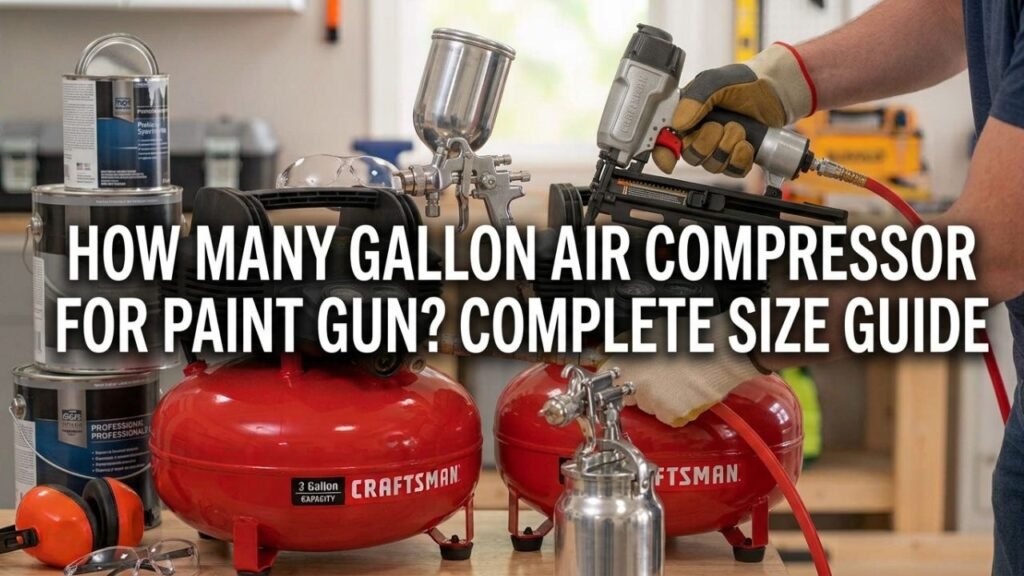
For most pneumatic paint guns, I would consider 20 gallons the practical minimum for occasional DIY painting, but the ideal size depends heavily on the spray gun’s air consumption.
Here is a useful general guide:
| Painting Use | Practical Tank Size | Typical Suitability |
| Airbrush or very small detail work | 1–3 gallons | Good |
| Mini touch-up gun | 3–6 gallons | Usually workable |
| Low-CFM LVLP gun | 10–20 gallons | Good for many DIY jobs |
| Full-size conventional spray gun | 20–30+ gallons | Better |
| Full-size HVLP gun | 30–60+ gallons | Recommended |
| Full vehicle or continuous spraying | 60+ gallons | Best choice |
These are general tank-size guidelines rather than universal requirements. A compressor still needs enough CFM at the gun’s required pressure to keep up with continuous spraying.
Many full-size spray guns consume roughly 7–15 CFM, while lower-consumption detail and LVLP guns may require substantially less.
A larger tank helps by storing more compressed air, allowing the gun to draw from a reserve before the pump must recover. However, once the tank pressure falls, the compressor pump becomes responsible for replacing the air you are consuming.
If the pump produces 4 CFM while the gun consumes 10 CFM, a large tank only delays the pressure drop. It does not solve the underlying airflow shortage.
Key Takeaways:
- A 20-gallon compressor is a useful starting point for many DIY paint jobs.
- Full-size HVLP painting is better suited to approximately 30–60 gallons or more.
- Small tanks can work with low-CFM detail or LVLP guns.
- Always compare the spray gun’s CFM requirement with the compressor’s delivered CFM.
Why CFM Matters More Than Gallon Capacity
Gallons describe how much compressed air the tank can store. CFM, or cubic feet per minute, describes how quickly the compressor can supply air.
For a paint gun, CFM is usually the more important specification.
Spray guns consume air continuously while the trigger is held. This is very different from a nail gun, which uses a short burst of air and then stops.
A typical full-size HVLP gun can require roughly 8–15 CFM depending on its design, while many LVLP guns operate in a lower range.
That means a compressor producing only 2.5–3 CFM may initially spray using stored air from the tank, but pressure will continue falling because the pump cannot replace air as quickly as the gun consumes it.
How to Match Compressor CFM to a Paint Gun
Check the spray gun’s specifications for a requirement such as:
8 CFM at 30 PSI
Then choose a compressor capable of delivering more than 8 CFM at a comparable pressure.
I recommend leaving approximately 25–50% additional airflow capacity rather than matching the gun exactly. That gives the compressor useful headroom for pressure losses through hoses, regulators, filters, and normal compressor cycling.
For example, if the gun requires 8 CFM, a compressor capable of approximately 10–12 CFM is a much more comfortable match than one rated at exactly 8 CFM.
Pro Tip: Check the pressure associated with every CFM rating. A compressor’s CFM rating at 40 PSI and its CFM rating at 90 PSI are not interchangeable specifications.
Key Takeaways:
- Gallons represent stored air; CFM represents air delivery.
- Continuous painting requires enough CFM to keep the spray pattern stable.
- Choose a compressor with more airflow than the gun’s minimum requirement.
- Tank size cannot permanently compensate for an undersized compressor pump.
Can a 6 Gallon Air Compressor Run a Paint Gun?
Yes, a 6-gallon air compressor can run some paint guns, but it is usually too small for continuous use with a full-size HVLP spray gun.
A common 6-gallon pancake compressor supplies only around 2.5–3 SCFM at 90 PSI, whereas a full-size HVLP gun may consume 8–15 CFM or more depending on the model.
The gun may spray normally at first because the tank is fully charged. As the stored air is consumed, however, pressure begins to fall faster than the pump can replace it.
You may then notice:
- A shrinking or inconsistent spray fan.
- Poor paint atomization.
- More noticeable texture in the finish.
- Frequent pauses while the compressor refills.
- The compressor running almost continuously.
When a 6-Gallon Compressor Can Work
A 6-gallon unit becomes more practical if you use a mini spray gun, touch-up gun, airbrush, or low-consumption LVLP gun.
It can also work for short jobs such as:
- Small trim pieces.
- Furniture components.
- Crafts.
- Motorcycle parts.
- Touch-up repairs.
- Small metal panels.
For these jobs, you can spray for a short period, allow the compressor to recover, and continue.
When I Would Avoid a 6-Gallon Compressor
I would not choose a typical 6-gallon pancake compressor for:
- Painting an entire vehicle.
- Spraying large doors or body panels continuously.
- Full-size HVLP guns with high airflow demand.
- Large cabinets or furniture requiring uninterrupted passes.
- Production painting.
Interrupted airflow can make it difficult to maintain consistent overlap, fan shape, and paint atomization.
Can You Paint With a 6 Gallon Air Compressor?
Yes, but the important distinction is between being able to spray paint and being able to spray continuously with consistent results.
A 6-gallon compressor can be adequate for small projects when paired with the right gun. It becomes frustrating when the spray gun requires considerably more airflow than the compressor can produce.
For a small compressor, I recommend looking for a spray gun specifically designed for low air consumption. An LVLP gun is usually a better match than a large HVLP gun because LVLP designs generally use less compressed air.
You should still verify the exact CFM requirement of the individual gun rather than assuming every LVLP model will work.
Important Tip: Do not compensate for an undersized compressor simply by turning up tank pressure. Higher stored pressure may give you slightly more usable reserve, but it does not increase the pump’s sustained CFM enough to support a high-demand gun.
Key Takeaways:
- A 6-gallon compressor is best for small or intermittent painting jobs.
- It usually cannot sustain a high-CFM full-size HVLP gun.
- LVLP and touch-up guns are better choices for small compressors.
- Match the gun’s CFM requirement before buying or spraying.
Can You Paint With a 20 Gallon Air Compressor?
Yes, you can paint with a 20-gallon air compressor, and it is much more practical than a 3- or 6-gallon unit for DIY spray painting.
A 20-gallon tank gives you a much larger reserve of compressed air, so pressure remains stable longer between compressor cycles.
However, the same rule still applies: CFM output determines whether the compressor can truly keep up with the paint gun.
A strong 20-gallon compressor paired with a moderate-CFM LVLP or conventional gun can work very well for:
- Furniture.
- Cabinets.
- Doors.
- Fenders.
- Motorcycle parts.
- Small automotive panels.
- Equipment.
- General home-shop painting.
A weaker 20-gallon compressor may still struggle with a full-size HVLP gun that needs 10–15 CFM continuously.
Is a 20-Gallon Compressor Enough to Paint a Car?
It can be used to paint sections of a car, but I would not consider a typical 20-gallon portable compressor the ideal choice for a complete automotive paint job.
The main problem is maintaining uninterrupted airflow across large panels.
A full automotive finish normally benefits from a compressor that can maintain consistent CFM throughout long spray passes. For full-size HVLP automotive painting, larger shop compressors—often around 60 gallons—are commonly used because they combine a larger air reserve with higher-output pumps.
If your 20-gallon compressor has unusually strong CFM output and your spray gun has low air consumption, it may still work. Check the actual specifications rather than assuming tank size alone decides the answer.
Is a 3 Gallon Air Compressor Good for Painting?
A 3-gallon air compressor is generally not a good choice for normal spray painting with a full-size paint gun.
The tank is small, and most compressors in this category also have relatively low CFM output.
That means the stored air disappears quickly while spraying.
A 3-gallon compressor is more appropriate for:
- Airbrushing.
- Very small touch-up guns.
- Hobby painting.
- Crafts.
- Small repair areas.
It is poorly suited to large furniture, automotive panels, walls, or other projects requiring long continuous spray passes.
Even if a full-size spray gun connects to the compressor and sprays initially, that does not mean the compressor is correctly sized.
What Happens When the Compressor Is Too Small?
As tank pressure falls, the pressure reaching the gun can become unstable.
That can cause poor atomization and an inconsistent spray pattern. An undersized compressor may also run continuously trying to recover, which can increase heat and moisture production in the compressed-air system.
For most beginners planning regular spray-gun work, I would skip a 3-gallon compressor and start with something larger unless portability and tiny detail jobs are the main priorities.
Paint Gun Air Compressor Size by Gun Type
The type of paint gun makes a major difference because different designs consume different amounts of air.
| Paint Gun Type | Typical Air Demand | Practical Compressor Approach |
| Airbrush | About 1–2 CFM | 1–3 gallons may work |
| Mini/detail gun | About 3–5 CFM | 3–10 gallons |
| LVLP gun | Roughly 3.5–7 CFM | 10–20+ gallons |
| Conventional gravity gun | Roughly 5–8 CFM | 20–30+ gallons |
| Conventional siphon gun | Roughly 6–10+ CFM | 20–30+ gallons |
| Full-size HVLP gun | Roughly 8–15+ CFM | 30–60+ gallons |
Actual requirements vary by spray gun, air cap, nozzle, and manufacturer, so the gun’s published specification should always take priority over a general chart.
HVLP Paint Guns
HVLP means high volume, low pressure.
The gun operates at relatively low pressure but uses a high volume of air to atomize paint.
That high airflow requirement is why many small compressors struggle with HVLP guns even though they can easily reach the required PSI.
LVLP Paint Guns
LVLP means low volume, low pressure.
These guns are often a better choice for home garages because many models require less CFM than full-size HVLP guns.
If you already own a 10- or 20-gallon compressor, I would strongly consider an LVLP gun before purchasing a larger compressor solely for occasional painting.
Conventional Paint Guns
Conventional spray guns vary considerably in air consumption. Some gravity-fed models can operate with moderate airflow, while larger siphon-feed designs may require substantially more.
Always check the actual CFM specification.
Key Takeaways:
- HVLP guns generally require the most airflow among common DIY paint guns.
- LVLP guns are often easier to pair with smaller compressors.
- A 20-gallon compressor can work well when the gun’s CFM requirement is moderate.
- Manufacturer CFM specifications matter more than the gun category alone.
How to Choose the Right Air Compressor for a Paint Gun
Tank size is only one part of the decision. I would compare the following specifications before buying a compressor for painting.
1. Check the Paint Gun’s CFM Requirement
Find the manufacturer’s required airflow.
For example:
Paint gun requirement: 6 CFM at 30 PSI
The compressor should supply at least that amount, preferably with extra capacity.
2. Add Airflow Headroom
I recommend approximately 25–50% extra CFM when practical.
If the gun needs 6 CFM, look for approximately 7.5–9 CFM or more.
This helps compensate for airflow losses and prevents the compressor from operating at its absolute limit.
3. Choose an Appropriate Tank Size
For occasional detail painting, a small tank may be fine.
For larger jobs:
- 10–20 gallons: good for many low-CFM DIY setups.
- 20–30 gallons: more comfortable for furniture and panel work.
- 30–60 gallons: better for sustained spraying.
- 60+ gallons: preferred for full-car and frequent shop painting.
4. Check the Compressor Duty Cycle
The duty cycle tells you how long the compressor pump is designed to run during a given period.
Painting can demand air for long periods. A compressor that repeatedly reaches its duty-cycle limit may require pauses even if its tank initially provides adequate air.
5. Account for Hose and Filter Restrictions
Pressure can drop through:
- Long air hoses.
- Undersized fittings.
- Small couplers.
- Regulators.
- Moisture separators.
- Air filters.
Use fittings and hose sizes appropriate for the airflow your gun requires.
6. Control Moisture
Compressed air becomes hot inside the compressor and can release condensation as it cools.
Water in the air line can contaminate paint and damage the finish.
Drain the compressor tank regularly and use appropriate moisture separation or air-drying equipment for finishing work.
7. Set Pressure With Air Flowing
Set the regulator according to the spray gun manufacturer’s instructions.
For many spray guns, pressure should be checked while the trigger is pulled so you are measuring working pressure rather than static pressure.
Does More Gallons Mean Better Painting?
Usually, a larger tank makes painting easier, but more gallons do not automatically mean a better compressor.
Consider two examples:
Compressor A has a 30-gallon tank but produces 5 CFM.
Compressor B has a 20-gallon tank but produces 9 CFM.
For a gun requiring 7 CFM, Compressor B may be the better choice even though its tank is smaller.
The larger tank in Compressor A stores more air, but the pump still cannot replace air as quickly as the gun consumes it.
For spray painting, prioritize specifications in roughly this order:
- Required CFM.
- Compressor CFM output.
- Duty cycle.
- Tank size.
- Air quality and moisture control.
- Hose and regulator setup.
What PSI Does a Paint Gun Need?
The exact PSI depends on the spray gun.
Many paint guns operate at relatively modest inlet pressures, often somewhere around 20–45 PSI depending on design and manufacturer specifications.
Do not assume a compressor is suitable simply because it can produce 125 or 150 PSI.
A compressor may easily achieve high pressure but still lack enough CFM to maintain airflow while spraying.
Think of it this way:
PSI is pressure. CFM is volume.
Paint guns need both, but sustained airflow is often the limiting factor.
Can a Small Compressor Damage a Paint Job?
An undersized compressor does not necessarily damage the paint itself, but it can create conditions that make a poor finish more likely.
When airflow drops, the gun may not atomize paint consistently.
Possible results include:
- Coarse spray droplets.
- Uneven fan pattern.
- Dry spray.
- Excess texture.
- Inconsistent coverage.
- Difficulty maintaining overlap.
Frequent compressor cycling can also generate more heat, which contributes to moisture accumulation in the compressed-air system.
A properly sized compressor gives you more stable conditions and allows you to focus on gun setup and spraying technique.
My Recommended Compressor Sizes for Common Painting Jobs
For small crafts or touch-ups, I would choose a 3–6 gallon compressor only when using an airbrush or low-CFM mini gun.
For furniture, cabinets, doors, and occasional automotive panel work, I prefer a 20–30 gallon compressor with enough CFM for the chosen gun.
For full-size HVLP spraying, frequent automotive painting, or complete vehicle refinishing, I would move to a 60-gallon class compressor with strong sustained airflow.
That setup costs more and takes up more space, but consistent airflow becomes much more important as the project size increases.
FAQs about how many gallon air compressor for paint gun
Can a 6 gallon air compressor run a paint gun?
Yes, a 6-gallon compressor can operate a low-CFM paint gun for small or intermittent jobs. A typical 6-gallon pancake compressor is generally too small to maintain continuous airflow for a full-size HVLP gun.
Can you paint with a 6 gallon air compressor?
Yes. Use a mini spray gun, touch-up gun, airbrush, or compatible low-CFM LVLP gun and expect occasional recovery pauses. It is not my preferred setup for large panels or complete vehicle painting.
Can you paint with a 20 gallon air compressor?
Yes. A 20-gallon compressor can be very useful for furniture, cabinets, doors, equipment, touch-ups, and automotive panels when its CFM output matches the gun.
Is a 3 gallon air compressor good for painting?
A 3-gallon compressor is suitable mainly for airbrushing, hobby painting, and very small touch-up work. It is generally too small for sustained spraying with a standard paint gun.
Is a 20 gallon air compressor enough for an HVLP spray gun?
Sometimes, but not always. Compare the compressor’s CFM output with the HVLP gun’s required CFM. Many full-size HVLP guns consume enough air that a typical portable 20-gallon compressor cannot keep up continuously.
Is a 30 gallon compressor enough for painting?
A 30-gallon compressor can be a good choice for many medium-size DIY projects, especially with an LVLP or moderate-CFM gun. Higher-demand HVLP guns may still require a stronger compressor.
Is a 60 gallon compressor good for painting?
Yes. A 60-gallon compressor is a strong choice for larger painting jobs and automotive work, provided its pump delivers enough CFM for the spray gun.
What matters more for painting, gallons or CFM?
CFM matters more. Gallon capacity determines how much compressed air is stored, while CFM determines how quickly the compressor can replace the air being consumed.
How much CFM do I need for a paint gun?
It depends on the gun. Small detail guns can use only a few CFM, LVLP guns often use moderate airflow, and full-size HVLP guns frequently require roughly 8–15 CFM. Always use the exact manufacturer’s specification for your gun.
Can I paint a car with a small air compressor?
Small sections and touch-ups may be possible with an appropriate low-CFM gun. For an entire vehicle, I recommend a larger compressor capable of maintaining steady airflow through long spray passes.
Conclusion
The practical answer to how many gallon air compressor for paint gun use is that 20 gallons is a sensible starting point for many DIY painting projects, while 30–60 gallons or more is preferable for larger jobs and full-size HVLP guns.
A 3-gallon compressor is best reserved for airbrushes and very small detail work. A 6-gallon unit can handle low-CFM paint guns in short bursts, but it normally cannot keep up with a high-air-demand full-size gun. A 20-gallon compressor is far more useful and can handle many home-shop painting projects when paired with the right gun.
For regular automotive painting or long uninterrupted spray passes, I would choose a 60-gallon class compressor with sufficient CFM rather than trying to make a small compressor work at its limit.
Most importantly, do not choose your compressor by gallons alone. Check the paint gun’s required CFM and PSI, make sure the compressor can exceed that airflow requirement with reasonable headroom, and use clean, dry compressed air. That combination will give you a much more consistent spray pattern and a better chance of achieving a smooth finish.