
What Size Air Compressor for Impact Tools? Full Sizing Guide
If you are wondering what size air compressor for impact tools you need, a good starting point for most home garages is a compressor that delivers about 5–8 CFM at 90 PSI with a 20–30 gallon tank. Smaller impact tools may work with less, while large 3/4-inch and 1-inch impact wrenches can require substantially more airflow. The compressor’s CFM output matters more than tank size alone.
That distinction is important because two compressors can both have 20-gallon tanks while producing very different amounts of usable air. A compressor that cannot replenish air as quickly as your impact wrench consumes it will eventually lose pressure, causing the tool to slow down and deliver less torque.
Impact tools are also only one part of the pneumatic-tool picture. Nailers need relatively little air, while grinders, sanders, die grinders, sandblasters, and other continuously operated tools can overwhelm compressors that handle an impact wrench without difficulty.
In this guide, I’ll explain how to size an air compressor for impact tools and other pneumatic tools, including CFM, PSI, tank capacity, horsepower, duty cycle, hose size, pressure loss, multiple-tool operation, and practical compressor recommendations for different workloads.
What Size Air Compressor for Impact Tools Do You Need?
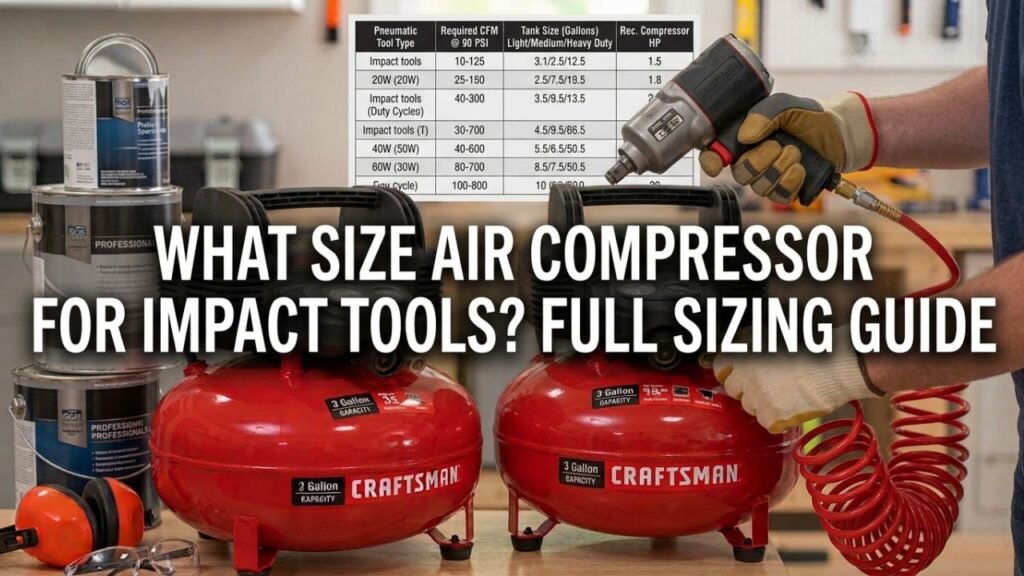
For most common 1/2-inch impact wrenches used for automotive work, I recommend looking for approximately 5–8 CFM at 90 PSI or more and preferably a 20-gallon or larger tank if you expect regular use.
A smaller compressor can still operate many impact wrenches because an impact wrench is normally used intermittently. You squeeze the trigger for a few seconds, release it, reposition the socket, and use it again. During those pauses, the compressor has an opportunity to refill the tank.
The correct size ultimately depends on three main specifications:
• The impact tool’s required CFM or SCFM
• Its required operating PSI
• How long and how frequently you plan to run it
Tank capacity affects how long you can operate before pressure begins falling, but the compressor pump’s airflow determines whether the machine can keep up over time.
Here is a practical starting point.
| Impact Tool | Typical Air Demand | Recommended Compressor Delivery | Practical Tank Size |
| Small 1/4-inch impact driver | About 2–5 CFM | 4–6+ CFM at 90 PSI | 6–10+ gallons |
| 3/8-inch impact wrench | About 3–6 CFM | 5–7+ CFM at 90 PSI | 10–20+ gallons |
| 1/2-inch impact wrench | About 4–8 CFM | 6–10+ CFM at 90 PSI | 20–30+ gallons |
| 3/4-inch impact wrench | About 7–15+ CFM | 10–18+ CFM at 90 PSI | 30–60+ gallons |
| 1-inch impact wrench | About 10–25+ CFM depending on model | 15–30+ CFM at 90 PSI | 60+ gallons or shop compressor |
These numbers are general sizing ranges, not universal tool specifications. Actual air demand varies greatly between impact-wrench designs.
For example, some professional impact wrenches list modest average air consumption but considerably higher airflow while the tool is actually under load. Large industrial 1-inch impact wrenches can consume several times as much air as an ordinary automotive 1/2-inch model.
Always check the specification for your particular tool before buying a compressor.
Key Takeaways:
• For a typical 1/2-inch impact wrench, 5–8+ CFM at 90 PSI is a sensible minimum target.
• A 20–30 gallon compressor is a practical home-garage choice for intermittent impact-wrench use.
• Large 3/4-inch and 1-inch tools can require dramatically more airflow.
• Match the compressor’s CFM at the required PSI, not tank gallons alone.
CFM Is the Most Important Number When Sizing a Compressor
CFM stands for cubic feet per minute. It measures the volume of air a compressor can deliver.
For pneumatic tools, CFM is usually the specification that determines whether the compressor can keep the tool operating effectively.
A compressor might be capable of reaching 150 PSI, but that does not mean it can supply enough air for a demanding tool.
For example, imagine an impact wrench requires 6 CFM at 90 PSI.
A compressor rated for:
3 CFM at 90 PSI will eventually fall behind.
A compressor rated for:
7 CFM at 90 PSI has a much better chance of keeping up.
The tank may temporarily compensate for a low-CFM pump, but once the stored air is depleted, compressor output becomes the limiting factor.
CFM vs. SCFM
You may see airflow expressed as either CFM or SCFM.
SCFM means standard cubic feet per minute. It represents airflow referenced to standardized atmospheric conditions, although the exact standard used can vary.
For ordinary compressor shopping, the most useful approach is to compare the air tool’s stated airflow requirement with the compressor’s rated airflow at the appropriate pressure.
For example:
Air tool requirement: 5 CFM at 90 PSI
Compressor output: 6.5 SCFM at 90 PSI
That is much more useful information than simply knowing that the compressor has a 20-gallon tank or a certain peak horsepower rating.
Give Yourself Some CFM Headroom
I would not normally buy a compressor whose rated airflow exactly equals the tool’s requirement.
A reasonable approach for many home and shop applications is to allow approximately 20–30% extra airflow capacity when possible.
If your tool requires 5 CFM:
5 × 1.25 = 6.25 CFM
A compressor delivering around 6.25 CFM or more at the required pressure would therefore provide useful headroom.
Additional capacity can help compensate for:
• Pressure losses in hoses and fittings
• Compressor performance differences
• Longer periods of tool operation
• Future pneumatic tools
• Minor system leakage
• More demanding real-world workloads
For continuous-use tools, I would be even more conservative.
Pro Tip: Compare CFM ratings at the same pressure. A compressor advertised as producing high airflow at 40 PSI may deliver noticeably less airflow at 90 PSI.
How Much PSI Do Impact Tools Need?
Most common pneumatic impact wrenches are designed to operate at approximately 90 PSI at the tool, although some manufacturers specify different pressure ranges.
This is why 90 PSI appears so frequently in air-tool specifications.
Do not assume that setting your compressor tank to 90 PSI automatically means the impact wrench is receiving 90 PSI while operating.
Pressure can drop between the compressor and tool because of:
• Long air hoses
• Narrow hoses
• Restrictive quick-connect fittings
• Dirty filters
• Undersized regulators
• Multiple connections
• Air leakage
• High tool airflow
The relevant pressure is the pressure available while air is flowing, not just the static pressure shown when the tool is sitting idle.
Higher Compressor PSI Does Not Replace CFM
This is one of the most common misunderstandings when selecting a compressor.
Suppose one compressor reaches 150 PSI but only delivers 3 CFM at 90 PSI.
Another reaches 135 PSI but delivers 7 CFM at 90 PSI.
For an impact wrench requiring 6 CFM at 90 PSI, the second compressor is normally the more suitable machine.
Maximum tank pressure tells you how much pressure the system can store. It does not tell you how quickly the compressor can replace the air being consumed.
Do Not Simply Turn Up the Pressure
If an impact wrench feels weak, operating it above its specified pressure is not the correct solution.
Excessive pressure can increase tool wear and create unnecessary safety risks.
Instead, check:
• Compressor CFM
• Regulator setting
• Hose diameter
• Hose length
• Coupler restrictions
• Water or contamination
• Tool lubrication where required
• Air leaks
• Manufacturer-recommended pressure
A weak impact wrench is frequently experiencing insufficient airflow or excessive pressure loss, not simply insufficient tank pressure.
Key Takeaways:
• Many pneumatic impact tools operate around 90 PSI, but always check the specific tool.
• High maximum PSI cannot compensate for inadequate CFM.
• Measure and maintain sufficient pressure while the tool is actually operating.
• Never exceed the tool manufacturer’s pressure specification to compensate for poor airflow.
What Size Tank Do You Need for Impact Tools?
Tank size is measured in gallons and determines how much compressed air can be stored.
For impact tools, larger tanks generally provide longer bursts of operation before the compressor pump must replace the consumed air.
A practical breakdown is:
| Tank Size | Impact-Tool Suitability | Best Use |
| 3–6 gallons | Limited | Brief use with small tools |
| 8–10 gallons | Light duty | Occasional fastening |
| 15–20 gallons | Good for intermittent use | DIY automotive work |
| 20–30 gallons | Very good general-purpose size | Regular impact-wrench use |
| 30–60 gallons | Heavy DIY/light shop use | Frequent pneumatic tools |
| 60–80+ gallons | Shop-oriented | High-demand or multiple tools |
These are practical categories rather than strict limits.
A high-output compressor with a smaller tank can outperform a weak compressor with a much larger tank.
That is why I would never choose a compressor based on gallons alone.
Is a 6-Gallon Compressor Enough for Impact Tools?
Sometimes.
A 6-gallon pancake compressor may operate a smaller impact wrench for short bursts if it provides sufficient pressure and airflow.
It can be useful for jobs such as:
• Removing a few lug nuts
• Driving occasional fasteners
• Short repair jobs
• Portable roadside or jobsite use
The limitation is reserve air.
After several hard fasteners, the tank pressure may drop and the compressor may need time to recover.
If you regularly rotate tires, work on suspension components, perform automotive repair, or use your impact wrench repeatedly, I would prefer a larger compressor.
Is a 20-Gallon Compressor Good for Impact Tools?
For most DIY users, yes.
A well-matched 20-gallon compressor is one of the most practical sizes for an ordinary 1/2-inch impact wrench.
However, its airflow rating still matters.
A 20-gallon compressor delivering 4 CFM at 90 PSI is very different from one delivering 8 CFM at 90 PSI.
For regular automotive work, I would favor the higher-output machine even if both have identical tank capacities.
Is a 30-Gallon Compressor Better?
A 30-gallon tank gives you additional reserve capacity and generally suits a garage where pneumatic tools are used frequently.
It can reduce how rapidly pressure drops during repeated impact-wrench operation and usually gives you more flexibility for other air tools.
If portability is not a priority, 20–30 gallons is the range I would recommend for many serious DIY garages.
When Do You Need 60 Gallons or More?
A 60-gallon compressor becomes attractive when your workload extends beyond occasional impact-wrench use.
Examples include:
• Long sessions with pneumatic tools
• Large 3/4-inch impact wrenches
• Grinding
• Sanding
• Die grinders
• Air hammers
• Multiple users
• Automotive restoration
• Professional garage work
Large tanks are especially useful when combined with a compressor pump capable of substantial continuous airflow.
What Size Air Compressor Do I Need for Pneumatic Tools?
If your goal is broader than an impact wrench, the question what size air compressor do I need for pneumatic tools depends primarily on your highest-demand tool and whether several tools will run at the same time.
Different pneumatic tools consume dramatically different amounts of air.
An intermittent framing nailer may work beautifully with a small portable compressor, while an air grinder can force that same compressor to run constantly and still lose pressure.
Here is a practical comparison.
| Pneumatic Tool | Typical General Air Demand | Typical Pressure | Compressor Consideration |
| Brad nailer | 0.5–2 CFM | 70–100 PSI | Small compressor usually sufficient |
| Finish nailer | 1–2.5 CFM | 70–100 PSI | Small portable compressor |
| Framing nailer | 2–4 CFM | 70–120 PSI | 4–6 gallon commonly practical |
| Air ratchet | 3–5 CFM | Around 90 PSI | 10–20+ gallons helpful |
| 1/2-inch impact wrench | 4–8 CFM | Around 90 PSI | 20–30 gallons preferred |
| Air hammer | 3–8 CFM | Around 90 PSI | 20+ gallons |
| Die grinder | 5–10+ CFM | Around 90 PSI | High-CFM compressor |
| Angle grinder | 5–12+ CFM | Around 90 PSI | 30–60+ gallons often preferable |
| Dual-action sander | 8–15+ CFM | Around 90 PSI | 60-gallon/high-output compressor |
| HVLP spray gun | Roughly 6–15+ CFM depending on gun | Often lower than 90 PSI | High continuous CFM |
| Sandblasting equipment | About 10 CFM to far above 25 CFM | Varies | Large compressor often required |
These are broad planning ranges. Individual tool specifications can fall outside them.
That is particularly important with grinders, sanders, spray equipment, and sandblasters, where air consumption varies significantly by model and operating conditions.
Intermittent Tools vs. Continuous-Air Tools
This distinction makes compressor sizing much easier.
Intermittent pneumatic tools
Examples include:
• Impact wrenches
• Nail guns
• Staplers
• Air ratchets used in short bursts
• Some air hammers
These tools do not normally consume their maximum airflow continuously.
That means a receiver tank can provide stored air during short periods of high demand.
Continuous-air tools
Examples include:
• Die grinders
• Angle grinders
• Sanders
• Spray guns
• Sandblasters
These tools can use air for long periods without significant pauses.
A large tank may delay pressure loss, but it cannot permanently compensate for a compressor that produces less air than the tool consumes.
For continuous pneumatic tools, compressor pump output and duty cycle become especially important.
Key Takeaways:
• Size a pneumatic-tool compressor around your highest-demand tool.
• Nail guns require relatively little air compared with grinders and sanders.
• Impact wrenches are easier on a compressor because they normally operate intermittently.
• Continuous tools require enough sustained CFM; tank capacity alone will not solve an airflow shortage.
How to Calculate the Compressor Size You Actually Need
Instead of guessing from tank capacity, you can calculate a much better compressor target.
Step 1: Find the Tool’s CFM Requirement
Check the:
• Tool manual
• Product label
• Manufacturer specification sheet
Use the manufacturer’s stated airflow requirement whenever available.
Suppose your 1/2-inch impact wrench requires:
5 CFM at 90 PSI
Step 2: Add Airflow Headroom
For a single intermittent tool, adding approximately 20–30% capacity is a useful general approach.
Using 25%:
5 CFM × 1.25 = 6.25 CFM
I would therefore look for a compressor producing roughly 6.25 CFM or more at 90 PSI.
Step 3: Consider How Long the Tool Runs
An impact wrench used for two-second bursts has very different requirements from a die grinder running for several minutes.
The longer the trigger remains pressed, the more important continuous compressor output becomes.
Step 4: Consider Multiple Tools
If tools may operate simultaneously, add their airflow requirements.
For example:
Impact wrench = 5 CFM
Air ratchet = 4 CFM
Total simultaneous demand = 9 CFM
Add 25% headroom:
9 × 1.25 = 11.25 CFM
A compressor delivering around 11–12 CFM at the required pressure would therefore be a much more appropriate target than a 6-CFM unit.
If only one person will use one tool at a time, you generally do not need to add every tool in the garage together.
Step 5: Confirm Required PSI
Choose a compressor capable of delivering the required airflow at or above the tool’s operating pressure.
For many automotive air tools, that means comparing ratings at approximately 90 PSI.
Step 6: Select a Tank for Your Usage Pattern
Once CFM and PSI are adequate, choose tank capacity according to:
• How long you use tools
• Available floor space
• Portability needs
• How frequently you want the compressor cycling
• Whether you plan to add more pneumatic tools
For many garages using impact tools, 20–30 gallons provides a useful balance.
Compressor Recommendations by Type of User
There is no single ideal compressor for everyone. The right choice depends heavily on what you expect the machine to do.
Occasional Home User
If you only need:
• Tire inflation
• Brad or finish nailers
• Blow guns
• Occasional small impact-tool operation
A portable 6–10 gallon compressor may be sufficient.
I would still check its 90-PSI CFM rating before assuming it can comfortably operate an impact wrench.
DIY Automotive User
For jobs such as:
• Tire rotations
• Brake work
• Suspension repair
• Lug-nut removal
• General automotive maintenance
I recommend roughly:
20–30 gallons
6–10+ CFM at 90 PSI
125–175 PSI maximum storage pressure, depending on the compressor design
The exact maximum tank pressure is much less important than having sufficient airflow at tool operating pressure.
Serious Home Garage
If pneumatic tools are a major part of your workshop, consider:
30–60 gallons
10–15+ CFM at 90 PSI
This gives you substantially more flexibility for impact wrenches, air hammers, ratchets, die grinders, and other shop tools.
Professional or Heavy-Duty Shop
Professional shops using multiple pneumatic tools should size the compressor according to combined simultaneous airflow demand, duty cycle, distribution-system losses, and future expansion.
A 60–80 gallon reciprocating compressor may work for some shops, while demanding operations can justify a larger industrial compressor system.
Large 3/4-inch and 1-inch impact tools can be particularly demanding.
For example, professional 1-inch impact wrench specifications can show air consumption under load ranging from several dozen CFM depending on the model.
That is well beyond what an ordinary portable home compressor is designed to deliver.
Why Impact Wrench Drive Size Is Not Enough to Size the Compressor
It is tempting to assume:
1/4-inch wrench = small compressor
3/8-inch wrench = medium compressor
1/2-inch wrench = larger compressor
1-inch wrench = huge compressor
There is some truth to that pattern, but drive size alone does not determine air consumption.
Two 1/2-inch impact wrenches can have very different:
• Motor designs
• Free speeds
• Torque outputs
• Hammer mechanisms
• Air consumption
• Inlet sizes
• Hose requirements
• Intended duty cycles
One professional 1/2-inch impact wrench may require considerably more airflow under load than another.
Always size from the actual tool’s specifications rather than assuming every tool with the same square drive consumes the same amount of air.
Average Air Consumption vs. Air Consumption Under Load
This is another specification that deserves attention.
Some manufacturers publish average air consumption, while others also list air consumption when the tool is operating under load.
Those numbers can be very different.
An impact wrench might show an average consumption of only a few CFM because manufacturers assume it will be triggered intermittently.
During actual operation, however, instantaneous airflow demand can be much greater.
That does not necessarily mean your compressor must continuously produce the full loaded-consumption number for occasional lug-nut removal. The tank can support intermittent bursts.
But if you expect frequent or prolonged operation, relying only on a low “average consumption” number can lead to an undersized compressor.
For demanding use, I prefer to give the compressor generous airflow headroom rather than choose one that barely satisfies an optimistic average rating.
Why Duty Cycle Matters
Compressor duty cycle describes how much of a given operating period the compressor is designed to spend running.
For example, a compressor intended for intermittent operation may need periodic cooling time.
A high-duty-cycle compressor can support demanding pneumatic work more effectively.
This matters because an undersized compressor may run nearly constantly when connected to a hungry air tool.
That can create:
• Excessive heat
• More moisture in compressed air
• Increased wear
• Longer recovery times
• Reduced tool performance
• Shorter compressor life if the machine is operated beyond its intended duty cycle
If you frequently use grinders, sanders, spray guns, or other continuous-flow tools, duty cycle deserves nearly as much attention as rated CFM.
Hose Size Can Make a Powerful Compressor Feel Weak
Buying the right compressor does not guarantee full impact-tool performance.
Air still has to travel from the receiver to the tool.
A restrictive hose can create substantial pressure loss.
For many ordinary impact wrenches, a 3/8-inch inside-diameter air hose is a common choice.
Larger professional impact tools may specify a 1/2-inch, 3/4-inch, or other larger hose size.
Always follow the tool manufacturer’s minimum hose specification.
Why a Small Hose Causes Problems
A narrow hose restricts airflow.
The problem becomes more noticeable when:
• The hose is very long
• The tool consumes high CFM
• Several fittings are installed
• Small quick-connect couplers are used
• Pressure is already marginal
You may see adequate tank pressure but still have weak torque at the wrench.
Keep the Hose Reasonably Short
A 25-foot hose usually creates less pressure loss than a 100-foot hose of the same diameter.
When long hose runs are unavoidable, using a larger internal diameter can help reduce restriction.
Check Your Fittings Too
The hose may be large enough while the fittings are not.
Small-bore couplers, regulators, filters, swivels, and connectors can become bottlenecks.
A high-CFM pneumatic system should have appropriately sized components from the tank outlet all the way to the tool.
Key Takeaways:
• Follow the impact-tool manufacturer’s minimum hose diameter.
• A 3/8-inch hose is common for many automotive impact wrenches.
• Longer hoses and restrictive fittings increase pressure loss.
• Good compressor specifications cannot overcome a severely restricted air-delivery system.
Does Compressor Horsepower Matter?
Horsepower tells you something about the motor driving the compressor pump, but it should not be your primary sizing specification for pneumatic tools.
A higher-horsepower motor can support greater compressor output, but different compressors convert that motor power into compressed air with different efficiency.
For practical shopping, prioritize:
- CFM at your required PSI
- Duty cycle
- Tank size
- Compressor type and construction
- Horsepower
I would choose a compressor with verified adequate CFM over one advertised primarily around a large horsepower number.
Oil-Lubricated vs. Oil-Free Compressors for Air Tools
Both types can power impact tools.
Oil-Free Compressor
Advantages include:
• Lower routine pump maintenance
• No compressor oil changes
• Often convenient for portable use
• Common in smaller consumer compressors
They are perfectly reasonable for many DIY users.
Oil-Lubricated Compressor
Traditional oil-lubricated reciprocating compressors are common in larger garages and workshops.
Depending on the design, they may offer advantages for frequent or demanding operation, including durability and lower operating noise compared with some small oil-free designs.
However, compressor construction varies widely, so lubrication type alone should not determine your purchase.
For ordinary impact-wrench use, I would prioritize adequate CFM, tank capacity, duty cycle, and build quality before focusing on whether the pump is oil-free.
Portable vs. Stationary Compressor
A portable compressor makes sense when you need to move it between:
• Vehicles
• Jobsites
• Different garage bays
• Indoor and outdoor work areas
The downside is usually reduced tank capacity and airflow compared with larger stationary machines.
Stationary compressors are better when:
• Pneumatic tools are used frequently
• Higher CFM is required
• Shop space is available
• Long air lines are installed
• Portability is unnecessary
If your workshop will regularly use impact wrenches plus grinders, sanders, and spray equipment, I would generally choose a stationary compressor rather than trying to make a small portable model handle every task.
Common Signs Your Compressor Is Too Small
An undersized compressor usually makes itself obvious.
Impact Wrench Starts Strong but Quickly Becomes Weak
This usually means the tank initially contains enough air, but the compressor cannot replenish it fast enough.
Compressor Runs Almost Constantly
Frequent running is normal during heavy use, but continuous operation can indicate that demand is exceeding compressor capacity.
Pressure Drops Dramatically When You Pull the Trigger
Check CFM capacity, hose restrictions, regulator size, and fittings.
You Must Constantly Stop and Wait
Occasional recovery time with a small compressor is expected.
If every few fasteners require a long pause, the compressor is probably undersized for your usage pattern.
Impact Wrench Cannot Produce Expected Torque
Possible causes include:
• Insufficient operating pressure
• Insufficient airflow
• Undersized hose
• Restricted couplers
• Tool wear
• Incorrect lubrication
• Compressor limitations
Do not immediately assume the impact wrench itself is faulty.
Can You Use an Undersized Compressor Temporarily?
Yes, in some situations.
If your impact wrench requires more airflow than the compressor continuously produces, a sufficiently pressurized tank may still provide short bursts of operation.
You may be able to:
- Allow the compressor to fill completely.
- Use the impact wrench briefly.
- Release the trigger.
- Allow tank pressure to recover.
- Continue working.
That can be acceptable for occasional DIY jobs.
However, I would not intentionally buy an undersized compressor for frequent use simply because this workaround technically functions.
The disadvantages include:
• Slow workflow
• Repeated waiting
• Reduced tool performance
• More compressor cycling
• Potential overheating if duty-cycle limits are ignored
The better long-term solution is a compressor properly matched to your workload.
What Size Compressor for Multiple Pneumatic Tools?
If multiple tools will operate at exactly the same time, add their airflow consumption.
Suppose a two-person garage may simultaneously use:
1/2-inch impact wrench = 6 CFM
Die grinder = 8 CFM
Total = 14 CFM
Add approximately 25% headroom:
14 × 1.25 = 17.5 CFM
A compressor producing approximately 17.5 CFM or more at the required operating pressure would be a reasonable starting target.
If tools will never be used simultaneously, you can usually size the compressor around the most demanding tool rather than adding every tool together.
For professional systems, also consider leaks, distribution losses, future equipment, utilization factors, and peak demand.
Safety Tips When Running Pneumatic Impact Tools
Compressed air stores substantial energy, and impact tools can produce high torque. Use them appropriately.
Wear eye protection when operating pneumatic tools, especially around automotive fasteners where rust, dirt, or metal debris may break loose.
Use sockets specifically designed for impact tools. Ordinary chrome hand-tool sockets are not intended to withstand repeated impact loading.
Inspect hoses and fittings for:
• Cuts
• Abrasion
• Cracks
• Loose connectors
• Air leaks
• Damaged couplers
Do not exceed the rated pressure of the:
• Tool
• Hose
• Regulator
• Fittings
• Compressor system
Drain accumulated moisture from the receiver according to the compressor manufacturer’s instructions.
Follow the tool manufacturer’s lubrication instructions as well. Many pneumatic impact wrenches require appropriate air-tool lubrication even when the compressor itself is oil-free.
Important Tip: Never use higher-than-recommended air pressure as a substitute for buying a properly sized compressor or fixing restrictive hoses and fittings.
How I Would Choose an Air Compressor for Impact Tools
For an average U.S. homeowner who wants to run a 1/2-inch pneumatic impact wrench for tire rotations, brake work, suspension repairs, and general garage maintenance, I would start around:
20–30 gallon tank
6–10 CFM at 90 PSI
Enough maximum pressure to provide normal compressor cycling and stored-air reserve
3/8-inch air hose when compatible with the wrench specification
This size range offers a useful balance between capability, cost, space, and reasonable recovery time.
If you only need occasional lug-nut removal, a smaller compressor may work.
If you want to add continuous-use pneumatic grinders or sanders, I would move toward a higher-CFM 30–60 gallon compressor or larger, depending on the tools.
For frequent professional use or large 3/4-inch and 1-inch impacts, calculate the actual tool airflow requirements rather than relying on a general gallon recommendation.
Mistakes to Avoid When Buying a Compressor for Pneumatic Tools
Choosing Based Only on Gallons
Tank capacity is important, but it tells you nothing about how quickly the compressor produces air.
Always inspect the CFM rating at the pressure you need.
Looking Only at Maximum PSI
A 175-PSI compressor is not automatically better for impact tools than a 150-PSI compressor.
Airflow at working pressure matters more.
Ignoring the Tool Manual
Manufacturer specifications beat generic charts.
Use general recommendations for initial planning, then confirm the exact tool requirement.
Buying Exactly the Minimum CFM
Extra airflow capacity makes the system more forgiving and gives you room for longer use or future tools.
Ignoring Hose Diameter
A powerful compressor feeding a high-demand tool through a restrictive hose can still deliver poor results.
Sizing for Today’s Smallest Tool
If you know you may eventually add an impact wrench, air hammer, die grinder, or spray gun, buying a slightly larger compressor now may be cheaper than replacing an undersized compressor later.
FAQs about what size air compressor for impact tools
What size air compressor do I need for impact tools?
For many common automotive impact tools, a compressor producing around 5–8 CFM or more at 90 PSI is a practical starting point. A 20–30 gallon tank works well for many DIY users, although the exact requirement depends on the impact tool.
What size air compressor do I need for pneumatic tools?
Size the compressor around the most air-hungry pneumatic tool you expect to use. Nail guns may need only a few CFM, while sanders, grinders, spray equipment, and sandblasters may require substantially more continuous airflow.
Is a 6-gallon air compressor enough for an impact wrench?
It can be for short, intermittent use. A 6-gallon compressor may remove several fasteners before needing to recover, provided it delivers adequate CFM and pressure. It is less convenient for frequent automotive work.
Is a 20-gallon air compressor enough for an impact wrench?
Yes, a properly sized 20-gallon compressor is a good match for many 1/2-inch automotive impact wrenches. Check that its airflow output at 90 PSI meets or exceeds the wrench requirement.
Is a 30-gallon air compressor good for impact tools?
Yes. A 30-gallon compressor is an excellent garage size when paired with adequate pump output. It offers more stored air than smaller portable compressors and works well for repeated impact-wrench use.
How many CFM does a 1/2-inch impact wrench need?
Many 1/2-inch pneumatic impact wrenches fall roughly within the 4–8 CFM range for general planning, but actual specifications vary significantly. Some tools publish both average air consumption and much higher airflow under load. Check the exact wrench specification.
How many PSI does an impact wrench need?
Approximately 90 PSI is common for pneumatic impact wrenches, but not universal. Follow the manufacturer’s specified operating pressure.
Can a small air compressor run an impact wrench?
Yes, if it can supply appropriate pressure and enough stored air for short bursts. A small compressor that cannot match the tool’s airflow demand will require frequent recovery pauses.
Is a bigger tank better for an impact wrench?
A bigger tank provides more reserve air and allows longer operation before pressure falls. However, it does not increase the compressor pump’s continuous airflow capacity. CFM remains critical.
Is CFM or PSI more important for pneumatic tools?
Both must be adequate. PSI provides the required working pressure, while CFM provides the necessary volume of air. Once the required pressure is available, inadequate CFM is frequently what limits pneumatic-tool performance.
Can a compressor have enough PSI but not enough CFM?
Absolutely. A small compressor might reach 150 PSI yet deliver only a few CFM. It can therefore have plenty of stored pressure but still be unable to keep a demanding pneumatic tool running continuously.
What happens if the compressor CFM is too low?
The tool may initially work from stored tank air, but pressure will fall as the tank empties. You may experience reduced speed, weak torque, frequent compressor cycling, and repeated waiting for recovery.
How much extra CFM should I buy?
For many single-tool DIY applications, I recommend roughly 20–30% airflow headroom above the tool’s stated requirement when practical. Continuous-use and professional systems may warrant more careful sizing.
Can I run two air tools from one compressor?
Yes, but if both operate simultaneously, the compressor needs enough airflow for their combined demand. Add the CFM requirements and include reasonable extra capacity.
What hose size should I use for an impact wrench?
A 3/8-inch inside-diameter hose is common for many automotive impact wrenches, but large high-flow tools may require 1/2-inch or larger hoses. Follow the manufacturer’s minimum hose specification.
Will a longer air hose reduce impact-wrench power?
It can. Longer hoses create more pressure loss, especially when the hose is narrow or the tool requires substantial airflow. A larger-diameter hose can help reduce restriction on long runs.
Do I need a 60-gallon compressor for an impact wrench?
Usually not for occasional use with a typical 1/2-inch impact wrench. A 60-gallon compressor becomes more worthwhile for frequent shop work, high-CFM tools, continuous pneumatic equipment, or large impact wrenches.
Can I use a pancake compressor for an impact wrench?
Some pancake compressors can run an impact wrench briefly. Their small tanks and modest airflow make them better suited to intermittent use than sustained impact work.
Does higher compressor horsepower make an impact wrench stronger?
Not directly. The impact wrench needs adequate airflow and pressure. Compressor horsepower matters only insofar as it helps the compressor produce sufficient air.
Can I run an air grinder with the same compressor as an impact wrench?
Possibly, but grinders often require more sustained airflow because their triggers may remain pressed for long periods. A compressor that handles an impact wrench comfortably may still struggle with a grinder.
Why does my impact wrench lose power after a few seconds?
The most likely air-supply causes are insufficient CFM, falling tank pressure, an undersized hose, restrictive fittings, or an incorrectly adjusted regulator. Tool condition can also affect performance.
Conclusion
Choosing what size air compressor for impact tools is mainly about matching CFM and PSI, not simply buying the biggest tank you can afford.
For an ordinary 1/2-inch pneumatic impact wrench in a home garage, I recommend starting around 6–10 CFM at 90 PSI with a 20–30 gallon tank if you want comfortable intermittent automotive use. A smaller compressor can work for occasional short bursts, while a larger 30–60 gallon unit provides more flexibility for frequent use and additional pneumatic tools.
For larger 3/4-inch or 1-inch impact wrenches, ignore generic gallon rules and check the specific tool’s air-consumption requirement. Some heavy-duty impacts demand far more airflow than a normal portable compressor can provide.
The same principle applies when deciding what size air compressor you need for pneumatic tools in general. Match the compressor to the most demanding tool you will actually use, add reasonable airflow headroom, and account for simultaneous operation where necessary.
If I were building a general-purpose DIY automotive garage, I would choose a 20–30 gallon compressor delivering at least 6–10 CFM at 90 PSI rather than a tiny high-pressure compressor with limited airflow. It gives an ordinary impact wrench enough breathing room while leaving useful capacity for other pneumatic tools.
Most importantly, check the specifications printed for your exact tool before buying. The right compressor is the one that can continuously deliver the airflow your tool needs at its required operating pressure—with enough reserve capacity for the way you actually work.