
What Size Air Compressor for Tire Machine? PSI, CFM & Gallons
If you are wondering what size air compressor for tire machine use is appropriate, a 60-gallon compressor with roughly 12–15+ CFM of usable airflow and enough capacity to maintain about 125–150 PSI is a strong general choice for many passenger-car tire changers. However, tire-machine requirements vary considerably. Some models need only around 110–145 PSI, while certain professional machines specify 15–25 CFM and pressures as high as 165 PSI.
The biggest mistake is choosing a compressor only by tank size. A 60-gallon tank sounds large, but if the compressor pump cannot supply the tire changer’s required airflow at the required pressure, the machine can still have a weak bead breaker, slow pneumatic cylinders, poor clamping performance, or inadequate bead-seating airflow.
A tire changer can also be considerably more demanding than common garage tools because it may use compressed air for the bead breaker, wheel clamps, assist arms, tilt-back tower, inflation system, and bead-seating blast. These functions often use large amounts of air in short bursts.
For a home garage working on a few passenger-car tires, a properly specified 30-gallon compressor may be usable with some machines. For regular tire-changing work, I would choose a 60-gallon compressor. For a busy tire shop, especially one running a tire changer alongside impact wrenches and other pneumatic equipment, a 60- to 80-gallon or larger commercial compressor with adequate continuous CFM is usually the better approach.
In this guide, I’ll explain exactly how to size an air compressor for a tire machine, including PSI, CFM, gallons, horsepower, tank capacity, bead-breaking and bead-seating demand, home versus professional use, air-line sizing, and whether 20-, 30-, 60-, and 80-gallon compressors are suitable.
What Size Air Compressor for Tire Machine Use?
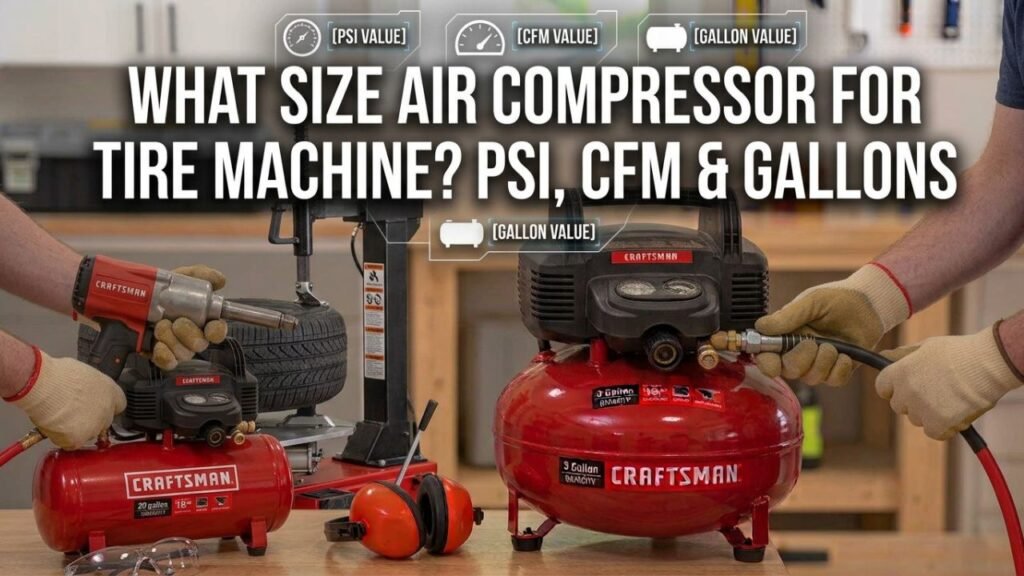
There is no universal compressor size that fits every tire changer.
A practical starting point for a conventional passenger-car tire machine is:
| Tire Machine Use | Suggested Compressor Size | Airflow Target | Pressure Capability |
| Occasional home use | 30–60 gallons | About 10–15+ CFM | Usually 125–150+ PSI |
| Serious home garage | 60 gallons | About 12–18+ CFM | 135–175 PSI |
| Small tire shop | 60–80 gallons | About 15–20+ CFM | 150–175 PSI |
| Busy professional shop | 80+ gallons or commercial system | 20–30+ CFM | Match all equipment requirements |
| Multiple tire machines/tools | Commercial system | Based on combined demand | Match highest required pressure |
These figures are planning guidelines rather than replacements for the tire changer’s manual.
That distinction matters because actual machines vary widely.
For example, Hunter TCX50-series specifications list an air requirement around 110–145 PSI and 14 CFM, while certain Ranger tire changers specify approximately 15–25 CFM with 140–165 PSI available. An Atlas passenger-car tire changer manual specifies an air supply of approximately 115–145 PSI.
Therefore, the first specification you should check is not tank capacity.
It is the tire machine manufacturer’s required pressure and airflow.
My Recommendation for Most Home Garages
If you are buying both the tire changer and compressor from scratch, I would generally choose:
60-gallon tank
Approximately 12–15 SCFM or more
Maximum tank pressure of at least 150 PSI, preferably higher when the tire changer requires it
Adequate CFM at the machine’s actual operating pressure
3/8-inch or larger properly sized air supply line, depending on the machine
A 60-gallon compressor provides enough reserve capacity that the bead breaker, clamps, and inflation functions can work without the compressor cycling excessively after every operation.
But do not assume every 60-gallon compressor automatically qualifies. Check actual delivered airflow.
Key Takeaways:
- A 60-gallon compressor is a strong general choice for a home or light-commercial tire changer.
- Professional machines may require 14–25 CFM or more and pressures approaching 165 PSI.
- Tank gallons alone do not determine compatibility.
- Always match both CFM and PSI to the exact tire changer specification.
Why Tire Machines Need So Much Compressed Air
A tire changer is different from an air nailer or blow gun because multiple pneumatic systems can be involved.
Understanding where the air goes makes compressor sizing easier.
Bead Breaker
The bead breaker pushes the tire bead away from the rim.
This requires significant force, particularly on:
- Old tires.
- Low-profile tires.
- Heavy sidewalls.
- Rusted or corroded wheels.
- Tires that have been mounted for years.
- Some truck and SUV tires.
The bead breaker normally uses a pneumatic cylinder.
If air pressure is too low, the bead-breaker blade may move but lack enough force to separate the bead effectively.
If airflow is inadequate, repeated bead-breaking cycles can drain the compressor receiver and make each subsequent cycle weaker.
Wheel Clamps
Many conventional tire changers use pneumatic wheel-clamping cylinders.
The clamps must securely hold the wheel during mounting and demounting.
This operation normally happens quickly, so it does not consume air continuously, but each cycle adds to total air demand.
Assist Arms
More advanced machines may have pneumatic helper arms for:
- Low-profile tires.
- Run-flat tires.
- Stiff sidewalls.
- Keeping the bead in the drop center.
- Controlling difficult tire beads.
A machine with one or two assist arms generally consumes more compressed air than a simple entry-level swing-arm tire changer.
Tilt-Back Tower
Some machines use compressed air to move or lock the tower.
Again, this is intermittent consumption rather than continuous airflow, but a busy shop may operate these cylinders hundreds of times throughout a workday.
Tire Inflation
The tire changer may also provide regulated air for tire inflation.
Filling a passenger-car tire requires significantly more total air volume than simply operating a small pneumatic cylinder.
Bead-Seating Blast
This is often the most demanding moment.
Some tire changers provide a high-volume blast of compressed air to help seat a difficult tire bead.
A bead-seating system needs a large quantity of air almost instantly.
The compressor’s receiver tank is particularly valuable here because a compressor pump alone cannot normally produce such a sudden burst instantaneously.
Instead, compressed air is stored in the receiver or the tire machine’s bead-blast reservoir and released rapidly when needed.
The compressor then replenishes that stored air.
This is one reason a large receiver can make a noticeable difference even when two compressors have similar pump CFM.
CFM Is More Important Than Gallons
When comparing compressors, CFM is one of the most important specifications.
CFM means cubic feet per minute.
It indicates how much air the compressor can deliver over time.
A tire changer might require something such as:
14 CFM
or
15–25 CFM
depending on its design.
If your compressor can only produce 5 CFM, installing a larger receiver tank does not magically turn the pump into a 15-CFM compressor.
The larger tank merely stores more air.
Eventually, the tire changer consumes that stored air and tank pressure falls.
Why SCFM Ratings Can Be Confusing
Air compressors are commonly advertised with ratings such as:
11.5 SCFM at 90 PSI
A tire changer, however, may require substantially more than 90 PSI.
That creates an important problem when comparing specifications.
A compressor that provides 11.5 SCFM at 90 PSI will normally provide less airflow as discharge pressure increases.
Therefore, if your tire changer requires 14 CFM around 125–145 PSI, do not automatically assume a compressor rated for 14 CFM at 90 PSI will meet that requirement.
Look for:
- Compressor performance data at higher pressures.
- Manufacturer airflow curves.
- Tire changer compressor recommendations.
- Compressor maximum operating pressure.
- Pump displacement and delivered airflow specifications.
If necessary, ask the compressor manufacturer for delivered CFM at your intended working pressure.
Add Some Airflow Reserve
I prefer not to size a compressor exactly at the machine’s minimum airflow requirement.
If a tire changer needs 14 CFM, choosing a compressor that barely produces 14 CFM leaves little reserve for:
- Air leaks.
- Pressure loss.
- Aging equipment.
- Other pneumatic tools.
- Repeated machine cycling.
- Hose and fitting restrictions.
For a 14-CFM tire changer, a compressor capable of roughly 17–18 CFM at the relevant pressure provides much more comfortable headroom.
That does not mean every homeowner must buy an industrial compressor. Intermittent tire-machine operation allows the tank to act as a buffer.
But if you expect frequent professional use, extra CFM is valuable.
How Much PSI Does a Tire Machine Need?
Most automotive tire changers require substantially more supply pressure than common 90-PSI pneumatic hand tools.
Typical requirements fall somewhere around 110–150 PSI, although some professional machines require supply pressure reaching approximately 165 PSI.
This is why a small compressor advertised as “150 PSI maximum” is not automatically suitable.
The compressor might technically reach 150 PSI in its tank but have very little airflow at that pressure.
Maximum PSI Is Not the Same as Working Capability
Suppose you compare two compressors.
Compressor A:
6 gallons
150 PSI maximum
2.6 SCFM at 90 PSI
Compressor B:
60 gallons
175 PSI maximum
13 SCFM at 90 PSI
Both can generate relatively high pressure.
But their ability to operate a tire machine is completely different.
Compressor B has:
- Much more stored air.
- Far higher pump output.
- Better recovery.
- More reserve at high pressure.
That is why shopping only by maximum PSI can lead to the wrong compressor.
Your Tire Changer Regulator Still Matters
Many tire machines incorporate a filter/regulator/lubricator assembly.
The compressor supplies air to the machine, and the machine’s pneumatic system regulates and conditions that air according to its design.
Do not remove or bypass safety devices or pressure-control components to make an undersized compressor appear more powerful.
How Many Gallon Air Compressor for Tire Machine Use?
Tank capacity determines how much compressed air is available before the compressor must replace it.
For tire-changing work, I generally categorize common compressor sizes this way.
6-Gallon Compressor
I would not recommend a typical 6-gallon pancake compressor for a pneumatic tire changer.
The problem is not simply the small tank.
Most compressors in this category also have relatively low CFM.
A 6-gallon compressor might reach 150 PSI, but tire-machine functions can exhaust the small air reserve rapidly.
You may experience:
- Slow cylinder movement.
- Weak bead breaking.
- Frequent compressor cycling.
- Long waiting periods.
- Poor bead-blaster performance.
- Large pressure drops during inflation.
A 6-gallon compressor is excellent for many nailers and tire-inflation tasks, but a full tire-changing machine is a different level of demand.
10-Gallon Compressor
A 10-gallon compressor is still smaller than I would choose.
A high-output specialty compressor could theoretically operate certain basic pneumatic functions, but the receiver offers very little reserve for repeated bead-breaking and inflation.
For a full tire changer, it is generally not a practical long-term solution.
20-Gallon Compressor
A 20-gallon compressor is where the answer becomes more nuanced.
A high-output 20-gallon compressor may operate a basic tire machine intermittently, provided it meets the required PSI and CFM.
The problem is that many 20-gallon consumer compressors do not.
A machine might work when the tank is fully charged, but after several pneumatic operations the compressor has to recover.
This can become frustrating if you are changing multiple tires.
I would consider a 20-gallon compressor only when:
- Tire changing is occasional.
- The machine has relatively modest air requirements.
- The compressor has unusually good CFM for its size.
- You already own the compressor.
- You do not mind recovery pauses.
I would not make 20 gallons my first choice when buying a complete tire-changing setup.
30-Gallon Compressor
A 30-gallon compressor can be a realistic option for a home enthusiast.
With sufficient pump output, it can handle:
- Occasional passenger-car tire changes.
- Pneumatic clamping.
- Bead breaking.
- Basic inflation.
You may still notice recovery delays when using a powerful bead-seating blast or working continuously.
For someone changing only several sets of tires per year, a strong 30-gallon unit may be adequate.
For regular shop work, I would move up.
60-Gallon Compressor
For most serious home garages and light professional use, 60 gallons is my preferred starting point.
A properly specified 60-gallon compressor provides:
- Larger reserve capacity.
- Better bead-breaker consistency.
- Faster recovery between tires.
- More useful bead-seating performance.
- Less frequent cycling.
- Better support for additional pneumatic tools.
The key phrase is properly specified.
If the tire changer requires 15–25 CFM, a low-output 60-gallon compressor may still be undersized.
80-Gallon Compressor
An 80-gallon compressor makes sense for a busy shop.
It gives you more stored air and is usually paired with a larger pump and motor.
This becomes especially useful if the same compressed-air system powers:
- Tire changer.
- Impact wrench.
- Air ratchet.
- Blow gun.
- Brake equipment.
- Pneumatic lift accessories.
- Other shop tools.
An 80-gallon compressor is not automatically necessary for one occasional-use tire changer, but it provides much greater flexibility.
120-Gallon and Larger Commercial Systems
High-volume automotive shops may need much larger systems.
At that point, tank size becomes only one part of compressor-system engineering.
You need to account for:
- Simultaneous equipment use.
- Total shop CFM.
- Pipe length.
- Pressure drop.
- Compressor duty cycle.
- Dryer and filter losses.
- Future expansion.
- Redundancy requirements.
For a commercial installation, size the compressor for the whole shop rather than only the tire machine.
Key Takeaways:
- 6- and 10-gallon compressors are generally too small for a full pneumatic tire changer.
- 20 gallons may work occasionally when CFM and PSI are adequate.
- 30 gallons can work for light home use.
- 60 gallons is my preferred general-purpose size for a serious home garage.
- Busy tire shops should consider 80 gallons or larger, based on total CFM demand.
Is a 60 Gallon Air Compressor Enough for a Tire Machine?
In many cases, yes.
A 60-gallon compressor is enough for many automotive tire machines if its pump provides the required airflow and pressure.
Tank capacity alone cannot confirm compatibility.
Before buying, compare the following two sets of numbers.
Tire changer:
Required CFM
Minimum and maximum air pressure
Compressor:
Delivered CFM
Pressure at which that CFM is available
Maximum tank pressure
If all of those requirements are satisfied, 60 gallons provides a useful amount of reserve air.
For a typical home garage changing passenger-car and light-truck tires, this is usually the size I would choose.
Is a 30 Gallon Air Compressor Enough for a Tire Machine?
It can be.
A 30-gallon compressor makes the most sense for:
- Occasional tire changing.
- Home mechanics.
- Basic swing-arm machines.
- Low daily tire volume.
But I would examine airflow carefully.
If the tire changer specifies 14 CFM and your 30-gallon compressor produces only 5 or 6 CFM, the tank will temporarily mask the mismatch but will not solve it.
You will eventually be waiting for recovery.
If the compressor produces strong airflow and you change tires intermittently, a 30-gallon receiver can be completely workable.
Will a 20 Gallon Air Compressor Run a Tire Machine?
Possibly, but I would consider it a compromise.
A 20-gallon compressor can operate some pneumatic tire-machine functions when fully charged.
The problem comes with repeated use.
Imagine this sequence:
- Clamp the wheel.
- Operate the bead breaker several times.
- Use an assist arm.
- Mount the tire.
- Attempt bead seating.
- Inflate the tire.
- Immediately begin another wheel.
Each operation consumes stored compressed air.
A small receiver reaches its compressor cut-in pressure much sooner.
If pump CFM is also low, waiting time becomes significant.
For one set of tires occasionally, that may be acceptable.
For a tire business, it is not.
Do You Need a 5 HP Compressor for a Tire Machine?
Horsepower can provide a rough indication of compressor capability, but do not choose the compressor based on horsepower alone.
Some professional tire-machine documentation does recommend compressor systems in the 5-HP class. For example, COATS documentation for certain all-air center-clamp machines specifies a 5-HP compressor capable of roughly 14–15 SCFM at 150 PSI.
That example illustrates the real priority:
The useful specification is not simply “5 HP.”
It is:
14–15 SCFM at 150 PSI.
Different compressor designs can produce different amounts of usable air even if their advertised motor horsepower is similar.
When shopping, I prioritize:
- Required PSI.
- Delivered CFM at that pressure.
- Duty cycle.
- Tank capacity.
- Motor horsepower.
Electric vs. Pneumatic Tire Machines
Not every tire changer uses compressed air in the same way.
Electric/Pneumatic Tire Changer
Many common automotive tire changers use an electric motor for the turntable but compressed air for functions such as:
- Clamping.
- Bead breaking.
- Assist arms.
- Inflation.
These machines still need a serious air supply even though their primary rotation is electric.
All-Air Tire Changer
Some machines use compressed air more extensively, including for drive functions.
These can place greater demands on the compressor.
One manufacturer specification for all-air tire changers calls for approximately 14–15 SCFM at 150 PSI, which is well beyond what a typical small portable compressor can provide.
Manual Tire Changer
A manual tire changer is different.
If the machine relies primarily on hand-operated mechanical leverage, it may not require a compressor at all.
However, you may still want compressed air for tire inflation or a separate bead seater.
Always identify exactly what kind of “tire machine” you own before sizing the compressor.
Tire Changer Compressor Size for Home Garage vs. Tire Shop
How frequently you use the machine changes the answer significantly.
Occasional Home Use
Suppose you change:
- Your own seasonal tires.
- Family vehicles.
- Project-car tires.
- A few wheels each month.
The compressor receives plenty of recovery time between jobs.
A strong 30-gallon compressor may be adequate.
A 60-gallon compressor gives you a much better experience and more flexibility.
Serious DIY Garage
If you regularly work on vehicles and also use:
- Impact wrench.
- Air hammer.
- Pneumatic ratchet.
- Blow gun.
- Die grinder.
I recommend a 60-gallon compressor with as much CFM as your electrical supply and budget reasonably allow.
The compressor becomes shop infrastructure rather than a single-purpose appliance.
Small Tire Business
For regular customer tire work, downtime matters.
Waiting for compressor recovery costs productivity.
I would generally begin with:
60–80 gallon receiver
and
15–20+ CFM, depending on the specific machine and other tools.
High-Volume Tire Shop
A high-volume operation should calculate total simultaneous air demand.
If two technicians are working while the system supplies:
- Tire changer.
- Impact wrench.
- Air blow gun.
- Additional pneumatic equipment.
a residential-style 60-gallon compressor may be insufficient even though it can operate the tire changer alone.
How to Calculate the Compressor Size You Need
A reliable sizing method is straightforward.
Step 1: Find the Tire Changer Air Requirement
Read the:
- Data plate.
- Owner’s manual.
- Manufacturer specification sheet.
- Installation instructions.
Record both:
CFM
and
PSI
Do not guess from the machine’s appearance.
Step 2: Find the Compressor’s Delivered Airflow
Do not rely on:
- Tank gallons alone.
- Peak horsepower.
- Maximum PSI alone.
- Pump displacement without delivered-air data.
Look for actual delivered CFM or SCFM.
Ideally, obtain the figure at or close to the tire machine’s working pressure.
Step 3: Add Reserve Capacity
For professional use, I prefer some airflow headroom.
For example:
Machine requirement:
14 CFM
Useful target with approximately 25% headroom:
14 × 1.25 = 17.5 CFM
A compressor delivering around 17–18 CFM at the required operating pressure gives you significantly more margin than one that just meets 14 CFM.
Step 4: Account for Other Tools
If you operate additional air tools at the same time, include their realistic simultaneous demand.
For example:
Tire changer = 14 CFM
Impact wrench = 5 CFM
Possible combined demand = 19 CFM
With some reserve:
19 × 1.25 = 23.75 CFM
You would therefore consider roughly 24 CFM or greater.
You do not necessarily add every pneumatic tool in the building together.
Add tools that can realistically operate at the same time.
Step 5: Choose the Receiver Size
After you have enough CFM and PSI, select receiver capacity based on work volume.
For intermittent home use:
30–60 gallons
For regular tire work:
60–80 gallons
For high-volume commercial work:
80 gallons or larger, depending on the system.
Air Line and Hose Size Matters
An adequately sized compressor can still produce a weak tire changer if the air line is restrictive.
Pressure loss occurs through:
- Small hose.
- Long hose runs.
- Undersized pipe.
- Restrictive quick-connect fittings.
- Dirty filters.
- Regulators.
- Excessive elbows.
- Leaks.
A tire changer that needs 15 CFM cannot receive 15 CFM efficiently through a severely restrictive air line.
Avoid Very Small Air Hose
A 1/4-inch hose commonly used with small portable compressors can become restrictive for high-flow equipment.
Many tire-machine installations benefit from 3/8-inch or 1/2-inch air lines, depending on required airflow, run length, and manufacturer instructions.
For long shop piping, larger pipe may be appropriate.
Follow the tire machine manufacturer’s inlet-size requirements.
Keep Pressure Drop Under Control
Imagine the compressor tank is at 150 PSI but only 115 PSI reaches the machine while it is operating.
The regulator gauge may appear correct when everything is idle.
As soon as the bead breaker activates, pressure falls sharply.
That is a classic sign of a flow restriction.
Measure or observe pressure while the machine is actually consuming air whenever troubleshooting performance.
Pro Tip: If a tire machine suddenly seems weak even though the compressor is adequately sized, inspect the filter/regulator/lubricator assembly, air hose, fittings, and leaks before replacing the compressor.
Why the Bead Breaker Feels Weak
A weak bead breaker is one of the most common signs of an air-supply problem.
Possible causes include:
- Low supply pressure.
- Insufficient CFM.
- Compressor tank nearly depleted.
- Restricted air line.
- Clogged filter.
- Incorrect regulator setting.
- Air leaks.
- Pneumatic-cylinder problems.
- Insufficient lubricator oil where required.
- Mechanical binding.
Some manufacturers specifically advise checking machine lubrication and ensuring adequate incoming air pressure when bead-breaking performance becomes weak.
Do not immediately increase pressure beyond the machine’s specification.
Find the underlying problem first.
Does the Bead Blaster Require a Bigger Compressor?
A bead-seating blast is one of the best reasons to choose a larger compressor receiver.
The system releases a large quantity of air quickly to push the tire sidewalls outward and help the beads make contact with the rim.
Because this airflow happens almost instantly, stored air is critical.
A small compressor can sometimes build enough pressure eventually, but you may have to wait a long time between attempts.
With a larger receiver:
- More stored air is available.
- Pressure drops less dramatically.
- The system recharges less frequently.
- Repeated tire work becomes faster.
For bead-seating systems, I would much rather have a 60-gallon receiver than a 20-gallon receiver when everything else is equal.
Can the Same Compressor Run a Tire Machine and Impact Wrench?
Yes, and this is common in automotive shops.
The question is whether they will operate simultaneously.
An impact wrench typically uses air in short bursts.
A tire machine also operates intermittently.
For a single home mechanic, both may share a good 60-gallon compressor successfully because the user normally cannot operate both tools simultaneously.
In a shop with multiple technicians, the situation changes.
One technician may run the bead breaker while another uses an impact wrench continuously.
The compressor must then handle their combined demand.
If several technicians share one compressor, calculate shop-wide CFM rather than sizing only for the tire changer.
Oil-Free vs. Oil-Lubricated Compressor for a Tire Machine
Both types can operate a tire changer if their CFM and PSI are adequate.
Oil-Free Compressor
Advantages include:
- Less pump maintenance.
- No compressor crankcase oil changes.
- Often simpler ownership.
- Many modern options available.
For light or occasional tire work, oil-free may be completely suitable.
Oil-Lubricated Compressor
For a busy automotive shop, I generally favor a quality oil-lubricated reciprocating or rotary compressor designed for demanding service.
Potential advantages include:
- Better suitability for frequent use.
- Longer service life in many commercial applications.
- Availability in high-CFM stationary configurations.
The compressor type is still secondary to actual capacity and duty cycle.
Tire Machine Lubrication Is Separate
Do not assume an oil-free air compressor means the tire machine itself needs no pneumatic lubrication.
Many tire changers have an air-line lubricator and require periodic oil checks.
Follow the tire changer’s maintenance instructions.
Key Takeaways:
- Compressor lubrication type does not determine tire-machine compatibility; CFM, PSI, and duty cycle do.
- The tire changer may have its own lubricator even when the compressor is oil-free.
- A compressor supplying several garage tools should be sized for realistic combined demand.
- Proper air lines and fittings are as important as adequate compressor capacity.
Compressor Duty Cycle Matters in a Tire Shop
Duty cycle describes how much of the time a compressor is designed to run.
A home compressor may tolerate intermittent work very well but not continuous heavy operation.
A busy tire shop may keep a compressor cycling throughout the day.
If the compressor is constantly running to maintain tire-machine pressure, several problems can occur:
- Excessive heat.
- Increased wear.
- Moisture production.
- Shorter pump life.
- More maintenance.
- Reduced reliability.
For commercial work, I prefer a compressor with enough capacity that it is not operating at its absolute limit throughout the day.
The more tires you service, the more important duty cycle becomes.
Electrical Requirements Also Matter
Larger compressors often require dedicated electrical service.
Do not purchase a 60- or 80-gallon compressor assuming it plugs into a standard household receptacle.
Many stationary compressors require:
- 240-volt power.
- Dedicated circuit.
- Proper breaker size.
- Correct wire gauge.
- Professional installation.
The tire changer may also require its own 120- or 240-volt circuit if it uses an electric turntable motor.
Plan both utilities before installing the equipment.
Never improvise electrical wiring to operate large shop machinery.
Moisture Control for Tire Machine Air Supply
Compressed air contains moisture.
As compressed air cools inside the tank and piping, water condenses.
Excessive moisture can contribute to:
- Corrosion.
- Pneumatic component problems.
- Contaminated lubrication.
- Reduced equipment life.
Drain the compressor receiver according to the compressor manufacturer’s instructions.
Many tire machines include or require a filter/regulator/lubricator assembly.
A professional shop may also benefit from:
- Aftercooler.
- Water separator.
- Automatic tank drain.
- Refrigerated air dryer.
The required level of air treatment depends on workload and local humidity.
Safety: Tire Inflation Requires Special Care
A tire changer combines compressed air with a tire and wheel assembly capable of storing significant energy.
Incorrect inflation or bead seating can cause severe injury.
Before using the machine:
- Read the tire changer operating manual.
- Inspect the tire and rim.
- Verify tire and wheel compatibility.
- Use the machine’s supplied inflation controls and safety features.
- Keep your body away from hazardous trajectory zones.
- Never bypass an inflation-pressure limiter.
- Never exceed the tire manufacturer’s specified final inflation pressure.
- Use an appropriate tire inflation cage when required.
Some professional tire changers incorporate automatic pressure-limiting systems specifically to reduce overinflation risk. Manufacturer instructions also warn against bypassing these safety systems.
Important Tip: More compressor pressure is not a substitute for correct bead-seating technique. If the bead will not seat, stop and identify the cause rather than exceeding the tire changer or tire manufacturer’s pressure limits.
Common Compressor Sizing Mistakes
Choosing by Tank Size Alone
“It’s a 60-gallon compressor, so it must work” is not enough.
Check airflow and pressure.
Looking Only at Maximum PSI
A compressor reaching 175 PSI does not necessarily produce enough CFM for a tire changer.
Comparing CFM at Different Pressures
A compressor’s CFM rating at 90 PSI should not automatically be treated as its CFM output at 150 PSI.
Buying the Smallest Compressor That Technically Works
A marginal setup may operate one tire successfully but become frustrating during repeated use.
Forgetting the Bead-Seating System
High-volume bead-seating blasts benefit significantly from stored air.
Ignoring Air-Line Restrictions
An undersized hose can waste the capacity you paid for.
Ignoring Other Shop Equipment
Your compressor may operate the tire changer perfectly by itself but struggle when someone uses an impact wrench simultaneously.
Ignoring Duty Cycle
Commercial tire service requires more than occasional DIY capacity.
Assuming More Pressure Fixes Everything
If poor airflow is the problem, excessive pressure is not the solution.
My Recommended Tire Machine Compressor Setup
For a serious home garage installing a conventional passenger-car tire changer, I would aim for:
60-gallon receiver
Approximately 15+ CFM if possible
150–175 PSI maximum tank pressure
Enough delivered airflow at the tire machine’s required operating pressure
Properly sized 3/8- or 1/2-inch air supply
Quality filter/regulator system
Adequate electrical service
This setup provides enough flexibility for most home tire-changing jobs while also supporting other automotive pneumatic tools.
For a professional tire shop, I would consider:
60–80+ gallons
Approximately 20+ CFM or whatever the combined shop calculation requires
Commercial-duty pump
High duty cycle
Proper shop piping
Moisture management
If your tire changer specifically requires 15–25 CFM at 140–165 PSI, buy to that specification rather than following a generic gallon recommendation. Certain current Ranger tire changers do specify that level of air supply.
Key Takeaways:
- For most serious DIY tire-changing setups, I recommend starting around 60 gallons and 15+ CFM.
- Professional shops should size the compressor for the combined demand of all tools, not just the tire machine.
- Confirm delivered CFM at the required pressure instead of relying only on a 90-PSI compressor rating.
- Never increase pressure beyond machine specifications to compensate for poor airflow.
FAQs about What Size Air Compressor for Tire Machine
What size compressor do I need to run a tire machine?
For many passenger-car tire changers, a 60-gallon compressor producing approximately 12–15+ CFM is a good general starting point. However, some professional machines require 15–25 CFM and up to approximately 165 PSI, so always use the specifications for your exact machine.
How many gallons does an air compressor need for a tire changer?
I recommend 60 gallons for regular tire-changing work.
A 30-gallon compressor can work for occasional home use if CFM and PSI are sufficient. A 20-gallon unit is often marginal, while 6- and 10-gallon compressors are generally too small for a conventional pneumatic tire changer.
Is a 20 gallon air compressor enough for a tire machine?
It can operate some machines intermittently if the compressor meets the pressure and airflow requirements.
However, a 20-gallon tank runs through its stored air relatively quickly during repeated bead breaking, clamping, bead seating, and inflation.
I would choose 30–60 gallons for a home setup instead.
Is a 30 gallon air compressor enough for a tire changer?
A good 30-gallon compressor can be adequate for occasional tire changing.
The deciding factor is its CFM at the required pressure.
If the machine needs 14 CFM and your compressor delivers only 5 CFM, the 30-gallon tank does not solve the underlying mismatch.
Is a 60 gallon air compressor enough for a tire machine?
Usually, yes, provided the pump also delivers adequate airflow.
A 60-gallon receiver gives you useful air reserve for bead breaking, clamping, inflation, and bead seating.
For most home garages, this is the size I prefer.
Do I need an 80 gallon compressor for a tire changer?
Not necessarily.
One tire changer used occasionally normally does not require an 80-gallon receiver.
An 80-gallon compressor becomes more attractive for professional shops, high tire volume, larger pneumatic equipment, or several technicians using air simultaneously.
How much CFM does a tire machine require?
Many professional passenger-car tire changers require around 14–15 CFM, while some models specify an air source in the 15–25 CFM range. Exact requirements vary substantially by machine design.
Always check your machine’s documentation.
How much PSI does a tire changer need?
Many tire changers operate with roughly 110–150 PSI of incoming air, while some professional machines require pressure up to approximately 165 PSI.
Use the range specified by your tire changer manufacturer.
Is 125 PSI enough for a tire changer?
It may be enough for machines designed to operate around that pressure.
It is not enough for every model.
Some machines have minimum supply requirements above 125 PSI, so you should check the manual rather than relying on a universal number.
Is 150 PSI enough for a tire machine?
For many machines, yes.
However, certain tire changers specify operating ranges extending to approximately 165 PSI.
More importantly, the compressor must provide enough airflow at working pressure, not merely be capable of reaching 150 PSI with no airflow.
Can a pancake compressor run a tire changer?
I would not recommend it.
Most pancake compressors have small tanks and relatively low CFM.
They may build enough pressure to operate a pneumatic cylinder temporarily, but repeated tire-machine use will drain their stored air rapidly.
Can I use the same compressor for a tire changer and impact wrench?
Yes.
A good 60-gallon shop compressor can commonly support both when one person uses the tools intermittently.
If several technicians may use tools simultaneously, add their realistic CFM requirements and size the compressor accordingly.
What is more important for a tire changer, PSI or CFM?
Both are essential.
The tire machine needs enough PSI to generate the required pneumatic force and enough CFM to maintain airflow through repeated operations.
A compressor that satisfies only one requirement is not properly sized.
Is CFM more important than gallons for a tire machine?
For long-term performance, yes.
Gallons determine how much air can be stored.
CFM determines how quickly the compressor can replenish that air.
A large tank with a weak pump eventually runs out of usable reserve.
Does a bead breaker need a large compressor?
A pneumatic bead breaker requires adequate pressure to produce force and adequate airflow for repeated cycling.
One isolated bead-breaking operation may work from a smaller receiver, but frequent tire changes benefit from a larger compressor.
Why is my tire machine bead breaker weak?
Common causes include insufficient air pressure, low CFM, restricted hoses, clogged filters, air leaks, low lubricator oil where required, or mechanical problems with the machine.
Check the tire changer’s required supply pressure before adjusting anything.
Why does my compressor run constantly with a tire machine?
The tire machine is probably consuming air almost as quickly as, or faster than, the compressor can produce it.
A leak can create the same symptom.
Compare the machine’s CFM requirement with compressor output and check the complete system for air leaks.
What size air hose should I use for a tire machine?
A 3/8-inch or 1/2-inch air supply is common for higher-flow shop equipment, but use the inlet and line size recommended by your tire-machine manufacturer.
Longer air runs or high-CFM machines may require larger shop piping to control pressure drop.
Do I need a separate compressor for my tire machine?
Usually not.
A properly sized central shop compressor can power the tire changer and other pneumatic tools.
A separate compressor may make sense only when total shop demand exceeds the existing system’s capacity or when operational redundancy is important.
Conclusion
If you are deciding what size air compressor for tire machine use makes sense, a 60-gallon compressor with approximately 12–15+ CFM and sufficient capacity to maintain the tire changer’s required 125–150 PSI range is a strong general choice for a home or light-duty shop. Some professional tire machines require substantially more—up to roughly 15–25 CFM and 165 PSI—so your machine’s specification always takes priority over a generic recommendation.
A 20-gallon compressor can sometimes run a tire machine intermittently, but I would consider it marginal. A properly specified 30-gallon compressor can serve an occasional home user. For regular tire changing, I prefer 60 gallons. An 80-gallon or larger commercial compressor becomes more appropriate when several air tools operate at once or the tire changer is used continuously throughout the workday.
Most importantly, do not choose by gallons, horsepower, or maximum PSI alone. First identify the tire machine’s required CFM and operating pressure, make sure the compressor can actually deliver that airflow at the required pressure, and then select enough tank capacity for your workload.
For most people building a capable home tire-changing setup from scratch, my practical recommendation is straightforward: buy a good 60-gallon compressor with strong CFM output rather than trying to make a small portable compressor do a job it was never designed to handle.