
What Is CFM in Air Compressor? Complete CFM & SCFM Guide
What is CFM in air compressor terminology? CFM means cubic feet per minute, and it tells you how much air a compressor can deliver in one minute at a stated pressure. In practical terms, CFM is one of the most important numbers for determining whether an air compressor can keep a pneumatic tool running properly.
A compressor may advertise 125, 150, or even 175 PSI, but high pressure alone does not mean it can power an air-hungry tool. An impact wrench, spray gun, die grinder, air sander, nail gun, tire inflator, and other pneumatic equipment all consume air at different rates. If the compressor cannot supply air as quickly as the tool uses it, pressure eventually drops and the tool loses performance.
You may also see SCFM, which stands for standard cubic feet per minute. SCFM expresses airflow after it has been referenced to defined standard atmospheric conditions so compressor performance can be compared more consistently. CFM and SCFM are closely related, but they are not always interchangeable because actual air volume changes with pressure, temperature, humidity, and altitude.
Understanding airflow becomes especially important when comparing compressors. Tank gallons tell you how much compressed air can be stored, PSI tells you pressure, horsepower relates to the power available to drive the pump, and CFM tells you how quickly useful air can be supplied. None of these numbers should be considered in isolation.
In this guide, I’ll explain CFM and SCFM from the ground up, how they differ, how PSI affects usable airflow, what compressor ratings really mean, how much CFM common air tools need, how tank size and horsepower fit into the equation, how to size a compressor correctly, and what to do when your compressor appears to have enough pressure but still cannot keep up.
What Is CFM in Air Compressor Ratings?
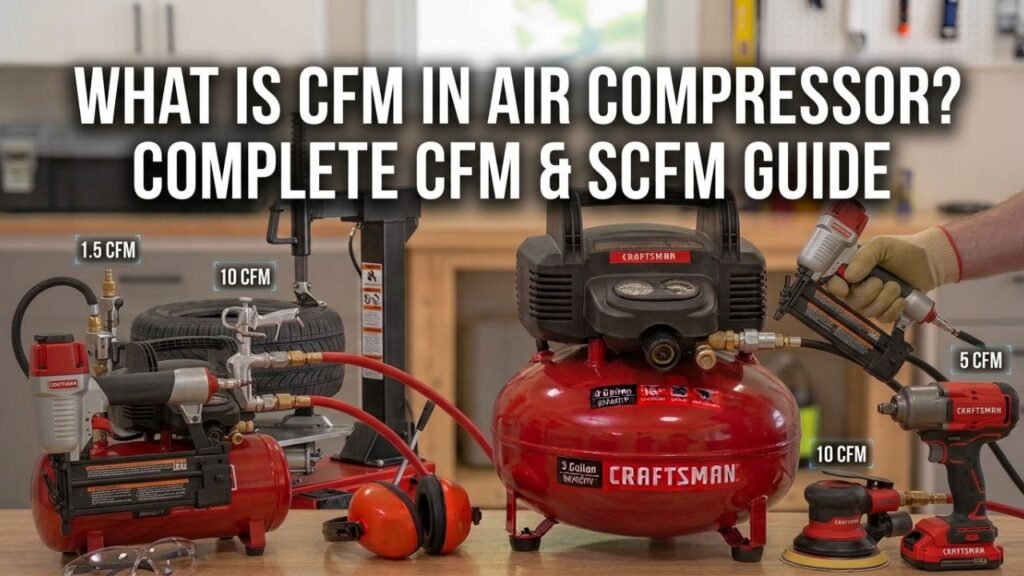
CFM stands for cubic feet per minute.
It is a measurement of volumetric airflow.
If a compressor is rated to provide 6 CFM under a particular operating condition, that means its air-delivery capacity is represented as six cubic feet of air per minute under the conditions used for that rating.
For an air compressor owner, the most useful way to think about CFM is:
CFM tells you how much air the compressor can supply, while PSI tells you the pressure at which that air is supplied.
Both matter because pneumatic tools need a certain combination of airflow and pressure.
A tool that requires approximately 5 CFM at 90 PSI needs substantially more airflow than a small nail gun that fires only short bursts of air.
What Does “Cubic Feet” Actually Mean?
A cubic foot is a unit of volume.
Imagine a cube measuring:
- 1 foot wide
- 1 foot long
- 1 foot high
The volume inside that cube is one cubic foot.
CFM describes how many cubic feet of air flow through a system each minute.
However, compressed air introduces an important complication: air is compressible.
One cubic foot of air at atmospheric pressure does not contain the same amount of air mass as one cubic foot at a much higher pressure.
That is one reason compressor specifications often use standardized airflow measurements such as SCFM.
Why CFM Matters So Much
CFM affects whether your compressor can keep up with your tool.
If the compressor produces air faster than the tool consumes it, the system can generally maintain pressure without excessive downtime.
If the tool uses air faster than the compressor can replenish it, the compressor must depend on stored air in the tank.
Eventually:
- Tank pressure falls.
- The compressor starts running.
- Air consumption continues.
- The pump cannot replace air quickly enough.
- Regulated pressure begins dropping.
- Tool performance declines.
This is why CFM is especially important for continuous-use pneumatic tools such as sanders, grinders, spray equipment, and certain production tools.
What Are CFM in Air Compressor Specifications?
People sometimes search for “what are CFM in air compressor” because compressor labels display more than one CFM number.
For example, a compressor might be rated at one airflow at 40 PSI and a lower airflow at 90 PSI.
That does not mean the compressor has different pumps.
It means compressor airflow performance changes with operating pressure.
As discharge pressure increases, the pump has to work harder, and the amount of air it can deliver generally decreases.
That is why you should compare the compressor’s airflow rating at or near the pressure your tool actually requires.
If an impact wrench requires 90 PSI, the compressor’s CFM or SCFM rating at 90 PSI matters much more than its rating at 40 PSI.
Key Takeaways:
- CFM means cubic feet per minute and measures airflow volume.
- CFM tells you how quickly a compressor can supply air.
- PSI and CFM must be considered together.
- Compare compressor CFM at the pressure your pneumatic tool actually uses.
What Does SCFM Mean on an Air Compressor?
SCFM means standard cubic feet per minute.
It represents airflow referenced to a defined set of standard atmospheric conditions.
The purpose of SCFM is to make air-volume measurements more comparable.
Air expands and contracts depending on:
- Atmospheric pressure
- Temperature
- Humidity
- Altitude
Without a reference condition, two measurements described simply as “CFM” could represent different quantities of actual air.
SCFM reduces this problem by expressing airflow as though it were measured under agreed reference conditions.
Why Compressor Manufacturers Use SCFM
Imagine one compressor being tested on a cool day near sea level and another being tested at high altitude in hot weather.
The actual volume and density of air entering each compressor would be different.
A standardized reference allows performance to be expressed more consistently.
That is why compressor labels often show ratings such as:
5.0 SCFM @ 90 PSI
The important parts are:
- 5.0 SCFM = standardized airflow
- 90 PSI = operating pressure associated with that airflow rating
This gives you a useful number for comparing the compressor against a tool’s air requirement.
Does Every Manufacturer Use Exactly the Same SCFM Standard?
Not necessarily.
“Standard conditions” can differ depending on the test standard, industry convention, manufacturer, or specification method.
Standard temperature, atmospheric pressure, and humidity assumptions are not universally identical in every technical context.
Because of this, I recommend comparing compressor ratings using:
- The same pressure
- The same type of airflow rating
- Reputable manufacturer specifications
- Comparable test methods where available
For ordinary home and automotive compressor shopping, the biggest mistake is usually not a small difference in SCFM reference conditions. It is comparing unrelated numbers—for example, comparing one compressor’s airflow at 40 PSI with another compressor’s airflow at 90 PSI.
Is SCFM Better Than CFM?
SCFM is generally more useful for performance comparison because it normalizes the airflow measurement.
However, that does not mean every specification labeled CFM is wrong.
Manufacturers and users often use “CFM” casually when referring to rated compressor airflow.
The important question is:
Under what conditions was the airflow measured?
If you are comparing two compressors, look for ratings expressed at the same pressure and under comparable conditions.
CFM vs SCFM: What Is the Difference?
CFM and SCFM both describe airflow, but they describe it in different ways.
| Measurement | Meaning | Main Purpose |
| CFM | Cubic feet per minute | Describes volumetric airflow |
| SCFM | Standard cubic feet per minute | Describes airflow referenced to standard conditions |
| ACFM | Actual cubic feet per minute | Describes volume flowing under actual operating conditions |
| FAD | Free air delivery | Expresses useful compressor output referenced to inlet/free-air conditions |
CFM
CFM is a general measurement of airflow volume.
Without additional information, it does not tell you:
- Temperature
- Absolute pressure
- Humidity
- Test method
- Discharge pressure
That is why a bare CFM number can be incomplete.
SCFM
SCFM adjusts airflow to a defined reference condition.
This makes it easier to compare equipment operating under different atmospheric conditions.
ACFM
ACFM means actual cubic feet per minute.
It refers to the actual physical volume of air flowing under the temperature and pressure conditions that exist at the measurement point.
ACFM becomes particularly important in engineering applications because compressed air occupies a different physical volume depending on its actual state.
Free Air Delivery
You may also see Free Air Delivery, often abbreviated FAD.
This is intended to describe how much usable air a compressor actually delivers, expressed relative to free or inlet-air conditions rather than simply the pump’s theoretical displacement.
For practical compressor shopping, a tested delivered-air rating is considerably more meaningful than a theoretical displacement number.
Key Takeaways:
- CFM measures airflow volume.
- SCFM expresses that airflow at standardized reference conditions.
- ACFM describes airflow under actual operating conditions.
- When comparing compressors, use delivered airflow measured at comparable pressures and conditions.
CFM vs PSI: What Is the Difference?
CFM and PSI are probably the two most important specifications for matching a compressor to pneumatic equipment.
They measure completely different things.
CFM Measures Airflow
CFM tells you how much air moves through the system per unit of time.
Think:
How much air can the compressor deliver?
PSI Measures Pressure
PSI means pounds per square inch.
It measures pressure.
Think:
At what pressure is the air being supplied?
A Simple Water-Hose Analogy
A simplified analogy is a water system.
Pressure is similar to how forcefully water is pushed.
Flow rate is similar to how much water passes through the hose.
You can have:
- High pressure with relatively low flow
- High flow with lower pressure
- High pressure and high flow
- Low pressure and low flow
Compressed air behaves differently from water because air is compressible, but the analogy helps explain why pressure and flow are separate concepts.
Why High PSI Does Not Mean High CFM
A small compressor may reach 150 PSI inside its tank while delivering only a modest amount of air per minute.
A much larger compressor might also have a 150 PSI maximum but deliver several times more CFM.
The second compressor will generally support high-consumption air tools far better, even though both tanks reach the same maximum pressure.
Why CFM Usually Falls as PSI Rises
Compressors generally produce less delivered airflow as discharge pressure increases.
That is why you might see ratings such as:
| Pressure | Example Compressor Output |
| 40 PSI | 6.2 SCFM |
| 90 PSI | 5.1 SCFM |
These numbers are only illustrative, but the pattern is common.
At higher discharge pressure, the compressor is working against greater resistance, so usable airflow output declines.
Why CFM Matters More Than Maximum PSI for Many Air Tools
Maximum PSI is important because a compressor must be capable of reaching the required pressure.
But once the pressure requirement is satisfied, airflow frequently becomes the limiting factor.
Consider a tool requiring:
6 CFM at 90 PSI
Two compressors could both reach 150 PSI.
Compressor A delivers:
3 CFM at 90 PSI
Compressor B delivers:
8 CFM at 90 PSI
Both technically provide enough maximum pressure.
But Compressor B is much better matched because it can supply enough air while the tool operates.
Compressor A may run the tool briefly using stored tank air, but it cannot replenish that air quickly enough for sustained operation.
What Does “SCFM at 90 PSI” Mean?
A specification such as:
6.0 SCFM at 90 PSI
means the compressor’s rated delivered airflow is six standard cubic feet per minute when it is operating against approximately 90 PSI discharge pressure under the manufacturer’s specified test conditions.
This is one of the most useful ratings for air-tool applications because many pneumatic tools are designed to operate near 90 PSI.
However, you still need to compare that rating with the actual tool specification.
A nail gun, impact wrench, die grinder, spray gun, or air sander can have very different airflow demands even if all operate near similar pressures.
Why Air Tools Have CFM Requirements
Pneumatic tools convert compressed air energy into mechanical work.
The tool continuously or intermittently exhausts air while operating.
That air must be replaced.
The amount consumed depends on factors such as:
- Motor size
- Tool design
- Operating pressure
- Speed
- Load
- Trigger time
- Nozzle or passage size
- Duty cycle
A small brad nailer uses a quick pulse of air each time it fires.
An orbital sander may consume air nearly continuously for several minutes.
This is why the sander usually requires a much more capable compressor even if both tools use similar working pressure.
Continuous Tools vs Intermittent Tools
Understanding duty cycle is critical when sizing a compressor.
Intermittent Air Tools
These consume air in relatively short bursts.
Examples include:
- Brad nailers
- Finish nailers
- Framing nailers
- Impact wrenches used in short bursts
- Air ratchets used periodically
A tank can act as a buffer for these tools.
The compressor may not equal instantaneous tool airflow every second, but stored air can support brief operation while the pump catches up afterward.
Continuous Air Tools
These consume air for long periods.
Examples include:
- Dual-action sanders
- Air grinders
- Cut-off tools
- Some spray guns
- Sandblasting equipment
- Production pneumatic tools
These applications depend much more heavily on compressor pump output.
A large tank cannot compensate indefinitely for insufficient CFM.
Once the tank’s stored air is depleted, the pump must supply almost all ongoing demand.
How Much CFM Do Common Air Tools Need?
There is no universal airflow requirement for a category of tool.
Two 1/2-inch impact wrenches can have significantly different air consumption.
Always use the specification for the actual tool you own or intend to buy.
Still, the following broad ranges can help with preliminary planning.
| Pneumatic Tool | Approximate Typical Air Demand | Usage Pattern |
| Brad nailer | Less than 1 to about 2 CFM average | Intermittent |
| Finish nailer | Roughly 1–3 CFM average | Intermittent |
| Framing nailer | Roughly 2–4 CFM average | Intermittent |
| Small air ratchet | Roughly 3–6 CFM | Intermittent |
| 1/2-inch impact wrench | Roughly 4–8+ CFM | Intermittent |
| Air hammer | Roughly 3–6 CFM | Intermittent |
| Die grinder | Roughly 5–10+ CFM | Often continuous |
| Angle grinder | Roughly 6–12+ CFM | Often continuous |
| Dual-action sander | Roughly 8–15+ CFM | Continuous |
| HVLP spray gun | Roughly 8–20+ CFM | Continuous while spraying |
| Sandblasting equipment | Often 10–30+ CFM | Continuous/high demand |
These are planning ranges only.
Tool specifications vary substantially, and some professional models can fall outside these ranges.
Nail Guns
Nail guns consume compressed air in short bursts.
This makes them relatively easy to run with compact compressors.
A small pancake compressor may support many nailers because the compressor has time to recover between shots.
Impact Wrenches
Impact wrenches consume considerably more air while the trigger is held, but automotive use is often intermittent.
A compressor can sometimes run an impact wrench even when pump output is slightly below the tool’s peak consumption because tank storage supports short bursts.
However, repeated heavy use may quickly expose insufficient compressor CFM.
Air Sanders
Air sanders are demanding because they are often operated continuously.
This means advertised average consumption figures should be treated carefully.
For continuous sanding, I would size the compressor around sustained tool demand rather than assuming a small storage tank can cover the difference.
Spray Guns
Spray guns can require substantial airflow.
Insufficient CFM may cause:
- Pressure fluctuation
- Inconsistent atomization
- Changes in spray pattern
- Poor finish quality
For painting, airflow consistency can be just as important as having enough peak pressure.
Sandblasters
Sandblasting is one of the most demanding common compressed-air applications.
Larger nozzle sizes can consume large quantities of air.
If sandblasting is a major goal, compressor selection should be based directly on the nozzle’s specified airflow requirement.
How to Calculate What CFM Air Compressor You Need
A simple compressor-sizing process works for most home garages and workshops.
Step 1: Find the Tool’s Air Requirement
Check the tool:
- Manual
- Specification label
- Manufacturer documentation
Look for a figure such as:
5 CFM at 90 PSI
or:
5 SCFM @ 90 PSI
Step 2: Determine Whether the Tool Is Continuous or Intermittent
Continuous tools require the compressor to sustain airflow for long periods.
Intermittent tools can rely more heavily on stored tank air.
This distinction can dramatically affect how satisfactory a compressor feels in real use.
Step 3: Add Capacity Headroom
I recommend choosing more compressor output than the tool’s absolute minimum whenever practical.
For many home and shop applications, approximately 25–50% airflow headroom is a sensible planning target.
For example, if a tool needs:
6 CFM at 90 PSI
a compressor capable of roughly:
7.5–9 CFM at 90 PSI
provides useful additional capacity.
That headroom helps account for:
- Pressure loss
- Hose restrictions
- Fittings
- Filters
- Compressor cycling
- Real-world operating variation
This is a sizing recommendation rather than a universal engineering requirement.
Step 4: Account for Multiple Tools
If two tools will run simultaneously, add their airflow requirements together.
Suppose:
Tool A requires 5 CFM.
Tool B requires 4 CFM.
Simultaneous demand is:
5 + 4 = 9 CFM
Then apply whatever capacity margin is appropriate for your system.
If the tools will never operate at the same time, you generally do not need to add their full airflow requirements together.
Step 5: Compare at the Correct PSI
A 10-CFM rating at 40 PSI does not automatically mean the compressor delivers 10 CFM at 90 PSI.
Compare compressor output and tool consumption at approximately the same operating pressure.
Key Takeaways:
- Start with the tool manufacturer’s airflow requirement.
- Separate continuous-use tools from intermittent-use tools.
- I recommend roughly 25–50% CFM headroom when practical.
- Add the requirements of tools that must operate simultaneously.
- Always compare CFM at the required operating pressure.
Example: Sizing a Compressor for a 1/2-Inch Impact Wrench
Suppose your wrench requires:
5 CFM at 90 PSI
A compressor rated:
5.2 SCFM at 90 PSI
may technically meet the requirement, but it leaves almost no reserve.
A compressor rated:
7 SCFM at 90 PSI
offers more comfortable headroom.
For occasional lug-nut removal, even a somewhat smaller compressor may operate the wrench for short bursts using stored tank air.
For frequent automotive work, I would choose enough compressor output to keep the tool working without constant recovery pauses.
Example: Sizing a Compressor for an Air Sander
Suppose a dual-action sander consumes:
12 CFM at 90 PSI
A portable compressor producing 4 CFM at 90 PSI is not a good continuous-use match.
A large tank might let the sander run briefly, but pressure will eventually fall because:
Air leaving the tank = faster than air entering the tank
The proper solution is a compressor with substantially greater continuous airflow capacity.
What Is Compressor Displacement CFM?
This specification can confuse buyers because it can be higher than actual usable airflow.
Displacement CFM is based on the theoretical volume swept by the compressor pump.
For a reciprocating compressor, it is influenced by:
- Cylinder dimensions
- Stroke
- Number of cylinders
- Pump speed
Theoretical displacement does not account fully for real-world losses.
Actual delivered air is lower because of:
- Valve losses
- Heat
- Leakage
- Clearance volume
- Pump inefficiency
- Compression losses
For comparing compressors, delivered CFM or SCFM at a stated pressure is generally far more useful than pump displacement.
Why Advertised CFM Can Be Confusing
A compressor description may contain several numbers:
- Displacement CFM
- Delivered CFM
- SCFM at 40 PSI
- SCFM at 90 PSI
- Maximum PSI
- Tank gallons
These numbers describe different aspects of performance.
Do not compare a theoretical displacement figure from one compressor with a delivered-air figure from another.
That can make the first compressor appear much more powerful than it really is.
What Is Free Air Delivery?
Free Air Delivery, or FAD, is a useful compressor-performance concept.
It is intended to represent the quantity of useful air actually delivered by the compressor, expressed relative to inlet or free-air conditions.
That makes FAD much more representative of real compressor capacity than theoretical piston displacement.
When choosing equipment, prioritize credible delivered-air specifications measured under defined test conditions.
How Does Tank Size Affect CFM?
Tank size and CFM are related to compressor performance, but they are not the same.
CFM Is Pump Output
CFM tells you how quickly the compressor can replace the air you use.
Gallons Are Storage
Tank size tells you how much compressed air can be stored.
A 20-gallon compressor does not automatically produce more CFM than a 10-gallon compressor.
A smaller tank paired with a strong pump can have more airflow capacity than a large tank paired with a weak pump.
Why a Larger Tank Still Helps
A larger tank provides an air reserve.
This can:
- Reduce rapid pressure fluctuations
- Extend short tool-use periods
- Increase time between compressor cycles
- Help with intermittent high-demand tools
But it does not permanently solve low pump output.
If your tool continuously consumes 12 CFM and your compressor produces only 5 CFM, a larger tank merely delays the point at which the compressor falls behind.
CFM vs Tank Size Example
Imagine two compressors:
| Compressor | Tank | Output at 90 PSI |
| Compressor A | 30 gallons | 4 SCFM |
| Compressor B | 20 gallons | 7 SCFM |
For a tool requiring sustained airflow around 6 CFM, Compressor B is generally the better match even though its tank is smaller.
Its pump can replenish air more quickly.
Does Horsepower Determine CFM?
Horsepower affects how much mechanical power is available to drive the compressor pump, so it is related to airflow capacity.
However, horsepower alone does not tell you how much useful compressed air you will receive.
Two compressors using motors with similar horsepower can have different CFM output because of differences in:
- Pump design
- Efficiency
- Speed
- Number of compression stages
- Motor efficiency
- Cooling
- Operating pressure
- Manufacturer design
When choosing a compressor for air tools, I recommend using delivered CFM at the required pressure rather than estimating performance from horsepower.
Be Careful With Peak Horsepower
Some compressor marketing has historically emphasized peak or starting horsepower values that are not equivalent to continuous running horsepower.
For practical sizing, delivered airflow is much harder to misunderstand.
How Does Compressor Size Affect CFM?
Larger compressors often produce more CFM, but physical size or tank volume is not enough to predict performance.
Airflow depends primarily on the pump and motor system.
Generally, increasing compressor capacity may involve:
- Larger pump displacement
- Higher motor power
- Multiple cylinders
- Multiple compression stages
- Greater pump efficiency
- More cooling capacity
- Lower pump speed with a larger pump
Always verify the actual airflow rating.
What Does CFM at 40 PSI vs 90 PSI Mean?
Compressor manufacturers often publish two airflow ratings.
For example:
6.5 SCFM at 40 PSI
5.5 SCFM at 90 PSI
This tells you how the compressor performs under two different discharge-pressure conditions.
The lower-pressure rating is often more relevant for tools such as certain spray equipment.
The 90-PSI rating is particularly useful for many pneumatic shop tools.
Which Rating Should You Use?
Use the rating closest to your tool’s required inlet pressure.
For a tool requiring 90 PSI, compare compressors using their 90-PSI airflow.
For equipment requiring 40 PSI, the lower-pressure rating becomes more meaningful.
Does More CFM Mean a Better Air Compressor?
Not automatically.
Higher CFM is valuable when you need more airflow, but it does not by itself determine overall compressor quality.
Other important factors include:
- Required PSI
- Tank capacity
- Duty cycle
- Pump design
- Noise
- Electrical requirements
- Portability
- Maintenance
- Moisture management
- Serviceability
- Intended application
A 15-CFM stationary compressor may be excellent for an automotive shop but unnecessarily large for someone using only a brad nailer and tire inflator.
The best compressor is the one appropriately sized for the work.
When Higher CFM Is Worth Paying For
Additional airflow makes sense when you:
- Run grinders or sanders
- Spray paint regularly
- Use high-demand impact tools
- Operate several tools
- Use air tools professionally
- Want less recovery downtime
- Expect to expand your pneumatic tool collection
When Lower CFM Is Enough
A modest compressor can be perfectly adequate for:
- Tire inflation
- Brad nailing
- Finish nailing
- Stapling
- Blow-off work in short bursts
- Occasional light impact-wrench use
Buying significantly more compressor than necessary can increase cost, weight, noise, and electrical demands without improving your actual workflow.
Does More CFM Make an Air Tool More Powerful?
Not beyond what the tool is designed to use.
If a tool is being starved of airflow, fixing that shortage can restore its expected performance.
But providing a compressor capable of 20 CFM does not force 20 CFM through a tool that requires only 5 CFM.
The tool consumes air according to:
- Its internal passages
- Operating pressure
- Load
- Valve position
- Trigger use
- Design
The extra compressor capacity simply means the air supply can keep up more easily.
Pressure Still Needs Regulation
Do not confuse extra available CFM with permission to increase PSI.
A high-capacity compressor must still be regulated to the pressure specified for the tool.
Can an Air Compressor Have Too Much CFM?
From the tool’s perspective, having a compressor capable of more CFM than required is generally not a problem.
The compressor does not force all of its maximum airflow through the tool.
The tool draws what it needs.
However, an oversized compressor may create practical disadvantages:
- Higher purchase cost
- Larger electrical requirements
- More space
- Greater weight
- Less portability
- Potentially more maintenance
So the question is not whether excess CFM will damage the tool.
The better question is whether paying for that extra capacity benefits your work.
Why Does My Air Compressor Lose CFM?
Strictly speaking, users usually experience reduced usable airflow or pressure, rather than the compressor suddenly changing its fundamental rating.
Several problems can restrict air delivery.
Dirty Intake Filter
The pump needs unrestricted inlet air.
A severely dirty intake filter can reduce compressor performance.
Air Leaks
Leaks waste output continuously.
Common leak points include:
- Quick couplers
- Threaded fittings
- Hose ends
- Regulators
- Drain valves
- Manifolds
Restrictive Hose
A narrow or excessively long hose can create a major pressure drop.
Small Quick Couplers
Small internal passages can become a bottleneck, especially with high-CFM tools.
Restricted Filter or Water Separator
A filter that is too small or clogged can limit flow.
Undersized Regulator
The regulator itself has a flow capacity.
A small regulator feeding an air-hungry tool may create significant pressure drop.
Pump Wear
Worn rings, valves, seals, or other pump components can reduce compressor output.
Drive Problems
On belt-driven compressors, loose or damaged drive components can affect pump speed and performance.
High Altitude
At higher elevations, air density decreases.
A compressor draws less air mass into each intake volume, which can reduce effective capacity.
Why Does Pressure Drop When I Use an Air Tool?
Pressure drop is a classic sign that air demand exceeds what the system can deliver through the available flow path.
The restriction may come from:
- Compressor pump capacity
- Hose diameter
- Hose length
- Coupler size
- Filter
- Regulator
- Air leaks
- Multiple tools operating at once
The tank gauge may initially show plenty of pressure.
Once the tool starts consuming air, pressure falls because the system cannot maintain the required flow.
Static Pressure Can Be Misleading
Suppose your compressor shows:
120 PSI in the tank
and:
90 PSI regulated outlet pressure
Everything appears correct.
Then you pull the trigger on an impact wrench and outlet pressure falls to 60 PSI.
The problem is not necessarily the maximum-pressure capability of the compressor.
The system is failing to maintain sufficient dynamic pressure under flow.
That is fundamentally an airflow problem.
Pro Tip: When troubleshooting a weak pneumatic tool, pay attention to pressure while the tool is operating—not only the gauge reading when everything is idle.
How Air Hose Diameter Affects CFM
Your compressor can produce adequate CFM but still fail to deliver it to the tool if the hose is too restrictive.
A larger internal hose diameter generally supports greater airflow with less pressure loss.
Typical hose sizes include:
- 1/4 inch
- 5/16 inch
- 3/8 inch
- 1/2 inch
- Larger industrial sizes
1/4-Inch Hose
A 1/4-inch hose is lightweight and convenient.
It can work well for:
- Nailers
- Inflation
- Low-consumption pneumatic equipment
It may become restrictive for high-air-demand tools.
3/8-Inch Hose
A 3/8-inch hose is a common general-purpose choice for garage air tools.
It usually provides better flow for:
- Impact wrenches
- Air ratchets
- Moderate-demand grinders
- General automotive work
1/2-Inch Hose
A 1/2-inch hose becomes valuable for:
- High-CFM tools
- Long hose runs
- Large impact wrenches
- Commercial shops
- Heavy pneumatic equipment
The proper size should always follow the tool and system requirements.
How Hose Length Affects CFM and Pressure
As hose length increases, friction losses increase.
A long air hose therefore produces more pressure drop than a short hose of the same diameter at the same airflow.
The effect becomes more noticeable when:
- CFM demand is high
- Hose diameter is small
- Hose is very long
- Multiple couplers are used
If you need a long hose run, increasing hose diameter can help maintain airflow.
How Quick-Connect Fittings Affect Airflow
A fitting may have the correct thread size while still being restrictive internally.
For example, installing a small-flow quick coupler on a high-output compressor can effectively create a choke point.
Airflow is influenced by the smallest restrictive section in the system.
A high-CFM setup may therefore require:
- High-flow couplers
- Larger fittings
- Larger regulators
- Larger filters
- Proper hose diameter
This is especially important for large impact wrenches, sanders, grinders, and industrial tools.
How Regulators Affect Compressor CFM
A pressure regulator is not infinitely capable of flowing air.
Every regulator has an airflow capacity.
A small regulator may hold the desired pressure when no air is flowing, then suffer a major pressure drop when a high-demand tool starts.
This is one reason people sometimes blame the compressor when the actual bottleneck is downstream.
If your compressor has adequate rated output but your tool still starves for air, check the regulator and other accessories for flow restrictions.
How Filters and Moisture Separators Affect CFM
Filters and moisture separators are useful because compressed-air systems can carry:
- Moisture
- Rust
- Oil contamination
- Dirt
- Other debris
However, every component introduces some flow resistance.
A properly sized filter causes manageable pressure loss.
An undersized or clogged filter can become a major restriction.
For high-airflow systems, choose air-treatment components rated for the required CFM.
How Altitude Affects Air Compressor CFM
Altitude affects compressor performance because atmospheric pressure decreases as elevation increases.
At higher altitude, each cubic foot of intake air contains less air mass.
A compressor therefore may deliver less usable air capacity than it would near sea level.
This matters particularly when:
- Operating at significantly elevated locations
- Sizing a compressor close to its maximum requirement
- Running continuous high-demand tools
If you live at high elevation and need reliable continuous airflow, additional compressor capacity provides useful margin.
How Temperature Affects Airflow
Air density changes with temperature.
Warmer air is less dense than cooler air at the same pressure.
Compressors also generate substantial heat during operation.
High ambient temperatures can affect:
- Air density
- Cooling
- Compressor duty cycle
- Moisture behavior
- Equipment performance
This is another reason standardized airflow measurements are useful.
How Humidity Affects SCFM
Water vapor changes the composition and density of atmospheric air.
Humidity therefore becomes one of the variables involved when converting between actual and standardized gas-flow measurements.
For everyday compressor selection, you normally do not need to calculate humidity corrections manually.
Just understand that SCFM exists partly because environmental conditions affect actual airflow.
What Is Duty Cycle on an Air Compressor?
Duty cycle describes how much of a given period a compressor is designed to spend running.
A compressor that can produce sufficient CFM on paper may still be unsuitable for a continuous application if its allowed duty cycle requires frequent rest periods.
This matters for:
- Sanding
- Grinding
- Painting
- Sandblasting
- Commercial pneumatic equipment
A compressor intended for intermittent DIY use should not automatically be treated as a continuous-duty industrial machine.
Why CFM and Duty Cycle Must Be Considered Together
Suppose a compressor produces enough CFM for your tool but is designed for limited run time.
If the tool requires continuous air for long periods, the compressor may have to run nearly constantly.
That can exceed the machine’s intended operating pattern.
For continuous applications, look for both:
Adequate airflow + suitable duty cycle
What Is Compressor Recovery Time?
Recovery time is how long the compressor takes to raise tank pressure after air has been used.
Higher pump output generally shortens recovery time for a given tank size and pressure range.
Recovery becomes noticeable with intermittent tools.
A small compressor might operate an impact wrench for several bursts and then require a pause while pressure rebuilds.
That can be acceptable for occasional work but frustrating in a busy shop.
Can Tank Gallons Be Converted Directly to CFM?
No.
Tank gallons measure storage volume.
CFM measures flow rate.
You cannot accurately determine compressor CFM simply from tank size.
For example:
- A 6-gallon compressor may have one output rating.
- Another 6-gallon compressor may deliver substantially more or less airflow.
- A 20-gallon compressor may even have lower CFM than a smaller high-performance compressor.
Always read the pump’s delivered-air specification.
Can PSI Be Converted Directly to CFM?
Not without additional information.
PSI measures pressure.
CFM measures flow.
There is no universal formula such as:
“100 PSI equals X CFM.”
To calculate flow from pressure, you would need much more information about:
- Orifice size
- Pipe or hose diameter
- Temperature
- Upstream pressure
- Downstream pressure
- Gas properties
- Flow restrictions
- Compressor characteristics
For compressor shopping, use the manufacturer’s tested airflow rating rather than attempting to convert maximum PSI into CFM.
Can Horsepower Be Converted Directly to CFM?
Not accurately.
Horsepower and CFM are related through compressor efficiency and operating pressure, but there is no single reliable conversion that applies to every compressor.
Pump design matters too much.
Two compressors with similar motor horsepower can produce different airflow.
Use tested output specifications.
How Much Extra CFM Should an Air Compressor Have?
For many DIY and workshop applications, I recommend selecting a compressor with approximately 25–50% more delivered airflow than your primary tool’s stated requirement when budget and space allow.
This does not mean every compressor must follow a rigid percentage.
A larger margin may make sense if:
- The tool runs continuously
- Several tools may operate together
- Hose runs are long
- The system has many filters and fittings
- You work professionally
- Downtime is costly
- You plan to buy larger tools later
A smaller margin may be acceptable for:
- Occasional intermittent tools
- Nailers
- Light impact-wrench use
- Short-duration inflation
Key Takeaways:
- More tank capacity cannot permanently compensate for low compressor CFM.
- Hose, fittings, filters, and regulators can reduce usable airflow.
- Continuous-use tools need stronger compressor output and suitable duty cycle.
- For many applications, 25–50% airflow headroom gives a more comfortable real-world setup.
How to Read an Air Compressor Specification Label
Suppose a compressor label shows:
Tank: 20 gallons
Maximum pressure: 150 PSI
Air delivery: 6.2 SCFM @ 40 PSI
Air delivery: 5.1 SCFM @ 90 PSI
Here is what those numbers mean.
20-Gallon Tank
This describes stored-air capacity.
It does not tell you pump output.
150 PSI Maximum
This describes the compressor’s maximum system pressure.
It does not mean every tool should receive 150 PSI.
6.2 SCFM at 40 PSI
This is standardized airflow performance at the lower discharge pressure.
5.1 SCFM at 90 PSI
This is standardized airflow at 90 PSI.
For many pneumatic tools, this is the more useful comparison number.
How to Compare Two Air Compressors Correctly
Avoid comparing the biggest number on each product page.
Instead, compare specifications systematically.
Compare CFM at the Same Pressure
If Compressor A produces:
6 CFM at 90 PSI
and Compressor B produces:
7 CFM at 40 PSI
you do not yet have an apples-to-apples comparison.
Find Compressor B’s 90-PSI rating.
Compare Delivered Air, Not Only Displacement
A displacement number can exaggerate practical performance compared with useful delivered output.
Consider Duty Cycle
This becomes crucial for continuous work.
Consider Electrical Requirements
Higher-CFM compressors may require:
- Higher amperage
- 240-volt service
- Dedicated circuits
depending on compressor design.
Consider Tank Size
Once pump output is adequate, tank size affects how the compressor cycles and handles short bursts.
Consider the Entire Air System
A high-output compressor connected to tiny hoses and fittings will not perform like a properly designed system.
Common CFM Mistakes to Avoid
Buying Based Only on Maximum PSI
High PSI does not guarantee high airflow.
Assuming Bigger Tank Means More CFM
A tank stores air; the pump creates airflow.
Comparing 40-PSI CFM to 90-PSI CFM
Always compare at similar operating pressure.
Trusting Theoretical Displacement
Delivered-air performance is more useful.
Ignoring Tool Duty Cycle
A sander consuming air continuously is far more demanding than an impact wrench used in short bursts.
Matching Compressor CFM Exactly to Tool CFM
This leaves little room for real-world losses.
I prefer additional airflow capacity.
Ignoring Hoses and Fittings
Even a powerful compressor can feel weak through a restrictive air path.
Using Average Consumption Without Understanding It
Some tool airflow ratings assume intermittent operation.
If you intend to hold the trigger continuously, actual air demand may be considerably more demanding than an average-consumption figure suggests.
How to Increase Usable CFM at Your Air Tool
You generally cannot dramatically increase the compressor pump’s actual maximum output without replacing or modifying the compressor system.
However, you can reduce unnecessary restrictions.
Use a Larger Air Hose
If your current hose is undersized, increasing internal diameter can improve delivered airflow.
Shorten Excessive Hose Runs
Use only the length needed for safe operation.
Use High-Flow Couplers
Restrictive quick connects can limit high-demand tools.
Check the Regulator
Use a regulator with enough flow capacity.
Replace Clogged Filters
A dirty filter restricts airflow.
Repair Leaks
Leaks consume compressor capacity continuously.
Maintain the Compressor
Follow manufacturer maintenance instructions for:
- Intake filters
- Oil changes where applicable
- Belts
- Drain valves
- Cooling systems
Use a Larger Compressor When Necessary
If pump capacity itself is the limitation, the real solution is a compressor capable of higher delivered airflow.
Can You Connect Two Air Compressors to Increase CFM?
Technically, appropriately designed compressed-air systems can combine compressor capacity.
However, simply connecting two random portable compressors together with improvised fittings is not a setup I recommend.
Safe multi-compressor systems require proper consideration of:
- Pressure ratings
- Check valves
- Regulators
- Tank ratings
- Pressure-switch behavior
- Electrical circuits
- Drainage
- Air distribution
For most home users who routinely lack airflow, buying a correctly sized compressor is the simpler and safer long-term solution.
Is SCFM the Same as Air Consumption?
Not exactly.
SCFM describes a standardized airflow quantity.
Air consumption describes how much air a tool uses.
A tool’s air consumption may itself be specified in SCFM.
The key distinction is context:
- Compressor SCFM tells you what the compressor can supply.
- Tool SCFM tells you what the tool requires or consumes.
For a good match:
Compressor supply should meet or exceed tool demand at the required pressure.
Is Higher SCFM Better?
Higher SCFM means greater rated airflow capacity, assuming you are comparing at the same pressure and using comparable test conditions.
Whether it is “better” depends on your needs.
For a brad nailer, 15 SCFM may provide no meaningful advantage over 5 SCFM if both systems already satisfy the task.
For a high-consumption air sander, the extra airflow could make the difference between continuous operation and constant waiting.
CFM Requirements for a Home Garage
A home garage can involve very different air demands.
Light-Duty Garage
Typical work:
- Tire inflation
- Blow gun
- Brad nailer
- Occasional finish nailer
A relatively low-CFM compressor can work well.
General Automotive DIY
Typical work:
- 1/2-inch impact wrench
- Air ratchet
- Blow gun
- Tire inflation
- Occasional air hammer
A moderate-CFM compressor offers a much better experience.
Serious Pneumatic Tool Use
Typical work:
- Die grinder
- Air sander
- Cut-off tool
- Paint spray equipment
- Frequent impact wrench use
This is where larger compressor output becomes important.
Professional or Fabrication Shop
Typical work:
- Multiple pneumatic tools
- Continuous grinders and sanders
- Large impact wrenches
- Spray equipment
- Production tools
Compressor sizing should be based on simultaneous airflow demand, duty cycle, distribution-system losses, and future capacity.
CFM Requirements for Painting
Painting deserves special attention because airflow consistency affects finish quality.
A spray gun may have:
- Required inlet pressure
- Recommended working pressure
- Air consumption rating
Do not choose the compressor based only on tank size.
If the spray gun requires more continuous airflow than the pump produces, tank pressure will steadily fall during painting.
That can change atomization and spray pattern.
For painting, I recommend sizing the compressor for sustained output rather than relying heavily on stored tank air.
CFM Requirements for Impact Wrenches
Impact wrenches are easier to run than some continuous tools because they are normally used intermittently.
However, larger impact wrenches can consume substantial air.
If your compressor barely meets the requirement, you may experience:
- Strong initial impacts
- Declining power
- Frequent compressor cycling
- Long recovery pauses
For regular automotive work, additional CFM headroom improves consistency.
CFM Requirements for Nail Guns
Nail guns typically use small bursts of compressed air.
This allows compact compressors to perform surprisingly well.
The important consideration is firing frequency.
Occasional DIY nailing places much less demand on a compressor than rapid production framing.
CFM Requirements for Sanding and Grinding
These are among the most common reasons people discover their compressor is too small.
The problem is continuous airflow.
An air sander that needs 12 CFM does not care that the compressor has a large tank once that reserve has been consumed.
For these tools, pump output and duty cycle should be major buying priorities.
Should You Buy a Compressor With More CFM for Future Tools?
Usually, yes—within reason.
Air compressor purchases often last much longer than individual pneumatic tools.
If you currently need 5 CFM but expect to add:
- An air sander
- Spray gun
- Larger impact wrench
- Die grinder
buying somewhat more capacity now can prevent an expensive upgrade later.
I would avoid extreme oversizing unless you have a realistic future need because larger compressors may require more:
- Money
- Space
- Electrical capacity
- Maintenance
When CFM Is Not the Only Number That Matters
CFM is critical, but a good compressor match also requires attention to other specifications.
PSI
The compressor must achieve your tool’s required operating pressure.
Tank Capacity
Storage affects run time and cycling.
Duty Cycle
Continuous work requires a compressor designed to run accordingly.
Noise Level
Important for garages and indoor workshops.
Electrical Supply
Large compressors may require dedicated higher-voltage circuits.
Portability
A stationary compressor may provide excellent airflow but make little sense for mobile work.
Moisture Control
Painting and professional pneumatic systems can benefit significantly from proper air treatment.
Serviceability
Replacement filters, belts, valves, oil, and parts availability can matter over years of ownership.
FAQs about What Is CFM in Air Compressor
What is CFM in air compressor?
CFM means cubic feet per minute. It measures how much airflow an air compressor can deliver.
When sizing a compressor for pneumatic tools, compare its CFM rating at the tool’s required operating pressure.
What are CFM in air compressor specifications?
Multiple CFM ratings usually show compressor airflow at different discharge pressures.
For example, a compressor may produce more CFM at 40 PSI than it does at 90 PSI.
Use the rating closest to your tool’s required pressure.
What does SCFM mean on an air compressor?
SCFM means standard cubic feet per minute.
It expresses airflow relative to defined standard atmospheric conditions so different compressor performance measurements can be compared more consistently.
What is SCFM in air compressors?
SCFM in air compressors represents standardized air-delivery capacity.
A specification such as 5 SCFM at 90 PSI indicates how much standardized airflow the compressor is rated to deliver while operating at approximately 90 PSI.
Is CFM the same as PSI?
No.
CFM measures airflow volume.
PSI measures pressure.
A pneumatic tool needs sufficient amounts of both.
Is SCFM the same as CFM?
Not exactly.
CFM is a general volumetric airflow measurement, while SCFM references airflow to standardized atmospheric conditions.
In casual compressor discussions, people sometimes use the terms interchangeably, but technically they are different.
Is higher CFM better for an air compressor?
Higher CFM gives you more airflow capacity.
It is better when your tools require that extra airflow, but unnecessarily high CFM may add cost, size, electrical requirements, and weight.
How much CFM do I need for an air compressor?
Add the airflow requirements of tools that will operate simultaneously, compare them at the required PSI, and add reasonable capacity headroom.
For many home-shop applications, I recommend approximately 25–50% additional CFM where practical.
How much CFM is good for an air compressor?
There is no universal “good” number.
A compressor delivering a few CFM may be excellent for nailers and inflation but inadequate for sanding or painting.
The correct CFM depends on the tools you plan to operate.
How much CFM does an impact wrench need?
Many 1/2-inch pneumatic impact wrenches fall roughly in the 4–8+ CFM range, but designs vary substantially.
Use the exact manufacturer’s airflow requirement for your wrench.
How much CFM does an air sander need?
Air sanders are often high-consumption tools and may require roughly 8–15 CFM or more.
Because sanding tends to be continuous, compressor pump output is especially important.
How much CFM does a spray gun need?
Depending on its design, a spray gun may require roughly 4 CFM to well above 15 CFM.
HVLP and production spray equipment can require substantial continuous airflow.
Always use the gun’s actual specification.
Can a compressor with low CFM run a high-CFM tool?
It may run the tool briefly using air stored in the tank.
However, if the tool consumes air faster than the compressor pump can replenish it, pressure will fall and performance will decline.
Does a bigger air tank increase CFM?
No.
A larger tank increases stored-air capacity but does not increase the pump’s fundamental airflow output.
It can extend the amount of time a high-demand tool operates before pressure drops.
Does higher horsepower mean higher CFM?
Often there is some relationship, but horsepower does not directly determine CFM.
Pump design, pressure, efficiency, speed, and other factors also affect output.
Compare actual delivered airflow instead.
Why is CFM lower at 90 PSI than at 40 PSI?
The compressor has to work against greater pressure at 90 PSI.
As discharge pressure increases, delivered airflow generally decreases.
Does hose size affect CFM?
Yes.
A hose that is too narrow can restrict airflow and create pressure drop, especially with high-consumption tools or long hose runs.
Does hose length affect CFM?
Longer hoses increase flow resistance.
A long, narrow hose can significantly reduce pressure available at the tool.
Increasing hose diameter can reduce this problem.
Do air fittings reduce CFM?
They can.
Small or restrictive quick couplers, regulators, filters, and fittings may become bottlenecks in a high-airflow system.
Can I increase CFM by increasing PSI?
No.
Raising regulator pressure does not increase compressor pump capacity and can exceed your tool’s safe pressure rating.
If airflow is inadequate, solve the airflow restriction or use a larger compressor.
Can I convert PSI to CFM?
Not with a simple universal conversion.
Pressure and airflow are different measurements.
Calculating airflow from pressure requires additional information about the system and restrictions.
Can I convert gallons to CFM?
No.
Gallons describe tank storage volume, while CFM describes airflow rate.
Two compressors with identical tank sizes can have very different CFM ratings.
Can I convert horsepower directly to CFM?
Not accurately.
Compressor design and efficiency vary, so horsepower alone cannot reliably predict delivered airflow.
What is the difference between displacement CFM and delivered CFM?
Displacement CFM represents the theoretical volume moved by the pump.
Delivered CFM reflects usable air output after real-world losses.
Delivered airflow is generally the more useful specification for choosing a compressor.
What is free air delivery?
Free Air Delivery describes actual compressor output expressed relative to inlet or free-air conditions.
It is more useful than theoretical pump displacement when comparing practical compressor capacity.
What happens if my compressor CFM is too low?
The tool may initially operate normally using stored tank air, but pressure will drop as the tank empties.
You may experience weak performance, frequent recovery pauses, and excessive compressor run time.
Should compressor CFM be higher than tool CFM?
Ideally, yes.
Some additional airflow capacity provides room for pressure losses, fittings, hose restrictions, and real-world operating conditions.
Is 90 PSI important when comparing CFM?
Yes, if your tool operates around 90 PSI.
Compare compressor CFM or SCFM at approximately the same pressure required by the tool.
Why does my compressor show high PSI but my tool is weak?
High static pressure does not guarantee enough airflow.
The compressor, regulator, hose, filter, or couplers may not provide enough CFM when the tool is actually running.
Is SCFM more accurate than CFM?
SCFM is more standardized because it references airflow to defined atmospheric conditions.
Whether it is “more accurate” depends on what you are measuring, but it is generally more useful for comparing compressor capacities.
Does altitude reduce compressor CFM?
Higher altitude lowers atmospheric air density, which can reduce the effective amount of air a compressor takes in and delivers.
This matters more when operating near the compressor’s maximum capacity.
How do I know my compressor’s real CFM?
Look for the manufacturer’s delivered-air rating at a stated pressure, such as SCFM at 90 PSI.
Avoid relying only on theoretical pump displacement, maximum PSI, tank size, or horsepower.
Conclusion
Understanding what is CFM in air compressor specifications makes choosing and using compressed-air equipment much easier. CFM means cubic feet per minute and tells you how much air the compressor can deliver, while PSI tells you the pressure of that air.
SCFM, or standard cubic feet per minute, expresses airflow under standardized reference conditions so compressor performance can be compared more consistently. When you see a specification such as “5 SCFM at 90 PSI,” the airflow number and pressure rating must be considered together.
For choosing a compressor, I recommend focusing primarily on the delivered CFM or SCFM at the pressure your tool requires. Do not choose equipment based only on maximum PSI, tank gallons, or horsepower. Those specifications matter, but none replaces adequate airflow.
Also remember that the compressor is only part of the system. Small hoses, long air lines, restrictive couplers, undersized regulators, dirty filters, leaks, altitude, and continuous tool operation can all reduce real-world performance.
For intermittent tools such as nail guns and occasional impact-wrench use, stored tank air allows a relatively small compressor to handle short bursts. For continuous tools such as sanders, grinders, spray guns, and sandblasting equipment, pump CFM and duty cycle become much more important.
My practical recommendation is to identify the highest-CFM tool you plan to use, check its airflow requirement at the correct PSI, account for any tools that will operate simultaneously, and choose a compressor with reasonable extra capacity—often around 25–50% where practical. That approach gives you a compressed-air system that maintains pressure better, spends less time recovering, and is far more likely to run your tools the way they were designed to operate.