Can I Use Tire Inflator as Air Compressor? Uses, Limits & Tips
If you are asking “can I use tire inflator as air compressor,” the answer is yes for a few light inflation jobs, but usually no as a replacement for a conventional air compressor. A tire inflator is technically a small type of compressor because it compresses air, but most portable tire inflators are designed specifically to inflate tires rather than store and deliver large volumes of compressed air for pneumatic tools, spray guns, blow guns, or other shop equipment.
The biggest difference is not simply pressure. Many compact tire inflators can produce surprisingly high PSI, sometimes enough for passenger tires, truck tires, bicycle tires, and other high-pressure applications. However, they usually deliver relatively little airflow, measured in CFM, and most do not have an air-storage tank.
That means a tire inflator can be excellent for raising tire pressure from 28 PSI to 35 PSI but completely unsuitable for running an impact wrench that needs a large volume of air at approximately 90 PSI.
In this guide, I’ll explain when you can use a tire inflator as an air compressor, what jobs it can handle, why PSI and CFM are different, whether you can run air tools from one, and when a conventional tank-style compressor is the better choice.
Can You Use a Tire Inflator as an Air Compressor?
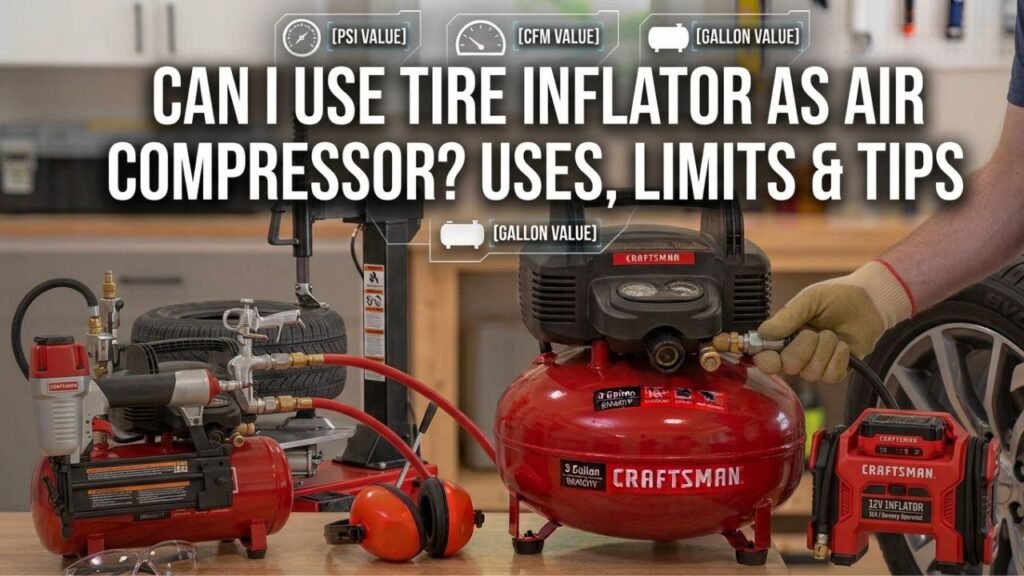
You can use a tire inflator for jobs that involve slowly putting compressed air into a relatively small sealed object.
Typical examples include:
• Car and truck tires
• Motorcycle tires
• Bicycle tires, with the correct adapter
• Sports balls
• Small inflatable toys
• Some air mattresses and recreational inflatables, depending on the inflator
However, most tire inflators cannot function like a traditional workshop air compressor because they lack two important things:
High airflow and stored compressed air.
A standard shop compressor has a pump that fills a receiver tank. That tank provides a reserve of compressed air that can be released quickly when a pneumatic tool needs it.
Most tire inflators are tankless. They produce air and send it directly through the hose.
This works well when filling a tire because tire inflation is comparatively slow and does not require a sudden high-volume blast of air.
It becomes a problem when operating equipment such as an impact wrench, air ratchet, grinder, or spray gun because those tools can require much more airflow.
Is a Tire Inflator Technically an Air Compressor?
Yes.
The basic mechanism performs the same fundamental job: it takes atmospheric air and compresses it.
However, the intended application is different.
It is similar to comparing a small electric screwdriver with a heavy-duty drill. Both rotate a bit, but they are designed around very different loads.
A tire inflator is generally optimized for:
• Portability
• High enough pressure for tires
• Low electrical power requirements
• Compact size
• Short or moderate inflation cycles
A shop air compressor is generally optimized for:
• Higher sustained airflow
• Compressed-air storage
• Pneumatic tools
• Repeated operation
• Multiple accessories
• Higher-duty workloads
Key Takeaways:
• A tire inflator is technically a small compressor, but it is not normally a full replacement for a shop compressor.
• It works best for tires and other inflation tasks.
• The main limitations are usually low CFM, no storage tank, and limited duty cycle.
• High maximum PSI does not automatically mean an inflator can operate pneumatic tools.
Tire Inflator vs. Air Compressor: What Is the Difference?
The terms are sometimes used interchangeably because both machines compress air, but their practical capabilities can be very different.
| Feature | Tire Inflator | Conventional Air Compressor |
| Primary purpose | Inflating tires | Supplying compressed air for many tasks |
| Air tank | Usually none | Commonly included |
| Airflow | Generally low | Can range from low to very high |
| Maximum PSI | Often relatively high | Varies by model |
| Portability | Usually excellent | Depends on size |
| Tire inflation | Excellent | Excellent |
| Nail guns | Usually unsuitable | Commonly suitable |
| Impact wrench | Usually unsuitable | Suitable when CFM is adequate |
| Spray gun | Usually unsuitable | Suitable with adequate CFM |
| Air blow gun | Limited or impractical | Suitable |
| Continuous air tools | Usually unsuitable | Possible with proper compressor |
| Power source | Battery, 12V, or AC | AC, gasoline, battery, or other systems |
The important lesson is that PSI alone does not describe compressor capability.
PSI Measures Pressure
PSI means pounds per square inch.
For example, if your car tire needs 35 PSI, an inflator must be capable of producing pressure above that level to fill it.
Many portable inflators have more than enough maximum pressure for ordinary vehicle tires.
CFM Measures Air Volume
CFM means cubic feet per minute.
It tells you how much air the machine can move during a given amount of time.
This is especially important when operating pneumatic tools.
Imagine two devices can both produce 120 PSI.
Device A produces a very small amount of air.
Device B produces several times more air every minute.
They have similar maximum pressure, but their useful capabilities can be dramatically different.
A Storage Tank Changes How Air Is Delivered
A receiver tank stores compressed air so the system can release a larger volume immediately.
Suppose an impact wrench needs a high burst of airflow.
A tank-style compressor can supply that burst from stored air while its pump continues replenishing the tank.
A tankless tire inflator normally cannot provide the same reserve.
It must supply air directly from its small pump in real time.
Maximum PSI Can Be Misleading
A tire inflator advertised with a high maximum pressure might appear more powerful than a conventional compressor with a lower maximum PSI.
That comparison can be misleading.
For most pneumatic tools, you need both:
Adequate operating pressure
and
Adequate airflow at that pressure
A high-pressure inflator with very low airflow can still be incapable of operating even a modest air tool.
Can a Tire Inflator Run Air Tools?
For most ordinary portable tire inflators, no.
Pneumatic tools generally consume air much faster than a tankless tire inflator can supply it.
Tools that usually should not be connected directly to a basic tire inflator include:
• Impact wrenches
• Air ratchets
• Die grinders
• Angle grinders
• Air hammers
• Pneumatic sanders
• Paint spray guns
• Sandblasting equipment
• Most high-demand blow guns
There can be exceptions with specialized onboard-air systems or high-output compressors designed for more than tire inflation, but those systems should not be confused with a typical handheld or small portable tire inflator.
Can a Tire Inflator Run an Impact Wrench?
Normally, no.
Many pneumatic impact wrenches need several CFM at approximately 90 PSI, with instantaneous airflow demand potentially much higher depending on the tool.
A small tire inflator might reach 100 PSI, 120 PSI, or even higher, but that does not mean it can provide enough air volume.
An impact wrench also consumes air very quickly while its trigger is pressed.
A tire inflator without a storage tank usually cannot supply that demand.
If you want to operate an air impact wrench regularly, I recommend using a conventional compressor sized according to the wrench manufacturer’s CFM requirement.
For a typical automotive 1/2-inch impact wrench, a compressor in roughly the 6–10 CFM at 90 PSI range with a 20–30 gallon tank is a far more practical starting point than a portable tire inflator.
Can a Tire Inflator Run a Nail Gun?
Usually not directly.
Nail guns use relatively little air compared with grinders or sanders, and they consume air in short bursts rather than continuously.
That makes them compatible with surprisingly small tank-style compressors.
However, a basic tire inflator still usually lacks:
• An air receiver tank
• A standard regulator
• Appropriate quick-connect fittings
• Sufficient instantaneous airflow
A small 2–6 gallon compressor is generally a much better choice for nailers.
Can a Tire Inflator Run a Blow Gun?
A standard blow gun needs a steady stream of compressed air.
A tire inflator may technically push air through an open fitting, but the airflow will normally be far weaker than what you expect from a conventional compressor.
It is not a practical substitute for:
• Cleaning workshop equipment
• Blowing dust from machinery
• Drying components
• Clearing debris
If compressed-air cleaning is one of your goals, buy a compressor designed to supply continuous airflow.
Key Takeaways:
• Most tire inflators cannot run pneumatic tools because their airflow is too low.
• Impact wrenches need much more than high PSI; they also require adequate CFM.
• Even low-air-consumption tools such as nail guns are better paired with a small tank compressor.
• Specialized onboard-air systems may handle more tasks, but a typical portable inflator should be treated primarily as an inflation device.
What Can You Actually Do With a Tire Inflator?
A tire inflator can be extremely useful when you use it for the jobs it was designed to perform.
Inflate Car Tires
This is its primary purpose.
A portable inflator is excellent for:
• Correcting slightly low tire pressure
• Restoring pressure after temperature changes
• Inflating a tire after repairing a small puncture
• Emergency roadside inflation
• Maintaining spare tires
For normal tire maintenance, I actually prefer a portable inflator over hauling out a large shop compressor because it is quicker and easier to set up.
Inflate Motorcycle Tires
Motorcycle tires have relatively low internal air volume, so a portable inflator can usually handle them comfortably.
Always set pressure according to the motorcycle or tire manufacturer’s recommendations.
Inflate Bicycle Tires
Many tire inflators can handle bicycle tires when used with the correct valve adapter.
Check whether your bicycle uses:
• Schrader valves
• Presta valves
High-pressure road-bike tires may require greater pressure than typical passenger-car tires, so verify the inflator’s working range.
Inflate Sports Balls
An inflation needle allows many units to fill:
• Basketballs
• Footballs
• Soccer balls
• Volleyballs
Use care because the internal volume is small, meaning pressure can rise quickly.
Inflate Air Mattresses and Pool Toys
Some inflators include adapters for inflatables.
However, a high-pressure tire inflator is not always ideal for large-volume, low-pressure items such as air mattresses.
A dedicated high-volume inflator can often fill these items faster.
This illustrates another important difference between pressure and airflow: an air mattress needs lots of air volume but very little pressure.
Use It for Emergency Tire Inflation
This is arguably one of the best reasons to carry a portable inflator.
A slow leak that leaves a tire several PSI below specification can sometimes be corrected long enough to reach a safe repair location, provided the tire is otherwise safe to inflate and drive on.
Do not inflate or drive on a tire with obvious structural damage, exposed cords, a major sidewall failure, severe deformation, or other unsafe conditions.
What a Tire Inflator Usually Cannot Replace
A tire inflator should generally not be considered a replacement for a compressor if you need to:
• Operate pneumatic impact tools
• Use die grinders
• Run pneumatic sanders
• Spray automotive paint
• Operate larger nail guns continuously
• Sandblast
• Supply shop air lines
• Seat difficult tire beads
• Power several pneumatic devices
• Produce strong continuous blow-gun airflow
These applications depend more heavily on air volume and reserve capacity.
Why CFM Is More Important Than Maximum PSI for Air Tools
One of the most common buying mistakes is comparing only PSI ratings.
Consider this simplified example:
| Device | Maximum Pressure | Airflow Capability | Best Use |
| Portable tire inflator | High | Low | Tires |
| Small tank compressor | High | Low to moderate | Nailers, inflation, light tools |
| Garage compressor | High | Moderate to high | Impact tools, automotive work |
| Large shop compressor | High | High | Continuous pneumatic tools |
A small inflator may advertise 150 PSI while a larger shop compressor advertises a similar maximum pressure.
That does not make them equally capable.
The larger machine may produce several times the airflow and store multiple gallons of compressed air.
Airflow Falls as Pressure Increases
Another detail worth understanding is that compressor airflow generally changes with discharge pressure.
A compressor may produce its highest airflow when there is little resistance at the outlet.
As system pressure increases, usable airflow generally decreases.
That is why compressor specifications for pneumatic tools should ideally be compared at a realistic operating pressure, such as 90 PSI, rather than using only an unrestricted or zero-pressure airflow number.
Pro Tip: When comparing a compressor with an air tool, look for the compressor’s CFM or SCFM rating at the PSI required by the tool.
Why Tire Inflators Usually Do Not Have Tanks
Removing the tank makes a tire inflator:
• Smaller
• Lighter
• Easier to store
• Easier to carry in a vehicle
• Less expensive to manufacture
A tire does not normally need an external air reservoir because the tire itself receives the air directly as the pump produces it.
Pneumatic tools are different.
They may consume a large amount of air almost instantly.
A receiver tank gives a conventional compressor stored energy that can satisfy these short peaks in demand.
Could You Add an Air Tank to a Tire Inflator?
Technically, some compressor systems are designed to work with receiver tanks.
However, I would not recommend improvising a pressure-vessel system around an ordinary portable tire inflator unless the manufacturer specifically designed and approved the equipment for that type of use.
A safe compressed-air system needs properly rated components, including:
• Pressure vessel
• Pressure switch
• Safety relief valve
• Pressure regulator
• Appropriate fittings
• Rated hose
• Suitable compressor controls
Compressed-air tanks store significant energy. This is not an area where makeshift modifications are worthwhile.
If you need a tank, buying a purpose-built compressor is the safer and usually more practical solution.
Can You Use a 12-Volt Tire Inflator Like a Compressor?
A 12-volt inflator is still a small compressor, but its power supply limits what it can realistically do.
It is primarily intended for vehicle-tire inflation.
Some units plug into a 12-volt accessory socket, while more powerful versions may connect directly to the vehicle battery.
Watch the Electrical Requirements
Do not assume every 12-volt inflator can safely plug into every vehicle outlet.
High-output inflators can draw substantial current.
Follow the manufacturer’s connection instructions.
If the unit requires battery clamps, do not replace them with a small accessory-plug connection just for convenience.
Observe the Duty Cycle
Many compact compressors are not designed to run indefinitely.
A manufacturer’s duty-cycle or runtime limit tells you how long the motor and pump can operate before needing cooling time.
Ignoring it can cause:
• Excessive heat
• Thermal shutdown
• Premature motor wear
• Damaged electrical components
• Reduced compressor life
Important Tip: If your tire inflator becomes unusually hot, stops automatically, or reaches its specified runtime limit, stop using it and follow the manufacturer’s cooling instructions.
Can a Cordless Tire Inflator Replace a Compressor?
For tire maintenance, possibly.
For a workshop, no.
Battery-powered inflators are convenient because you do not need:
• An extension cord
• A 12-volt socket
• A large compressor tank
• A long air hose
They are excellent for keeping vehicle tires at the correct pressure.
However, the same airflow limitations apply.
A cordless inflator is not automatically suitable for pneumatic tools simply because it uses a powerful battery platform.
Its motor, pump, hose, controls, and operating cycle are still designed primarily around inflation.
Tire Inflator vs. Small Pancake Compressor
If you are deciding between these two machines, think about what you expect to do later.
Choose a Tire Inflator If You Mainly Need:
• Car tire inflation
• Motorcycle tire inflation
• Bicycle tire inflation
• Emergency roadside use
• Sports equipment inflation
• Maximum portability
Choose a Small Pancake Compressor If You Need:
• Tire inflation
• Brad nailers
• Finish nailers
• Staplers
• Blow-gun capability
• A small compressed-air reserve
• Standard air fittings
A pancake compressor is less portable than a small inflator but substantially more versatile.
Choose a Larger Compressor If You Need:
• Impact wrenches
• Air ratchets
• Air hammers
• Die grinders
• Pneumatic sanders
• Spray equipment
• Regular automotive repair
The exact compressor size should be based on the highest-CFM tool you intend to use.
Key Takeaways:
• Choose a tire inflator when portability and tire maintenance are the priorities.
• Choose a pancake compressor if you want a tank and need to operate nailers or light pneumatic equipment.
• Choose a larger high-CFM compressor for automotive impact tools and continuous air tools.
• Buy for the most demanding task you realistically expect to perform.
Can an Air Compressor Be Used as a Tire Inflator?
Yes. The reverse situation is much easier.
A conventional air compressor can generally inflate tires very effectively when equipped with:
• A suitable tire chuck
• An accurate pressure gauge
• A regulator when necessary
• Properly rated hose and fittings
A shop compressor may inflate a tire much faster than a compact portable inflator because it has stored compressed air available in its tank.
However, faster inflation also means it can be easier to overshoot the desired pressure.
Check pressure frequently or use a quality inflator gauge.
Do Not Inflate to the Number on the Tire Sidewall
For normal vehicle use, follow the vehicle manufacturer’s recommended cold tire pressure, which is commonly listed on the tire-information placard located around the driver’s door area or in the owner’s manual.
The maximum pressure molded into a tire’s sidewall is not automatically the correct everyday inflation pressure for your vehicle.
When a Tire Inflator Is Better Than an Air Compressor
A conventional compressor is more versatile, but bigger is not always better.
I would choose a tire inflator instead when:
You Need Something for the Trunk
A compact inflator can stay in the vehicle without taking up much space.
You Only Maintain Tire Pressure
There is little reason to operate a large garage compressor solely to add a few PSI to one tire if a portable inflator can do it conveniently.
You Live in an Apartment
Portable battery or 12-volt inflators can be much easier to store than tank compressors.
You Need Roadside Capability
A garage compressor does not help much if your tire is low several miles from home.
Noise and Storage Matter
Although tire inflators can still be noisy, they are substantially smaller and easier to store than most tank-style compressors.
When You Definitely Need a Real Air Compressor
Choose a conventional compressor when the job requires air volume, stored air, or continuous operation.
Pneumatic Automotive Tools
Impact wrenches, ratchets, and air hammers work much better from a correctly sized tank compressor.
Woodworking Nailers
Even though nail guns have relatively modest air requirements, a small tank compressor provides the necessary short bursts efficiently.
Painting
Spray guns can require significant sustained airflow.
A small tire inflator is not an appropriate paint-compressor substitute.
Grinding and Sanding
Pneumatic grinders and sanders are among the more demanding common shop tools because they may operate continuously.
Shop Cleaning
If you want strong airflow from a blow gun, a tank compressor is far more suitable.
Multiple Air Tools
A workshop supplying more than one tool needs enough compressor capacity for its expected simultaneous air demand.
What Size Air Compressor Should You Buy Instead?
Your ideal size depends on your planned applications.
| Main Use | Practical Compressor Starting Point |
| Tire inflation only | Tire inflator or small compressor |
| Brad/finish nailer | 2–6 gallon compressor |
| Framing nailer | 4–6+ gallon compressor |
| Occasional small air tools | 10–20 gallon compressor |
| 1/2-inch impact wrench | About 20–30 gallons with adequate CFM |
| Frequent automotive air tools | 30–60 gallons with higher CFM |
| Sanders/grinders | High-CFM 30–60+ gallon unit |
| Professional shop use | 60–80+ gallons or properly engineered shop system |
Tank size is only part of the decision.
Always compare:
CFM at operating pressure
Required PSI
Duty cycle
Electrical requirements
Tool usage duration
Number of simultaneous users
For air tools, I recommend choosing the compressor based first on CFM rather than selecting a tank size and assuming it will work.
Can You Convert a Tire Inflator Into a Regular Compressor?
For a typical consumer inflator, it usually does not make sense.
You might be able to modify fittings physically, but doing so does not change the machine’s:
• Pump displacement
• Airflow capacity
• Motor power
• Cooling capability
• Duty cycle
• Intended operating design
Adding fittings will not turn a 1-CFM inflator into a compressor capable of providing 6 CFM.
Likewise, attaching a tank does not magically increase long-term compressor output. It merely provides temporary storage.
Once the tank empties, the pump must replace the air.
Why I Would Avoid DIY Pressure-Tank Conversions
Pressure vessels require appropriate design and safety controls.
Improvised systems can expose you to risks from:
• Excessive pressure
• Incorrect fittings
• Hose failure
• Missing pressure relief
• Electrical overload
• Compressor overheating
If your project genuinely needs stored compressed air, buying a purpose-built tank compressor is the better solution.
Key Takeaways:
• Changing hoses or fittings cannot increase an inflator’s fundamental CFM output.
• Adding a tank only creates temporary storage; it does not make the pump more powerful.
• Homemade compressed-air tank systems can create serious safety problems.
• A purpose-built air compressor is the better choice when you need conventional compressor functionality.
How to Tell Whether Your Inflator Can Handle a Particular Job
If you have an unusual inflation or compressed-air application, check the specifications rather than guessing.
Check Maximum Working Pressure
The device must safely produce the pressure required by the application.
Check Airflow
Look for CFM, SCFM, L/min, or another airflow specification.
Be careful about comparing airflow measured at different pressures.
Check Duty Cycle
A machine that can run for only limited periods may not suit long inflation jobs.
Check Hose and Connection Type
Most tire inflators use tire-specific chucks rather than standard pneumatic-tool quick-connect fittings.
Check the Manufacturer’s Approved Uses
This is especially important before connecting equipment that was not included with the inflator.
If the manufacturer describes the device strictly as a tire inflator, I would not assume it is approved for pneumatic tools simply because you can physically create an adapter.
Common Mistakes to Avoid
Assuming 150 PSI Means It Can Run Air Tools
Maximum pressure does not tell you how much air the compressor produces.
Always consider airflow.
Buying Based on PSI Alone
For inflation, PSI matters.
For pneumatic tools, CFM becomes equally or more important once sufficient pressure is available.
Ignoring Runtime Limits
A small pump can overheat if operated beyond its intended duty cycle.
Using Unrated Adapters and Hoses
Every pressurized component should be suitable for the system’s working pressure.
Running an Inflator Unattended
Monitor inflation unless the manufacturer specifically provides and approves automatic shutoff operation.
Trying to Inflate a Seriously Damaged Tire
Compressed air cannot make a structurally unsafe tire safe.
A damaged sidewall, exposed reinforcement, severe bulge, or major bead problem requires proper inspection or replacement.
FAQs About Can I Use Tire Inflator as Air Compressor
Can you use a tire inflator as an air compressor?
Yes, but only for limited applications. A tire inflator compresses air and can handle tires and similar inflation jobs, but most models do not provide enough airflow or stored air for pneumatic tools.
Is a tire inflator the same thing as an air compressor?
A tire inflator contains a small air compressor, but the terms usually describe different types of equipment. A tire inflator is optimized for inflation, while a conventional air compressor is designed to supply compressed air for a wider range of equipment.
Can I use a tire inflator for an impact wrench?
Generally no. Pneumatic impact wrenches need substantially more airflow than most portable tire inflators can supply.
Can I use a tire inflator with a nail gun?
A typical tire inflator is not recommended. A small tank-style air compressor is a much better match for pneumatic nailers because it can store air for each firing cycle.
Can a tire inflator power a spray gun?
Normally no. Spray guns require sustained airflow, and most tire inflators have insufficient CFM.
Can I use a tire inflator as a blow gun?
Most portable tire inflators provide too little airflow to function effectively as a workshop blow gun. A conventional compressor with a tank is more suitable.
Can a tire inflator fill an air mattress?
Some can, particularly if they include an appropriate nozzle. However, large air mattresses require high air volume at low pressure, so a dedicated high-volume inflator may fill them faster.
Can a tire inflator fill truck tires?
Many heavy-duty portable inflators can fill pickup and light-truck tires, but you should verify the manufacturer’s recommended tire-size and pressure limits. Large commercial-truck and RV tires can require a more capable unit.
Why can a 150 PSI tire inflator not run a 90 PSI air tool?
Because pressure and airflow are different. The inflator may reach 150 PSI slowly while producing only a small volume of air. An air tool operating at 90 PSI may consume air much faster than the inflator can produce it.
Does a tire inflator have CFM?
Yes, every compressor has an airflow rate, even if the manufacturer does not prominently advertise it. Some manufacturers express output in CFM while others use liters per minute.
Can I connect an air tank to a portable tire inflator?
Only if the equipment is specifically designed and approved for that configuration. I would avoid homemade pressure-tank conversions because a safe system requires appropriate controls, fittings, pressure relief, and rated components.
Is a pancake compressor better than a tire inflator?
For pneumatic tools, yes. A pancake compressor has a storage tank and is generally designed to operate nailers and other light air equipment. For keeping in a vehicle and inflating tires, a portable inflator is usually more convenient.
Can a regular air compressor inflate car tires?
Yes. With a tire chuck, gauge, hose, and appropriate regulator, a conventional air compressor is excellent for tire inflation.
Do I need an air compressor if I only inflate tires?
Usually not. If tire inflation is your only intended task, a quality portable tire inflator is generally simpler, smaller, and more convenient.
What is more important, PSI or CFM?
For tire inflation, you need enough PSI to reach the required tire pressure, while airflow affects how quickly the tire fills. For pneumatic tools, both PSI and CFM are critical.
Can I use a cordless tire inflator instead of a compressor?
For tire maintenance and similar inflation jobs, yes. For running pneumatic tools, painting, sanding, grinding, or supplying workshop air, generally no.
Conclusion
If your question is can I use tire inflator as air compressor, the practical answer is yes for inflation tasks, but generally no as a substitute for a conventional air compressor.
A tire inflator really does compress air, so it can handle car tires, motorcycle tires, bicycle tires, sports equipment, and compatible inflatables. Its compact size and portability can actually make it a better choice than a large compressor when tire maintenance is your only goal.
The limitation appears when you need high airflow. Most portable tire inflators are tankless and produce far less CFM than a conventional compressor. That makes them unsuitable for impact wrenches, grinders, sanders, spray guns, and most other pneumatic tools.
So, can you use a tire inflator as an air compressor? Only within its intended capabilities. For filling tires, absolutely. For powering a workshop, no.
If I only needed to maintain vehicle tire pressure, I would choose a good portable tire inflator because it is convenient, compact, and purpose-built for the job. If I expected to operate pneumatic tools, use a blow gun regularly, or spray paint, I would buy a proper tank-style compressor and size it according to the required CFM and PSI.
The easiest rule to remember is simple: use a tire inflator when you need pressure inside a tire; use a conventional air compressor when you need a significant volume of compressed air to do work.