
How to Increase CFM on Air Compressor: 9 Safe Ways That Work
If you want to know how to increase CFM on air compressor systems, the safest approach is to first restore lost airflow, reduce restrictions, operate at the lowest pressure your tools require, and add compressor capacity if you genuinely need more continuous CFM. You usually cannot dramatically increase the actual CFM produced by an existing compressor pump without changing or replacing major components.
That distinction is important. A compressor may feel like it does not produce enough air because of a clogged intake filter, leaks, restrictive hoses, undersized fittings, a dirty regulator, worn pump components, or excessive operating pressure. Correcting those problems can significantly improve the amount of usable air reaching your tool without modifying the compressor itself.
Adding a larger receiver tank can also make a small compressor handle short bursts of high air demand better, but it does not increase the pump’s continuous CFM output. Similarly, increasing tank pressure beyond the manufacturer’s rating is not a safe way to get more airflow.
In this guide, I’ll explain what really determines compressor CFM, nine practical ways to improve or increase available airflow, which popular modifications do not actually increase CFM, how to measure compressor output, and when upgrading to a larger compressor is the better solution.
Can You Actually Increase CFM on an Air Compressor?
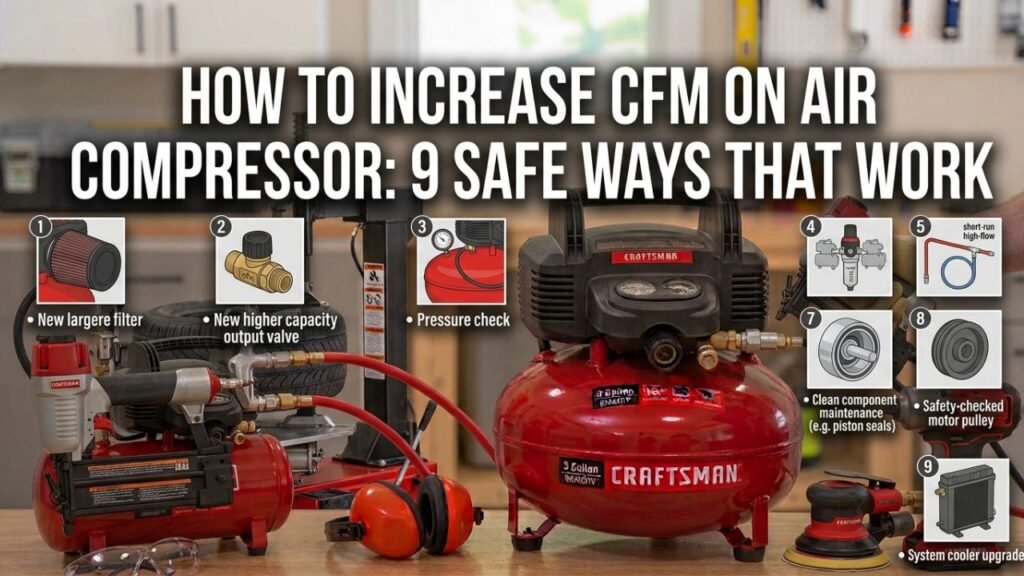
Yes, but there are two different meanings of “increase CFM,” and understanding the difference prevents a lot of wasted money and unsafe modifications.
You can either:
- Increase the actual amount of air the compressor pump produces.
- Increase the usable airflow reaching your pneumatic tool.
The second option is usually much easier.
If a compressor is rated at 4 CFM at 90 PSI, for example, installing a larger hose will not magically turn the pump into an 8-CFM compressor. However, an undersized hose, clogged filter, leaking connection, or restrictive regulator might prevent your tool from receiving the full airflow the compressor already produces.
Fixing those restrictions can make the compressor perform noticeably better.
Actual CFM vs. Usable CFM
| Change | Increases Pump CFM? | Can Improve Tool Airflow? |
| Repair air leaks | No | Yes |
| Replace clogged intake filter | May restore lost output | Yes |
| Use a larger air hose | No | Yes |
| Install high-flow fittings | No | Yes |
| Lower excessive operating pressure | Can improve available flow | Yes |
| Add a larger tank | No | Temporarily |
| Add a second compressor | Yes, combined capacity increases | Yes |
| Install a larger approved pump/motor system | Yes | Yes |
| Raise tank pressure above rating | No safe benefit | No |
| Overspeed the compressor pump | Potentially, but unsafe | Not recommended |
The first thing I recommend is determining whether you truly need more compressor capacity or whether your current system simply has excessive pressure drop.
A pneumatic tool that requires 5 CFM may perform poorly on a compressor rated for 6 CFM if restrictive fittings, hoses, filters, and leaks prevent those 6 CFM from reaching the tool.
Key Takeaways:
• Improving airflow at the tool is not necessarily the same as increasing compressor pump CFM.
• Fix restrictions and maintenance problems before modifying or replacing the compressor.
• A larger tank provides more stored air but does not increase continuous compressor output.
• Major increases in true CFM normally require additional or larger compressor capacity.
What Determines an Air Compressor’s CFM?
CFM means cubic feet per minute. It describes how much air a compressor can deliver over a given period.
Compressor airflow is primarily determined by the design and operating conditions of the compression system.
Compressor Pump Displacement
A reciprocating compressor creates airflow by drawing air into one or more cylinders and compressing it.
Pump displacement depends on factors such as:
• Cylinder bore.
• Piston stroke.
• Number of cylinders.
• Pump speed.
A physically larger pump can generally move more air per revolution than a smaller one.
However, theoretical displacement is not the same as actual delivered CFM because the pump cannot operate at 100% volumetric efficiency.
Pump Speed
Increasing pump RPM can theoretically move more air per minute.
That does not mean you should change pulleys or increase motor speed.
Every compressor pump has a maximum allowable RPM. Overspeeding it can create excessive heat, increase lubrication problems, overload bearings, increase valve wear, overwork the motor, and potentially cause mechanical failure.
I would not modify compressor pulley ratios unless the manufacturer specifically approves the configuration.
Operating Pressure
The pressure against which the compressor operates affects its airflow.
A compressor may produce more CFM at 40 PSI than at 90 PSI, for example. As discharge pressure rises, the pump has to work harder and its delivered airflow may decrease.
This is why compressor specifications commonly include ratings such as:
5.3 CFM at 90 PSI
rather than simply stating “5.3 CFM.”
Always compare CFM at the pressure you actually need.
Volumetric Efficiency
Real compressor output is lower than theoretical displacement because of factors including:
• Valve losses.
• Piston-ring leakage.
• Clearance volume.
• Intake restrictions.
• Heat.
• Internal wear.
• Pressure level.
As components wear or filters become restricted, actual output may fall below what the compressor delivered when new.
Motor Power
The motor provides the power required to turn the compressor pump.
A larger motor alone does not automatically increase CFM. The pump must also be capable of converting that additional power into greater airflow.
Installing a larger motor on the same pump without an engineered reason may simply add cost without improving output.
9 Safe Ways to Increase or Improve CFM on an Air Compressor
The best method depends on whether your compressor has lost performance or was simply too small for your air demand from the beginning.
1. Find and Repair Air Leaks
Leaks are one of the first things to check when a compressed-air system seems unable to keep up.
Air can escape from:
• Hose connections.
• Quick-connect couplers.
• Regulators.
• Manifolds.
• Drain valves.
• Pipe joints.
• Tool fittings.
• Damaged hoses.
• Automatic drains.
Even small leaks force the compressor to replace air that never reaches your tool.
A simple home-shop check is to pressurize the system, stop using all air tools, and listen for leakage. A suitable leak-detection solution can also help identify small leaks around fittings.
Repairing leaks does not increase the compressor’s rated pump displacement, but it increases the percentage of produced air available for useful work.
If your compressor cycles repeatedly when no air should be in use, leakage is one possible cause worth investigating.
2. Clean or Replace the Compressor Intake Filter
The compressor must pull atmospheric air through its intake before it can compress anything.
A dirty intake filter restricts that airflow.
As the filter becomes clogged with dust and debris, pump performance can decline. The motor and pump may also run longer trying to satisfy demand.
Inspect the intake filter according to the manufacturer’s maintenance schedule.
Depending on the compressor design, the correct service may involve:
• Cleaning a reusable element.
• Replacing a disposable filter.
• Replacing damaged filter housing.
• Removing dust around the compressor intake area.
Do not simply operate the compressor permanently without its intake filter. Unfiltered dirt entering the pump can accelerate cylinder, piston-ring, valve, and bearing wear.
3. Restore the Compressor to Proper Mechanical Condition
A compressor that originally produced enough CFM but no longer keeps up may have a maintenance or mechanical problem.
Potential causes include:
• Worn piston rings.
• Damaged reed or intake valves.
• Belt slippage.
• Incorrect belt tension.
• Head-gasket leakage.
• Dirty cooling surfaces.
• Improper oil level on oil-lubricated compressors.
• Internal seal wear.
• Carbon buildup in appropriate compressor designs.
For belt-driven compressors, a slipping belt can prevent the pump from reaching its intended operating speed.
For oil-lubricated compressors, use the correct lubricant and maintain the level specified by the manufacturer.
Restoring a worn compressor can recover CFM that has gradually been lost.
Important Tip: Disconnect power and release stored pressure before servicing compressor components when required by the manufacturer’s procedure. Compressor tanks and lines can remain pressurized even after the motor stops.
4. Operate at the Lowest Pressure That Satisfies the Tool
More PSI does not automatically mean more useful CFM.
In fact, making a compressor operate at unnecessarily high pressure increases the compression work required and can reduce available airflow.
Suppose your pneumatic tool requires 90 PSI but you continually operate the system substantially higher simply because the compressor can produce that pressure. You may be using additional energy without gaining useful tool performance.
Set the compressor and regulator according to the requirements of your equipment.
Do not confuse:
Maximum compressor pressure
with
Required tool pressure
A compressor rated for 150 PSI does not mean every tool should receive 150 PSI.
Using the lowest pressure that reliably satisfies the application can improve system efficiency and, depending on the compressor, improve available airflow.
Never exceed the compressor or tool manufacturer’s allowable pressure.
5. Use a Larger Air Hose
Sometimes the compressor produces sufficient CFM but cannot deliver it efficiently through the hose.
Small-diameter hoses create greater resistance to airflow, particularly when:
• CFM demand is high.
• The hose is long.
• Several fittings are installed.
• The tool uses air continuously.
For light nailers, a small hose may be perfectly adequate.
For an impact wrench, die grinder, sander, spray gun, or other higher-demand air tool, moving from a restrictive 1/4-inch hose to an appropriately sized 3/8-inch hose can noticeably reduce pressure loss.
Large professional systems may require even larger lines.
The correct diameter depends on:
• Required CFM.
• Hose length.
• Operating pressure.
• Fitting size.
• Number of tools.
Do not choose the hose solely by the size of the compressor outlet.
6. Upgrade Restrictive Fittings, Couplers, Regulators, and Filters
Your hose can be large enough while another component still acts like a bottleneck.
Common restrictions include:
• Small quick-connect couplers.
• Narrow plug fittings.
• Undersized regulators.
• Dirty inline filters.
• Water separators with inadequate flow capacity.
• Excessive elbows.
• Small manifolds.
• Partially closed valves.
Every restriction can create pressure drop when air is flowing.
A pressure gauge may show 90 PSI with the tool stopped, yet pressure at the tool may fall substantially when you pull the trigger.
That is why dynamic pressure matters.
If a high-demand tool feels weak, compare pressure near the compressor and at the tool while air is actually flowing.
High-flow couplers and appropriately sized regulators can help when standard components are the bottleneck.
Do not remove necessary filtration or safety devices merely to reduce restriction. Use components with an adequate rated flow instead.
Key Takeaways:
• Leaks and clogged filters waste airflow that your compressor already produces.
• Larger hoses and properly sized fittings can reduce pressure drop substantially.
• Measure pressure while the tool is operating, not just while the system is idle.
• Do not raise system pressure merely to compensate for an avoidable restriction.
7. Reduce Hose Length and Unnecessary Plumbing Restrictions
Longer airflow paths generally create greater pressure loss.
For portable compressors, avoid using 100 feet of narrow hose when 25 feet will do the job.
In a permanent garage or shop installation, piping layout matters even more.
Try to minimize unnecessary:
• Sharp elbows.
• Narrow sections.
• Reducing fittings.
• Excessively long branch lines.
• Restrictive valves.
A larger-diameter main line can transport a higher volume of air with less pressure drop than a small line.
For a large compressed-air network, properly sized loop piping can also allow air to reach demand points through more than one direction.
For a home garage, the same principle is simpler: keep the air path appropriately sized, reasonably short, and free of unnecessary bottlenecks.
8. Add an Approved Air Receiver for Short High-CFM Demands
Adding an auxiliary tank is frequently suggested as a way to “increase compressor CFM.”
Technically, it does not.
A receiver tank stores air your compressor has already produced.
Imagine a compressor that produces 4 CFM while your impact wrench needs significantly more airflow during short bursts.
A larger tank lets the compressor build up a larger reserve before you start. The tool can temporarily draw from that stored air faster than the pump produces it.
Eventually, however, the stored pressure falls.
If the tool continuously consumes more air than the pump produces, no tank size can solve that imbalance indefinitely.
When an Auxiliary Tank Helps
Additional storage is most useful for intermittent equipment such as:
• Impact wrenches.
• Nail guns.
• Air ratchets.
• Blow guns.
• Other short-duration pneumatic tools.
It is less effective as a solution for continuous high-demand tools such as:
• Sanders.
• Die grinders.
• Some spray equipment.
• Sandblasting equipment.
• Continuous pneumatic machinery.
These applications eventually consume the stored reserve and expose the compressor’s actual continuous CFM limitation.
Air Receiver Safety Matters
Only use a properly manufactured pressure vessel rated for compressed-air service and for the intended operating pressure.
The receiver needs appropriate pressure-control and safety equipment for its application.
Never build a homemade air tank from:
• Propane cylinders.
• Water heaters.
• Unrated pipe.
• Fire extinguishers not designed and approved for the application.
• Other improvised containers.
Also never weld, drill, or structurally modify a pressurized air receiver unless the work is performed under the appropriate professional engineering and pressure-vessel requirements.
A failed compressed-air tank can release tremendous stored energy.
9. Add Compressor Capacity
If you need a genuine and substantial increase in continuous CFM, this is the solution that eventually matters.
There are several ways to do it.
Run Two Compatible Compressors Together
Two properly configured compressors can supply greater combined airflow than either unit individually.
For example, two compressors each capable of delivering approximately 5 CFM at the required operating pressure could theoretically provide close to 10 CFM combined before system losses, provided the system is engineered and controlled appropriately.
The setup must account for:
• Check valves.
• Pressure-switch settings.
• Tank pressure ratings.
• Electrical circuit capacity.
• Correct manifolds and piping.
• Moisture management.
• Compressor duty cycles.
Simply joining two compressors with random fittings is not the best approach.
For a permanent installation, use a configuration approved for the equipment or have the system designed by someone familiar with compressed-air systems.
Upgrade the Compressor Pump and Motor as an Engineered Package
Some larger belt-driven compressors can support manufacturer-approved pump or motor configurations.
However, replacing the pump with a higher-output model may also require changes to:
• Motor horsepower.
• Pulley ratio.
• Belt size.
• Electrical supply.
• Starter or overload protection.
• Pressure switch.
• Check valve.
• Discharge tubing.
• Cooling.
• Tank compatibility.
At that point, upgrading the complete compressor is frequently more practical and safer.
Replace the Compressor With a Higher-CFM Model
For most home users, this is the simplest way to gain substantial continuous airflow.
If your current compressor produces 2.6 CFM at 90 PSI and your equipment needs 8–10 CFM continuously, optimizing hoses and fixing leaks will not bridge the entire gap.
You need more compressor capacity.
Choose the replacement based primarily on delivered CFM at the required PSI, not tank gallons or maximum PSI alone.
Does Adding a Second Air Compressor Double CFM?
It can approximately add the output of both compressors when the compressors are supplying the same system under compatible operating conditions.
For example:
Compressor A = 5 CFM at 90 PSI
Compressor B = 5 CFM at 90 PSI
Potential combined supply ≈ 10 CFM at comparable conditions
Real-world usable airflow may be somewhat lower because of plumbing restrictions, pressure-control differences, and other losses.
The compressors also need compatible pressure ranges.
If one compressor switches off much earlier than the other, airflow sharing may be uneven.
For occasional DIY use, combining portable compressors can sometimes be practical with appropriate hardware. For a permanent or high-demand system, coordinated controls are better.
Also verify your electrical supply. Two compressors starting simultaneously can place a significant demand on household or shop circuits.
Does a Bigger Air Tank Increase CFM?
No. A bigger tank does not increase the compressor pump’s continuous CFM.
This deserves emphasis because it is one of the biggest misconceptions about compressors.
Consider a compressor that produces 5 CFM.
Whether it has a:
• 6-gallon tank.
• 20-gallon tank.
• 60-gallon tank.
the pump is still fundamentally producing approximately the airflow it was designed to deliver at a given pressure.
What changes is the amount of compressed air stored for temporary use.
A larger tank can provide:
• Longer operation before pressure falls.
• More reserve for short airflow spikes.
• Longer compressor run cycles.
• Fewer rapid start-stop cycles when properly sized.
But after the stored air is depleted, your sustainable airflow returns to what the pump can continuously produce.
Key Takeaways:
• A larger receiver increases stored-air capacity, not pump CFM.
• Extra storage works best for short bursts of high demand.
• Continuous tools still require a compressor capable of matching their average sustained airflow.
• Adding actual compressor capacity is the correct solution when demand consistently exceeds supply.
Will Increasing PSI Increase CFM?
Generally, no.
Trying to solve a low-CFM problem by dramatically increasing pressure is usually the wrong approach.
CFM and PSI describe different things:
CFM = volume of airflow
PSI = air pressure
Higher tank pressure allows more compressed air to be stored within the same tank volume, but generating that higher pressure also makes the compressor work harder.
A compressor’s delivered airflow commonly decreases as discharge pressure increases.
Never adjust the pressure switch above the compressor manufacturer’s maximum setting.
Doing so can:
• Overload the motor.
• Increase pump temperature.
• Exceed component ratings.
• Accelerate wear.
• Cause the relief valve to open.
• Create a serious pressure-vessel hazard if safety systems are defeated or inappropriate modifications are made.
The correct way to obtain more CFM is not to defeat pressure limits.
Can You Increase CFM by Changing the Compressor Pulley?
Changing pulley sizes can alter pump RPM on a belt-driven compressor.
Technically, increasing pump RPM can increase displacement per minute.
That does not make pulley modification a good DIY CFM upgrade.
The pump manufacturer establishes an acceptable speed range based on lubrication, cooling, valve behavior, bearing loads, piston speed, and heat generation.
Overspeeding a compressor can lead to:
• Excessive heat.
• Pump damage.
• Motor overload.
• Belt problems.
• Increased oil carryover.
• Valve failure.
• Reduced service life.
• Potential mechanical failure.
If the manufacturer provides an approved pulley combination for your exact pump and motor, follow that specification.
Otherwise, I would avoid pulley changes as a way to increase CFM.
Will a Bigger Motor Increase Air Compressor CFM?
Not by itself.
CFM is determined by the entire compressor system.
Installing a 5-horsepower motor where a 3-horsepower motor was originally used does not automatically make the pump move more air if the pump continues running at exactly the same RPM.
The larger motor simply has more potential mechanical power available.
To take advantage of that power, the compressor pump would need to safely support additional displacement or loading.
That may require a different:
• Pump.
• Pump speed.
• Pulley combination.
• Electrical system.
• Cooling arrangement.
• Control system.
In most small compressors, replacing the entire unit with a correctly engineered higher-CFM model makes more sense.
How to Increase CFM at the Air Tool
If the problem is specifically that an impact wrench, paint gun, sander, or grinder feels weak, focus on the complete air path.
A useful diagnostic sequence is:
- Confirm the tool’s required CFM and PSI.
- Check the compressor’s CFM rating at that pressure.
- Fully charge the compressor.
- Set the regulator correctly.
- Measure pressure while the tool is operating.
- Inspect for air leaks.
- Check the compressor intake filter.
- Inspect inline filters and water separators.
- Use an appropriately sized hose.
- Remove unnecessary restrictive adapters.
- Check coupler and regulator flow capacity.
- Service the compressor if output appears lower than normal.
If the compressor still cannot maintain pressure while the tool runs, the compressor is probably undersized for sustained operation.
How Much Extra CFM Should an Air Compressor Have?
There is no single percentage that suits every compressed-air system because duty cycle and simultaneous demand matter.
For a home workshop, a practical approach is to avoid choosing a compressor whose rated output barely equals your tool requirement.
For example, if a tool consumes approximately 5 CFM at 90 PSI, choosing a compressor that provides some additional capacity makes operation easier than selecting one rated at exactly 5 CFM.
Extra capacity helps accommodate:
• Small system losses.
• Tool-demand variation.
• Compressor wear.
• Future tools.
• Longer operating periods.
For multiple tools operating simultaneously, add their expected simultaneous CFM requirements rather than their PSI values.
For example:
| Tool | Air Requirement |
| Tool A | 4 CFM |
| Tool B | 5 CFM |
| Combined simultaneous demand | 9 CFM |
You would need a compressor system capable of meeting that airflow while maintaining the required operating pressure.
If the tools are never used simultaneously, your calculation can be based on the actual operating pattern instead.
How to Check Your Compressor’s Actual CFM
The manufacturer’s rated CFM should be your primary reference, but a pump-up test can help identify whether an older compressor has lost performance.
One approximate method uses the receiver volume, pressure increase, and time required to pump between two pressure points.
A commonly used simplified formula is:
Approximate CFM = Tank gallons × pressure increase ÷ (7.48 × 14.7 × pump-up time in minutes)
Suppose you have a 20-gallon tank and measure the time required for pressure to rise from 90 PSI to 120 PSI.
Pressure increase = 30 PSI
If the compressor takes one minute:
20 × 30 = 600
7.48 × 14.7 ≈ 110
600 ÷ 110 ≈ 5.45 CFM
This simplified calculation gives an approximate free-air delivery figure and does not fully account for temperature effects or every real-world variable.
Use it primarily for diagnostic comparison rather than as a laboratory-precision measurement.
For example, if the same compressor previously completed the test much faster, a major increase in pump-up time can indicate maintenance or mechanical problems.
Pro Tip: Repeat a pump-up test under similar starting temperature and pressure conditions. Comparing consistent tests is more useful than relying on one isolated measurement.
Signs You Need More CFM
You may genuinely have an airflow-capacity problem if:
• Tank pressure continually falls while the tool operates.
• The compressor runs almost constantly.
• An impact wrench loses strength after a few seconds.
• A spray gun’s performance changes during continuous spraying.
• A sander slows during use.
• Several tools cannot operate simultaneously.
• Recovery periods interrupt your work repeatedly.
• Pressure at the tank remains reasonable but collapses at the tool.
The last symptom may indicate a restriction rather than insufficient compressor capacity.
That is why I recommend diagnosing pressure drop before purchasing a larger compressor.
What Not to Do When Trying to Increase Air Compressor CFM
Some modifications can appear tempting because they are inexpensive, but they may create more problems than they solve.
Do Not Exceed the Tank Pressure Rating
Never adjust pressure controls beyond manufacturer limits.
An air receiver is a pressure vessel containing substantial stored energy.
Do Not Disable the Safety Relief Valve
The relief valve is a critical safety device.
Never plug it, remove it, block it, or prevent it from operating normally.
Do Not Overspeed the Pump
Do not install a different pulley simply because it makes the compressor pump turn faster.
Stay within manufacturer-approved pump RPM.
Do Not Build a Homemade Receiver
An ordinary steel container is not automatically safe for compressed air.
Use an appropriately rated pressure vessel.
Do Not Assume More Horsepower Automatically Means More CFM
Motor horsepower is only one part of compressor performance.
Compare delivered airflow at the pressure you actually use.
Do Not Remove Necessary Filters
A filter can create pressure drop when undersized or clogged, but eliminating essential filtration is not the correct fix.
Use a properly sized, clean filter instead.
Key Takeaways:
• Never increase CFM by exceeding rated pressure or disabling safety equipment.
• Pump-speed and motor modifications should only follow approved engineering specifications.
• Diagnose airflow restrictions before assuming you need a larger compressor.
• When demand consistently exceeds output, buying more compressor capacity is usually the safest and most effective answer.
Best CFM Upgrade Based on Your Situation
| Your Problem | Best Approach |
| Compressor used to perform better | Service pump and inspect intake filter |
| Pressure drops through hose | Increase hose diameter or reduce length |
| Weak airflow through connections | Upgrade properly sized couplers/regulator |
| Compressor runs with no tools operating | Find and repair leaks |
| Tool needs short bursts of high CFM | Consider an approved larger receiver |
| One small compressor cannot keep up | Add compatible compressor capacity |
| Continuous tool demand exceeds output | Upgrade to higher-CFM compressor |
| Pressure is set unnecessarily high | Reduce to appropriate operating pressure |
| Pump is heavily worn | Repair or replace pump/compressor |
For most home users, I would begin with the inexpensive fixes: leaks, filters, hose diameter, fittings, regulator sizing, and maintenance.
If those are correct and your compressor still cannot supply the tool, stop trying to make a small compressor behave like a much larger one.
Upgrade the air source.
FAQs about How to Increase CFM on Air Compressor
Can I increase the CFM of my existing air compressor?
You can often improve usable airflow and restore lost CFM through maintenance, leak repair, and reduced restrictions. A major increase in actual pump CFM normally requires additional or larger compressor capacity.
Does adding another tank increase CFM?
No. Another tank increases stored-air capacity, allowing short periods of high airflow, but it does not increase the compressor pump’s continuous CFM.
Does a bigger hose increase CFM?
A larger hose does not increase the compressor’s rated output, but it can allow more of the available airflow to reach the tool by reducing pressure loss.
This can produce a noticeable performance improvement with high-demand pneumatic tools.
Will higher PSI give me more CFM?
Generally, no. Higher discharge pressure makes a compressor work harder, and compressor airflow commonly decreases as pressure rises. Use only the pressure required by your equipment.
Can I adjust the pressure switch to increase airflow?
Do not raise the cut-out pressure beyond the manufacturer’s approved range. Changing a pressure switch cannot safely turn an undersized compressor into a higher-CFM compressor.
Can I put a larger pulley on my compressor motor?
Changing pulley diameter changes pump speed. Increasing pump RPM beyond its design limit can overheat or damage the compressor and overload the motor. Use only manufacturer-approved pulley combinations.
Does a more powerful motor increase CFM?
Not automatically. If the same pump continues operating at the same speed, installing a higher-horsepower motor generally does not increase its displacement.
Can I connect two air compressors together for more CFM?
Yes. Properly configured compressors can combine their airflow capacity. The system needs suitable pressure controls, check valves, piping, tank ratings, and adequate electrical power.
How can I get more airflow from a small air compressor?
Fix leaks, maintain the intake filter and pump, use an appropriately sized hose and high-flow connections, eliminate unnecessary restrictions, and let the tank recover between high-demand uses.
An auxiliary receiver can provide additional short-term reserve but will not increase continuous CFM.
Why does my compressor have enough PSI but not enough CFM?
Pressure and airflow are different measurements. A small compressor may reach 150 PSI while producing only a few CFM. It can build high pressure slowly without moving enough air continuously for a high-demand tool.
How do I increase CFM for an impact wrench?
Start with an appropriately sized hose, unrestricted fittings, correct regulated pressure, a fully charged tank, and a well-maintained compressor.
If the wrench consumes more air than the pump produces, a larger receiver may improve short bursts, but a higher-CFM compressor is the long-term solution.
How do I increase CFM for a paint gun?
Reduce restrictions and compare the spray gun’s required CFM with the compressor’s delivered CFM at the necessary pressure. Because many spray guns consume air continuously, extra tank capacity alone may not solve an undersized-compressor problem.
Can a dirty air filter reduce compressor CFM?
Yes. A heavily restricted intake filter can reduce the amount of atmospheric air entering the pump, lowering performance. Inspect and service it according to the compressor manufacturer’s instructions.
Does tank size affect compressor CFM?
Tank size affects how much compressed air can be stored, not how much continuous airflow the pump produces.
A larger tank can make an intermittent high-CFM tool easier to use, but the compressor eventually has to replace every cubic foot of air consumed.
Conclusion
Learning how to increase CFM on air compressor systems begins with understanding that true compressor output and usable airflow are not exactly the same thing. You may not need to modify the pump at all.
Start by repairing leaks, servicing the intake filter and compressor, using the correct operating pressure, increasing hose diameter where necessary, and eliminating restrictive couplers, regulators, filters, and unnecessary plumbing. These changes can help deliver more of the compressor’s existing airflow to your tools.
If you only need occasional bursts of additional air, an appropriately rated receiver tank can increase stored capacity. However, it will not increase continuous CFM.
For a genuine increase in sustained airflow, the practical choices are adding compatible compressor capacity or upgrading to a compressor with a higher delivered CFM rating at the pressure you need.
I would avoid attempts to gain CFM by raising pressure beyond manufacturer limits, overspeeding the pump, changing pulleys without approved specifications, disabling safety equipment, or using homemade air receivers. If your compressor is fundamentally too small for the tool, a properly sized higher-CFM compressor is the safest, most reliable, and most effective solution.