
How to Figure Out CFM of Air Compressor: Accurate Test Guide
If you want to know how to figure out CFM of air compressor, first check the compressor’s specification label, manual, or manufacturer data for its delivered CFM or SCFM at a stated PSI. If that information is unavailable, you can estimate actual output with a timed tank-fill test using the receiver volume, pressure increase, and fill time.
CFM, or cubic feet per minute, tells you how much air a compressor can deliver over time. It is one of the most important specifications when deciding whether a compressor can keep up with an impact wrench, spray gun, grinder, nailer, tire machine, or other pneumatic equipment.
Finding the correct number is not always as simple as reading the largest number printed on the compressor. You may see CFM, SCFM, displacement CFM, free air delivery, tank gallons, maximum PSI, and horsepower on the same machine. These measurements are related, but they are not interchangeable.
The pressure attached to the airflow rating also matters. A compressor advertised as delivering 6 SCFM at 40 PSI may deliver less at 90 PSI. If your air tool requires 5 CFM at 90 PSI, the specification that matters is the compressor’s delivered airflow around 90 PSI—not its maximum PSI, horsepower, or tank size.
In this guide, I’ll explain how to find, check, calculate, and test air compressor CFM; how to perform a practical tank-fill test; what the formula means; how CFM differs from SCFM and displacement CFM; and how to determine how many CFM your compressor actually provides.
How to Figure Out CFM of Air Compressor
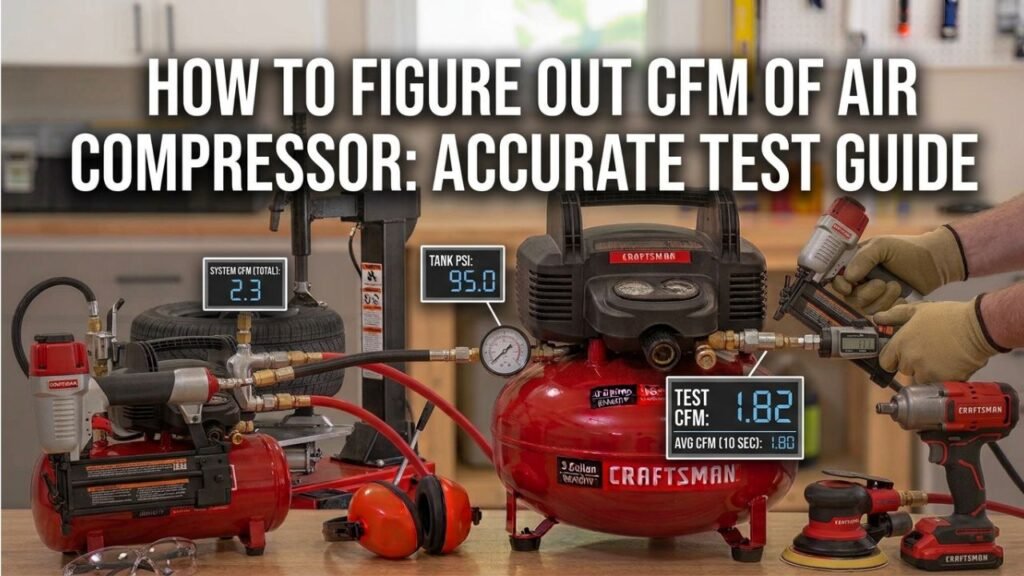
There are three practical ways to figure out the CFM of an air compressor:
- Check the manufacturer’s rated airflow. This is usually the easiest and most useful method.
- Perform a timed tank-fill test. This provides a practical estimate when specifications are unavailable or you want to evaluate current compressor performance.
- Calculate theoretical pump displacement. This can be done on some reciprocating compressors if you know the pump dimensions and speed, but it does not tell you exact delivered airflow.
For most owners, I recommend starting with the manufacturer’s rating.
Look for specifications such as:
- CFM at 90 PSI
- SCFM at 90 PSI
- SCFM at 40 PSI
- Free Air Delivery or FAD
- Air delivery
- Delivered air
- Compressor capacity
A specification such as 5.0 SCFM @ 90 PSI is far more useful than simply knowing that the compressor has a 20-gallon tank and a 150 PSI maximum pressure.
Where to Look for Your Compressor’s CFM Rating
Check these places in order:
- Compressor specification label or data plate
- Owner’s manual
- Original product specification sheet
- Manufacturer’s website
- Pump or compressor model documentation
The specification may be printed on the compressor tank, motor cover, pump housing, or a separate identification label.
If you have an older compressor, record the full model number and search the manufacturer’s documentation for that exact model. Compressors that look nearly identical can use different pumps or motors and have different CFM ratings.
Look for CFM at a Specific PSI
Do not stop when you find the letters CFM.
Look at the pressure associated with that airflow figure.
For example:
| Compressor Rating | What It Means |
| 6.5 SCFM @ 40 PSI | Rated airflow at 40 PSI |
| 5.1 SCFM @ 90 PSI | Rated airflow at 90 PSI |
| 150 PSI maximum | Maximum pressure capability, not airflow |
| 20-gallon tank | Stored-air capacity, not pump CFM |
| 2 HP motor | Motor power, not exact airflow |
If you plan to use an air tool at 90 PSI, the 90 PSI airflow rating is usually the more relevant specification.
What Does CFM Mean on an Air Compressor?
CFM stands for cubic feet per minute.
It describes a volumetric flow rate: how much air moves through the compressor system during one minute.
Higher CFM means the compressor can supply a greater volume of air over time.
That is particularly important for tools that consume air continuously.
A framing nailer may use short bursts and therefore operate satisfactorily from a relatively small compressor. A grinder or spray gun can consume air almost continuously, so sustained compressor CFM becomes much more important.
CFM Is Not the Same as PSI
PSI and CFM measure different things.
PSI measures pressure.
CFM measures airflow volume over time.
A compressor must provide enough of both.
A machine that reaches 175 PSI but produces very little CFM may still struggle with a high-air-demand tool.
Likewise, high airflow is not useful if the compressor cannot maintain the operating pressure required by the equipment.
Tank Gallons Are Not CFM
A 60-gallon compressor does not automatically produce more CFM than a 30-gallon compressor.
The tank stores compressed air.
The compressor pump produces airflow.
A large receiver can help handle temporary demand and reduce rapid pressure fluctuations, but it does not increase the pump’s continuous airflow capacity.
Horsepower Is Not CFM
Motor horsepower can influence how much compressor capacity is possible, but you cannot accurately determine CFM from horsepower alone.
Two compressors with the same horsepower can have different:
- Pump designs
- Pump speeds
- Operating pressures
- Volumetric efficiencies
- Number of compression stages
- Drive systems
- Cooling characteristics
- Actual delivered airflow
Internet rules that assign a fixed number of CFM to every horsepower rating are useful only as very rough estimates. They should not replace manufacturer data or an actual airflow test.
CFM vs. SCFM vs. FAD: Know Which Number You Are Comparing
Air compressor airflow can be expressed in several ways. Understanding the terminology prevents misleading comparisons.
CFM
CFM is simply a unit of volumetric airflow: cubic feet per minute.
For the number to be truly meaningful, the conditions at which the volume is measured should also be known because air volume changes with pressure and temperature.
SCFM
SCFM means standard cubic feet per minute.
The airflow is converted to a defined set of standard reference conditions so different measurements can be compared more consistently.
However, the exact temperature, pressure, and humidity used as the “standard” can vary with the standard or manufacturer. When making close comparisons, check how the manufacturer defines SCFM rather than assuming every rating was normalized identically.
Free Air Delivery
Free Air Delivery (FAD) expresses compressor output as an equivalent volume of air at specified inlet or free-air conditions.
This is useful because it represents the amount of atmospheric air the compressor actually takes in and delivers after accounting for compression.
For compressor selection, delivered airflow or FAD at your required operating pressure is generally much more useful than theoretical pump displacement.
Displacement CFM
Displacement CFM is the theoretical volume the compressor pump could move based on its physical displacement and speed.
It does not fully account for real-world losses.
Actual delivered airflow is lower because compressors have losses associated with:
- Valve operation
- Clearance volume
- Leakage
- Heating
- Pressure
- Pump efficiency
- Mechanical design
If one compressor advertises displacement CFM and another advertises delivered SCFM, you are not comparing equivalent numbers.
Key Takeaways:
- CFM measures airflow; PSI measures pressure.
- Tank gallons tell you storage capacity, not continuous compressor output.
- SCFM normalizes airflow to specified standard conditions.
- Delivered airflow or FAD is more useful than theoretical displacement when evaluating real compressor performance.
How to Find CFM of Air Compressor From the Label or Manual
Finding the manufacturer’s published specification is usually the most reliable starting point.
Step 1: Find the Model Number
Locate the compressor’s identification plate and write down:
- Brand
- Complete model number
- Pump model if listed
- Serial number if needed to identify a production version
Do not rely only on tank size or horsepower.
A manufacturer may sell several 20-gallon compressors with very different airflow ratings.
Step 2: Find the Air Delivery Specification
Look for wording such as:
SCFM @ 90 PSI
or:
CFM @ 100 PSI
or:
Free Air Delivery
You may also see multiple ratings.
For example, a compressor could have one airflow figure at 40 PSI and another at 90 PSI.
Step 3: Use the Rating Closest to Your Working Pressure
Suppose your spray equipment operates around 40 PSI and your impact wrench requires 90 PSI.
The 40 PSI rating helps with the spray application.
The 90 PSI rating is more useful for the impact wrench.
Do not assume the compressor delivers exactly the same CFM at every discharge pressure.
Step 4: Make Sure It Is Delivered CFM
If the specification says displacement, pump displacement, or theoretical airflow, do not treat that number as actual tool-ready output.
Look for delivered CFM, SCFM, FAD, or another manufacturer-defined output rating.
How to Check CFM on an Air Compressor When the Rating Is Missing
If the identification label is unreadable, the compressor is old, or no airflow specification can be found, a practical pump-up test can estimate its output.
The basic idea is straightforward:
You know the volume of the receiver tank.
You measure how much its pressure increases.
You measure how long the compressor takes to create that increase.
From those values, you estimate the equivalent volume of free air pumped into the tank per minute.
This is commonly called a tank-fill test, pump-up test, or receiver test.
It is especially useful when you want to answer questions such as:
- How many CFM is my old compressor?
- Is my compressor still producing close to its original capacity?
- Is the pump weaker than I expected?
- Can an unidentified compressor supply enough air for my tools?
How to Test Air Compressor CFM With a Tank-Fill Test
A tank-fill test is one of the simplest DIY ways to estimate compressor output without installing a dedicated airflow meter.
Safety Before Testing
Compressed-air receivers store substantial energy.
Never bypass the pressure switch, safety relief valve, unloader, or any other safety device to perform a CFM test. Never exceed the tank’s rated working pressure.
Make sure fittings are secure and the receiver is in safe condition. Do not test a tank that is badly rusted, physically damaged, leaking, or otherwise questionable.
Follow the manufacturer’s instructions when draining condensation or servicing the compressor.
What You Need
You need:
- Known receiver tank capacity
- Reliable tank pressure gauge
- Stopwatch or timer
- Calculator
- Compressor operating normally
- No air tools consuming air during the test
If more than one receiver is permanently connected and participating in the test, the effective storage volume needs to account for those receivers as well.
Step 1: Find the Tank Capacity
Tank capacity is usually listed in gallons in the United States.
Common sizes include:
- 6 gallons
- 10 gallons
- 20 gallons
- 30 gallons
- 60 gallons
- 80 gallons
You will convert gallons to cubic feet for the basic formula.
One cubic foot is approximately 7.48 U.S. gallons.
So:
Tank volume in cubic feet = tank gallons ÷ 7.48
For a 20-gallon tank:
20 ÷ 7.48 ≈ 2.67 cubic feet.
Step 2: Choose a Starting and Ending Pressure
You need two gauge-pressure readings:
P1 = starting pressure
P2 = ending pressure
For example:
Starting pressure = 40 PSI
Ending pressure = 90 PSI
The pressure increase is:
90 − 40 = 50 PSI.
The compressor must run normally throughout the measured interval.
Do not alter or bypass its normal controls merely to achieve a particular test range.
Step 3: Prevent Air From Being Consumed During the Test
Disconnect or shut off equipment that would consume compressed air.
Close the tank drain valve normally.
Inspect the system for obvious leakage before testing.
Air leaking out while the compressor is filling the receiver makes the calculated output lower than the pump’s actual production.
Step 4: Time the Pressure Increase
Start timing when the tank pressure reaches your selected starting pressure.
Stop timing when the pressure reaches the ending pressure.
Record the time accurately.
Seconds matter, particularly on small tanks that fill quickly.
Step 5: Calculate the Pressure Difference
Use:
Pressure increase = ending PSI − starting PSI
If the tank increases from 40 PSI to 90 PSI:
Pressure increase = 50 PSI.
Step 6: Put the Numbers Into the CFM Formula
The simplified pump-up test formula is:
CFM ≈ (Tank volume in cubic feet × pressure increase in PSI) ÷ (14.7 × fill time in minutes)
Where:
- Tank volume is in cubic feet
- Pressure increase is in PSI
- 14.7 PSI represents approximate atmospheric pressure at sea level
- Time must be in minutes
This gives an estimate of free-air volume per minute under the assumptions of the simplified test.
Air Compressor CFM Formula Using Tank Gallons
Because U.S. compressor tanks are usually labeled in gallons, you can combine the gallon-to-cubic-foot conversion directly into the formula.
Use:
CFM ≈ (Tank gallons × pressure increase) ÷ (7.48 × 14.7 × time in minutes)
Because:
7.48 × 14.7 ≈ 109.96
you can also write:
CFM ≈ (Tank gallons × pressure increase) ÷ (109.96 × time in minutes)
This makes the calculation fairly quick.
Air Compressor CFM Formula When Time Is Measured in Seconds
If your stopwatch gives seconds, do not accidentally enter seconds into a formula that expects minutes.
Use:
CFM ≈ (Tank gallons × pressure increase × 60) ÷ (7.48 × 14.7 × time in seconds)
or approximately:
CFM ≈ (Tank gallons × pressure increase × 60) ÷ (109.96 × time in seconds)
Using the wrong time unit can make your result off by a factor of 60.
Example: Calculating CFM From a 20-Gallon Tank
Suppose you have:
- 20-gallon tank
- Starting pressure: 40 PSI
- Ending pressure: 90 PSI
- Fill time: 2 minutes
First convert tank capacity:
20 ÷ 7.48 = approximately 2.67 cubic feet.
Calculate the pressure increase:
90 − 40 = 50 PSI.
Now apply the formula:
CFM ≈ (2.67 × 50) ÷ (14.7 × 2)
CFM ≈ 133.5 ÷ 29.4
CFM ≈ 4.5 CFM
So the compressor produced an estimated average of about 4.5 CFM of free air over that test pressure range.
That does not automatically mean the manufacturer would rate the machine at exactly 4.5 SCFM @ 90 PSI. The DIY tank-fill method is an approximation, and the result represents average performance during the selected pressure rise.
Key Takeaways:
- A timed receiver test can estimate compressor CFM when specifications are unavailable.
- You need tank volume, pressure increase, and fill time.
- Convert gallons to cubic feet or use the gallons version of the formula.
- A pump-up calculation is an estimate, not necessarily an official SCFM or FAD certification.
How to Test Air Compressor CFM Near 90 PSI
Many pneumatic tools are rated around 90 PSI, so owners often want to know the compressor’s CFM around that pressure.
This requires a little more care.
If you test the compressor from an empty tank all the way to its maximum pressure, the result is an average across that entire pressure range. It does not isolate output at 90 PSI.
A more representative DIY approach is to measure a pressure window around the pressure you care about, provided the compressor naturally runs continuously through that range.
For example, a test from approximately 80 PSI to 100 PSI gives you an average centered near 90 PSI.
However, your compressor’s normal pressure-switch settings may make a particular test range impractical. Do not modify safety controls or force the compressor to operate outside its intended sequence just to run the test.
For an exact, standardized airflow measurement at a specific discharge pressure, a properly installed airflow meter or professional compressor performance test is the better method.
How Accurate Is a Tank-Fill CFM Test?
A tank-fill test is useful, but it is not a laboratory measurement.
Several factors affect the result.
Air Temperature
Compression heats air.
The simplified calculation assumes conditions that may not exactly match what is happening inside a hot receiver during the pump-up test.
Rapidly filling a tank can therefore introduce measurement error.
Atmospheric Pressure
The commonly used 14.7 PSI atmospheric-pressure value represents approximately sea-level atmospheric pressure.
Actual atmospheric pressure changes with elevation and weather.
At significant altitude, using local absolute atmospheric pressure provides a more accurate calculation.
Pressure Gauge Accuracy
A poor tank gauge directly affects the pressure difference used in the calculation.
If the gauge reads several PSI high or low, your calculated CFM will also be affected.
Tank Volume
Nominal tank capacity may not exactly equal the effective internal volume involved in the test.
Connected receivers and substantial piping can also add volume.
Air Leaks
Leaks cause some compressor output to escape rather than remain in the receiver.
The test will then make compressor output appear lower.
Pump Temperature
A compressor’s performance can change as it heats.
A cold test and a fully warmed-up test may not produce identical results.
Motor and Electrical Conditions
Low supply voltage, extension-cord voltage drop, poor electrical connections, or motor problems can reduce compressor performance.
Pressure Range
Reciprocating compressor output is not necessarily identical at every discharge pressure.
A test from 0 to 120 PSI provides a broad average, whereas a narrower test around the intended operating pressure may be more relevant.
How to Make Your CFM Test More Reliable
You can improve a DIY test by using consistent conditions.
Check for Leaks First
Charge the system and listen for obvious leaks around:
- Drain valve
- Couplers
- Regulator
- Pressure switch connections
- Safety valve
- Check valve plumbing
- Hose fittings
Leaks can significantly distort the result.
Use the Same Pressure Range Each Time
If you are testing compressor condition over time, repeat the test using the same starting and ending pressures.
This makes comparison much more meaningful.
Measure Time Carefully
Use a stopwatch rather than estimating.
A difference of only several seconds can matter when testing a small receiver.
Repeat the Test
Performing the test more than once under similar conditions can reveal an obviously inconsistent result.
If one run differs substantially, investigate why rather than simply averaging everything without question.
Compare Like With Like
If the compressor is officially rated at 90 PSI, do not assume a pump-up test averaging 0–150 PSI should exactly equal that specification.
Pressure range and reference conditions need to be considered.
Using a Flow Meter to Check Air Compressor CFM
For more precise testing, airflow can be measured with a suitable compressed-air flow meter installed in the air line.
A flow meter can provide direct information about how much air is moving through the system.
This is especially useful for:
- Industrial compressor audits
- Evaluating large compressors
- Measuring plant air consumption
- Identifying demand patterns
- Confirming compressor capacity
- Checking changes in system performance
Correct flow-meter selection and installation matter. The meter must be designed for the pipe size, pressure, flow range, and compressed-air conditions being measured.
For a homeowner with a small portable compressor, installing a professional flow meter is usually unnecessary. The manufacturer’s specification plus a pump-up test is generally more practical.
How Many CFM Is My Air Compressor?
If you are asking how many CFM is my air compressor, use this order:
1. Check the Official Specification
This gives you the easiest answer if the information is available.
Look specifically for airflow at the pressure you plan to use.
2. Identify Whether the Number Is Delivered or Theoretical
Delivered airflow is more relevant than pump displacement.
Do not assume the largest CFM number on a sales page represents usable output.
3. Test the Compressor
If specifications are missing or you suspect the compressor has lost performance, perform a tank pump-up test.
4. Compare the Test With the Rated Performance Carefully
Make sure you are comparing similar pressure conditions.
A difference between measured and advertised airflow does not automatically mean the compressor is faulty if the measurements were obtained using different methods or reference conditions.
Can You Calculate CFM From Compressor Horsepower?
Not accurately.
Horsepower tells you about mechanical or motor power, not directly how many cubic feet of air the compressor delivers each minute.
A fixed equation such as:
“1 HP always equals X CFM”
is not reliable enough for determining actual compressor output.
Pump efficiency, pressure, speed, compressor type, and design all influence airflow.
If you need the real CFM, use manufacturer airflow data or measure it.
Can You Calculate CFM From Tank Size?
No—not from tank size alone.
Knowing that a compressor has a 30-gallon receiver does not tell you how quickly the pump can refill it.
For example, two compressors could both have 30-gallon tanks but use completely different pumps.
One might recover much faster than the other.
Tank capacity becomes useful for calculating CFM only when you also know:
- Pressure change
- Time required for that pressure change
That is exactly what the tank-fill test measures.
Can You Calculate CFM From Maximum PSI?
No.
Maximum PSI tells you the highest pressure the compressor system is designed to reach under normal operation.
It does not tell you how quickly air is delivered.
Two compressors can both be rated for 150 PSI while having dramatically different airflow capacities.
Can You Calculate Air Compressor CFM From Pump Dimensions?
For some reciprocating piston compressors, you can estimate theoretical displacement if you know the cylinder bore, stroke, pump speed, and number of appropriate cylinders.
For a basic single-acting reciprocating cylinder:
Cylinder area = π × bore² ÷ 4
Then:
Theoretical displacement CFM = cylinder area × stroke × strokes per minute ÷ 1,728
The number 1,728 converts cubic inches to cubic feet.
For multiple applicable cylinders, their displacements may need to be included according to the pump’s configuration.
However, this calculation has important limitations.
Pump RPM Is Not Always Motor RPM
Belt-driven compressors commonly run the pump at a different speed from the electric motor.
If you use motor RPM instead of actual pump RPM, the result can be badly wrong.
Multi-Stage Compressors Require More Care
In a multi-stage compressor, air is compressed through successive cylinders.
You cannot simply treat every cylinder as if each one independently delivers its full displacement of new atmospheric air.
Displacement Is Not Delivered CFM
Even with perfect dimensions and pump speed, the calculation gives theoretical swept volume.
Actual free-air delivery will be lower because real compressors are not 100% volumetrically efficient.
For that reason, I would use pump-displacement calculations only when manufacturer data and practical testing are unavailable.
Key Takeaways:
- You cannot determine exact CFM from horsepower, maximum PSI, or tank gallons alone.
- Tank volume becomes useful only when combined with pressure change and fill time.
- Pump dimensions can estimate theoretical displacement but not exact delivered airflow.
- Manufacturer FAD/SCFM data or measured airflow is preferable when accuracy matters.
Why Does Air Compressor CFM Change With Pressure?
Compressing air to a higher pressure requires more work.
For many compressors, available delivered airflow decreases as discharge pressure increases.
That is why manufacturers often publish separate numbers such as:
SCFM @ 40 PSI
and:
SCFM @ 90 PSI
When matching a compressor to equipment, use the rating at or near the pressure your equipment requires.
A compressor that appears large enough based on its 40 PSI airflow could still be undersized for a tool requiring the same CFM at 90 PSI.
How to Compare Your Measured CFM With the Compressor Rating
Suppose your compressor is rated for a certain SCFM at 90 PSI and you want to determine whether its current performance is reasonable.
Do not compare the numbers blindly.
First ask:
- Was the manufacturer’s number SCFM, FAD, or displacement?
- At what pressure was it rated?
- What conditions were used?
- What pressure range did your test cover?
- Was the compressor warm or cold?
- Were there any system leaks?
- Was the receiver volume correct?
- Was your pressure gauge accurate?
If you measure a meaningful reduction in pump-up performance compared with previous tests performed under the same conditions, the compressor may deserve inspection.
Why an Air Compressor May Produce Less CFM Than Expected
If a compressor seems to have lost airflow, several problems may be responsible.
Dirty Intake Filter
A restricted intake reduces the amount of atmospheric air entering the pump.
Check and service the filter according to the manufacturer’s maintenance instructions.
Air Leaks
Leaks consume compressor capacity before the air reaches your tool or receiver.
Common leak points include couplers, hose connections, drain valves, regulators, and threaded fittings.
Worn Compressor Valves
Reciprocating compressor valves control airflow into and out of the cylinders.
Damaged or contaminated valves can reduce pumping efficiency.
Worn Piston Rings or Cylinder Components
Internal wear can reduce the pump’s ability to compress air effectively.
Belt Problems
A loose, worn, or incorrectly adjusted drive belt on a belt-driven compressor can affect pump speed and performance.
Head or Gasket Leakage
Internal or external leakage around the compressor head can reduce delivered air.
Electrical Supply Problems
Incorrect voltage, excessive voltage drop, inappropriate extension cords, or other electrical issues can affect motor performance.
Follow the manufacturer’s electrical requirements rather than improvising wiring.
Excessive System Restriction
A small hose, restrictive coupler, clogged filter, or poorly sized regulator may make it appear that the compressor cannot provide enough air at the tool even when pump capacity itself is acceptable.
Compressor CFM vs. CFM at the Tool
The compressor’s rated CFM and the airflow actually available at the tool are not always identical.
Air has to travel through:
- Tank outlet
- Regulator
- Filter
- Couplers
- Hose
- Fittings
- Additional air-treatment equipment
Every restriction can create pressure drop.
A compressor may be capable of supplying adequate airflow, while a small hose or restrictive fitting prevents the tool from receiving it effectively.
This is why diagnosing poor air-tool performance should include the entire air-delivery system rather than only the compressor pump.
How Much CFM Does Your Air Tool Need?
Once you know your compressor’s airflow, compare it with the tool manufacturer’s requirement.
Suppose an impact wrench requires 5 CFM at 90 PSI.
A compressor rated for only 3 CFM at 90 PSI cannot continuously replace air as quickly as the tool consumes it.
A sufficiently large receiver may allow the wrench to operate briefly using stored air, but tank pressure will fall during sustained operation.
The pump eventually becomes the limiting factor.
Match Both CFM and PSI
Your compressor needs to satisfy both requirements.
If a tool requires:
5 CFM @ 90 PSI
then a compressor capable of:
6 CFM @ 90 PSI
provides more useful capacity than a compressor rated:
6 CFM @ 40 PSI
when the intended tool really needs the higher pressure.
Account for Simultaneous Tools
If multiple pneumatic tools will actually operate at the same time, their combined airflow demand must be considered.
You generally do not add their PSI requirements together.
Instead, the air system must maintain the necessary operating pressure while supplying enough total airflow for the equipment operating simultaneously.
Common Mistakes When Checking Air Compressor CFM
Several mistakes can produce misleading answers.
Using Tank Gallons as the CFM Rating
Tank capacity and pump airflow are separate specifications.
A bigger tank does not automatically mean a higher-CFM compressor.
Using Maximum PSI as CFM
PSI measures pressure, not flow.
A 175 PSI compressor can have lower airflow than another compressor rated for a lower maximum pressure.
Using Motor Horsepower Alone
Horsepower does not provide an exact CFM value.
Use actual airflow specifications.
Ignoring the Pressure Attached to the Rating
“8 CFM” is incomplete information for a meaningful compressor comparison if the operating pressure or reference conditions are unknown.
Comparing Displacement CFM With Delivered CFM
Theoretical pump displacement is normally higher than usable delivered airflow.
Make sure the specifications represent the same type of measurement.
Mixing Seconds and Minutes in the Formula
If the formula expects minutes and you enter seconds, the answer will be dramatically incorrect.
Always check your units before calculating.
Forgetting Gallon Conversion
Tank gallons are not cubic feet.
For the standard cubic-foot version of the formula, divide U.S. gallons by approximately 7.48.
Testing With Air Leaks
If air escapes during the test, the receiver fills more slowly and the calculated pump output appears lower.
Ignoring Heat
Compressed air gets hot.
A simple tank-fill test does not perfectly correct for changing air temperature, so treat the answer as an estimate.
Quick CFM Calculation Reference
| What You Know | Can You Find CFM? | Best Approach |
| Manufacturer model number | Usually | Check official specifications |
| CFM/SCFM at stated PSI | Yes | Use published rating |
| Tank gallons + pressure rise + time | Approximately | Pump-up test |
| Horsepower only | No exact answer | Find specs or test |
| Maximum PSI only | No | Find specs or test |
| Tank gallons only | No | Need pressure change and time |
| Pump bore, stroke, and RPM | Theoretical displacement | Calculate pump displacement |
| Installed airflow meter | Yes, if correctly applied | Direct flow measurement |
For most users, the first two methods I recommend are checking manufacturer specifications and performing a tank-fill test.
Which CFM Number Should You Trust When Several Are Listed?
A compressor advertisement may show several airflow numbers.
Use this priority for practical tool matching:
Delivered Airflow at Your Required PSI
This is generally the most useful figure.
If your tool runs at 90 PSI, look for delivered CFM or SCFM around 90 PSI.
Free Air Delivery
FAD is useful when clearly specified at the relevant operating pressure and reference conditions.
SCFM
SCFM can be useful for comparing compressor output when the reference conditions and test methods are comparable.
Displacement CFM
Treat theoretical displacement as descriptive pump information, not as guaranteed usable airflow.
Maximum PSI
Maximum PSI is important for pressure capability but should not be used as an airflow rating.
When Should You Have Compressor CFM Professionally Tested?
A DIY pump-up test is often enough for home and small-shop troubleshooting.
Professional testing becomes more worthwhile when:
- Compressor performance affects production
- Several compressors operate together
- Energy costs are significant
- Air demand changes continuously
- You need accurate FAD verification
- You are sizing industrial equipment
- Compressor output appears substantially lower than expected
- Accurate system-flow data is required for expansion
A compressed-air audit or correctly installed flow meter can provide far more useful information than a simple tank-fill calculation in a complex system.
Key Takeaways:
- For home compressors, the manufacturer’s specification plus a pump-up test is usually sufficient.
- Industrial systems benefit from direct flow measurement and professional air-demand analysis.
- Always compare airflow at the relevant operating pressure.
- Troubleshoot the complete air system if measured tool performance is poor.
FAQs about how to figure out CFM of air compressor
How to find CFM of air compressor?
First check the compressor label, owner’s manual, or manufacturer specifications for CFM, SCFM, or FAD at a stated PSI.
If the specification is unavailable, estimate CFM using a tank-fill test:
CFM ≈ (tank volume in cubic feet × pressure increase) ÷ (14.7 × time in minutes)
Treat the tank-fill result as an estimate rather than an exact standardized airflow certification.
How to check CFM on air compressor?
Look for a rating such as SCFM @ 90 PSI on the compressor specification label or manual.
If no rating is available, check output by timing how long the compressor takes to raise a known receiver tank from one pressure to another and use the pump-up CFM formula.
How to know CFM of air compressor?
The simplest way is to identify the compressor model and find its official delivered airflow specification.
Do not try to determine exact CFM from tank size, maximum PSI, or horsepower alone.
If official specifications cannot be found, perform a timed receiver test.
How to test air compressor CFM?
Use a known tank volume, record starting and ending tank pressures, and time the pressure increase while no tools are using air.
Then calculate:
CFM ≈ (tank cubic feet × PSI increase) ÷ (14.7 × minutes)
Make sure the compressor operates normally and never bypass safety controls during testing.
How many CFM is my air compressor?
Check the label or manual for an airflow rating such as CFM or SCFM at 90 PSI.
If it is not listed, use your receiver size, pump-up time, and pressure increase to estimate output. The exact number cannot be determined merely from horsepower, tank gallons, or maximum PSI.
How do I calculate CFM from a gallon air tank?
Convert gallons to cubic feet by dividing by approximately 7.48, then multiply the tank volume in cubic feet by the pressure increase. Divide that result by approximately 14.7 times the fill time in minutes.
Alternatively:
CFM ≈ (tank gallons × PSI increase) ÷ (109.96 × time in minutes)
Can I calculate compressor CFM from horsepower?
Not accurately.
Horsepower indicates motor or mechanical power, while CFM depends on pump design, efficiency, speed, operating pressure, and other factors.
Use manufacturer airflow data or test the compressor instead.
How many CFM is a 1 HP air compressor?
There is no universal exact answer.
Different 1 HP compressors can have different actual delivered airflow because pump design, operating pressure, motor loading, efficiency, and manufacturer ratings vary.
Check the specific compressor’s airflow specification.
How many CFM is a 2 HP air compressor?
Horsepower alone is not sufficient to determine exact CFM.
Two compressors marketed with similar horsepower can produce different airflow. The manufacturer’s delivered CFM/SCFM specification at your required PSI is the number to use.
Does a larger tank increase CFM?
No. A larger receiver increases stored-air capacity but does not increase the compressor pump’s continuous output.
It can help handle brief periods when air demand exceeds pump output, but once stored air is depleted, pump CFM determines recovery.
Does higher PSI mean higher CFM?
No.
PSI measures pressure, while CFM measures airflow volume.
A compressor with a high maximum pressure can still have relatively low airflow.
Why are there two CFM ratings on my compressor?
Manufacturers often provide airflow at two pressures, such as 40 PSI and 90 PSI.
The compressor may deliver different amounts of air at different discharge pressures, so use the rating closest to the pressure required by your application.
Why is SCFM different from CFM?
SCFM expresses airflow after converting it to defined standard conditions.
CFM is a general volumetric airflow measurement and can refer to air under actual or otherwise stated conditions.
Because air volume changes with temperature and pressure, reference conditions matter when comparing precise airflow values.
What is FAD on an air compressor?
FAD means Free Air Delivery.
It represents delivered compressor airflow expressed in terms of equivalent free air at defined inlet or reference conditions.
It is useful for evaluating how much usable air a compressor can actually supply.
What is displacement CFM?
Displacement CFM is theoretical pump capacity calculated from the compressor’s cylinder displacement and operating speed.
It does not fully account for real-world losses, so actual delivered airflow is normally lower.
Is the tank-fill method accurate?
It is useful for estimating compressor output but is not perfectly precise.
Air temperature, atmospheric pressure, gauge accuracy, leaks, receiver volume, and the test pressure range can all affect the result.
For high-accuracy applications, use proper flow-measurement equipment or standardized compressor performance data.
Should I test my compressor from 0 PSI to maximum pressure?
You can use a broad pump-up test as a general performance check, but the result represents average output across that pressure range.
If you need performance near a particular working pressure, a test range around that pressure can be more representative, provided the compressor runs normally through the range without any modification to its controls.
How do I determine CFM at 90 PSI?
The easiest method is to use the manufacturer’s published CFM or SCFM @ 90 PSI rating.
For a DIY estimate, measure pump-up performance through a pressure range near 90 PSI when the compressor’s normal control settings allow it. For precise measurement, use suitable airflow-measurement equipment.
Why does my compressor take longer to fill than it used to?
Possible causes include intake restriction, air leaks, worn valves, internal pump wear, belt problems, electrical supply issues, excessive heat, or other mechanical problems.
Compare pump-up times under similar starting conditions before assuming the compressor has lost capacity.
Does hose size affect compressor CFM?
Hose size does not change the pump’s actual production capacity, but an undersized or restrictive hose can reduce useful airflow and pressure available at the tool.
For high-CFM equipment, proper hose and fitting sizing is important.
Can a pressure gauge measure CFM?
No.
A pressure gauge measures PSI, not airflow.
You need manufacturer airflow data, a tank-fill calculation, or an appropriate airflow meter to determine CFM.
Is rated CFM the same as actual CFM at my air tool?
Not necessarily.
Pressure drop through regulators, hoses, couplers, filters, fittings, and piping can reduce performance at the point of use.
Compressor capacity and air-distribution-system performance should both be considered.
Conclusion
If you need to know how to figure out CFM of air compressor, start with the simplest and most reliable option: find the manufacturer’s delivered CFM, SCFM, or Free Air Delivery rating at the pressure you actually use.
If that information is unavailable, a timed tank-fill test provides a useful practical estimate. Measure the receiver volume, record the pressure increase, time the fill, and use:
CFM ≈ (tank volume in cubic feet × pressure increase in PSI) ÷ (14.7 × fill time in minutes)
For a tank measured in U.S. gallons, you can use:
CFM ≈ (tank gallons × pressure increase) ÷ (109.96 × fill time in minutes)
Remember that this is an estimate. Temperature changes, atmospheric pressure, leaks, gauge accuracy, and pressure range can all influence the result.
I would avoid trying to determine exact CFM from horsepower, tank gallons, or maximum PSI alone. None of those specifications independently tells you how much air the compressor actually delivers per minute.
For choosing air tools, the number that matters most is delivered airflow at the required working pressure. If your tool needs 5 CFM at 90 PSI, compare that requirement with the compressor’s output around 90 PSI—not its displacement CFM, maximum pressure, or receiver size.
Once you separate airflow, pressure, and storage capacity, figuring out how many CFM your air compressor produces becomes much easier—and you can make a much more reliable decision about what tools it can actually run.