
How Many CFM Air Compressor Do I Need? Complete Sizing Guide
If you are asking how many CFM air compressor do I need, choose a compressor that delivers at least the CFM required by your highest-demand air tool at its specified PSI, then add about 25% extra capacity. If several tools will run at the same time, add their CFM requirements together first and then add the extra capacity. For many home garages, roughly 5–10 CFM at 90 PSI is a useful range, but small nailers may need far less while grinders, sanders, spray equipment, and multiple simultaneous tools can require considerably more.
CFM is one of the most important specifications when choosing an air compressor because it tells you how much air the compressor can deliver over time. Tank size and maximum PSI matter too, but neither can compensate for a compressor that cannot continuously supply the airflow your tool needs.
This is why there is no single CFM number that is perfect for every compressor. A homeowner running a brad nailer may be completely satisfied with a small compressor delivering around 2 CFM, while someone running an air grinder continuously may need 10 CFM or more.
In this guide, I’ll explain how much CFM you need for an air compressor, how to calculate your requirement, what is considered a good CFM rating, how PSI affects CFM, typical requirements for common air tools, and how much extra compressor capacity I recommend buying.
How Many CFM Air Compressor Do I Need?
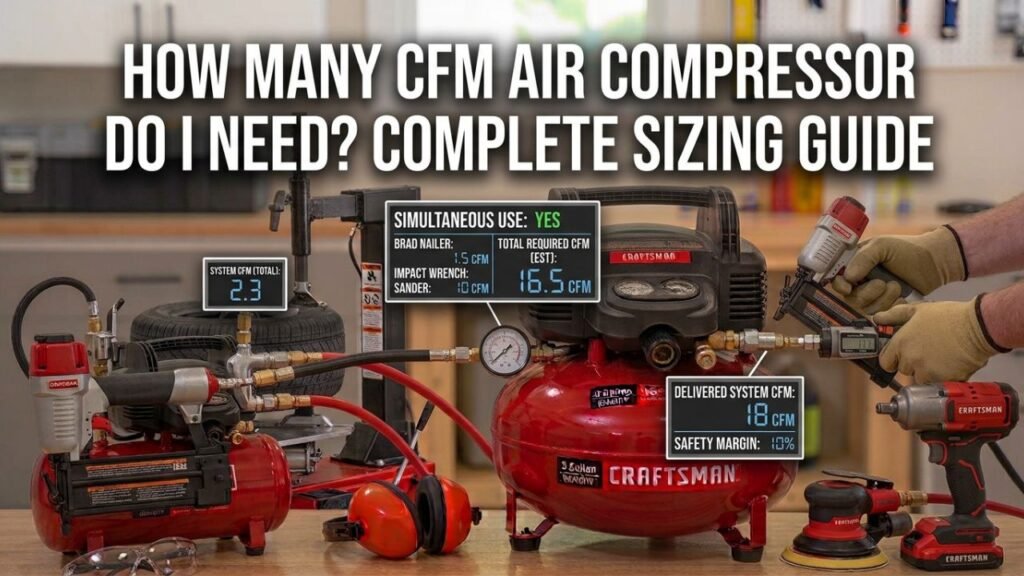
The easiest sizing rule is:
Required compressor CFM = combined tool CFM × 1.25
That additional 25% gives the compressor some breathing room for normal variations, minor air-system losses, and future requirements.
For example, suppose your impact wrench requires 5 CFM at 90 PSI.
5 CFM × 1.25 = 6.25 CFM
I would therefore look for a compressor capable of delivering at least about 6.25 CFM at 90 PSI, rather than buying one rated for exactly 5 CFM.
The pressure at which the CFM is rated is extremely important. A compressor advertised as producing 6 CFM at a low pressure does not necessarily produce 6 CFM at 90 PSI.
Quick CFM Recommendations
| Type of Use | Approximate Compressor CFM Range |
| Tire inflation and light inflation | 1–3 CFM |
| Brad/pin/finish nailers | 1–3 CFM |
| Framing nailer | 2–4+ CFM |
| Occasional impact wrench use | 4–6+ CFM |
| Ratchet or air drill | 4–7+ CFM |
| Spray gun | 6–15+ CFM |
| Die grinder | 8–12+ CFM |
| Orbital sander | 8–15+ CFM |
| Continuous automotive air tools | 10–20+ CFM |
| Multiple tools simultaneously | Combined tool demand + reserve |
These are general planning ranges, not universal specifications. Two impact wrenches of the same drive size can have different airflow requirements, and spray guns vary enormously.
Always use the CFM and PSI listed for the specific tool whenever that information is available.
Key Takeaways:
- Match compressor CFM to the tool’s required CFM at the specified pressure.
- Add about 25% capacity instead of buying a compressor that barely meets the requirement.
- Add together the requirements of tools that will operate simultaneously.
- Never choose a compressor using CFM without also checking the PSI at which that CFM is delivered.
What Does CFM Mean on an Air Compressor?
CFM stands for cubic feet per minute.
It measures the volume of air moving through the system each minute.
If a compressor is rated at 5 CFM at 90 PSI, it means the compressor can deliver approximately 5 cubic feet of compressed-air flow per minute under the manufacturer’s specified test conditions at that pressure.
Think of CFM as the compressor’s airflow capacity.
An air tool consumes compressed air while it operates. If the compressor can replace that air as quickly as the tool uses it, the tool can continue running normally.
If the tool consumes air faster than the compressor produces it, tank pressure gradually falls.
Eventually, the tool may:
- Lose power
- Slow down
- Produce less torque
- Perform inconsistently
- Require frequent pauses while the compressor catches up
That is why CFM is especially important for continuous-demand tools such as grinders and sanders.
CFM vs SCFM
You may also see SCFM, which stands for standard cubic feet per minute.
SCFM expresses airflow under standardized reference conditions so compressor performance can be compared more consistently.
Exact reference conditions can differ depending on the standard being used, which is one reason you should compare ratings carefully rather than assuming all published airflow numbers were measured identically.
For practical compressor shopping, the key principle is simple:
Compare compressor output and tool consumption at comparable pressures and under comparable rating methods whenever possible.
CFM and PSI Are Not the Same Thing
CFM and PSI are closely related, but they measure completely different things.
CFM measures airflow volume.
PSI measures air pressure.
Imagine water flowing through a hose. Pressure is similar to how forcefully the water is pushed, while flow tells you how much water moves through the hose over a certain amount of time.
An air tool normally needs both adequate pressure and adequate airflow.
For example, a tool may be specified at:
5 CFM at 90 PSI
Your compressor should therefore be capable of supplying the required airflow while maintaining approximately the required operating pressure.
Why Compressor CFM Changes With Pressure
A compressor normally delivers different amounts of airflow at different pressures.
As discharge pressure increases, available CFM generally decreases.
That is why compressor labels often provide ratings such as:
- CFM at 40 PSI
- CFM at 90 PSI
The 40 PSI number will commonly be higher.
If your tool runs at 90 PSI, the 90 PSI compressor rating is the meaningful number.
Do not compare a tool requiring 6 CFM at 90 PSI with a compressor advertised as producing 6 CFM only at 40 PSI.
Key Takeaways:
- CFM measures airflow; PSI measures pressure.
- Air tools need sufficient CFM and PSI at the same time.
- Compressor airflow normally falls as operating pressure increases.
- Compare the compressor’s CFM at or near the actual pressure required by your tool.
How Much CFM Do I Need for an Air Compressor?
The amount you need depends primarily on four factors:
- Which air tools you use
- How many tools operate simultaneously
- How continuously the tools run
- The pressure at which those tools require their rated airflow
The most accurate approach is to calculate your actual demand rather than choosing a compressor based on a broad garage-size recommendation.
Step 1: Find Each Tool’s CFM Requirement
Check the tool’s:
- Owner’s manual
- Specification plate
- Product documentation
- Manufacturer specifications
Look for something similar to:
Air consumption: 4.5 CFM at 90 PSI
Whenever possible, use the manufacturer’s specification for your exact model.
Generic air-tool charts are useful for planning, but they cannot account for every tool design.
Step 2: Decide Which Tools Will Run at the Same Time
If you operate only one pneumatic tool at once, use the highest CFM requirement among your tools.
Suppose you own:
| Tool | Example Air Requirement |
| Brad nailer | 1.5 CFM |
| Impact wrench | 5 CFM |
| Air drill | 4 CFM |
If only one will ever operate at a time, the impact wrench creates the highest demand.
You would size around its 5 CFM requirement rather than adding all three together.
Step 3: Add Simultaneous Tool Requirements
If several tools operate simultaneously, add their requirements.
For example:
Impact wrench: 5 CFM
Air drill: 4 CFM
Total simultaneous demand:
5 + 4 = 9 CFM
Step 4: Add Approximately 25% Reserve
Now provide some additional compressor capacity.
9 × 1.25 = 11.25 CFM
A compressor providing at least approximately 11.25 CFM at the required operating pressure would be a sensible minimum target in this example.
Step 5: Confirm the Required PSI
You do not add PSI requirements together.
If one tool needs 90 PSI and another needs 100 PSI, your system needs to provide enough pressure for the tool with the highest required pressure.
Individual regulators may then be used where appropriate to supply lower pressures to other equipment.
Pro Tip: Size a compressor using delivered CFM at the pressure you actually need, not just the largest airflow number printed in advertising material.
What Is a Good CFM for an Air Compressor?
For general DIY and garage use, around 5–10 CFM at 90 PSI is a useful range, but what qualifies as “good” depends completely on what you intend to power.
There is no benefit in paying for 15 CFM if every tool you own uses only 2 CFM. At the same time, a 4 CFM compressor is not a good choice if your main tool continuously consumes 10 CFM.
1–3 CFM: Light-Duty Work
This range can work well for:
- Tire inflation
- Blow-off work with modest demand
- Pin nailers
- Brad nailers
- Some finish nailers
- Other intermittent fastening tools
Small pancake and portable compressors commonly serve this category well.
4–6 CFM: General Garage and DIY Use
This range gives you more flexibility.
It can accommodate many:
- Impact wrenches used intermittently
- Air ratchets
- Nail guns
- Inflation tasks
- Small pneumatic tools
For a homeowner who wants more than basic nail-gun capability but does not plan to operate continuous-demand tools extensively, this can be a practical range.
7–10 CFM: Heavier Garage Work
This level opens up more pneumatic-tool possibilities and reduces how frequently the compressor has to recover during demanding jobs.
It may suit:
- Larger impact tools
- Some paint guns
- Air drills
- Intermittent grinders
- Automotive repair work
Always verify the actual tool requirements because some tools in these categories require substantially more airflow.
10–15+ CFM: High-Demand Air Tools
This range becomes much more useful for:
- Die grinders
- Orbital sanders
- Bodywork tools
- Spray equipment
- Sandblasting equipment
- Continuous pneumatic-tool operation
These tools consume large volumes of air because they often run continuously rather than in short bursts.
15–20+ CFM: Serious Workshop Use
Higher airflow becomes appropriate when you:
- Run large pneumatic tools
- Use high-demand tools continuously
- Operate multiple tools
- Perform professional automotive/body work
- Need significant reserve capacity
At this point, larger stationary compressors and 240V electrical systems often become more relevant than small portable units.
Key Takeaways:
- Around 5–10 CFM at 90 PSI is versatile for many home-garage applications.
- Light nailers and inflation tasks can work with considerably less.
- Grinders, sanders, paint equipment, and continuous-use tools often need much more.
- A “good CFM” is one that comfortably exceeds your actual tool demand.
Typical CFM Requirements for Common Air Tools
Air consumption varies by model, so the following figures should be used as planning guidance rather than replacements for manufacturer specifications.
| Air Tool or Application | Typical Planning Range |
| Pin nailer | 0.5–2 CFM |
| Brad nailer | 0.5–2 CFM |
| Finish nailer | 1–3 CFM |
| Framing nailer | 2–4 CFM |
| Tire inflator | 1–3 CFM |
| Air ratchet | 3–5 CFM |
| 3/8-inch air drill | 3–6 CFM |
| 1/2-inch impact wrench | 4–7+ CFM |
| Air hammer | 3–15+ CFM depending on load |
| Spray gun | 6–15+ CFM |
| Die grinder | 8–12+ CFM |
| Orbital sander | 8–15+ CFM |
| Cut-off tool | 4–10+ CFM |
| Sandblasting equipment | 10–30+ CFM or considerably more |
The large ranges are intentional.
A tool’s average air consumption may also be very different from its consumption while loaded continuously. For example, an air hammer may show modest average consumption but require much higher airflow while it is actually working.
That distinction matters when selecting a compressor for sustained operation.
How Much CFM Do I Need for an Impact Wrench?
For many common 1/2-inch impact wrenches, roughly 4–7 CFM at around 90 PSI is a reasonable planning range, although individual models can fall outside it.
Impact wrenches are unusual because they are typically used intermittently.
You squeeze the trigger for a few seconds, release it, reposition the tool, and continue. During the pauses, the compressor can refill its tank.
This means a compressor whose pump output is slightly below the tool’s instantaneous demand may still operate an impact wrench adequately for occasional jobs.
However, performance will suffer if you repeatedly hold the trigger while the tank pressure falls.
For regular automotive work, I prefer some airflow reserve rather than depending heavily on the tank.
How Much CFM Do I Need for a Nail Gun?
Most pneumatic nailers require relatively little continuous airflow because each fastener uses only a short burst of compressed air.
A small compressor in roughly the 1–4 CFM range can handle many nailers depending on the nailer type and firing rate.
This is why compact pancake compressors are so popular for:
- Brad nailers
- Finish nailers
- Roofing nailers
- Framing nailers
Production-speed fastening can increase the airflow requirement substantially, so check the manufacturer’s specification if you intend to fire continuously.
How Much CFM Do I Need for a Spray Gun?
Spray guns can be significantly more demanding than nailers.
A typical automotive or general-purpose spray gun may need somewhere around 6–15 CFM or more, depending on its design, nozzle, pressure, and application.
HVLP guns in particular may require considerable air volume even though they operate at relatively low pressure at the air cap.
For painting, I recommend sizing the compressor generously because insufficient airflow can cause pressure drop and inconsistent spray performance.
A compressor that is perfectly adequate for an impact wrench may be frustrating for continuous painting.
How Much CFM Do I Need for a Die Grinder?
Many pneumatic die grinders require approximately 8–12 CFM or more during sustained operation.
This makes them much more demanding than their small physical size suggests.
A small 6-gallon compressor may technically operate a die grinder briefly, but it can spend much of the job trying to recover.
For regular grinding, a larger compressor with strong continuous CFM output is a far better choice.
How Much CFM Do I Need for an Orbital Sander?
Pneumatic orbital sanders commonly require substantial continuous airflow, often approximately 8–15 CFM or more depending on the model.
Because sanding can involve holding the trigger for minutes rather than seconds, the compressor pump has far less opportunity to catch up.
If sanding or bodywork is one of your main tasks, size the compressor around the sander rather than around intermittent tools such as nailers or impact wrenches.
Average CFM vs CFM Under Load
This distinction can prevent you from buying an undersized compressor.
Some air-tool manufacturers publish:
- Average air consumption
- Air consumption at load
- Maximum air consumption
These numbers can differ dramatically.
A tool that averages 4 CFM during typical intermittent use may consume 15 CFM or more while operating continuously under load.
Which CFM Number Should You Use?
For intermittent home use, average consumption can sometimes be useful.
For continuous work, I recommend paying much closer attention to air consumption under load or continuous consumption.
If you size a compressor solely around a low average figure and then use the tool continuously, tank pressure may fall much faster than expected.
Does Tank Size Change How Much CFM I Need?
No. A larger tank does not create more CFM.
This is one of the most common misunderstandings about compressor sizing.
The tank stores compressed air.
The compressor pump produces airflow.
A larger tank gives you a bigger reserve, which can let a high-demand tool run longer before pressure drops. Once that stored air is depleted, however, long-term performance depends on how quickly the compressor pump can replace it.
Example
Imagine two compressors:
| Compressor | Tank | Pump Output |
| Compressor A | 6 gallons | 4 CFM at 90 PSI |
| Compressor B | 20 gallons | 4 CFM at 90 PSI |
Compressor B stores considerably more air, so a demanding tool can operate longer before the pressure falls.
But once continuous operation settles in, both pumps are still producing only 4 CFM.
If your tool continuously requires 10 CFM, neither compressor can keep up indefinitely.
When a Bigger Tank Helps
A larger tank is beneficial for tools used in short bursts, including:
- Impact wrenches
- Nail guns
- Air ratchets
- Inflation
- Blow guns
It provides a reserve between compressor cycles.
When Pump CFM Matters More
Pump output becomes especially important with:
- Grinders
- Sanders
- Spray guns
- Sandblasters
- Continuous production tools
For these applications, I would prioritize adequate compressor CFM over simply buying the largest tank you can find.
Key Takeaways:
- Tank capacity and CFM are different specifications.
- A large tank can supply temporary reserve air but cannot compensate indefinitely for insufficient pump output.
- Intermittent tools benefit greatly from stored air.
- Continuous tools require enough compressor CFM to replace the air they consume.
Can a Compressor With Lower CFM Than the Tool Still Work?
Sometimes, but only with limitations.
Suppose a tool requires 8 CFM while your compressor produces 5 CFM.
If the compressor has stored air in its tank, the tool may initially work normally.
But while the tool is consuming 8 CFM, the pump is replacing only about 5 CFM.
The missing airflow comes from the tank.
As the tank empties:
- Pressure falls
- Tool performance declines
- The compressor runs continuously
- You eventually have to stop and wait
For an impact wrench used for a few lug nuts, this may be acceptable.
For a grinder you want to run continuously for several minutes, it can be extremely frustrating.
My recommendation is to match or exceed the tool’s airflow requirement whenever sustained operation matters.
How Much Extra CFM Should an Air Compressor Have?
A useful general rule is to choose approximately 25% more CFM than your calculated requirement.
For a 6 CFM tool:
6 × 1.25 = 7.5 CFM
For a 10 CFM tool:
10 × 1.25 = 12.5 CFM
The reserve provides breathing room for:
- Pressure losses
- Minor air leaks
- Filter and fitting restrictions
- Differences in real-world operating conditions
- Future tool upgrades
- Less stressful compressor operation
It is not necessary to buy a compressor several times larger than your requirement for ordinary home use, but buying a machine that barely meets your calculated demand leaves very little margin.
How to Calculate CFM When Running Multiple Air Tools
If two or more tools will genuinely operate at the same time, add their airflow demands.
Suppose your workshop uses:
- Impact wrench: 5 CFM
- Air drill: 4 CFM
- Blow gun: 3 CFM
If all three can operate simultaneously:
5 + 4 + 3 = 12 CFM
Add 25%:
12 × 1.25 = 15 CFM
You would therefore target approximately 15 CFM or more at the necessary operating pressure.
If only one tool is ever used at a time, you usually do not need to total every tool in the shop.
Instead, size around the highest-demand tool and your desired reserve.
What If Two People Use the Compressor?
This changes the sizing calculation considerably.
A one-person garage normally runs only one main tool at a time.
In a two-person workshop, one person might operate a grinder while another uses an impact wrench.
You need to account for realistic simultaneous demand.
For example:
Grinder: 10 CFM
Impact wrench: 5 CFM
Combined demand:
15 CFM
With 25% reserve:
15 × 1.25 = 18.75 CFM
A small portable compressor that is perfectly useful for either tool individually can become severely undersized in a multi-user shop.
Why Hose Size and Fittings Matter
A compressor can have enough rated CFM but still deliver poor tool performance if the air path is restrictive.
Potential restrictions include:
- Undersized hose
- Excessively long hose
- Narrow quick-connect fittings
- Clogged filters
- Restrictive regulators
- Damaged couplers
- Moisture separators
- Poorly designed piping
High-flow tools require enough capacity throughout the entire system.
For example, installing a powerful compressor and then feeding a high-demand impact wrench through a very small hose can create excessive pressure drop.
Follow the tool manufacturer’s minimum hose-size recommendation whenever one is provided.
Does Horsepower Tell Me Compressor CFM?
Not reliably enough for compressor selection.
Horsepower describes motor power, not directly how much usable compressed air reaches your tool.
Compressor efficiency, pump design, operating pressure, motor design, and other factors all influence delivered airflow.
Two compressors with similar horsepower ratings can have different CFM outputs.
I recommend comparing rated CFM or SCFM at your required PSI, rather than buying based primarily on horsepower.
CFM vs Tank Gallons: Which Should I Prioritize?
For tool performance, I would prioritize CFM first, then choose a tank size appropriate for your work pattern.
The right order is generally:
- Determine required CFM.
- Determine required PSI.
- Choose enough reserve capacity.
- Consider duty cycle.
- Choose an appropriate tank size.
- Confirm electrical requirements and portability.
Tank size matters, but it should not distract you from inadequate compressor output.
A 60-gallon tank attached to an undersized pump can still disappoint during continuous high-air-demand work.
Should I Size the Compressor for My Largest Tool?
Usually, yes, if you use only one tool at a time.
Suppose your tools need:
- Brad nailer: 1 CFM
- Impact wrench: 5 CFM
- Air ratchet: 4 CFM
- Die grinder: 10 CFM
The die grinder is your largest airflow demand.
If you want to run it properly, size around approximately 10 CFM plus your reserve rather than averaging the requirements of all four tools.
Using a 25% allowance gives:
10 × 1.25 = 12.5 CFM
That compressor should have enough airflow for the lower-demand tools as well, assuming their pressure requirements are also covered.
Intermittent vs Continuous Air Use
How long the trigger remains pressed is almost as important as the tool’s published CFM.
Intermittent Tools
Examples include:
- Nail guns
- Impact wrenches
- Air ratchets
- Staplers
These consume air in relatively short bursts.
A tank can cover temporary demand while the pump recovers between uses.
Continuous Tools
Examples include:
- Sanders
- Grinders
- Spray guns
- Sandblasters
These may consume air continuously for long periods.
For these tools, I recommend sizing around continuous or loaded air consumption rather than assuming the tank will make up the difference.
Common CFM Sizing Mistakes
Looking Only at Maximum PSI
A compressor advertising 175 PSI is not automatically more suitable for air tools than one rated for 135 PSI.
If the first unit produces only 3 CFM at 90 PSI and your tool needs 8 CFM, the high maximum pressure does not solve the airflow shortage.
Comparing CFM at Different Pressures
Always check the pressure accompanying the airflow specification.
5 CFM at 40 PSI is not equivalent to 5 CFM at 90 PSI for a tool that needs 90 PSI.
Confusing Tank Size With Airflow
Tank gallons tell you storage capacity.
CFM tells you how quickly the compressor produces usable airflow.
Buying Exactly the Tool’s Minimum Requirement
A compressor that exactly matches the tool on paper leaves little room for losses or demanding real-world use.
I prefer approximately 25% additional capacity where practical.
Ignoring Continuous Air Consumption
A grinder advertised with relatively low “average” consumption can require much more airflow under sustained load.
Adding CFM for Tools That Never Run Together
You do not normally need to add the requirements of every tool you own.
Add only the tools likely to operate simultaneously.
Ignoring Future Tools
If you already expect to buy a higher-demand spray gun or sander next year, sizing only for today’s nailer may force you to buy another compressor later.
How Much CFM Should I Buy for a Home Garage?
For a typical home garage, I consider these broad categories useful:
| Garage Use | CFM I Would Target |
| Inflation and nailers | 2–4+ CFM |
| Basic automotive work | 5–8+ CFM |
| More capable automotive garage | 8–12+ CFM |
| Grinding, sanding, painting | 10–15+ CFM |
| Multiple demanding tools | 15–20+ CFM |
For a homeowner primarily using an impact wrench, air ratchet, inflator, and occasional nailer, a compressor in the 5–8 CFM at 90 PSI range can be very useful.
If I expected to run grinders, sanders, or paint guns regularly, I would prefer 10–15 CFM or more, depending on the exact equipment.
Going slightly larger than your current requirement can be worthwhile because air-tool needs have a tendency to grow once a workshop is equipped with compressed air.
What Compressor CFM Do I Recommend?
For an occasional DIY user, I would not chase the highest CFM number available. Buy enough compressor for the tools you actually expect to use.
My general approach would be:
Light DIY and nail guns: around 2–4 CFM may be sufficient.
General automotive garage: roughly 5–8 CFM provides significantly more flexibility.
Frequent pneumatic-tool use: around 8–12 CFM is a stronger starting point.
Painting, sanding, and grinding: I would look toward roughly 10–15+ CFM after checking the exact tools.
Multi-user or professional workshop: calculate simultaneous demand individually rather than relying on a generic CFM recommendation.
The manufacturer’s CFM requirement for your most demanding tool should always take priority over these general ranges.
FAQs about How Many CFM Air Compressor Do I Need
How many CFM do I need air compressor for general home use?
For light home use such as tire inflation, nailers, and occasional small pneumatic tools, approximately 2–5 CFM may be enough.
If you plan to use automotive impact tools or other moderately demanding equipment, roughly 5–8 CFM or more at 90 PSI gives you considerably more flexibility.
How much CFM do I need air compressor for automotive work?
For general home automotive work, approximately 5–10 CFM at 90 PSI can cover many intermittent tools.
Continuous grinders, sanders, paint guns, and professional workloads can require 10–15 CFM or substantially more.
What is a good CFM for an air compressor?
For an all-around home garage compressor, about 5–10 CFM at 90 PSI is a useful range.
However, the truly correct CFM is whatever comfortably exceeds the requirements of your specific tools.
Is 4 CFM enough for air tools?
It can be.
Four CFM is suitable for many nailers, inflation tasks, and some intermittent pneumatic tools.
It is generally too little for continuous operation of high-demand grinders, sanders, many spray guns, and similar equipment.
Is 5 CFM enough for an impact wrench?
It may be sufficient for many impact wrenches, especially during intermittent automotive work, but check your exact wrench’s specification.
A wrench requiring 5 CFM will benefit from a compressor producing somewhat more than 5 CFM at the required operating pressure.
Is 6 CFM a good air compressor?
Six CFM can be a very useful output for home garages, automotive maintenance, nailers, inflation, and various intermittent air tools.
It is not enough for every application, particularly high-demand continuous tools.
Is 10 CFM a lot for an air compressor?
For a home or DIY compressor, 10 CFM is a substantial and useful amount of airflow.
For commercial shops, sandblasting, production painting, or multiple simultaneous tools, however, 10 CFM may be relatively modest.
How much extra CFM should my compressor have?
A useful target is approximately 25% more CFM than your calculated simultaneous tool requirement.
If your tool requires 8 CFM, for example:
8 × 1.25 = 10 CFM
A compressor around 10 CFM at the required pressure would provide a reasonable reserve.
Does a bigger air tank increase CFM?
No.
A bigger tank increases stored compressed-air capacity, but the compressor pump’s output determines how much air it can continuously replace.
A larger tank lets a high-demand tool run longer temporarily, but it does not increase the compressor’s sustained pump CFM.
Does higher PSI mean higher CFM?
No.
PSI and CFM measure different things, and compressor CFM generally decreases as output pressure increases.
Always compare airflow at the pressure you actually intend to use.
Should compressor CFM be higher than tool CFM?
Yes, preferably.
I recommend selecting a compressor whose delivered CFM exceeds the tool requirement rather than matching it exactly. Approximately 25% extra capacity is a practical target for many applications.
Do I add the CFM of all my air tools together?
Only if those tools will operate at the same time.
If you use one tool at a time, size the compressor around the highest-demand tool plus appropriate reserve capacity.
What happens if my compressor does not have enough CFM?
The tool may initially operate using stored tank air, but pressure will gradually fall because the tool removes air faster than the compressor can replace it.
You may experience reduced tool power, constant compressor operation, and frequent pauses while the tank recovers.
Is SCFM more important than CFM?
SCFM can make airflow comparisons more consistent because it references standardized conditions.
The most important practical point is to compare compressor and tool ratings using compatible units and at the correct operating pressure.
How many CFM do I need for two air tools?
Add the CFM requirements of both tools if they will run simultaneously, then add approximately 25% reserve.
For example, two tools requiring 4 and 6 CFM create a 10 CFM combined demand.
10 × 1.25 = 12.5 CFM
I would therefore look for approximately 12.5 CFM or more at the pressure required by the tools.
Conclusion
If you are asking how many CFM air compressor do I need, there is no universal number—the right answer is determined by your air tools and how you use them. Find the manufacturer’s CFM requirement for your highest-demand tool, or add the CFM of tools that will operate simultaneously, and then allow approximately 25% additional compressor capacity.
For many home users, 2–4 CFM is enough for inflation and nailers. A general automotive garage benefits from roughly 5–10 CFM, while grinders, sanders, spray equipment, and other continuous-demand tools commonly push requirements into the 10–15+ CFM range.
My recommendation is to prioritize CFM at the required PSI before tank gallons, horsepower, or maximum pressure. A large tank can provide temporary reserve air, but it cannot replace inadequate compressor output.
Choose a compressor that comfortably meets your highest realistic airflow demand rather than one that only barely meets the specification. That extra capacity will give your tools more consistent performance, reduce recovery interruptions, and leave useful room for future equipment.