
Can I Leave My Air Compressor On All the Time? Risks and Safety
For most portable and home-shop air compressors, turn the unit off when you finish using it rather than leaving it powered continuously. An automatic pressure switch can stop and restart the motor as tank pressure changes, but a leaking hose, fitting, or tool can make the compressor cycle while nobody is around to notice a problem.
Leaving a compressor in the AUTO position is different from simply leaving air stored in the receiver. In AUTO mode, the motor can restart without someone touching the machine whenever pressure falls to its cut-in setting.
DEWALT warns in several current compressor manuals that unattended operation can lead to injury or property damage and instructs users to remain present while the compressor operates. The manuals also say to turn the compressor off and unplug it when it is not being used.
Air-receiver condition also matters. OSHA requires covered receivers to have a pressure gauge and spring-loaded safety valve, and the relief capacity must prevent pressure from exceeding the receiver’s maximum allowable working pressure by more than 10 percent. OSHA also requires accumulated oil and water to be drained often enough to prevent excessive buildup.
So, can i leave my air compressor on all the time? For a typical portable reciprocating compressor in a garage or home workshop, the safer routine is no: switch it off after use, isolate the air supply, and follow the manual’s shutdown and tank-draining procedure. Certain stationary commercial compressors are built for continuous or automatic operation, but that is a different equipment class and installation.
The sections below explain what happens when a compressor stays on, how automatic pressure switches work, the difference between leaving it powered and leaving the tank pressurized, duty-cycle limits, overnight use, moisture buildup, and the shutdown routine that makes sense for most home compressors.
Can I Leave My Air Compressor On All the Time in AUTO Mode?
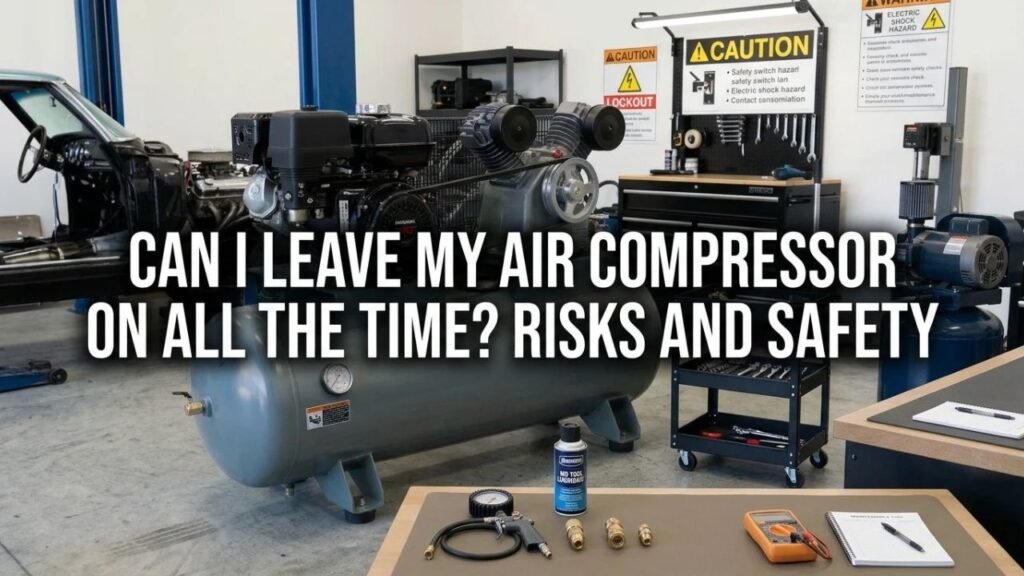
For most portable compressors, leaving the machine in AUTO continuously is not the recommended practice.
AUTO means the compressor is ready to restart whenever tank pressure drops below its cut-in setting.
The Pressure Switch Can Restart the Motor Automatically
A typical reciprocating compressor runs until the tank reaches its cut-out pressure.
The pressure switch then shuts the motor off.
As air is used or leaks from the system, tank pressure falls. Once it reaches the cut-in setting, the pressure switch starts the motor again.
That is normal operation while you are actively using the compressor.
The problem with leaving it unattended is that the machine can restart when nobody expects it.
DEWALT manuals warn that unattended operation creates fire and property-damage risk and direct owners to remain with the compressor while it operates.
An Air Leak Can Make the Compressor Cycle Repeatedly
A small leak from a hose, fitting, coupler, regulator, drain valve, or pneumatic tool slowly lowers tank pressure.
If the compressor remains in AUTO, it replaces that lost air.
A larger leak can cause frequent cycling.
That creates extra:
- Motor starts
- Pump run time
- Heat
- Electricity use
- Mechanical wear
DEWALT notes that even minor air leaks can make a compressor overwork and contribute to premature failure or poor performance.
A Failed Hose Can Trigger a Long Run
Imagine a compressor sitting at full pressure overnight.
A hose splits or a fitting separates.
Tank pressure falls quickly, the pressure switch starts the motor, and the compressor begins trying to replace escaping air.
Depending on the size of the leak, it may run for a long period.
If the compressor is unattended, nobody is present to hear unusual running, smell overheating insulation, notice vibration, or shut the machine down.
Key Takeaway: AUTO mode is intended to control pressure during normal use, not to make a portable compressor safe for indefinite unattended operation.
What Happens if You Leave an Air Compressor On Overnight?
Nothing may happen on a well-maintained machine with no leaks, but the risk is unnecessary for most home-shop setups.
The main concern is that something changes after you leave.
It May Restart Several Times
A perfectly sealed compressed-air system should hold pressure for a long time.
Real systems often have small leaks.
Quick couplers, hoses, regulators, thread connections, and tool fittings can leak slowly enough that they are difficult to hear.
During an eight-hour period, that pressure loss may be enough to restart the compressor several times.
You may return the next morning without realizing the machine ran while you were away.
The Compressor Can Overheat if It Runs Too Long
Many portable reciprocating compressors have a duty-cycle limit.
A DEWALT compressor manual, for example, recommends maintaining roughly a 50%–75% average duty cycle, meaning the pump should run no more than about 30–45 minutes during an hour.
Other models have different ratings.
ROLAIR states that some of its belt-drive machines use 100% duty-cycle motors and pumps, while several direct-drive models are rated at 70% duty cycle and may trip their overload protection if subjected to continuous operation.
This is why the model’s duty-cycle rating matters.
A machine designed for short intermittent use should not be treated like an industrial continuous-duty compressor.
Automatic Thermal Protection Is Not a Reason to Leave It Unattended
Many compressors include a thermal motor overload.
If the motor gets too hot, the protector may shut it down.
That protection is useful, but it should not be treated as permission to leave a portable compressor powered indefinitely.
A safety device is there for abnormal conditions. Normal operating habits should not depend on it activating.
Key Takeaway: Overnight operation may lead to unnoticed cycling, excess heat, and unnecessary wear. Portable units should generally be switched off after the work session ends.
Can I Leave My Air Compressor On All the Time if It Is Stationary?
A permanently installed stationary compressor can be different from a portable garage compressor.
Some industrial machines are built to remain available for automatic operation during scheduled production periods.
Some Compressors Are Designed for Continuous Operation
ROLAIR explains that certain belt-drive compressors have motors and pumps rated for a 100% duty cycle and can operate continuously when installed with proper ventilation and electrical power.
Constant-speed compressor systems also exist.
In that arrangement, the motor may continue running after receiver pressure reaches its upper setting while the compressor unloads rather than repeatedly starting and stopping. ROLAIR describes constant-speed operation as a setup intended to reduce repeated motor starts in suitable applications.
That is very different from leaving a homeowner pancake compressor plugged in for days.
Commercial Systems Still Need Safety Controls
A stationary system that remains available automatically should have the correct:
- Pressure controls
- Receiver safety valve
- Pressure gauge
- Automatic or manual drains
- Electrical protection
- Ventilation
- Check valves
- Maintenance schedule
- Leak management
OSHA requires covered air receivers to have visible pressure gauges, spring-loaded safety valves, and provisions for draining accumulated moisture and oil.
Follow the Exact Compressor Manual
Do not decide from tank size alone.
A 60-gallon compressor is not automatically continuous-duty.
A small commercial compressor is not automatically intermittent-duty.
Check the pump and motor duty-cycle rating, pressure-control design, installation instructions, and shutdown procedure supplied by the manufacturer.
Key Takeaway: Some stationary commercial compressors are designed for long automatic or continuous operation, but portable home-shop rules should not be applied to industrial equipment—or vice versa.
Powered On vs Leaving the Tank Pressurized
These are two different questions.
A compressor can be switched off while its receiver still contains compressed air.
Leaving the Compressor Powered On
If the switch remains in AUTO and the unit stays connected to electrical power, it can restart automatically.
That is the main unattended-operation concern.
The pressure switch does not know that you have left the building.
It only sees tank pressure.
Leaving Air in the Tank
A receiver can hold pressure after the compressor is switched off.
Some owners leave air stored for the next use, while some portable-compressor manuals instruct the user to drain the receiver after each work session.
DEWALT’s shutdown instructions for one portable model tell the user to switch the unit off, unplug it, remove the hose, and drain the air tank after use. The same manual warns that condensed water can corrode and weaken the receiver.
California Air Tools states that its average tank-draining interval is every one to two days, adjusted for operating time and environmental conditions, and says draining protects the receiver from rust and corrosion.
Follow the procedure for your model rather than applying one storage rule to every receiver.
Long-Term Pressure Storage Adds No Real Advantage
If you will not use the compressor for days or weeks, there is little reason to keep a portable receiver fully pressurized.
Shutting down, draining moisture, and storing the compressor according to its manual reduces the chance of corrosion and removes stored pneumatic energy.
Key Takeaway: Switching the compressor off prevents automatic restart. Tank-pressure storage is a separate issue and should follow the manufacturer’s shutdown and draining instructions.
Why Air Compressor Tanks Need Regular Draining
Every time air is compressed, moisture from the surrounding air can condense inside the receiver.
That water collects at the bottom of the steel tank.
Water Can Cause Internal Corrosion
A steel receiver may look clean outside while rust develops internally.
DEWALT warns that failure to drain condensed water can rust and thin the steel tank, creating a rupture hazard.
OSHA also requires covered air receivers to be drained often enough to prevent excessive liquid accumulation.
Internal Rust Can Become a Serious Pressure-Vessel Hazard
Receiver corrosion is not just a cosmetic problem.
OSHA records an accident involving a 300-gallon air receiver that ruptured after internal rust weakened the steel. The investigation also found an inoperative safety valve and faulty gauge. The failure caused severe injuries.
That example involved a large industrial receiver, but the basic reason for draining applies to smaller steel tanks too.
Humid Conditions Produce More Condensate
Hot, humid air contains more moisture.
A compressor used heavily in humid weather can collect water faster than one used briefly in a dry climate.
Drain frequency should therefore account for operating hours and environmental conditions.
Key Takeaway: Receiver water promotes internal corrosion. Regular draining protects the tank and should be part of the normal shutdown and maintenance routine.
Does Leaving an Air Compressor On Waste Electricity?
It can, especially if the system leaks.
A compressor that remains at pressure but never restarts uses very little motor energy because the pump is not running.
The situation changes when leaks lower receiver pressure.
Each restart uses electricity to replace air that escaped without doing useful work.
A shop with several small leaks can lose a surprising amount of compressed air over time.
Fixing leaks also reduces:
- Pump hours
- Motor starts
- Heat production
- Noise
- Wear
If a portable compressor cycles while no tools are being used, find the leak rather than treating periodic restart as normal standby behavior.
Should I Turn Off My Air Compressor After Every Use?
For a portable home or jobsite compressor, yes, unless the manual gives a different shutdown procedure.
A good routine is simple.
Switch the Compressor Off
Use the compressor’s ON/OFF or AUTO/OFF switch.
Do not normally stop it by pulling the plug while the switch remains in AUTO.
ROLAIR instructs users to use the pressure-switch lever to start and stop its electric compressors rather than unplugging them as the primary operating control.
Unplug Portable Electric Units
DEWALT manuals for several portable compressors state that the unit should be unplugged when not in use.
This prevents an unintended automatic restart and removes electrical power from the machine.
Disconnect the Tool or Hose
Release regulated line pressure first.
Disconnect hoses carefully because trapped air can cause hose whip.
If the compressor feeds permanent shop plumbing, use the isolation procedure designed for that installation.
Drain Condensate
Follow the tank manual.
Some portable compressors call for daily draining or draining after each use.
Keep your face and eyes away from the drain outlet because compressed air can eject water, rust, and debris.
Inspect for Leaks
If pressure drops rapidly while the compressor is off, use soapy water on fittings, couplers, drain valves, and hose connections.
Growing bubbles identify leaks.
Repair them with the system fully depressurized.
Key Takeaway: A practical portable-compressor shutdown includes switching off, unplugging, relieving downstream pressure, draining the receiver as instructed, and checking leaks.
Is It Safe to Leave a 60-Gallon Air Compressor On?
Tank size does not settle the question.
Many 60-gallon units are stationary and built for heavier use than small portable compressors, but their duty cycles and operating instructions still differ.
A 60-gallon reciprocating compressor may use automatic start/stop control just like a small unit.
If air leaks from shop piping overnight, the motor can restart.
Before leaving a stationary compressor available automatically, check:
- Manufacturer approval for the operating schedule
- Pump duty cycle
- Electrical installation
- Tank condition
- Relief-valve condition
- Drain system
- Ventilation
- Leak rate
- Pressure-switch operation
For a personal garage where compressed air is not needed overnight, shutting the compressor off is the simpler choice.
Can an Air Compressor Catch Fire if Left On?
A fault can create a fire hazard, which is why portable-compressor manuals warn against unattended operation.
Potential problems include:
- Motor overheating
- Restricted cooling airflow
- Damaged electrical wiring
- Failed extension cords
- Excessive cycling from air leaks
- Pump overheating
- Flammable material stored too close to hot compressor parts
DEWALT warns that blocked ventilation openings can cause serious overheating and may lead to fire. The company also instructs users to operate its compressors in clean, dry, well-ventilated locations with clearance around cooling openings.
Do not cover a running compressor or use it where airflow around the motor and pump is restricted.
Is It Okay for the Compressor Tank to Stay Full Overnight?
The answer is model-specific.
A sound receiver does not normally lose structural strength simply because it contains rated pressure for several hours. The larger maintenance concern is moisture collecting inside the tank and leaving stored pressure in equipment that is not being used.
Many portable-compressor manuals call for draining after the work session.
If your manual instructs you to drain the tank, follow that instruction.
For a permanently installed shop receiver designed to remain pressurized, follow its maintenance schedule, automatic-drain setup, and inspection requirements.
Never keep using a receiver that shows:
- Deep rust
- Pitting
- Bulging
- Cracks
- Weld damage
- Air leaking through the tank wall
A leaking receiver should be replaced rather than welded or patched unless an approved pressure-vessel repair procedure applies.
When Can Leaving a Compressor On Make Sense?
Continuous availability may make sense in a commercial compressed-air system designed around automatic operation.
Examples include facilities where pneumatic equipment runs throughout a shift or needs air at unpredictable times.
Those systems usually have more than a compressor and tank.
They may include:
- Automatic condensate drains
- Air dryers
- Filtration
- Leak-management programs
- Remote controls
- Receiver inspection
- Scheduled maintenance
- Multiple compressors
- Alarm systems
That setup should not be used as justification for leaving a small portable compressor running in an empty garage overnight.
Conclusion
For can i leave my air compressor on all the time, the answer for most portable and home-shop compressors is no. Leave the machine powered only while it is being used and supervised, then follow the manufacturer’s shutdown instructions.
AUTO mode controls tank pressure, but it also means the motor can restart without warning. A leaking hose or fitting can make an unattended compressor cycle repeatedly, adding heat, wear, and unnecessary run time.
Tank maintenance matters too. Condensed water should be drained at the interval specified by the manufacturer because moisture can corrode a steel receiver from the inside.
My normal home-shop routine would be to switch the compressor off, unplug a portable electric unit, relieve downstream pressure, drain condensate as specified, and leave it unavailable for automatic restart until the next work session.
FAQs About Leaving an Air Compressor On
Can I leave my air compressor on overnight?
For most portable compressors, no. Manufacturer instructions commonly tell users to switch the unit off and unplug it when not in use. Leaving it in AUTO means a leak can cause the motor to restart during the night with nobody present to notice overheating, vibration, or another fault.
Can I leave a 60-gallon air compressor on all the time?
Some stationary 60-gallon compressors are built for heavier automatic use, but tank size alone does not determine safe operating practice. Check the pump duty cycle, manufacturer instructions, receiver condition, drainage system, ventilation, and electrical installation before leaving it available automatically.
Should I empty my air compressor tank after every use?
Follow the manual for your compressor. Many portable models instruct owners to drain the receiver after use or daily to remove accumulated water. Other stationary systems may use automatic drains while staying pressurized during operating periods.
Does an air compressor use electricity while the tank is full?
A start/stop compressor normally shuts its motor off when the receiver reaches cut-out pressure, so the pump is not consuming full running power at that point. If air leaks and pressure falls to the cut-in setting, the motor starts again and consumes electricity to refill the tank.
Why does my air compressor turn on when I am not using it?
The system is probably losing pressure. Check hoses, couplers, fittings, regulator connections, drain valves, check valves, and connected pneumatic equipment for leaks. A pressure drop eventually reaches the pressure-switch cut-in point and causes the compressor to restart.
Can leaving an air compressor on damage it?
Repeated cycling, excessive duty time, blocked ventilation, or a large air leak can increase heat and wear. Damage risk depends on the compressor’s duty-cycle rating and design. A machine rated for intermittent service should not be forced into near-continuous operation.
Is it bad to leave an air compressor tank pressurized?
A sound receiver is designed to contain pressure within its rating, but portable-compressor manuals often call for draining after use. Moisture left inside the tank can cause internal corrosion, so follow the manufacturer’s pressure-release and condensate-drain procedure.
Should I unplug my air compressor when I am done?
For portable electric compressors whose manuals call for unplugging after use, yes. Turn the compressor switch to OFF first, then disconnect power according to the shutdown instructions. This prevents the motor from restarting automatically while the machine is unattended.