
What Is Duty Cycle on Air Compressor? Meaning, 100% & Formula
Air-compressor duty cycle is the percentage of a specified operating period that the compressor is designed to run under load before it needs an off or unloaded period. A 50% rating might mean 5 minutes running and 5 minutes resting in a 10-minute cycle, while a 100% model is designed for continuous operation at rated conditions.
Duty cycle matters most with compressors that create substantial heat during operation, including many reciprocating piston models. Running an intermittent-duty compressor too long can raise pump and motor temperatures and accelerate wear.
For what is duty cycle on air compressor, think of it as the compressor’s allowed ratio of working time to total cycle time. The rating needs to be considered alongside CFM, PSI, tank size, and the air demand of your tools.
Atlas Copco calculates duty cycle as compressor run time divided by total cycle time, multiplied by 100. Its example of 36 minutes of operation during a 60-minute period gives a 60% duty cycle. (atlascopco.com)
A 100% rating does not mean the compressor never needs maintenance or can ignore temperature limits. It means the compressor is designed to operate continuously within the pressure, temperature, ventilation, and service conditions stated by its manufacturer.
Compressed-air operation also has a large energy footprint. The U.S. Department of Energy’s Better Plants program reports that compressed-air systems consume around 90 billion kWh of electricity per year in the United States, so matching compressor size and operating pattern to actual air demand can have a major impact on power use. (betterbuildingssolutioncenter.energy.gov)
One detail needs close attention: manufacturers do not all use the same time base for duty-cycle ratings. Some piston compressors use a 10-minute reference cycle, while other specifications may be based on longer periods or different operating standards. Always check the manual or nameplate before translating a percentage into run minutes.
What Is Duty Cycle on Air Compressor?
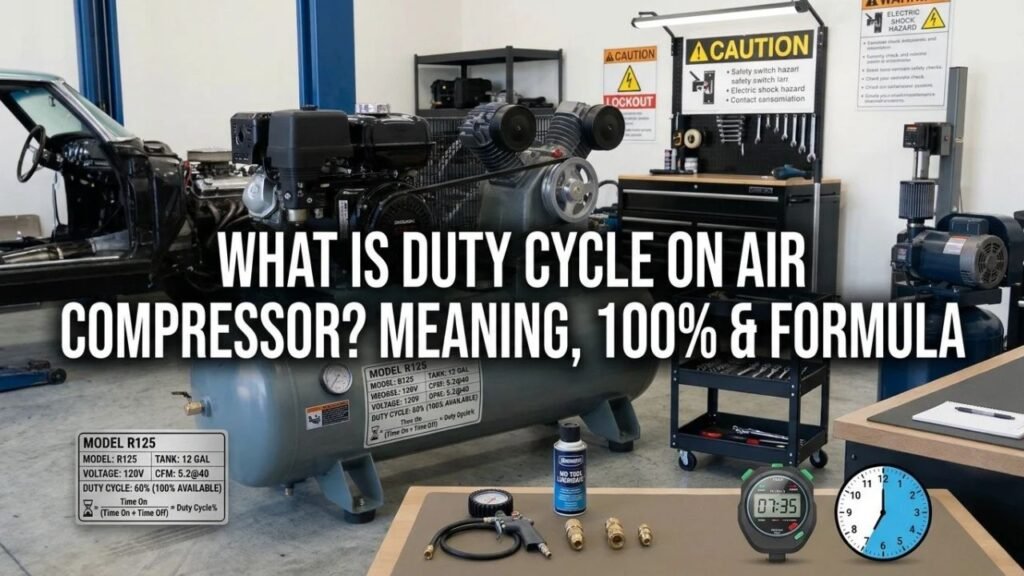
Duty cycle tells you how much of a full operating cycle the compressor may spend running under its rated working conditions.
Run Time and Rest Time
A simple cycle has two portions:
Run time:
The compressor pump is operating and producing compressed air.
Rest time:
The pump is stopped, or the system is in the specified unloaded state, allowing heat to dissipate.
The basic relationship is:
Duty Cycle (%) = Run Time ÷ Total Cycle Time × 100
Total cycle time equals:
Run Time + Rest Time
For example, a compressor that runs for 6 minutes and rests for 4 minutes has:
6 ÷ 10 × 100 = 60% duty cycle
Atlas Copco uses this same 6-minute-on, 4-minute-off example to describe a 60% compressor duty cycle. (atlascopco.com)
Rated Duty Cycle vs Actual Duty Cycle
Two different numbers can be discussed.
The rated duty cycle is the operating limit or capability stated by the manufacturer.
The actual duty cycle is how much your compressor really runs during a measured period.
Suppose your compressor is rated for 75% duty but your measurements show it running 9 minutes out of every 10.
Your actual duty cycle is:
9 ÷ 10 × 100 = 90%
That means the compressor is being operated above a 75% rating.
You cannot determine the manufacturer’s design rating merely by timing the compressor. Check the manual or equipment specifications.
Why Duty Cycle Matters
Compression generates heat.
An intermittent-duty compressor needs enough non-running time to shed heat before the next heavy operating period.
Atlas Copco warns that operating above the intended duty cycle can raise thermal load, accelerate component wear, and increase the chance of overheating or unplanned shutdown. (atlascopco.com)
Key Takeaway: Duty cycle is the percentage of a defined cycle that the compressor is designed to run; rated duty comes from the manufacturer, while actual duty can be measured from real run and rest times.
What Does Duty Cycle Mean on Air Compressor?
In practical terms, duty cycle tells you how hard you can work the compressor over time.
A 20-gallon compressor and a 60-gallon compressor might both reach 135 PSI, yet their pumps may have very different duty ratings.
The percentage becomes easier to understand with a 10-minute example:
| Duty cycle | Run time | Rest time |
| 25% | 2.5 min | 7.5 min |
| 50% | 5 min | 5 min |
| 60% | 6 min | 4 min |
| 75% | 7.5 min | 2.5 min |
| 100% | 10 min | 0 min required by the percentage |
These are mathematical examples. Use them only if the compressor’s rating uses a 10-minute reference period.
A Higher Percentage Supports Longer Work
A compressor with a high duty rating fits air demand that keeps the pump running for longer stretches.
This matters for tools such as:
- Air sanders
- Grinders
- Spray equipment
- Sandblasters
- Production pneumatic tools
- Multiple tools used repeatedly
Intermittent tools such as nailers and tire inflators may give the compressor much more time between air demands.
Duty Cycle Is Not the Same as CFM
CFM tells you how much airflow a compressor delivers.
Duty cycle tells you how long the compressor is designed to operate within a cycle.
A machine might deliver enough CFM for a tool while it is running but have too low a duty rating for hours of repeated use.
Atlas Copco recommends looking at both CFM demand and duty cycle when matching an air compressor to air tools. (atlascopco.com)
Duty Cycle Is Not the Same as Tank Size
Tank gallons measure stored-air volume.
A larger tank provides more reserve air, but it does not change the pump’s rated duty cycle.
For example, moving the same 50%-duty pump from a 20-gallon receiver to a 60-gallon receiver does not turn it into a 100%-duty pump.
Key Takeaway: Duty cycle describes operating time, not airflow or tank capacity; all three specifications need to fit the planned workload.
How to Calculate Duty Cycle of Air Compressor
The basic calculation is straightforward:
Duty Cycle (%) = Run Time ÷ (Run Time + Rest Time) × 100
You can use seconds, minutes, or hours as long as the same unit is used throughout the calculation.
Example 1: 5 Minutes Running, 5 Minutes Resting
Run time = 5 minutes
Rest time = 5 minutes
Total = 10 minutes
5 ÷ 10 × 100 = 50%
The observed duty cycle is 50%.
Example 2: 7.5 Minutes Running, 2.5 Minutes Resting
Run time = 7.5 minutes
Rest time = 2.5 minutes
Total = 10 minutes
7.5 ÷ 10 × 100 = 75%
The observed duty cycle is 75%.
Atlas Copco gives an S3-75 piston-compressor example in which a 75% rating based on a 10-minute period permits up to 7.5 minutes of operation in that period. (atlascopco.com)
Example 3: Measure an Hour of Shop Use
Suppose you time the compressor over one hour.
It runs for a combined 42 minutes and remains off for 18 minutes.
42 ÷ 60 × 100 = 70%
Your measured operating duty is 70%.
If the machine is rated for only 50% operation under those conditions, the workload is asking more from the compressor than its rating allows.
Calculating Allowed Run Time From a Rating
If you know the duty percentage and cycle length:
Allowed Run Time = Duty Cycle as a Decimal × Total Cycle Time
For a 60% rating over 10 minutes:
0.60 × 10 = 6 minutes
For a 75% rating over 10 minutes:
0.75 × 10 = 7.5 minutes
Do not invent a 10-minute cycle if the manufacturer gives another reference period.
Key Takeaway: Divide running time by total run-plus-rest time and multiply by 100; use the manufacturer’s stated cycle period when translating a rated percentage into allowed minutes.
What Is a 100% Duty Cycle Air Compressor?
A 100% duty cycle air compressor is designed to operate continuously at its rated operating conditions without a scheduled cooling break based solely on duty percentage.
Atlas Copco states that rotary screw compressors can typically operate at a 100% duty cycle, making them well suited to continuous compressed-air demand. (atlascopco.com)
Does 100% Mean It Runs Forever?
No.
A full-duty rating does not eliminate:
- Oil changes
- Filter service
- Condensate drainage
- Cooling requirements
- Maximum ambient temperature
- Pressure limits
- Scheduled inspection
- Repair needs
A 100%-duty compressor still has to remain within its operating specifications.
Can a Piston Compressor Have 100% Duty Cycle?
Yes.
Many piston compressors are intended for intermittent use, but 100%-duty reciprocating models also exist.
Atlas Copco notes that its LE-series piston compressors include units rated for 100% duty. (atlascopco.com)
Do not assume that every piston model needs a 50% rest period simply because it uses reciprocating cylinders.
Does 100% Duty Mean 100% Loaded All the Time?
Not necessarily.
Industrial compressors may run continuously while alternating between loaded and unloaded states according to air demand.
CAGI defines a compressor cycle as a sequence that may include fully loaded, modulating, unloaded, and idle conditions. (cagi.org)
The machine may therefore remain running while not producing full airflow at every moment.
Key Takeaway: A 100%-duty compressor can operate continuously within its rated conditions, but it still needs normal maintenance, cooling, and proper system controls.
How Often Should an Air Compressor Cycle?
There is no universal number of cycles per hour that is correct for every air compressor.
Cycle frequency depends on:
- Compressor type
- Motor size
- Receiver volume
- Cut-in pressure
- Cut-out pressure
- Air demand
- Compressor CFM
- Control system
- Manufacturer’s motor-start limits
Normal Start/Stop Cycling
A small piston compressor commonly works like this:
- Tank pressure reaches cut-out.
- Motor stops.
- Air tools consume stored air.
- Pressure drops to cut-in.
- Motor starts again.
- Receiver pressure rises.
The amount of time between those starts changes with air use.
Using a nailer might leave the compressor off for a long period.
Running an air sander may cause it to restart soon after reaching cut-out.
Frequent Short Cycling Is Not Desirable
Short cycling means the compressor repeatedly starts, loads, unloads, or stops in brief intervals.
Quincy states that short cycles can increase heat and premature wear, and it associates repeated start-stop activity with added wear on motor components. (quincycompressor.com)
Atlas Copco also notes that control systems limit motor starts per hour to protect the electric motor. The exact permitted number is equipment-specific. (atlascopco.com)
Do not use a generic “six starts per hour” or “ten starts per hour” rule for every machine.
Too Much Cycling May Point to a System Issue
Possible causes include:
- Tank too small for the demand pattern
- Air leaks
- Narrow cut-in/cut-out pressure range
- Compressor oversized for very small intermittent demand
- High fluctuating air consumption
- Incorrect controls
- Pressure-switch problem
A larger receiver can reduce the frequency of loading or starting by storing more compressed air between cycles. Atlas Copco identifies reduced loading and unloading cycles as one purpose of an air receiver. (atlascopco.com)
Key Takeaway: There is no single correct cycle frequency; avoid repeated short cycling and follow the motor-start and control limits specified for the compressor.
Typical Duty Cycle Examples
The table below shows how common percentages translate mathematically.
| Duty rating | Run time in 10 min | Rest time in 10 min | Run time in 60 min |
| 25% | 2.5 min | 7.5 min | 15 min |
| 50% | 5 min | 5 min | 30 min |
| 60% | 6 min | 4 min | 36 min |
| 75% | 7.5 min | 2.5 min | 45 min |
| 100% | 10 min | 0 min | 60 min |
The 60-minute column is useful for understanding the percentage, but it does not mean every manufacturer’s rating is based on a one-hour cycle.
Atlas Copco states that many smaller piston-compressor ratings use a 10-minute cycle unless another period is specified. (atlascopco.com)
Read the manual before turning a percentage into an operating schedule.
Duty Cycle by Air Compressor Type
Compressor design strongly influences the operating pattern it can support.
Reciprocating Piston Compressors
Many piston compressors are suited to intermittent air demand.
CAGI recommends considering reciprocating compressors where compressed air is needed for half the day or less and notes that many piston compressors require loaded running periods followed by unloaded or off periods for cooling. (cagi.org)
Small shop compressors may therefore have ratings such as:
- 25%
- 50%
- 60%
- 75%
Other piston models are built for continuous duty.
The nameplate and manual settle the question.
Rotary Screw Compressors
Rotary screw machines are commonly designed around continuous industrial use.
Atlas Copco states that rotary screw compressors can typically run at a 100% duty cycle. (atlascopco.com)
CAGI also says rotary screw, rotary vane, scroll, centrifugal, and axial compressors are generally designed to run best fully loaded rather than spending long periods at very low load. (cagi.org)
Portable DIY Compressors
Small portable piston compressors are often paired with intermittent tools such as:
- Nailers
- Staplers
- Tire inflators
- Blow guns
These tools use air in bursts, allowing stored tank air and compressor rest periods to fit naturally into the workflow.
Continuous tools such as sanders and grinders may expose a low-duty-cycle compressor’s limits much faster.
Key Takeaway: Many small piston compressors favor intermittent work, while rotary screw systems commonly support continuous operation; the stated rating for the exact model always controls.
What Happens If You Exceed Air Compressor Duty Cycle?
Running beyond the rated duty period can keep the compressor hotter than intended.
Pump Temperature Rises
Piston compression creates substantial heat.
Without enough rest time, the pump may begin the next cycle before the previous heat has dissipated.
Lubricant Can Run Hotter
On oil-lubricated compressors, sustained high temperature can accelerate oil breakdown.
That can affect lubrication of:
- Bearings
- Cylinder surfaces
- Connecting components
- Other pump parts
Seals and Valves Face More Stress
Repeated high-temperature operation places more thermal and mechanical load on internal parts.
Atlas Copco warns that exceeding piston-compressor duty ratings can lead to overheating, malfunction, and in severe cases piston seizure. (atlascopco.com)
Thermal Protection May Shut the Motor Down
Some compressors have thermal overload protection.
If the machine becomes too hot, the motor may stop.
Do not defeat or repeatedly reset a thermal protection device without identifying why the compressor is overheating.
Key Takeaway: Exceeding duty cycle raises heat and wear; recurring thermal shutdowns are a reason to check airflow demand, compressor sizing, ventilation, and the manufacturer’s operating limits.
How Tank Size Affects Compressor Cycling
An air receiver stores compressed air between pump cycles.
A larger receiver can change the frequency and duration of those cycles.
Larger Tank Means More Stored Air
With more reserve air available, small intermittent demands can be supplied without immediately restarting the compressor.
Atlas Copco lists reduced loading and unloading frequency as one reason compressed-air systems use receivers. (atlascopco.com)
Larger Tank Does Not Increase Pump CFM
A 5-CFM pump remains a 5-CFM pump after you connect a larger tank.
The additional storage delays pressure drop; it does not create additional continuous airflow.
Larger Tank Does Not Raise the Pump’s Duty Rating
A pump rated for 50% duty remains a 50%-rated pump unless the manufacturer states otherwise.
The larger receiver may give it longer intervals between starts during intermittent use, but sustained tool demand can still make the pump run beyond its rating.
How to Check Your Compressor’s Actual Duty Cycle
You can measure real operating behavior with a stopwatch or timer.
Choose a period that reflects normal tool use.
For example, monitor the compressor for 30 minutes.
Record every period when the pump is running.
Suppose the total running time is 18 minutes.
18 ÷ 30 × 100 = 60% actual duty
Compare that result with the manufacturer’s rating.
Also pay attention to:
- Ambient temperature
- Pump temperature
- Rest time
- Number of starts
- Tool CFM
- Tank pressure behavior
A compressor that stays within its duty percentage but still overheats may have another issue such as blocked ventilation, low oil, a clogged intake filter, high ambient temperature, incorrect voltage, or mechanical trouble.
Conclusion
For what is duty cycle on air compressor, duty cycle is the percentage of a defined operating period that the compressor is designed to run. A 50% rating means half of that defined period is available for running and half for rest; a 100% rating supports continuous operation within the manufacturer’s stated conditions.
Calculate actual duty cycle by dividing compressor run time by total run-plus-rest time and multiplying by 100. Do not assume every rating uses the same 10-minute or one-hour reference period.
Cycle frequency is a separate issue. A compressor should start and stop according to air demand without excessive short cycling. Tank storage, pressure settings, tool airflow, system leaks, and controls all influence how frequently that happens.
Before running a compressor for long periods, check both its CFM and its duty cycle. A pump can deliver enough air on paper yet still be a poor match for a tool that requires continuous airflow for extended work.
FAQs About Air Compressor Duty Cycle
What does duty cycle mean on air compressor?
It means the percentage of a defined operating cycle during which the compressor is designed to run. A 60% rating on a 10-minute reference cycle would mean up to 6 minutes of running followed by 4 minutes of rest.
What is a 100 duty cycle air compressor?
A 100% duty cycle compressor is designed for continuous operation at rated conditions without a rest period required by the duty-cycle percentage. Rotary screw compressors commonly fit this category, and some reciprocating piston models are also rated for continuous duty. (atlascopco.com)
How often should an air compressor cycle?
There is no universal number. It depends on tank size, CFM, air demand, cut-in and cut-out settings, compressor design, and motor-start limits. Very short repeated cycles should be investigated because they can increase motor and control-system wear. (quincycompressor.com)
How do you calculate duty cycle of an air compressor?
Use:
Duty Cycle (%) = Run Time ÷ (Run Time + Rest Time) × 100
If the compressor runs 15 minutes and rests 5 minutes, its observed duty cycle is:
15 ÷ 20 × 100 = 75%
Is a 50% duty cycle air compressor good?
It can be a good fit for intermittent work such as inflation, nailers, staplers, and occasional air-tool use. It is less suited to long-running tools if those tools keep the pump operating beyond its rated run/rest pattern.
Does a bigger air tank increase duty cycle?
No. A larger tank stores more compressed air and may reduce how frequently the compressor starts, but it does not change the pump’s manufacturer-rated duty cycle or CFM output.
Can I run a 100% duty cycle compressor all day?
A genuine 100%-duty model is designed for continuous operation within its rated pressure, temperature, ventilation, and service conditions. It still needs normal maintenance, proper cooling, condensate management, and any inspections specified by the manufacturer.