
Can I Use 5W30 in My Air Compressor? Compatibility and Risks
You can use 5W-30 in some oil-lubricated piston air compressors, but only when the manufacturer specifically lists it as an approved lubricant. Many compressors call for SAE 30 non-detergent compressor oil or a dedicated synthetic compressor lubricant instead, and some manuals specifically warn against multi-viscosity automotive oils.
The safest oil choice comes from the exact compressor manual rather than the tank size, horsepower, or age of the machine. Two similar-looking compressors can have very different pump lubrication requirements.
There are real examples on both sides. Campbell Hausfeld lists synthetic 5W-30 as an approved option in some compressor manuals, while other compressor manuals specify SAE 30 non-detergent oil and warn that multi-viscosity automotive oil can leave deposits inside the pump.
Oil-free compressors are another case entirely. They are built with permanently lubricated or low-friction pump components and should not have 5W-30, SAE 30, or any other crankcase oil poured into them.
So, can i use 5w30 in my air compressor? Yes, if your owner’s manual specifically permits SAE 5W-30 or a named 5W-30 synthetic oil. If the manual calls for compressor oil, SAE 30 non-detergent, ISO VG 100, or another dedicated lubricant, use that specification instead.
A 5W-30 motor oil and SAE 30 compressor oil may appear similar once hot, but viscosity is only part of the lubrication requirement. Additive chemistry, foaming behavior, oxidation resistance, moisture handling, and pump design also matter.
The sections below explain which compressors can use 5W-30, when it should be avoided, how it compares with SAE 30 and compressor oil, cold-weather choices, and what to do if you have already put 5W-30 in the pump.
Can I Use 5W30 in My Air Compressor?
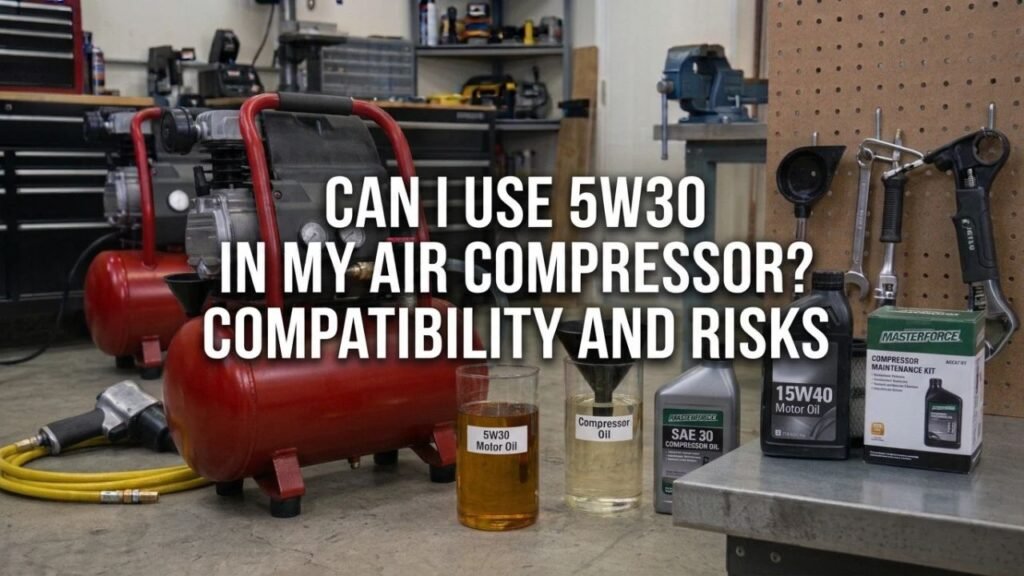
Sometimes. The answer depends on the pump manufacturer’s oil specification.
A blanket rule that all compressors can use 5W-30 is wrong, but so is the claim that 5W-30 can never be used in a compressor.
Some Compressors Specifically Approve 5W-30
Campbell Hausfeld provides a clear example.
One of its HL4330 manuals states that the compressor can use Chevron synthetic 5W-30, Mobil 1 5W-30, 10W-30 synthetic motor oil, or SAE 30 ISO 100 non-detergent compressor oil.
Other compressor manuals have also specified SAE 5W-30 motor oil as the required lubricant.
In those machines, using the specified 5W-30 is acceptable because the pump was designed and tested around that lubricant.
Other Compressors Prohibit Multi-Viscosity Oil
Some compressor pumps take the opposite approach.
A Central Pneumatic manual specifies premium SAE 30 non-detergent compressor oil and warns against multi-viscosity oils such as 10W-30 because the manufacturer says they can leave carbon deposits and shorten pump life.
That warning should also make you cautious about substituting 5W-30 unless the manual approves it.
The Owner’s Manual Settles the Question
Look for wording such as:
- SAE 30 non-detergent
- ISO VG 100
- ISO VG 68
- SAE 10W
- Synthetic compressor oil
- 10W-30 synthetic
- 5W-30 synthetic
- Manufacturer-specific compressor lubricant
Use the listed oil type and viscosity.
Do not assume a viscosity close to the specified oil automatically makes a substitute safe.
Key Takeaway: 5W-30 is acceptable in compressors whose manuals specifically approve it. If the manual specifies another lubricant or warns against multigrade motor oil, do not substitute 5W-30.
Why Do Some Air Compressors Use SAE 30 Instead?
Reciprocating air-compressor pumps have lubrication demands that differ from a gasoline engine.
Many older and current piston compressors use single-viscosity SAE 30 non-detergent compressor oil.
Compressor Pumps Do Not Have Combustion Contamination
Engine oil works inside an engine that produces combustion byproducts.
For that reason, automotive motor oils commonly contain detergent and dispersant additive packages designed around engine operation.
A piston compressor does not have combustion taking place in its crankcase.
Many compressor manufacturers therefore specify non-detergent oils formulated around pump lubrication instead.
Campbell Hausfeld lists SAE 30 ISO 100 non-detergent compressor oil as the recommended lubricant for several single-stage and two-stage compressor pumps.
Compressor Oil Is Made for Pump Conditions
Dedicated compressor oil is selected around conditions such as:
- High pump temperatures
- Continuous contact with compressed air
- Moisture entering with intake air
- Valve and piston deposits
- Foaming
- Oxidation over long service periods
That does not mean automotive oil instantly damages every compressor.
It means the lubricant should match the pump design.
SAE 30 and 5W-30 Are Not the Same Product
Both oils contain “30” in their viscosity designation, but that does not make them interchangeable.
SAE 30 is a single-grade oil.
5W-30 is a multigrade oil designed to flow more readily when cold while still meeting an SAE 30 viscosity range at higher test temperatures.
Their additive packages can also differ greatly.
Key Takeaway: Many compressor pumps use SAE 30 non-detergent oil because its viscosity and additive package suit the pump design; the shared “30” does not make SAE 30 and 5W-30 interchangeable.
5W-30 vs SAE 30 Compressor Oil
The comparison becomes clearer when you separate cold behavior from oil formulation.
| Feature | 5W-30 Motor Oil | SAE 30 Compressor Oil |
| Viscosity type | Multigrade | Single grade |
| Cold-flow rating | 5W | No winter rating |
| Common application | Automotive engines | Reciprocating compressor pumps |
| Detergent additives | Common | Often non-detergent |
| Compressor approval | Model-specific | Common on many piston compressors |
| Cold starting | Better flow when cold | Thicker in cold conditions |
| Safe substitute | Only if approved | Use when manual specifies it |
The 5W Rating Matters in Cold Weather
The “5W” describes low-temperature viscosity behavior.
A 5W-30 oil moves more freely during cold startup than straight SAE 30.
That can be useful on a compressor designed to operate outdoors or in an unheated shop during winter.
Some manufacturers use a thinner oil for cold-temperature operation instead of 5W-30. For example, some Central Pneumatic instructions specify SAE 10W non-detergent compressor oil in low temperatures rather than multigrade automotive oil.
The 30 Rating Does Not Tell the Whole Story
The second number tells you about the oil’s high-temperature viscosity category.
It says nothing by itself about:
- Detergent content
- Anti-foam additives
- Rust inhibitors
- Oxidation stability
- Moisture separation
- Compressor approval
That is why choosing oil only from the “30” on the bottle can lead to the wrong product.
Key Takeaway: 5W-30 flows better when cold, while SAE 30 compressor oil is a common single-grade pump lubricant. The correct choice depends on the complete manufacturer specification, not the number 30 alone.
Can I Use Synthetic 5W-30 in an Air Compressor?
Synthetic 5W-30 may be acceptable when the compressor manufacturer lists it.
The word “synthetic” alone does not guarantee compatibility.
Some Campbell Hausfeld Compressors Permit It
Campbell Hausfeld documentation provides several examples of approved synthetic automotive oils.
One single-stage manual lists SAE 30 ISO 100 non-detergent compressor oil or 10W-30 synthetic oil such as Mobil 1. Another manual specifically lists synthetic 5W-30 among the approved choices.
This shows why checking the exact model matters.
Other Pumps Require Dedicated Synthetic Compressor Oil
A compressor labeled for “full synthetic compressor oil” may require a lubricant formulated specifically for compressed-air equipment.
One Campbell Hausfeld manual states that full synthetic compressor oil or SAE 30 ISO 100 non-detergent compressor oil should be used and warns against regular automotive oil because its additives can create deposits and shorten pump life.
Do not replace a specified compressor lubricant with synthetic 5W-30 solely because both products use synthetic base stocks.
Key Takeaway: Synthetic 5W-30 can be correct for certain compressors, but other pumps require dedicated synthetic compressor oil. Follow the exact model specification.
Can I Use 5W-30 in Cold Weather?
Cold weather is one reason someone might consider 5W-30.
Straight SAE 30 becomes thicker as temperature falls, increasing starting load on the pump and motor.
Use 5W-30 Only if the Manual Approves It
If the manual lists synthetic 5W-30 for cold operation or general service, it is a suitable choice.
If the manual specifies SAE 10W non-detergent compressor oil during winter, use that instead.
Do not invent a cold-weather substitution.
Thick Oil Can Make the Compressor Hard to Start
Cold, high-viscosity oil creates more resistance during pump startup.
Possible signs include:
- Slow motor startup
- Breaker tripping
- Motor overload activation
- Compressor humming without starting
- Long pump acceleration time
Oil is not the only possible cause. Low voltage, undersized extension cords, faulty capacitors, pressure-switch trouble, and failed unloaders can create similar symptoms.
Keep the Compressor Within Its Temperature Rating
The oil choice cannot compensate for operating a compressor outside the temperature range listed by its maker.
Check storage and operating-temperature guidance if the unit stays in an unheated garage.
Key Takeaway: 5W-30 has better low-temperature flow than SAE 30, but use it for winter operation only when the compressor manufacturer permits that grade.
Can I Use 5W-30 in an Oil-Free Air Compressor?
No.
An oil-free compressor does not have a user-serviceable oil sump for the pump.
The pump may use permanently lubricated bearings, specialized coatings, or other low-friction materials.
Do not pour 5W-30 into:
- The air intake
- Pump cylinder
- Air tank
- Outlet hose
- Regulator
- Tool connection
Adding oil to the wrong location can contaminate the air system or damage pump components.
If your compressor has no oil sight glass, crankcase fill plug, dipstick, or oil-change instructions, check the manual before assuming it needs oil.
Can I Use 5W-30 in a Rotary Screw Air Compressor?
Do not substitute automotive 5W-30 unless the compressor manufacturer specifically authorizes it.
Rotary screw compressors commonly use purpose-specific compressor fluids.
Those lubricants may handle several jobs at once, including:
- Rotor lubrication
- Bearing lubrication
- Sealing
- Cooling
- Heat transfer
The required viscosity may be listed as an ISO viscosity grade instead of an SAE engine-oil grade.
Using the wrong lubricant can affect temperature, separators, seals, deposits, oil carryover, and service life.
For rotary screw equipment, use the manufacturer’s specified fluid or an approved equivalent.
What Does ISO VG Mean on Air Compressor Oil?
Many compressor lubricants use an ISO VG rating instead of SAE engine-oil terminology.
ISO VG describes kinematic viscosity at 40°C.
Common compressor grades include:
- ISO VG 32
- ISO VG 46
- ISO VG 68
- ISO VG 100
Many reciprocating compressor manuals pair SAE 30 with ISO 100 as their recommended pump-oil category. Campbell Hausfeld is one manufacturer that lists SAE 30 ISO 100 non-detergent oil on multiple reciprocating compressors.
Do not assume two products are identical because their viscosities are close.
Additive chemistry and manufacturer approval still matter.
What Happens if You Use the Wrong Oil in an Air Compressor?
The outcome depends on the oil and compressor.
Using an unapproved lubricant does not always cause an immediate failure, but continued operation may create problems.
Carbon and Valve Deposits
Some compressor manuals warn that multigrade motor oils can leave deposits on pump parts.
Deposits around valves can interfere with sealing and reduce pumping performance.
Foaming
Oil that foams excessively may not maintain a stable lubricating film.
Foaming may also contribute to oil carryover.
Dedicated compressor lubricants are formulated with pump operation in mind.
Hard Starting
Oil that is too thick for the ambient temperature can increase motor load during startup.
The motor may struggle to accelerate the pump.
Excess Oil Carryover
Wrong viscosity, overfilling, worn rings, or other pump problems can increase the amount of oil entering the compressed-air stream.
Oil carryover is unwanted for applications such as painting or other work requiring clean air.
Shorter Pump Life
Wrong lubrication can raise wear on:
- Bearings
- Cylinder walls
- Pistons
- Rings
- Crankshaft parts
- Valves
The risk becomes greater during long run times and high pump temperatures.
Key Takeaway: An unsuitable lubricant can contribute to deposits, foaming, hard starting, oil carryover, and pump wear, even if the compressor appears to run normally at first.
What If I Already Put 5W-30 in My Air Compressor?
First, check the manual before assuming you made a mistake.
If the Manual Approves 5W-30
No corrective action is needed solely because the oil is 5W-30.
Confirm:
- Correct oil level
- Approved oil type
- Correct change interval
- No leaks
Keep using the compressor according to its maintenance schedule.
If the Manual Calls for Another Oil
If 5W-30 is not approved, changing it to the specified lubricant is the safer choice.
Do not run the compressor longer simply to use up the wrong oil.
A general change procedure is:
- Switch the compressor off.
- Disconnect electrical power.
- Let the pump cool enough for safe service.
- Release receiver pressure if the manual requires it before maintenance.
- Drain the old pump oil.
- Reinstall the drain plug correctly.
- Fill with the specified compressor oil.
- Bring the level to the sight-glass or dipstick mark.
- Do not overfill.
- Run the compressor and recheck the oil level and leaks.
Follow your model’s service procedure because pump designs differ.
Do You Need to Flush the Crankcase?
Usually not after a brief exposure unless the manufacturer directs it.
Draining the incorrect oil and refilling with the proper product is often sufficient for a simple reciprocating compressor.
Do not add solvents, diesel fuel, gasoline, or other improvised flushing liquids to the crankcase.
Key Takeaway: If 5W-30 is approved, leave it in service. If it is not listed, drain it and refill with the exact lubricant specified by the compressor manufacturer.
How to Find the Correct Oil for Your Air Compressor
Finding the model-specific specification takes only a few checks.
Read the Owner’s Manual
Look under sections named:
- Lubrication
- Maintenance
- Oil
- Pump Oil
- Crankcase Oil
- Cold Weather Operation
Write down the full specification rather than only the viscosity.
For example, “SAE 30 non-detergent compressor oil” is more specific than “30-weight oil.”
Check the Compressor Data Plate
Find the exact model number.
Manufacturers may produce several visually similar compressors with different pumps.
Use that exact model when locating the manual.
Check the Sight Glass or Dipstick
Oil-lubricated piston compressors often have:
- Sight glass
- Dipstick
- Oil-fill cap
- Breather cap
- Drain plug
Maintain the oil at the specified level.
Too much oil can create problems just as low oil can.
Use the Manufacturer’s Oil When Unsure
A branded compressor lubricant listed for your pump removes most compatibility guesswork.
The cost difference between the proper oil and an improvised substitute is small compared with a damaged compressor pump.
Key Takeaway: Identify the exact model, read the lubrication section, and match viscosity plus oil type rather than choosing from viscosity alone.
SAE 30, 10W-30, or 5W-30: Which One Should You Use?
There is no universal winner.
Use the one your compressor manual lists.
A simple decision table looks like this:
| Manual Specification | What to Use |
| SAE 30 non-detergent | SAE 30 non-detergent compressor oil |
| ISO VG 100 | ISO VG 100 compressor lubricant |
| Synthetic compressor oil | Approved synthetic compressor oil |
| 10W-30 synthetic | Approved 10W-30 synthetic |
| 5W-30 synthetic | Approved 5W-30 synthetic |
| SAE 10W for cold weather | SAE 10W of the specified type |
| Oil-free | Do not add pump oil |
Do not replace one entry with another unless the manual gives both as options.
Conclusion
For can i use 5w30 in my air compressor, the answer is yes only when the exact compressor manufacturer approves 5W-30 for that pump. Some Campbell Hausfeld compressors specifically permit synthetic 5W-30, proving that the oil is not universally wrong for compressor use.
Many other compressors call for SAE 30 non-detergent, ISO VG 100, or a dedicated synthetic compressor oil. Some manuals specifically warn against multigrade automotive oils, so substituting 5W-30 without checking the specification is a gamble.
The safest choice is the exact viscosity and lubricant type printed in the owner’s manual. Oil-free compressors should receive no crankcase oil, and rotary screw compressors usually need their own specified compressor fluid.
If you already added 5W-30 and the manual does not list it, drain the pump and refill it with the specified oil rather than continuing to run the machine on an uncertain lubricant.
FAQs About Using 5W-30 in an Air Compressor
Is 5W-30 the same as air compressor oil?
No. 5W-30 describes an SAE multigrade viscosity category commonly used for engine oil. Compressor oils may use SAE or ISO viscosity ratings and can have a different additive package. Some compressor manufacturers approve specific 5W-30 oils, while others call for dedicated compressor lubricant.
Can I use regular 5W-30 motor oil in my air compressor?
Only if the compressor manual says that type of 5W-30 is acceptable. Do not assume regular automotive oil is suitable because the viscosity looks close. Some pumps permit synthetic automotive oils, while others specify non-detergent compressor oil and warn against multigrade motor oil.
Can I use synthetic 5W-30 in my air compressor?
Yes on certain models. Campbell Hausfeld has published compressor instructions that list synthetic 5W-30 as an approved lubricant. Other models from the same manufacturer use different specifications, so confirm the exact pump before adding it.
Is SAE 30 better than 5W-30 for an air compressor?
SAE 30 is the better choice when the compressor manual specifies SAE 30 non-detergent oil. 5W-30 is the correct choice when the manufacturer lists it. Neither grade should replace the other solely from personal preference.
Can 5W-30 damage an air compressor?
It can contribute to lubrication or deposit problems if the pump was designed for another type of oil. Some compressor manuals warn against multi-viscosity oils, while other models approve 5W-30. The effect depends on the compressor design and the exact oil formulation.
What oil do most oil-lubricated air compressors use?
Many reciprocating pumps use SAE 30 non-detergent compressor oil, ISO VG 100, or a dedicated synthetic compressor lubricant. Other designs use ISO VG 46, ISO VG 68, 10W-30 synthetic, 5W-30, or another manufacturer-specified oil.
Can I use 5W-30 in my compressor during winter?
Only when 5W-30 appears in the approved oil list. Its low-temperature flow is better than straight SAE 30, but some compressors specify SAE 10W non-detergent or another cold-weather lubricant instead.
What should I do if I put the wrong oil in my air compressor?
Stop the compressor, check the manual, and replace the oil with the specified lubricant if the current oil is not approved. Follow the manufacturer’s oil-change procedure, use the correct fill level, and do not add solvents to flush the pump unless the manufacturer specifically instructs you to do so.