
Can I Use 10W30 in My Air Compressor? Oil Compatibility Guide
You can use 10W30 in some oil-lubricated air compressors, but only when the compressor manufacturer specifically approves it. Some models permit synthetic 10W30, while others warn that multi-viscosity motor oils can cause carbon deposits and shorten compressor life. The safest choice is always the oil grade listed in your compressor manual.
This difference between manufacturers is important. Campbell Hausfeld currently lists synthetic 10W30 such as Mobil 1 as an approved option for several oil-lubricated compressor pumps. In contrast, DEWALT manuals for certain reciprocating compressors specifically warn against multi-viscosity motor oils such as 10W30 and call for compressor-specific lubricant instead.
For can I use 10W30 in my air compressor, the answer therefore cannot be based on viscosity alone. The compressor design, pump type, operating temperature, oil formulation, and manufacturer specification all matter.
There is another distinction to check before adding anything: some compressors use oil-free pumps. These pumps are designed to operate without crankcase oil, so adding 10W30 or any other lubricant to the pump is incorrect. DEWALT currently sells multiple compressors specifically described as oil-free and maintenance-free at the pump.
Gas-powered compressors can be even more confusing because they may contain two separate lubrication systems. The gasoline engine may call for 10W30 engine oil while the compressor pump requires SAE 30 compressor oil or another lubricant.
Before pouring 10W30 into an air compressor, identify exactly which component you are servicing and find the oil requirement for that model.
Can I Use 10W30 in My Air Compressor?
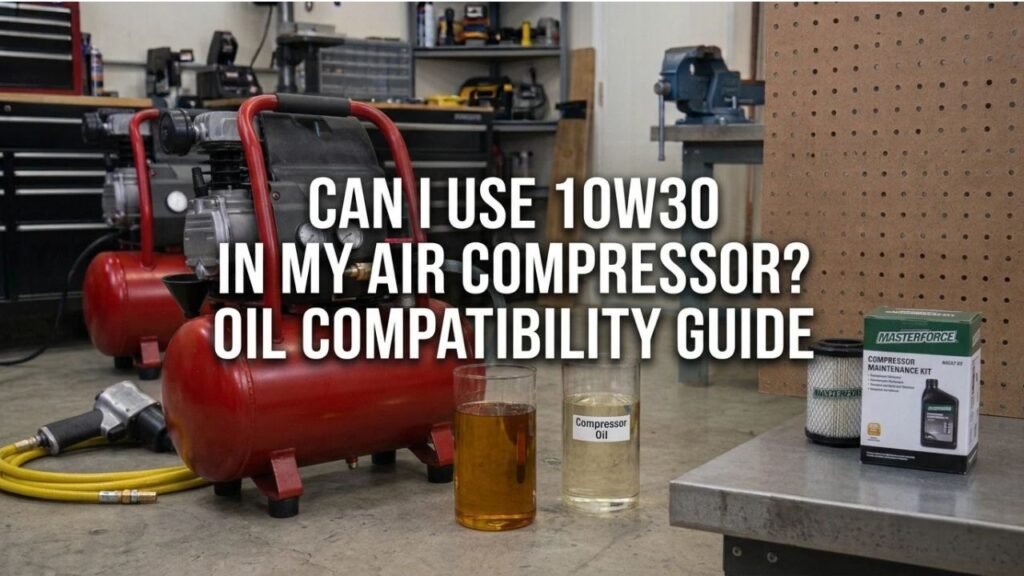
You can use 10W30 only if the compressor manufacturer lists it as an acceptable pump lubricant.
Do not assume that a compressor will accept 10W30 simply because another brand does.
When 10W30 Is Acceptable
Some oil-lubricated reciprocating compressors specifically permit synthetic 10W30.
For example, Campbell Hausfeld’s current single-stage compressor documentation lists two oil choices:
- SAE 30 ISO 100 non-detergent compressor oil
- Synthetic 10W30 such as Mobil 1
Another current Campbell Hausfeld pump manual gives the same choice.
In a compressor with that specification, the approved synthetic 10W30 is a legitimate option.
When 10W30 Should Not Be Used
Other manufacturers give the opposite instruction.
A DEWALT compressor manual warns against multi-viscosity motor oils such as 10W30, stating that they can leave carbon deposits on internal components and reduce compressor performance and service life. That model specifies DEWALT synthetic compressor oil or SAE 40 non-detergent compressor oil instead.
Another Campbell Hausfeld manual for a different pump also states not to use motor oil or multi-viscosity 10W30 and specifies SAE 30 ISO 100 oil.
This shows why brand name alone is not enough. Two compressors from the same broad product category can have different oil requirements.
What if the Compressor Is Oil-Free?
Do not add 10W30.
An oil-free pump does not have a conventional oil-filled compressor crankcase that needs routine oil changes.
DEWALT describes its oil-free direct-drive compressors as eliminating the need to add, change, or dispose of pump oil.
If your compressor says:
- Oil-free
- Maintenance-free pump
- Oil-less
check the manual before attempting to lubricate anything internally.
Key Takeaway: 10W30 is acceptable only when the exact compressor manual approves it. Some pumps allow synthetic 10W30, some specifically prohibit it, and oil-free pumps require no crankcase oil at all.
Why Do Some Air Compressors Prohibit 10W30?
The issue is not simply that 10W30 is “car oil.”
Compressor pumps and automobile engines operate under different lubrication conditions.
10W30 Is a Multi-Viscosity Oil
The “10W30” designation describes how the oil behaves across different temperature ranges.
The 10W portion represents low-temperature viscosity behavior, while the 30 indicates its viscosity grade at operating temperature.
That flexibility is useful in engines exposed to cold starts and a wide operating-temperature range.
A compressor designed around a single-viscosity oil may not need or be designed for the same formulation.
Additive Packages Differ
Automotive engine oils are formulated for combustion engines.
Depending on the oil, additives can include compounds intended to address:
- Engine deposits
- Oxidation
- Wear
- Acid formation
- Sludge
- Temperature changes
Compressor oils are formulated around the operating conditions of compressor pumps.
That is why the correct viscosity number alone does not prove two oils are interchangeable.
Carbon Deposits Can Be a Concern
DEWALT’s warning against 10W30 on specified compressor models specifically cites carbon deposits on internal compressor components as the reason multi-viscosity motor oil should not be used.
Carbon buildup can interfere with:
- Valves
- Piston operation
- Heat transfer
- Compressor efficiency
The risk depends on the compressor design and oil formulation.
Warranty Requirements Matter
Using an oil that conflicts with the manufacturer’s service instructions can create warranty problems if lubrication-related damage occurs.
Ingersoll Rand, for example, recommends its own All Season Select synthetic lubricant for a range of reciprocating compressors and specifies maintenance intervals based on that lubricant.
Using the listed lubricant keeps the maintenance procedure aligned with the equipment maker’s requirements.
Key Takeaway: Some compressors prohibit 10W30 because their pumps are designed around a different lubricant formulation and viscosity behavior, and improper oil can contribute to deposits, wear, or service issues.
Why Do Some Compressors Allow Synthetic 10W30?
If 10W30 can be wrong for one compressor, why does another manufacturer recommend it?
Because the compressor pump has been designed and validated around that lubricant option.
Synthetic Oil Performs Well Across Temperature Changes
Synthetic lubricants can maintain useful flow characteristics across a broad temperature range.
That can be helpful in compressors operating in colder environments where a heavy single-grade lubricant flows more slowly during startup.
This does not mean any synthetic 10W30 is suitable for every compressor.
The approval still needs to come from the equipment manufacturer.
Campbell Hausfeld Provides a Clear Example
Current Campbell Hausfeld documentation for several oil-lubricated pumps gives users a choice between:
- SAE 30 ISO 100 non-detergent compressor oil
- Synthetic 10W30 such as Mobil 1
That manufacturer-specific approval is a much stronger reason to use 10W30 than a generic online statement claiming it works in all compressors.
Synthetic Compressor Oil Is Another Option
Some compressor manufacturers develop dedicated synthetic lubricants rather than recommending automotive synthetic oil.
Ingersoll Rand’s All Season Select is a synthetic all-temperature compressor lubricant designed for its reciprocating compressor range and carries a recommended service interval of up to 2,000 hours or 12 months under normal conditions.
Key Takeaway: Synthetic 10W30 can work well in compressors specifically designed to use it, but an OEM-approved compressor lubricant remains the safer choice when the manual does not list 10W30.
10W30 vs Air Compressor Oil
The labels may look similar from a viscosity standpoint, but the intended applications can be different.
| Feature | 10W30 Motor Oil | Compressor Oil |
| Primary application | Internal-combustion engines | Compressor pumps |
| Viscosity type | Usually multi-viscosity | Often single-grade or compressor-specific synthetic |
| Additive package | Designed for engines | Designed for compressor service |
| Can be used in every compressor? | No | No; correct grade still matters |
| Cold-temperature behavior | Generally good | Depends on lubricant |
| Manufacturer approval required | Yes | Yes |
| Typical compressor examples | Approved in some models | Preferred in many oil-lubricated models |
The safest rule is simple: match the lubricant to the specification, not just to a viscosity number.
What Oil Should You Use in an Air Compressor?
The correct oil depends on the pump.
Common specifications include SAE 30 non-detergent oil, ISO 100 compressor oil, dedicated synthetic compressor lubricant, and manufacturer-specific fluids.
SAE 30 Non-Detergent Compressor Oil
SAE 30 is common in oil-lubricated reciprocating compressors.
Campbell Hausfeld lists single-viscosity SAE 30 ISO 100 non-detergent compressor oil for several current pumps.
This type of lubricant is easy to recognize because it is specifically labeled for compressor service.
SAE 40 Compressor Oil
Some compressors require a heavier grade.
The DEWALT model cited earlier specifies SAE 40 non-detergent compressor oil as one acceptable option.
Do not substitute SAE 30 simply because it is common in other compressor pumps.
Synthetic Compressor Lubricant
Synthetic compressor oils can provide strong temperature stability and longer service intervals when approved.
Ingersoll Rand’s All Season Select is an example designed specifically for reciprocating compressors.
Manufacturer-Specific Oil
Rotary screw and other industrial compressors may require fluids that are completely different from common piston-compressor oils.
Follow the model’s lubrication chart rather than assuming SAE 30 or 10W30 will work.
Oil-Free Compressors
Oil-free pumps do not need crankcase oil.
Do not add lubricant simply because the compressor sounds louder than expected.
A mechanical problem in an oil-free pump needs diagnosis rather than an improvised oil fill.
Key Takeaway: Common compressor oils include SAE 30 non-detergent, SAE 40, and compressor-specific synthetics, but the exact pump specification always takes priority.
Can You Use Regular Car 10W30 in an Air Compressor?
Sometimes, but only when the compressor documentation explicitly permits it.
The word “regular” creates a problem because 10W30 oils are not all formulated identically.
Do Not Choose It Only Because the Viscosity Matches
A compressor manual may specify:
- Synthetic 10W30
- SAE 30 non-detergent
- ISO 100
- OEM compressor lubricant
Those are not interchangeable instructions.
If the manual specifically says “synthetic 10W30,” a conventional 10W30 motor oil is not automatically the same recommendation.
Check the Exact Wording
Campbell Hausfeld’s manuals specifically state 10W30 synthetic oil such as Mobil 1 for several pumps.
That wording is more specific than simply saying “10W30.”
Use the product type described by the manufacturer.
Can I Use 10W30 in a Gas-Powered Air Compressor?
This depends on which oil fill you mean.
Gas-powered compressors can have both an engine crankcase and a compressor pump crankcase.
The Engine and Pump Are Separate
A gas compressor commonly contains:
- Gasoline engine
- Belt or direct drive
- Compressor pump
- Air receiver tank
The gasoline engine needs engine oil.
The compressor pump may require compressor oil.
They can use completely different lubricants.
The Engine May Require 10W30
Many small gasoline engines permit 10W30 under certain temperature conditions.
If the engine manual specifies 10W30, use it in the engine crankcase.
That does not mean you should pour the same oil into the compressor pump.
Check Both Manuals
Gas compressor documentation may refer users to a separate engine manual for engine oil while listing a completely different compressor-pump lubricant.
Older Campbell Hausfeld documentation, for example, lists compressor-pump oil separately and directs users to the engine manufacturer’s information for engine oil.
Key Takeaway: On a gas-powered compressor, 10W30 may be correct for the gasoline engine but wrong for the compressor pump, so identify the correct oil fill before adding lubricant.
What Happens if You Put the Wrong Oil in an Air Compressor?
The outcome depends on how different the oil is from the required lubricant and how long the compressor runs with it.
Carbon and Deposit Formation
An unsuitable lubricant may leave deposits on hot compressor parts.
DEWALT specifically warns of carbon deposits when prohibited multi-viscosity oils are used in affected pumps.
Excessive Wear
Oil that is too thin under operating conditions may not provide the intended lubrication film between moving parts.
Possible wear areas include:
- Bearings
- Cylinder walls
- Crankshaft surfaces
- Connecting-rod components
Hard Starting in Cold Weather
Oil that is too thick when cold can make the pump harder to turn.
The electric motor then needs more starting torque and current.
High Operating Temperature
Poor lubrication increases friction and heat.
An incorrect viscosity can also affect oil circulation through the pump.
Reduced Compressor Life
Long-term operation with an unsuitable lubricant can contribute to premature mechanical wear or deposit buildup.
This is why choosing oil from the manual is more important than selecting a grade based only on availability.
Key Takeaway: Wrong compressor oil can contribute to deposits, increased friction, hard starting, higher temperature, and premature pump wear.
What Should You Do if You Already Added 10W30?
Do not panic.
First determine if the oil is actually incorrect for your compressor.
Check the Manual Before Running It Again
Look for the pump lubrication section.
If 10W30 synthetic is listed as an approved option and you used the correct type, no corrective action may be needed.
If 10W30 Is Specifically Prohibited
If the compressor has not been run, drain the incorrect oil and refill it with the specified lubricant.
If it has already run, changing the oil promptly is still sensible.
Consult the manufacturer if:
- The compressor ran for many hours
- The oil smells burned
- The pump became unusually hot
- Performance changed
- Oil has become heavily discolored
Do Not Flush With Random Solvents
Avoid pouring gasoline, brake cleaner, kerosene, or other unapproved fluids into the compressor crankcase.
A normal drain-and-refill procedure is safer unless the manufacturer provides a specific flushing process.
Set the Correct Oil Level
Too much oil can also cause problems.
Some manuals warn that overfilling can contribute to premature compressor failure or excessive oil carryover.
Fill to the dipstick, sight glass, or marked level specified for the model.
Key Takeaway: If 10W30 is not approved, drain it and refill with the correct compressor lubricant rather than trying to compensate with additives or improvised flushing chemicals.
Is 10W30 Better for Cold Weather?
Its multi-viscosity behavior can make 10W30 flow more readily at low temperatures than a heavy single-grade oil.
That does not override the compressor manufacturer’s specification.
Cold Starts Put More Load on the Motor
Oil thickens as temperature falls.
A compressor pump filled with oil that is too heavy for the conditions may turn more slowly during startup.
This can contribute to:
- Slow motor acceleration
- Breaker trips
- Overload protection activation
- Hard starting
Use an Approved All-Temperature Lubricant
If the compressor operates in a cold garage or outdoor workspace, check the manufacturer’s low-temperature oil recommendation.
Ingersoll Rand, for example, markets All Season Select as an all-temperature synthetic lubricant for its reciprocating compressors.
If your manufacturer lists synthetic 10W30 for cold conditions, use it.
If the manual prohibits 10W30, choose the recommended compressor-specific cold-weather lubricant instead.
How Often Should Air Compressor Oil Be Changed?
Oil-change intervals vary greatly by compressor and lubricant.
There is no universal interval.
Check the Manufacturer Schedule
The owner’s manual may specify oil changes by:
- Operating hours
- Months
- First break-in period
- Severe-duty conditions
Ingersoll Rand currently recommends changing its All Season Select lubricant at 2,000 hours or 12 months, whichever comes first, for the applicable reciprocating compressors.
Other compressor oils and models may require much shorter intervals.
Check Oil Level Regularly
Many oil-lubricated compressors use:
- Sight glass
- Dipstick
- Oil-level window
Check the level with the compressor positioned as directed by the manufacturer.
Replace Oil Earlier if It Is Contaminated
Oil may need early replacement if it becomes:
- Milky from moisture
- Burned smelling
- Very dark
- Contaminated with debris
A sudden change in oil condition can also point toward an operating problem that needs inspection.
Conclusion
For can I use 10W30 in my air compressor, the answer is yes for some models and no for others. There is no safe universal rule.
Campbell Hausfeld currently approves synthetic 10W30 for several oil-lubricated compressor pumps, while DEWALT documentation for other compressors specifically warns against 10W30 and calls for dedicated compressor oil.
Check the manual for the exact model before adding oil. If it specifies SAE 30 non-detergent, SAE 40, ISO 100, an OEM synthetic lubricant, or another oil, use that specification.
Also confirm that you are servicing an oil-lubricated pump. Oil-free compressors require no pump oil, and gas-powered compressors may have separate oil requirements for the engine and compressor pump.
Using the correct lubricant is inexpensive compared with replacing a damaged compressor pump.
FAQs About Using 10W30 in an Air Compressor
Is 10W30 Good for an Air Compressor?
It can be good for a compressor specifically designed to use it.
Several Campbell Hausfeld pumps approve synthetic 10W30, while certain DEWALT compressors prohibit multi-viscosity 10W30. Check the exact compressor manual rather than applying one rule to every pump.
Can I Use Synthetic 10W30 in My Air Compressor?
Yes, if the manufacturer lists synthetic 10W30 as an approved lubricant.
Campbell Hausfeld currently specifies synthetic 10W30 such as Mobil 1 for several oil-lubricated pump models.
Can I Use Regular Motor Oil in an Air Compressor?
Only if the manufacturer approves the exact type.
Many compressor pumps call for non-detergent compressor oil or dedicated synthetic compressor lubricant instead of ordinary automotive motor oil.
Is SAE 30 Better Than 10W30 for an Air Compressor?
Neither is universally better.
SAE 30 non-detergent is specified for many reciprocating compressors, while some models permit synthetic 10W30. Use the oil listed for your pump.
What Happens if I Use 10W30 When the Manual Says SAE 30?
If 10W30 is not approved, drain it and refill with the specified lubricant.
Continuing to use the wrong formulation can contribute to deposits, lubrication problems, or premature wear depending on the compressor design.
Can I Put 10W30 in an Oil-Free Air Compressor?
No.
An oil-free compressor pump is designed to operate without crankcase oil. Adding 10W30 does not convert it into an oil-lubricated compressor and may damage the pump.
Can I Use 10W30 in a Gas Air Compressor?
Possibly in the gasoline engine if its engine manual calls for 10W30.
The compressor pump may require a completely different oil. Treat the engine and compressor pump as separate lubrication systems.
What Is the Safest Air Compressor Oil to Use?
The safest choice is the viscosity and product type specified by the compressor manufacturer.
When available, an OEM compressor lubricant removes uncertainty about viscosity, additives, and compatibility with the pump.