
What Is a Screw Air Compressor? How It Works, Uses, and Types
A screw air compressor is a positive-displacement compressor that uses rotating helical rotors instead of pistons to compress air. Air becomes trapped between the rotors and housing, then its available space becomes smaller as the rotors turn. This creates a steady supply of compressed air suited to shops, factories, and other applications with frequent or continuous demand.
The design is commonly called a rotary screw compressor. Compared with a piston compressor, it produces air with much less pulsation and can be built for long operating periods without the repeated start-stop pattern common to many smaller reciprocating machines. The U.S. Department of Energy identifies lubricant-injected rotary screw machines as a dominant compressor type in many industrial plant-air applications.
Compressed air represents a major industrial energy load. A U.S. Department of Energy Better Plants resource reports that compressed-air systems consume around 90 billion kWh of electricity per year in the United States, with a large share of that input energy leaving the system as heat.
So, what is a screw air compressor in practical terms? It is a machine built around one or more screw-shaped rotors, usually a matched male and female pair, that continuously draw air in, trap it, reduce its volume, and discharge it at a higher pressure. CAGI describes the process as air moving through spaces between intermeshing helical rotors while those spaces progressively shrink toward the discharge end.
Rotary screw machines are sold in oil-injected and oil-free designs, with fixed-speed and variable-speed drive options. They range from small workshop units to large plant-air systems and engine-driven portable machines used at construction and utility sites.
For a home user, a screw compressor may be unnecessary if the air demand consists mainly of tire inflation and occasional nail-gun use. For a business running grinders, production equipment, pneumatic controls, or several tools for long periods each day, the screw design starts making much more sense.
What Is a Screw Air Compressor and How Does It Work?
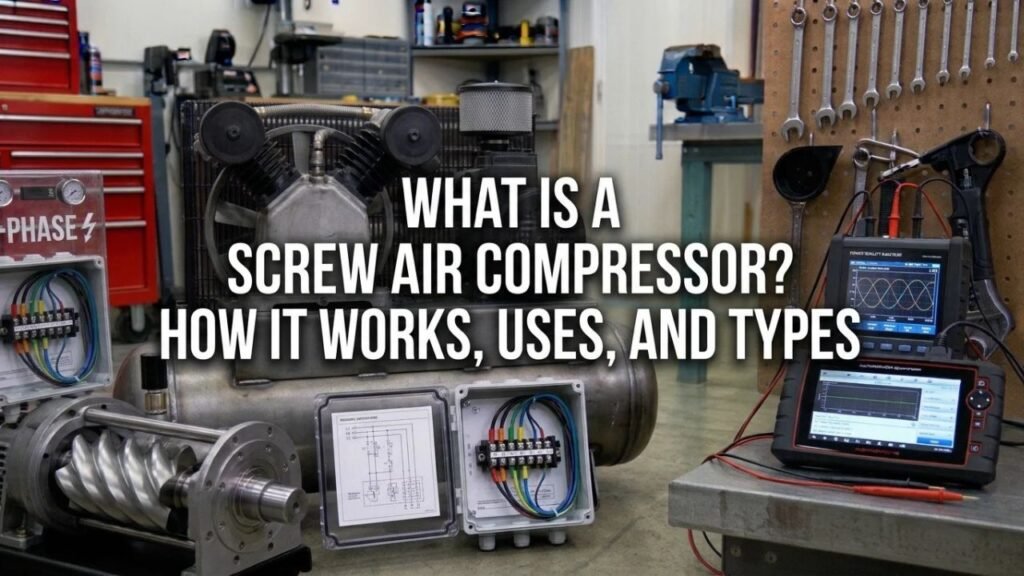
A screw air compressor compresses air by reducing the space trapped between rotating helical rotors and the compressor housing.
The rotor assembly is normally called the airend.
Air Enters Through the Intake
Atmospheric air first passes through an intake filter.
The filter helps stop dust and debris from entering the precision-machined rotor chamber.
An inlet valve controls how much air reaches the compression element. Depending on compressor design and control mode, the inlet may be fully open, partly controlled, or closed when the machine unloads.
Twin Rotors Trap the Air
Most rotary screw compressors use two intermeshing rotors.
One is commonly called the male rotor, while the other is called the female rotor.
CAGI describes the male rotor as having helical lobes and the female rotor as having matching grooves or flutes. As the pair turns, air becomes trapped between the rotor profiles and the surrounding housing.
The rotors do not work like two flat gears simply squeezing air at one point. The trapped air travels lengthwise along the screw profiles toward the outlet.
The Trapped Space Gets Smaller
As the rotors continue turning, their intermeshing profiles progressively reduce the volume containing the trapped air.
Reducing volume raises pressure.
Atlas Copco describes rotary screw compression as a positive-displacement process in which the chamber containing the air becomes progressively smaller before the compressed air reaches the discharge port.
The process is continuous while the rotors turn, which is one reason a screw compressor produces a relatively smooth airflow.
Compressed Air Leaves the Airend
Once the trapped air reaches the designed pressure relationship inside the airend, it reaches the discharge opening.
From there, the path depends on compressor type.
In an oil-injected machine, the outgoing air contains compressor oil that must be separated before the air enters the plant or tool system.
In an oil-free design, oil is kept out of the compression chamber, so the separation arrangement is different.
Key Takeaway: A rotary screw compressor draws air between helical rotors, traps it, reduces the trapped volume as the rotors turn, and sends the resulting compressed air toward the outlet.
Oil-Injected Screw Air Compressors
Oil-injected units are among the most common rotary screw compressors used for general shop and plant air.
They are also called:
- Oil-flooded screw compressors
- Oil-lubricated screw compressors
- Lubricant-injected rotary screw compressors
What the Oil Does
Oil performs several jobs inside an oil-injected screw compressor.
CAGI identifies three primary functions: lubricating components, carrying away heat created by compression, and sealing clearances between the rotors and housing.
Atlas Copco also describes oil as helping with cooling, sealing, lubrication, and noise reduction in the compression chamber.
This combination lets an oil-injected airend compress air in a compact package while keeping internal temperatures under control.
The Oil Must Be Removed From the Air
Oil and compressed air leave the airend together.
The mixture then enters a separation system. Much of the oil is removed mechanically in the separator vessel, while a separator element removes much smaller droplets.
The recovered lubricant is filtered, cooled, and sent back through the compressor circuit.
The compressed air may then pass through an aftercooler and moisture separator before entering an air receiver, dryer, or distribution system.
Oil-Injected Does Not Mean Air Tools Receive Liquid Oil
A properly operating separator removes most of the compressor lubricant before the air enters the distribution system.
Trace oil carryover may still remain, which matters in processes where direct product contact must stay free from oil contamination.
For ordinary pneumatic tools, manufacturing equipment, and general plant-air systems, oil-injected machines are widely used. Atlas Copco lists pneumatic tools, assembly equipment, metalworking equipment, material handling, and general plant use among common applications.
Key Takeaway: Oil-injected screw compressors use lubricant inside the airend for cooling, sealing, and lubrication, then separate that oil from the compressed air before delivery.
Oil-Free Screw Air Compressors
An oil-free screw compressor keeps lubricant out of the compression chamber.
That does not necessarily mean the entire machine contains no oil.
The Rotors Do Not Depend on Injected Oil
In an oil-free screw airend, the rotors are synchronized so they do not need an oil film between them for the compression process.
Atlas Copco states that external timing gears maintain rotor position with small calculated clearances, preventing direct rotor contact inside the compression chamber.
The timing gears and bearings may still need lubrication outside the compression chamber.
Oil-Free Designs Often Use Multiple Stages
Oil in an oil-injected compressor carries away a large amount of compression heat.
Without oil inside the chamber, controlling air temperature becomes more demanding.
Atlas Copco states that oil-free screw compressors frequently use multiple compression stages with cooling between stages to control temperature while reaching normal industrial pressures.
Where Oil-Free Air Is Used
Oil-free compressors are associated with processes where compressor lubricant in the air stream can create product or process problems.
Examples include selected applications in:
- Food and beverage production
- Pharmaceutical manufacturing
- Electronics
- Chemical processes
- Medical or laboratory systems
- High-purity manufacturing
The Department of Energy specifically notes lubricant-free rotary screw compressors in applications requiring clean compressed air, including food processing, pharmaceuticals, and electronics.
Key Takeaway: Oil-free screw compressors keep oil out of the compression chamber and are used where lubricant contamination in the compressed-air stream must be minimized.
Main Parts of a Screw Air Compressor
A packaged rotary screw machine contains much more than the two rotors.
Airend
The airend contains the screw rotors and housing where compression takes place.
This is the defining component of the machine.
Clearances inside the airend are tightly controlled because excess leakage around the rotors lowers output.
Electric Motor or Engine
Most stationary machines use an electric motor.
Portable construction compressors may use diesel engines, while vehicle-mounted units can use power-take-off drives. CAGI lists diesel engine-driven screw compressors for construction and road work and PTO screw compressors for service and utility trucks.
Inlet Valve and Air Filter
The intake filter removes airborne debris.
The inlet valve controls incoming air and forms part of the compressor’s loading and unloading system.
Oil Separator
Oil-injected machines use a separator vessel and separator element to remove lubricant from the compressed air.
The oil returns to the compressor circuit rather than being intentionally sent down the airline.
Oil Filter
The oil filter captures contaminants circulating with the lubricant.
Oil and filter service intervals should come from the manufacturer because heat, operating hours, environment, and lubricant type affect service life.
Cooler
Compression generates heat.
Air-cooled compressors use airflow across a cooler, while water-cooled machines move heat into a water circuit.
Atlas Copco notes that cooling is required to remove heat generated during compression and describes both air-cooled and water-cooled screw-compressor configurations.
Aftercooler and Moisture Separator
Compressed air exits the airend hot.
Cooling it causes some water vapor to condense into liquid.
An aftercooler lowers air temperature, and a moisture separator removes part of the resulting condensate before the air enters the rest of the system.
Controller
Modern packages use electronic controllers to monitor items such as:
- Pressure
- Temperature
- Motor operation
- Service intervals
- Loading status
- Fault conditions
Variable-speed machines also use electronic motor control to change compressor speed as demand changes.
Key Takeaway: A complete screw compressor combines the airend with a drive motor, intake system, cooling system, controls, and—on oil-injected machines—oil filtration and separation components.
Fixed-Speed vs Variable-Speed Screw Compressors
The rotor system may be similar, but the way output is controlled can differ substantially.
Fixed-Speed Compressor
A fixed-speed compressor normally runs its motor at a set speed while loaded.
When air demand drops, the machine may unload rather than continuously producing full compressed-air output.
This arrangement works well where demand stays fairly stable for long periods.
Variable-Speed Drive Compressor
A variable-speed drive, often shortened to VSD, changes motor speed to match changing airflow demand within the compressor’s control range.
Atlas Copco states that VSD designs can reduce wasted power where compressed-air demand varies across shifts, processes, or production cycles.
A VSD compressor is not automatically the right choice for every installation. A facility with steady near-full-load demand may be well suited to a properly sized fixed-speed machine.
The correct choice comes from the actual air-demand profile rather than the VSD label alone.
Key Takeaway: Fixed-speed screw compressors suit steady air demand, while variable-speed units can adjust output when demand rises and falls during operation.
Screw Air Compressor vs Piston Air Compressor
Both are positive-displacement compressors, but they create compressed air in different ways.
| Feature | Screw Compressor | Piston Compressor |
| Compression method | Rotating helical rotors | Reciprocating piston |
| Air delivery | Smooth, continuous flow | Pulsating flow |
| Typical use | Frequent or continuous plant/shop demand | Intermittent shop and portable demand |
| Vibration | Generally lower | Generally higher |
| Package size for steady flow | Compact for its output | Can become larger at higher output |
| Purchase price | Usually higher | Usually lower in smaller sizes |
| Service work | Oil, filters, separator, cooling system | Oil, valves, rings, belts depending on design |
| Best fit | Long operating periods | Shorter or intermittent use |
The Department of Energy notes that lubricant-injected rotary screw compressors produce continuous flow with less pressure pulsation than reciprocating machines and tend to have lower vibration and smaller space requirements for many industrial installations.
Piston Compressors Make Sense for Intermittent Use
A home garage that uses a nailer, impact wrench, or blow gun for short periods may not need a rotary screw machine.
Piston compressors are widely available in small sizes, cost less to buy, and can sit idle between occasional jobs.
Screw Compressors Make Sense for Long Run Time
Screw compressors become attractive when a business needs air for many hours per day.
Common examples include production shops, auto repair facilities with several air users, manufacturing lines, and industrial equipment.
CAGI describes rotary compressor technology as commonly applied to continuous-duty and process applications.
A Large Tank Does Not Turn a Piston Unit Into a Screw Compressor
Tank size and compressor type are separate issues.
A 60-gallon piston compressor still uses a reciprocating pump.
A screw compressor may have an integrated receiver, separate receiver, or little receiver volume depending on the system layout.
The airend design determines the compressor type.
Key Takeaway: Piston compressors are often a good match for intermittent jobs, while rotary screw machines are built around steadier airflow and longer operating periods.
Advantages and Limitations of Screw Air Compressors
The screw design solves several problems found in heavy compressed-air use, but it also brings extra cost and service requirements.
Smooth Air Delivery
Because compression occurs continuously as the rotors turn, output has much less pulsation than a piston pump.
That makes screw compressors a strong fit for plant-air distribution and processes that operate for long periods.
Long Duty Capability
Atlas Copco states that many rotary screw compressors are built for operation up to a 100% duty cycle, depending on the package and application.
That is very different from a small hobby piston compressor that may need regular cooling periods.
Always use the duty rating supplied for the exact compressor.
Lower Vibration
Rotary motion creates less reciprocating vibration than a piston moving back and forth.
The Department of Energy lists reduced vibration and noise among the reasons rotary screw compressors became common in industrial plant-air applications.
Higher Purchase Cost
A screw compressor normally costs more than a comparably small piston compressor.
The package may contain:
- Airend
- Separator vessel
- Oil separator
- Oil cooler
- Aftercooler
- Electronic controller
- Variable-speed electronics on some models
That added hardware makes little financial sense for a user who only fills tires a few times each month.
Maintenance Must Be Done on Schedule
A screw compressor may need periodic replacement of:
- Intake filter
- Oil filter
- Separator element
- Compressor lubricant
- Belts on belt-driven models
- Coolant or cooling-system components on applicable units
Ignoring these items can raise operating temperature, increase oil carryover, reduce airflow, or damage the airend.
Part-Load Operation Needs Attention
A machine that is much larger than the real air demand may spend too much time unloaded or operating outside its strongest range.
The Department of Energy notes that lubricant-injected rotary screw machines can perform poorly at part load compared with some other compressor types.
This is one reason proper sizing and control strategy matter.
Key Takeaway: Screw compressors provide smooth air, low vibration, and long run capability, but purchase cost, scheduled service, and correct sizing deserve serious attention.
What Are Screw Air Compressors Used For?
Rotary screw compressors are used wherever a steady source of compressed air is needed.
Automotive Shops
A larger repair shop may use compressed air for:
- Impact wrenches
- Tire changers
- Air lifts
- Blow guns
- Air ratchets
- Paint-related equipment
- Pneumatic shop machinery
A screw compressor becomes more attractive when several technicians draw air throughout the workday.
Manufacturing
Factories use compressed air for:
- Pneumatic cylinders
- Assembly tools
- Packaging machinery
- Material handling
- Robotic systems
- Machine controls
- Air-operated valves
The Department of Energy identifies rotary screw machines as a common industrial plant-air technology.
Construction
Portable diesel rotary screw compressors can supply large amounts of air at job sites where electrical service is unavailable.
Common loads include pneumatic breakers, rock drills, air tools, and utility equipment.
CAGI notes that diesel-driven screw compressors are widely used at construction and road-work sites.
Sandblasting
Blasting nozzles consume a large and continuous volume of air.
A high-output screw compressor is often better suited than a small piston unit because the process can require sustained airflow.
Food, Pharmaceutical, and Electronics Work
Selected processes need compressed air with very low risk of lubricant contamination.
Oil-free screw compressors are used in these areas when process requirements call for oil-free compression.
Key Takeaway: Rotary screw compressors are common in automotive, manufacturing, construction, blasting, packaging, and process applications that need frequent or continuous airflow.
How to Choose a Screw Air Compressor
Do not choose one from horsepower alone.
Start with the air system’s actual demand.
Determine Required CFM
List the tools and equipment that may operate at the same time.
Record each item’s airflow requirement in CFM or SCFM.
A compressor should have enough output to cover realistic simultaneous demand plus reasonable system losses and future expansion.
Determine Required PSI
Find the highest pressure needed by the equipment.
A machine producing 500 CFM is still the wrong compressor if it cannot reach the system’s required working pressure.
Pressure should not be raised simply to compensate for undersized piping or excessive pressure drop.
Consider the Demand Pattern
Ask how the air is used throughout a normal day.
Steady demand may suit fixed-speed equipment.
Demand that repeatedly rises and falls may suit a properly sized variable-speed machine or a mixed system using more than one compressor.
Check Air Quality Requirements
General pneumatic tools may be satisfied with filtered and dried air from an oil-injected machine.
A process with strict oil limits may call for an oil-free compressor plus the appropriate drying and filtration system.
Plan for Cooling and Ventilation
A compressor converts much of its electrical input into heat.
The DOE Better Plants resource states that almost 80% of compressor input electricity can be dissipated as heat across compressed-air systems.
The compressor room therefore needs adequate ventilation or another approved heat-removal arrangement.
Look at Service Access
Filters, lubricant, separator elements, drains, coolers, and belts should be accessible without dismantling half the room.
Service cost and parts availability matter over a machine’s life.
Key Takeaway: Size a screw compressor from real CFM, PSI, air-quality, duty pattern, cooling, and service requirements rather than horsepower or tank size alone.
Conclusion
What is a screw air compressor? It is a positive-displacement compressor that uses rotating helical rotors to trap air and progressively reduce its volume until the air reaches a higher pressure.
Its continuous rotary action makes the design well suited to applications that use compressed air for long periods. Oil-injected models dominate many general industrial uses, while oil-free screw compressors serve processes where lubricant must stay out of the compression chamber.
A screw compressor is not automatically the best machine for every garage. For occasional nailers, tire inflation, and short air-tool use, a piston compressor may cost less and do the job well. For sustained shop or production demand, a correctly sized rotary screw compressor can provide the steadier airflow and long operating periods those applications require.
FAQs About Screw Air Compressors
Is a screw compressor the same as a rotary screw compressor?
Yes. “Screw compressor” is commonly used as a shorter name for a rotary screw air compressor. The machine uses rotating helical screw-shaped rotors inside an airend to trap and compress air.
Does a screw air compressor have pistons?
No. Its main compression element uses rotating screw rotors rather than reciprocating pistons. The rotors trap air between their profiles and the housing, then reduce the trapped volume as the air moves toward the discharge port.
Can a screw compressor run continuously?
Many industrial rotary screw compressors are designed for long operating periods, and some packages are rated for up to 100% duty operation. The exact duty rating and operating limits should come from the manufacturer of the specific machine.
Does a rotary screw compressor need an air tank?
Not every installation uses the same receiver arrangement. An air receiver can store compressed air, stabilize system pressure, handle short demand changes, and support moisture separation. The compressor itself can still create compressed air without a large tank attached directly beneath it.
What is the difference between oil-free and oil-injected screw compressors?
An oil-injected unit introduces lubricant into the compression chamber for cooling, sealing, and lubrication, then separates the oil from the discharged air. An oil-free screw compressor keeps oil out of the compression chamber and normally uses timing gears to maintain rotor clearances.
Is a screw air compressor better than a piston compressor?
It depends on the workload. Screw compressors are a strong fit for steady, long-duration air demand and multiple shop or industrial users. Piston compressors are often a simpler and lower-cost choice for occasional or intermittent air-tool use.
Why are rotary screw compressors used in factories?
They provide continuous airflow with low pressure pulsation, relatively low vibration, and strong long-run capability. Those traits suit plant-air systems feeding pneumatic tools, controls, manufacturing equipment, and production processes for many hours each day.