
What Makes an Air Compressor Quiet? Features That Reduce Noise
A quiet air compressor cuts noise by slowing the motor and pump, controlling vibration, smoothing intake airflow, and isolating mechanical sound with mounts or enclosures. Low-noise models often run around 1,680–1,750 RPM and combine that slower speed with quieter pump geometry, intake silencers, and vibration-damping supports.
Compressor noise comes from several places at once. The motor produces mechanical and electrical sound, the pump creates pulsation, the intake makes sharp air noises, valves open and close rapidly, and vibration can travel into the tank, frame, floor, walls, and connected piping.
Noise level matters beyond comfort. OSHA requires a hearing conservation program in general industry when worker exposure reaches an 8-hour time-weighted average of 85 dBA. A home compressor may run for much shorter periods, but that benchmark shows why large differences in compressor sound ratings deserve attention.
The central answer to what makes an air compressor quiet is not simply an oil-filled pump or a larger tank. Motor speed, pump speed, vibration isolation, intake silencing, pump layout, enclosure design, and installation all influence the sound reaching your ears.
Current low-noise portable compressors demonstrate the pattern. Makita’s Quiet Series runs at about 1,750 RPM, with the MAC100Q rated at 58 dB. ROLAIR’s JC10PLUS uses a low-speed 1,725 RPM motor, an intake filter/silencer, and is rated at 60 dBA. California Air Tools also uses motors around 1,680 RPM on several 60 dB models.
I’d compare the published dBA rating and delivered CFM first when shopping. A compressor that is quiet but cannot supply the tool’s airflow will run more often, which can make the low sound rating less useful during real work.
The sections below explain each low-noise feature, how oil-free and oil-lubricated compressors compare, what dB ratings mean, and what you can do to make an existing compressor less noisy.
What Makes an Air Compressor Quiet?
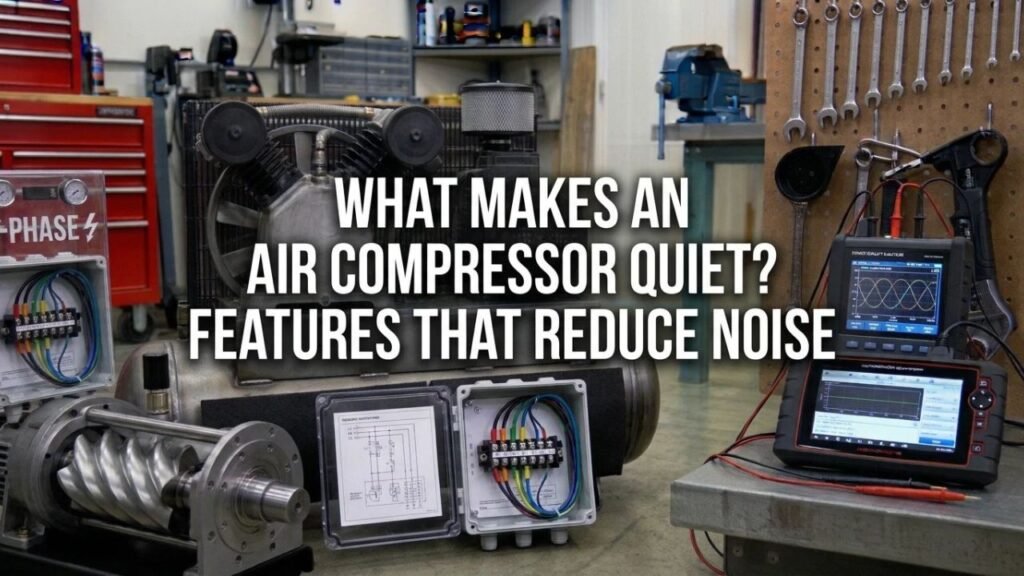
A quiet compressor is usually the result of several noise-control features working together rather than one special component.
Low Motor and Pump Speed
Motor speed is one of the strongest clues.
Many ordinary portable compressors use relatively fast-running pump systems. Faster movement means more piston strokes, valve events, vibration, and intake pulses every second.
Quiet models often slow that process down.
California Air Tools says its 1 HP SP-9413 motor operates at only 1,680 RPM and produces about 60 dB. Makita uses about 1,750 RPM across its Quiet Series. ROLAIR’s 60 dBA JC10PLUS runs at 1,725 RPM.
Lower RPM generally creates a softer mechanical sound and reduces vibration.
The compressor still needs enough displacement to produce useful CFM, which is why many low-speed pumps use larger pistons or more than one cylinder.
Multi-Piston Pump Design
A larger or dual-piston pump can move useful amounts of air without spinning extremely fast.
California Air Tools uses dual-piston pump systems on many of its quiet models. Its 1 HP low-speed system delivers 2.2 CFM at 90 PSI while running at 1,680 RPM.
Dividing compression work across multiple cylinders can also smooth the pump’s pulsation compared with a small high-speed single-cylinder arrangement.
Pump balance matters too. Better-balanced moving parts create less shaking that can turn the tank or frame into a sound source.
Intake Silencer
The air inlet can be surprisingly loud.
Every piston intake stroke pulls air sharply through the inlet passage. Those repeated pulses create a popping or chuffing sound.
A proper intake filter and silencer reduce that sound before it spreads into the room.
ROLAIR includes an intake filter/silencer as part of the JC10PLUS low-noise design.
A dirty or damaged intake filter can change airflow and may increase noise, so intake components should remain clean and securely fitted.
Vibration Isolation
Mechanical vibration becomes much louder when it transfers into another surface.
A compressor sitting directly against a wall, shelf, hollow floor, or rigid pipe can make those surfaces act like amplifiers.
Quiet machines often use rubber feet, shock mounts, or isolated pump/motor mounts.
California Air Tools supplies shock struts with several of its quiet pump/motor systems. Atlas Copco also identifies rubber, springs, cork, and similar isolating materials as ways to stop vibration from traveling into floors and other structures.
Sound-Absorbing Enclosures
Large stationary compressors may surround the pump and motor with a sound-reducing cabinet.
The enclosure blocks direct mechanical sound and often contains sound-absorbing material.
Atlas Copco describes sound insulation, sound absorption, vibration isolation, and vibration damping as separate ways compressor installations control noise. Its packaged stationary systems commonly place internal components inside sound-reducing enclosures.
Ventilation still has to remain open. A compressor should never be wrapped tightly in foam or placed inside an unventilated homemade box.
Key Takeaway: Low RPM, larger or multiple pistons, intake silencers, vibration isolation, and acoustic enclosures are the main design features behind a quiet compressor.
Why Low RPM Makes Such a Big Difference
A reciprocating compressor creates noise every time its piston changes direction and its valves open or close.
Lower speed means those events occur fewer times each minute.
Less Mechanical Impact
A piston accelerates, stops, and reverses direction thousands of times per minute.
That motion transfers force through:
- Connecting rods
- Crankshaft
- Bearings
- Cylinder block
- Motor mounts
- Frame
- Tank
Reducing pump speed lowers the frequency and often the harshness of those forces.
This is one reason a low-speed compressor tends to sound more like a steady hum and less like a rapid mechanical clatter.
Lower Valve Noise
Air-compressor reed or plate valves open and close repeatedly as the piston draws in and compresses air.
Faster operation increases the frequency of those valve events.
California Air Tools specifically notes that the valve-plate and reed-valve design on some of its low-speed pumps contributes to lower sound levels.
Less Vibration Through the Frame
Lower pump speed can also reduce vibration transmitted to the receiver and floor.
A compressor that sounds fairly quiet when lifted slightly may become much louder when its feet touch a resonant wooden floor or metal shelf.
That difference is vibration transmission rather than pump sound alone.
Key Takeaway: Lower RPM reduces piston impacts, valve events, vibration, and intake pulses, which is why many 56–60 dB portable compressors operate near 1,700 RPM.
Are Oil-Lubricated Air Compressors Quieter?
They often can be, but oil lubrication does not automatically make a compressor quiet.
Oil Can Reduce Mechanical Friction
Oil-lubricated piston compressors use a crankcase lubricant around moving parts such as bearings, cylinder walls, and crank mechanisms.
A well-designed, low-speed oil-lubricated pump can run smoothly and quietly.
Belt-drive compressors may also operate the pump slower than the motor through pulley sizing, which can lower pump noise.
Oil-Free Does Not Mean Loud
Modern low-noise compressors prove that an oil-free pump can be very quiet.
Makita’s Quiet Series uses oil-free dual-piston pumps, including the 58 dB MAC100Q. California Air Tools has oil-free models rated at 56–60 dB, and ROLAIR’s JC10PLUS is also an oil-free 60 dBA machine.
The old rule that oil-free compressors are always loud no longer works.
A high-speed oil-free pump can still be noisy, but a low-speed oil-free design with good isolation can be quieter than a poorly isolated oil-lubricated machine.
Compare the dBA Rating Instead
When noise is the priority, compare measured sound output rather than assuming one lubrication type wins.
Look for:
- Published dBA rating
- Pump RPM
- Delivered CFM at 90 PSI
- Intake silencer
- Vibration mounts
- Enclosure
- Duty cycle
Key Takeaway: Oil lubrication can contribute to smooth operation, but modern oil-free compressors can reach very low sound levels. The measured dBA rating tells you more than the lubrication type alone.
How Quiet Is a Quiet Air Compressor?
Sound ratings are normally listed in dBA or simply dB on consumer product pages.
Lower numbers mean less sound pressure.
A rough shopping comparison looks like this:
| Compressor Noise Rating | General Impression |
| 55–60 dBA | Very quiet for a portable piston compressor |
| 60–70 dBA | Quiet to moderate |
| 70–80 dBA | Noticeably louder |
| 80–85 dBA | Loud for long indoor use |
| 85+ dBA | Hearing exposure becomes a workplace concern with enough duration |
Actual perceived noise changes with distance, room acoustics, compressor load, and how the manufacturer measured the machine.
Real Low-Noise Examples
Current manufacturer ratings show how low portable piston compressors can go.
California Air Tools rates its 1P1060S at 56 dB, using a 1,680 RPM motor.
Makita rates its MAC100Q at 58 dB and uses a 1,750 RPM motor/pump arrangement.
ROLAIR rates the JC10PLUS at 60 dBA, with a 1,725 RPM motor and intake silencer.
Those numbers are useful reference points when comparing small indoor compressors.
Distance Changes What You Hear
Sound level falls as you move farther from the source.
OSHA notes that in open space, doubling the distance from a noise source can reduce the sound level by about 6 dBA.
Moving a compressor farther from the workstation can therefore make a noticeable difference, provided the longer air hose does not create too much pressure loss.
Room Surfaces Matter
Concrete walls, metal buildings, bare ceilings, and hard floors reflect sound.
A compressor rated at a certain dBA outdoors may feel louder inside a small hard-surfaced garage because reflected sound reaches the listener from multiple directions.
Atlas Copco notes that room size, wall materials, ceiling materials, compressor position, and piping can all change the noise experienced after installation.
Key Takeaway: Around 55–60 dBA is very quiet for a small piston compressor. Published ratings still need context because distance and room surfaces change the sound reaching the user.
Does a Bigger Air Compressor Run Quieter?
Not necessarily.
Tank size and noise level are separate specifications.
A Bigger Tank Does Not Silence the Pump
A 20-gallon compressor can have the same pump and motor design as a smaller model and produce a similar sound level while running.
Tank capacity mainly changes how much compressed air is stored.
A larger receiver may allow longer pauses between pump cycles during intermittent tool use, which can make the workspace feel quieter over time.
The compressor is not necessarily quieter during the actual pump cycle.
Larger Motors Can Produce More Sound
Higher-CFM compressors need to move more air.
That may require:
- Larger pumps
- More cylinders
- Larger cooling fans
- Bigger motors
California Air Tools, for example, rates a 1 HP system at about 60 dB, a 2 HP low-speed system at about 70 dB, and a 4 HP low-speed system at about 75 dB. All use low-speed designs, but greater output still brings more sound.
Match Noise With CFM
Do not buy the lowest-dB machine if it cannot supply your tools.
An undersized compressor may run almost continuously.
A slightly louder unit with enough CFM may spend much more time switched off.
Key Takeaway: Bigger tanks can reduce how often a compressor starts during intermittent work, but tank gallons do not determine how loud the pump is while running.
What Type of Air Compressor Is the Quietest?
Compressor type changes the amount and character of mechanical noise.
Quiet Reciprocating Compressors
Piston compressors are common in garages and small shops.
Low-noise versions rely on slower pumps, several cylinders, isolation mounts, and intake silencers.
They are usually the most practical quiet choice for nailers, inflation, light spray work, and other intermittent home uses.
Rotary Screw Compressors
Rotary screw compressors use rotating screw elements rather than reciprocating pistons.
They can produce smoother sound and less pulsation than many large piston units.
They are generally aimed at shops that need a steady supply of compressed air rather than occasional DIY use.
Scroll Compressors
Scroll compressors use orbiting scroll elements and can operate at very low sound levels.
Atlas Copco identifies scroll compressors among the quietest compressor types and lists industrial scroll packages capable of sound levels around 53 dBA in some configurations.
Their price and intended applications make them less common in ordinary home garages.
Key Takeaway: For home use, a low-speed quiet piston compressor is usually the practical option. Scroll and some rotary screw machines can run even quieter in commercial applications.
How to Make an Existing Air Compressor Quieter
You may be able to lower the sound from an existing machine without replacing it.
Put It on Vibration-Isolating Pads
Rubber isolation pads can stop vibration from transferring directly into the floor.
This works best when vibration is a major part of the noise.
The compressor must remain stable and level.
Do not place it on soft material that allows the machine to rock or block cooling airflow.
Move It Away From Walls
A compressor pressed against a wall can transfer vibration into the structure and create reflected sound.
Leave the clearance required by the owner’s manual.
Moving it away from corners may also reduce sound reflections.
Tighten Loose Hardware
A loose:
- Wheel
- Handle
- Belt guard
- Tank bracket
- Motor mount
- Shroud
- Drain component
can turn normal pump vibration into a metallic rattle.
Depressurize and disconnect electrical power before working on the machine.
Maintain the Intake Filter
A clogged or damaged intake filter can alter intake sound and pump airflow.
Replace or clean it according to the compressor manual.
If the model supports a manufacturer-approved intake silencer, that component may reduce the sharp intake pulse.
Use Flexible Connections
Rigid piping can carry vibration from the compressor into walls and building structure.
Atlas Copco notes that vibration transferred into compressed-air piping can become a major source of sound and recommends vibration isolation where needed.
A properly rated flexible connector between a stationary compressor and rigid air piping can isolate some of that vibration when the installation instructions permit it.
Move the Compressor Farther Away
A longer properly sized air hose can move the compressor away from the person using the tool.
As noted earlier, increasing distance lowers sound exposure.
Use enough hose diameter to avoid excessive pressure drop.
Use a Factory Sound Enclosure
Some stationary compressors have optional acoustic cabinets or factory-installed sound hoods.
Atlas Copco warns against homemade sound covers because poor ventilation can trap heat and create a fire or equipment hazard.
Never put a running compressor inside a sealed plywood or foam box without a system engineered for ventilation and cooling.
Key Takeaway: Vibration pads, proper placement, maintenance, flexible piping, greater distance, and factory sound enclosures can lower compressor noise without interfering with cooling.
What to Look for When Buying a Quiet Air Compressor
The product name is not enough.
Manufacturers can use terms such as “quiet,” “silent,” or “ultra quiet” differently, so compare measurable specifications.
Published dBA Rating
This is the first number I would check.
For indoor portable use, models around 60 dBA are much easier to live with than machines around 80 dBA.
Compare ratings measured under similar conditions when possible.
Motor RPM
A motor/pump speed close to 1,700 RPM is common among several current quiet portable compressors.
RPM alone does not guarantee low sound, but it is a strong clue when combined with other low-noise features.
Delivered CFM
Check SCFM or CFM at 90 PSI for most pneumatic-tool comparisons.
The compressor still needs enough output for your nailer, inflator, impact wrench, spray gun, or other tool.
Intake Silencer and Vibration Mounts
These are signs that noise control was considered during the machine’s design rather than added only as a marketing label.
Duty Cycle
A quiet machine that has to stop frequently for cooling may be unsuitable for a high-demand tool.
Check how long the pump may run during an hour and compare that with your air demand.
Pump Type
Do not automatically reject oil-free models.
Current 56–60 dB compressors show that an oil-free pump can run quietly when its speed, balance, intake, and vibration control are built around low noise.
Key Takeaway: Compare dBA, RPM, CFM, isolation features, intake design, and duty cycle. The word “quiet” on the box is less useful than those specifications.
Why Did My Air Compressor Suddenly Get Louder?
A machine that was quiet when new but becomes noticeably louder may have a maintenance or mechanical problem.
Possible causes include:
- Loose mounting hardware
- Worn vibration feet
- Dirty intake filter
- Damaged intake silencer
- Loose belt guard
- Belt wear or incorrect tension
- Bearing wear
- Pump wear
- Loose piping
- Tank or frame vibration
- Air leaks
Listen for the type of new sound.
A hiss points toward an air leak.
A metallic rattle suggests loose hardware or internal mechanical movement.
A squeal can come from a belt or bearing.
A knocking sound from the pump deserves prompt inspection rather than simply adding sound insulation around the compressor.
Do not keep operating a machine that develops severe knocking, burning odor, abnormal heat, or major vibration.
Conclusion
What makes an air compressor quiet is a combination of lower pump speed, smoother pump geometry, controlled intake noise, vibration isolation, and sound containment. No single feature is responsible for every quiet model.
Many of today’s low-noise portable compressors run close to 1,700 RPM. Current examples from Makita, ROLAIR, and California Air Tools sit around 56–60 dB while using low-speed oil-free pump systems.
Oil lubrication can make a piston pump smooth, but it is not required for quiet operation. Tank size also does not directly determine running noise, though a larger tank can reduce how often the pump cycles during short tool use.
I’d compare dBA, CFM at 90 PSI, motor RPM, intake silencing, vibration mounts, and duty cycle before choosing a compressor. Those numbers and features give a much clearer picture than a “silent” or “quiet” label alone.
FAQs About Quiet Air Compressors
What dB level is considered quiet for an air compressor?
Around 55–65 dBA is quiet for a portable piston compressor. Current low-noise models include units rated at 56, 58, and 60 dB. Machines around 70 dBA are still much less harsh than many traditional high-speed compressors, though room acoustics and distance change what you hear.
Why are some air compressors much quieter than others?
Quiet models usually run the pump more slowly, isolate vibration from the tank and floor, reduce intake pulsation, and use pump components shaped for smoother airflow. Some also use acoustic covers or cabinets to contain motor and pump sound.
Are oil-free air compressors louder?
Not always. Modern low-speed oil-free compressors can operate around 56–60 dBA. Pump speed, piston design, vibration control, and intake silencing have a larger influence than simply having oil or no oil.
Does lower RPM make an air compressor quieter?
Usually, yes. Lower RPM means fewer piston strokes, valve movements, and intake pulses each minute. Makita, ROLAIR, and California Air Tools all use motors around 1,680–1,750 RPM in several of their quiet portable compressors.
Does a larger air tank make a compressor quieter?
A larger tank does not directly lower pump dBA. It stores more air, so the compressor may run less often during intermittent work. While the pump is actually running, motor and pump design determine most of the noise.
Can rubber feet make an air compressor quieter?
Yes. Rubber isolation feet can reduce vibration transferred from the compressor into the floor. This can make a large difference on wooden floors, shelves, or other surfaces that resonate. The compressor still needs to remain stable and properly ventilated.
Can I build a soundproof box around my air compressor?
A sealed homemade box is risky because compressors need airflow for cooling. Trapped heat can damage the motor or pump and create a fire hazard. Use a manufacturer-approved sound enclosure or an engineered installation with proper ventilation rather than enclosing the machine tightly.
What is the quietest type of air compressor?
Scroll compressors can run at very low sound levels and are among the quietest designs used in commercial settings. For home and portable work, a low-speed piston compressor rated near 55–65 dBA is usually the more practical choice.