How Are Air Compressors Rated? PSI, CFM, HP & Tank Size Guide
Air compressors are measured by several separate performance specifications, with airflow and pressure being the most useful for most buyers. PSI tells you how much pressure the machine produces, while CFM or SCFM tells you how much air it can deliver. Tank gallons, horsepower, duty cycle, electrical demand, and noise describe other parts of compressor performance.
A typical portable compressor label might show 150 PSI, 2.6 SCFM at 90 PSI, a 6-gallon tank, 120 volts, and a motor amp rating. None of those numbers means the same thing, and one large number does not automatically mean the compressor is stronger.
For pneumatic tools, the first comparison should usually be the tool’s required airflow and operating pressure. A compressor can reach 200 PSI yet still struggle with an air sander if its pump produces too little air per minute.
The U.S. Department of Energy’s Better Plants program has cited roughly 90 billion kWh of annual U.S. electricity consumption by compressed-air systems. That scale is one reason industrial compressor ratings also include power-consumption and energy-performance measurements, not just airflow and pressure.
The basic answer to how are air compressors rated is through a combination of PSI, CFM or SCFM, tank volume, horsepower, duty cycle, electrical specifications, and sometimes dBA and energy-performance data. Each rating answers a different question about what the compressor can do.
Once those ratings are separated, choosing between a pancake compressor, a larger garage unit, and an industrial rotary compressor becomes much simpler.
How Are Air Compressors Rated in Real-World Specifications?
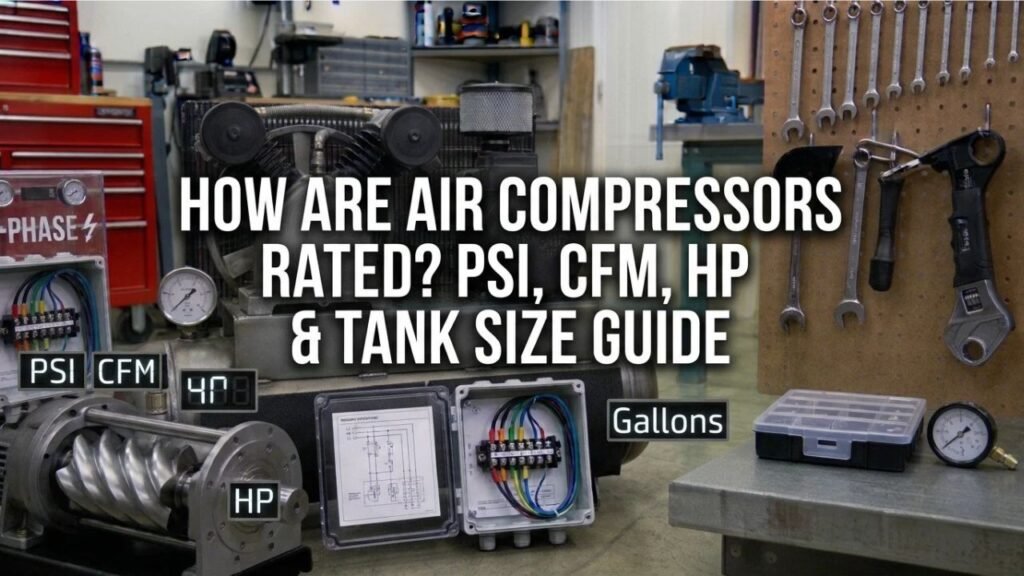
Manufacturers use several measurements because an air compressor has to perform more than one job.
It must create pressure, move enough air, store compressed air when a receiver is fitted, and operate within the limits of its motor or engine.
PSI Measures Pressure
PSI means pounds per square inch.
It tells you the pressure of the compressed air.
A compressor advertised as 150 PSI can reach approximately that upper operating pressure in its receiver tank under its designed operating conditions.
Common portable ratings include:
- 110 PSI
- 125 PSI
- 135 PSI
- 150 PSI
- 175 PSI
- 200 PSI
A higher maximum pressure does not automatically mean higher airflow.
CFM and SCFM Measure Airflow
CFM means cubic feet per minute.
SCFM means standard cubic feet per minute.
Both describe airflow rather than pressure.
A specification such as:
2.6 SCFM at 90 PSI
means the compressor is rated to deliver a stated volume of air while operating at that pressure condition.
For pneumatic-tool selection, this number is often more useful than maximum tank pressure.
Gallons Measure Receiver Size
A compressor with a 6-gallon tank has roughly six gallons of physical receiver volume.
Common tank capacities include:
- 1 gallon
- 3 gallons
- 6 gallons
- 10 gallons
- 20 gallons
- 30 gallons
- 60 gallons
- 80 gallons
Tank capacity tells you about stored-air reserve.
It does not tell you how quickly the pump produces air.
Key Takeaway: PSI measures pressure, CFM or SCFM measures airflow, and gallons measure storage. You need all three measurements for a clear picture of compressor performance.
How Is Air Compressor PSI Rated?
Pressure is one of the most visible numbers on a compressor because manufacturers often print the maximum PSI prominently on the tank or packaging.
Several different pressure ratings may appear.
Maximum PSI
Maximum PSI is the upper operating pressure the compressor is designed to reach during its normal pressure-switch cycle.
A compressor labeled 150 PSI normally stops pumping around its factory-set upper limit.
You do not normally send that full pressure directly to every tool.
A regulator reduces outlet pressure to the level required by the connected equipment.
For example:
Tank pressure: 150 PSI
Tool pressure: 90 PSI
This setup is normal.
Cut-In and Cut-Out Pressure
A tank compressor cycles automatically between two pressure points.
Cut-in pressure is the lower point at which the compressor motor starts.
Cut-out pressure is the upper point at which it stops.
Suppose a compressor reaches its cut-out setting and shuts off.
As you use air, tank pressure falls.
Once it reaches the cut-in setting, the motor starts and refills the receiver.
Exact settings vary by compressor and should not be changed casually.
Rated Discharge Pressure
Larger commercial and industrial compressors may list a rated discharge pressure.
Published airflow and power data are tied to that operating pressure.
This is important because a compressor can deliver different airflow and consume different power at different pressure settings.
Key Takeaway: Maximum PSI shows upper pressure capability, while cut-in and cut-out pressure control tank cycling. Rated discharge pressure provides the operating point used for published performance data.
How Are CFM and SCFM Ratings Calculated?
Airflow rating is one of the most useful ways to compare compressors because pneumatic equipment consumes a volume of air over time.
What CFM Means
CFM means cubic feet per minute.
A compressor rated at 5 CFM moves or delivers a stated volume of air each minute under the conditions used for that rating.
The pressure at which the CFM is measured matters.
A compressor does not necessarily produce 5 CFM at every pressure.
What SCFM Means
SCFM converts airflow to a defined set of reference conditions.
The Compressed Air & Gas Institute uses 14.5 psia, 68°F, and 0% relative humidity as its standard reference conditions for SCFM.
Using reference conditions makes it easier to compare airflow figures because air density changes with:
- Temperature
- Atmospheric pressure
- Elevation
- Humidity
A raw airflow figure without its reference conditions can be harder to compare accurately.
Why Compressors List Different SCFM at 40 and 90 PSI
Portable compressors often show two ratings, such as:
3.7 SCFM at 40 PSI
2.6 SCFM at 90 PSI
The 40-PSI number is higher because the compressor is working against less discharge pressure.
As required pressure rises, delivered airflow normally falls.
This is why you should compare your tool with the compressor rating at the closest matching PSI.
A spray gun running at lower pressure may be compared with the lower-pressure airflow figure.
A pneumatic tool rated around 90 PSI should be compared with the compressor’s 90-PSI airflow rating.
Key Takeaway: SCFM represents airflow referenced to stated standard conditions. Always compare airflow at the pressure your tool actually requires rather than choosing the largest SCFM number on the label.
Why Is CFM at 90 PSI So Common?
Many pneumatic shop tools are designed to operate near 90 PSI at the tool inlet.
That makes 90 PSI a useful comparison point.
Tools often associated with this pressure range include:
- Impact wrenches
- Air ratchets
- Die grinders
- Air drills
- Sanders
- Pneumatic polishers
Suppose an impact wrench requires:
5 CFM at 90 PSI
and your compressor delivers:
2.6 SCFM at 90 PSI
The compressor may run the impact wrench for a short period using stored air.
During extended operation, the tool can consume air faster than the pump replaces it.
Now consider a compressor rated:
6 SCFM at 90 PSI
That pump is much closer to the airflow requirement of the tool.
For continuous pneumatic work, this distinction matters more than having a very high maximum tank PSI.
How Are Air Compressor Tanks Rated?
Air receiver tanks are generally identified by volume in gallons for U.S. consumer compressors.
Tank volume tells you how much physical storage space is available for compressed air.
What a Larger Tank Changes
A larger receiver gives you a greater stored-air reserve.
This can be useful for tools that consume air in bursts.
Examples include:
- Impact wrenches
- Nail guns
- Staplers
- Blow guns
- Tire inflation equipment
The tool can draw temporarily from stored air even if instantaneous demand exceeds pump output.
What a Larger Tank Does Not Change
A larger tank does not increase pump CFM.
Consider these two machines:
| Compressor | Tank Size | Airflow at 90 PSI |
| Compressor A | 20 gal | 4 SCFM |
| Compressor B | 10 gal | 6 SCFM |
Compressor A stores more air.
Compressor B produces replacement air faster.
For short bursts, the larger tank may be useful.
For sustained air use, the 6-SCFM pump may have the advantage.
Why Tank Pressure Matters Too
The same physical tank can store more usable compressed air when charged to a higher pressure.
That is one reason manufacturers sometimes use higher maximum tank pressure to increase the usable air reserve of a relatively small portable compressor.
The pump still needs enough airflow to refill that reserve.
Key Takeaway: Tank gallons describe storage, not production. A larger tank provides longer reserve time, while SCFM controls how fast the compressor replaces used air.
How Is Air Compressor Horsepower Rated?
Horsepower describes the power of the motor or engine driving the compressor pump.
It is useful information, but it should not be the first specification used to size a compressor for a pneumatic tool.
Horsepower Does Not Equal CFM
Two compressors with identical horsepower ratings can produce different airflow.
The difference can come from:
- Pump design
- Pump speed
- Compression stages
- Operating pressure
- Mechanical losses
- Compressor type
A buyer who selects only by horsepower may end up with less usable airflow than expected.
Peak Horsepower vs. Running Horsepower
Some consumer equipment has been marketed using peak motor horsepower.
A peak figure represents a short operating condition and should not be treated as continuous output.
Rated or running horsepower is more useful for comparison.
For tool compatibility, published SCFM at the required PSI is still the stronger specification.
Horsepower and Electrical Watts Are Different
One mechanical horsepower equals about 746 watts of mechanical output.
A 1 HP compressor does not consume exactly 746 watts from the outlet.
An electric motor has losses, and the compressor pump has mechanical losses.
Electrical input is therefore greater than mechanical shaft output.
Key Takeaway: Horsepower tells you how much drive power is available, but it does not directly reveal airflow. Use SCFM at the required PSI to judge pneumatic-tool capability.
How Is Air Compressor Duty Cycle Rated?
Duty cycle describes how much running time a compressor is designed to handle within a stated period.
This rating is most relevant to reciprocating compressors.
50% Duty Cycle
A 50% duty-cycle compressor is intended to spend about half of the specified cycle running under the manufacturer’s stated conditions.
A simple one-hour illustration would be:
30 minutes running
30 minutes resting
The manufacturer’s definition should always take priority over a generic calculation.
75% Duty Cycle
A 75% unit can spend more of the stated period operating.
This makes it better suited to jobs that require longer pump runtime.
100% Duty Cycle
A 100% duty-cycle compressor is designed for continuous operation under its rated conditions.
That does not mean it produces unlimited air.
If the compressor delivers 10 CFM and the connected equipment consumes 15 CFM, system pressure can still fall.
Why Duty Cycle Matters
An undersized compressor may run almost continuously while trying to keep up with an air-hungry tool.
If the compressor was designed for intermittent operation, excessive runtime can contribute to:
- High operating temperature
- Thermal overload shutdown
- Faster component wear
- Reduced pump life
Key Takeaway: Duty cycle measures allowable operating time. Continuous pneumatic work needs both enough airflow and a compressor designed for the required runtime.
How Are Electric Air Compressors Rated?
Electric compressors include electrical information that tells you what power supply they require.
Voltage and Amperage
Common U.S. compressor voltages include:
- 120V
- 208V
- 230V
- 240V
- 460V
Small portable compressors commonly use 120V.
Larger garage and stationary machines often use 240V.
Industrial compressors may operate from higher-voltage systems.
The nameplate also lists motor amperage.
A small portable compressor might draw 10, 12, or 15 amps, while a large industrial machine draws much more.
Single Phase vs. Three Phase
Home and small-shop compressors commonly use single-phase power.
Large industrial equipment often uses three-phase motors.
Check both voltage and phase before selecting a stationary compressor.
A machine designed for three-phase power cannot be connected directly to a standard single-phase household circuit.
Starting Current
Electric motors draw a short surge of current when starting.
This is important for:
- Generators
- Inverters
- Portable power stations
A generator may have enough continuous wattage to run a compressor once the motor reaches speed but still fail during startup.
Both continuous output and surge output need to match the motor load.
Key Takeaway: Electric compressor ratings include voltage, amperage, phase, and frequency. Motor startup demand also matters when the power source is a generator or inverter.
How Are Air Compressors Rated for Noise?
Compressor noise is commonly reported in dBA, or A-weighted decibels.
Portable machines can vary widely.
You may see ratings around:
- 60 dBA
- 70 dBA
- 80 dBA
- 90 dBA
A lower published number indicates a quieter test result under the stated conditions.
Measurement distance and test procedure matter, so two dBA numbers should be compared only when the testing conditions are reasonably similar.
Noise rating deserves extra attention when the compressor will run:
- In a home garage
- Near living spaces
- In a small workshop
- Around customers
- For long periods
A small tank does not automatically mean a quiet compressor. Pump speed, enclosure design, motor construction, and vibration control all affect sound.
What Are Recovery Rate and Fill Time Ratings?
Recovery and fill time describe how quickly the compressor restores stored pressure.
They are related to pump airflow but describe different operating situations.
Initial Fill Time
Initial fill time describes how long the compressor takes to bring an empty or low-pressure tank to its cut-out setting.
A large tank generally takes longer to fill than a small tank when pump output is similar.
Recovery Time
Recovery time describes how quickly the compressor raises tank pressure after normal air use causes it to fall.
Imagine two 6-gallon compressors:
Compressor A: 2.6 SCFM at 90 PSI
Compressor B: 5.0 SCFM at 90 PSI
Under similar conditions, the second compressor can replenish used air faster.
That means shorter waiting periods between demanding tool-use cycles.
Key Takeaway: Initial fill measures the first tank charge, while recovery describes refill during normal operation. Higher pump output generally reduces recovery time.
How Are Industrial Air Compressors Performance-Rated?
Large commercial and industrial compressors use more detailed performance data than a basic portable unit.
ISO 1217 Testing
For displacement compressors, ISO 1217 is a recognized test standard used for compressor acceptance and performance testing.
The Compressed Air & Gas Institute works with standardized compressor data sheets based on recognized test methods so users can compare published airflow, pressure, and power information on a common basis.
These ratings are far more useful for industrial buying than relying on motor horsepower alone.
Specific Power
Industrial compressor data may list specific power.
This compares electrical input with the amount of compressed air delivered at a stated pressure.
A common form expresses the power required to deliver a set amount of airflow.
Specific power gives plant operators a way to compare the electrical demand of similarly sized compressors.
Isentropic Efficiency
Modern industrial performance data may also use isentropic efficiency.
This measure accounts for compressor input power and operating pressure, making it useful when comparing machines that do not have exactly the same rated discharge pressure.
U.S. Department of Energy rules also establish test and energy-conservation requirements for covered commercial and industrial air compressors.
Key Takeaway: Industrial ratings go beyond PSI and CFM. Standardized testing, input power, specific power, and isentropic efficiency provide a stronger basis for comparing large compressor packages.
Which Air Compressor Rating Matters Most for Air Tools?
For most pneumatic tools, start with two numbers:
Required CFM or SCFM
and
Required PSI
Then compare those figures with the compressor.
Nail Guns
Nailers use small bursts of compressed air rather than a continuous flow.
Focus on:
- Tool operating PSI
- Compressor SCFM
- Tank reserve
- Firing rate
Small portable compressors often perform well with brad, finish, and framing nailers because there is recovery time between shots.
Impact Wrenches
Impact wrenches may use much more airflow.
Check:
- CFM at the tool’s rated PSI
- Hose diameter
- Coupler size
- Tank reserve
A small compressor may operate an impact wrench for a few bursts but lose pressure during longer use.
Sanders and Grinders
Air sanders and grinders can expose an undersized compressor very quickly because they consume air continuously.
SCFM should be one of your first comparisons.
A large tank alone will only delay the pressure drop if pump airflow is too low.
Spray Guns
Spray guns demonstrate why maximum PSI can be misleading.
A spray gun may operate at modest pressure while requiring a large amount of airflow.
For painting, compare the spray gun’s CFM requirement directly with the compressor’s airflow rating.
Key Takeaway: For pneumatic tools, airflow at the required pressure matters more than tank gallons or maximum PSI. Continuous tools place the greatest demand on compressor CFM.
How to Read an Air Compressor Specification Label
Imagine a portable compressor with these specifications:
| Specification | Example Rating |
| Tank | 6 gallons |
| Maximum pressure | 150 PSI |
| Airflow | 3.7 SCFM at 40 PSI |
| Airflow | 2.6 SCFM at 90 PSI |
| Voltage | 120V |
| Motor current | 10A |
| Noise | 78 dBA |
Here is what those numbers tell you.
6 gallons tells you receiver volume.
150 PSI tells you the upper operating pressure.
3.7 SCFM at 40 PSI tells you lower-pressure airflow.
2.6 SCFM at 90 PSI gives a more useful comparison for many common pneumatic shop tools.
120V and 10A tell you about electrical demand.
78 dBA is the published sound rating under the manufacturer’s test conditions.
A buyer planning to operate a 90-PSI air tool should pay much more attention to the 2.6-SCFM figure than the 150-PSI number printed prominently on the tank.
How to Compare Two Air Compressors Correctly
Do not compare the largest number on each box.
Use the same rating conditions.
First, identify the tool with the highest airflow demand.
Then check its required PSI and CFM.
For example:
Tool requirement:
8 CFM at 90 PSI
Compressor A:
200 PSI maximum
3 CFM at 90 PSI
Compressor B:
135 PSI maximum
10 CFM at 90 PSI
Compressor A has the higher maximum pressure.
Compressor B is the stronger match for the tool because its pump supplies enough airflow at 90 PSI.
Next, compare:
- Duty cycle
- Tank capacity
- Voltage
- Amperage
- Noise
- Portability
- Recovery rate
This gives a far more useful comparison than selecting from PSI or horsepower alone.
Conclusion
How are air compressors rated comes down to several measurements working together. PSI measures pressure, CFM or SCFM measures airflow, tank gallons measure storage, horsepower describes drive power, and duty cycle tells you how long the machine is designed to operate.
For air tools, the specification I would check first is SCFM at the tool’s required PSI. Once airflow and pressure match the job, tank size, duty cycle, recovery, electrical requirements, and noise become the next useful comparison points.
Do not assume that the compressor with the largest tank, highest PSI, or biggest horsepower figure is automatically the better performer. Match the ratings to the actual air demand of the equipment you plan to run.
FAQs About Air Compressor Ratings
Is PSI or CFM More Important on an Air Compressor?
Both are required, but CFM often becomes the limiting factor after the compressor provides enough pressure.
A tool needing 90 PSI and 8 CFM will not run continuously from a compressor producing only 3 CFM at 90 PSI, even if that compressor can build 200 PSI in its tank.
What Does 2.6 SCFM at 90 PSI Mean?
It means the compressor is rated to deliver approximately 2.6 standard cubic feet of air per minute at the stated 90-PSI condition.
Compare this figure with the CFM requirement of a tool that operates near 90 PSI.
Does Higher PSI Mean a Stronger Air Compressor?
No.
Higher PSI means the compressor can create greater pressure. It does not prove that the pump moves more air per minute. A lower-PSI compressor with substantially higher SCFM can perform better with an air-hungry tool.
Does a Bigger Air Compressor Tank Mean More CFM?
No.
Tank capacity measures stored air. CFM measures pump airflow.
A large tank gives you a larger reserve, but once that reserve is consumed, continuous tool performance is limited by the pump’s airflow.
What Is a Good CFM Rating for an Air Compressor?
There is no single CFM rating that suits every job.
Check the airflow requirement of your highest-demand tool at its operating PSI. If several tools will operate together, account for their combined airflow demand.
What Does Duty Cycle Mean on an Air Compressor?
Duty cycle describes how much operating time a compressor is designed to handle within a stated period.
A compressor intended for intermittent use may require cooling time, while a 100% duty-cycle machine is designed for continuous operation under its rated conditions.
Why Does My Compressor Show SCFM at 40 PSI and 90 PSI?
The compressor delivers different airflow at different pressures.
The 40-PSI number is normally higher because the pump works against less discharge pressure. Use the airflow rating closest to the pressure required by your tool.
What Air Compressor Rating Should I Check First?
Start with CFM or SCFM at the PSI required by your tool.
After confirming airflow and pressure, compare tank size, duty cycle, electrical supply, recovery rate, and noise to judge how well the compressor fits the job.