
Are Air Compressor Accessories Universal? Hose and Fitting Guide
Air compressor accessories are not completely interchangeable. Many compressors and pneumatic tools use common 1/4-inch NPT threads and familiar quick-connect systems, but hose diameter, fitting thread, plug profile, pressure rating, flow capacity, and connection size must all match. Adapters and multi-style couplers can connect many mismatched components, but not every accessory fits every compressor.
Air hoses create similar confusion. Two hoses can look almost identical yet have different inside diameters, end fittings, working-pressure ratings, and materials. A hose that physically connects may also be too restrictive for a high-air-demand tool.
The question are air compressor accessories universal therefore has two separate parts: mechanical fit and pneumatic performance. A fitting can screw into a port or click into a coupler and still restrict airflow enough to reduce tool performance.
Quick-connect fittings are especially easy to mix up. Common U.S. plug patterns include Industrial/M-style, Automotive/T-style, ARO/A-style, Lincoln/L-style, and high-flow V-style. Milton’s 5-in-One coupler is specifically built to accept five major interchange styles, which also shows why a standard single-style coupler should not be assumed to accept every plug.
Hose size matters independently of the fitting thread. Ingersoll Rand, for example, specifies a 3/8-inch minimum hose for several air ratchets even though the tool itself has a 1/4-inch NPTF inlet. A higher-demand impact model uses a 3/8-inch NPT inlet and calls for a minimum 1/2-inch hose.
Pressure compatibility is just as important as fit. OSHA requires compressed-air hoses and hose connections used in workplaces to be designed for the pressure and service they experience, and it also requires damaged hoses to be taken out of service.
Understanding the differences between hose size, pipe thread, coupler body size, and plug style makes it much easier to assemble an air system that connects properly without starving the tool of airflow.
Are Air Compressor Accessories Universal?
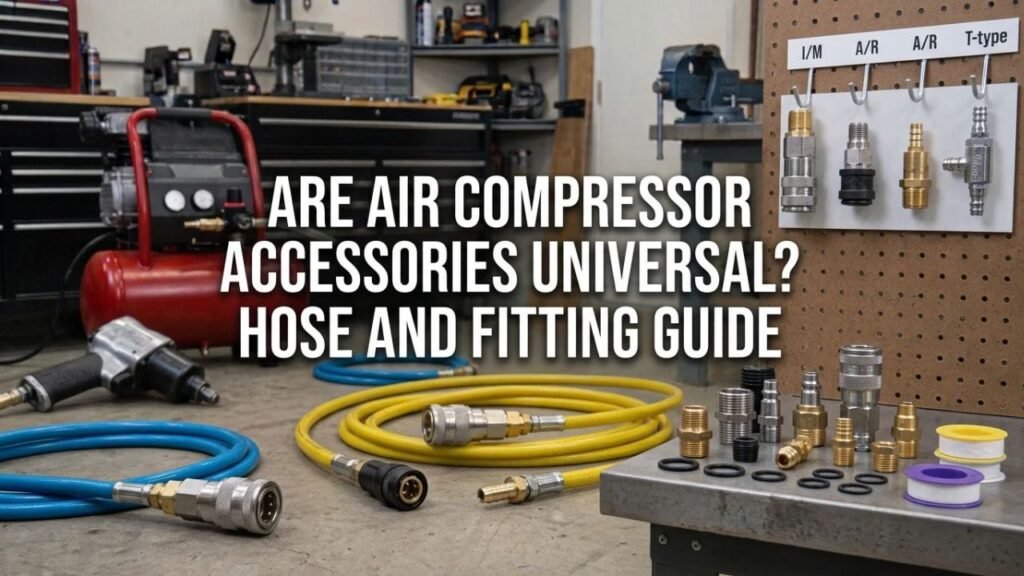
No. Some accessories use common standards, but there is no single connection system that makes every air compressor accessory interchangeable.
Some Parts Are Widely Standardized
Common examples include:
- 1/4-inch NPT threaded fittings
- 3/8-inch NPT fittings
- Industrial-style quick-connect plugs
- Standard hose-barb sizes
- Common tire-inflator fittings
Because these sizes are widely sold, accessories from different brands often can be mixed successfully.
Milton’s standard Industrial M-style coupler, for example, is designed to interchange with other M-style or Industrial-profile plugs from compatible manufacturers.
Thread Size Does Not Guarantee Quick-Connect Compatibility
A fitting may have a 1/4-inch NPT thread on one end and an Industrial plug on the other.
Another fitting may also have 1/4-inch NPT threads but use an Automotive-profile plug.
Both screw into the same threaded tool port, yet their quick-connect ends may not fit the same coupler.
Pressure Rating Must Match
An accessory must be rated for at least the pressure it will encounter.
Do not assume a fitting, regulator, hose, filter, or coupler is safe just because its threads fit.
Milton, for example, sells quick couplers with specific maximum-pressure ratings rather than treating every pneumatic fitting as having the same limit.
Key Takeaway: Compressor accessories often share common thread sizes, but thread type, coupler profile, airflow, and pressure rating must all be compatible before two parts should be considered interchangeable.
Are All Air Compressor Hoses Universal?
No. Air compressor hoses differ in diameter, length, material, fittings, and pressure rating.
Hose Inside Diameter Varies
Common air-hose inside diameters include:
- 1/4 inch
- 3/8 inch
- 1/2 inch
Larger hose typically allows more airflow with less pressure loss, especially across long runs or with high-CFM tools.
A small hose can physically connect to a large compressor and large pneumatic tool yet choke the airflow between them.
A 1/4-Inch Fitting Does Not Mean a 1/4-Inch Hose
This distinction is easy to miss.
A pneumatic tool may have a 1/4-inch NPT air inlet while requiring a 3/8-inch ID hose.
Ingersoll Rand’s 107XPA air ratchet is one example: it lists a 1/4-inch NPTF air inlet and a 3/8-inch minimum hose size.
This is because pipe-thread size describes the connection, while hose ID describes the size of the air passage through the hose.
Length Also Affects Performance
Pressure drops as compressed air moves through a hose.
The loss becomes greater when you combine:
- Long hose
- Small inside diameter
- High air consumption
- Restrictive couplers
- Multiple fittings
A 25-foot hose that runs a nail gun easily may not perform the same way with a continuously running DA sander or large impact wrench.
Hose Material Varies
Air hoses may use materials such as:
- Rubber
- PVC
- Polyurethane
- Hybrid polymer
Material affects flexibility, weight, abrasion resistance, temperature behavior, and handling.
It does not make one hose automatically compatible with every compressed-air application.
Key Takeaway: Air hoses are not universal because ID, length, pressure rating, material, and end connections differ, and hose size must be large enough to supply the tool’s airflow requirement.
Understanding Air Compressor Thread Sizes
Thread size is one of the first things to check when joining compressor accessories.
1/4-Inch NPT Is Very Common
Many portable pneumatic tools and compressor accessories use 1/4-inch NPT or NPTF connections.
Examples include:
- Air ratchets
- Nailers
- Blow guns
- Tire inflators
- Small filters and regulators
- Quick-connect plugs
Milton’s common 5-in-One coupler, for example, is available with 1/4-inch male or female NPT connections.
3/8-Inch NPT Is Also Common
Higher-flow fittings and larger pneumatic tools may use 3/8-inch threads.
Milton also offers universal-style couplers in 3/8-inch NPT versions.
NPT Size Is Not Measured Like a Normal Bolt
A nominal 1/4-inch NPT thread does not have an outside diameter of exactly 1/4 inch.
Pipe-thread sizes are nominal designations based on the piping standard.
This is why measuring the outside diameter with a ruler and choosing the nearest fractional size can lead to the wrong fitting.
NPT and BSP Are Different
U.S. air equipment commonly uses NPT.
Imported equipment may use BSP or another thread system.
NPT and BSP can look similar in some sizes but differ in thread geometry and sealing design.
Do not force one into the other because partial engagement does not mean the joint is correct.
Key Takeaway: Verify both nominal thread size and thread standard—such as NPT—rather than choosing a fitting only because the diameter appears close.
Air Compressor Quick-Connect Fittings Are Not All the Same
Quick-connect profiles are one of the biggest reasons accessories fail to interchange.
Industrial or M-Style
Industrial/M-style is widely used in U.S. pneumatic systems.
Milton describes its M-style couplers and plugs as an industry-standard interchange and makes them compatible with equivalent Industrial/M-style products.
Automotive or T-Style
Automotive/T-style uses a different plug shape.
A standard Industrial-only coupler should not be assumed to accept an Automotive plug.
ARO or A-Style
ARO/A-style is another plug-and-coupler profile.
Again, it can have the same 1/4-inch threaded connection on the back while being mechanically different at the quick-connect end.
Lincoln or L-Style
Lincoln/L-style has its own profile.
Matching thread size does not make it interchangeable with Industrial or Automotive plugs.
High-Flow V-Style
High-flow fittings are designed with larger internal passages to reduce restriction.
They are useful where airflow demand is high.
Milton’s multi-style 5-in-One coupler lists V-style among the plug systems it accepts.
Larger H- and P-Style Systems
Higher-flow pneumatic systems may use larger H- and P-style plugs.
Milton makes a separate 2-in-One design for H- and P-style interchanges, rather than combining them into the same small-body 5-in-One product.
Key Takeaway: Industrial, Automotive, ARO, Lincoln, V-style, H-style, and P-style quick-connect systems are different profiles; match the plug and coupler or use an explicitly compatible multi-style coupler.
What Is a Universal Air Compressor Coupler?
A universal coupler is designed to accept more than one plug profile.
The word “universal” should not be interpreted as literally accepting every pneumatic connection ever made.
Multi-Style Couplers
Milton’s 5-in-One model accepts:
- Industrial/M-style
- High-flow V-style
- Automotive/T-style
- ARO/A-style
- Lincoln/L-style
That can be useful in a garage containing tools purchased with several plug styles.
High-Flow Systems May Need Another Coupler
Larger H- and P-style systems use a different multi-profile coupler in Milton’s lineup.
That reinforces the point that “universal” has a defined compatibility list rather than unlimited compatibility.
Check Flow Capacity
Even if the coupler accepts the plug, make sure its internal flow capacity is suitable for the pneumatic tool.
A small quick connector becomes a restriction if you try to feed a tool that consumes a large volume of air.
Check Working Pressure
The coupler’s maximum working pressure must meet or exceed system pressure.
Never treat an accessory’s compatibility list as proof that its pressure rating is adequate.
Key Takeaway: A universal coupler accepts several specified plug profiles, but you still need to check body size, flow capacity, thread size, and pressure rating.
Does Air Hose Diameter Really Matter?
Yes. Hose diameter directly affects the amount of air you can deliver with acceptable pressure loss.
1/4-Inch Hose
A 1/4-inch hose can work well for:
- Brad nailers
- Finish nailers
- Staplers
- Tire inflation
- Blow guns
- Short, low-CFM tasks
It is light and easy to handle.
Its smaller passage becomes a disadvantage with demanding tools.
3/8-Inch Hose
A 3/8-inch hose is a strong general-purpose size for many garages and workshops.
It is often used with:
- Impact wrenches
- Air ratchets
- DA sanders
- Some grinders
- Spray equipment
Actual tool requirements still take priority.
1/2-Inch Hose
Higher-CFM equipment may require a 1/2-inch or larger hose.
Ingersoll Rand’s current 2922-series pneumatic impact wrench, for example, specifies a minimum 1/2-inch hose and consumes much more air than a small ratchet.
Bigger Is Not Always Necessary
A large hose is heavier, bulkier, and harder to handle.
If a nailer needs little airflow, carrying a 1/2-inch hose around a jobsite may provide no practical benefit.
Choose the smallest hose that still delivers the required airflow over the intended length without excessive pressure drop.
Key Takeaway: Hose ID should be sized to the tool’s airflow demand and hose length; high-CFM tools often need 3/8- or 1/2-inch hose even when their threaded inlet is smaller.
Can You Mix Different Air Compressor Brands?
Usually, yes—if the connection specifications match.
A compressor does not normally care which brand made the:
- Hose
- Coupler
- Plug
- Blow gun
- Tire chuck
- Regulator
- Filter
The specifications matter more than the logo.
Check the Thread
Verify:
- NPT vs another standard
- Nominal size
- Male vs female
Check the Quick-Connect Style
A Milton Industrial plug can work with another manufacturer’s Industrial-compatible coupler if both are truly built to the same interchange profile.
Milton specifically describes its M-style products as interchangeable with competing M-style/Industrial fittings.
Check Pressure
The accessory must be rated for the system.
Do not install a low-pressure hose or regulator on a compressor simply because the fittings screw together.
Check Flow
A physically compatible fitting can still be undersized.
This matters most with tools that consume air continuously.
Key Takeaway: Mixing brands is normally fine when thread type, quick-connect profile, working pressure, and airflow capacity all match.
How to Make Different Air Compressor Accessories Compatible
Adapters solve many connection problems, but use them carefully.
Thread Reducers and Bushings
A reducer can connect sizes such as:
- 3/8-inch NPT to 1/4-inch NPT
- 1/2-inch NPT to 3/8-inch NPT
This changes physical connection size but can also create a restriction.
Universal Quick Couplers
A multi-style coupler lets you connect several plug designs without changing every tool plug.
This is convenient when a shop already contains mixed fittings.
Replace Tool Plugs With One Standard
Another option is to standardize the whole shop.
For example, you could put the same Industrial-profile plug on every compatible pneumatic tool.
Advantages include:
- Fewer adapters
- Faster tool changes
- Easier troubleshooting
- Consistent flow characteristics
Avoid Long Chains of Adapters
A connection such as:
compressor → adapter → reducer → coupler → adapter → hose
may work, but every connection adds another possible:
- Leak
- Restriction
- Failure point
Build the air path as simply as practical.
Key Takeaway: Use approved reducers or multi-style couplers when needed, but a shop-wide fitting standard usually provides a cleaner and less restrictive system.
How to Check if an Air Hose Will Fit Your Compressor
A few checks can prevent buying the wrong hose.
Step 1: Find the Compressor Outlet Size
Check the outlet, regulator, or existing coupler.
Look for markings such as:
- 1/4 NPT
- 3/8 NPT
- Industrial
- M-style
The owner’s manual may give the specification.
Step 2: Check the Hose End Fittings
Determine:
- Male or female
- Thread size
- Quick-connect style
- Swivel or fixed connection
Step 3: Check Hose ID
Look for the hose’s inside diameter.
Do not confuse it with thread size.
Step 4: Check the Tool Requirement
Read the pneumatic tool’s specification for:
- Minimum hose ID
- Required pressure
- Air inlet size
- Air consumption
A tool may call for a larger hose than you expected from its inlet fitting.
Step 5: Check Working Pressure
The hose, fittings, coupler, and other components must all be rated for the pressure they will experience.
OSHA’s workplace standard requires air hose and hose connections to be designed for their pressure and service.
Step 6: Inspect Before Pressurizing
Look for:
- Cuts
- Bulges
- Cracked fittings
- Loose crimps
- Damaged couplers
OSHA also requires visibly damaged and unsafe compressed-air hose to be taken out of use in covered maritime workplaces.
Key Takeaway: Confirm outlet threads, coupler profile, hose ID, tool airflow, and pressure rating before connecting and pressurizing a new hose.
Common Air Compressor Accessory Compatibility Mistakes
Assuming All 1/4-Inch Fittings Are the Same
One part may be 1/4-inch NPT but have an Automotive plug.
Another may be 1/4-inch NPT with an Industrial plug.
The threaded ends match; the quick-connect ends do not necessarily match.
Confusing Hose Size With Thread Size
A tool with a 1/4-inch inlet can still need a 3/8-inch hose.
Ingersoll Rand’s air-ratchet specifications demonstrate this exact combination.
Using a Hose That Is Too Small
Symptoms can include:
- Weak impact wrench
- Slow grinder
- DA sander losing speed
- Spray gun pressure falling
- Good static pressure but poor running pressure
A larger hose or less restrictive fittings may solve the problem.
Ignoring the Lowest Pressure Rating
The system is only as strong as the lowest-rated component exposed to full pressure.
A 175-PSI compressor should not feed an accessory whose safe working pressure is below the pressure reaching it.
Improvising Hose Connections
Do not secure pressurized air hose to a fitting with hardware not designed for pneumatic hose service.
OSHA has cited workplace use of worm-drive clamps where the hose connection was not designed for the pressure and service, citing the risk of the hose coming loose and whipping.
Disconnecting Pressurized Hoses Carelessly
A pressurized hose can whip after an accidental disconnection.
OSHA requires positive means to prevent pneumatic tools from accidentally disconnecting in covered construction work. Safety-exhaust couplers are one design that releases pressure before completely letting go of the plug.
Key Takeaway: The most common errors are confusing thread size with plug style, undersizing the hose, overlooking pressure ratings, and improvising connections that are not designed for compressed air.
Conclusion
For are air compressor accessories universal, the answer is no. Many accessories use widely available standards, but you cannot assume every hose, fitting, coupler, regulator, or pneumatic tool will connect correctly just because it is designed for compressed air.
The same applies to are all air compressor hoses universal. Hoses differ in ID, pressure rating, length, material, and end connections. A hose can fit the compressor yet still be too restrictive for the tool.
Start by identifying thread size and standard, then determine the quick-connect profile. Industrial/M-style, Automotive/T-style, ARO/A-style, Lincoln/L-style, and high-flow systems are not automatically interchangeable, though approved multi-style couplers can accept several types.
Finally, size the hose and fittings for airflow rather than appearance. Check the pneumatic tool manufacturer’s minimum hose diameter and running pressure, and make sure every component is rated for the system pressure before use.
FAQs About Air Compressor Accessory Compatibility
Are All Air Compressor Hoses Universal?
No.
Air hoses differ in inside diameter, material, length, pressure rating, and end connections. A 1/4-inch, 3/8-inch, and 1/2-inch hose can all serve compressed-air systems but suit different airflow demands.
Are Air Compressor Quick Connects Universal?
Not all of them.
Common profiles include Industrial/M-style, Automotive/T-style, ARO/A-style, Lincoln/L-style, and several high-flow designs. A standard coupler usually accepts its matching plug style, while a multi-style coupler can accept several specified profiles.
Is 1/4-Inch NPT Standard for Air Compressors?
It is very common on small pneumatic tools and accessories in the U.S., but it is not the only size.
Larger systems may use 3/8-inch, 1/2-inch, or larger connections.
Can I Use a 3/8-Inch Hose With a 1/4-Inch Fitting?
Yes, if you use fittings designed for that hose and thread combination.
This is common. Some pneumatic tools have 1/4-inch NPT inlets while the manufacturer recommends a 3/8-inch hose for adequate airflow.
Can I Use Any Air Hose With a 175 PSI Compressor?
Only if the hose and all fittings exposed to that pressure have suitable working-pressure ratings and are intended for compressed-air service.
Do not choose a hose solely because its fitting connects to the compressor.
Can Different Brands of Air Compressor Fittings Work Together?
Yes, when they use the same thread and interchange standard.
For example, Milton states that its Industrial/M-style coupler is compatible with competing M-style/Industrial plugs.
What Size Air Hose Should I Use?
Use the minimum hose ID specified by the pneumatic tool manufacturer, then account for hose length and airflow demand.
Light tools may work well with 1/4-inch hose, while many shop tools use 3/8-inch hose and some high-air-demand equipment requires 1/2 inch or larger.
How Do I Know What Air Compressor Fittings I Have?
Inspect the fitting shape and markings, measure or identify the pipe-thread size, and compare the plug with the manufacturer’s interchange diagram.
If identification remains uncertain, replace both the coupler and tool plugs with a known compatible standard rather than forcing mismatched fittings together.