
Is a 3 Gallon Air Compressor Good for Nail Gun? Complete Guide
Yes, a 3-gallon air compressor is good for nail gun use in many DIY and finish-carpentry jobs, especially with brad, pin, and finish nailers. It can also operate some framing and roofing nailers for slower, intermittent work, but its small air tank means the compressor will cycle more frequently during rapid nailing.
Nail guns are relatively easy tools for a compressor to run because they consume compressed air in short bursts rather than continuously. That makes tank size less critical than it would be for an air sander, grinder, or paint gun.
However, not every 3-gallon compressor performs the same. The compressor’s SCFM or CFM output at the nailer’s required pressure, along with the nail gun type and how quickly you fire, determines whether the setup will work comfortably.
In this guide, I’ll explain which nail guns a 3-gallon compressor can run, how much CFM and PSI you need, whether it is suitable for framing and roofing nailers, and when moving up to a 6-gallon compressor makes more sense.
Is a 3 Gallon Air Compressor Good for Nail Gun Use?
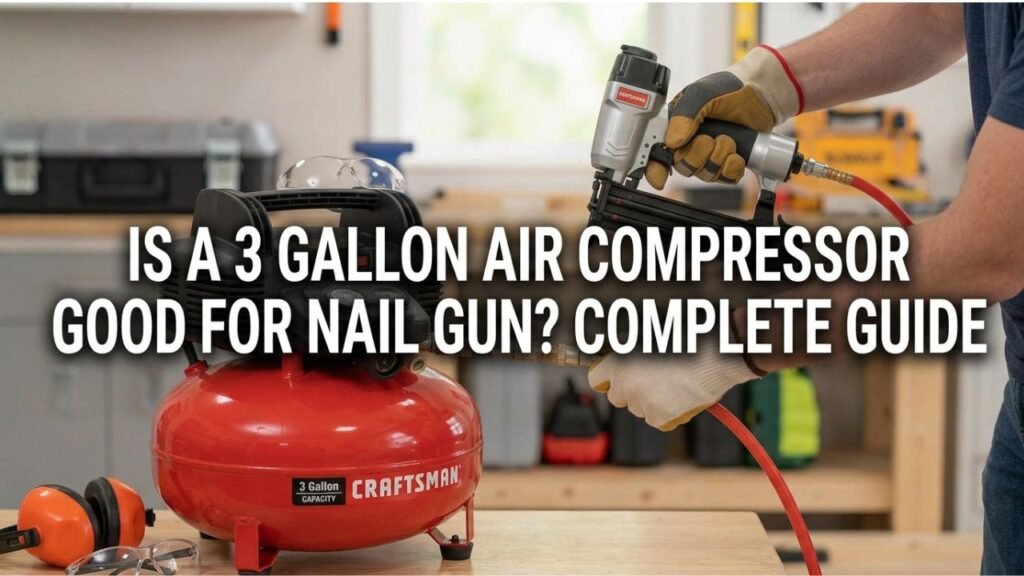
For one person doing typical home improvement, trim, molding, furniture, or woodworking projects, a 3-gallon compressor is usually plenty for a pneumatic nail gun.
Small pneumatic nailers do not continuously consume air. Each trigger pull releases a relatively small amount of stored compressed air. Between shots, the compressor has time to refill the tank.
That makes a 3-gallon unit particularly well suited to:
• Pin nailers
• Brad nailers
• Finish nailers
• Narrow-crown staplers
• Other small pneumatic fastening tools
A 3-gallon compressor may also run a framing or roofing nailer, but the difference appears when you start firing rapidly. A small tank empties sooner, and the compressor has less time to recover between shots.
Nail Gun Compatibility With a 3-Gallon Compressor
| Nail Gun Type | 3-Gallon Compressor Suitability | Best Use |
| 23-gauge pin nailer | Excellent | Detail work, trim, crafts |
| 18-gauge brad nailer | Excellent | Baseboards, molding, woodworking |
| 15/16-gauge finish nailer | Very good | Trim, cabinets, interior finishing |
| Pneumatic stapler | Very good | Upholstery, sheathing, light construction |
| Framing nailer | Usable with limitations | Occasional or slower framing |
| Roofing nailer | Usable with limitations | Small repairs and intermittent use |
| Multiple nailers at once | Usually not ideal | Larger compressor recommended |
These are general recommendations. Your nail gun’s operating requirements and the compressor’s actual airflow rating should always take priority.
Key Takeaways:
• A 3-gallon compressor is an excellent match for brad, pin, and finish nailers.
• Framing and roofing nailers can work, but rapid firing may exceed the compressor’s recovery capability.
• CFM and PSI matter in addition to tank capacity.
• A single nail gun is much easier to support than several pneumatic tools operating simultaneously.
Why a Small Compressor Can Run a Nail Gun
A common misunderstanding is that a powerful-looking nail gun automatically requires a large air compressor.
In reality, nail guns generally have intermittent air demand.
When you pull the trigger, compressed air drives the piston that pushes the fastener into the material. The tool consumes air for that individual firing cycle and then stops consuming significant air until you fire again.
Compare that with a paint gun or pneumatic sander, which may demand a steady airflow for many seconds or minutes.
This intermittent operation is why relatively small portable compressors can perform surprisingly well with nail guns.
What the 3-Gallon Tank Actually Does
The tank stores compressed air.
A larger tank lets you fire more nails before the pump needs to replenish the stored air. A smaller tank reaches its cut-in pressure sooner, so the motor starts more frequently.
However, gallons do not directly determine whether a compressor can power a nailer.
A strong 3-gallon compressor with adequate airflow can be a better nail-gun compressor than a larger unit with weak airflow.
Tank Size vs. CFM
Think of it this way:
Gallons = how much compressed air is stored.
CFM = how quickly the compressor can replace that air.
For nail guns, both are useful, but CFM becomes increasingly important as your firing rate increases.
Key Takeaways:
• Nail guns consume air in short bursts rather than continuously.
• The tank provides stored air between compressor cycles.
• A small tank is not automatically a problem for intermittent nailing.
• Faster nailing requires faster compressor recovery.
How Much CFM Does a Nail Gun Need?
CFM means cubic feet per minute, while SCFM means standard cubic feet per minute. These ratings indicate how much air a compressor can deliver.
Nail gun requirements vary significantly by tool type and firing rate.
Typical air-demand ranges can look roughly like this:
| Nail Gun Type | Approximate Air Demand | 3-Gallon Compressor |
| Pin nailer | Very low | Excellent |
| Brad nailer | About 0.3–1.5 CFM | Excellent |
| Finish nailer | About 0.5–2 CFM | Usually excellent |
| Stapler | About 0.5–2 CFM | Usually very good |
| Framing nailer | About 2–4 CFM during repeated use | Depends on compressor |
| Roofing nailer | About 2–3+ CFM during repeated use | Depends on firing speed |
These numbers are only general ranges because pneumatic tools are often rated differently depending on firing frequency.
The most reliable approach is to check the nailer’s manual or specification label and compare its requirement with the compressor’s SCFM rating at the relevant PSI, commonly around 90 PSI.
How Much Compressor CFM Should You Have?
I prefer giving the compressor some extra airflow capacity instead of matching the tool requirement exactly.
For example, if a nailer effectively requires around 2 CFM during your intended use, having roughly 3 CFM available provides more recovery headroom than choosing a compressor operating right at its limit.
Extra capacity can mean:
• Faster tank recovery
• Less continuous compressor operation
• More consistent nail-driving performance
• Better capability for faster firing
Pro Tip: Compare CFM at the same pressure whenever possible. A compressor’s airflow rating at 40 PSI should not be directly treated as its airflow output at 90 PSI.
How Much PSI Does a Nail Gun Need?
Most pneumatic nailers operate somewhere around 70–120 PSI, although the exact operating range varies by manufacturer and model.
Smaller trim nailers often operate toward the lower end of that range. Framing and roofing nailers can require higher working pressure depending on the fastener, wood density, and tool design.
Do not automatically set the regulator to the compressor’s maximum PSI.
Instead:
- Check the nailer’s specified operating-pressure range.
- Set the compressor regulator within that range.
- Test the nailer on scrap material.
- Adjust pressure and the nailer’s depth control as needed.
- Use the lowest suitable pressure that consistently drives the fastener correctly.
Higher pressure is not necessarily better.
Excess pressure can unnecessarily stress the tool and may drive fasteners too deeply.
Important Tip: Never exceed the nail gun’s maximum rated operating pressure. Follow the manufacturer’s specified pressure range rather than relying on a general PSI recommendation.
Can a 3 Gallon Air Compressor Run a Brad Nailer?
Yes. A 3-gallon air compressor is an excellent size for most brad nailers.
An 18-gauge brad nailer has relatively low air consumption because it drives thin, lightweight fasteners.
A 3-gallon setup is well suited to jobs such as:
• Baseboard installation
• Decorative molding
• Cabinet trim
• Furniture assembly
• Small woodworking projects
• Door and window trim
• Craft projects
For a typical DIY user who pauses briefly while positioning each piece and lining up each nail, the compressor has plenty of opportunities to recover.
In fact, if a brad nailer is your main pneumatic tool, I generally would not buy a much larger compressor solely for additional tank capacity.
Can a 3 Gallon Air Compressor Run a Finish Nailer?
Yes. Most 15- and 16-gauge finish nailers can work well with a 3-gallon compressor.
Finish nailers consume somewhat more air than small pin or brad nailers, but they are still intermittent-use tools.
A 3-gallon compressor is a practical option for:
• Crown molding
• Baseboards
• Window casing
• Door casing
• Cabinet installation
• Furniture projects
• Interior trim
For ordinary DIY use, the setup should be comfortable as long as the compressor’s airflow and pressure meet the nailer’s requirements.
If you are doing professional production work and firing continuously throughout the day, a larger compressor may reduce recovery interruptions.
Can a 3 Gallon Air Compressor Run a Framing Nailer?
Yes, many 3-gallon compressors can run a framing nailer, but this is where the limitations of the small tank become more noticeable.
A framing nailer uses more compressed air per shot than a brad or finish nailer because it must drive much larger fasteners.
For occasional framing, repairs, blocking, fencing, or slower DIY construction, a capable 3-gallon compressor may work perfectly well.
The issue is rapid-fire framing.
If you drive nails quickly one after another, tank pressure can fall before the pump replaces the used air. Eventually, you may need to pause briefly while the compressor recovers.
Signs the Compressor Is Struggling
You may notice:
• The compressor runs almost continuously.
• Recovery periods become frequent.
• Nails stop driving to a consistent depth.
• Tank pressure falls rapidly during repeated firing.
• Performance improves immediately after the tank refills.
If this occurs frequently, the compressor is undersized for your firing rate rather than necessarily incapable of powering the nailer.
Is 3 Gallons Enough for DIY Framing?
For occasional DIY framing, I would use a good 3-gallon compressor if I already owned one and its CFM output met the nailer’s requirements.
If I were specifically buying a compressor for regular framing, however, I would choose a 6-gallon model with adequate SCFM. The larger air reserve makes repeated firing more comfortable without sacrificing much portability.
Key Takeaways:
• A 3-gallon compressor can operate many framing nailers.
• Slow or moderate sequential firing is much easier for a small compressor.
• Fast production framing can cause frequent recovery cycles.
• A 6-gallon compressor is a better long-term choice for frequent framing work.
Can a 3 Gallon Air Compressor Run a Roofing Nailer?
It can, but a roofing nailer puts more pressure on a small compressor because roofers often fire fasteners quickly.
If you are replacing a few shingles or completing a small repair, a 3-gallon compressor may be completely adequate.
For installing an entire roof, however, frequent cycling and recovery pauses can become frustrating.
A 6-gallon or larger portable compressor is generally a better choice for sustained roofing because it provides more stored air between cycles.
Again, verify that its airflow output matches the particular roofing nailer’s requirements.
Is a 3 Gallon Compressor Better Than a 6 Gallon Compressor for Nail Guns?
Neither size is automatically better. The right choice depends on portability and workload.
| Feature | 3-Gallon Compressor | 6-Gallon Compressor |
| Portability | Excellent | Good |
| Storage space | Requires less | Requires more |
| Brad nailer | Excellent | Excellent |
| Finish nailer | Excellent | Excellent |
| Framing nailer | Good for intermittent work | Better for repeated work |
| Roofing nailer | Small jobs | Better for larger jobs |
| Recovery interruptions | More likely | Less frequent |
| DIY trim work | Excellent | Excellent |
| Frequent construction use | Limited | Better choice |
For baseboards, trim, crafts, cabinetry, and occasional fastening, I prefer the 3-gallon size for its portability.
For framing, roofing, or someone who wants one compressor capable of handling several different nailers comfortably, I would choose a 6-gallon compressor.
The important qualification is that the larger compressor must also have suitable airflow. Doubling tank capacity does not automatically double pump performance.
What to Check Before Connecting a Nail Gun to a 3-Gallon Compressor
Before deciding that your compressor is compatible, check four important specifications.
Nail Gun Operating PSI
Find the minimum and maximum pressure stated in the nailer’s manual.
The compressor needs to maintain pressure within this range.
Compressor SCFM at 90 PSI
This tells you considerably more about usable airflow than tank capacity alone.
Compare it with the nailer’s air requirements.
Firing Rate
Driving one nail every several seconds puts far less demand on a compressor than rapid bump firing.
Your real-world use matters just as much as the specifications.
Number of Nail Guns
A compressor that easily supports one nailer may struggle with two people using pneumatic nailers at the same time.
When several tools operate simultaneously, their airflow demands must be considered together.
How to Set Up a 3-Gallon Compressor for a Nail Gun
A basic pneumatic nail-gun setup is straightforward.
- Place the compressor on a stable surface with adequate ventilation.
- Make sure the tank drain valve is closed.
- Connect an appropriate air hose to the compressor outlet.
- Connect the other end to the nail gun using compatible quick-connect fittings.
- Turn on the compressor and allow the tank to reach its normal cutoff pressure.
- Adjust the outlet regulator to a pressure within the nail gun manufacturer’s specified range.
- Load the correct fasteners into the nailer.
- Test several nails in scrap material.
- Fine-tune pressure and the nailer’s depth adjustment until the fasteners are driven correctly.
Do not rely solely on pressure to control nail depth if your nailer includes a mechanical depth adjustment.
Start Low and Adjust Gradually
I recommend starting toward the lower portion of the manufacturer’s pressure range and increasing pressure gradually until the fastener is driven properly.
This avoids unnecessary tool stress and reduces the chance of burying nails too deeply.
Common Problems When Using a Small Compressor With a Nail Gun
A 3-gallon compressor usually works well, but several problems can make the setup seem weaker than it actually is.
Nails Are Not Driving All the Way In
Low pressure is one possible cause, but it is not the only one.
Check:
• Regulator pressure
• Tank pressure
• Nail depth adjustment
• Correct fastener size
• Hose restrictions
• Air leaks
• Tool maintenance
• Wood hardness
Do not immediately exceed the manufacturer’s pressure range to solve incomplete nail penetration.
Compressor Runs Frequently
Frequent cycling is normal with a small tank.
If it recovers quickly and the nail gun continues working properly, this is not necessarily a problem.
Continuous operation with declining pressure, however, can indicate that the nailer is consuming air faster than the compressor can recover.
Pressure Drops During Rapid Firing
Slow your firing rate and give the compressor time to rebuild pressure.
If this happens constantly during your normal work, a larger or higher-CFM compressor is the better solution.
The Compressor Reaches Pressure but the Nailer Feels Weak
Look for restrictions or leaks in:
• Air hose
• Quick-connect fittings
• Regulator
• Couplers
• Tool connection
An undersized or damaged air hose can reduce the pressure available at the nailer.
Key Takeaways:
• Incomplete nail penetration does not always mean the compressor is too small.
• Check pressure, air leaks, hose restrictions, fasteners, and depth adjustment.
• Frequent cycling is expected from a 3-gallon tank.
• Persistent pressure loss during normal use suggests you need more airflow or tank capacity.
Safety Tips for Using an Air Compressor and Nail Gun
Pneumatic nailers can cause serious injuries, so proper setup matters more than simply making the tool fire.
Wear appropriate eye protection and follow the nailer’s operating instructions.
Keep your hands away from the fastener exit point and never point a nail gun toward yourself or another person.
Disconnect the air supply before clearing jams, performing maintenance, or making adjustments that require your hands near the firing mechanism.
Inspect hoses and fittings for damage before use. Do not use components rated below the pressure produced by the compressor.
Drain accumulated water from the compressor tank according to the manufacturer’s instructions. Condensation can promote internal tank corrosion if it is routinely ignored.
For nailers that offer sequential and contact/bump-trigger modes, sequential firing is generally easier for beginners to control and also reduces instantaneous air demand.
When Should You Buy a Bigger Compressor?
A 3-gallon compressor is worth keeping if your primary jobs involve trim and occasional fastening.
Consider moving to a 6-gallon or larger compressor if:
• You regularly use a framing nailer.
• You frequently use a roofing nailer.
• You need rapid-fire performance.
• Two people will use pneumatic tools simultaneously.
• The compressor cannot recover fast enough for your normal work.
• You plan to operate higher-air-demand tools later.
If you intend to add paint guns, sanders, grinders, or other continuously operated pneumatic tools, you may need a considerably larger compressor because those tools consume far more sustained airflow than nail guns.
FAQs about is a 3 gallon air compressor good for nail gun
Can a 3 gallon air compressor run a nail gun?
Yes. A 3-gallon compressor can run most common pneumatic nail guns as long as its CFM and pressure ratings satisfy the nailer’s requirements. It is particularly well suited to brad, pin, and finish nailers.
Is a 3 gallon air compressor enough for a brad nailer?
Yes. A 3-gallon compressor is more than adequate for most 18-gauge brad nailers used for trim, baseboards, woodworking, cabinets, and similar projects.
Can a 3 gallon compressor run a finish nailer?
Yes. Most pneumatic finish nailers have modest intermittent air requirements, making a 3-gallon compressor a practical match for typical DIY and interior trim work.
Will a 3 gallon compressor run a framing nailer?
Usually, yes, provided the compressor supplies the required pressure and airflow. It works best for intermittent or moderate firing. Sustained rapid framing can require frequent recovery pauses.
Can a 3 gallon air compressor run a roofing nailer?
It can run many roofing nailers for repairs or slower work. For a complete roofing job where fasteners are fired rapidly, a 6-gallon or larger compressor is generally more convenient.
What size compressor is best for a nail gun?
For brad and finish nailers, approximately 2–3 gallons is often sufficient. A 6-gallon portable compressor is a versatile choice if you also plan to run framing and roofing nailers regularly.
Does tank size matter for a nail gun?
Yes, but it is not the only specification that matters. A bigger tank stores more air and reduces recovery interruptions, while the compressor’s CFM rating determines how quickly that air can be replaced.
How much PSI does a nail gun require?
Many pneumatic nailers operate somewhere around 70–120 PSI, but exact requirements vary. Always follow the operating-pressure range specified for your particular nail gun.
Is a 6 gallon compressor better than a 3 gallon compressor for nail guns?
For high-volume framing and roofing, generally yes because the larger tank provides more stored air. For brad nailing, finish work, and ordinary DIY projects, a 3-gallon compressor can be more convenient because it is smaller and easier to carry.
Can I run two nail guns from a 3 gallon compressor?
It may be technically possible with low-demand nailers, but I would not choose a 3-gallon compressor specifically for two simultaneous users. The combined airflow demand can cause frequent cycling and pressure drops. A higher-CFM compressor with a larger tank is the better choice.
Conclusion
Is a 3 gallon air compressor good for nail gun use? Yes—for most homeowners and DIY users, a 3-gallon compressor is an excellent choice for pneumatic brad, pin, and finish nailers. These tools consume relatively little air and operate intermittently, so they do not need the large tanks required by many continuous-air tools.
A 3-gallon compressor can also operate many framing and roofing nailers, especially when you work at a moderate pace. Its main limitation is stored-air capacity. During rapid repeated firing, the compressor may cycle frequently or require occasional recovery pauses.
If your work is primarily trim, molding, cabinetry, furniture, and home repairs, I would confidently choose a 3-gallon compressor provided its CFM and PSI ratings match the nailer. If regular framing or roofing is your priority, I would move up to a 6-gallon model with adequate airflow for a more comfortable working pace.
The practical bottom line is to check CFM and operating PSI instead of choosing by gallons alone. When those specifications match your nail gun, a compact 3-gallon compressor can provide all the air most light and medium fastening jobs require.