
Simplex vs Duplex Air Compressor: Differences, Uses, and Choice
A simplex air compressor has one compressor pump and motor assembly, while a duplex system has two separate compressor assemblies that can alternate, stage, or operate together. Simplex units cost less and suit steady or intermittent demand, while duplex systems offer more available airflow, shared runtime, and better protection against downtime.
The terms describe how many compression units are included in the system rather than how many compression stages are inside each pump. That distinction matters because duplex is sometimes incorrectly used as another name for a two-stage compressor.
With a simplex package, one motor and pump must handle the entire air demand. If that compression unit is shut down for maintenance or suffers a failure, compressed-air production normally stops.
A duplex package usually combines two compressor pumps and two motors with a common control arrangement. One unit can operate as the lead compressor while the second starts when demand rises. Many systems can alternate which compressor starts first so operating hours are shared.
For simplex vs duplex air compressor, duplex is usually the stronger option for shops and facilities that experience fluctuating demand, high peak airflow, or costly downtime. Simplex is usually more practical when air consumption is moderate and backup capacity is not worth the higher purchase and maintenance cost.
If you are asking what is a duplex air compressor, think of it as two compressors working as one coordinated compressed-air system. The exact configuration varies, but the goal is usually greater capacity, runtime sharing, or redundancy.
What Is a Simplex Air Compressor?
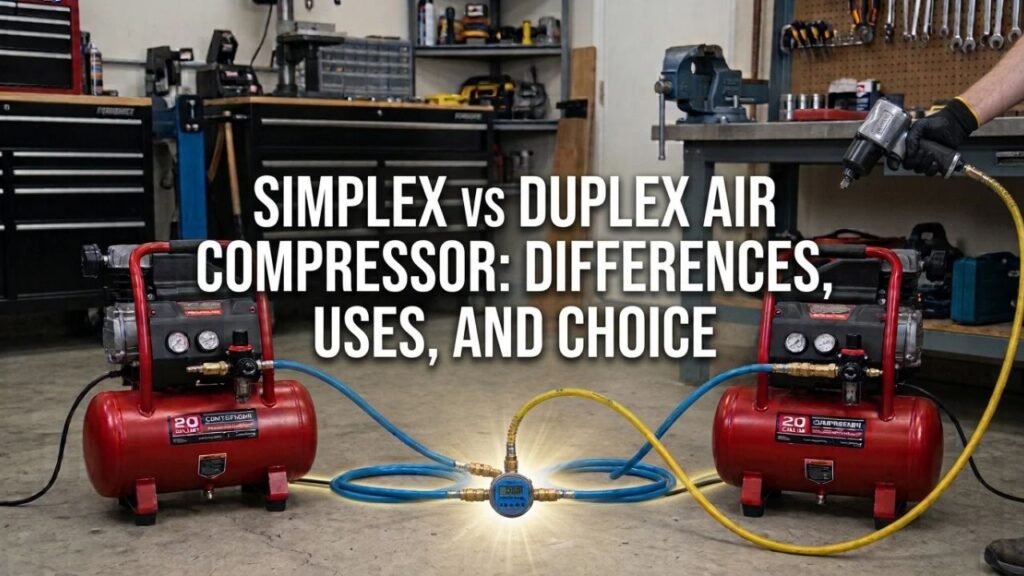
A simplex air compressor package contains one primary compression unit.
That generally means:
- One electric motor
- One compressor pump
- One drive system
- One receiver tank or air connection
- One primary control system
One Pump Handles the Entire Demand
Whenever system pressure falls to the compressor’s cut-in point, the single pump starts and produces compressed air.
It continues operating until:
- Demand falls
- Receiver pressure reaches cut-out
- Another control condition stops it
If the compressor is correctly sized, this arrangement can handle many residential, commercial, and workshop applications.
Simplex Does Not Mean Single-Stage
This is an important terminology point.
A simplex compressor can have:
- A single-stage pump
- A two-stage pump
- Another compressor design
“Simplex” tells you there is one compressor unit.
“Single-stage” or “two-stage” describes what happens to the air during compression.
Simplex Systems Are Mechanically Simpler
With only one motor and one pump, there are fewer major components to:
- Purchase
- Wire
- Control
- Service
- Replace
This often makes simplex equipment the less expensive option.
Key Takeaway: A simplex compressor uses one motor-and-pump assembly to supply all compressed-air demand, and the term has nothing to do with single-stage versus two-stage compression.
What Is a Duplex Air Compressor?
A duplex air compressor has two separate compression units installed as part of one coordinated system.
A common reciprocating duplex package includes:
- Two electric motors
- Two compressor pumps
- Two drive assemblies
- A shared receiver tank
- A duplex control panel
- Pressure controls
- Safety components
Some systems use separate tanks or connect both compressors to a common plant air header instead.
Each Compressor Can Operate Independently
The two pumps do not need to run at the same time.
During light demand, one compressor may be enough.
As demand rises, the controller can start the second compressor.
The Compressors Can Alternate
Many duplex systems periodically switch the lead position.
For example:
- Compressor A handles one cycle.
- Compressor B becomes lead for a later cycle.
- Operating hours are distributed more evenly.
This prevents one machine from accumulating nearly all the runtime while the second sits unused.
Both Pumps Can Run During Peak Demand
If one compressor cannot keep receiver pressure high enough, the second unit can start.
Two identical pumps running together may provide roughly twice the airflow of one pump under the same rated conditions, though actual system output depends on the compressor package, controls, piping, and operating pressure.
Duplex Can Provide Partial Backup
If one compressor is unavailable, the other may continue supplying air.
That does not guarantee full production capacity.
If normal demand requires both compressors, losing one still reduces system performance.
Key Takeaway: A duplex compressor combines two independently driven compression units that can alternate, stage, or run together to provide additional airflow and improved availability.
What Is the Difference Between Simplex and Duplex Air Compressors?
The biggest difference is the number of compression units.
Simplex Has One Compressor Unit
A simplex package depends on one pump and motor.
If that unit stops, compressed-air production normally stops too.
Duplex Has Two Compressor Units
A duplex system can use one or both depending on demand.
This creates several potential benefits:
- More peak airflow
- Shared operating hours
- Reduced individual pump runtime
- Backup capability
- Easier maintenance scheduling
Duplex Requires More Equipment
The second compression unit adds:
- Another motor
- Another pump
- Additional electrical components
- More valves
- More maintenance points
- More complex controls
That increases purchase price and service requirements.
Key Takeaway: Simplex uses one compression unit, while duplex uses two; duplex offers greater flexibility and potential redundancy but costs more and contains more equipment to maintain.
Simplex vs Duplex Air Compressor Comparison
| Feature | Simplex Compressor | Duplex Compressor |
| Compressor Pumps | 1 | 2 |
| Motors | 1 | 2 |
| Available Airflow | Based on one pump | One or both pumps |
| Peak Demand Handling | Limited to one compressor | Better |
| Backup Capability | No compressor backup | Partial or full, depending on sizing |
| Runtime Sharing | No | Usually |
| Controls | Simpler | More complex |
| Initial Cost | Lower | Higher |
| Maintenance Cost | Lower | Higher |
| Downtime Risk | Higher | Lower when properly designed |
| Electrical Demand | Lower | Potentially higher |
| Best for | Moderate air demand | Variable or critical air demand |
How Does a Duplex Air Compressor Work?
A duplex system usually works through staged pressure control.
One Compressor Starts First
The controller designates one machine as the lead compressor.
Suppose receiver pressure falls because air tools are being used.
The lead compressor starts.
If it can meet demand by itself, the second compressor remains off.
The Second Compressor Starts as Demand Increases
If pressure continues dropping, the lag compressor starts at another control point.
Now both pumps supply compressed air.
This increases total available CFM.
Compressors Stop as Pressure Recovers
Once demand drops and system pressure rises, the controller unloads or shuts down the compressors according to the package design.
Lead and Lag Positions Can Alternate
The control system may switch which compressor receives the first start command.
Alternating spreads wear across both machines.
Some Controllers Use Runtime Balancing
More advanced controls can consider:
- Compressor operating hours
- Start counts
- Pressure
- System demand
The basic purpose remains the same: use only as much compressor capacity as the system needs while distributing work across both units.
Key Takeaway: A duplex system normally runs one compressor during lighter demand, adds the second when pressure continues falling, and alternates lead duty to distribute operating hours.
Does a Duplex Compressor Produce Twice the Air?
It can approach twice the airflow when both identical pumps run together, but this should not be assumed from the word “duplex.”
CFM Comes From the Individual Compressors
Suppose each pump is rated for 15 SCFM at 90 PSI.
If both are operating under suitable conditions, the package may provide close to a combined 30 SCFM at that pressure.
Actual delivered airflow may differ because of:
- Piping losses
- Pressure settings
- Compressor controls
- Temperature
- Pump condition
- Installation restrictions
Duplex Does Not Double Pressure
Two 175 PSI compressors operating together do not produce 350 PSI.
They increase available airflow at the system’s designed pressure.
Tank Size Does Not Determine Pump Output
A large receiver stores more compressed air.
It does not create CFM.
When sizing a duplex system, compare compressor airflow at the actual operating pressure required by your tools or equipment.
Key Takeaway: Two identical duplex pumps can substantially increase available CFM when both run, but they do not double the system’s maximum pressure.
Simplex vs Duplex Air Compressor for Duty Cycle
Duplex systems can be useful where a single compressor would accumulate heavy runtime.
Simplex Runtime Depends Entirely on One Pump
If demand is close to the machine’s output, the compressor may run for long periods.
This can increase:
- Pump temperature
- Motor temperature
- Wear
- Maintenance frequency
The compressor still needs to remain within its rated duty cycle.
Duplex Shares the Work
When demand is moderate, the system can alternate compressors.
Instead of one machine collecting all operating hours, runtime is divided.
Both May Run During Busy Periods
When air consumption rises beyond the capacity of one compressor, both can operate.
Once demand falls, the system returns to one-pump operation.
Duplex Cannot Fix Severe Undersizing
If both compressors must run continuously just to maintain normal pressure, the system may simply be too small.
Adding a second undersized pump does not remove the need to calculate total air consumption properly.
Key Takeaway: Duplex systems can distribute runtime and manage changing demand, but both pumps still need enough total capacity and duty-cycle rating for the application.
Simplex vs Duplex Air Compressor for Reliability
Duplex usually has an advantage when uptime matters.
Simplex Has a Single Compression Source
A failure involving the:
- Motor
- Pump
- Starter
- Drive belt
- Major valve assembly
can stop air production completely.
Duplex Can Keep Producing Air
If one compressor is taken offline, the second may continue operating.
That can keep essential pneumatic equipment running while service is performed.
Redundancy Is Not Automatic
A duplex compressor still may have shared components, such as:
- Receiver tank
- Electrical supply
- Controller
- Main outlet
- Dryer
- Filtration system
Failure of a shared component can stop both compressors.
Backup Capacity Must Be Sized
If one compressor produces 20 CFM and the facility requires 35 CFM continuously, losing one pump leaves a serious capacity shortage.
True redundancy requires enough remaining capacity to cover the critical load.
Key Takeaway: Duplex systems reduce dependence on one pump and motor, but true backup requires proper capacity planning and attention to shared components.
Simplex vs Duplex Air Compressor Cost
Simplex equipment usually costs less upfront.
Simplex Has Fewer Major Components
You purchase one:
- Pump
- Motor
- Starter
- Drive system
Controls are usually simpler too.
Duplex Requires Two Compression Assemblies
The second compressor adds significant hardware.
The package may also require:
- Larger electrical service
- Duplex controller
- Additional contactors or starters
- More valves
- Additional maintenance parts
Downtime Has a Cost Too
Purchase price is only one part of the decision.
If compressed air is essential to a business, downtime may cost more than the additional compressor equipment.
For a small home shop, that argument may not justify a duplex machine.
For a production facility, it can.
Key Takeaway: Simplex has the lower purchase and maintenance cost, while duplex can justify its higher price where lost production or insufficient peak airflow would be expensive.
Simplex vs Duplex Air Compressor Maintenance
Simplex is easier to maintain because there is less equipment.
Simplex Maintenance
Depending on compressor type, routine service may include:
- Oil changes
- Intake filter replacement
- Belt inspection
- Tank drainage
- Valve inspection
- Fastener checks
There is one primary compression assembly to service.
Duplex Maintenance
A duplex package has two sets of many wear components.
That can mean twice as many:
- Filters
- Belts
- Motors
- Pumps
- Check valves
- Oil changes
Duplex Can Make Scheduled Service Easier
When the installation permits isolation, one compressor may be serviced while the second remains available.
The remaining unit must still be capable of supporting the required load.
Runtime Balancing Helps Maintenance Planning
Alternating controls keep the operating hours closer together.
This can simplify scheduling because both units may reach service intervals at a predictable rate.
Key Takeaway: Duplex systems contain more serviceable components but may allow one compressor to remain available while the other receives planned maintenance.
Simplex vs Duplex Is Not the Same as Single-Stage vs Two-Stage
These terms describe different compressor characteristics.
Simplex and Duplex Describe Quantity
Simplex:
- One compression unit
Duplex:
- Two compression units
Single-Stage and Two-Stage Describe Compression
A single-stage reciprocating compressor brings air from atmospheric pressure to final discharge pressure in one compression stage.
A two-stage compressor compresses the air, cools it between stages, then compresses it again to the final pressure.
A Duplex Compressor Can Be Two-Stage
A duplex package might contain:
- Two single-stage pumps
- Two two-stage pumps
A simplex machine can also use either pump design.
Check the Specification Instead of the Name
If you need high pressure, look at:
- Maximum working pressure
- Pump design
- SCFM at required PSI
Do not assume “duplex” means higher pressure.
Key Takeaway: Simplex versus duplex refers to how many compressor units are present; single-stage versus two-stage refers to how each pump compresses the air.
When Is a Simplex Air Compressor Better?
Simplex is the sensible choice for many smaller applications.
Home Garages
A single compressor may easily handle:
- Tire inflation
- Nailers
- Blow guns
- Occasional impact wrench use
- Light pneumatic tools
Small Workshops
Simplex works well if demand is:
- Predictable
- Intermittent
- Within one compressor’s CFM capacity
Low Downtime Cost
If stopping for compressor maintenance does not disrupt critical work, redundancy may provide little economic benefit.
Limited Space
A simplex package may have:
- Smaller footprint
- Simpler wiring
- Lower installed cost
Limited Budget
Money saved on a second compressor can be spent on:
- Larger receiver
- Dryer
- Filters
- Better piping
- Proper electrical installation
Key Takeaway: Simplex is usually better for homes and smaller shops where one correctly sized compressor can meet demand and downtime is manageable.
When Is a Duplex Air Compressor Better?
Duplex becomes more attractive as air demand and uptime requirements increase.
Variable Air Demand
A shop may have low consumption most of the day but occasional periods where several air tools operate together.
One pump can handle light demand.
Both can run during peak periods.
Production Environments
Manufacturing equipment may depend on compressed air for:
- Cylinders
- Valves
- Pneumatic tools
- Automation
Losing all compressed air can stop production.
Auto Repair Shops
Several technicians may use air simultaneously.
Demand can change rapidly as:
- Impact tools
- Tire equipment
- Blow guns
- Pneumatic tools
cycle on and off.
Operations Requiring Backup
If air must remain available during pump maintenance, duplex provides another compression source.
Future Demand Growth
A duplex configuration can provide more flexibility when air usage is expected to vary or grow.
The full system still needs to be sized from realistic demand calculations.
Key Takeaway: Duplex is best suited to variable, high, or business-critical air demand where peak capacity and continued air availability justify the added cost.
How to Size a Simplex or Duplex Air Compressor
Do not choose based on tank gallons alone.
List Every Air-Using Device
Record the required airflow for:
- Pneumatic tools
- Machines
- Cylinders
- Blow-off stations
- Other equipment
Use the CFM or SCFM rating at the required PSI.
Estimate Simultaneous Usage
A shop may own ten pneumatic tools but rarely operate all ten simultaneously.
Calculate realistic peak demand.
Use CFM at the Required Pressure
A compressor’s airflow rating changes with pressure.
Compare output at the PSI your equipment actually requires.
Include Reasonable Capacity Margin
A compressor that exactly matches today’s peak demand may spend too much time running at maximum capacity.
Allow for:
- Leaks
- Demand variation
- Future equipment
- Pressure losses
Determine Redundancy Requirements
For a duplex system, decide what should happen if one compressor fails.
Options include:
- Remaining unit handles all demand
- Remaining unit handles only critical equipment
- Reduced production is acceptable
That decision strongly affects compressor sizing.
Key Takeaway: Size simplex and duplex compressors from required SCFM at operating pressure, realistic simultaneous demand, runtime expectations, and the amount of backup capacity needed.
Does a Duplex Compressor Save Energy?
Not automatically.
Energy performance depends on how the system is controlled and sized.
Staging Can Match Demand Better
During low air demand, one compressor can run instead of two.
When demand rises, the second unit joins it.
This can prevent unnecessary operation of excess capacity.
Poor Controls Can Waste Energy
Two compressors that constantly:
- Cycle
- Unload
- Fight each other’s pressure settings
may operate inefficiently.
Correct control sequencing matters.
Air Leaks Still Waste Power
Installing duplex compressors does not solve a leaking compressed-air system.
Before adding more compressor capacity, inspect:
- Fittings
- Hoses
- Couplers
- Regulators
- Distribution piping
A demand problem caused by leaks should be repaired before buying additional equipment.
Key Takeaway: Duplex control can match compressor capacity to changing demand, but actual energy performance depends on sizing, sequencing, pressure settings, and control of air leaks.
Electrical Requirements for Duplex Compressors
Two motors increase the electrical considerations.
Each Motor Needs Proper Protection
The installation may require correctly sized:
- Conductors
- Motor starters
- Overload protection
- Disconnects
- Breakers or fuses
Requirements depend on the motor and local electrical code.
Starting Current Can Be High
Electric motors draw substantial current during startup.
Duplex controls may be designed to avoid starting both motors at exactly the same moment.
Do Not Increase Breaker Size to Stop Trips
Repeated breaker trips can indicate:
- Undersized circuit
- Low voltage
- Motor problems
- Excessive starting load
- Wiring problems
Simply installing a larger breaker without confirming conductor and equipment ratings can create a fire hazard.
Have fixed high-power compressor wiring installed or evaluated by a qualified electrician.
Key Takeaway: Duplex compressors place greater demands on the electrical system because they have two motors, so circuit sizing and motor protection need to match the equipment.
Common Misunderstandings About Duplex Air Compressors
Several assumptions can lead to buying the wrong system.
Duplex Means Two-Stage
False.
The terms describe different things.
Duplex Automatically Gives Full Backup
Not always.
One compressor must have enough capacity to carry the required load if full redundancy is expected.
Duplex Doubles PSI
False.
Adding a second compressor increases available airflow, not the designed maximum system pressure.
A Larger Tank Replaces a Second Compressor
No.
A receiver stores compressed air but cannot create new airflow.
Once stored air is consumed, pump capacity determines whether pressure recovers.
Two Small Compressors Always Beat One Large Compressor
Not necessarily.
The best arrangement depends on:
- Demand profile
- Maintenance requirements
- Energy controls
- Installation cost
- Required redundancy
Key Takeaway: Duplex refers to two compressor units, not two-stage compression, double pressure, guaranteed redundancy, or a substitute for proper system sizing.
Conclusion
For simplex vs duplex air compressor, the main difference is simple: a simplex system has one compressor pump and motor, while a duplex system has two compression units that can be coordinated according to air demand.
If you are asking what is the difference between simplex and duplex air compressors, simplex offers lower cost, simpler controls, and less maintenance. Duplex provides greater peak airflow, runtime sharing, and the possibility of maintaining some air production if one compressor is unavailable.
For what is a duplex air compressor, it is best viewed as a coordinated two-compressor system rather than a special type of compression stage. One unit can handle normal demand, the second can start during higher demand, and the controller can alternate lead duty to distribute wear.
Choose simplex when one properly sized compressor can comfortably meet your workload. Choose duplex when demand changes significantly, production depends heavily on compressed air, or having a second compressor available is worth the added purchase and maintenance cost.
FAQs About Simplex and Duplex Air Compressors
What does simplex mean on an air compressor?
Simplex means the system has one primary compressor unit, generally consisting of one motor and one pump. That single compression assembly must handle the full air demand.
What does duplex mean on an air compressor?
Duplex means two separate compressor units are installed in one coordinated system. They may alternate operation, run in lead-lag sequence, or operate together during high demand.
Is a duplex compressor the same as a two-stage compressor?
No. Duplex describes the number of compressor units, while two-stage describes the number of compression stages inside a pump. A duplex package can contain two single-stage or two two-stage pumps.
Does a duplex air compressor make more CFM?
Yes, when both compressors are operating, their airflow can be combined. If two identical pumps each produce 15 SCFM at the required pressure, combined output may approach 30 SCFM under suitable conditions.
Does a duplex air compressor make twice the PSI?
No. Two compressors operating together increase available airflow, not maximum pressure. The system still operates within its designed pressure range.
Is a duplex air compressor more reliable?
It can provide greater availability because one compressor may continue running if the other is offline. Full redundancy exists only if the remaining compressor and shared system components can support the required load.
Is a duplex air compressor better for an auto repair shop?
It can be a good choice for a busy shop where several pneumatic tools operate at once and air demand changes throughout the day. A smaller shop with intermittent tool use may be adequately served by a simplex compressor.
Should I buy a simplex or duplex air compressor?
Choose simplex for moderate, predictable demand and lower upfront cost. Choose duplex when you need higher peak airflow, shared runtime, or reduced dependence on a single compressor unit.