
Will a 3 Gallon Air Compressor Run a Framing Nailer? 3 vs 6 Gallon Guide
Yes, a 3-gallon air compressor can run many framing nailers, but it is best for slow or intermittent nailing. A 6-gallon air compressor is generally a much better choice because it stores more air, usually recovers faster, and can handle repeated framing shots with fewer pauses.
Framing nailers use compressed air in short bursts rather than continuously. Because of that, they do not require the large compressors typically needed for paint guns, sanders, or grinders.
However, there is an important difference between simply being able to fire a framing nailer and being able to keep up with fast framing work. A small compressor may drive several nails perfectly and then require time to recover.
In this guide, I’ll explain whether a 3-gallon or 6-gallon compressor can run a framing nailer, how much CFM and PSI you need, how tank size affects performance, and which compressor size makes the most sense for different framing jobs.
Will a 3 Gallon Air Compressor Run a Framing Nailer?
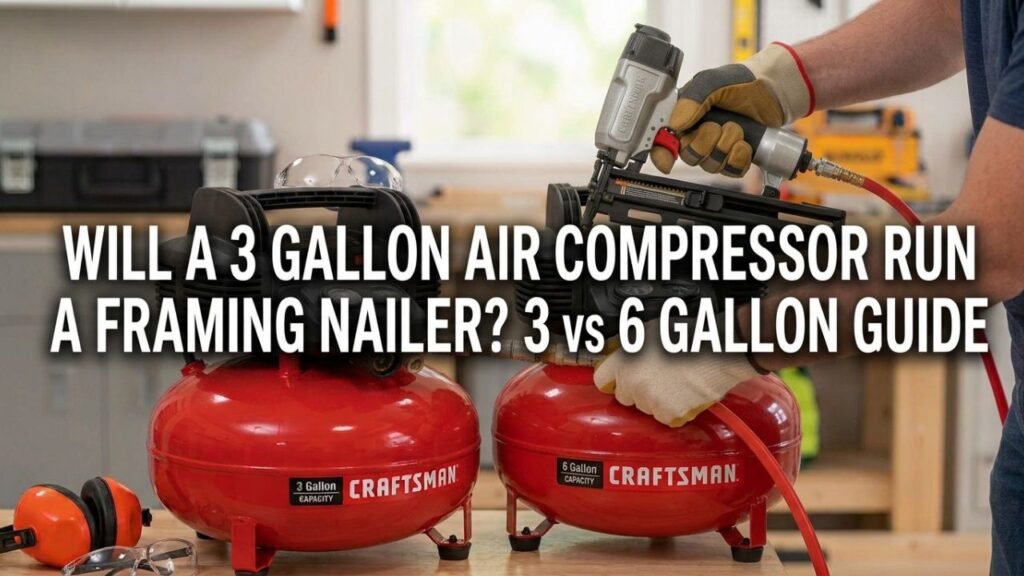
Yes, a 3-gallon air compressor will run many pneumatic framing nailers as long as it can supply the required PSI and enough airflow for your firing rate.
For occasional construction, repairs, fencing, blocking, or small framing projects, a capable 3-gallon compressor can be perfectly usable.
Framing nailers consume air only when you fire them. If you drive one nail, reposition the material, measure, and then drive another nail, the compressor gets time to replenish the air used between shots.
The limitation becomes more noticeable when you fire rapidly.
Because a 3-gallon tank stores relatively little compressed air, repeated shots can cause tank pressure to fall quickly. Once that happens, the compressor pump has to replace the air while you continue working.
You may notice:
- Frequent compressor cycling
- Slower recovery between rapid shots
- Falling regulated pressure
- Nails occasionally failing to drive fully
- Short pauses while tank pressure recovers
This does not necessarily mean the compressor cannot operate the framing nailer. It usually means the compressor cannot sustain your firing rate indefinitely.
Key Takeaways:
- A 3-gallon compressor can run many framing nailers.
- It works best for occasional or moderate-speed framing.
- Rapid firing can use stored air faster than the compressor replaces it.
- CFM matters just as much as tank capacity.
Will a 6 Gallon Air Compressor Run a Framing Nailer?
Yes, a 6-gallon air compressor is generally an excellent portable choice for running a framing nailer.
A typical jobsite-style 6-gallon pancake compressor combines useful stored-air capacity with good portability.
For one framing nailer, a capable 6-gallon compressor can normally handle jobs such as:
- Wall framing
- Deck construction
- Fencing
- Remodeling
- Sheathing
- Blocking
- Small additions
- General construction
The compressor will still cycle while you work, but the larger tank gives you considerably more stored air than a 3-gallon unit.
For most homeowners, DIY users, and individual contractors using one framing nailer, 6 gallons is the size I would normally choose.
Why a 6-Gallon Compressor Is Better for Framing
The main advantage is not simply that the tank is twice as large.
A 6-gallon compressor gives you a larger reserve of compressed air, allowing you to fire more nails before tank pressure falls to the compressor’s cut-in point.
Many 6-gallon units also have stronger pumps than compact 3-gallon compressors.
That can provide:
- More shots between recovery cycles
- Better performance during rapid nailing
- Less waiting
- More stable working pressure
- Better versatility with other nailers and staplers
If portability is still important, a 6-gallon pancake compressor offers an excellent balance between size and usable performance.
3 Gallon vs. 6 Gallon Air Compressor for Framing Nailer
The differences are easiest to understand side by side.
| Feature | 3-Gallon Compressor | 6-Gallon Compressor |
| Runs a framing nailer | Yes | Yes |
| Best use | Light or occasional framing | Regular framing |
| Stored air | Limited | Better |
| Rapid firing | More limited | Better |
| Recovery interruptions | More frequent | Less frequent |
| Portability | Excellent | Very good |
| Small DIY repairs | Excellent | Excellent |
| Full framing projects | Possible with pauses | Much better |
| Multiple nailers | Usually not ideal | Possible with suitable output |
| Overall recommendation | Occasional use | Best all-around portable choice |
For trim work or occasional framing, a 3-gallon compressor may be enough.
If you are buying a compressor specifically for a framing nailer, I would usually choose the 6-gallon model.
Key Takeaways:
- Both 3- and 6-gallon compressors can run framing nailers.
- A 6-gallon compressor provides a much larger air reserve.
- A 3-gallon compressor makes sense for occasional or slower framing.
- For regular framing, I recommend a 6-gallon compressor with adequate CFM.
How Much CFM Does a Framing Nailer Need?
CFM means cubic feet per minute, and it indicates how much airflow a pneumatic tool uses or how much air a compressor can supply.
Framing nailers generally have modest average airflow requirements because they use air in individual bursts.
However, the effective air demand increases as you fire faster.
A framing nailer used for one shot every several seconds places relatively little continuous demand on the compressor.
The same nailer being fired rapidly requires much more airflow over time.
For many portable framing setups, approximately 2–4 CFM at 90 PSI is a useful general range, although the exact requirement depends on the specific nailer and firing rate.
Always check the specifications for your individual tool.
Why CFM Matters More Than Gallons Alone
Tank size determines how much compressed air is stored.
CFM determines how quickly the compressor can replace that air.
A larger tank can give you more shots before pressure drops, but it cannot permanently compensate for a weak pump.
For long-term performance, you need both:
Adequate tank capacity + adequate compressor CFM
How Much Compressor CFM Should You Look For?
For one framing nailer, I would generally look for at least around 2.5 CFM at 90 PSI, with 3–4 CFM giving you more comfortable recovery performance.
More airflow is especially helpful if you plan to fire quickly.
Pro Tip: Compare CFM ratings at the same pressure. For pneumatic nailers, the compressor’s airflow rating at 90 PSI is usually the most useful number to compare.
How Much PSI Does a Framing Nailer Need?
Most pneumatic framing nailers operate somewhere around 70–120 PSI, although exact requirements vary by model.
Many framing nailers work comfortably around 90 PSI, but the manufacturer’s specified operating range should always take priority.
Do not simply turn the regulator to maximum pressure.
Start within the recommended range and adjust the nailer’s depth control and regulator until the fastener drives correctly.
If nails are not driving fully, check:
- Tank pressure
- Regulated outlet pressure
- Nail depth adjustment
- Compressor recovery
- Air hose condition
- Hose fittings
- Tool lubrication requirements
Increase pressure only when necessary and never exceed the nailer’s maximum operating pressure.
Important Tip: Maximum compressor pressure and nail-gun operating pressure are different specifications. A compressor capable of 150 or 200 PSI does not mean the framing nailer should receive that pressure.
Why Tank Size Matters With a Framing Nailer
The compressor tank acts as an air reservoir.
Every time you fire the nailer, some compressed air leaves the system.
With a larger tank, each shot represents a smaller percentage of the available stored air. Tank pressure therefore falls more slowly.
A 6-gallon compressor generally allows more consecutive shots before the compressor has to replenish a significant amount of air.
A 3-gallon compressor reaches that recovery point sooner.
However, tank size cannot compensate indefinitely for insufficient pump output.
If your framing nailer consumes air faster than the compressor can produce it, even a larger tank will eventually lose pressure.
How Many Nails Can a 3 Gallon Compressor Shoot?
There is no universal number.
The number of nails you can fire before pressure drops depends on:
- Tank pressure
- Compressor cut-in pressure
- Nail-gun air consumption per shot
- Regulator setting
- Nail size
- Compressor pump output
- Firing speed
During normal sequential framing, a 3-gallon compressor may fire many nails because the pump continually replaces some of the air between shots.
If you fire very rapidly without allowing recovery time, the usable number of consecutive shots will be lower.
For that reason, the better question is not simply how many nails the tank can hold enough air for.
The more useful question is:
Can the compressor recover fast enough for your normal framing pace?
Can You Use a 3 Gallon Compressor for a Full Framing Project?
Yes, but it may not be the most comfortable choice for a large project.
For a small wall, shed repair, basement renovation, deck repair, or occasional framing project, a capable 3-gallon compressor can get the job done.
For framing an entire house or spending many hours continuously driving nails, I would choose something larger.
A smaller compressor may require more frequent recovery cycles and may run for long periods trying to keep up.
For substantial framing work, a 6-gallon compressor is the minimum portable size I would personally prefer.
Key Takeaways:
- A 3-gallon compressor can complete real framing work.
- Firing rate matters more than project size alone.
- Larger projects make recovery pauses more noticeable.
- A 6-gallon compressor is better suited to sustained framing.
Can a 6 Gallon Compressor Run Two Framing Nailers?
Some can, but not all.
This is a good example of why tank size alone does not determine performance.
A basic 6-gallon compressor may work comfortably with one framing nailer but struggle when two people fire nailers rapidly.
A higher-output 6-gallon compressor may be designed to support two pneumatic nailers.
If you plan to run multiple framing nailers, compare:
- Compressor CFM at 90 PSI
- Manufacturer tool-support recommendations
- Recovery rate
- Number of outlets
- Expected firing rate
For one framing nailer, most capable 6-gallon jobsite compressors are easy to recommend.
For two framing nailers, I would choose a higher-output model specifically designed for multi-user jobsite use.
Is a 3 Gallon Compressor Too Small for a Framing Nailer?
Not necessarily.
A 3-gallon compressor is only too small if its airflow and stored-air capacity cannot support your normal working pace.
It may be a good option if you:
- Already own the compressor
- Only frame occasionally
- Work alone
- Fire sequentially rather than rapidly
- Need a lightweight portable compressor
- Perform small repairs or remodeling jobs
I would consider it undersized if you:
- Frame professionally every day
- Frequently fire nails rapidly
- Experience constant pressure drops
- Need multiple nailers operating at once
- Spend too much time waiting for recovery
In those situations, moving to a larger or higher-CFM compressor can improve productivity significantly.
Is a 6 Gallon Compressor Big Enough for Framing?
Yes. For one framing nailer, a capable 6-gallon compressor is generally big enough for normal framing work.
You do not need a 20- or 30-gallon compressor simply to operate one framing nailer.
Larger compressors become more useful when you:
- Run multiple pneumatic tools
- Have multiple workers
- Use higher-air-demand tools
- Want fewer recovery cycles
- Need extended production-level operation
For a homeowner, remodeler, or individual carpenter, a good 6-gallon compressor is often the practical sweet spot.
What Size Air Compressor Is Best for a Framing Nailer?
For most people, I recommend a 6-gallon portable compressor producing at least around 2.5–3 CFM at 90 PSI for one framing nailer.
More airflow provides better recovery performance.
| Compressor Size | Framing Nailer Use | Recommendation |
| 1–2 gallons | Very limited | Not my first choice |
| 3 gallons | Occasional or light framing | Usable |
| 4–6 gallons | Regular DIY or jobsite framing | Recommended |
| 6 gallons, high output | Fast framing or multiple nailers | Excellent |
| 8–10+ gallons | Heavy or multi-user work | Excellent but less portable |
| 20+ gallons | Shop or multiple air tools | More than needed for one nailer |
Tank capacity should not be your only purchasing criterion.
Also compare:
- SCFM or CFM at 90 PSI
- Maximum pressure
- Recovery rate
- Duty cycle
- Weight
- Noise level
- Number of outlets
- Manufacturer recommendations
For one framing nailer, I would prioritize airflow, portability, and recovery speed over simply buying the largest tank available.
3 Gallon or 6 Gallon Compressor: Which Should You Buy?
If you already own a 3-gallon compressor, try it before replacing it.
As long as it meets your framing nailer’s pressure requirements and recovers quickly enough for your working pace, there may be no reason to upgrade.
If you are purchasing a compressor primarily for framing, however, I would buy a 6-gallon unit instead.
The additional tank capacity gives you more working time between recovery cycles, and many 6-gallon jobsite compressors also provide stronger airflow.
A 6-gallon compressor is also more versatile if you later add:
- Roofing nailers
- Siding nailers
- Finish nailers
- Brad nailers
- Pneumatic staplers
- Blow guns
- Tire-inflation accessories
For most homeowners, remodelers, and individual contractors, it provides an excellent balance of portability and performance.
How to Tell If Your Compressor Is Too Small
Your compressor’s behavior during normal framing can tell you whether it is adequately sized.
The Compressor Runs Frequently but Keeps Up
This is generally normal.
Small compressors are designed to cycle. If pressure remains adequate and the nailer continues driving fasteners correctly, frequent cycling alone does not mean you need a larger compressor.
Nails Stop Driving Fully
If nail depth becomes inconsistent as tank pressure falls, the compressor may not be recovering quickly enough.
Allow it to refill and test again.
If the problem repeatedly occurs during your normal firing pace, more airflow or tank capacity may be useful.
You Constantly Wait for Recovery
Occasional recovery is normal with a small compressor.
If you have to stop every few moments, the compressor is probably undersized for your workload.
The Compressor Runs Almost Continuously
Long periods of operation can occur during heavy use, but you should not exceed the compressor manufacturer’s duty-cycle limitations.
If the pump cannot catch up during reasonable framing use, a higher-CFM compressor is the better solution.
Key Takeaways:
- Frequent cycling alone does not mean the compressor is inadequate.
- Inconsistent nail depth can indicate falling air pressure.
- Constant recovery pauses are a strong sign you need more capacity.
- Upgrade based on real performance, not tank size alone.
How to Set Up an Air Compressor for a Framing Nailer
A proper setup helps the framing nailer work consistently.
- Place the compressor on a stable, ventilated surface.
- Connect an air hose rated for the compressor’s working pressure.
- Attach the hose securely to the framing nailer.
- Allow the compressor tank to reach its normal cut-out pressure.
- Set the outlet regulator within the nailer manufacturer’s specified operating range.
- Load the correct framing nails.
- Test the nailer on scrap lumber.
- Adjust the tool’s depth setting and air pressure until the nails drive correctly.
- Watch tank pressure and regulated pressure during repeated firing.
If pressure falls significantly during normal work, allow the compressor to recover.
Safety When Using a Compressor and Framing Nailer
Framing nailers can cause serious injuries, so proper safety practices are essential.
Always wear appropriate eye protection and follow the nailer manufacturer’s operating instructions.
Never point a nailer toward yourself or another person, even when you believe it is unloaded.
Keep your hands and other body parts away from the fastening area. Framing nails can deflect after striking knots, hidden fasteners, or dense grain.
Disconnect the air hose before:
- Clearing a jam
- Performing maintenance
- Removing stuck fasteners
- Inspecting the nose mechanism
- Making repairs
Never exceed the nailer’s maximum operating pressure.
When working at height, keep the compressor in a secure location and use an appropriate air hose rather than placing the compressor where it could fall.
FAQs about Will a 3 Gallon Air Compressor Run a Framing Nailer
Can a 3 gallon air compressor run a framing nailer?
Yes. Many 3-gallon compressors can operate a framing nailer for intermittent or moderate-speed work. The compressor must provide the required PSI and enough CFM for your firing rate.
Will a 6 gallon air compressor run a framing nailer?
Yes. A 6-gallon compressor is one of the most practical portable sizes for a framing nailer and is generally better suited to repeated firing than a 3-gallon model.
Is a 3 gallon compressor enough for framing?
It can be enough for small projects, DIY repairs, and slower sequential framing. For long projects or rapid firing, I would choose a 6-gallon or higher-output compressor.
Is a 6 gallon air compressor enough for framing?
Yes, for one framing nailer in most situations. Higher-output 6-gallon compressors may also support multiple nailers, depending on CFM and firing rate.
How much CFM do I need for a framing nailer?
Exact requirements vary, but approximately 2–4 CFM at 90 PSI is a useful general range for many portable framing setups. Check your nailer’s specifications for the exact requirement.
How much PSI does a framing nailer need?
Many framing nailers operate somewhere around 70–120 PSI. Always follow the pressure range specified by the manufacturer.
Can a pancake compressor run a framing nailer?
Yes. A 6-gallon pancake compressor is particularly well suited to framing nailers because it combines useful stored-air capacity with portability.
Can you frame a house with a 6 gallon compressor?
Yes, especially when one person is using one framing nailer. A higher-output compressor may be preferable for professional crews or multiple nailers.
Can you frame a house with a 3 gallon compressor?
Technically, yes, if the compressor provides enough airflow and you allow it to recover when necessary. For a project that large, however, I would prefer at least a capable 6-gallon unit.
Does a framing nailer need a large air compressor?
No. Framing nailers use intermittent bursts of compressed air, so they generally require much less sustained airflow than spray guns, grinders, or sanders.
Is higher PSI better for a framing nailer?
No. Use enough pressure to operate the nailer correctly while staying within the manufacturer’s recommended range. Excessive pressure can unnecessarily stress the tool and drive fasteners too deeply.
Which is better for a framing nailer, 3 gallon or 6 gallon?
A 6-gallon compressor is better for most framing work because it stores more air and normally provides better recovery performance. A 3-gallon compressor is better when maximum portability is important and the workload is light.
Conclusion
Will a 3 gallon air compressor run a framing nailer? Yes, in many cases it will, especially for occasional DIY framing, repairs, and moderate sequential firing. Its biggest limitation is the small air reserve, which can lead to more frequent compressor cycling and recovery pauses during rapid use.
A 6-gallon air compressor will also run a framing nailer, and for most users it is the better overall choice. The larger tank gives you more stored air, improves sustained performance, and reduces interruptions while remaining portable enough for normal jobsite use.
If you already own a 3-gallon compressor and its CFM and PSI specifications match your framing nailer, I would try it before spending money on an upgrade.
If you are buying a compressor specifically for framing, I recommend a 6-gallon model with roughly 2.5–4 CFM or more at 90 PSI.
The practical bottom line is simple: do not choose based on gallons alone. Match the framing nailer’s required PSI and airflow to the compressor’s output, then choose tank size based on how quickly and how often you plan to drive nails.