
How Big Air Compressor for Impact Gun? Complete Sizing Guide
If you are wondering how big air compressor for impact gun use, for most 1/2-inch pneumatic impact wrenches, I recommend roughly 5–8 SCFM at 90 PSI with a 20–30 gallon tank for normal DIY automotive work. A 30–60 gallon compressor is more comfortable for frequent use, while 3-, 6-, and many 8-gallon compressors are better considered short-burst solutions rather than ideal long-term setups.
The important point is that tank size alone does not determine whether an air compressor can run an impact wrench. CFM or SCFM at the wrench’s required operating pressure is the more important specification. The tank stores compressed air for temporary demand, while the compressor pump must replace the air you use. That is why two compressors with identical 20-gallon tanks can perform very differently.
Most impact wrenches operate at approximately 90 PSI, but their airflow requirements vary significantly with the wrench design, drive size, torque output, and manufacturer. For example, published specifications for pneumatic impact wrenches can show average consumption around 4–6 CFM for common 3/8- and 1/2-inch tools, while larger 3/4- and 1-inch models can require considerably more.
In this guide, I’ll explain what size air compressor for impact wrench use makes sense, how much CFM and PSI you need, what tank size to choose, whether 3-, 6-, 8-, and 20-gallon compressors work, how to size a compressor for different impact wrench drive sizes, and how to avoid the airflow problems that make an otherwise powerful impact gun feel weak.
How Big Air Compressor for Impact Gun Use: The Practical Answer
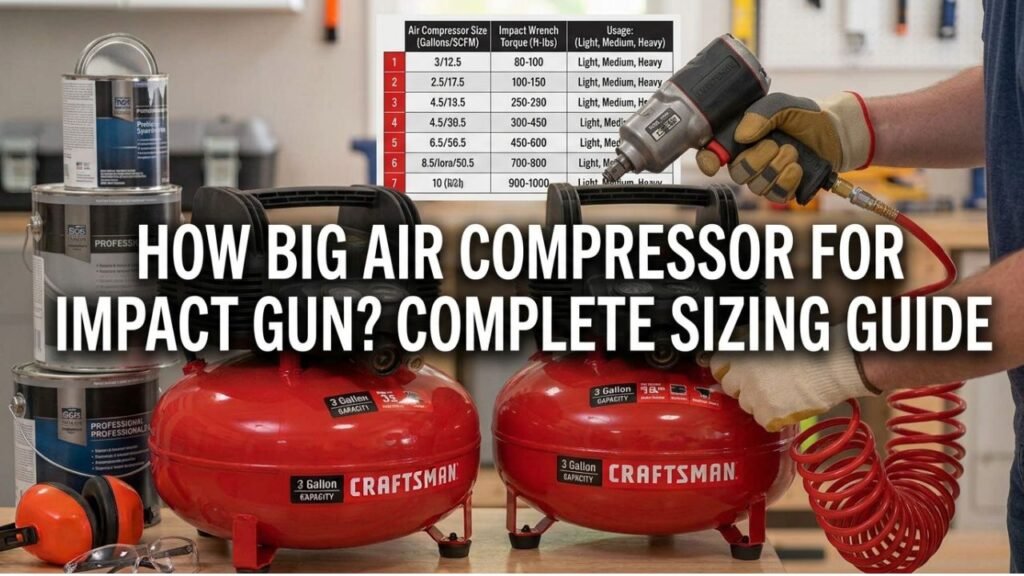
For a typical home garage using a 1/2-inch air impact wrench, a compressor in the 20–30 gallon range delivering approximately 5–8 SCFM at 90 PSI is a practical target.
You can go smaller if you use the wrench only for occasional short bursts. You should go larger if you regularly remove wheels, work on suspension components, service several vehicles, run multiple pneumatic tools, or use a high-air-consumption impact wrench.
A compressor should ideally provide more airflow than the tool’s stated average requirement rather than matching it exactly. A reasonable sizing approach is to provide around 25% additional airflow capacity, especially when buying a new compressor rather than trying to make an existing one work. Quincy Compressor, for example, recommends adding a 25% margin when calculating compressor airflow requirements.
Here is a useful starting point.
| Impact Wrench Size | Typical Planning Airflow | Compressor Target at 90 PSI | Practical Tank Size |
| 1/4-inch | About 2–3 CFM | About 3–4+ SCFM | 6–10 gallons |
| 3/8-inch | About 3–4 CFM | About 4–5+ SCFM | 10–20 gallons |
| 1/2-inch | About 4–6 CFM | About 5–8 SCFM | 20–30 gallons |
| 3/4-inch | About 8–14 CFM | About 10–18 SCFM | 30–60+ gallons |
| 1-inch | About 10–15+ CFM | About 14+ SCFM | 60+ gallons |
These numbers are planning ranges, not substitutes for the specification of your actual impact wrench. Air consumption varies widely even between tools with the same square-drive size. Published Ingersoll Rand specifications, for example, list a 3/8-inch 2115TiMAX at 4 CFM average consumption, a 1/2-inch 2235-series wrench at about 6 CFM average consumption, a 3/4-inch 2145QiMAX at 8.5 CFM, and a 1-inch 285B at 11 CFM. Other models may require substantially different airflow.
For that reason, always read the wrench’s manual or specification sheet before buying the compressor.
Key Takeaways:
- A 20–30 gallon, 5–8 SCFM @ 90 PSI compressor is a strong general choice for a 1/2-inch impact wrench.
- CFM matters more than gallons when deciding whether the compressor can actually keep up.
- Larger 3/4- and 1-inch impact wrenches can require dramatically more airflow.
- Add some compressor capacity above the tool’s stated requirement when possible.
Impact Gun vs. Impact Wrench: Are the Compressor Requirements Different?
In normal automotive and workshop conversation, impact gun, impact wrench, and air impact wrench usually refer to the same general type of pneumatic tool.
So if you are asking:
“What size air compressor for impact gun?”
“What size air compressor for air impact wrench?”
or
“How big a compressor for air impact wrench?”
the sizing process is essentially the same.
The important distinction is not what you call the tool. It is its air consumption, operating pressure, drive size, and intended usage pattern.
A compact 3/8-inch impact wrench designed for smaller fasteners may consume much less air than a high-output 1/2-inch wrench. Likewise, a heavy-duty 3/4-inch impact used for truck service can have a completely different compressor requirement from a compact automotive wrench even though both are called impact guns.
CFM, PSI, and Gallons: What Actually Determines Compressor Size?
Three specifications cause most of the confusion when people choose an air compressor:
CFM or SCFM
PSI
Tank capacity in gallons
All three matter, but they do different jobs.
CFM Is Usually the Most Important Number
CFM means cubic feet per minute. SCFM means standard cubic feet per minute, which expresses airflow under standardized reference conditions.
For practical compressor shopping, the important thing is to compare the wrench requirement with the compressor output at the same operating pressure.
If an impact wrench requires 5 CFM at 90 PSI, a compressor specification of 6 SCFM at 90 PSI is useful.
A compressor specification of 6 CFM at 40 PSI does not tell you that it can provide 6 CFM at 90 PSI. Compressor airflow decreases as discharge pressure increases.
Air-compressor manufacturers therefore commonly publish ratings such as:
5.5 SCFM @ 90 PSI
or
2.6 SCFM @ 90 PSI
That 90-PSI number is particularly useful because many pneumatic impact tools are designed around roughly 90 PSI inlet pressure. Atlas Copco similarly identifies CFM and operating pressure as the two primary measurements when matching a compressor to pneumatic tools.
Average Air Consumption vs. Air Consumption Under Load
This distinction is extremely important with impact wrenches.
A manufacturer may give you both:
Average air consumption
and
Air consumption at load
The numbers can be very different.
For example, one 1/2-inch Ingersoll Rand 231C is specified at approximately 4.2 CFM average consumption but 22 CFM under load. A more powerful 1/2-inch 2235-series model is listed around 6 CFM average and 24 CFM under load.
That does not automatically mean a home user needs a 24-CFM compressor.
Impact wrenches are normally intermittent tools. You squeeze the trigger, the wrench hammers for a short period, you release the trigger, move to another fastener, reposition the tool, change direction, or remove the socket.
During the short high-demand period, the receiver tank supplies stored air. The compressor then replenishes the tank.
This is precisely why a moderate-output compressor with a reasonably sized receiver can operate a pneumatic impact wrench even though the instantaneous air demand may temporarily exceed the pump’s continuous output.
However, the harder and longer you hold the trigger, the more important pump capacity becomes.
PSI Is Pressure, Not Air Volume
PSI means pounds per square inch.
A compressor might advertise 150 or 175 maximum PSI, but that does not automatically make it suitable for an impact wrench.
Maximum tank pressure tells you how much pressure the compressor can store. It does not tell you how much air the pump can deliver while the tool is operating.
A small compressor capable of reaching 150 PSI may still produce only 2 or 3 SCFM at 90 PSI.
Meanwhile, a larger compressor might deliver 6, 10, or 12+ SCFM at 90 PSI.
The second compressor is usually much more capable of powering pneumatic tools.
Gallons Tell You How Much Reserve Air You Have
Tank capacity controls storage, not continuous air production.
A larger receiver gives you several advantages with an impact wrench:
- Longer working bursts before pressure drops.
- Less immediate dependence on pump output.
- More time for the compressor to recover between trigger pulls.
- More stable tool pressure during intermittent work.
But a larger tank cannot permanently compensate for an undersized pump.
If your impact wrench continuously uses more air than the compressor produces, the stored air eventually runs down. Once that happens, tool performance falls until the compressor rebuilds pressure.
Duty Cycle Matters Too
Duty cycle describes how much time the compressor is designed to spend running versus resting.
For example, a compressor with a 50% duty cycle might be intended to run approximately half of a given operating period rather than continuously. Some portable compressor manuals explicitly specify run/rest limits, while heavier shop compressors may be designed for significantly longer operation.
If your compressor runs almost constantly whenever you use the impact wrench, airflow is not the only concern. You may also be pushing the compressor beyond its intended duty cycle.
Key Takeaways:
- CFM determines whether the compressor can replace the air your wrench consumes.
- PSI tells you the required pressure, while gallons determine stored-air capacity.
- Maximum tank PSI should not be confused with tool operating PSI.
- Impact wrenches have high short-term airflow demand, so the tank acts as an important buffer.
What Size Air Compressor for Impact Wrench by Drive Size?
Drive size gives you a useful starting point, although the manufacturer’s actual CFM specification always takes priority.
1/4-Inch Impact Wrench
A compact 1/4-inch pneumatic impact is normally used for small fasteners and relatively light-duty work.
These tools generally need much less airflow than large automotive impacts.
A compressor producing roughly 3–4 SCFM at 90 PSI with approximately 6–10 gallons of storage should cover many light-duty applications comfortably.
You may be able to use a smaller compressor because the tool is normally operated intermittently.
3/8-Inch Impact Wrench
A 3/8-inch impact wrench is common for engine work, smaller automotive fasteners, motorcycles, light mechanical work, and applications where a full-size 1/2-inch impact is unnecessary.
A representative professional 3/8-inch wrench can consume around 4 CFM average at 90 PSI, although exact requirements vary.
For comfortable operation, I would generally look for:
About 4–5+ SCFM at 90 PSI
and
A 10–20 gallon tank
A good high-output smaller compressor may also work if your trigger time is short.
1/2-Inch Impact Wrench
This is the size most home mechanics are asking about.
A 1/2-inch impact wrench is commonly used for:
- Lug nuts.
- Brake and suspension fasteners.
- Automotive repair.
- Lawn and agricultural equipment.
- General mechanical work.
- Medium-sized nuts and bolts.
Published average air-consumption figures for 1/2-inch impact wrenches can be around 4–6 CFM at 90 PSI, while at-load consumption can exceed 20 CFM during active hammering on some models.
For a new compressor purchase, I recommend approximately:
5–8 SCFM at 90 PSI
with
20–30 gallons for normal DIY use
or
30–60 gallons for frequent automotive work.
A 20-gallon compressor is often the point where using a 1/2-inch impact starts feeling reasonably convenient rather than like a compromise.
3/4-Inch Impact Wrench
A 3/4-inch impact wrench is a much more demanding tool.
These are commonly used for:
- Heavy trucks.
- Agricultural equipment.
- Construction machinery.
- Large suspension components.
- Industrial maintenance.
- Heavier commercial repair.
Air consumption can vary considerably. For example, published specifications for Ingersoll Rand 3/4-inch models include average requirements around 8.5 CFM on one model and 14 CFM on another. Their consumption under load is much higher.
I would therefore start around:
10–18 SCFM at 90 PSI
and
30–60 gallons minimum for intermittent work, with a 60-gallon or larger shop compressor being a much better choice for frequent use.
1-Inch Impact Wrench
A 1-inch impact wrench belongs in an entirely different class.
It is normally intended for heavy vehicles, industrial equipment, construction, fleet maintenance, and large fasteners.
One professional 1-inch model, for example, lists approximately 11 CFM average air consumption and 46 CFM under load at 90 PSI.
For a serious 1-inch pneumatic impact, I would generally consider:
14+ SCFM at 90 PSI
and
At least a 60-gallon tank, often larger depending on the wrench and how continuously it will be used.
A compact pancake compressor is not an appropriate match for this class of tool.
How Many Gallon Air Compressor for Impact Wrench Use?
For most people using a 1/2-inch impact wrench, 20–30 gallons is the practical sweet spot.
It provides substantially more reserve air than a pancake compressor without forcing every home mechanic into a large stationary 60- or 80-gallon system.
But gallon recommendations should always be paired with CFM.
Here is how common tank sizes compare.
| Compressor Size | Impact Wrench Suitability | Practical Verdict |
| 3 gallon | Very limited | Usually too small |
| 6 gallon | Short intermittent bursts | Usable as a temporary/light-duty solution |
| 8 gallon | Short intermittent work | Better storage, but CFM may still be low |
| 20 gallon | Good for many 1/2-inch impacts | Strong DIY choice if CFM is adequate |
| 30 gallon | Very good for frequent 1/2-inch use | Excellent home-garage size |
| 60 gallon | Heavy/frequent pneumatic work | Better for 3/4-inch tools and shop use |
| 80+ gallon | High-demand professional work | Best for multiple or heavy pneumatic tools |
Will a 3 Gallon Air Compressor Run an Impact Wrench?
A 3-gallon air compressor can sometimes spin an impact wrench for a very short burst, but I would not consider it a practical compressor for regular impact-wrench use.
Many compressors this small simply do not produce enough airflow.
For perspective, one current 3-gallon light-duty compressor is rated at only 0.6 SCFM at 90 PSI.
Compare that with a common 1/2-inch impact wrench requiring 4–6 CFM average, and the problem becomes obvious.
The tank may initially provide enough air to make the impact gun operate. Once those few gallons of stored air are depleted, however, the compressor cannot replenish the air nearly as quickly as the impact consumes it.
You will experience:
- Rapid pressure drop.
- Weakening impact power.
- Long recovery delays.
- Frequent compressor cycling.
- Potentially excessive compressor runtime.
For tire inflation or nailers, a 3-gallon compressor can be useful. For a pneumatic impact wrench, I would choose something larger.
Can a 6 Gallon Air Compressor Run an Impact Wrench?
Yes, a 6-gallon air compressor can run an impact wrench for short, intermittent bursts, but most 6-gallon pancake compressors are undersized for comfortable continuous 1/2-inch impact-wrench use.
This is one of the most misunderstood compressor questions.
A common 6-gallon pancake compressor may store air at 150 PSI but produce only about 2.6 SCFM at 90 PSI.
A 1/2-inch impact wrench may average 4–6 CFM.
That means the tank can temporarily make up the difference, but the pump cannot replace the consumed air fast enough during repeated use.
A 6-gallon compressor may be acceptable if you:
- Remove only a few fasteners.
- Allow recovery time between trigger pulls.
- Use a relatively efficient impact wrench.
- Keep the hose and fittings unrestricted.
- Already own the compressor and do not want to buy another one.
I would not buy a typical 6-gallon pancake compressor specifically for regular impact-wrench work.
Will a 6 Gallon Air Compressor Run an Impact Wrench for Lug Nuts?
Usually, it can handle some lug-nut work, especially if the nuts are not badly rusted or severely overtightened.
You might remove a few lug nuts successfully and then notice the tool losing power while the compressor rebuilds pressure.
That does not necessarily mean the wrench is defective. It usually means the tool is consuming stored air faster than the compressor can replace it.
For occasional tire rotation on one personal vehicle, you may tolerate this.
For repeated automotive work, I would move to at least a 20-gallon, higher-CFM compressor.
Will an 8 Gallon Air Compressor Run an Impact Wrench?
An 8-gallon compressor can run many impact wrenches intermittently, but the extra two gallons compared with a 6-gallon compressor do not automatically solve the airflow problem.
This is a perfect example of why gallons alone can be misleading.
Current 8-gallon compressors can vary in output. Some models provide only about 2.2 SCFM at 90 PSI, while other 8-gallon designs produce around 3 SCFM at 90 PSI.
Both provide more storage than a 6-gallon tank, but neither automatically becomes an ideal compressor for a wrench requiring 5 or 6 CFM.
An 8-gallon compressor works best for:
- Occasional short bursts.
- Smaller impact wrenches.
- Light automotive maintenance.
- Users willing to pause for recovery.
If you are buying specifically for a 1/2-inch impact wrench, I would generally skip from the small portable category to a higher-output 20-gallon model rather than choosing by tank size alone.
Will a 20 Gallon Air Compressor Run an Impact Wrench?
Yes. A properly specified 20-gallon compressor can run most common 1/2-inch impact wrenches very effectively for DIY and intermittent automotive use.
Again, verify CFM.
One current 20-gallon shop compressor, for example, delivers approximately 5.5 CFM at 90 PSI.
That is much closer to what a typical 1/2-inch pneumatic impact needs than the roughly 2–3 SCFM output found on many small portable compressors.
With 20 gallons of storage, you also have considerably more reserve air before pressure falls.
A 20-gallon compressor is therefore a good choice for:
- Tire rotations.
- Brake jobs.
- Suspension repairs.
- General automotive maintenance.
- Lawn equipment.
- Occasional mechanical projects.
It may still be too small for prolonged 3/4-inch impact-wrench use or a busy commercial environment.
Key Takeaways:
- A 3-gallon compressor is normally too small for practical impact-wrench use.
- A 6- or 8-gallon compressor can work in short bursts, but low pump CFM remains the main limitation.
- A 20-gallon compressor with roughly 5–6+ SCFM at 90 PSI is a much better match for a 1/2-inch impact wrench.
- For heavy 3/4- and 1-inch impacts, move toward 30–60 gallons or more with significantly higher airflow.
Can a Small Air Compressor Run an Impact Wrench?
Yes, but there is a difference between making the tool run and running the tool properly.
A small compressor can charge its tank, and that stored compressed air may provide enough flow to operate an impact wrench briefly.
The tool might feel powerful during the first trigger pull.
Then tank pressure falls.
The compressor switches on.
If the impact wrench consumes 5 CFM while the compressor produces only 2.6 SCFM, you now have an airflow deficit.
Continue holding the trigger and the wrench starts slowing or hammering weakly.
That is why someone can truthfully say, “My 6-gallon compressor runs my impact wrench,” while another person with a similar setup says, “A 6-gallon compressor is useless for an impact.”
Their jobs, wrench specifications, hose setups, compressor outputs, and expectations may all be different.
A small compressor is reasonable when you already own it and need occasional impact-wrench capability.
It is less reasonable when you are buying a new compressor specifically to power pneumatic automotive tools.
How to Calculate the Exact Compressor Size You Need
Rather than guessing from gallons, use a simple sizing process.
1. Find the Impact Wrench’s Required CFM
Look at:
- The wrench label.
- Owner’s manual.
- Manufacturer specification sheet.
- Official product page.
Look specifically for airflow at the wrench’s rated pressure.
If you see:
5 CFM @ 90 PSI
that is the number you want to compare against the compressor.
2. Add Airflow Headroom
If you are buying a compressor, do not intentionally choose one that barely matches the wrench.
A straightforward rule is:
Required tool CFM × 1.25 = useful compressor target
For a wrench requiring 5 CFM:
5 × 1.25 = 6.25 SCFM
I would therefore look for a compressor delivering approximately 6.25 SCFM or more at 90 PSI.
The additional capacity helps account for normal system losses, recovery needs, leaks, and future tool use.
3. Decide How Long You Will Use the Tool
Usage pattern changes the tank recommendation.
If you loosen one stubborn bolt every few minutes, a relatively small tank may work because the compressor has plenty of recovery time.
If you are removing four wheels, working through suspension fasteners, or servicing multiple vehicles, a larger tank becomes much more useful.
For a typical 1/2-inch impact wrench:
Occasional use: 10–20 gallons may be workable.
Regular DIY use: 20–30 gallons is better.
Frequent garage use: 30–60 gallons is more comfortable.
Professional/high-volume use: 60 gallons or more may make sense.
4. Check Compressor Duty Cycle
A compressor that provides enough CFM on paper can still be unsuitable if it must run beyond its rated duty cycle.
If your compressor repeatedly runs for long periods with almost no rest, read the manual.
Do not assume every piston compressor is designed for continuous operation.
5. Size for Multiple Tools When Necessary
If two air tools will run simultaneously, their airflow requirements may need to be added together.
Suppose two technicians use:
Impact wrench: 5 CFM
Air ratchet: 4 CFM
Combined demand:
5 + 4 = 9 CFM
Adding 25% capacity:
9 × 1.25 = 11.25 CFM
You would therefore look for approximately 11–12+ SCFM at the required working pressure.
If you are the only person in the garage and you never operate those tools at the same time, adding every tool’s CFM together is unnecessary.
6. Do Not Size the Compressor by Horsepower Alone
Horsepower can tell you something about the compressor motor, but it is not the best specification for tool compatibility.
Two compressors advertised with similar horsepower can have different actual air-delivery ratings.
Use:
SCFM at 90 PSI
first.
Then consider:
- Tank capacity.
- Duty cycle.
- Maximum pressure.
- Voltage.
- Noise.
- Portability.
- Pump design.
Key Takeaways:
- Start with the manufacturer’s CFM requirement, not a generic gallon recommendation.
- A useful buying target is approximately tool CFM × 1.25.
- Increase tank capacity as trigger time and work frequency increase.
- Size for combined CFM only when multiple tools will actually operate simultaneously.
Air Hose Size Can Make a Good Compressor Feel Too Small
You can buy an adequate compressor and still starve the impact wrench.
The air has to travel through:
- Regulator.
- Coupler.
- Hose.
- Fittings.
- Tool inlet.
Every restriction causes pressure loss.
For many 1/2-inch impact wrenches, 3/8-inch inside-diameter hose is a much better choice than a restrictive 1/4-inch hose.
This is not just a generic recommendation. Manufacturer specifications for several professional 1/2-inch impact wrenches call for a minimum 3/8-inch hose. Larger 3/4- and 1-inch tools may specify a 1/2-inch or even larger hose.
Keep hose runs only as long as necessary.
Longer hoses increase pressure loss, especially when their internal diameter is small.
High-flow couplers can also help when a conventional quick-connect fitting becomes the narrowest point in the air path.
Pro Tip: If your impact wrench initially feels powerful but becomes weak under load even though the compressor appears large enough, inspect the hose and couplers before assuming you need a new compressor.
What PSI Should an Air Impact Wrench Run At?
Many pneumatic impact wrenches are rated around 90 PSI at the tool inlet, but you should use the pressure specified by your wrench manufacturer.
Do not automatically set the tool to the compressor’s maximum tank pressure.
A compressor may store air at:
125 PSI
135 PSI
150 PSI
175 PSI
or another pressure.
The regulator reduces that tank pressure to the amount required by the tool.
If your wrench specifies 90 PSI, set the regulated supply accordingly.
Also remember that pressure displayed at the compressor can be higher than pressure actually reaching the tool during operation because hoses and fittings create pressure drop.
For demanding setups, checking pressure while air is flowing gives you a more realistic picture than looking only at static pressure before pulling the trigger.
Never exceed the tool manufacturer’s maximum allowable pressure in an attempt to get more torque.
Why Does My Impact Wrench Feel Weak?
A weak pneumatic impact wrench does not automatically mean you need a bigger tool.
The air supply may be the real problem.
| Symptom | Possible Cause | What to Check |
| Powerful at first, then quickly weak | Small tank or low compressor CFM | Compressor SCFM @ 90 PSI |
| Compressor runs constantly | Pump cannot keep up | Tool CFM and compressor duty cycle |
| Pressure looks good until trigger is pulled | Restricted airflow | Hose, regulator, couplers |
| Tool slowly loses speed | Pressure drop | Hose length and diameter |
| Compressor takes a long time to recover | Low pump output or leak | SCFM rating and leaks |
| Correct pressure but poor wrench performance | Tool maintenance issue | Lubrication and tool condition |
| Large compressor but weak tool | Restrictive fittings | High-flow couplers and correct hose size |
A common diagnostic mistake is increasing the regulator pressure.
If inadequate airflow is the problem, excessive pressure does not fix the underlying restriction and could exceed the tool’s rated operating pressure.
Choosing Between a 20-, 30-, and 60-Gallon Compressor
If you are purchasing a compressor primarily for automotive work, these three sizes deserve the most attention.
20-Gallon Compressor
Choose a 20-gallon model if:
- You are a home DIY user.
- A 1/2-inch impact is your primary air tool.
- You use pneumatic tools intermittently.
- Portability still matters.
- You have limited garage space.
Look for approximately 5–7+ SCFM at 90 PSI rather than buying solely because the tank says 20 gallons.
30-Gallon Compressor
A 30-gallon compressor is one of my favorite sizes for a serious home garage.
It gives you:
- More reserve air.
- Fewer interruptions.
- Better support for multiple pneumatic tools.
- More flexibility for future tools.
Current 30-gallon consumer compressors can deliver more than 6 SCFM at 90 PSI, although specifications differ by model.
A good 30-gallon compressor is an excellent partner for most 1/2-inch impacts.
60-Gallon Compressor
Choose a 60-gallon compressor when pneumatic tools are becoming a major part of your workshop.
This size is better suited to:
- Frequent 1/2-inch impact use.
- Higher-demand 3/4-inch impacts.
- Air grinders.
- Sanders.
- Multiple tools.
- Professional or semi-professional automotive work.
A current 60-gallon shop compressor can provide more than 11 SCFM at 90 PSI, illustrating how much additional continuous airflow becomes available as you move into larger shop machines.
The downside is reduced portability, greater electrical requirements, increased space requirements, and higher initial cost.
Should You Buy an Oil-Free or Oil-Lubricated Compressor?
Either compressor type can power an impact wrench.
For occasional home use, an oil-free compressor is attractive because it requires less pump maintenance and is widely available in portable sizes.
An oil-lubricated compressor may make more sense for a serious garage where durability, long operating life, and frequent use matter more than low maintenance and portability.
Do not confuse compressor lubrication with impact-wrench lubrication.
Many pneumatic impact wrenches require their own periodic lubrication regardless of whether the compressor itself has an oil-free or oil-lubricated pump.
Follow the impact wrench manufacturer’s lubrication instructions.
What About Portable Pancake Compressors?
Pancake compressors are excellent for the jobs they were designed around.
They are popular because they are:
- Compact.
- Portable.
- Easy to store.
- Convenient on 120-volt household power.
- Excellent for nailers and inflation.
A common 6-gallon pancake compressor delivers approximately 2.6 SCFM at 90 PSI.
That can be perfect for nail guns because nailers consume small quantities of air intermittently.
An impact wrench is much more demanding during each trigger pull.
Therefore, a pancake compressor can be useful when you occasionally need an impact wrench, but it is not my preferred compressor if automotive air tools are the main reason you are purchasing one.
How Compressor Size Changes for Different Jobs
The same 1/2-inch impact wrench can require different practical compressor setups depending on how it is used.
Occasional Lug Nut Removal
A small compressor may be acceptable.
You might use the wrench for a few seconds, reposition it, move to another lug nut, then pause again.
The tank gets recovery time.
A 6- or 8-gallon compressor can sometimes handle this type of job, although performance will depend heavily on CFM.
Full Tire Rotation
Now the compressor has more work to do.
You may remove 20 lug nuts and later reinstall them.
A small tank will cycle repeatedly.
A 20-gallon compressor is significantly more comfortable.
Suspension and Rusted Fasteners
Stubborn fasteners often require the impact to hammer continuously for longer periods.
This dramatically increases air consumption.
A 20–30 gallon, higher-output compressor makes much more sense than a small pancake compressor.
Professional Tire or Repair Shop
A technician may use an impact dozens or hundreds of times throughout the workday.
Multiple technicians may use air simultaneously.
At that point, compressor sizing should be based on total shop demand, realistic simultaneous usage, piping pressure loss, reserve capacity, and duty cycle rather than a simple tank-size recommendation.
Important Safety Rules for Using an Impact Wrench and Air Compressor
Compressed air and impact tools deserve the same respect as any other power tool.
Wear eye protection and hearing protection when operating an impact wrench.
Use impact-rated sockets, not ordinary chrome hand-tool sockets. Impact sockets are designed for the repeated shock produced by an impact mechanism.
Inspect the air hose and fittings for damage before use.
Do not use a hose with serious cracking, cuts, damaged fittings, or leaks.
Keep the compressor on a stable surface and drain accumulated tank moisture according to the manufacturer’s instructions.
Do not alter the pressure switch, safety valve, tank, or other pressure-control components.
Do not exceed the impact wrench’s rated inlet pressure.
Disconnect the tool from the air supply before servicing it or making maintenance changes where required by the manufacturer.
Do Not Use an Impact Wrench as Your Final Torque Measurement
An impact wrench is excellent for removing fasteners and quickly running them down.
It is not a precision torque-measuring tool.
When tightening critical automotive fasteners such as wheel lug nuts, use the correct vehicle torque specification and complete final tightening with a properly used torque wrench.
An impact wrench can leave a fastener either under-tightened or over-tightened.
The Compressor Setup I Recommend for Most Home Mechanics
For a person building a general home automotive garage around a 1/2-inch pneumatic impact wrench, my preferred target would be:
20–30 gallon receiver
Approximately 6–8 SCFM at 90 PSI
90 PSI regulated tool pressure when specified by the wrench
3/8-inch ID air hose
Quality unrestricted couplers
Adequate compressor duty cycle
That combination gives you much more flexibility than trying to operate a demanding impact wrench from a small 3- or 6-gallon compressor.
If you already own a 6-gallon pancake compressor, I would try it before replacing it. For occasional lug nuts, it may accomplish exactly what you need.
But if you are buying from scratch, I would rather spend the money once on a 20- or 30-gallon compressor with sufficient CFM.
Common Mistakes When Buying a Compressor for an Impact Gun
Choosing by Gallons Alone
A 20-gallon tank does not guarantee adequate airflow.
Always check SCFM at 90 PSI.
Looking Only at Maximum PSI
A compressor capable of 175 PSI is not automatically stronger for air tools than a compressor rated at 150 PSI.
Air delivery matters.
Buying Exactly the Tool’s CFM Requirement
Leaving some airflow headroom gives the system breathing room and reduces how hard the compressor must work.
Ignoring Hose Diameter
A restrictive hose can turn an adequately sized compressor into an underperforming system.
Assuming Every 1/2-Inch Impact Uses the Same Air
They do not.
One model may average around 4 CFM while another requires 6 CFM or more.
Expecting a Larger Tank to Fix a Tiny Pump
A bigger receiver provides longer bursts.
It does not permanently increase compressor pump output.
Ignoring Future Air Tools
If you expect to add grinders, sanders, air hammers, spray equipment, or larger impacts, buy enough compressor capacity now rather than sizing for only the easiest tool in your garage.
Key Takeaways:
- For most home mechanics, 20–30 gallons and roughly 6–8 SCFM at 90 PSI is a versatile target.
- A large tank cannot compensate indefinitely for insufficient pump airflow.
- Use the correct hose, fittings, regulator setting, and impact-rated sockets.
- If future air tools are likely, buying additional CFM now can prevent an expensive second compressor purchase.
FAQs about How Big Air Compressor for Impact Gun
What size air compressor for impact wrench use is best?
For most 1/2-inch impact wrenches used in a home garage, I recommend a compressor delivering approximately 5–8 SCFM at 90 PSI with a 20–30 gallon tank. Frequent use benefits from 30–60 gallons. Always compare the compressor with the exact CFM requirement of your wrench.
What size air compressor for impact gun use do I need?
The compressor should meet the impact gun’s required operating pressure and deliver at least its required airflow. If the wrench requires 5 CFM at 90 PSI, I would target approximately 6.25 CFM or more at 90 PSI when purchasing a new compressor.
What size air compressor for air impact wrench use is recommended?
For common 1/2-inch automotive air impact wrenches, approximately 20–30 gallons and 5–8 SCFM at 90 PSI is a useful general recommendation. Smaller 3/8-inch tools may need less, while 3/4- and 1-inch impacts require much more airflow.
What size air compressor do I need for impact gun lug nut removal?
A 20-gallon compressor producing approximately 5–6+ SCFM at 90 PSI is a practical minimum for comfortable home automotive use. A 30-gallon compressor with 6–8+ SCFM gives you more reserve and faster recovery.
A 6-gallon compressor may remove lug nuts occasionally, but expect more compressor cycling and waiting.
How big a compressor for air impact wrench use should I buy for a home garage?
For a general home garage, I would choose a 20–30 gallon compressor delivering around 6–8 SCFM at 90 PSI. This provides a good balance between size, price, storage, portability, and performance for a typical 1/2-inch impact wrench.
How many gallon air compressor for impact wrench use is enough?
Approximately 20 gallons is enough for many intermittent 1/2-inch impact-wrench jobs, while 30 gallons is more comfortable. A 60-gallon compressor is better for frequent use, large pneumatic tools, or heavy 3/4-inch impact wrenches.
Tank size does not replace the need for sufficient CFM.
Can a 6 gallon air compressor run an impact wrench?
Yes, but usually only for short bursts.
Many 6-gallon pancake compressors produce around 2.6 SCFM at 90 PSI, while common 1/2-inch impact wrenches may average approximately 4–6 CFM. The tank provides temporary reserve air, but you will usually have to wait for the compressor to recover during repeated use.
Will a 6 gallon air compressor run an impact wrench for tire changes?
It can work for occasional tire changes, particularly when lug nuts loosen easily and you give the compressor recovery time.
For regular tire rotations or automotive repair, a 20-gallon or larger higher-CFM compressor is more convenient.
Will a 20 gallon air compressor run an impact wrench?
Yes. A 20-gallon compressor with approximately 5–6+ SCFM at 90 PSI is a good match for many 1/2-inch impact wrenches used intermittently.
Check the wrench specification because some high-output models consume more air.
Will a 3 gallon air compressor run an impact wrench?
Technically, a fully charged 3-gallon compressor may operate an impact wrench briefly.
Practically, it is usually too small.
Many 3-gallon compressors have extremely low airflow at 90 PSI and lose their stored air quickly. I would not buy one specifically for an impact wrench.
Will an 8 gallon air compressor run an impact wrench?
Yes, for intermittent use, but check the compressor’s SCFM.
Some 8-gallon compressors produce only about 2–3 SCFM at 90 PSI. That is below the average air requirement of many 1/2-inch impacts, so the extra tank capacity helps only temporarily.
Can a small air compressor run an impact wrench?
Yes. A small compressor can run an impact wrench from stored tank air for short periods.
The problem begins when the tank pressure falls. If the compressor pump cannot supply as much CFM as the wrench consumes, tool power decreases and you must wait for recovery.
Is CFM or tank size more important for an impact wrench?
CFM is more important for long-term performance.
Tank size determines how much reserve air is available for short bursts. CFM determines how quickly that air is replaced.
The best system has both adequate airflow and enough tank storage for the way you work.
How much CFM does a 1/2-inch impact wrench need?
Many common 1/2-inch pneumatic impacts average roughly 4–6 CFM at around 90 PSI, although individual models can fall outside this range.
Always use the manufacturer’s specification for your exact wrench.
Is 2.6 SCFM enough for an impact wrench?
A compressor delivering 2.6 SCFM at 90 PSI can power many impact wrenches temporarily from stored tank air, but it is below the average airflow demand of many common 1/2-inch pneumatic impacts.
It is acceptable for occasional short bursts but not ideal for repeated use.
Is 5 CFM enough for an impact wrench?
Five CFM at 90 PSI can operate many moderate 1/2-inch impact wrenches, particularly for intermittent automotive work.
If the wrench itself requires 5 CFM, however, I would prefer a compressor with additional capacity rather than running the pump at its limit.
Do I need a 60 gallon compressor for an impact wrench?
Not for a normal 1/2-inch impact used occasionally at home.
A 20–30 gallon compressor is usually more practical.
A 60-gallon compressor becomes valuable for frequent pneumatic-tool use, larger 3/4-inch impacts, multiple tools, or a serious workshop.
Can I run an impact wrench at more than 90 PSI for extra power?
Do not exceed the manufacturer’s specified inlet pressure.
Although increased pressure may temporarily change tool performance, excessive pressure can increase wear and create unnecessary safety risks.
Use the correct regulator setting and fix airflow restrictions instead of simply raising pressure.
What air hose should I use for a 1/2-inch impact wrench?
A 3/8-inch inside-diameter hose is a good general choice and is the minimum hose size specified for many professional 1/2-inch impact wrenches.
Larger impacts may require a 1/2-inch hose. Keep the hose reasonably short and avoid restrictive couplers.
Why does my impact wrench lose power after a few seconds?
The most likely explanation is that the tool is consuming air faster than the compressor can replace it.
Other possible causes include:
- Small or long air hose.
- Restrictive couplers.
- Incorrect regulator setting.
- Air leaks.
- Dirty or poorly maintained tool.
- Insufficient lubrication where required.
- Compressor that is simply too small.
Watch the regulated pressure while the wrench is operating. A large drop under load usually points toward an air-supply problem.
Conclusion
If you are deciding how big air compressor for impact gun use should be, the best answer is not based on gallons alone. For a typical 1/2-inch pneumatic impact wrench, I recommend approximately 5–8 SCFM at 90 PSI with a 20–30 gallon tank for normal home-garage use. A 30–60 gallon setup is better when you use the wrench frequently or plan to run other demanding air tools.
A 3-gallon compressor is generally too small. A 6-gallon compressor can run an impact wrench in short bursts, but its pump often cannot keep up with repeated use. An 8-gallon compressor gives you slightly more reserve, although CFM remains the limiting factor. A properly specified 20-gallon compressor is where impact-wrench use becomes much more practical.
For larger 3/4- and 1-inch impact wrenches, do not rely on the same recommendations used for a 1/2-inch tool. Their airflow requirements can rise dramatically, making a 30–60 gallon or larger high-output compressor much more appropriate.
My recommendation is simple: check the exact wrench CFM requirement at its rated PSI, add reasonable airflow headroom, then choose enough tank capacity for how frequently you actually use the tool. If you follow that order—CFM first, PSI second, gallons third—you are far more likely to end up with an impact wrench that delivers its expected power without constantly waiting for the compressor to recover.