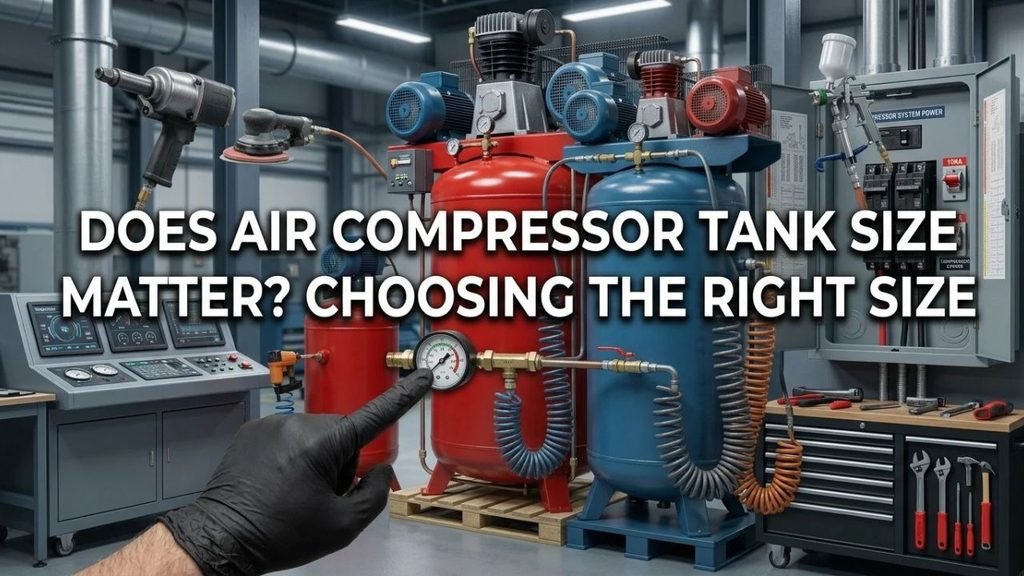
Does Air Compressor Tank Size Matter? Choosing the Right Size
Yes, air compressor tank size matters because the tank determines how much compressed air is stored and available during short bursts of demand. A larger tank can provide longer tool run time before pressure falls, reduce frequent compressor cycling, and smooth pressure changes, but it does not increase the compressor pump’s actual CFM output.
This distinction is important when comparing compressors. A 60-gallon unit is not automatically stronger than a 20-gallon unit. The compressor’s CFM at the required PSI determines how quickly it can produce usable air, while tank capacity determines how much reserve air is available.
A small tank can work very well with nail guns, inflators, staplers, and other tools that use air intermittently. Sanders, grinders, spray guns, and other high-air-demand tools usually need more airflow and can make a small receiver lose pressure quickly.
For does air compressor tank size matter, the answer depends heavily on how the air will be used. Tank capacity matters more for pressure buffering and short demand peaks, while compressor output matters more for continuous work. Atlas Copco describes the receiver as a buffer that absorbs changes in air demand and reduces pressure fluctuations.
Compressed air can also represent a meaningful energy load in U.S. workplaces. A U.S. Department of Energy publication reported that compressed-air generation accounts for around 10% of electricity use in a typical industrial facility, with some facilities reaching 30% or more. Receiver sizing and compressor cycling therefore matter beyond simple tool run time.
The best tank size depends on the tool’s CFM demand, required PSI, how long the tool runs at a time, compressor recovery rate, portability needs, and how many tools may operate together.
Does Air Compressor Tank Size Matter for Performance?
Yes, but tank capacity affects a different part of performance than CFM or horsepower.
A Larger Tank Stores More Compressed Air
The receiver acts as an air reservoir.
When the compressor reaches its cut-out pressure, the tank contains compressed air ready for use.
As you operate a tool, that stored air leaves the receiver and tank pressure begins to fall.
A larger tank contains more usable stored air between the compressor’s cut-out and cut-in pressures.
This means the tool can often operate longer before the motor needs to restart.
Tank Size Helps With Short Bursts of High Demand
Some tools consume large amounts of air for only a few seconds at a time.
Examples include:
- Impact wrenches
- Framing nailers
- Air ratchets
- Blow guns
- Pneumatic staplers
A receiver can supply that temporary peak even if the tool briefly draws air faster than the compressor pump produces it.
Atlas Copco describes this as one of the main purposes of an air receiver: covering short demand peaks that exceed compressor output for a limited period.
Larger Tanks Reduce Rapid Pressure Changes
Air demand is rarely perfectly steady.
A larger reserve can make system pressure change more slowly when a tool suddenly starts drawing air.
That can make tool operation feel more consistent during short work cycles.
A Larger Tank Does Not Create More Air
This is the limitation that matters most.
If a compressor produces 5 SCFM at 90 PSI and the tool continuously consumes 10 SCFM at 90 PSI, the tank will eventually empty faster than the pump can replenish it.
A 60-gallon tank delays the pressure drop longer than a 6-gallon tank, but it cannot eliminate the airflow shortage.
Atlas Copco specifically notes that increasing receiver size does not increase the compressor’s continuous airflow output.
Key Takeaway: Tank size determines stored-air reserve and helps absorb temporary demand, while the compressor’s CFM determines how much air it can continually replace.
What Does Air Compressor Tank Size Affect?
Tank capacity affects several practical characteristics of an air compressor.
Tool Run Time Before Pressure Drops
With two otherwise similar compressors, the unit with the larger tank generally supplies air longer before reaching its cut-in pressure.
This matters most with tools that consume substantial air for periods longer than a few seconds.
Compressor Cycling
A small tank fills quickly but can also empty quickly.
That may cause the compressor motor to start and stop more frequently during intermittent use.
A larger receiver generally allows longer periods between starts.
Atlas Copco notes that receiver storage can reduce excessive cycling, while Quincy points out that larger tanks can reduce repeated motor starts in reciprocating compressors.
Pressure Stability
Stored air acts as a cushion between the pump and the tool.
More storage can reduce sudden pressure drops during brief demand spikes.
This can matter when a tool or process reacts badly to changing supply pressure.
Recovery Time
A large tank also has a tradeoff: once pressure has fallen substantially, more air must be pumped into it.
With the same pump, a 60-gallon tank takes longer to refill through a given pressure range than a 20-gallon tank.
A large receiver paired with a small pump can therefore produce long recovery periods.
Portability
Tank size strongly affects:
- Weight
- Physical dimensions
- Wheel requirements
- Storage space
- Ease of loading into a vehicle
A 2- or 6-gallon compressor is easy to carry around a jobsite.
A 60- or 80-gallon vertical unit is generally intended to stay in one workshop location.
Moisture Management
Compressed air heats during compression and contains moisture.
A receiver gives the air time and space to cool, allowing some moisture to condense in the tank.
Larger receivers can support this cooling process, but accumulated water must be drained.
OSHA’s workplace air-receiver standard requires a drain at the tank’s lowest point and calls for receivers to be drained frequently enough to prevent excessive liquid accumulation.
Key Takeaway: Tank size affects reserve air, cycling frequency, pressure stability, recovery time, portability, and moisture handling.
Does a Bigger Air Compressor Tank Mean More CFM?
No.
CFM and tank gallons describe two different things.
CFM Measures Airflow
CFM means cubic feet per minute.
It tells you how much air the compressor can deliver over time.
When shopping for a tool compressor, look at the compressor’s CFM or SCFM rating at the pressure your tool requires.
For example, a rating might state:
5.5 SCFM at 90 PSI
That is much more useful for tool matching than maximum PSI alone.
Gallons Measure Storage Volume
A 20-gallon receiver has more storage capacity than a 6-gallon receiver.
It does not tell you how fast the compressor pump fills that tank.
Two 20-gallon compressors can have very different:
- Motors
- Pump designs
- CFM ratings
- Duty cycles
- Recovery speeds
Bigger Tanks Only Extend the Reserve
Imagine two compressors both deliver 6 SCFM at 90 PSI.
One has a 10-gallon tank and the other has a 30-gallon tank.
The 30-gallon model stores more air and can better absorb temporary high demand.
Once both compressors are running continuously, though, each pump still produces about 6 SCFM at the specified pressure.
Ingersoll Rand advises sizing compressors around required CFM and PSI rather than judging them by horsepower or tank volume alone.
Key Takeaway: Tank gallons measure stored-air capacity; CFM measures how quickly the compressor can produce air. A bigger receiver does not raise the pump’s CFM.
What Size Air Compressor Tank Do You Need?
There is no single gallon size that works best for every person.
Start with the tools you plan to use.
| Tank Size | Typical Use |
| 1–3 gallons | Inflation, brad nailers, light stapling |
| 4–6 gallons | Finish and framing nailers, portable jobsite work |
| 8–15 gallons | Home garage work, intermittent impact tools |
| 20–30 gallons | Automotive work, air ratchets, short bursts with higher-demand tools |
| 30–60 gallons | Larger garage, more frequent pneumatic-tool use |
| 60–80+ gallons | Stationary shop use, higher-demand tools with adequate compressor CFM |
These are general examples rather than tool guarantees.
A 20-gallon compressor with high CFM may outperform a poorly matched 60-gallon compressor once the stored air is depleted.
1- to 6-Gallon Tanks
Small portable compressors are well suited to tools that use brief bursts of air.
Common jobs include:
- Brad nailing
- Finish nailing
- Stapling
- Tire inflation
- Sports-equipment inflation
- Occasional blow-gun use
They are compact and refill quickly because the tank is small.
They are a poor match for most continuous pneumatic sanders and grinders unless the compressor itself has unusually high output.
8- to 20-Gallon Tanks
This range fits many DIY garages.
It can support tasks such as:
- Tire service
- Intermittent impact wrench use
- Air ratchets
- Light pneumatic repair work
- Short periods of air spraying
The exact usefulness still comes back to CFM.
20- to 30-Gallon Tanks
These provide more reserve for automotive work and tools that stay on longer.
They can be a good middle ground when a user wants more stored air but still needs some mobility.
60- to 80-Gallon Tanks
Large vertical tanks are common in fixed workshops.
They make more sense when:
- Tools run frequently
- Demand changes rapidly
- Several air outlets are used
- Reduced cycling is desired
- A high-output compressor pump is installed
Atlas Copco describes 60- and 80-gallon receivers as useful buffers for more demanding shop conditions, but stresses that total CFM demand must still match compressor output.
Key Takeaway: Choose tank capacity according to tool duty pattern and storage needs, but confirm that compressor CFM at the required PSI can actually support the tool.
What Tank Size Is Best for Air Tools?
The answer changes according to how the tool consumes air.
Nail Guns
Nailers use a short burst of compressed air each time they fire.
The compressor has time to refill the receiver between bursts in many applications.
That makes small portable tanks practical.
A 4- to 6-gallon compressor is common for jobsite nailer work, assuming its pressure and output meet the nailer’s requirements.
Impact Wrenches
An impact wrench uses more air but is usually operated intermittently.
A modest tank can work for occasional wheel removal or automotive repairs.
For repeated commercial use, more storage and higher compressor output are preferable.
Air Ratchets
Air ratchets run longer than an impact wrench during many repairs.
A 20-gallon or larger receiver can offer a better reserve, though CFM still determines how long the tool can run after tank pressure begins falling.
Sanders
Pneumatic sanders are demanding because they can consume air continuously.
A large tank improves initial run time but does not solve low CFM.
For sustained sanding, compressor output is usually more important than tank capacity.
Die Grinders
Die grinders can also consume substantial continuous airflow.
Small pancake compressors tend to cycle heavily and lose pressure during extended grinding.
A larger stationary compressor with adequate CFM is a better match.
Paint Spray Guns
Spray guns need stable airflow during a paint pass.
Pressure dropping halfway through a panel can change atomization and spray quality.
More receiver capacity provides a useful buffer, but the pump must still produce enough CFM to support the spray gun.
Quincy specifically lists sanders and grinders as tools that generally call for larger tanks than intermittent nailers and staplers.
Key Takeaway: Intermittent tools can work well with smaller tanks, while sanders, grinders, and spray guns benefit from more stored air and, more importantly, enough continuous CFM.
Is a Bigger Air Compressor Tank Always Better?
No.
More storage has advantages, but bigger is not automatically the best choice.
Advantages of a Larger Tank
A larger receiver can provide:
- More stored air
- Longer time between motor starts
- Better handling of short demand spikes
- Smoother pressure changes
- More reserve for intermittent high-CFM tools
Disadvantages of a Larger Tank
A bigger tank can also mean:
- Higher purchase cost
- More weight
- Larger footprint
- Longer initial fill time
- Longer recovery after major pressure loss
- Less portability
An oversized receiver paired with a very small compressor pump can also be frustrating because refill takes a long time.
The goal is to match receiver size to the pump and use pattern rather than simply buying the highest gallon rating available.
How Tank Size Affects Compressor Duty Cycle
Duty cycle describes how much of a given period a compressor can safely spend running.
For example, a reciprocating compressor that is not designed for continuous operation needs periods when it can stop and cool.
A Larger Tank Can Lengthen Off-Time
During intermittent demand, more stored air means the motor may stay off longer before receiver pressure reaches the cut-in point.
This can reduce frequent starts.
The Tank Cannot Fix Continuous Overload
Suppose your tool continuously needs more air than the compressor produces.
The receiver pressure will keep dropping.
Eventually, the compressor runs continuously trying to keep up.
Installing a larger tank only delays that point.
For sustained high-CFM applications, the real fix is enough compressor capacity and a duty cycle suited to the workload.
Key Takeaway: Larger receivers can reduce cycling during intermittent use, but they cannot prevent continuous running when tool demand exceeds compressor output.
How Many Gallons per CFM Should an Air Compressor Tank Have?
Rules of thumb exist, but they are not universal purchasing formulas.
Atlas Copco gives a general air-receiver sizing guideline of about 3–4 gallons of storage for each CFM of compressor capacity, depending on compressor design and the application.
Campbell Hausfeld gives a broader reference of roughly 2–5 gallons per CFM, suggesting the lower end for intermittent tools and more storage for tools with longer air demand.
These guidelines are more applicable to complete compressed-air system design than simply choosing a portable DIY compressor from a store shelf.
Real receiver sizing also depends on:
- Compressor control method
- Cut-in and cut-out pressures
- Demand peaks
- Tool run time
- Compressor CFM
- Acceptable pressure drop
- Number of users
Use gallon-per-CFM ratios as a starting point, not as a substitute for the manufacturer’s sizing information.
Does Tank PSI Matter Along With Tank Size?
Yes.
Tank volume tells you how much physical space the receiver has.
Pressure tells you how tightly the air is compressed inside that space.
A tank containing air at 175 PSI stores more usable compressed air than the same-size tank at 125 PSI, assuming the system is designed and rated for that pressure.
Do not exceed the receiver’s maximum allowable working pressure.
OSHA’s air-receiver rules require pressure gauges and spring-loaded safety valves on covered workplace receivers, with relief capacity sufficient to prevent dangerous overpressure.
A higher maximum PSI rating also does not mean a tool should be operated at that pressure.
Use a regulator to set the outlet pressure required by the tool.
Can You Add a Bigger Tank to an Air Compressor?
An additional receiver can increase stored-air volume in a properly designed system.
It will not increase pump CFM.
What an Extra Tank Can Do
Additional storage may:
- Increase reserve air
- Reduce short-term pressure drops
- Increase time between cycles
- Supply brief high-demand events
What an Extra Tank Cannot Do
It cannot:
- Increase motor horsepower
- Increase pump displacement
- Raise continuous CFM
- Make an undersized pump support unlimited tool demand
Tank Safety Matters
Any added receiver needs to be intended for compressed-air service and rated for the system pressure.
Do not improvise a receiver from propane cylinders, refrigerant containers, homemade welded tanks, or other vessels not intended for the application.
The system must retain suitable pressure relief, drainage, and pressure monitoring.
Air Compressor Tank Maintenance Matters Too
Tank size means little if the receiver is poorly maintained.
Drain Condensation
Moisture collects at the bottom of the receiver.
Drain it at the interval specified by the compressor manufacturer.
OSHA requires covered workplace receivers to be drained often enough to prevent excessive oil and water buildup.
Inspect for Corrosion
Internal corrosion can weaken a steel receiver.
Do not continue using a tank that shows significant rust damage, swelling, cracking, leaking, or other structural concerns.
Never Repair a Pressure Tank Casually
A compressed-air receiver stores substantial energy.
Do not drill, weld, grind, or modify the tank unless the work is performed under an approved engineering and repair procedure.
Keep the Safety Valve Functional
Do not plug, block, or disable the pressure-relief valve.
The valve protects the receiver if normal pressure controls fail.
Key Takeaway: Drain condensate, watch for corrosion, preserve the relief valve, and never treat a pressurized receiver like an ordinary metal container.
How to Choose Between Two Compressors With Different Tank Sizes
If two units have different gallon ratings, compare the entire specification instead of choosing solely by tank volume.
Look at:
- SCFM or CFM at your tool’s required PSI
- Tank capacity
- Maximum pressure
- Duty cycle
- Recovery performance
- Noise
- Weight and portability
- Power supply requirements
For tool operation, CFM at pressure generally deserves more attention than maximum PSI or tank gallons.
A 20-gallon compressor producing 8 SCFM at 90 PSI may be more useful for a high-air-demand tool than a 30-gallon model producing only 4 SCFM at 90 PSI.
The larger 30-gallon receiver provides a longer initial reserve, but the 8-CFM compressor replenishes air twice as quickly once both pumps are running.
Conclusion
For does air compressor tank size matter, yes—it affects how much compressed air is stored, how long a tool can draw from that reserve, how quickly pressure changes during demand peaks, and how often a reciprocating compressor may cycle.
Tank capacity does not determine continuous tool performance by itself. A large tank cannot compensate indefinitely for a pump whose CFM output is below the tool’s sustained airflow requirement.
Small tanks make sense for inflation, nailers, staplers, and portable work. Larger receivers become more useful for automotive shops, spray work, sanding, grinding, or systems with repeated demand peaks.
When choosing a compressor, check CFM at the required PSI first, then choose enough tank capacity to fit your work pattern, portability needs, and desired air reserve.
FAQs About Air Compressor Tank Size
Does a Bigger Air Compressor Tank Give More Power?
No.
A bigger tank stores more compressed air but does not increase motor horsepower or compressor CFM. It can let a high-demand tool run longer before pressure falls.
Is a 20-Gallon Air Compressor Better Than a 6-Gallon?
It depends on the job.
A 20-gallon unit offers more stored air and is better suited to longer pneumatic-tool use. A 6-gallon compressor is lighter and easier to carry and may be a better choice for nailers, inflation, and jobsite tasks.
Is a 60-Gallon Air Compressor Better Than a 30-Gallon?
A 60-gallon tank provides more reserve and can reduce cycling during variable demand.
The better compressor still depends on CFM, PSI, duty cycle, motor size, and the tools being used. Tank capacity alone cannot determine performance.
What Size Air Compressor Tank Do I Need for an Impact Wrench?
Intermittent impact-wrench work can be done with a modest tank if the compressor delivers enough CFM at the wrench’s operating pressure.
For repeated automotive work, a 20-gallon or larger receiver generally provides a more comfortable reserve than a small pancake compressor.
What Size Tank Do I Need for a Paint Gun?
Spray guns often run for extended periods and need stable airflow.
A larger receiver, commonly 30–60 gallons or more for shop use, provides useful storage, but the compressor must also meet or exceed the spray gun’s required CFM at the specified pressure.
Does a Larger Tank Make an Air Compressor Quieter?
Not directly.
A larger receiver may reduce how frequently the motor starts during intermittent use, so you may hear the compressor less often. The actual noise level while the motor and pump are running depends on compressor design.
Will a Bigger Tank Stop My Compressor From Running Constantly?
Only if your air demand is intermittent.
If the connected tool uses more CFM continuously than the pump produces, tank pressure will eventually fall and the compressor will run continuously regardless of receiver size.
Is CFM More Important Than Tank Size?
For tools that need continuous airflow, yes.
CFM determines how much air the compressor can continually produce. Tank size determines how much air is available in reserve. Both matter, but CFM is the more important specification for sustained tool operation.
v