
What Size Hose for 6 Gallon Air Compressor? Complete Size Guide
If you are wondering what size hose for 6 gallon air compressor use, a 1/4-inch inside-diameter air hose is usually the best choice for nail guns, tire inflation, staplers, and other light-duty jobs. A 3/8-inch hose is better when you need more airflow for an impact wrench or other pneumatic tools, when the hose is long, or when minimizing pressure drop matters.
For the average 6-gallon pancake compressor, I would choose a 1/4-inch × 25-foot hose for maximum portability and light tools or a 3/8-inch × 25-foot hose for a more versatile garage setup. If you plan to use pneumatic automotive tools, the 3/8-inch hose is generally the better long-term choice.
The important point is that hose diameter does not increase the compressor’s actual CFM output. A larger hose simply creates less airflow restriction. Many common 6-gallon pancake compressors produce only around a few SCFM at 90 PSI, so the compressor itself may still be the limiting factor when running demanding air tools.
Hose inside diameter, length, CFM demand, operating pressure, fittings, material, and the tool being used all affect the right choice. In this guide, I’ll explain 1/4-inch vs. 3/8-inch air hose, recommended lengths, pressure drop, fittings, materials, tool compatibility, and the best hose setup for a 6-gallon compressor.
What Size Hose for 6 Gallon Air Compressor Is Best?
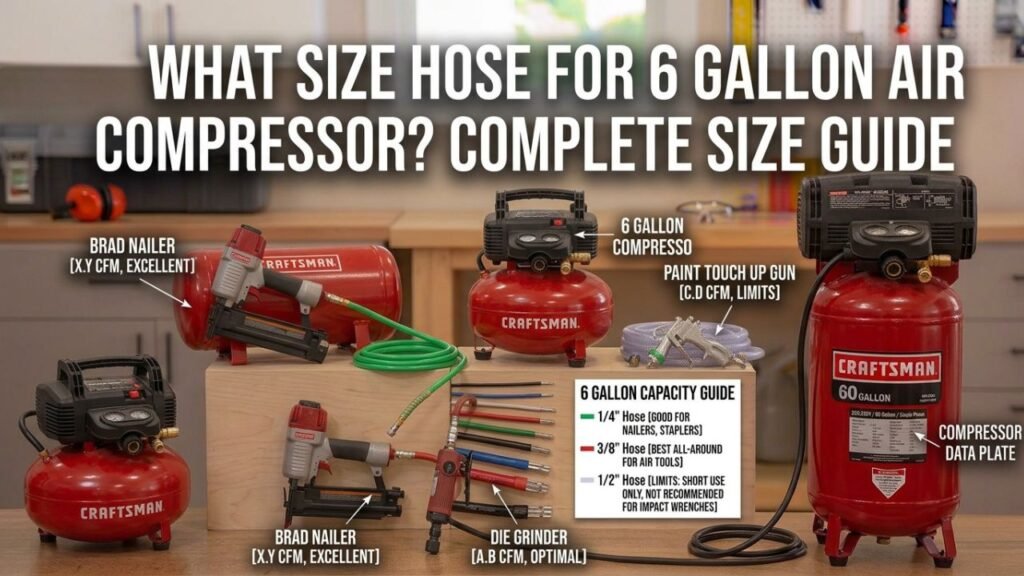
For most 6-gallon air compressors, the two sizes worth considering are:
• 1/4-inch inside diameter: Best for nail guns, staplers, inflation, blowing small areas, and other low-air-demand applications.
• 3/8-inch inside diameter: Better for impact wrenches, air ratchets, air hammers, other higher-flow tools, and longer hose runs.
For a basic pancake compressor used primarily for construction nailers, I recommend 1/4 inch.
For a 6-gallon compressor kept in a home garage where you may occasionally connect an impact wrench or other pneumatic tool, I recommend 3/8 inch.
Quick Hose Size Recommendation
| Application | Recommended Hose ID | Suggested Length |
| Brad nailer | 1/4 inch | 25–50 ft |
| Finish nailer | 1/4 inch | 25–50 ft |
| Framing nailer | 1/4 or 3/8 inch | 25–50 ft |
| Roofing nailer | 1/4 or 3/8 inch | 25–50 ft |
| Stapler | 1/4 inch | 25–50 ft |
| Tire inflation | 1/4 inch | 25 ft |
| Blow gun | 1/4 or 3/8 inch | 25 ft |
| Small impact wrench | 3/8 inch | 25 ft |
| 1/2-inch impact wrench | 3/8 inch | 25 ft preferred |
| Air ratchet | 3/8 inch | 25 ft |
| Air hammer | 3/8 inch | 25 ft |
| Die grinder | 3/8 inch | 25 ft |
| General-purpose garage use | 3/8 inch | 25–50 ft |
These are practical recommendations rather than universal rules. Always check the minimum hose size and airflow requirements specified by your particular air-tool manufacturer.
Key Takeaways:
- A 1/4-inch hose is sufficient for most light-duty 6-gallon compressor jobs.
- Choose 3/8 inch for higher-airflow pneumatic tools or longer runs.
- A 25-foot hose generally produces less restriction than an unnecessarily long hose.
- Hose diameter cannot compensate for a compressor that produces too little CFM.
What Does Air Hose Size Actually Mean?
Air-hose size usually refers to the inside diameter, often abbreviated ID.
Common portable-compressor hose sizes include:
• 1/4-inch ID
• 3/8-inch ID
• 1/2-inch ID
The inside diameter determines how much space compressed air has to travel through.
A larger internal passage generally creates less resistance to airflow.
Think of it like drinking through straws of different sizes. You can move more fluid through a wide straw with less restriction than through a narrow one. Compressed-air hoses behave in a similar way.
Hose ID Is Not the Same as Fitting Size
This causes considerable confusion.
You might have a:
3/8-inch ID hose with 1/4-inch NPT fittings
That is completely normal.
The 3/8 inch describes the internal diameter of the hose.
The 1/4-inch NPT measurement refers to the threaded connection used for the fitting or coupler.
Therefore, seeing a 1/4-inch connection on your 6-gallon compressor does not necessarily mean you must use a 1/4-inch ID hose.
1/4-Inch vs. 3/8-Inch Air Hose for a 6-Gallon Compressor
For most people, this is the main decision.
Both sizes can work well, but each has different advantages.
| Feature | 1/4-Inch Hose | 3/8-Inch Hose |
| Weight | Lighter | Heavier |
| Flexibility | Usually easier to handle | Usually bulkier |
| Airflow capacity | Lower | Higher |
| Pressure drop | Greater at high flow | Lower at high flow |
| Nail guns | Excellent | Excellent |
| Tire inflation | Excellent | Excellent |
| Impact wrench | Limited to acceptable depending on tool | Better choice |
| Air ratchet | Can be restrictive | Better choice |
| High-CFM tools | Less suitable | Better |
| Long hose runs | More pressure loss | Better |
| Storage | Easier | Takes more space |
| Best overall use | Light portable work | General garage air tools |
When a 1/4-Inch Hose Makes More Sense
Use a 1/4-inch hose when portability and ease of handling matter more than maximum airflow.
It is particularly well suited to:
• Brad nailers
• Finish nailers
• Staplers
• Roofing nailers
• Framing nailers used individually
• Tire inflators
• Small blow guns
• Airbrush-type applications, where appropriate
Nail guns consume compressed air in short bursts rather than continuously. That makes a large hose unnecessary in many situations.
A 1/4-inch hose is also lighter, which makes a noticeable difference when dragging a hose around a jobsite all day.
When a 3/8-Inch Hose Makes More Sense
Choose a 3/8-inch hose when airflow is more important.
Good applications include:
• Impact wrenches
• Air ratchets
• Air hammers
• Die grinders
• Air drills
• Higher-flow blow guns
• Longer hose runs
• General automotive work
Many pneumatic automotive tools specify a minimum 3/8-inch hose even though their air inlet itself may use a 1/4-inch threaded fitting.
This is because the larger hose reduces restriction upstream of the tool.
Which One Would I Buy?
If I owned a 6-gallon compressor primarily for nail guns, I would buy a 1/4-inch hose.
If I wanted one hose to handle the widest range of jobs, I would buy a 3/8-inch hose.
The 3/8-inch hose is bulkier, but the additional airflow capacity means you are less likely to outgrow it if you begin using pneumatic automotive tools later.
Does a 3/8-Inch Hose Give You More CFM?
A 3/8-inch hose does not make your compressor pump produce more CFM.
Instead, it helps preserve the airflow the compressor can already provide by reducing restrictions between the compressor and the tool.
Suppose your compressor is rated at:
2.6 SCFM at 90 PSI
Changing from a 1/4-inch hose to a 3/8-inch hose does not transform it into a 5-SCFM compressor.
The pump is still capable of approximately its rated output.
However, if a small hose, long hose, restrictive couplers, and other components create excessive pressure loss, switching to a larger hose can allow more of the available airflow to reach the tool.
This distinction is important.
Compressor CFM Is Still the Main Limitation
A typical 6-gallon pancake compressor is designed primarily for relatively low-to-moderate airflow requirements.
Some common 6-gallon units deliver roughly 2.6 SCFM at 90 PSI, although actual specifications vary by model.
Compare that with pneumatic tools that may need substantially more airflow.
For example, some impact wrenches may average several CFM, while grinders, sanders, and other continuously running air tools can require much more.
A 3/8-inch hose improves the air path, but it cannot solve a fundamental compressor-capacity problem.
Key Takeaways:
- Larger hose diameter reduces airflow restriction.
- A 3/8-inch hose does not increase the compressor pump’s rated SCFM.
- The compressor’s CFM remains the limiting factor during sustained tool use.
- Larger hose is most valuable when the tool itself demands high airflow.
What Length Hose Is Best for a 6-Gallon Air Compressor?
For most users, I recommend either:
25 feet for garage and workshop use
or
50 feet when additional reach is genuinely necessary.
Avoid automatically buying the longest hose available.
Every additional foot of hose creates some resistance, and pressure loss becomes more noticeable when airflow demand is high.
25-Foot Air Hose
A 25-foot hose is my preferred option for a home garage.
Advantages include:
• Lower pressure drop
• Less weight
• Easier storage
• Less tangling
• Good reach around one vehicle
• Better performance with pneumatic tools
If the compressor can remain reasonably close to your work area, 25 feet is usually enough.
50-Foot Air Hose
A 50-foot hose makes sense for:
• Construction work
• Larger garages
• Working around multiple vehicles
• Keeping the noisy compressor farther away
• Reaching different areas without moving the compressor
For a 50-foot run, I lean more strongly toward a 3/8-inch hose, especially if you use airflow-demanding tools.
100-Foot Air Hose
A 100-foot hose can certainly be used, but I would not choose one for a 6-gallon compressor unless the distance is genuinely needed.
At long distances, resistance through the hose becomes more relevant.
For long hose runs, increasing hose diameter is usually better than trying to push large airflow through a long 1/4-inch line.
Should You Use Two 25-Foot Hoses Instead?
This can be a useful setup.
Keep one 25-foot hose for everyday use and connect a second hose only when additional reach is required.
That allows you to minimize hose length during normal work without giving up flexibility.
Why Hose Diameter and Length Affect Pressure Drop
Pressure measured at the compressor regulator is not necessarily the same pressure available at the air tool while the tool is operating.
As air travels through:
• Hose
• Couplers
• Plugs
• Regulators
• Filters
• Swivel fittings
• Other restrictions
friction and turbulence create pressure loss.
The more airflow the tool demands, the more noticeable that loss can become.
Static Pressure vs. Working Pressure
Suppose the regulator gauge shows:
90 PSI
with the tool disconnected or not running.
When you pull the trigger on an air tool, the gauge or tool-end pressure may fall.
That difference is called dynamic or flowing pressure loss.
For an airflow-hungry tool, a restrictive air system can cause the pressure at the tool to fall enough that performance suffers.
Common Symptoms of Excessive Hose Restriction
You may notice:
• Impact wrench feels weak
• Air ratchet slows under load
• Grinder loses RPM
• Tool works well for the first few seconds and then fades
• Pressure at the tool drops substantially when operating
• Compressor runs frequently
The first thing many people blame is the compressor.
Sometimes that is correct, especially with a small 6-gallon unit.
But hose diameter, fittings, and couplers can also be part of the problem.
What Hose Size for Nail Guns on a 6-Gallon Compressor?
For nail guns, 1/4-inch hose is generally the best choice.
That includes:
• Brad nailers
• Pin nailers
• Finish nailers
• Staplers
• Roofing nailers
• Many framing nailers
These tools use relatively small volumes of air each time they fire.
A 1/4-inch hose gives you enough airflow while remaining lightweight and easy to carry around a jobsite.
Brad Nailer
My choice:
1/4 inch × 25 or 50 feet
A larger hose generally adds unnecessary weight for this application.
Finish Nailer
My choice:
1/4 inch × 25 or 50 feet
Again, airflow demand is relatively low.
Framing Nailer
A 1/4-inch hose is usually sufficient for one framing nailer.
For rapid production framing, longer hose runs, or multiple nailers connected to one compressor, a 3/8-inch supply line may help reduce restrictions.
The compressor’s own capacity becomes important if multiple tools are being fired rapidly.
Roofing Nailer
Either 1/4 or 3/8 inch can work.
For one nailer and a relatively short run, I would still choose 1/4 inch because it is lighter.
What Size Hose for an Impact Wrench on a 6-Gallon Compressor?
For an impact wrench, I recommend a 3/8-inch air hose.
Many pneumatic impact-wrench manufacturers specify a 3/8-inch minimum hose even when the tool has a 1/4-inch air inlet.
That larger hose helps deliver the high instantaneous airflow an impact wrench needs.
Can You Use a 1/4-Inch Hose With an Impact Wrench?
Sometimes, yes.
A smaller impact wrench may operate through a short 1/4-inch hose.
However, you may experience more pressure loss and reduced tool performance, especially with:
• Long hoses
• High-torque impacts
• Restrictive fittings
• High airflow requirements
• Repeated tool use
For a 1/2-inch impact wrench, I would choose 3/8 inch × 25 feet whenever practical.
The Bigger Limitation: Your 6-Gallon Compressor
A 3/8-inch hose solves only the hose restriction.
A 6-gallon compressor may still struggle to keep up with repeated impact-wrench operation because of limited tank volume and pump airflow.
It may work well enough for removing several lug nuts because an impact wrench operates intermittently.
If you hold the trigger repeatedly, pressure will eventually drop and the compressor will need time to recover.
What Size Hose for an Air Ratchet?
Use a 3/8-inch hose if you want the best performance from an air ratchet.
Air ratchets may operate longer continuously than impact wrenches because you hold the trigger while running a fastener in or out.
Some air ratchet manufacturers specify a minimum 3/8-inch hose.
A 6-gallon compressor can operate an air ratchet intermittently, but recovery time may become an issue during extended use.
What Size Hose for an Air Hammer?
I recommend a 3/8-inch hose.
Air hammers can demand significant airflow while operating, and many models specify a 3/8-inch minimum hose.
A 6-gallon compressor may work for short hammering sessions, but the motor will likely cycle frequently during longer use.
What Size Hose for a Die Grinder?
Use a 3/8-inch hose, but understand that the compressor is usually a much bigger concern.
Die grinders are often continuous-air-demand tools.
Many grinders require far more airflow than a typical 6-gallon pancake compressor can continuously deliver.
A large hose will reduce restriction, but the compressor may still run out of stored air quickly.
For frequent grinding, I would use a larger compressor rather than trying to improve a 6-gallon unit with hose upgrades alone.
Can You Use a 1/2-Inch Hose With a 6-Gallon Compressor?
Yes, but there is usually little reason to.
A 1/2-inch ID hose offers very high airflow capacity, but a typical 6-gallon portable compressor cannot produce enough air to take meaningful advantage of such a large hose in normal applications.
It also adds:
• Weight
• Bulk
• Storage difficulty
• Higher cost
• More cumbersome handling
For a 6-gallon compressor, 3/8 inch is normally the largest practical general-purpose hose size.
A 1/2-inch hose becomes more appropriate with high-CFM stationary compressors, long industrial air lines, or large pneumatic equipment.
Does Air Hose Material Matter?
Yes.
The three common materials you will encounter are:
• Rubber
• PVC
• Hybrid polymer
Each behaves differently.
Rubber Air Hose
Rubber is an excellent all-around hose material.
Advantages:
• Very flexible
• Good durability
• Usually performs well in cold conditions
• Lies relatively flat
• Good abrasion resistance
Disadvantages:
• Heavier
• Usually more expensive than basic PVC
For a garage where the hose will see regular use, rubber is a strong choice.
PVC Air Hose
PVC hoses are often inexpensive and lightweight.
Advantages:
• Low cost
• Lightweight
• Resistant to many oils and chemicals
Disadvantages:
• Can become stiff in cold weather
• Often retains coil memory
• Can be less pleasant to work with
PVC is acceptable for occasional warm-weather work, but it is not my first choice for a hose you will use frequently.
Hybrid Polymer Air Hose
Hybrid hoses combine characteristics of multiple materials.
Advantages:
• Lightweight
• Flexible
• Usually easy to coil
• Good cold-weather handling
• Often less expensive than premium rubber
For a portable 6-gallon compressor, a hybrid polymer hose is my favorite overall choice because it offers a good balance of flexibility, low weight, and durability.
Best Material by Use
| Hose Material | Best Use | Main Benefit | Main Drawback |
| Rubber | Garage/shop | Durable and flexible | Heavy |
| PVC | Occasional/light work | Affordable | Can be stiff |
| Hybrid polymer | General portable use | Light and flexible | Quality varies |
| Polyurethane | Nailers/very portable work | Extremely light | Can be less rugged |
What Pressure Rating Should the Air Hose Have?
The hose’s working-pressure rating must be suitable for the compressor.
Many 6-gallon pancake compressors have maximum tank pressures around 150 PSI or more, depending on model.
Therefore, use a hose with a working-pressure rating comfortably above the maximum pressure it could experience.
Many quality air hoses are rated to:
• 250 PSI
• 300 PSI
• 300+ PSI
Check the actual hose labeling rather than assuming.
Working Pressure Is Different From Burst Pressure
Do not select a hose based on burst pressure.
The important specification for routine use is the maximum working pressure.
If a hose says:
Working pressure: 300 PSI
Burst pressure: 1,200 PSI
you should treat 300 PSI—not 1,200 PSI—as its usable operating limit.
Important Tip: Never use a damaged air hose simply because its original pressure rating was high. Cuts, abrasion, heat damage, damaged fittings, and severe kinks can compromise hose safety.
Key Takeaways:
- Select a hose whose working-pressure rating exceeds your compressor’s maximum operating pressure.
- Do not confuse working pressure with burst pressure.
- Inspect hoses and fittings regularly for physical damage and leaks.
- A quality flexible hose is worth paying slightly more for if you use your compressor frequently.
What Size Fittings for a 6-Gallon Air Compressor?
Most small portable compressors use common quick-connect couplers and fittings.
1/4-inch NPT threaded connections are extremely common on portable compressors and air tools.
Remember:
1/4-inch NPT fitting size does not require a 1/4-inch ID hose.
You can commonly have:
3/8-inch ID hose → 1/4-inch NPT fitting → quick-connect plug
Why Quick Couplers Matter
Quick couplers can become significant airflow restrictions.
A standard small coupler is usually fine for nail guns and light-duty tools.
For an impact wrench or another high-flow tool, a high-flow coupler system may improve performance by reducing restriction.
The whole airflow path matters:
Compressor → regulator → coupler → plug → hose → plug → tool
Installing a large hose while leaving extremely restrictive fittings at both ends limits the benefit.
Keep Coupler Types Consistent
Several quick-connect profiles are available.
Make sure the male plugs and female couplers are designed to work together.
Do not force incompatible fittings together.
Should You Use a Coiled Hose or Straight Hose?
For most 6-gallon compressor applications, I prefer a normal straight flexible hose.
Coiled Hose
Advantages:
• Compact storage
• Automatically retracts
• Convenient for very light tasks
Disadvantages:
• Can fight against you as it stretches
• Often has a relatively small inside diameter
• Can create additional airflow restriction
• Less convenient around vehicles
A coiled hose can be useful for tire inflation or a small blow gun.
Straight Hose
Advantages:
• Better general-purpose airflow
• Easier to route around a work area
• Available in more diameters
• Better for pneumatic tools
For nailers, automotive work, and general garage use, straight hose is usually the better choice.
Is a 25-Foot 3/8-Inch Hose Too Big for a 6-Gallon Compressor?
No.
A 25-foot × 3/8-inch hose is one of the most versatile choices you can pair with a 6-gallon compressor.
The larger diameter does not harm the compressor.
There is a small additional volume inside the hose that must initially be pressurized, but in normal use this is insignificant compared with the benefits of reduced restriction.
If portability is not your highest priority, a 3/8-inch × 25-foot hybrid hose is the setup I would choose for a general-purpose home garage.
Is a 50-Foot 3/8-Inch Hose Good for a 6-Gallon Compressor?
Yes.
It gives you excellent reach while keeping airflow restriction relatively low.
It makes sense for:
• Larger garages
• Driveways
• Construction work
• Automotive work around multiple positions
• Situations where the compressor needs to remain stationary
The downside is additional weight and storage space.
If you rarely need 50 feet, a 25-foot hose is easier to manage.
Is a 1/4-Inch 50-Foot Hose Too Small?
Not for low-demand tools.
A 1/4-inch × 50-foot hose is commonly suitable for:
• Brad nailers
• Finish nailers
• Staplers
• Many framing nailers
• Tire inflation
It becomes less desirable when using an impact wrench or another tool that demands significant airflow.
In that situation, a 3/8-inch hose is the safer choice for maintaining airflow.
Can a Bigger Hose Improve a Weak Air Tool?
It depends on why the tool is weak.
A larger hose can help when the problem is:
• Excessive hose restriction
• Long hose length
• High airflow through a small hose
• Restrictive fittings
It will not solve:
• Insufficient compressor CFM
• Compressor mechanical problems
• Regulator problems
• Low tank pressure
• Major air leaks
• Worn pneumatic tool components
• Tool requiring far more air than the compressor can produce
Before buying a new compressor, checking the hose and fittings is worthwhile.
But do not expect a hose upgrade to transform a small 6-gallon compressor into a shop-size air supply.
How to Choose the Correct Hose for Your 6-Gallon Compressor
Use this simple process.
- Check the compressor’s maximum pressure and SCFM rating.
The specifications are normally printed on the compressor label or listed in the manual.
- Identify the tool you plan to operate.
Find its required PSI, CFM or SCFM, minimum hose size, and air-inlet specification.
- Choose hose diameter according to airflow demand.
Use 1/4 inch for low-demand tools and 3/8 inch for higher-flow applications.
- Use the shortest practical hose.
A 25-foot hose is ideal for many garages. Choose 50 feet when you genuinely need more reach.
- Confirm pressure rating.
The hose’s working-pressure rating should safely exceed the maximum pressure it will encounter.
- Check fitting compatibility.
Make sure plugs, couplers, and thread types match correctly.
- Avoid unnecessary restrictions.
For demanding tools, consider higher-flow couplers and fittings.
- Test the tool under load.
A tool that works well when first triggered but quickly becomes weak may be consuming more air than the compressor can replace.
Best Hose Setup for Different 6-Gallon Compressor Users
For a Carpenter
My recommendation:
1/4-inch × 50-foot lightweight hybrid or polyurethane hose
Why?
It provides plenty of airflow for most nailers while keeping the hose light enough to drag around a jobsite.
For a Homeowner
My recommendation:
1/4-inch × 25-foot hybrid hose
This is ideal for:
• Tire inflation
• Blow gun use
• Small nailers
• General household compressor tasks
For a Home Mechanic
My recommendation:
3/8-inch × 25-foot hybrid or rubber hose
This gives better airflow to impact wrenches, air ratchets, and air hammers.
Just remember that the 6-gallon compressor itself may limit extended operation.
For Someone Who Wants One Hose for Everything
My recommendation:
3/8-inch × 25-foot hybrid hose
It is slightly heavier than 1/4 inch, but it creates fewer airflow restrictions and works just as well with low-demand tools.
I consider this the best all-around choice if you only want to buy one hose.
Common Air Hose Mistakes to Avoid
Choosing Hose Size Based Only on Tank Gallons
A 6-gallon tank does not automatically require a specific diameter hose.
The correct hose depends more on airflow demand and tool requirements.
Buying a Hose That Is Longer Than Necessary
Extra length adds weight, clutter, and airflow resistance.
Use the shortest hose that comfortably reaches your work.
Assuming Larger Hose Creates More Compressor CFM
It does not.
It reduces restrictions but cannot increase pump displacement.
Ignoring Tool Manufacturer Hose Requirements
Some pneumatic tools explicitly require a minimum hose diameter.
Follow that recommendation.
Using Restrictive Fittings With a Large Hose
A 3/8-inch hose can still be restricted by undersized couplers and fittings.
Confusing Hose ID With Fitting Thread Size
A 3/8-inch hose can use 1/4-inch NPT fittings.
These measurements describe different components.
Ignoring Hose Pressure Rating
Never use an air hose whose working-pressure rating is below the pressure it may experience.
Continuing to Use a Damaged Hose
Replace hoses showing significant:
• Cuts
• Cracks
• Blisters
• Severe abrasion
• Damaged fittings
• Exposed reinforcement
• Leakage
Compressed-air equipment stores considerable energy. Treat damaged components seriously.
How to Get Better Airflow From a 6-Gallon Compressor
If you already own a 6-gallon compressor and want the best possible pneumatic-tool performance, focus on reducing unnecessary restrictions.
Use:
• A 3/8-inch hose for higher-demand tools
• The shortest practical hose
• Properly sized quick couplers
• High-flow fittings when appropriate
• Clean regulator and filter components
• Leak-free connections
• Correct operating pressure
Avoid continually increasing regulator pressure to compensate for inadequate airflow.
If the tool requires 90 PSI, supplying excessive pressure can exceed its rating without fixing the underlying CFM shortage.
Check Pressure While the Tool Is Running
This is one of the most useful diagnostic steps.
A compressor might show 90 PSI at the regulator when no air is moving.
Pull the tool trigger and observe what happens.
If pressure drops dramatically, investigate:
• Hose restriction
• Fitting restriction
• Regulator restriction
• Air leaks
• Compressor capacity
Use More Air Hose Instead of an Improper Extension Cord
If you need to work farther from an electrical outlet, it is often preferable to keep the compressor connected according to its electrical requirements and extend the air side instead.
An undersized electrical extension cord can cause excessive voltage drop and poor motor performance.
Follow the compressor manufacturer’s electrical and extension-cord instructions.
Do You Need a Hose Reel for a 6-Gallon Compressor?
No, but one can make a permanent garage setup more convenient.
A hose reel provides:
• Faster storage
• Less floor clutter
• Reduced tangling
• Easier hose management
For a portable pancake compressor, however, a hose reel can undermine the main advantage of portability.
If you regularly move the compressor from place to place, manually coiling a lightweight 25- or 50-foot hose is usually simpler.
FAQs about What Size Hose for 6 Gallon Air Compressor
Is 1/4-inch hose good for a 6-gallon air compressor?
Yes. A 1/4-inch hose is excellent for nailers, staplers, tire inflation, and other light-duty applications. It is lightweight and works especially well with short-to-moderate hose lengths.
Is 3/8-inch hose too big for a 6-gallon air compressor?
No. A 3/8-inch hose works perfectly well with a 6-gallon compressor and is preferable for impact wrenches, air ratchets, air hammers, and other tools that benefit from higher airflow.
Should I use 1/4 or 3/8 air hose for a pancake compressor?
Use 1/4 inch for nailers and light-duty work. Use 3/8 inch for automotive pneumatic tools, higher airflow, or longer hose runs. If you want one versatile hose, I recommend 3/8 inch.
What size hose for a 6-gallon pancake compressor is best for nail guns?
A 1/4-inch hose is typically ideal. Nail guns require relatively little air per shot, so the larger and heavier 3/8-inch hose is usually unnecessary.
What size hose should I use for an impact wrench?
A 3/8-inch ID hose is the better choice for most pneumatic impact wrenches. Always check the impact-wrench manufacturer’s minimum hose-size specification.
Can I run a 1/2-inch impact wrench on a 6-gallon compressor?
It may work for short bursts, such as removing a few lug nuts, if the compressor provides sufficient pressure and stored air. Sustained use can exceed the compressor’s recovery capacity. Use a 3/8-inch hose to minimize airflow restriction.
Is a 25-foot hose better than a 50-foot hose?
A 25-foot hose provides less restriction, weighs less, and is easier to store. If 25 feet gives you enough reach, I prefer it. Use 50 feet when the extra reach is necessary.
Can I use a 50-foot 1/4-inch hose?
Yes, especially for nailers and low-CFM applications. For high-airflow tools, a 3/8-inch hose is preferable over that distance.
Does a larger air hose increase PSI?
No. Hose diameter does not increase compressor pressure. A larger hose can reduce pressure loss while air is flowing, allowing more of the regulated pressure to reach the tool.
Does a larger hose increase CFM?
It does not increase the compressor pump’s rated CFM. It can reduce restrictions and therefore help deliver more of the compressor’s available airflow to the tool.
Is 1/2-inch air hose better than 3/8 inch?
Not necessarily. A 1/2-inch hose has greater airflow capacity but is generally excessive for a typical 6-gallon compressor. A 3/8-inch hose provides an excellent balance of airflow, weight, and flexibility.
What size fitting does a 6-gallon air compressor use?
Many portable 6-gallon compressors use 1/4-inch NPT connections and common quick-connect couplers, but you should verify the exact specifications of your compressor.
Can I put 1/4-inch fittings on a 3/8-inch hose?
Yes. A 3/8-inch hose commonly uses fittings with 1/4-inch NPT threads. Hose inside diameter and thread size are separate measurements.
What PSI should an air hose be rated for?
Choose a hose with a maximum working-pressure rating above the highest pressure it will experience from your compressor. Many general-purpose air hoses have working-pressure ratings around 250–300 PSI or more, but always verify the specific hose.
What is the best air hose material for a 6-gallon compressor?
For most users, I recommend hybrid polymer because it is lightweight, flexible, and easy to store. Rubber is excellent for durability and regular shop use, while polyurethane is particularly useful when very low hose weight is important.
Can a 6-gallon air compressor run air tools?
Yes, but mainly low-demand or intermittently operated tools. Nail guns work particularly well. Impact wrenches can often be used in short bursts. Continuously operating tools such as grinders and sanders may consume more air than a typical 6-gallon compressor can continuously produce.
Why does my air tool lose power after a few seconds?
Possible causes include inadequate compressor CFM, an undersized hose, long hose length, restrictive fittings, low regulator pressure, air leaks, or a tool whose airflow demand exceeds the compressor’s capacity.
Should I use high-flow fittings with a 6-gallon compressor?
They can help when operating a higher-demand pneumatic tool because they reduce restriction. For nail guns and basic inflation, standard fittings are normally sufficient.
Conclusion
If you are choosing what size hose for 6 gallon air compressor use, the decision is fairly simple: choose a 1/4-inch ID hose for nail guns, tire inflation, staplers, and other light-duty work, or choose a 3/8-inch ID hose when operating pneumatic automotive tools, using a longer hose, or trying to minimize airflow restriction.
For a homeowner or carpenter using primarily nailers, I would choose a 1/4-inch × 25- or 50-foot lightweight hose.
For a home mechanic, I recommend a 3/8-inch × 25-foot hose. It provides better airflow for impact wrenches, ratchets, and air hammers without being excessively large.
If you only want to buy one hose and expect to use several different types of air tools, my overall choice is a 3/8-inch × 25-foot hybrid polymer hose with compatible fittings and a working-pressure rating safely above the compressor’s maximum pressure.
Just remember that a larger hose cannot increase the compressor’s actual CFM. It reduces airflow restriction, but the compressor pump and 6-gallon tank still determine how much air is available over time. For high-demand continuous tools such as grinders, sanders, and spray equipment, upgrading to a larger compressor may provide a much greater improvement than changing the hose alone.