
What Size Breaker for 60 Gallon Air Compressor? Complete Guide
If you are wondering what size breaker for 60 gallon air compressor you need, many residential 60-gallon compressors use a dedicated 240V circuit with a 20- to 30-amp double-pole breaker, but there is no universal breaker size. Some larger 5 HP and industrial models require different protection, so the compressor’s electrical nameplate and installation manual must determine the final size.
The fact that the tank holds 60 gallons does not determine the electrical requirement. A 60-gallon compressor may use a 3- to 3.7-running-HP motor, a nominal 5 HP motor, single-stage or two-stage pump, and different motor designs. Those differences change voltage, full-load current, starting current, wiring, and breaker requirements.
Motor circuits are also different from ordinary household resistance loads. An air compressor motor can draw a large amount of current for a short time when it starts, which is why simply dividing watts by volts or matching a breaker directly to the motor’s running amps can lead to the wrong conclusion.
For example, some current 60-gallon stationary compressors operate on 230–240V single-phase power with running currents in roughly the mid-teens, while manufacturer installation requirements may call for a 20-amp minimum branch circuit or a 30-amp double-pole breaker. Larger compressors can have substantially different requirements.
In this guide, I’ll explain how to determine the correct breaker size for a 60-gallon air compressor, why 240V models normally use a double-pole breaker, how horsepower and motor amps affect circuit sizing, why breaker amps can be higher than running amps, what to know about wire size, and when a licensed electrician should handle the installation.
What Size Breaker for 60 Gallon Air Compressor?
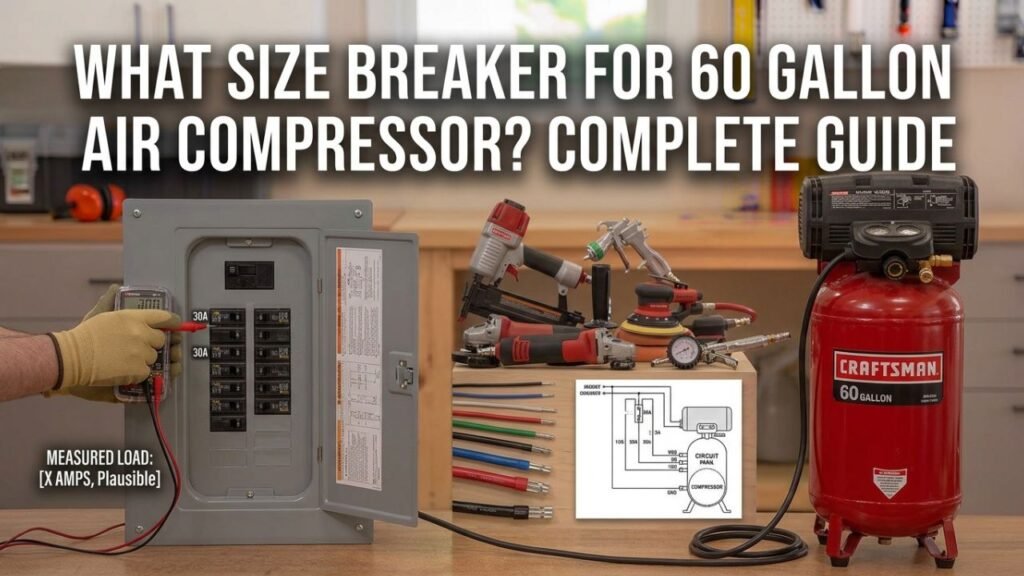
For many common residential and small-shop 60-gallon air compressors, the electrical setup falls somewhere around:
| Typical Compressor Type | Common Supply | Breaker Situation |
| Smaller stationary 60-gallon model | 230–240V, single phase | Often around 20A, if specified by manufacturer |
| Common mid-size 60-gallon model | 230–240V, single phase | Often 20–30A |
| Higher-output 60-gallon compressor | 230–240V, single phase | May require 30A or more |
| Large 5 HP 60-gallon model | 230V, single phase | Must follow motor and manufacturer requirements |
| Three-phase shop compressor | 208/230/460V three phase | Requires a three-phase circuit and model-specific protection |
These are general examples, not universal breaker recommendations.
The safest rule is:
Use the breaker size specified on the compressor nameplate or in the manufacturer’s electrical installation instructions.
If the equipment does not clearly specify the branch-circuit breaker, a qualified electrician should size the motor circuit using the applicable electrical code requirements and motor data.
Why 60 Gallons Does Not Tell You Breaker Size
Tank capacity is an air-storage specification.
The breaker protects an electrical circuit supplying the motor.
Two compressors can both have 60-gallon tanks yet use completely different motors.
For example, one might have:
- A 230V single-phase motor
- Approximately 15–17 running amps
- A relatively modest single-stage pump
Another could have:
- A larger 5 HP motor
- Higher current demand
- A two-stage pump
- Greater compressor output
- Different motor-starting characteristics
Both tanks are 60 gallons, but their electrical circuits may not be interchangeable.
The Four Numbers That Actually Matter
When sizing a circuit, pay attention to:
Voltage: Commonly around 230–240V on stationary 60-gallon home-shop compressors.
Phase: Usually single phase in residential garages, though commercial models may be three phase.
Motor horsepower: Larger motors generally require more current.
Motor or equipment amperage: The nameplate provides important electrical information, although motor-circuit breaker sizing is not always based directly on nameplate amps alone.
The manufacturer’s minimum circuit ampacity, maximum overcurrent protection, branch-circuit requirement, or specified breaker size, when provided, is especially important.
Key Takeaways:
- Many residential 60-gallon compressors use a 240V, 20- or 30-amp circuit, but this is not universal.
- Tank capacity does not determine electrical breaker size.
- Check voltage, phase, motor size, amperage, and manufacturer instructions.
- Never install a larger breaker simply because the compressor trips the existing one.
Does a 60 Gallon Air Compressor Need a 30 Amp Breaker?
Some do, but not all.
A 30-amp double-pole breaker is common on certain 240V 60-gallon compressors, particularly stationary models designed for home garages and workshops.
However, other 60-gallon models specify a 20-amp branch circuit, while more powerful compressors may need a different breaker arrangement.
This is why I would not automatically install a 30-amp breaker simply because a compressor has a 60-gallon tank.
When a 30 Amp Breaker May Be Correct
A 30A double-pole breaker may be appropriate when the manufacturer’s documentation explicitly requires or recommends one.
For example, some 240V 60-gallon compressor designs have running current in roughly the mid-teens but still specify a larger breaker so the circuit can tolerate normal motor starting current without nuisance tripping.
That is normal for motor circuits.
When a 30 Amp Breaker May Be Wrong
A 30A breaker can be inappropriate if:
- The manufacturer specifies a smaller breaker.
- The branch conductors are not suitable for the installation.
- The compressor requires a larger motor branch-circuit protective device.
- The equipment is three phase.
- The voltage is different.
- The circuit contains incompatible receptacles or other equipment.
- Local electrical requirements differ.
- Someone has replaced the original motor with a different one.
Always identify the exact compressor model before selecting the breaker.
Does a 60 Gallon Air Compressor Need 240V?
Most large stationary 60-gallon compressors intended for residential garages use approximately 230–240V single-phase power.
This allows a relatively powerful motor to operate without the very high current that would be required from a 120V circuit.
Smaller compressors commonly use 120V. Once compressor motors become larger, 240V becomes much more practical.
230V vs. 240V Air Compressor
You may see compressors labeled:
- 220V
- 230V
- 240V
- 208–230V
- 230/240V
These labels can create confusion.
In a typical U.S. residential installation, the nominal supply is generally described as 240V. Many motors are nameplated for approximately 230V operation because motor utilization voltage is commonly listed somewhat differently from nominal system voltage.
Do not assume every 230V motor accepts every possible supply arrangement. Follow its nameplate and manufacturer instructions.
Why a 240V Compressor Uses a Double-Pole Breaker
A typical residential 240V circuit uses two ungrounded conductors.
A double-pole circuit breaker simultaneously connects and disconnects both legs.
Therefore, a common 240V single-phase compressor will normally use a two-pole breaker rather than a single-pole breaker.
For example:
- 20A 240V compressor circuit → typically a 20A double-pole breaker
- 30A 240V compressor circuit → typically a 30A double-pole breaker
The two handles are mechanically tied as one breaker.
A 30A double-pole breaker does not mean 60 amps. It is a 30-amp 240V circuit.
What About Three-Phase Compressors?
Commercial or industrial 60-gallon compressors may use three-phase motors.
Possible supply voltages include 208V, 230V, 460V, or other system voltages depending on the equipment.
Those installations require completely different circuit considerations from a residential 240V single-phase compressor.
If the nameplate says 3 PH, do not attempt to connect it to an ordinary residential 240V single-phase circuit.
Key Takeaways:
- Most residential stationary 60-gallon compressors operate on about 230–240V.
- A 240V single-phase compressor normally uses a double-pole breaker.
- A 30A two-pole breaker is still a 30A circuit, not a 60A circuit.
- Three-phase compressor installations require different electrical service and protection.
How to Determine the Correct Breaker Size for Your 60 Gallon Compressor
Do not start by guessing the breaker size.
Start with the compressor itself.
Step 1: Find the Compressor Nameplate
Locate the manufacturer’s electrical information plate.
It may be attached to:
- Motor
- Belt guard
- Compressor frame
- Control enclosure
- Tank-mounted equipment plate
Record the exact model number as well.
Step 2: Check the Voltage
Look for something such as:
230V
240V
208–230V
or another voltage rating.
The supply voltage must be compatible with the compressor.
Step 3: Check the Phase
Look for:
1 PH or Single Phase
or:
3 PH or Three Phase
Most home-shop compressors are single phase.
Step 4: Find the Amperage Information
The label may identify:
- FLA
- Full-load amps
- Motor amps
- Running amps
- Rated current
Record the number but do not automatically select a breaker with the same amp rating.
Motor breaker sizing works differently from many ordinary branch circuits.
Step 5: Read the Compressor Manual
Look specifically for an electrical installation section.
Useful specifications include:
- Minimum branch-circuit requirement
- Required breaker
- Recommended breaker
- Maximum fuse or breaker
- Minimum circuit ampacity
- Wire requirements
- Disconnect requirements
- Grounding requirements
If the manufacturer states a breaker size, that information takes priority over generic internet recommendations.
Step 6: Verify Local Electrical Requirements
Electrical installations are subject to the adopted electrical code and local requirements.
A licensed electrician can verify:
- Breaker type
- Conductor size
- Disconnect
- Grounding
- Receptacle or hardwiring method
- Raceway
- Voltage drop
- Panel capacity
- Local code requirements
A stationary 60-gallon compressor is not the place to improvise electrical wiring.
Why Can a 15 Amp Compressor Use a 20 or 30 Amp Breaker?
This is one of the most confusing parts of air compressor electrical installation.
You might read a compressor label showing approximately 15 amps and naturally assume it needs a 15A breaker.
That is not necessarily correct.
Electric Motors Draw High Starting Current
When an induction motor starts from a stop, it may briefly draw substantially more current than it consumes after reaching normal operating speed.
This is called starting current, inrush current, or locked-rotor current under certain conditions.
The breaker must tolerate normal starting current without tripping every time the compressor starts.
That is one reason a motor’s branch-circuit breaker may have a significantly higher rating than its normal running current.
The Breaker and Motor Overload Do Different Jobs
This distinction is extremely important.
In a properly designed motor circuit, the branch-circuit breaker primarily provides short-circuit and ground-fault protection.
Motor overload protection serves a different function: protecting the motor from sustained overload conditions.
Because these are separate protection functions, motor branch-circuit rules do not always resemble the familiar “15 amps means a 15A breaker” logic used for ordinary household loads.
NEC Motor Breaker Rules Are Different
Under NEC motor-circuit rules, an inverse-time circuit breaker for many motors can be sized using a percentage of the motor full-load current from the applicable motor tables.
For many common AC motors, the permitted maximum starting point for an inverse-time breaker can be as high as 250% of the applicable full-load current, subject to the rest of the motor-circuit requirements and applicable exceptions.
That does not mean every compressor should receive a breaker equal to 250% of its nameplate amps.
It also does not mean you should automatically install the largest breaker that the code might permit.
The correct design considers:
- Motor type
- Horsepower
- Voltage
- Phase
- Applicable table current
- Breaker type
- Motor overload protection
- Manufacturer instructions
- Equipment listing
- Starting performance
- Local code
For a packaged 60-gallon compressor, the manufacturer’s required circuit is normally the most practical starting point.
What Size Wire for a 60 Gallon Air Compressor?
Wire size is closely related to breaker selection, but this is another area where guessing can be dangerous.
For ordinary non-motor circuits, people often associate:
- 20A circuits with 12 AWG copper
- 30A circuits with 10 AWG copper
- 40A circuits with larger conductors
However, motor branch circuits have special conductor and overcurrent-protection rules, so you should not blindly apply a basic household breaker-to-wire chart to a stationary air compressor.
Motor Conductors and Breakers Are Sized Differently
For a continuous-duty motor, branch-circuit conductors are generally sized to carry at least 125% of the applicable motor full-load current, subject to the applicable code rules.
Meanwhile, the breaker can be allowed a higher rating because it must withstand motor starting current.
Motor overload protection then protects against sustained overload.
This can create a situation where the breaker rating looks unusually large compared with the conductors if you are accustomed only to ordinary residential circuits.
That does not automatically make the installation unsafe; it reflects the way properly protected motor circuits are designed.
Do Not Increase Breaker Size Without Checking the Wire
Suppose your compressor repeatedly trips a 20A breaker.
Replacing it with a 30A or 40A breaker without evaluating the circuit is unsafe.
The problem could be:
- Undersized branch circuit
- Incorrect breaker
- Low supply voltage
- Excessive voltage drop
- Motor problem
- Failing start capacitor
- Mechanical pump problem
- Faulty check valve
- Unloader malfunction
- Compressor trying to start against pressure
- Damaged wiring
- Incorrect motor connection
Increasing breaker size can hide the symptom while leaving the real fault unresolved.
Long Wire Runs May Need Special Attention
A compressor installed far from the service panel can experience voltage drop.
Excessive voltage drop can make a motor harder to start and increase current during operation.
An electrician may select larger conductors than the minimum normally required when the run is long enough to justify reducing voltage drop.
The correct choice depends on:
- Distance
- Motor current
- Voltage
- Conductor material
- Conductor temperature rating
- Raceway
- Terminations
- Ambient conditions
- Local electrical requirements
Key Takeaways:
- Compressor wire size cannot safely be chosen from tank capacity.
- Motor conductors and motor breakers are governed by different sizing rules.
- Never solve breaker tripping by installing a larger breaker without evaluating the circuit.
- Long cable runs may justify larger conductors to control voltage drop.
Does a 60 Gallon Air Compressor Need a Dedicated Circuit?
In most cases, a large stationary 60-gallon compressor should be supplied by a dedicated branch circuit.
This means the circuit serves the compressor rather than sharing capacity with lights, receptacles, heaters, welders, or other shop equipment.
A dedicated circuit helps provide:
- Adequate starting current
- Stable supply voltage
- Proper overcurrent protection
- Less nuisance tripping
- Easier servicing
- Safer circuit design
Many compressor manufacturers specifically call for a dedicated electrical supply.
Does a 60 Gallon Compressor Need a Disconnect?
Stationary motor-driven equipment commonly requires an appropriate disconnecting means as part of a code-compliant installation.
The exact arrangement depends on the compressor, installation method, motor controller, circuit, and applicable code.
Possible arrangements can include an approved:
- Disconnect switch
- Properly located breaker where permitted
- Motor-rated switch
- Listed plug-and-receptacle arrangement on equipment designed for it
Do not assume the pressure switch is automatically a code-compliant service disconnect.
A pressure switch controls compressor operation; its primary purpose is not necessarily to provide safe electrical isolation for servicing.
Hardwired vs. Plug-In 60 Gallon Air Compressor
Many stationary compressors are supplied without a power cord because installation requirements can vary.
Hardwired Installation
A hardwired compressor is permanently connected to its branch circuit through an appropriate wiring and disconnect arrangement.
Advantages include:
- Secure permanent installation
- No loose plug connection
- Suitable for stationary equipment
- Clean shop layout
The installation should be performed according to the compressor instructions and applicable electrical requirements.
Plug and Receptacle
Some compressors permit an appropriate cord-and-plug setup.
If allowed by the manufacturer, the receptacle, plug, cord, conductor size, grounding, and circuit rating must all match the equipment and installation requirements.
Do not install a random dryer or welder plug simply because it physically carries 240V.
The electrical ratings and intended configuration still have to be correct.
What Breaker Size for a 3.7 HP 60 Gallon Air Compressor?
A number of common 60-gallon compressors use motors around 3.7 running HP and approximately 230–240V single-phase power.
These models may have running currents in roughly the mid-to-upper teens.
Depending on the specific compressor, the manufacturer may specify a circuit around 20–30 amps.
Do not choose the breaker solely from the 3.7 HP number.
Two motors labeled with similar horsepower can have different electrical requirements.
The exact model’s manual is the deciding factor.
What Breaker Size for a 5 HP 60 Gallon Air Compressor?
A 5 HP 60-gallon compressor requires more careful attention.
Some 5 HP compressors are true industrial motors with electrical characteristics quite different from consumer compressors that use horsepower terminology in other ways.
At 230V single phase, a genuine 5 HP motor can represent a substantial electrical load.
The correct branch-circuit breaker depends on the motor, controller, overload protection, starting method, manufacturer instructions, and applicable motor-circuit rules.
I would not recommend selecting a breaker for a 5 HP compressor based on a generic chart alone.
Have the electrical data evaluated if the manual does not provide a clear installation requirement.
Is a 20 Amp Breaker Enough for a 60 Gallon Air Compressor?
It can be.
Some 60-gallon 230–240V compressors have manufacturer specifications calling for approximately a 20A branch circuit.
Other compressors require 30A or something different.
A 20A breaker is enough only when it matches the requirements for the specific compressor and installation.
Do not install a 20A circuit first and assume every 60-gallon compressor will work on it.
Is a 30 Amp Breaker Enough for a 60 Gallon Air Compressor?
For many common residential 240V 60-gallon compressors, yes—a 30A double-pole breaker is a common arrangement.
However, it is not universal.
A larger motor may require a different branch-circuit protective device, while another compressor may specify only a 20A circuit.
The correct answer comes from the compressor’s electrical documentation.
Can I Use a 40 Amp Breaker for a 60 Gallon Compressor?
Only if the equipment and motor-circuit design permit it.
A 40A breaker should not be installed simply because:
- A 30A breaker trips
- The compressor has a large tank
- Someone online used 40A
- The motor sometimes starts slowly
Repeated breaker trips are a warning that needs diagnosis.
A larger breaker can reduce protection if it is not appropriate for the circuit.
Why Does My Air Compressor Trip the Breaker When Starting?
A compressor normally draws high current during startup, but correctly sized equipment should start without repeatedly tripping its properly designed circuit.
If it suddenly begins tripping, investigate the cause.
Incorrect Breaker or Circuit
The compressor may have been connected to a circuit that does not meet manufacturer requirements.
Low Voltage
Low voltage makes motor startup more difficult.
Possible causes include:
- Long undersized wiring
- Loose connections
- Inadequate supply
- Excessive voltage drop
Compressor Starts Against Tank Pressure
The unloader system normally removes trapped pressure from the pump discharge area when the compressor stops.
A malfunctioning unloader can make the motor start against excessive pressure.
That dramatically increases starting difficulty.
Faulty Tank Check Valve
A failing check valve can allow tank pressure to load the compressor pump when it should be isolated.
Weak Start Capacitor
Single-phase compressor motors may use capacitors for starting and/or running.
A deteriorated start capacitor can cause slow startup, humming, or breaker trips.
Mechanical Pump Problems
A damaged or binding compressor pump makes the motor work harder.
Motor Problems
Winding damage, bearings, internal electrical faults, or other motor problems can increase current.
Breaker Problems
Circuit breakers can fail, but replacing one should come after confirming that the compressor and circuit are otherwise correct.
Important Tip: If a stationary compressor repeatedly trips its breaker, stop resetting it over and over. Repeated tripping can indicate a genuine electrical or mechanical problem that needs to be diagnosed.
Why Does the Breaker Trip After the Compressor Runs for a While?
A breaker that trips immediately on startup suggests a different set of problems than one that trips several minutes later.
Delayed tripping can be associated with:
- Excessive sustained current
- Motor overheating
- Poor connections
- Supply-voltage problems
- Compressor overload
- Incorrect breaker
- Failing motor
- Poor ventilation
- Mechanical pump problems
The compressor’s motor overload may also trip independently of the panel breaker.
Identifying which protective device is opening is an important first diagnostic step.
Common Mistakes When Choosing a Breaker for a 60 Gallon Compressor
Choosing by Tank Size Alone
A 60-gallon tank tells you nothing definite about motor current.
Always identify the motor and compressor model.
Matching Breaker Amps Directly to Running Amps
Motor circuits have special starting-current and overcurrent-protection requirements.
A 15A running current does not automatically mean a 15A breaker.
Assuming Every 240V Compressor Uses 30 Amps
Many do not.
Use the manufacturer’s actual specifications.
Upsizing the Breaker to Stop Nuisance Trips
Breaker tripping is not solved safely by blindly increasing breaker size.
Find the reason for the trip.
Ignoring Conductor Size
Breaker, conductors, motor overloads, disconnect, and equipment requirements must work together as one electrical system.
Using an Extension Cord
Large stationary compressors are generally not equipment I would power through a typical household extension cord.
Voltage drop and inadequate conductor size can create serious motor-starting and heating problems.
Use the permanent circuit arrangement required by the manufacturer.
Ignoring the Grounding Requirement
A stationary compressor’s metal frame and electrical equipment must be properly grounded according to its installation requirements and applicable electrical code.
Never eliminate the equipment grounding connection to solve an electrical problem.
60 Gallon Air Compressor Breaker Size Quick Reference
| Question | Practical Answer |
| Most common voltage | Approximately 230–240V single phase |
| Common breaker range | Often 20–30A on many residential models |
| Is 30A always correct? | No |
| Is the breaker usually double pole? | Yes, for typical residential 240V single-phase units |
| Does 60-gallon tank size determine breaker? | No |
| Does motor horsepower matter? | Yes |
| Does running amperage matter? | Yes, but it is not the only factor |
| Should it have a dedicated circuit? | Usually yes |
| Can I increase breaker size if it trips? | Not without verifying the entire circuit |
| Best source for exact breaker size | Compressor nameplate and manufacturer installation manual |
How I Would Choose the Breaker for a 60 Gallon Compressor
I would follow this order rather than starting with a generic breaker chart.
First: Check the Exact Model Manual
If the manufacturer says the compressor requires a 30A double-pole breaker on a dedicated 240V circuit, that is the specification I would use as the basis for the installation.
Second: Verify the Motor Nameplate
Confirm voltage, phase, horsepower, and current match the manual.
If a replacement motor has been installed, the original compressor manual may no longer describe the electrical load accurately.
Third: Verify the Existing Circuit
Before connecting the compressor, verify that:
- Panel has appropriate capacity
- Breaker is correct
- Conductors are appropriate
- Grounding is present
- Voltage is correct
- Disconnect arrangement is compliant
- Connections are properly terminated
Fourth: Account for Distance
Long runs can create voltage drop and starting problems.
The minimum acceptable conductor may not provide the best motor performance on a long circuit.
Fifth: Have the Final Installation Checked
A 230–240V stationary compressor is a substantial motor load.
If the installation requires a new breaker, new branch circuit, hardwiring, or motor-circuit calculations, I recommend having a qualified electrician perform or verify the work.
Key Takeaways:
- Start with the exact manufacturer’s electrical requirements, not a generic online chart.
- Confirm voltage, phase, motor amps, horsepower, and whether the motor is original.
- Verify the breaker and wiring together rather than treating them as separate choices.
- Professional installation is the safer choice for a new 240V stationary compressor circuit.
FAQs about what size breaker for 60 gallon air compressor
What size breaker do I need for a 60 gallon air compressor?
Many residential 60-gallon air compressors use a 20- or 30-amp double-pole breaker on a 230–240V dedicated circuit, but there is no universal size.
Check the exact compressor nameplate and manufacturer’s electrical installation instructions before choosing the breaker.
Does a 60 gallon air compressor need a 30 amp breaker?
Many models do, but some require a 20A circuit and others require different protection.
A 30A breaker is correct only if it matches the requirements of your specific compressor and motor circuit.
What size breaker for a 240V air compressor?
Breaker size depends on motor horsepower, full-load current, starting characteristics, overload protection, and manufacturer requirements.
A 240V compressor commonly uses a double-pole breaker, but the breaker could be 20A, 30A, 40A, or another properly calculated size depending on the compressor.
Is a 60 gallon air compressor 220V or 240V?
Many residential stationary 60-gallon compressors are marketed as 230V or 240V units.
You may also see the informal term “220V.” Always follow the exact voltage range shown on the motor and compressor nameplates.
Can I run a 60 gallon air compressor on 120V?
Most full-size stationary 60-gallon compressors are designed for approximately 230–240V and cannot simply be plugged into a 120V household receptacle.
Only use the voltage specified by the manufacturer.
Does a 240V air compressor need a double-pole breaker?
A typical U.S. residential 240V single-phase compressor circuit normally uses a double-pole breaker so both ungrounded conductors are disconnected together.
Three-phase equipment uses a different circuit arrangement.
How many amps does a 60 gallon air compressor draw?
There is no single answer.
Current varies by motor size and design. Some common 230V 60-gallon compressors operate in roughly the mid-to-upper teens, while larger motors can draw considerably more.
Check the compressor’s motor nameplate for the actual model.
Why does my 15 amp air compressor need a 30 amp breaker?
Motor startup can require substantially more current than normal running operation.
Motor branch-circuit breakers provide short-circuit and ground-fault protection and must also tolerate normal starting current, while separate motor overload protection protects against sustained overload.
If your manufacturer specifies a 30A breaker, follow that specification rather than assuming the breaker must equal the running amps.
Can I use a 20 amp breaker for a 60 gallon air compressor?
Yes, if your exact compressor is designed for a 20A branch circuit.
Do not use a 20A breaker simply because another 60-gallon compressor uses one.
Can I use a 30 amp breaker for a 60 gallon air compressor?
Yes, a 30A double-pole breaker is common for certain 240V 60-gallon compressors.
However, you must confirm that it matches your compressor and branch-circuit design.
Can I use a 40 amp breaker for my 60 gallon air compressor?
Only when the compressor specifications and applicable motor-circuit requirements allow it.
Do not increase from a 20A or 30A breaker to 40A solely to prevent tripping.
What size wire do I need for a 60 gallon compressor?
Wire size depends on motor full-load current, breaker configuration, conductor type, terminals, installation method, distance, and motor-specific electrical-code requirements.
Although ordinary residential circuits commonly associate 20A with 12 AWG copper and 30A with 10 AWG copper, motor circuits have special rules. Use the compressor instructions and applicable electrical code rather than selecting wire size from breaker amps alone.
Can I use 10/2 wire for a 60 gallon air compressor?
It may be appropriate for some 240V compressor installations, but not universally.
The required conductor configuration, ampacity, grounding arrangement, installation method, motor requirements, and local code all have to be considered.
Do not choose cable based solely on the tank being 60 gallons.
Does a 60 gallon compressor need a neutral wire?
Many straight 240V compressor motors do not require a neutral because they use two ungrounded conductors plus an equipment grounding conductor.
However, some equipment may contain controls or accessories with different requirements.
Follow the compressor’s wiring diagram rather than assuming a neutral is or is not needed.
Does a 60 gallon air compressor need a dedicated circuit?
Usually, yes.
Large stationary compressors are typically best supplied from a dedicated branch circuit so the motor has adequate starting current and does not share the circuit with unrelated shop loads.
Does a stationary compressor need to be hardwired?
Not always.
Some models are designed or approved for cord-and-plug connection, while others are intended to be hardwired.
Follow the manufacturer’s installation instructions and applicable electrical requirements.
Why does my air compressor trip a 30 amp breaker?
Possible causes include incorrect circuit sizing, excessive voltage drop, a failing start capacitor, unloader problems, check-valve problems, motor faults, pump binding, low supply voltage, or damaged wiring.
Do not automatically replace the 30A breaker with a larger one.
Why does my compressor trip the breaker only when the tank has pressure?
A compressor that starts normally with an empty tank but struggles when the receiver contains pressure may have a problem with its unloader system, check valve, motor-start circuit, or another component that increases starting load.
The compressor should be inspected rather than repeatedly resetting the breaker.
What breaker does a 5 HP air compressor need?
There is no universal breaker size for every 5 HP compressor.
Voltage, phase, motor design, full-load current, motor controller, overload protection, starting method, and manufacturer requirements all affect breaker sizing.
A 5 HP stationary compressor is large enough that I recommend following its exact electrical installation data or having the motor circuit sized by a qualified electrician.
Can a breaker be larger than the motor’s running amps?
Yes.
This is common in motor circuits because the breaker has to tolerate high startup current. Separate motor overload protection handles sustained motor overload.
The breaker should still be sized according to the applicable motor-circuit rules and manufacturer requirements—not simply made larger until the motor stops tripping it.
Conclusion
If you are trying to determine what size breaker for 60 gallon air compressor is correct, do not choose the breaker from the 60-gallon tank capacity. For many residential stationary compressors, a dedicated 230–240V circuit with a 20- or 30-amp double-pole breaker is common, but that is only a general range.
The exact answer depends on the compressor’s motor voltage, phase, horsepower, amperage, starting characteristics, overload protection, and manufacturer’s electrical requirements. Larger 5 HP and commercial compressors may require substantially different circuit protection.
A motor’s running amperage also does not automatically equal its breaker rating. Air compressor motors draw significant current at startup, and motor branch-circuit protection is designed differently from ordinary household circuits. That is why a compressor drawing current in the mid-teens may legitimately have manufacturer instructions calling for a larger breaker.
My recommendation is simple: find the exact model number, read the compressor’s electrical installation specification, and use that requirement as the starting point. If the manual does not clearly specify the breaker, or you need to install a new 240V circuit, have a qualified electrician size the breaker, conductors, grounding, disconnect, and motor protection together.
Never solve repeated breaker trips by blindly installing a larger breaker. If the compressor is tripping a properly sized circuit, diagnose the electrical supply, motor, start components, unloader, check valve, and compressor pump before changing overcurrent protection.