Must Have Air Compressor Tools: Essential Garage & Shop Gear
The most important must have air compressor tools are a quality air hose, matching quick-connect fittings, regulator and pressure gauge, tire inflator with gauge, safety blow gun, and a few pneumatic tools suited to the work you actually do. For an automotive garage, an impact wrench and air ratchet are usually high-value additions. Woodworkers may get more use from nail guns, while fabrication and bodywork shops may prioritize air hammers, die grinders, sanders, and spray guns.
Owning an air compressor does not automatically give you a useful compressed-air system. The compressor provides the air, but hoses, couplers, regulators, filters, inflators, and pneumatic tools determine what you can actually accomplish with it. Choosing the wrong accessories can also restrict airflow enough to make a capable compressor feel underpowered.
You also do not need to buy every pneumatic tool you see. Some air tools are extremely useful for nearly any garage, while others make sense only for certain jobs. A small pancake compressor used for trim work needs a very different collection of tools than a 60-gallon shop compressor used for automotive repair or painting.
In this guide, I’ll cover the essential air compressor accessories and pneumatic tools from A to Z, explain what each one does, which tools are worth buying first, how much PSI and CFM different tools may need, what works with small versus large compressors, and how to build a practical air-tool setup without wasting money.
What Are the Must Have Air Compressor Tools?
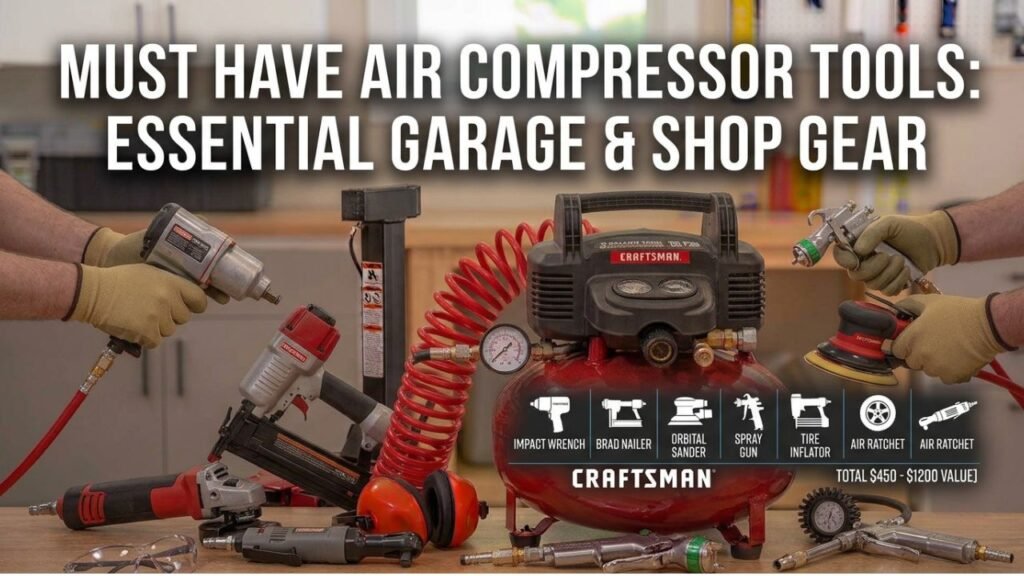
The term “air compressor tools” can refer to two different groups of equipment.
The first group is air-system accessories. These connect the compressor to the tool and control the air supply.
Examples include:
- Air hose
- Quick-connect couplers
- Air plugs
- Regulator
- Pressure gauge
- Moisture separator
- Filter
- Hose reel
- Air chuck
The second group is pneumatic tools, which use compressed air to perform work.
Examples include:
- Impact wrench
- Air ratchet
- Air hammer
- Die grinder
- Nail gun
- Spray gun
- Air sander
- Cut-off tool
You need both categories to get the most from a compressor.
In my view, beginners should buy the basic air-delivery accessories first and then add pneumatic tools according to actual jobs. Buying an expensive impact wrench does little good if your hose, couplers, regulator, or compressor cannot supply enough air to run it.
Essential Air Compressor Tools and Accessories at a Glance
| Tool or Accessory | Main Purpose | Best For | Priority |
| Air hose | Carries compressed air | Every compressor setup | Essential |
| Quick couplers and plugs | Fast tool connection | Every compressor setup | Essential |
| Regulator and gauge | Controls tool pressure | Nearly all pneumatic tools | Essential |
| Tire inflator with gauge | Inflates and checks tires | Automotive and home use | Essential |
| Safety blow gun | Controlled cleaning and blowing | Garage and workshop | Very useful |
| Moisture separator/filter | Reduces water and debris | Air tools and painting | Very useful |
| Impact wrench | Removes and installs fasteners | Automotive work | High priority |
| Air ratchet | Speeds repetitive fastener work | Automotive repair | Useful |
| Air hammer | Chiseling and separation work | Automotive/fabrication | Useful |
| Die grinder | Grinding and surface preparation | Metalwork and automotive | Useful |
| Cut-off tool | Cuts metal | Fabrication and repair | Job-specific |
| Nail gun | Drives fasteners | Carpentry and construction | Job-specific |
| Spray gun | Applies paint and coatings | Painting/bodywork | Job-specific |
| Air sander | Sanding and finishing | Bodywork/woodworking | High-air-demand |
| Hose reel | Organizes and protects hose | Permanent shop setup | Convenience upgrade |
The ideal collection depends on the compressor you own and the type of work you plan to do.
1. Quality Air Hose
A good air hose is the first accessory I would buy after the compressor itself.
The hose carries compressed air from the compressor to your tool. Its diameter, length, material, and pressure rating affect convenience and tool performance.
Why Hose Diameter Matters
A hose that is too narrow can restrict airflow.
Common hose inside diameters include:
- 1/4 inch
- 5/16 inch
- 3/8 inch
- 1/2 inch
A 1/4-inch hose is light and convenient for nailers, tire inflation, and other lower-air-demand tasks.
A 3/8-inch hose is a better general-purpose choice for many garage tools, including numerous impact wrenches and air ratchets.
A 1/2-inch hose becomes useful with larger tools, long air runs, or high-CFM equipment.
Do not choose hose size by compressor tank size alone. Match it to the airflow requirements of the tools.
Hose Length Matters Too
Longer hoses create additional flow resistance.
A 100-foot narrow hose can cause considerably more pressure loss than a short, properly sized hose when supplying a high-demand tool.
Use enough hose to work safely and conveniently, but avoid excessive length when it is unnecessary.
Common Air Hose Materials
Rubber hose is flexible and durable but can be relatively heavy.
PVC hose can be inexpensive and light but may become stiff in cold conditions.
Hybrid polymer hoses attempt to combine flexibility, manageable weight, and durability.
For a general garage, I prefer a flexible hose that remains easy to handle and has enough internal diameter for the highest-demand tool I regularly use.
2. Quick-Connect Couplers and Air Plugs
Quick-connect fittings allow you to attach and remove air tools without threading connections together every time.
A typical setup includes:
Compressor → Female Coupler → Male Hose Plug → Air Hose → Female Coupler → Male Tool Plug
The plug on the tool snaps into the coupler on the hose.
Not All Quick Connects Are the Same
Different plug and coupler profiles exist.
Two fittings may look similar but still be incompatible or seal poorly.
For a home garage, I recommend standardizing all of your tools and hoses around one compatible fitting system.
Flow Capacity Matters
A fitting’s thread size does not necessarily tell you how large its internal air passage is.
High-air-demand tools may benefit from higher-flow couplers.
A large compressor connected through restrictive fittings can still produce disappointing tool performance.
3. Air Pressure Regulator
A regulator controls the pressure supplied to your tools.
The compressor tank may hold 125, 150, 175 PSI, or another pressure, but that does not mean your pneumatic tool should receive the full tank pressure.
Many air tools are designed to operate around a specific inlet pressure, commonly near 90 PSI for numerous shop tools.
Always follow the actual tool specification.
Why the Regulator Matters
Excessive pressure can:
- Increase tool wear
- Overspeed pneumatic motors
- Stress internal components
- Damage equipment
- Create unsafe operating conditions
Too little pressure can make a tool weak or ineffective.
Regulator Flow Capacity Also Matters
A small regulator may show the correct pressure when no air is flowing yet drop significantly when a large pneumatic tool starts.
If a high-CFM tool feels weak, the regulator can be one of the restrictions worth checking.
4. Pressure Gauge
A pressure gauge lets you see what the compressor and regulated outlet are doing.
Many compressors have two gauges:
- Tank pressure gauge
- Regulated outlet pressure gauge
These numbers serve different purposes.
The tank gauge tells you how much pressure is stored.
The regulated gauge indicates the pressure being supplied downstream.
Check Pressure While the Tool Runs
A tool can appear to have the correct pressure when it is sitting idle.
Then pressure may fall dramatically when you pull the trigger.
That pressure drop can point to insufficient compressor CFM or restrictions in:
- Hose
- Couplers
- Filter
- Regulator
- Fittings
For troubleshooting air tools, pressure under flow is often more useful than static pressure.
5. Tire Inflator With Pressure Gauge
For most homeowners and automotive DIYers, a tire inflator is one of the most useful compressor tools you can own.
A good inflator combines:
- Trigger valve
- Pressure gauge
- Flexible hose
- Tire chuck
- Bleed or deflation control on many designs
This allows you to check and adjust pressure without repeatedly removing the chuck.
What You Can Inflate
Depending on the compressor and accessories, you can use an inflator for:
- Car tires
- Light-truck tires
- Motorcycle tires
- Bicycle tires with the appropriate adapter
- Lawn equipment tires
- Trailer tires
- Sports equipment with the appropriate needle
Always inflate a tire according to the appropriate vehicle or equipment specification rather than using the tire sidewall’s maximum-pressure marking as a general operating target.
Digital vs Analog Tire Inflator
Digital gauges are easy to read and can provide fine resolution.
Analog gauges require no battery and are simple.
Either style can work well if the gauge is accurate and appropriate for your required pressure range.
6. Safety Blow Gun
A blow gun directs compressed air through a nozzle for controlled cleaning, drying, and debris removal.
It is inexpensive and very useful around a shop.
Typical uses include:
- Blowing dust from equipment
- Clearing chips from work areas
- Drying certain parts
- Clearing appropriate passages
- Removing loose debris from inaccessible areas
However, compressed air should not be treated casually.
For U.S. workplaces, OSHA generally requires compressed air used for cleaning purposes to be reduced to less than 30 PSI and used with effective chip guarding and personal protective equipment. Compressed air should never be directed at your body or another person.
A properly designed safety blow gun is a much better choice than improvising with an open air fitting.
Key Takeaways:
- A hose, compatible couplers, regulator, and pressure gauge form the foundation of a useful compressed-air system.
- Hose diameter and fitting flow capacity can affect how much air actually reaches the tool.
- A tire inflator and safety blow gun are inexpensive accessories that make a compressor useful even before you buy major pneumatic tools.
- Always stay within the rated pressure of hoses, fittings, regulators, and tools.
7. Moisture Separator and Air Filter
Compressing air creates heat, and moisture can condense as the air cools.
That moisture may eventually travel through the hose toward your pneumatic tools.
A moisture separator helps remove condensed water from the air stream.
A filter can capture contaminants such as:
- Rust particles
- Scale
- Dirt
- Other debris
Why Moisture Matters
Water can contribute to:
- Pneumatic-tool corrosion
- Lubrication problems
- Contaminated paint
- Surface-finish defects
- Air-line corrosion
Painting usually demands better air quality than basic tire inflation or impact-wrench use.
A Separator Does Not Replace Tank Draining
Your compressor tank can collect condensed water.
Drain it according to the compressor manufacturer’s maintenance instructions.
Do not assume a downstream water separator means the receiver tank never needs maintenance.
8. Impact Wrench
For automotive work, an air impact wrench is one of the most valuable pneumatic tools you can own.
It delivers repeated rotational impacts that help loosen and tighten fasteners rapidly.
Common uses include:
- Wheel lug nuts
- Suspension fasteners
- Automotive repair
- Equipment maintenance
- Large bolts and nuts
Common Impact Wrench Drive Sizes
You may encounter:
- 3/8-inch drive
- 1/2-inch drive
- 3/4-inch drive
- 1-inch drive
For general passenger-car and light-truck work, 1/2-inch drive is usually the most versatile choice.
Compressor Requirements
Impact-wrench airflow varies considerably by model.
Many 1/2-inch pneumatic impact wrenches fall somewhere around several CFM during use, but you should always use the manufacturer’s actual air-consumption specification.
A small compressor may run an impact wrench in short bursts even if it cannot support extended operation.
Use Impact-Rated Sockets
Do not use ordinary chrome hand sockets as a substitute for proper impact sockets.
Impact sockets are made to tolerate repeated impact loading.
Do Not Use an Impact Wrench for Final Torque
An impact wrench is excellent for speed.
It is not a precision final-torque instrument.
For critical fasteners such as wheel lug nuts, finish tightening according to the vehicle manufacturer’s procedure using a suitable torque wrench.
9. Air Ratchet
An air ratchet rotates sockets continuously and is excellent for removing or installing fasteners in confined areas after they have been broken loose.
It is particularly useful for:
- Engine-bay work
- Underbody repairs
- Repetitive bolts
- Automotive disassembly
- Light mechanical work
An air ratchet is not the same as an impact wrench.
Air Ratchet vs Impact Wrench
An impact wrench delivers hammering torque and is ideal for stubborn fasteners.
An air ratchet provides smoother continuous rotation and is ideal for quickly spinning fasteners once high breakaway torque is no longer required.
In an automotive garage, the two complement each other rather than replace each other.
10. Air Hammer
An air hammer uses rapid reciprocating impacts to drive attachments.
Depending on the attachment and application, it may be useful for:
- Separating stubborn components
- Chiseling
- Cutting certain materials
- Removing rivets
- Driving out pins
- Automotive suspension and exhaust work
- Sheet-metal work
An air hammer can be extremely effective, but it can also damage components quickly if used carelessly.
Wear eye and hearing protection and make sure the attachment is intended for the tool and task.
11. Die Grinder
A pneumatic die grinder spins a small abrasive, carbide, brush, or finishing attachment at high speed.
It is one of the most versatile air tools for metalwork.
Common jobs include:
- Removing rust
- Grinding welds
- Deburring
- Porting
- Cleaning gasket surfaces where appropriate
- Surface preparation
- Using wire brushes
- Shaping metal
Straight vs Angle Die Grinder
A straight die grinder keeps the spindle aligned with the body.
An angle die grinder places the attachment at an angle, which can make surface work easier.
Many serious garages eventually own both.
Die Grinders Need Air
Unlike a nail gun, a die grinder may run continuously for long periods.
That makes compressor CFM much more important.
A small compressor may operate the grinder briefly but spend substantial time recovering.
12. Pneumatic Cut-Off Tool
A cut-off tool uses a small abrasive wheel to cut metal.
It is useful for:
- Exhaust work
- Sheet metal
- Small bolts
- Brackets
- Fabrication
- Removing damaged hardware where appropriate
It can be much faster than using a hand saw in suitable situations.
However, sparks, abrasive-wheel failure, and flying particles create hazards.
Always use the correct wheel, wheel guard, and personal protective equipment, and keep sparks away from fuel, vapors, batteries, and flammable materials.
13. Nail Gun
If you do construction, remodeling, trim work, cabinetry, furniture building, or woodworking, a pneumatic nail gun may be more valuable than any automotive air tool.
Common types include:
Brad Nailer
Brad nailers typically drive smaller fasteners used for:
- Trim
- Molding
- Crafts
- Light woodworking
Finish Nailer
Finish nailers use larger nails for jobs such as:
- Baseboards
- Door trim
- Window trim
- Cabinet work
Framing Nailer
Framing nailers drive larger fasteners for:
- Wall framing
- Deck construction
- Sheathing
- Structural carpentry where the fastener is appropriate
Roofing Nailer
Roofing nailers are designed for roofing fasteners and repetitive installation.
Why Nail Guns Work Well With Small Compressors
Nail guns consume air in short bursts rather than continuously.
The compressor tank can recharge between shots, allowing many compact compressors to operate nailers effectively.
Key Takeaways:
- An impact wrench is one of the highest-value pneumatic tools for automotive work.
- An air ratchet saves time on repetitive fasteners, while an air hammer handles impact and separation work.
- Die grinders and cut-off tools are versatile but demand more sustained airflow.
- Nail guns are exceptionally compressor-friendly because they use air intermittently rather than continuously.
14. Paint Spray Gun
A spray gun uses compressed air to atomize paint or coating material into a controlled spray pattern.
Depending on the gun and material, it can be used for:
- Automotive paint
- Primer
- Clear coat
- Furniture finishing
- Cabinets
- Equipment refinishing
- Other compatible coatings
Spray Guns Can Require a Lot of CFM
This is where many compressor owners run into trouble.
A compressor might have enough pressure for the spray gun but not enough continuous airflow.
If pressure falls during spraying, you may experience:
- Poor atomization
- Changing spray pattern
- Inconsistent material delivery
- Uneven finish
HVLP Spray Guns
HVLP means high volume, low pressure.
Although operating pressure may be relatively low, the “high volume” portion matters.
Many full-size HVLP guns require considerably more airflow than compact portable compressors can continuously provide.
Check the actual gun specification before choosing a compressor.
Moisture Control Becomes Critical
Paint and water do not mix well.
A painting setup should pay close attention to:
- Tank drainage
- Moisture separation
- Filtration
- Air-line configuration
- Clean, dry air
For professional-quality painting, air treatment deserves more attention than it does for an impact wrench.
15. Air Sander
Pneumatic sanders are common in automotive bodywork, woodworking, fabrication, and refinishing.
A dual-action or random-orbit pneumatic sander can remove material quickly and produce consistent finishing patterns.
The Main Disadvantage: Air Consumption
Sanders tend to run continuously.
That makes them among the more demanding garage air tools.
A small 6-gallon compressor can sometimes spin an air sander, but that does not mean it can maintain useful operation for several minutes.
The tool may quickly drain the tank and force the compressor into almost constant recovery.
For regular pneumatic sanding, I recommend buying a compressor based heavily on sustained CFM.
16. Pneumatic Grease Gun
A pneumatic grease gun uses compressed air to help dispense grease through fittings.
It can be useful for maintaining:
- Farm equipment
- Construction equipment
- Trailers
- Machinery
- Suspension and steering components designed with grease fittings
For someone maintaining multiple pieces of equipment, a pneumatic grease gun can save time compared with repeated manual pumping.
For a homeowner who only greases one or two fittings occasionally, a manual grease gun may make more sense.
17. Air Drill
A pneumatic drill is compact, durable, and can work well in shop environments.
It may be used for:
- Drilling metal
- Fabrication
- Automotive work
- Production environments
However, cordless electric drills have become so convenient that an air drill is no longer a must-have tool for every DIY user.
I would prioritize an impact wrench, tire inflator, blow gun, and possibly a die grinder before buying an air drill for a typical home garage.
18. Pneumatic Needle Scaler
A needle scaler uses a cluster of rapidly moving steel needles to break loose surface material.
It is useful for:
- Heavy rust
- Scale
- Old coatings
- Weld cleanup
- Metal restoration
It is especially useful for fabrication, industrial equipment, trailers, and restoration work.
The tradeoffs are significant vibration and noise.
This is a specialized tool rather than a first purchase for most compressor owners.
19. Air Stapler
A pneumatic stapler works similarly to a nail gun but drives staples.
It can be valuable for:
- Upholstery
- Furniture
- Insulation
- Crafts
- Light construction
- Certain flooring and sheathing applications with the appropriate stapler
Like nailers, many staplers use air intermittently, making them practical with compact compressors.
20. Air-Powered Caulking or Sealant Gun
A pneumatic dispensing gun can make repeated application of sealant, adhesive, or caulk easier.
This is most useful in production, automotive, construction, or fabrication environments where many cartridges are used.
It is not necessary for the average homeowner but can dramatically reduce hand fatigue during repetitive dispensing work.
Air Compressor Accessories You Should Not Overlook
Some accessories are not exciting, but they can matter more than another pneumatic tool.
Air Chuck
An air chuck connects the air hose or inflator to a tire valve.
Common designs include:
- Clip-on chuck
- Lock-on chuck
- Straight chuck
- Dual-foot chuck
A dual-foot chuck can be particularly useful for reaching valve stems on dual rear wheels.
Thread Sealant
Pneumatic pipe connections often require suitable thread sealant to prevent leaks.
Use a sealant compatible with compressed-air fittings and keep excess material from entering the air passage.
Pneumatic Tool Oil
Many air tools require regular lubrication through the air inlet or another lubrication point.
Use the lubricant specified by the manufacturer.
Do not assume automotive engine oil, penetrating oil, or another general-purpose lubricant is an appropriate substitute.
Inline Oiler
An inline lubricator automatically introduces a controlled amount of oil into the air stream.
It can be useful in permanent pneumatic-tool systems.
However, the same lubricated air line should generally not be used for applications that require clean, oil-free air, such as many painting operations.
Hose Reel
A reel keeps an air hose organized and off the floor.
Benefits include:
- Faster storage
- Less tripping risk
- Reduced hose tangling
- Easier shop organization
- Potentially less hose damage
For a permanent garage compressor, a quality hose reel is one of my favorite convenience upgrades.
Additional Pressure Gauge
A gauge closer to a high-demand tool can help identify pressure loss between the compressor and the working end of the hose.
This can be useful when diagnosing restrictive hoses, couplers, filters, or regulators.
Which Air Compressor Tools Should You Buy First?
If you are starting from nothing, I would not buy everything at once.
Build the system around the jobs you actually perform.
Best First Purchases for Almost Everyone
I would begin with:
- Properly sized air hose
- Compatible quick-connect fittings
- Regulator and working pressure gauge
- Tire inflator with gauge
- Safety blow gun
- Moisture separator if your setup benefits from one
These accessories immediately turn the compressor into a versatile tool.
Best First Tools for Automotive DIY
Next, I would add:
- 1/2-inch impact wrench
- Air ratchet
- Air hammer
- Die grinder
- Cut-off tool if you regularly fabricate or repair metal
The impact wrench usually offers the biggest immediate productivity gain.
Best First Tools for Woodworking and Construction
Consider:
- Brad nailer
- Finish nailer
- Framing nailer if needed
- Stapler
- Blow gun
You do not need a huge compressor for many intermittent fastening jobs.
Best First Tools for Auto Body and Painting
Priorities change considerably:
- Spray gun
- Air sander
- Die grinder
- Blow gun
- Good moisture filtration and separation system
Here, compressor CFM and air quality become extremely important.
How Much CFM Do Air Compressor Tools Need?
CFM stands for cubic feet per minute and describes airflow.
Every pneumatic tool has an airflow requirement.
The following ranges are only broad planning estimates. Actual requirements vary by model, and the manufacturer’s specification should always be used for compressor sizing.
| Air Tool | Broad Typical Air Demand | Usage Style |
| Brad nailer | Less than 1 to about 2 CFM average | Intermittent |
| Finish nailer | Roughly 1–3 CFM average | Intermittent |
| Framing nailer | Roughly 2–4 CFM average | Intermittent |
| Air ratchet | Roughly 3–6 CFM | Intermittent |
| 1/2-inch impact wrench | Roughly 4–8+ CFM | Intermittent |
| Air hammer | Roughly 3–6 CFM | Intermittent |
| Die grinder | Roughly 5–10+ CFM | Often continuous |
| Cut-off tool | Roughly 4–10+ CFM | Often continuous |
| Pneumatic sander | Roughly 8–15+ CFM | Continuous |
| Full-size spray gun | Roughly 4–15+ CFM depending on design | Continuous while spraying |
Do not treat these ranges as specifications for a particular product.
Why Duty Cycle Changes Everything
A tool that needs 6 CFM but runs for five seconds at a time is easier on a compressor than a tool consuming 6 CFM continuously for ten minutes.
Tank storage helps with intermittent tools.
It cannot permanently make up for a compressor pump that produces less air than a continuously operating tool consumes.
Key Takeaways:
- Choose pneumatic tools according to the work you actually perform rather than trying to own every available air tool.
- Impact tools and nailers work well with intermittent compressor use.
- Sanders, grinders, and spray guns can require substantial sustained airflow.
- Always compare the actual tool CFM requirement with compressor output at the required PSI.
How Much PSI Do Air Compressor Tools Need?
PSI means pounds per square inch and measures pressure.
Many common pneumatic shop tools operate somewhere around 90 PSI, but that number should never be treated as a universal setting.
Different equipment can require very different pressure.
For example:
- Some nailers operate across a manufacturer-specified pressure range.
- Many impact and grinding tools commonly use approximately 90 PSI.
- Spray-gun pressure varies significantly by design.
- Tires should be inflated to the appropriate vehicle or equipment specification.
Set pressure using the tool manufacturer’s instructions.
More PSI Does Not Fix Low CFM
This is one of the most important compressed-air lessons.
If an impact wrench feels weak because the compressor cannot provide enough CFM, increasing pressure beyond the wrench’s maximum rating is not an appropriate solution.
Instead, inspect:
- Compressor airflow
- Hose diameter
- Hose length
- Couplers
- Filter
- Regulator
- Air leaks
What Size Compressor Do You Need for Air Tools?
There is no single compressor size that runs every pneumatic tool.
Start with CFM.
Step 1: Find the Tool’s Air Requirement
Check the tool label or documentation.
Suppose it requires:
5 CFM at 90 PSI
Step 2: Check Compressor Output at 90 PSI
Do not compare the tool requirement with compressor output at an unrelated pressure.
If the compressor produces only:
3 CFM at 90 PSI
it will probably fall behind during sustained tool use.
Step 3: Add Headroom
I generally prefer around 25–50% airflow headroom for a compressor when practical.
For a 5-CFM tool, something around 6.25–7.5 CFM provides more comfortable capacity than matching the tool requirement exactly.
This is a planning guideline rather than a universal requirement.
Step 4: Consider How Long You Run the Tool
An impact wrench used for three-second bursts can often tolerate a smaller compressor.
A continuously operating sander cannot.
Step 5: Consider Future Tools
If you plan to add spray equipment, grinders, or sanders later, buying more compressor capacity now may avoid a second compressor purchase.
Can a 3-Gallon Air Compressor Run Air Tools?
Yes, but mostly lower-demand or intermittent tools.
A 3-gallon compressor can often be useful for:
- Tire inflation
- Brad nailers
- Small staplers
- Blow-gun use in short bursts
It may physically operate a larger pneumatic tool for a short period, but its small tank and often modest pump output create limitations.
An impact wrench, grinder, sander, or spray gun can quickly consume the available reserve.
The actual CFM rating matters more than the tank gallons alone.
Can a 6-Gallon Pancake Compressor Run Air Tools?
Yes.
A 6-gallon pancake compressor is excellent for many fastening and general household tasks.
It is commonly suitable for:
- Brad nailers
- Finish nailers
- Many framing-nailer applications
- Staplers
- Tire inflation
- Blow-gun work in short bursts
Some 6-gallon compressors can run an impact wrench briefly, but repeated heavy impact work may require frequent recovery pauses.
Continuous grinders, sanders, and full-size spray equipment are generally poor matches for low-CFM pancake compressors.
Can a 20-Gallon Compressor Run Air Tools?
A 20-gallon compressor can be a good general-purpose garage size, but the answer still depends on pump CFM.
A reasonably capable 20-gallon unit can often support:
- Impact wrenches
- Air ratchets
- Air hammers
- Die grinders intermittently
- Cut-off tools intermittently
- Nailers
- Tire tools
Continuous sanding and painting may still exceed the airflow of some 20-gallon models.
Never assume all 20-gallon compressors perform alike.
What Can a 30-Gallon Compressor Run?
A 30-gallon compressor with adequate pump output gives you greater reserve and can be a strong DIY automotive option.
Depending on its CFM rating, it may handle:
- Impact tools
- Air hammer
- Air ratchet
- Die grinder
- Cut-off tool
- Nail guns
- Intermittent painting
- Other moderate-demand tools
Air sanders and continuous spray work still need to be checked carefully against actual CFM.
What Can a 60-Gallon Compressor Run?
A typical stationary 60-gallon compressor is often chosen for serious garage or workshop use because many models pair the larger receiver with substantially greater pump capacity.
Depending on output, these compressors may support:
- Frequent impact-wrench use
- Die grinders
- Cut-off tools
- Air hammers
- Spray guns
- Pneumatic sanders
- Multiple lower-demand tools
Some demanding equipment may still exceed the output of an individual 60-gallon compressor, so the CFM rating remains the deciding factor.
Tank Size vs CFM: Which Matters More for Air Tools?
For most air-tool sizing decisions, CFM is more important than tank gallons.
The tank stores air.
The compressor pump supplies new air.
Imagine a tool consuming 10 CFM while the compressor produces only 4 CFM.
A large tank lets you run the tool longer before pressure falls.
But eventually the stored air is depleted.
At that point the pump is still producing only 4 CFM while the tool wants 10 CFM.
Pressure continues falling.
A larger tank delays the shortage; it does not eliminate it.
Best Air Compressor Tools for Automotive Work
For a home mechanic, I would prioritize tools in this order:
1. Tire Inflator With Gauge
Useful on almost every vehicle and inexpensive.
2. 1/2-Inch Impact Wrench
Excellent for lug nuts and stubborn automotive fasteners.
3. Safety Blow Gun
Useful for controlled cleaning and drying.
4. Air Ratchet
Saves significant time on repetitive fasteners.
5. Air Hammer
Excellent for difficult suspension, exhaust, and separation jobs.
6. Die Grinder
Ideal for rust removal, metal cleanup, and fabrication.
7. Cut-Off Tool
Very useful if you regularly repair exhaust or fabricate metal.
For most DIY mechanics, I would buy these before specialized pneumatic tools.
Best Air Compressor Tools for Homeowners
A homeowner may not need heavy automotive equipment.
A practical home setup includes:
- Tire inflator
- Blow gun
- Brad nailer
- Finish nailer
- Stapler
- Basic hose and quick-connect kit
This setup can cover inflation, cleaning, trim work, furniture repair, crafts, and general DIY.
Best Air Compressor Tools for Woodworking
A woodworker can get excellent value from:
- Brad nailer
- Finish nailer
- Stapler
- Pin nailer
- Blow gun
- Spray gun if finishing with compatible coatings
Pneumatic sanders are also available, but many woodworkers may find an electric sander more practical unless they already own a high-CFM compressor.
Best Air Compressor Tools for Painting
For painting, the tool list is relatively short but the supporting air system becomes more important.
You may need:
- Appropriate spray gun
- Regulator
- Pressure gauge
- Adequately sized air hose
- Moisture separator
- Fine filtration as required by the coating system
- Clean fittings
- Compressor with sufficient continuous CFM
Painting is one application where buying a large tank without checking pump output can lead to disappointing results.
Pneumatic Tools vs Electric Tools: Which Are Better?
Air tools still have major advantages, but cordless tools have changed the decision considerably.
Advantages of Pneumatic Tools
Pneumatic tools can provide:
- High power-to-weight ratio
- Compact tool bodies
- Long service life
- Good performance during repeated work
- No battery to recharge at the tool
- Strong suitability for professional shop environments
Disadvantages of Pneumatic Tools
They require:
- Compressor
- Hose
- Fittings
- Maintenance
- Electricity for the compressor
- Noise management
- Moisture control
You also have to drag a hose around the work area.
Advantages of Cordless Tools
Cordless tools offer:
- Excellent portability
- Fast setup
- No air hose
- No compressor noise
- Easy outdoor or roadside use
Which Do I Recommend?
For occasional DIY work, modern cordless impact wrenches, ratchets, grinders, and drills can be more convenient.
If you already own a capable compressor or work in a stationary shop, pneumatic tools remain an excellent choice.
I would not build an entire compressed-air system only to replace a cordless drill. But an existing compressor can make air tools highly economical and productive.
Air Tool Maintenance You Should Not Ignore
Pneumatic tools can last a long time when maintained correctly.
Follow Lubrication Instructions
Many pneumatic motors require air-tool oil.
Some impact mechanisms require a separate grease or oil maintenance procedure.
Always follow the specific tool instructions.
Drain the Compressor Tank
Moisture can accumulate in the receiver tank.
Drain it according to the compressor manufacturer’s instructions.
Inspect Hoses
Replace hoses showing:
- Cuts
- Bulges
- Severe cracking
- Damaged ends
- Exposed reinforcement
- Persistent leakage
Check Couplers
Worn quick-connect couplers can leak considerable air.
Replace fittings that do not lock securely or seal correctly.
Clean Intake Filters
The compressor pump needs unrestricted intake air.
Service or replace the intake filter according to the compressor maintenance schedule.
Protect Tools From Dirt
Cover unused air inlets where appropriate and store tools in a dry area.
Dirt entering a pneumatic motor can shorten tool life.
Key Takeaways:
- Pneumatic tools need proper lubrication, dry air, secure couplers, and sound hoses.
- Drain receiver-tank moisture according to the compressor manufacturer’s maintenance procedure.
- Air leaks waste CFM and force the compressor to run more often.
- Preventive maintenance is usually cheaper than replacing damaged tools or compressor components.
Essential Air Compressor Safety Rules
Compressed air contains stored energy and deserves the same respect as other power sources.
Wear Eye Protection
Air tools can launch:
- Metal fragments
- Rust
- Wood chips
- Abrasive particles
- Broken fastener pieces
Eye protection should be standard practice.
Use Hearing Protection When Appropriate
Compressors and pneumatic impact tools can generate substantial noise.
Impact wrenches, air hammers, grinders, and blow guns can be particularly loud.
Never Point Compressed Air at People
Do not use compressed air to clean your skin or clothing.
High-velocity air and debris can cause serious injury.
Follow Safe Blow-Gun Practices
For workplace cleaning applications in the United States, OSHA generally limits cleaning air to less than 30 PSI while also requiring effective chip guarding and personal protective equipment.
The rule is not permission to aim air at yourself.
Stay Within Pressure Ratings
Never exceed the safe operating pressure of:
- Air tools
- Hoses
- Regulators
- Filters
- Fittings
- Accessories
Disconnect Air Before Servicing Tools
Before changing certain accessories or servicing a pneumatic tool, disconnect it from the air supply according to manufacturer instructions.
This helps prevent accidental activation.
Never Carry a Tool by Its Hose
Carry the tool itself.
Do not use the air hose to lift or lower pneumatic equipment.
Common Mistakes When Buying Air Compressor Tools
Buying Tools Before Checking Compressor CFM
This is probably the biggest mistake.
A small compressor may not support the air sander or spray gun you want to buy.
Check airflow first.
Focusing Only on Tank Gallons
A 30-gallon tank does not automatically make one compressor more powerful than another.
Compare delivered CFM.
Using Undersized Hoses
High-CFM tools need enough air-path capacity.
Using Restrictive Fittings
The smallest restriction can bottleneck the system.
Assuming All Air Tools Run at 90 PSI
Many do operate near this pressure, but not all.
Always use the actual tool specification.
Buying Every Tool in a Kit
Large pneumatic tool kits can look like good value.
But if half the tools do not match your work—or your compressor cannot support them—you have not really saved money.
Buy high-value tools individually when quality or performance matters.
Ignoring Tool Oil
Some air tools fail prematurely because users assume compressed air alone is all they need.
Using the Wrong Socket on an Impact Wrench
Use impact-rated sockets.
Buying a Spray Gun Without Checking CFM
A full-size gun may consume much more air than a small portable compressor can sustain.
How to Build a Complete Air Compressor Tool Setup
A practical system can be built in stages.
Stage 1: Basic Compressor Setup
Buy:
- Correct air hose
- Couplers and plugs
- Regulator
- Pressure gauge
- Tire inflator
- Safety blow gun
This creates a versatile starting system.
Stage 2: Protect the Air Supply
Add:
- Moisture separator
- Filter where needed
- Proper drainage routine
- Appropriate tool oil
Stage 3: Add Your Primary Pneumatic Tool
Choose based on your main job:
- Impact wrench for automotive repair
- Nailer for construction
- Spray gun for painting
- Air hammer for mechanical work
- Die grinder for fabrication
Stage 4: Upgrade Air Delivery
If high-demand tools are coming, consider:
- Larger-diameter hose
- High-flow couplers
- Higher-capacity regulator
- Better filtration
- Hose reel
- Permanent shop piping where appropriate
Stage 5: Upgrade the Compressor If Necessary
When tool demand consistently exceeds compressor output, stop trying to compensate with a larger tank or higher regulator pressure.
A higher-CFM compressor may be the proper solution.
A Practical Starter Air Tool Kit
If I were building a general home garage from scratch, my starter kit would contain:
- 3/8-inch general-purpose air hose
- Matching quick-connect couplers and plugs
- Regulator with readable pressure gauge
- Tire inflator with gauge
- Safety blow gun
- Moisture separator
- 1/2-inch impact wrench
- Impact socket set
- Pneumatic tool oil
- Air ratchet if automotive work is frequent
That combination handles an enormous range of garage tasks without filling the toolbox with specialized equipment you may rarely use.
For carpentry, I would replace the impact-focused items with brad and finish nailers.
FAQs about Must Have Air Compressor Tools
What are the must have air compressor tools for a home garage?
For most home garages, start with a quality air hose, matching quick-connect fittings, regulator and gauge, tire inflator, safety blow gun, and moisture separator.
If you repair vehicles, add a 1/2-inch impact wrench, air ratchet, air hammer, and die grinder as needed.
What tools can you use with an air compressor?
Common tools include impact wrenches, air ratchets, nail guns, staplers, air hammers, grinders, sanders, cut-off tools, spray guns, grease guns, drills, blow guns, and tire inflators.
Whether your compressor can run a particular tool depends primarily on the required PSI and CFM.
What should I buy first with an air compressor?
Buy the air-delivery basics first: hose, couplers, regulator, pressure gauge, and any necessary filtration.
A tire inflator and blow gun are excellent first working accessories because they are inexpensive and useful for many owners.
What is the most useful air compressor tool for a mechanic?
A 1/2-inch impact wrench is one of the most useful pneumatic tools for a mechanic because it speeds up wheel, suspension, and general fastener work.
A tire inflator and air ratchet are also extremely useful.
What is the most useful air compressor tool for a homeowner?
A tire inflator is probably the most universally useful.
For home improvement, a brad nailer or finish nailer can provide tremendous value.
Do I need a moisture separator for air tools?
It is highly useful.
Compressed air can carry condensed water that may contribute to internal corrosion and contamination.
Moisture management becomes particularly important for painting.
Do I need an air filter?
A filter helps keep debris and contamination out of pneumatic equipment.
The importance increases with precision tools, permanent shop systems, and paint work.
Do all air tools need oil?
No.
Many traditional pneumatic tools require lubrication, but designs vary.
Follow the maintenance instructions for the individual tool.
Do not automatically inject oil into air lines used for equipment requiring clean, oil-free air.
Is an air impact wrench worth buying?
Yes, particularly if you already have a compressor capable of supplying it.
For frequent automotive work, an impact wrench can save considerable effort and time.
Can a pancake compressor run air tools?
Yes.
Pancake compressors are particularly good for nailers, staplers, inflation, and short blow-gun use.
Some can operate larger pneumatic tools briefly, but their airflow may be inadequate for sustained grinders, sanders, spray guns, or repeated impact use.
Can a 6-gallon air compressor run an impact wrench?
It may run an impact wrench for short bursts if it provides the required pressure and sufficient stored air.
The limitation is usually pump CFM and recovery time rather than the fact that the tank is six gallons.
What air tools use the most CFM?
Continuous tools such as pneumatic sanders, grinders, spray guns, and sandblasting equipment can consume large amounts of air.
Exact requirements depend on the tool model.
What air tools use the least CFM?
Nailers and staplers typically have relatively low average air consumption because they use short bursts rather than continuous airflow.
Tire inflation is also practical with many small compressors.
Is a bigger air hose better?
A larger inside diameter reduces flow restriction, which can help high-CFM tools.
However, unnecessarily large hose is heavier and bulkier.
Choose the diameter appropriate for the required airflow and hose length.
Is 1/4-inch or 3/8-inch air hose better?
A 1/4-inch hose is lighter and works well for nailers and many low-demand tasks.
A 3/8-inch hose is generally a better all-around garage choice when you plan to operate impact wrenches and other tools requiring more airflow.
What fittings do I need for air tools?
You normally need compatible male air plugs and female quick couplers with the correct pipe-thread sizes for your hose, compressor, and tools.
Keep the fitting profile consistent throughout the system.
Do high-flow air fittings make a difference?
They can.
If conventional fittings are creating a restriction, higher-flow couplers may reduce pressure drop and improve performance of high-CFM tools.
What PSI do most air tools use?
Many common pneumatic shop tools are designed to operate around 90 PSI, but this is not universal.
Always use the pressure specified by the actual tool manufacturer.
What happens if my compressor does not have enough CFM?
The tool may work normally at first while drawing from stored tank air.
As pressure falls, tool performance decreases and the compressor may run continuously or require frequent recovery pauses.
Should I buy pneumatic or cordless tools?
Cordless tools are generally more portable and require less setup.
Pneumatic tools remain attractive when you already have a capable compressor, need compact tools, or perform frequent work in a stationary shop.
For many DIY users, a combination of cordless and pneumatic tools makes the most sense.
Do I need a hose reel?
No, but it is an excellent convenience upgrade for a permanent garage or workshop.
It makes the hose easier to store and helps keep the floor organized.
Can I use compressed air to clean myself?
No. Do not direct compressed air at your skin, body, or clothing.
Compressed air and airborne debris can cause serious injury.
Can I use regular sockets with an air impact wrench?
Use impact-rated sockets with an impact wrench.
Ordinary chrome hand-tool sockets are not designed for repeated impact loading.
Can I run multiple air tools at the same time?
Yes, if the compressor and air-distribution system can supply the combined airflow.
Add the CFM requirements of tools that will operate simultaneously and make sure the compressor has sufficient capacity at the required pressure.
How many air tools should a beginner buy?
Start with only the tools you expect to use regularly.
A quality hose, fittings, inflator, blow gun, and one or two job-specific pneumatic tools are more useful than a large kit full of rarely used equipment.
Conclusion
The best must have air compressor tools are not simply the biggest collection of pneumatic equipment you can afford. A useful setup starts with the fundamentals: an adequately sized air hose, compatible couplers and plugs, regulator, pressure gauge, tire inflator, safety blow gun, and appropriate moisture control.
After that, choose pneumatic tools according to your work. For automotive DIY, I would prioritize a 1/2-inch impact wrench, air ratchet, air hammer, and die grinder. For woodworking and construction, nailers and staplers provide far more value. For painting and bodywork, a spray gun and air sander may be priorities, but those tools also demand considerably more compressor airflow and better moisture control.
Most importantly, match every tool to the compressor’s CFM at the required PSI, not merely tank gallons or maximum pressure. A large tank cannot permanently compensate for a pump that produces too little air, and excessive PSI is not a safe solution to inadequate airflow.
Build your air system in stages, buy quality accessories before collecting specialized tools, and focus on the equipment that solves jobs you actually perform. That approach creates a safer, more capable garage while avoiding wasted money on pneumatic tools your compressor—or your workload—does not really need.