
What Size Breaker for 220/230v Air Compressor? Complete Guide
If you are wondering what size breaker for 220 air compressor is correct, there is no single breaker size based on voltage alone. Most 220/230V residential and garage air compressors use a double-pole breaker somewhere in the 20–40 amp range, while larger compressors may require 50 or 60 amps or more. The compressor manufacturer’s specified circuit requirement should be your first reference.
A 230V compressor that draws 17 amps while running does not necessarily belong on a breaker sized just above 17 amps. Electric motors can draw several times their normal running current for a brief period during startup, so motor circuits are treated differently from ordinary resistive electrical loads.
Horsepower, motor full-load current, phase, starting characteristics, manufacturer requirements, conductor size, wiring method, and the electrical code adopted in your area can all affect the correct breaker.
That distinction is especially important with larger stationary compressors. Installing too small a breaker can cause nuisance trips every time the motor starts. Installing an oversized breaker without properly sizing the motor circuit and overload protection can create a serious electrical and fire hazard.
In this guide, I’ll explain what size breaker for 230 volt air compressor installations typically require, why 220V, 230V, and 240V are commonly used to describe similar equipment, how motor breaker sizing works, why compressor horsepower alone is not enough, and how to determine the correct circuit safely.
What Size Breaker for 220 Air Compressor?
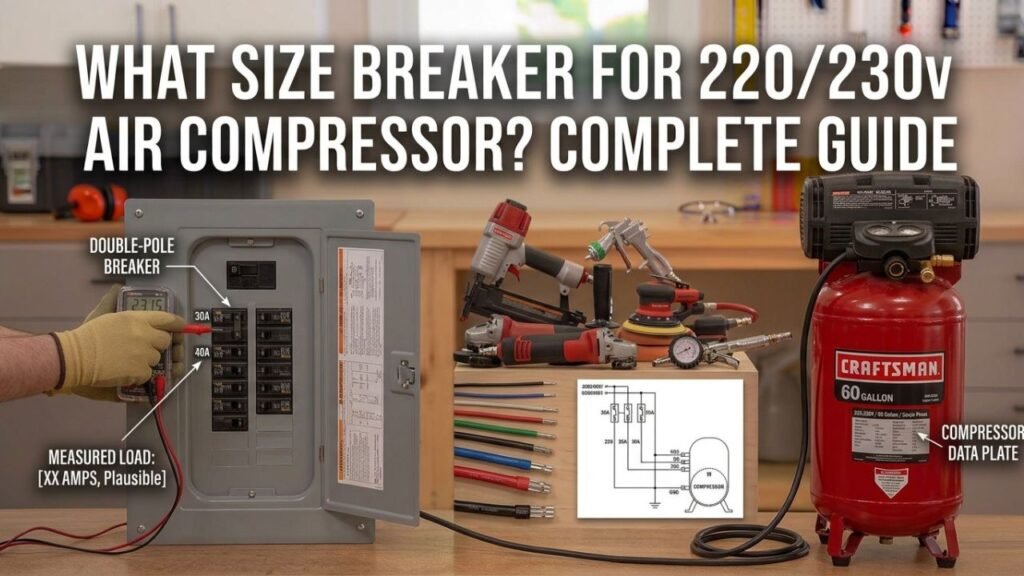
For a typical 220/230V single-phase air compressor used in a U.S. home garage, you will commonly encounter 20A, 30A, or 40A double-pole breakers.
Larger single-phase compressors can require 50A, 60A, or another manufacturer-specified size.
A rough overview looks like this:
| Compressor Type | Breaker Size You May Commonly Encounter |
| Small 220/230V portable or stationary compressor | 15–20A |
| Medium stationary compressor | 20–30A |
| Larger garage compressor | 30–40A |
| Many 5 HP-class single-phase compressors | Around 30–40A, depending on model |
| Larger single-phase compressor | 50–60A or manufacturer specified |
| Commercial/industrial compressor | Calculate from exact electrical specifications |
These are planning ranges, not a breaker-sizing chart.
For example, two compressors marketed with similar horsepower and tank capacity can specify different breakers because their motors, starting systems, full-load currents, efficiency, and electrical designs differ.
The correct priority is:
- Manufacturer’s installation instructions
- Compressor and motor nameplate information
- Applicable motor-circuit electrical-code requirements
- Actual wiring method and conductor conditions
If the manual explicitly calls for a 30A double-pole breaker, use that specification unless a qualified electrician determines that another arrangement is required by the applicable code.
Key Takeaways:
- Most residential 220/230V compressors use a two-pole breaker, not a single-pole breaker.
- 20A, 30A, and 40A are common, but voltage alone cannot determine the correct size.
- Larger compressors can require 50A, 60A, or more.
- Always prioritize the manufacturer’s electrical requirements over a generic horsepower chart.
What Size Breaker for 230 Volt Air Compressor?
A 230V compressor follows the same basic sizing principles as a compressor commonly described as “220V.”
If your compressor is rated for 230V single-phase power, look for an electrical specification showing information such as:
- Rated voltage
- Phase
- Full-load amps
- Horsepower
- Recommended circuit breaker
- Minimum circuit ampacity
- Maximum fuse or breaker
- Required conductor size
- Required disconnect
- Motor overload protection
When the manufacturer provides an exact breaker specification, that is usually the most useful answer.
For example, if the installation instructions state:
Power: 230V, single phase
Recommended breaker: 30A
the appropriate starting point is a 30A two-pole breaker, not a breaker calculated solely from the motor’s running amperage.
Why a 230V Compressor Needs a Double-Pole Breaker
Typical U.S. residential 240V service provides approximately 240 volts between two hot conductors.
A double-pole breaker connects to both legs and disconnects them together.
That is fundamentally different from taking power from one 120V leg.
A normal 230/240V compressor motor therefore commonly uses:
- Hot conductor
- Hot conductor
- Equipment grounding conductor
A neutral is often unnecessary for a motor that operates entirely at 230/240V.
However, do not assume that every compressor can omit a neutral. Some equipment may contain controls, receptacles, electronics, heaters, or accessories that require different wiring.
Follow the manufacturer’s wiring diagram.
Is a 220V, 230V, and 240V Air Compressor the Same Thing?
In everyday U.S. conversation, people often use 220V, 230V, and 240V almost interchangeably when talking about garage equipment.
There is an important distinction, however.
A typical modern U.S. residential electrical service is nominally 120/240 volts.
Electric motors and equipment may instead carry ratings such as:
- 208V
- 208/230V
- 230V
- 230/240V
- 240V
Older terminology and casual conversation often call a 240V circuit “220.”
Therefore, when someone asks what breaker a “220 air compressor” requires, the actual compressor nameplate may say 230V.
Do Not Assume 208V and 230V Are Interchangeable
This is particularly important.
A compressor designed only for 230V operation should not automatically be assumed suitable for a 208V supply.
Some motors are specifically labeled 208/230V, while others are not.
Low supply voltage can increase current, reduce starting performance, cause overheating, or make the motor’s overload protection trip.
Always verify the voltage range on the equipment nameplate.
Key Takeaways:
- “220V” is commonly used informally for equipment operating from a nominal 240V U.S. circuit.
- Your compressor nameplate may actually specify 230V or 230/240V.
- Do not assume a 230V-only motor can run correctly on 208V.
- The equipment nameplate and manual are more important than casual voltage terminology.
What Actually Determines Air Compressor Breaker Size?
Several specifications work together to determine the correct circuit.
Motor Full-Load Current
The motor’s current is obviously important, but it is not the only number used.
Electric motors have a normal running current and a much higher temporary current when starting.
A reciprocating compressor can place substantial load on the motor during startup, particularly if the unloader system is not functioning correctly.
Motor Horsepower
Larger motors generally require more current.
However, horsepower alone is not enough to select a breaker.
Two nominally 5 HP compressors can have different:
- Motor efficiency
- Nameplate current
- Starting characteristics
- Service factors
- Control systems
- Manufacturer wiring requirements
Single-Phase vs Three-Phase Power
This makes a major difference.
A 5 HP compressor running on 230V single-phase power does not have the same current requirements as a 5 HP compressor running on 230V three-phase power.
Do not use a three-phase breaker-sizing chart for a residential single-phase compressor.
Starting Current
An induction motor can momentarily draw much more current while accelerating from a stop.
If the breaker were selected only to match normal running current, it could trip unnecessarily during normal startup.
Motor-circuit rules account for this behavior.
Motor Overload Protection
Breaker protection and motor overload protection do not necessarily perform the same job.
This distinction is critical.
A branch-circuit breaker primarily provides short-circuit and ground-fault protection.
Motor overload protection protects the motor from excessive sustained current and overheating.
Many compressors have motor overload protection incorporated into the motor starter, thermal protector, or another control device.
This is one reason motor circuits cannot always be evaluated using the same breaker-versus-wire assumptions that apply to ordinary receptacle circuits.
Manufacturer Requirements
If the compressor is listed equipment and the manufacturer specifies a particular breaker, wire, disconnect, or branch circuit, those instructions matter.
A manual may say something like:
- Dedicated 20A circuit
- 30A double-pole breaker
- 40A breaker
- Time-delay protection
- Hardwire only
- Minimum conductor size
- Maximum circuit length
Do not ignore these specifications because a generic online calculator gives a different number.
Why You Cannot Simply Multiply Compressor Amps by 125%
You may see advice suggesting:
Running amps × 1.25 = breaker size
That is an oversimplification for many motor circuits.
The 125% concept is relevant to certain motor branch-circuit conductor calculations, but the short-circuit and ground-fault protective device for a motor is governed by separate motor rules.
Under U.S. NEC motor-circuit principles, conductor sizing, branch-circuit short-circuit protection, motor overload protection, and disconnect sizing are related but distinct calculations.
For many single-phase motors, an inverse-time circuit breaker can be permitted at a significantly higher percentage of the motor full-load current than an ordinary general-purpose load would suggest.
That higher breaker allowance exists because the breaker needs to tolerate motor starting current.
An Important Example
Suppose you see a 230V compressor motor with running current in the low-20-amp range and a manufacturer calling for a 40A breaker.
At first glance, someone accustomed to general household circuits might assume a 40A breaker is obviously too large.
For a properly designed motor circuit, that conclusion can be wrong.
The installation may rely on:
- A breaker sized to tolerate motor startup
- Branch-circuit conductors sized under motor rules
- Separate motor overload protection
- Manufacturer-approved electrical protection
This is why I strongly recommend not redesigning a compressor circuit from the motor nameplate amps alone.
How NEC Motor Rules Affect Compressor Breaker Sizing
Air compressor motors commonly fall under Article 430 motor-circuit requirements in the National Electrical Code.
The process is different from selecting a breaker for something like a simple electric heater.
Branch-Circuit Conductors
For many individual continuous-duty motor installations, branch-circuit conductor ampacity is based on at least 125% of the applicable motor full-load current used under the motor rules.
That does not necessarily mean the breaker will have the same amp rating as those conductors.
Short-Circuit and Ground-Fault Protection
For many common single-phase motors protected by an inverse-time breaker, NEC motor rules permit the breaker to be sized substantially above full-load current to accommodate motor starting.
The allowed value is a maximum under specific conditions, not an automatic breaker size every compressor should use.
You should not simply take a current value, multiply it by a maximum percentage, and install that breaker.
Overload Protection
The motor also needs appropriate overload protection.
Depending on the compressor, this may be provided by:
- Integral motor thermal protection
- A magnetic starter
- An overload relay
- Other manufacturer-specified protection
The combination of these protective devices is what makes a properly designed motor circuit different from a normal household branch circuit.
Important Tip: If a motor breaker appears larger than you expect based on the conductor size, do not automatically assume the installation is wrong. Motor circuits have special rules. Equally, never install an oversized breaker simply because motor rules sometimes allow one.
Common Breaker Sizes for 230V Air Compressors
The following sections explain where common breaker sizes are often encountered.
They are not substitutes for your compressor’s manual.
15-Amp Breaker
Some smaller 230V equipment may operate on a 15A circuit.
This is less common among large stationary garage compressors.
If the manufacturer specifies 15A protection, use the specified circuit arrangement rather than upgrading the breaker unnecessarily.
20-Amp Breaker
A 20A double-pole breaker is common with some smaller and medium-size 230V compressors.
Some stationary compressors with running current around the mid-to-high teens specifically call for a dedicated 20A circuit.
This is one reason you cannot guess solely from tank size.
A 60-gallon compressor does not automatically need a 30A or 40A breaker.
30-Amp Breaker
A 30A double-pole breaker is common for many larger residential stationary compressors.
You frequently encounter this size with garage compressors in the roughly 3–4 HP class, although the actual requirement varies significantly by model.
40-Amp Breaker
A 40A double-pole breaker is common with a number of larger single-phase compressors, including many machines marketed around the 5 HP class.
However, not every 5 HP compressor needs a 40A breaker.
Check the manual.
50- or 60-Amp Breaker
Larger single-phase compressor installations can require 50A or 60A circuits.
Once you reach this level, electrical installation requirements become increasingly important because:
- Conductors become larger
- Disconnect requirements matter
- Voltage drop can become important
- Panel capacity must be checked
- Motor starting current can be substantial
I would have a qualified electrician evaluate installations in this range rather than selecting a breaker from horsepower alone.
Key Takeaways:
- 20A breakers are common for some smaller 230V compressors.
- 30A is common for many medium-size stationary units.
- 40A is frequently encountered with larger single-phase shop compressors.
- 50A and 60A circuits may be necessary for larger motors.
- These are common examples, not universal horsepower-to-breaker rules.
Does Air Compressor Horsepower Tell You the Breaker Size?
Not by itself.
Horsepower is useful for estimating the general electrical load, but compressor manufacturers sometimes use motor labeling and marketing terminology differently.
A compressor advertised as “5 HP” does not automatically have the same electrical requirements as every other 5 HP compressor.
I would trust the following information, in order, before relying on a generic horsepower rule:
- Exact compressor installation manual
- Electrical information on the compressor
- Motor nameplate
- Approved motor-circuit calculations
- Generic horsepower estimates only for early planning
Typical Planning Range by Compressor Class
| Compressor Class | Common 230V Breaker Range You May Encounter |
| Small 230V compressor | 15–20A |
| Approximately 2–3 HP class | 20–30A |
| Approximately 3–4 HP class | 20–30A, sometimes higher |
| Approximately 5 HP class | 30–40A commonly encountered |
| Larger single-phase units | 40–60A+ |
Again, these ranges are useful for planning a garage electrical system, not for final circuit design.
What Breaker Does a 5 HP 230V Air Compressor Need?
A 40A double-pole breaker is a common manufacturer recommendation for many 5 HP-class, 230V single-phase air compressors, but it is not universal.
Other models may specify a different size.
This can be confusing because a motor’s normal running current may be considerably below 40 amps.
The larger breaker allows the compressor motor to start without nuisance tripping while properly designed motor overload protection handles sustained overload conditions.
Before using 40A, confirm:
- Compressor model
- Actual voltage
- Single-phase or three-phase operation
- Manufacturer breaker specification
- Conductor requirements
- Motor overload arrangement
Do not assume “5 HP = 40A” for every compressor.
What Breaker Does a 3 HP 230V Air Compressor Need?
Many compressors in the 3 HP range use 20A or 30A 230/240V circuits, but there are enough differences between models that I would not select between them without checking the manual.
A compressor’s starting behavior can be affected by its:
- Motor design
- Pressure switch
- Unloader valve
- Pump load
- Starter
- Supply voltage
If the manufacturer’s installation instructions call for a 30A breaker, use that requirement rather than downsizing simply because the running amperage appears low.
What Breaker Does a 3.7 HP 230V Compressor Need?
This is another case where model-specific requirements matter.
You can find 3.7 HP-class stationary compressors designed around 20A circuits, while other similarly sized compressors call for 30A protection.
That variation alone demonstrates why tank size and advertised horsepower are poor substitutes for the actual electrical specifications.
Does a 220/230V Air Compressor Need a Dedicated Circuit?
For a large stationary compressor, a dedicated branch circuit is generally the right approach and is often required by the manufacturer’s installation instructions.
A dedicated circuit prevents other equipment from adding load while the compressor is starting.
Motor startup already places a significant temporary demand on the electrical supply.
Sharing that circuit with:
- Welders
- Heaters
- Power tools
- Large chargers
- Other shop equipment
can contribute to voltage drop, nuisance breaker trips, and poor compressor starting.
For a permanently installed shop compressor, I would plan on a dedicated circuit unless the equipment documentation and applicable code specifically allow otherwise.
What Wire Size Do You Need for a 220/230V Air Compressor?
Breaker size and wire size must be considered together, but a compressor motor circuit should not automatically be sized using a generic household breaker-to-wire chart.
Motor circuits have special conductor and protection rules.
The correct conductor can depend on:
- Motor full-load current
- Compressor instructions
- Copper vs aluminum conductor
- Cable or conduit wiring method
- Terminal temperature ratings
- Ambient temperature
- Number of current-carrying conductors
- Circuit length
- Voltage drop
- Local electrical-code requirements
Why Generic Wire Charts Can Be Misleading
You may have learned standard household pairings such as:
- 20A circuit → commonly 12 AWG copper
- 30A circuit → commonly 10 AWG copper
- 40A circuit → commonly 8 AWG copper
- 50A circuit → commonly 6 AWG copper
Those are useful concepts for many ordinary branch circuits, but motor circuits can have different relationships between conductor ampacity and breaker rating because overload protection is handled separately.
Do not blindly apply a household receptacle chart to a hardwired compressor motor.
Longer Runs May Need Larger Conductors
Even if a conductor meets minimum ampacity requirements, a long circuit can experience excessive voltage drop.
Low voltage at the compressor can cause:
- Difficult starting
- Higher current
- Motor heating
- Overload trips
- Contactor problems
- Reduced motor life
Long garage, detached-shop, or outbuilding runs deserve special attention.
Pro Tip: If you are installing a new circuit anyway, discuss expected future compressor size with the electrician. Increasing conductor capacity during the initial installation may be much cheaper than replacing an undersized circuit later.
Does a 230V Compressor Need a Neutral Wire?
Many 230/240V single-phase compressor motors do not require a neutral.
A typical motor-only circuit can use:
- L1 hot
- L2 hot
- Equipment ground
However, the compressor’s wiring diagram determines the actual requirement.
A neutral might be needed if equipment includes 120V components or accessories.
Never use the equipment grounding conductor as a substitute for a neutral.
Does a 230V Compressor Need a Ground Wire?
Yes. Proper equipment grounding is essential.
The compressor frame and electrical equipment must be grounded according to the installation instructions and applicable electrical code.
A grounding connection helps provide a low-impedance fault-current path so protective equipment can operate if an energized conductor contacts exposed metal.
Never operate a permanently wired compressor with the equipment grounding connection intentionally omitted.
Does a 220V Air Compressor Need GFCI Protection?
It can, depending on how and where the compressor is connected and which electrical-code edition your jurisdiction has adopted.
Modern NEC requirements extend GFCI protection to many 125V through 250V receptacles in locations such as residential garages.
Therefore, a cord-and-plug-connected 240V compressor in a garage may require GFCI protection under the code applicable to that installation.
Hardwired equipment and other locations can be treated differently depending on the circumstances and adopted code edition.
Because local jurisdictions do not all adopt the same NEC edition at the same time, verify the requirement locally.
Does a 220V Air Compressor Need a Disconnect?
Many permanently installed motor-driven compressors require an appropriate disconnecting means.
Depending on the installation, this can involve:
- A suitable disconnect switch near the compressor
- A properly located breaker that qualifies as the disconnect
- A motor-rated disconnect
- A combination starter/disconnect
Exact requirements depend on visibility, location, motor size, equipment design, and applicable electrical rules.
Do not assume a normal light switch or arbitrary disconnect is rated to interrupt a large compressor motor.
How to Determine the Correct Breaker for Your Compressor
Because 230/240V circuits can cause lethal shock, severe burns, equipment damage, and electrical fires, do not remove a live panel cover or work on energized wiring simply to determine breaker size. If the installation requires panel work, hardwiring, conductor replacement, or motor-starter changes, use a qualified electrician.
For planning purposes, you can determine the required circuit using the following sequence.
1. Find the Compressor’s Electrical Label
Look for:
- Voltage
- Phase
- Frequency
- Motor horsepower
- Rated amperage
- Model number
Do not rely on the tank size.
2. Read the Installation Manual
This should be your first place to look for an exact breaker.
Search for terms such as:
- Circuit breaker
- Branch circuit
- Electrical requirements
- Fuse
- Wiring
- Minimum circuit
- Power supply
If it specifies a breaker size, do not substitute another size based only on an online chart.
3. Confirm Whether It Is Single-Phase or Three-Phase
Most U.S. residential garages have single-phase service.
Commercial compressors frequently use three-phase power.
The electrical requirements are dramatically different, even at the same horsepower.
4. Confirm the Supply Voltage
Verify whether the compressor allows:
- 208V
- 230V
- 208/230V
- 230/240V
Do not assume compatibility.
5. Check Circuit Length
A long conductor run may need to be upsized for acceptable voltage drop even when minimum ampacity is technically adequate.
6. Verify Breaker, Conductors, Disconnect, and Overload Protection as a System
Do not size one component independently from the rest of the motor circuit.
A proper installation accounts for:
- Branch conductors
- Breaker or fuse
- Disconnect
- Motor starter
- Overload protection
- Grounding
- Receptacle and plug, if used
7. Check Local Code Requirements
State and local authorities may adopt different code editions or amendments.
A compliant installation must meet the rules in effect where the compressor is installed.
Why Does My 230V Air Compressor Trip the Breaker?
A breaker that trips does not automatically mean you need a larger breaker.
Installing a larger breaker without finding the cause can be dangerous.
Breaker Trips Immediately When the Compressor Starts
Possible causes include:
- Breaker is undersized for the specified motor circuit
- Compressor is connected to the wrong voltage
- Short circuit
- Ground fault
- Motor or wiring fault
- Failed starting components
- Locked compressor pump
- Incorrect motor wiring
Do not repeatedly reset a breaker that trips instantly.
Breaker Trips After Several Seconds of Starting
Possible causes include:
- Low supply voltage
- Compressor trying to start against pressure
- Faulty unloader valve
- Excessive voltage drop
- Weak or defective starting components
- Mechanical pump problem
A properly functioning unloader relieves trapped head pressure so the compressor motor can restart more easily.
Breaker Trips After Running for Several Minutes
Possible causes include:
- Excessive motor load
- Electrical connection heating
- Faulty breaker
- Overheating motor
- Excessive compressor duty cycle
- Incorrect voltage
- Compressor mechanical problem
Do Not Automatically Install the Next Breaker Size
If a manufacturer specifies a 30A breaker and it repeatedly trips, replacing it with a 40A breaker is not an appropriate troubleshooting shortcut.
Find the reason for the excessive current first.
Key Takeaways:
- Breaker tripping can indicate an electrical or mechanical problem, not simply an undersized breaker.
- Low voltage and excessive voltage drop can make compressor motors harder to start.
- A malfunctioning unloader can create unusually high starting load.
- Never solve repeated breaker trips by blindly installing a larger breaker.
Common Mistakes When Wiring a 220/230V Air Compressor
Choosing the Breaker From Voltage Alone
Knowing that the compressor is 230V tells you the type of supply it needs, but not its amperage requirement.
Using a Single-Pole Breaker
A typical residential 230/240V compressor requires a common-trip two-pole breaker.
Do not create a 240V motor circuit from two unrelated single-pole breakers.
Matching the Breaker Exactly to Running Amps
Electric motors have substantial starting current.
Motor breaker sizing needs to account for the appropriate motor-circuit rules.
Oversizing the Breaker Because the Motor Trips
A larger breaker can mask a genuine fault.
Diagnose the cause.
Assuming Tank Gallons Determine Electrical Requirements
A 60-gallon tank does not tell you breaker size.
The motor and electrical design determine the circuit requirement.
Assuming Horsepower Alone Determines Everything
Even compressors advertised with the same horsepower can have different electrical specifications.
Ignoring Voltage Drop
A compressor installed far from the panel can receive significantly reduced voltage if conductors are inadequately sized.
Using an Undersized Extension Cord
Many stationary compressors are intended to be permanently wired or connected through a specific receptacle arrangement.
Improvised extension cords can create:
- Voltage drop
- Heating
- Starting problems
- Fire risk
Follow the manufacturer’s instructions.
Ignoring the Plug and Receptacle Rating
If the compressor is cord-and-plug connected, the plug, receptacle, circuit, and equipment must be appropriately matched.
Never modify a plug merely to fit an incompatible receptacle.
20A vs 30A vs 40A Breaker for a 230V Compressor
If you are choosing among these common sizes, use the compressor specification rather than assuming “bigger is better.”
| Breaker | When You Might Encounter It |
| 20A double-pole | Smaller 230V compressors and some mid-size models |
| 30A double-pole | Many medium stationary garage compressors |
| 40A double-pole | Many larger single-phase shop compressors |
| 50A+ double-pole | Larger motors and model-specific installations |
A 40A breaker does not make a compressor more powerful.
A 20A breaker is not automatically safer.
The correct breaker is the one designed for the compressor’s properly sized motor circuit.
Can I Run a 230V Air Compressor on a 30-Amp Breaker?
Yes, if the compressor manufacturer and applicable motor-circuit requirements allow a 30A breaker.
A large number of stationary compressors are designed for circuits around this size.
However, do not put a compressor requiring 40A protection on a 30A circuit and assume it will work properly.
The motor may trip the breaker during startup.
Likewise, do not substitute 30A protection for a compressor designed around a 20A circuit simply because a larger breaker is available.
Can I Run a 230V Air Compressor on a 40-Amp Breaker?
Yes, if the compressor’s electrical requirements call for or permit a 40A breaker and the entire circuit is correctly designed.
Forty-amp protection is commonly encountered with larger garage compressors.
Do not connect a small 20A-rated compressor circuit to a 40A breaker without confirming that the equipment, conductors, overload protection, and installation are appropriate.
Can I Put a 20-Amp Compressor on a 30-Amp Breaker?
Not merely because the compressor draws less than 20 amps while running.
Motor circuit sizing cannot be determined by comparing those two numbers alone.
If the manufacturer’s instructions specify a 20A maximum breaker, then a 30A breaker should not be substituted.
If the motor circuit is specifically designed under applicable motor rules for a larger breaker, that is a different situation.
This is exactly why the manual is so important.
Can a Breaker Be Larger Than the Wire on an Air Compressor Circuit?
A properly designed motor circuit can sometimes have a branch-circuit breaker whose amp rating appears unusually high relative to conductor size when compared with ordinary household circuits.
That does not mean it is acceptable to place undersized wires on oversized breakers arbitrarily.
Motor circuits have coordinated rules covering:
- Conductor ampacity
- Short-circuit protection
- Ground-fault protection
- Motor overload protection
Only use such an arrangement when it is permitted by the applicable motor rules and equipment instructions.
For a DIY homeowner unfamiliar with Article 430 motor circuits, this is an area where I recommend professional electrical installation.
Should You Use a Plug or Hardwire a 230V Compressor?
It depends on the compressor.
Smaller machines may come from the manufacturer with an approved 230V plug.
Large stationary compressors are often intended to be hardwired.
Plug-In Setup
Advantages include easy disconnection and some portability.
The plug and receptacle must be:
- Correct voltage
- Correct configuration
- Properly rated
- Correctly grounded
- Installed on the appropriate circuit
Hardwired Setup
Hardwiring can be appropriate for permanently installed stationary compressors.
The installation may also require a nearby disconnect depending on the arrangement.
I would follow the compressor manual rather than converting between hardwired and cord-and-plug operation without confirming that the change is permitted.
When Should You Call an Electrician?
Installing or modifying a 240V motor circuit is not a good project for someone unfamiliar with electrical panels and motor circuits.
I recommend a qualified electrician when:
- A new 230/240V circuit must be installed
- Panel capacity is uncertain
- The compressor is being hardwired
- Manufacturer breaker information is unavailable
- The installation uses a magnetic starter
- The compressor is 5 HP or larger
- The circuit run is long
- A subpanel or detached garage is involved
- The existing breaker repeatedly trips
- Existing conductor size is unknown
- Local permit or inspection requirements apply
A compressor is expensive equipment, and an incorrectly designed electrical circuit can damage the motor in addition to creating shock and fire hazards.
FAQs about What Size Breaker for 220 Air Compressor
What size breaker for 230 volt air compressor?
A typical 230V garage air compressor may require a 20A, 30A, or 40A double-pole breaker, while larger units can require 50A, 60A, or more. Check the exact compressor manual rather than choosing by voltage alone.
What amp breaker do I need for a 220V air compressor?
Check the manufacturer’s electrical requirements. If it specifies 30 amps, use the appropriate 30A double-pole circuit. If it specifies 40 amps, the circuit should be designed around that requirement.
There is no universal amperage for all 220V compressors.
What size breaker for a 5 HP 230V air compressor?
A 40A two-pole breaker is commonly specified for many 5 HP-class 230V single-phase compressors, but not every model uses the same breaker.
Verify the compressor manual, motor circuit, and local electrical requirements.
What size breaker for a 3 HP 230V air compressor?
Many 3 HP-class compressors use approximately 20A or 30A circuits, but the exact requirement varies by model.
Do not select the breaker solely from horsepower.
What size breaker for a 3.7 HP 230V air compressor?
Depending on the exact model, you may encounter 20A or 30A manufacturer requirements for compressors in this class.
Check the compressor’s installation instructions before installing the circuit.
Does a 220V compressor need a double-pole breaker?
A normal 220/230/240V single-phase compressor connected to a typical U.S. residential supply generally uses a common-trip double-pole breaker.
Does a 230V air compressor need a neutral?
Many 230V motor-only compressors use two hot conductors plus an equipment ground and do not require a neutral.
However, follow the machine’s wiring diagram because equipment with 120V accessories or control circuits can have different requirements.
Can I use a 30A breaker for a 220 air compressor?
Yes, if your compressor’s electrical specifications and the applicable motor-circuit rules call for a 30A breaker.
Do not assume 30 amps is appropriate simply because the compressor operates at 220/230V.
Can I use a 40A breaker for a 230V compressor?
Yes, when the compressor and branch circuit are designed for 40A protection.
Many larger single-phase stationary compressors use this size, but smaller equipment may require a different breaker.
Why does my air compressor trip the breaker when starting?
Possible causes include an undersized circuit, low voltage, excessive voltage drop, a faulty unloader valve, incorrect motor wiring, starting-component problems, mechanical binding, or an electrical fault.
Do not automatically install a larger breaker.
Why does a compressor need a bigger breaker than its running amps?
An electric motor can draw substantial current during startup.
Motor circuits are designed so short-circuit protection can tolerate this temporary inrush while separate motor overload protection protects against sustained overloads.
Is a 30A breaker enough for a 5 HP air compressor?
It depends entirely on the compressor.
Some units may operate with 30A protection, while many 5 HP-class single-phase compressors specify around 40A.
Follow the manufacturer requirement.
Can I use a 50A breaker for a 5 HP compressor?
Only if the compressor’s installation requirements and applicable motor-circuit calculations permit it.
Do not use a larger breaker simply to prevent startup trips.
What size wire do I need for a 230V air compressor?
Wire size depends on motor full-load current, manufacturer requirements, wiring method, conductor material, distance, temperature, and applicable motor-circuit rules.
Because motor circuits can use different breaker-to-conductor relationships than ordinary household circuits, breaker amperage by itself is not enough to choose the wire.
Does a 230V air compressor need its own circuit?
A dedicated circuit is the preferred arrangement for most large stationary compressors and is often specified by manufacturers.
It helps prevent other equipment from causing excessive voltage drop or overloading the circuit when the compressor starts.
Can I use my dryer outlet for a 230V air compressor?
Not automatically.
Even if the voltage appears correct, the receptacle configuration, breaker size, conductor arrangement, grounding, neutral requirements, compressor plug, and equipment instructions must all be compatible.
Do not modify plugs or adapters merely to make incompatible equipment fit.
Is 220V the same as 230V for an air compressor?
The terms are often used casually for the same general class of U.S. 240V equipment, but you should always follow the voltage range printed on the actual compressor.
A machine specifically rated only for 230V should not automatically be assumed compatible with every other supply voltage.
Conclusion
When deciding what size breaker for 220 air compressor installations require, do not choose the breaker from the 220/230V rating alone. For residential and garage compressors, 20A, 30A, and 40A double-pole breakers are commonly encountered, while larger single-phase compressors may require 50A, 60A, or another specified size.
The same rule applies when determining what size breaker for 230 volt air compressor equipment requires: start with the compressor’s installation manual and exact electrical specifications.
My recommendation is to avoid generic rules such as “5 HP always needs 40 amps” or “multiply the running amps by 125%.” Compressor motors have significant starting current, and U.S. motor circuits use separate requirements for branch conductors, short-circuit protection, and motor overload protection.
For a new stationary-compressor installation, especially a large 230V unit, have the complete circuit sized as a system—including the two-pole breaker, conductors, grounding, disconnect, motor starter or overload protection, circuit length, and local code requirements. That gives the compressor enough power to start reliably without sacrificing electrical safety.