
How to Move an 80 Gallon Air Compressor Safely and What It Weighs
An 80-gallon air compressor commonly weighs about 350–650 pounds empty, although lighter models may fall below that range and heavy industrial units can exceed 700 pounds. Because the compressor is tall, heavy, and top-heavy, moving one safely usually requires a forklift, liftgate, pallet jack, engine hoist, or properly rated equipment rather than manual lifting.
Tank capacity alone does not determine weight. The motor horsepower, pump construction, compressor stage count, tank thickness, belt-drive system, guards, and frame can change the total by hundreds of pounds.
Many stationary 80-gallon compressors place a heavy cast-iron pump and electric motor on top of a tall vertical receiver. This high center of gravity makes tipping one more dangerous than moving a similarly weighted low-profile machine.
If you are researching how to move 80 gallon air compressor, start by finding the exact machine weight on its nameplate, product manual, specification sheet, or shipping documentation. Do not plan lifting equipment from an estimated weight when the actual specification is available.
For how much does a 80 gallon air compressor weigh, about 350–650 pounds is a useful general range for many shop models, but commercial and industrial packages can be substantially heavier.
For perspective, the NIOSH lifting equation uses a 51-pound load constant under ideal manual-lifting conditions. An 80-gallon compressor can weigh many times that amount, making mechanical handling the appropriate approach.
How Much Does an 80 Gallon Air Compressor Weigh?
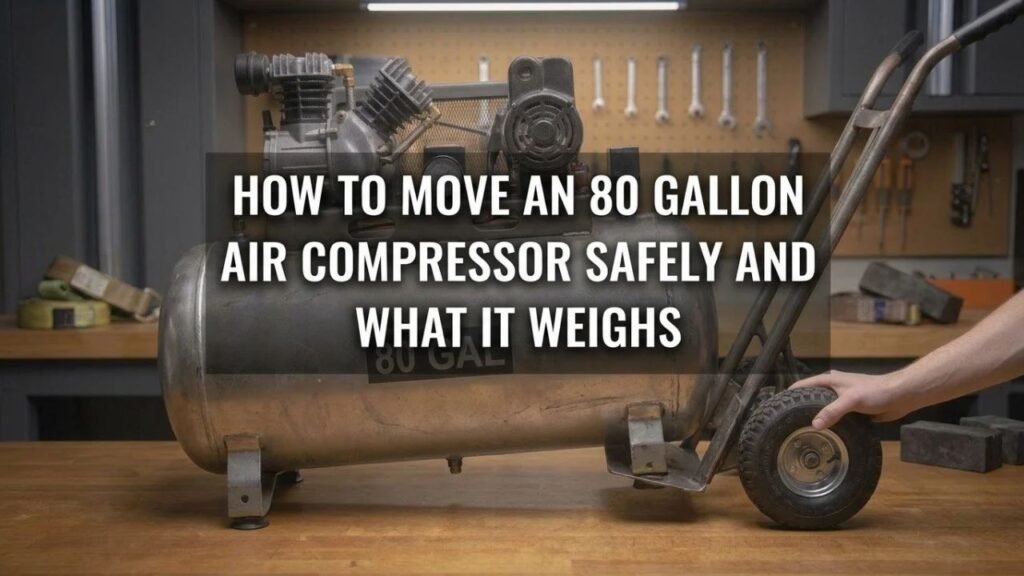
There is no universal weight for an 80-gallon compressor.
A reasonable general range is approximately:
350–650 pounds for many stationary 80-gallon shop compressors
Some units fall outside that range.
Lighter 80-Gallon Compressors
A relatively simple single-stage or lighter-duty vertical model may weigh roughly:
300–400 pounds
Weight can stay lower when the compressor uses:
- Smaller motor
- Lighter pump
- Simplified frame
- Smaller belt guard
- Fewer accessories
Typical Two-Stage Shop Compressors
Many 5 HP two-stage 80-gallon machines fall around:
400–600 pounds
A cast-iron pump, large electric motor, flywheel, belt guard, and heavier receiver all add weight.
Heavy Industrial Compressors
Larger commercial packages may weigh:
600–800 pounds or more
Additional weight can come from:
- Larger pump
- 7.5 HP or larger motor
- Heavy-duty receiver
- Control panel
- Aftercooler
- Belt enclosure
- Industrial mounting frame
Shipping Weight May Be Higher
Do not confuse net compressor weight with shipping weight.
Shipping weight can include:
- Pallet
- Crate
- Packaging
- Accessories
A machine listed at 500 pounds may arrive with a substantially higher total shipping weight.
Key Takeaway: Most 80-gallon compressors weigh several hundred pounds, with roughly 350–650 pounds being a useful general range, but always verify the exact model before selecting lifting equipment.
Why an 80-Gallon Compressor Is Difficult to Move
Weight is only part of the problem.
The Compressor Is Top-Heavy
On a vertical machine, the heaviest components are often mounted near the top:
- Motor
- Pump
- Flywheel
- Belt assembly
This raises the center of gravity.
A vertical compressor can therefore begin tipping sooner than its appearance suggests.
The Tank Is Tall
Many 80-gallon vertical compressors stand around five to six feet tall.
Doorways, ceilings, trailers, and pickup beds can create clearance problems.
The Base Is Relatively Narrow
The tank feet occupy a much smaller footprint than the compressor’s height.
A sudden tilt can move the center of gravity beyond the base.
Many Components Are Fragile
The compressor may have exposed:
- Pressure switch
- Gauges
- Regulator
- Air filter
- Safety valve
- Drain valve
- Electrical box
- Copper discharge tubing
None of these should be used as lifting points.
Key Takeaway: An 80-gallon compressor is difficult to move because several hundred pounds are concentrated in a tall, relatively narrow package with vulnerable components attached to it.
How to Find the Exact Weight of Your 80-Gallon Compressor
Find the actual weight before moving the machine.
Check the Product Manual
Look for specifications such as:
- Net weight
- Unit weight
- Shipping weight
Use net or unit weight when estimating the bare compressor.
Check the Manufacturer Specification Sheet
Search by exact model number.
Two visually similar 80-gallon compressors from the same brand can have very different weights.
Look at the Nameplate
The main data plate may provide model information even if it does not list weight directly.
Use that model number to find the specifications.
Check Original Shipping Information
If the compressor was delivered on a pallet, its freight paperwork may include shipping weight.
Remember to subtract the pallet or packaging weight if necessary.
What Equipment Should You Use to Move an 80-Gallon Compressor?
Mechanical handling is normally the safest approach.
Forklift
A forklift is one of the best options when:
- Compressor is palletized
- Fork access is available
- Floor can support the equipment
- Operator is trained
Keep the load low while traveling.
Do not raise a tall compressor unnecessarily.
Pallet Jack
A pallet jack works well on a smooth level floor when the compressor is securely attached to a suitable pallet.
It is useful for moving the machine around:
- Warehouse
- Garage
- Shop floor
A pallet jack does not solve stairs, truck loading, or large floor-height changes.
Liftgate
A truck with a properly rated hydraulic liftgate is a good option for transporting a compressor between locations.
The liftgate should have:
- Enough weight capacity
- Enough platform space
- Stable surface
- Suitable restraint points
Keep the compressor secured while the platform moves.
Engine Hoist
An engine crane may work if:
- Its capacity exceeds the compressor weight at the required boom extension
- The manufacturer provides an approved lifting arrangement
- Appropriate rigging is used
An engine hoist’s rated capacity often decreases as the boom is extended.
Read the capacity markings rather than relying on the crane’s maximum advertised rating.
Machinery Dolly
Heavy machinery dollies can move a compressor over a flat shop floor.
The compressor needs to be secured so it cannot slide or tip.
A standard household hand truck may not have sufficient weight capacity or stability.
Key Takeaway: Forklifts, pallet jacks, liftgates, engine hoists, and rated machinery dollies are safer choices than attempting to lift or carry an 80-gallon compressor manually.
How to Move an 80 Gallon Air Compressor Step by Step
Preparation should happen before the compressor moves even an inch.
Step 1: Shut the Compressor Off
Turn the pressure switch to OFF.
Disconnect electrical power.
If the unit is hardwired, isolate the circuit at the appropriate disconnect or breaker before electrical disconnection.
Step 2: Release All Tank Pressure
Drain the receiver until the pressure gauge reads zero.
Do not transport a large compressor unnecessarily while its tank contains compressed air.
Open the drain carefully after pressure is reduced.
Step 3: Drain Condensation
Remove accumulated water from the receiver.
This also prevents condensate from moving around inside the tank during transport.
Step 4: Disconnect the Air Piping
Remove the connection between the compressor and shop distribution system.
Do not pull the compressor away while rigid air piping is still attached.
Step 5: Disconnect Electrical Wiring
For plug-in equipment, unplug it.
A large 80-gallon compressor is often hardwired for 240V or three-phase power.
Permanent electrical connections should be handled correctly before the machine is moved.
Step 6: Remove Floor Anchors
Stationary compressors may be bolted to concrete.
Remove:
- Anchor nuts
- Mounting bolts
- Vibration pads when appropriate
Check that no hidden wiring or piping remains attached.
Step 7: Protect Fragile Components
Protect:
- Air filter
- Pressure switch
- Gauges
- Motor
- Pump
- Belt guard
- Drain
Do not place straps over components that can bend or crack.
Step 8: Attach the Correct Moving Equipment
Use:
- Pallet
- Forklift
- Hoist
- Machinery dolly
- Liftgate
based on the environment.
Confirm every device has enough capacity for the actual compressor weight.
Step 9: Keep the Compressor Upright
Move it vertically whenever possible.
Keep movements slow.
Avoid:
- Sharp turns
- Sudden stops
- Uneven surfaces
- Side slopes
Step 10: Secure It During Transport
Use appropriately rated tie-downs.
Restrain the compressor against movement:
- Forward
- Backward
- Sideways
Do not rely on its weight to keep it stationary.
Step 11: Position It at the New Location
Place the compressor on a:
- Solid
- Level
- Load-bearing
surface.
Leave the clearances required by the manufacturer for cooling and service.
Step 12: Reinstall and Inspect
Before operating:
- Anchor as required
- Reconnect electrical power properly
- Reconnect air piping
- Check pump oil
- Inspect for transport damage
- Confirm valves and guards are intact
Key Takeaway: Depressurize, drain, disconnect, protect, mechanically lift, transport upright, secure the load, and inspect the compressor before putting it back into service.
Should You Move an 80-Gallon Compressor Upright?
Yes, upright is normally the preferred orientation.
It Protects Pump Oil
Many large 80-gallon compressors have oil-lubricated pumps.
Keeping the compressor vertical keeps oil where the pump was designed to hold it.
It Protects Mounted Components
Upright handling reduces the chance of the machine resting on:
- Motor
- Pump
- Guard
- Pressure switch
- Fittings
Tank Drain Orientation Remains Normal
Any remaining condensation stays toward the normal drain area.
It Matches the Machine’s Structure
The tank feet and base are designed to carry the machine while vertical.
Key Takeaway: Keep an 80-gallon compressor upright whenever possible because its pump lubrication, feet, component layout, and structural support are designed around vertical orientation.
Can You Lay an 80-Gallon Air Compressor Down to Move It?
Sometimes transportation space makes horizontal placement tempting, but it is not the preferred approach.
Check the Manufacturer Instructions First
Some manufacturers may prohibit horizontal transportation or specify a particular side.
Follow model-specific guidance.
Oil-Lubricated Pumps Can Leak Internally
Pump oil may migrate into:
- Cylinder
- Intake
- Breather
- Air filter
when the compressor lies down.
The Machine Can Rest on Fragile Parts
A horizontal compressor may place hundreds of pounds against:
- Pump assembly
- Motor
- Guard
- Wiring box
Support must be arranged around structural areas.
Let It Sit Upright Before Restarting
If an oil-filled compressor has been transported horizontally, return it to its normal position and allow displaced oil to settle before startup.
Inspect:
- Oil level
- Air filter
- Breather
- Pump
before operating.
How to Move an 80-Gallon Compressor With a Forklift
A forklift is often the safest approach for a palletized compressor.
Use a Strong Pallet
The pallet must support the entire load.
A weak or damaged shipping pallet can collapse.
Strap the Compressor to the Pallet
Do not simply set the compressor on a pallet.
Secure it against tipping.
Center the Forks
Spread the forks appropriately for stability.
Keep the compressor’s center of gravity between them.
Tilt Carefully
Use only the amount of mast tilt needed to stabilize the load.
Excessive tilt is undesirable with a tall compressor.
Keep the Load Low
Travel with the compressor close to the floor.
A high load increases tipping risk.
How to Move an 80-Gallon Compressor With an Engine Hoist
An engine hoist can work in garages where a forklift cannot enter.
Check Hoist Capacity at Boom Length
A crane labeled “2 ton” may only support its full rating with the boom in its shortest position.
Extended positions typically have lower ratings.
Use Approved Lifting Points
If the manufacturer provides a lifting eye or lifting instructions, follow them.
Do not lift from:
- Motor
- Pump head
- Belt guard
- Air piping
- Safety valve
- Pressure switch
Keep Rigging Clear of Fragile Equipment
Chains or straps can crush components even when they are strong enough to hold the weight.
Lift Only Enough to Move
Avoid suspending the compressor higher than needed.
Place it onto:
- Heavy pallet
- Machinery dolly
- Trailer
as soon as practical.
Key Takeaway: An engine hoist can move a large compressor if both the crane and rigging are rated for the load and attached only to approved structural lifting points.
How to Get an 80-Gallon Compressor Into a Truck or Trailer
Loading creates one of the greatest tipping risks.
A Liftgate Is a Strong Option
A properly rated hydraulic liftgate keeps the compressor upright and avoids manually pushing it up a steep ramp.
A Forklift Is Even Better When Available
Lift a secured pallet directly onto the trailer or truck deck.
Be Cautious With Ramps
Trying to push a 400–600 pound top-heavy compressor up portable ramps manually is risky.
If ramps must be used, they need to be:
- Rated for the total load
- Properly secured
- Wide enough
- Supported correctly
A rated winch or other controlled mechanical system is preferable to people pushing from below.
Keep People Out of the Fall Path
Never stand downhill or directly behind a compressor being moved up a ramp.
If the load gets away, people should have a clear escape path.
Key Takeaway: Use a forklift or liftgate when possible; manually pushing a several-hundred-pound vertical compressor up ramps creates significant tipping and crushing risk.
How to Secure an 80-Gallon Compressor for Transport
Once loaded, the compressor must not move.
Use Rated Tie-Down Straps
Use load-rated ratchet straps suitable for the compressor’s weight.
Inspect them for:
- Cuts
- Fraying
- Damaged hooks
- Worn stitching
Restrain Multiple Directions
One strap may prevent tipping in only one direction.
Secure the machine against:
- Forward movement
- Rearward movement
- Side movement
- Tipping
Attach to Structural Areas
Do not tighten straps over fragile components.
Straps should load:
- Tank
- Structural frame
- Approved securement locations
without damaging the machine.
Block the Base
Wheel chocks or structural blocking can reduce sliding.
Do not use loose scrap pieces that can move during transportation.
Recheck After Driving
After a short distance, stop safely and inspect the restraints.
Tall loads can settle and loosen straps.
Can You Move an 80-Gallon Compressor With a Hand Truck?
A heavy-duty appliance or machinery hand truck may work in limited conditions, but capacity and stability must be verified.
Standard Hand Trucks Are Often Too Small
A household dolly may be rated for only a fraction of the compressor’s weight.
Do not exceed its rating.
Tilting Is the Dangerous Part
To put a vertical compressor onto a hand truck, the machine has to be tilted.
As soon as the center of gravity moves beyond the feet, its full weight becomes much harder to control.
Use Straps
Secure the tank to the dolly before moving.
Avoid Stairs
Moving a 400–600 pound compressor up or down stairs with a normal hand truck is unsafe.
Use professional machinery-moving equipment.
Key Takeaway: Only a properly rated heavy-duty machinery dolly should be considered, and stairs or major elevation changes call for specialized moving equipment.
Can Two People Move an 80-Gallon Air Compressor?
Two people should not plan to manually carry an 80-gallon compressor.
Even a relatively light unit may weigh several hundred pounds.
Weight Is Too High
If the compressor weighs 450 pounds, dividing that number by two does not make it a safe 225-pound lift per person.
The load is:
- Awkward
- Tall
- Unbalanced
- Difficult to grip
One Person Can Receive More of the Weight
If the compressor tilts slightly, a large portion of the load can suddenly shift to one person.
Crushing Injuries Are Possible
Hands, feet, and legs can become trapped between the tank and:
- Floor
- Wall
- Truck
- Dolly
Use people to guide the load while mechanical equipment supports the weight.
How to Move an 80-Gallon Compressor Across a Garage
For a short move on smooth concrete, a pallet jack or machinery dolly is usually practical.
Disconnect Everything First
Do not try to gain a few feet of movement by stretching:
- Electrical cable
- Copper pipe
- Air hose
Disconnect properly.
Protect the Floor
Very small hard wheels can damage some coated floors under a heavy point load.
Use equipment suitable for the surface.
Watch Door Clearance
Measure both:
- Compressor height
- Door opening
before moving.
Also measure width at:
- Motor
- Pump
- Belt guard
rather than tank diameter alone.
Plan the Route
Remove:
- Tools
- Hoses
- Vehicles
- Extension cords
before starting.
A heavy compressor is not easy to stop mid-move to clear an obstacle.
How to Move an 80-Gallon Compressor Through a Doorway
Measure before lifting.
Check Total Height
The compressor may fit in the room but not through the doorway.
Check Widest Point
The motor and belt guard can extend beyond the tank.
Remove Only Approved Components
Some accessories may be removable, but do not dismantle:
- Pump
- Motor mounts
- Pressure plumbing
just to squeeze through an opening unless the service instructions permit it.
Avoid Tipping Unless Necessary
Leaning the compressor to clear a low doorway changes its center of gravity quickly.
Mechanical support is essential if the unit must be tilted.
Does an 80-Gallon Compressor Need to Be Bolted Down?
Many stationary compressors are designed to be anchored according to manufacturer installation instructions.
Anchoring Controls Movement
A reciprocating compressor generates vibration.
Proper anchoring helps prevent:
- Walking
- Excess movement
- Piping stress
Vibration Pads May Be Required
Some installations use approved isolation pads between the compressor feet and floor.
Do not improvise thick soft pads that allow excessive movement.
Do Not Pull the Tank Into an Uneven Floor
If all feet do not sit level, forcing the tank down with anchor bolts can place unwanted stress on the receiver.
Level or shim the installation according to the manufacturer’s procedure.
What Should You Check After Moving the Compressor?
Transportation can loosen or disturb components.
Check Pump Oil
Verify the level with the compressor upright and level.
Inspect the Belt
Look for:
- Correct tension
- Damage
- Alignment
Make sure the guard is securely installed.
Check the Air Filter
Make sure it has not:
- Broken
- Filled with oil
- Come loose
Inspect Copper and Steel Lines
Look for transport damage around:
- Pump discharge
- Check valve
- Unloader line
Inspect Electrical Components
Verify that:
- Wires are secure
- Conduit is intact
- Motor connections are protected
Check the Drain Valve
Make sure the bottom fitting was not damaged during loading.
Run a Leak Check
After installation and pressurization, listen and test for leaks around any connections that were disturbed.
Key Takeaway: Check oil, belt condition, plumbing, electrical connections, drain fittings, guards, and air leaks before returning a moved compressor to normal service.
Common Mistakes When Moving an 80-Gallon Air Compressor
A few shortcuts create unnecessary risk.
Guessing the Weight
Find the model-specific weight before choosing lifting equipment.
Moving It While Pressurized
Depressurize the receiver first.
Lifting by the Motor or Pump
These are not general-purpose lifting handles.
Using the Belt Guard as a Handhold
A thin metal guard can bend.
Pulling on Air Plumbing
Copper lines and fittings can crack or deform.
Using an Underrated Dolly
Moving equipment needs enough capacity for the complete compressor.
Letting It Ride Unsecured
A tall compressor can tip during braking or cornering.
Pushing It Up a Ramp by Hand
A several-hundred-pound machine can roll backward or fall sideways.
Forgetting Pump Oil After Tipping
Oil-lubricated compressors need inspection and settling time after unusual orientation.
Key Takeaway: Verify weight, use rated lifting equipment, keep the compressor depressurized and upright, protect mounted components, and secure it firmly during transportation.
How Much Moving Capacity Should Your Equipment Have?
Do not select a hoist or dolly with a capacity exactly equal to an estimated compressor weight.
Start With the Actual Weight
Suppose the compressor weighs:
525 pounds
Your lifting equipment must safely exceed that load in the exact configuration being used.
Boom Position Matters
For an engine crane, capacity changes with boom extension.
A hoist may be rated for:
- 2 tons at one position
- 1 ton at another
- 1/2 ton at full extension
Use the rating for the actual boom position.
Include Added Equipment
If lifting:
- Compressor
- Pallet
- Rigging
- Cradle
the lifting device carries all of it.
Follow Equipment Ratings
Do not improvise a personal safety factor by guessing.
Use equipment according to its rated working capacity and instructions.
How Much Does an Empty 80-Gallon Tank Weigh?
The receiver alone weighs much less than the complete compressor, but exact tank weight varies considerably.
Factors include:
- Steel thickness
- Diameter
- Working-pressure rating
- Welded feet
- Number of ports
- Tank construction
The complete compressor adds a large amount of weight from:
- Motor
- Pump
- Flywheel
- Belt
- Guard
- Pressure controls
- Plumbing
This is why tank capacity alone is a poor way to estimate shipping or moving weight.
Conclusion
For how to move 80 gallon air compressor, treat the machine as heavy equipment rather than ordinary garage furniture. Most units weigh several hundred pounds and have a high center of gravity, making mechanical assistance the safest way to move them.
For how much does a 80 gallon air compressor weigh, roughly 350–650 pounds is a reasonable general estimate for many stationary shop models. Some lighter machines may fall closer to 300 pounds, while heavy commercial compressors can exceed 700 pounds. Always use the exact model specification when planning a move.
Depressurize the receiver, drain condensation, disconnect power and air piping, remove floor anchors, and protect the pump and controls. Keep the compressor upright whenever possible and move it with a forklift, pallet jack, liftgate, rated machinery dolly, or properly configured hoist.
During vehicle transport, secure the tank against movement in every direction. Once it reaches the new location, inspect the pump oil, plumbing, electrical system, belt drive, guards, and tank fittings before reconnecting and operating it.
FAQs About Moving an 80-Gallon Air Compressor
How much does an 80-gallon air compressor usually weigh?
Many 80-gallon stationary compressors weigh roughly 350–650 pounds empty. Lighter models may be closer to 300 pounds, while heavy industrial machines can exceed 700 pounds.
Can two people move an 80-gallon air compressor?
Two people can help guide it, but they should not plan to carry the full machine manually. Its weight, height, and high center of gravity make mechanical moving equipment much safer.
Can you lay an 80-gallon air compressor on its side?
Upright transportation is preferable. If the manufacturer permits horizontal transport, protect the motor, pump, fittings, and controls. An oil-lubricated compressor should be returned upright and allowed to settle before startup.
Can I move an 80-gallon compressor with an engine hoist?
Yes, if the hoist has enough capacity at the required boom position and the compressor has a safe approved lifting arrangement. Never lift it by the pump, motor, guard, or air plumbing.
Can I use a pallet jack to move an 80-gallon air compressor?
Yes, if the compressor is securely attached to a strong pallet and the pallet jack is appropriately rated. This works best on smooth, level floors.
How do I transport an 80-gallon air compressor in a truck?
Keep it upright when possible, use a forklift or rated liftgate for loading, and secure it with properly rated restraints so it cannot slide or tip during braking and cornering.
Should I drain an 80-gallon compressor before moving it?
Release all tank pressure and drain condensate before moving it. For an oil-lubricated pump, do not automatically drain pump oil unless the manufacturer recommends it for the planned transport orientation.
Is an 80-gallon air compressor too heavy for a normal dolly?
Often, yes. Many ordinary household hand trucks are not designed for a several-hundred-pound, top-heavy compressor. Use a machinery dolly or other moving equipment rated for the actual load.