
How Many Amps Does a 20 Gallon Air Compressor Use? Circuit Guide
Most 20-gallon electric air compressors made for a standard U.S. outlet draw roughly 14–15 amps at 120 volts. The exact amperage depends on motor horsepower, voltage, compressor design, and operating load. Startup current is briefly higher than normal running current, so the outlet and branch circuit also need to meet the compressor manufacturer’s electrical requirements.
Tank capacity alone does not determine electrical consumption. Two compressors can both have 20-gallon tanks while using different motors, producing different CFM, and drawing different amounts of current.
Current U.S.-market examples show the pattern clearly. A WEN 20-gallon compressor is rated at 120V and 15A, a Campbell Hausfeld 20-gallon model is listed at 120V and 14A, and several DeWalt 20-gallon units carry 15A ratings.
For how many amps does a 20 gallon air compressor use, a practical starting range is about 14–15 amps for many 120V portable models. Some units draw less, and compressors equipped with dual-voltage or larger induction motors may have different amperage ratings when wired for 240V.
The circuit matters almost as much as the compressor’s running amperage. A motor draws a short surge when it starts, and voltage drop from a long or undersized extension cord can make starting harder and cause the breaker to trip.
The sections below explain typical 120V and 240V amperage, startup current, breaker sizing, extension cords, motor horsepower, amperage calculations, and how to find the exact figure for any 20-gallon compressor.
How Many Amps Does a 20 Gallon Air Compressor Use at 120V?
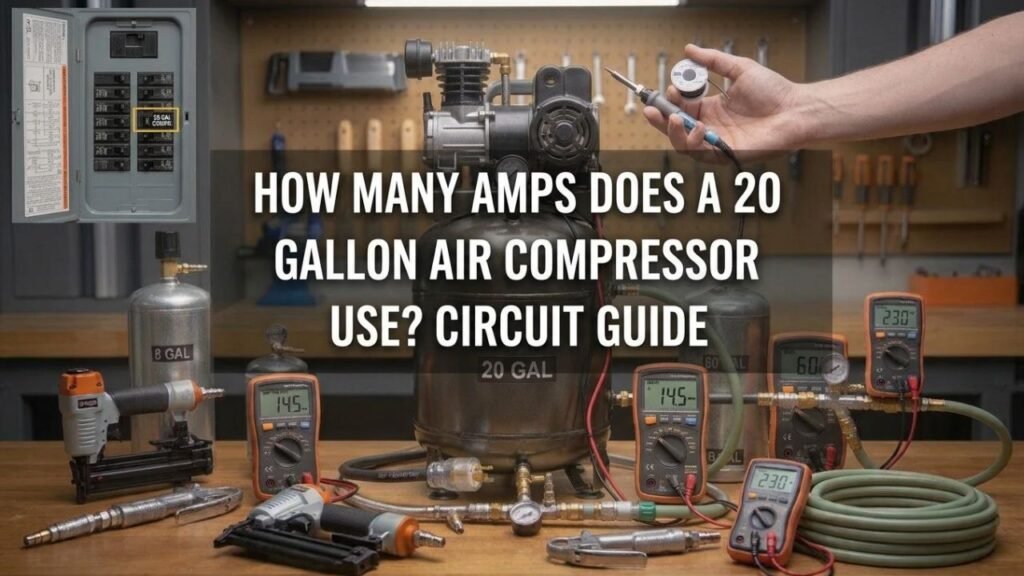
Many 20-gallon portable compressors sold for residential garages operate from a standard 120V single-phase supply and are rated around 14–15 amps.
That range is common because manufacturers design portable compressors to operate from ordinary household-style receptacles rather than requiring a dedicated 240V installation.
A 20-gallon tank itself uses no electricity. The motor driving the compressor pump creates the electrical load.
Typical 120V Amp Draw
A useful general range looks like this:
| 20-Gallon Compressor Type | Voltage | Typical Rated Amperage |
| Smaller portable electric | 120V | About 10–13A |
| Common 1.5–2 HP portable | 120V | About 14–15A |
| Higher-output portable | 120V | Often near 15A |
| Dual-voltage unit wired for 120V | 120V | Often near 15A |
These are broad ranges rather than specifications for every model.
The compressor nameplate should always take priority.
Current 20-Gallon Compressor Examples
Several current product specifications illustrate the common range:
- WEN 20-gallon, 2 HP compressor: 120V, 15A
- Campbell Hausfeld 20-gallon portable compressor: 120V, 14A
- DeWalt 20-gallon, 200 PSI compressor: 120V, 15A
- DieHard 20-gallon compressor: 15A
- Goodyear 20-gallon compressor: 15A
These examples also show why saying every 20-gallon compressor uses exactly 15 amps would be inaccurate.
Running Amps Can Change During Operation
The amperage printed on a specification sheet is not necessarily what an electrical meter will display every second the motor runs.
Actual current can change with:
- Tank pressure
- Pump load
- Supply voltage
- Motor temperature
- Mechanical condition
- Extension-cord voltage drop
- Compressor design
The motor generally works hardest as tank pressure rises toward the pressure-switch cutout point.
Key Takeaway: Many 120V 20-gallon compressors fall near 14–15 amps, but motor and model specifications—not tank capacity—determine the actual electrical load.
How Many Amps Does a 20 Gallon Air Compressor Use at 240V?
A compressor operating at 240V can draw fewer amps than a comparable motor operating at 120V for a similar power level.
Some 20-gallon compressors use dual-voltage motors that can be rewired from 120V to 230/240V.
Why Amps Drop When Voltage Increases
Electrical power is related to voltage and current.
A simple DC-style estimate is:
Watts = Volts × Amps
If a load required 1,800 watts:
At 120V:
1,800 ÷ 120 = 15 amps
At 240V:
1,800 ÷ 240 = 7.5 amps
Real AC induction motors also involve efficiency and power factor, so this calculation should be treated as a rough illustration rather than a motor-nameplate calculation.
Dual-Voltage Compressors
Some 20-gallon compressors are supplied wired for 120V but have motors that can be converted to 230/240V operation.
One DeWalt 20-gallon model, for example, uses a dual-voltage motor supplied for 120V operation and capable of conversion for 230/240V use.
The 240V amp rating must come from the motor nameplate or manufacturer wiring information.
Do not assume the 240V amperage is exactly one-half of the 120V rating.
Do Not Rewire a Compressor Without the Correct Motor
A compressor can operate at another voltage only if its motor and controls are designed for that voltage.
Connecting a 120V-only motor to 240V can destroy electrical components and create shock or fire hazards.
A dual-voltage conversion may also require changes to motor leads, plug, receptacle, branch circuit, pressure-switch wiring, or overload protection.
If the wiring diagram is unclear, use a qualified electrician.
Key Takeaway: A 240V compressor often draws fewer amps than a similar 120V unit, but the exact rating must come from the motor nameplate and wiring instructions.
Why Tank Size Does Not Determine Compressor Amps
A common mistake is assuming a larger air tank automatically means a larger electrical load.
Tank capacity and motor power describe different parts of the compressor.
What the 20-Gallon Rating Means
The 20-gallon number describes the approximate volume of the compressed-air storage tank.
A larger tank stores more compressed air before the motor has to cycle again.
It does not directly tell you:
- Motor amperage
- Horsepower
- Voltage
- CFM output
- Pump design
- Maximum PSI
- Motor startup current
You could install similar motors on tanks of different sizes and still have similar electrical demand while the motors are running.
Motor Size Has a Bigger Effect
The electric motor drives the compressor pump.
A higher-output pump generally requires more mechanical power, which usually means more electrical input.
Common 20-gallon compressors may use motors advertised around 1.5–2 HP, but advertised horsepower values are not enough for circuit sizing.
Use the actual nameplate amperage.
CFM Is Different From Tank Capacity
CFM tells you how much air the compressor can deliver under specified pressure conditions.
A 20-gallon compressor producing 6 SCFM at 90 PSI may need a stronger motor than another 20-gallon unit producing 3.8 SCFM at the same pressure.
The tanks can be identical in volume while the electrical demands are different.
Key Takeaway: Gallons describe stored air; motor voltage, amperage, horsepower, and pump output describe the electrical and mechanical workload.
Running Amps vs Starting Amps
The motor does not draw the same current during startup and steady operation.
This difference explains many compressor breaker problems.
Running Amps
Running current is the current used after the motor reaches normal operating speed and the compressor pump is working.
For many 120V 20-gallon units, the listed running or rated load falls near the 14–15A range.
The current may rise as tank pressure increases because the pump is compressing air against greater pressure.
Starting Amps
An electric motor draws a much larger current for a short period while starting.
At zero RPM, the motor has not yet developed the electrical conditions present at full speed. That produces a brief surge before current settles down.
You may notice this as:
- Lights dimming briefly
- Breaker trips at startup
- Motor humming without turning
- Compressor struggling to restart with pressure in the tank
The exact starting current varies by motor.
Why a Compressor May Trip a Breaker Only at Startup
A breaker can tolerate certain short motor-starting surges, but several conditions can push the circuit past its limit:
- Another appliance is using the same circuit
- Long extension cord
- Cord wire is too small
- Low supply voltage
- Compressor starting against pressure
- Weak start capacitor
- Bad check valve
- Motor problem
- Cold oil on an oil-lubricated compressor
- Loose electrical connection
Some compressor manuals specifically state that no other appliances or lights should share the branch circuit while the compressor is operating. A Campbell Hausfeld 120V, 15A manual gives that condition for operation on a 15A circuit.
Key Takeaway: Running amperage describes normal motor operation, while startup creates a short higher-current surge that can expose weak wiring, low voltage, or circuit-sharing problems.
Does a 20-Gallon Air Compressor Need a 15A or 20A Circuit?
There is no single breaker requirement for every 20-gallon compressor.
Check the compressor data plate and owner’s manual.
Some 15A Models Can Use a 15A Circuit
Certain 120V compressors rated at or near 15A are approved by their manufacturer for a 15A branch circuit under specific conditions.
One 20-gallon compressor manual states that a 120V, 15A unit can operate on a 15A circuit when:
- No other electrical loads share the circuit
- Supply voltage is correct
- The specified breaker or time-delay fuse is used
- Wiring length and conductor size meet the manual’s requirements
That does not mean every 15A compressor belongs on every 15A household circuit.
A 20A Circuit May Reduce Nuisance Trips on Approved Models
Some manufacturer documentation notes that 120V operation from a 20A circuit may be an option if required installation conditions are not met or nuisance tripping occurs.
This does not mean replacing a 15A breaker with a 20A breaker is a safe DIY fix.
The breaker must match the branch-circuit wiring and applicable electrical requirements. A 20A breaker generally requires wiring and receptacle arrangements suitable for that circuit.
Never install a larger breaker simply to stop trips.
Dedicated Circuit Is Often a Good Setup
A compressor motor places a large intermittent load on a household circuit.
Sharing the same circuit with a refrigerator, heater, saw, shop vacuum, lights, or battery charger can push total current beyond the circuit’s capacity.
For a workshop installation, a correctly sized dedicated branch circuit gives the motor a cleaner electrical supply and leaves less chance of another device starting at the same moment.
Key Takeaway: Some 20-gallon compressors are approved for a 15A circuit, while others work better or require a 20A or 240V setup; follow the exact model’s electrical instructions.
Can You Run a 20-Gallon Compressor From a Regular Outlet?
Many portable 120V 20-gallon compressors are made for standard grounded U.S. receptacles.
The plug design, nameplate, and manual will tell you.
A regular receptacle still needs a suitable branch circuit behind it. An outlet that physically accepts the plug does not guarantee adequate voltage or circuit capacity.
Check the Voltage
Most portable units in this class are 120V, though some are dual-voltage.
Never plug a compressor into an improvised adapter that changes plug style without confirming voltage and grounding.
Check What Else Is on the Circuit
The compressor may operate normally until another load starts.
For example, a 15A compressor sharing a circuit with shop lights and a vacuum can create an overload even if each item works normally by itself.
Check for Voltage Drop
Long wire runs and undersized extension cords cause voltage to fall at the compressor.
A motor trying to start with low voltage can draw excessive current, heat up, hum, or trip the breaker.
The farther the compressor is from the electrical panel, the more attention wire size deserves.
Key Takeaway: Many 20-gallon 120V compressors plug into a regular grounded outlet, but the branch circuit, voltage, wiring, and other connected loads still need to meet the manual.
Can You Use an Extension Cord With a 20-Gallon Air Compressor?
The better setup is usually to place the compressor close to the outlet and extend the air hose instead of the power cord.
If an extension cord is permitted, use the wire size and maximum length stated in the owner’s manual.
Why Thin Extension Cords Cause Problems
Every conductor has electrical resistance.
Longer and thinner cords create more voltage drop.
That can make the compressor:
- Start slowly
- Hum
- Trip the breaker
- Overheat the motor
- Stop before reaching full speed
A light household extension cord intended for lamps or small electronics is a poor match for a large compressor motor.
Wire Gauge Matters
A lower AWG number means a thicker conductor.
For example, 12 AWG wire is thicker than 14 AWG.
One 20-gallon compressor manual specifies progressively heavier wire as extension-cord length increases, showing how strongly cord length affects motor supply voltage.
Follow your specific manual rather than applying one cord size to every compressor.
Key Takeaway: Long, undersized extension cords can reduce voltage and raise motor stress; extending the air hose is usually preferable to extending the power connection.
How to Find the Exact Amp Draw of Your 20-Gallon Compressor
You do not need to guess based on tank size.
The compressor usually provides the answer in one of three places.
1. Read the Motor or Compressor Nameplate
Look for a label on the motor, pump cover, tank frame, or control housing.
The label may show:
- Voltage
- Amps
- Hertz
- Phase
- Horsepower
- Duty rating
- Model number
Look for markings such as:
120V — 15A — 60 Hz — 1 Phase
That is much more useful than the 20-gallon tank label.
2. Check the Owner’s Manual
Search the electrical specifications section using the exact model number.
The manual may give details that do not fit on the nameplate, such as:
- Minimum branch-circuit size
- Breaker or fuse type
- Extension-cord limits
- Dual-voltage wiring
- Grounding instructions
- Recommended conductor size
Do not rely on another compressor’s manual just because the tank size is the same.
3. Measure Current With a Clamp Meter
A qualified person can measure running current with a suitable clamp meter.
Measurement can show how current changes during:
- Startup
- Low tank pressure
- High tank pressure
- Recovery
- Near cutout pressure
The meter and test method must be suitable for the circuit.
Opening electrical equipment to access conductors creates shock and arc hazards, so leave live electrical measurements to someone trained to perform them if the conductors are not safely accessible.
Key Takeaway: The nameplate and owner’s manual provide the correct rated amperage; a proper current measurement can show what the motor draws under real operating conditions.
How to Estimate Air Compressor Amps From Watts
If a compressor lists watts but not amps, you can make a rough estimate.
For a simple resistive load:
Amps = Watts ÷ Volts
For example:
1,500 watts ÷ 120 volts = 12.5 amps
A compressor motor is an AC inductive load, so the real relationship also involves motor efficiency and power factor.
That means watts divided by volts should not replace the motor’s rated amperage when selecting a breaker or wiring.
Do Not Calculate From Horsepower Alone
One mechanical horsepower equals about 746 watts, but a motor needs more electrical input power than its mechanical output because no motor is 100% efficient.
A compressor advertised as 2 HP therefore cannot be accurately assigned an amp draw using:
2 × 746 ÷ 120
Motor labeling, peak horsepower marketing, efficiency, power factor, and actual shaft load can all change the result.
Use horsepower to compare general motor size, not to select electrical protection.
Why Does My 20-Gallon Compressor Keep Tripping the Breaker?
A breaker that trips repeatedly is giving you a symptom that deserves diagnosis.
Do not solve it by installing a larger breaker without checking the wiring and compressor.
Circuit Is Overloaded
Check for other devices sharing the branch circuit.
A compressor near the circuit’s capacity may run normally alone but trip the breaker as soon as another load operates.
Extension Cord Is Too Long or Thin
Voltage drop can make the motor struggle to start.
Test the compressor directly from a suitable outlet if the manufacturer’s instructions permit that setup.
Low Supply Voltage
Poor wiring connections, excessive circuit length, utility voltage issues, or overloaded wiring can lower voltage at the motor.
The compressor may then draw more current while producing less starting torque.
Compressor Is Starting Under Excess Pressure
A pressure-switch unloader normally releases trapped discharge pressure when the compressor stops.
If the unloader or tank check valve fails, the motor may have to restart against high head pressure.
A common clue is a compressor that starts easily with an empty tank but struggles during automatic restart.
Start Capacitor or Motor Is Failing
Many induction motors use starting components to produce the torque needed to begin turning.
A failing capacitor, switch, winding, or bearing can raise startup current and cause breaker trips.
Pump Has Excess Mechanical Load
Mechanical trouble can also overload the motor.
Possible causes include:
- Pump damage
- Seized bearing
- Cold or incorrect compressor oil
- Belt problem
- Internal pump wear
Key Takeaway: Breaker trips can come from circuit overload, voltage drop, restart pressure, motor faults, or pump resistance—not simply from the compressor having a 20-gallon tank.
Conclusion
For how many amps does a 20 gallon air compressor use, many common 120V portable models draw about 14–15 amps, with some compressors falling below that range. The exact number comes from the motor and electrical design rather than the tank capacity.
A 240V or dual-voltage compressor may draw fewer amps at the higher supply voltage. Startup current is also briefly higher than normal running current, which explains why a compressor can trip a breaker even when its listed running amperage appears to fit the circuit.
Check the nameplate and manual before choosing an outlet, breaker, extension cord, or generator. Never increase breaker size without confirming that the branch-circuit wiring and compressor installation are suitable for it.
I would treat the compressor’s published electrical requirements as the deciding numbers. If your 20-gallon model says 120V and 15A, plan the circuit around those specifications rather than assuming every 20-gallon machine has the same electrical needs.
FAQs About 20-Gallon Air Compressor Amp Draw
How many amps does a 20-gallon 120V air compressor draw?
Many 120V 20-gallon portable compressors are rated around 14–15 amps. Current examples from WEN, DeWalt, Campbell Hausfeld, DieHard, and Goodyear fall in or near that range. Check the exact model’s nameplate because motor size and pump output vary.
Can a 20-gallon air compressor run on a 15-amp breaker?
Some models can. Manufacturer instructions for certain 120V, 15A compressors permit operation on a 15A circuit when the compressor is the only major load and wiring conditions meet the manual. Other models may require or work better with a different branch-circuit setup.
Does a 20-gallon compressor need a 20-amp outlet?
Not every model does. Many portable 20-gallon units are supplied for ordinary 120V operation, while some installations use a 20A circuit. Follow the compressor manual and local electrical requirements rather than selecting an outlet solely from tank size.
How many amps does a 2 HP air compressor use at 120V?
There is no exact amp rating based on the 2 HP label alone. Many portable 2 HP-class 120V compressors operate near 15 amps, but motor efficiency, horsepower-rating method, pump load, and design affect current. Read the motor nameplate for the correct figure.
Does an air compressor draw more amps when the tank is full?
Motor load generally rises as tank pressure increases because the pump must compress air against greater pressure. Actual current can therefore change during the fill cycle. The pressure switch shuts the motor off when the tank reaches its cutout pressure.
Why does my 15-amp compressor trip a 15-amp breaker?
The motor draws a short current surge while starting. A shared circuit, voltage drop, thin extension cord, failed unloader valve, weak capacitor, motor trouble, or low supply voltage can cause repeated trips. Check the compressor manual and electrical supply before changing breaker size.
Can I run a 20-gallon air compressor on an extension cord?
Only if the manufacturer permits it and the cord meets the specified wire gauge and length. A long, undersized cord can lower voltage and make the motor overheat or trip the breaker. Running a longer air hose is often the better setup.
How do I know the exact amps my air compressor uses?
Read the electrical nameplate on the compressor or motor and check the owner’s manual using the exact model number. Those sources should list voltage and rated amperage. A clamp meter can measure real operating current when used safely by someone familiar with live electrical testing.