
What Can a 20 Gallon Air Compressor Do? Uses and Limits Explained
A 20-gallon air compressor is large enough for tire inflation, nailers, impact wrenches, air ratchets, blow guns, pneumatic grease guns, and many other intermittent garage tools. It offers much more air reserve than a small pancake compressor, but continuous tools such as air sanders and grinders may still consume air faster than the pump can replace it.
Twenty gallons describes the receiver size, not the amount of airflow the compressor can continuously deliver. Two compressors with identical 20-gallon tanks can perform very differently if one produces 4 SCFM at 90 PSI and the other produces 7 SCFM.
For many home garages, a 20-gallon unit sits in a useful middle ground. It stores enough air for short high-demand bursts but remains much easier to fit and move than a 60- or 80-gallon stationary compressor.
If you are asking what can a 20 gallon air compressor do, think of it as a strong light-to-medium-duty garage compressor. It handles intermittent automotive tools much better than a 6-gallon model and can support a broad selection of DIY equipment.
People also ask is 20 gallon air compressor enough for regular home use. It usually is if your main jobs involve inflation, impact tools, nailers, and occasional pneumatic repair work. High-CFM tools used for several minutes at a time are where its limits become apparent.
For is a 20 gallon air compressor big enough, look at SCFM at the tool’s operating pressure before looking at tank gallons. OSHA also restricts compressed-air cleaning above 30 PSI unless proper chip guarding and personal protection are used, so a larger compressor should still be used carefully around blow guns.
What Does a 20-Gallon Air Compressor Mean?
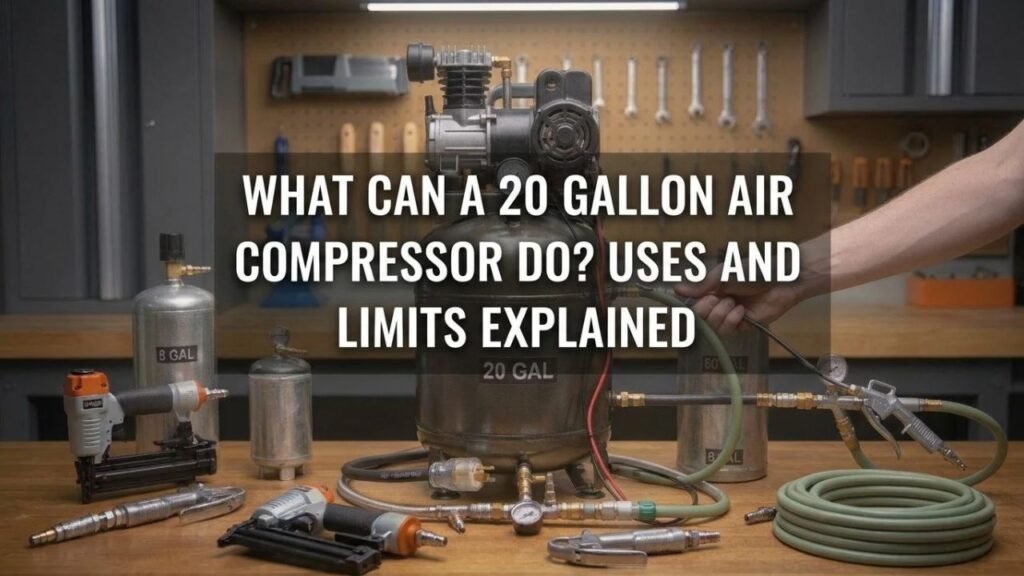
The 20-gallon rating refers to the internal volume of the receiver tank.
It does not describe pump output.
The Tank Stores Compressed Air
While the compressor runs, air is pumped into the receiver until the upper pressure limit is reached.
When you open an air tool:
- Stored air leaves the tank.
- Tank pressure falls.
- The compressor reaches its cut-in pressure.
- The pump starts.
- The pump replaces the air being consumed.
A larger tank lets a tool run longer before pressure falls to the cut-in point.
SCFM Determines Continuous Capability
SCFM tells you how much airflow the pump can provide.
Many 20-gallon compressors fall somewhere around 4–7 SCFM at 90 PSI, though actual ratings vary substantially by model.
A compressor rated at 6 SCFM at 90 PSI can support far more continuous air use than one rated at 4 SCFM at the same pressure.
PSI Tells You Pressure
Most common garage air tools operate around 90 PSI.
A 20-gallon compressor may have a maximum tank pressure of:
- 125 PSI
- 135 PSI
- 150 PSI
- 175 PSI
Maximum PSI alone does not tell you how well the compressor can run a demanding tool.
Key Takeaway: The 20-gallon tank provides stored air, while SCFM at the required PSI determines how well the compressor can keep an air tool running.
What Can a 20 Gallon Air Compressor Do?
A 20-gallon compressor can handle a wide range of home, garage, woodworking, and light automotive tasks.
Inflate Tires
Tire inflation is easy work for a compressor this size.
You can inflate:
- Passenger-car tires
- SUV tires
- Light-truck tires
- Trailer tires
- Motorcycle tires
- Lawn-equipment tires
- Bicycle tires
A 20-gallon receiver also provides enough stored air to top up several tires before the motor needs extensive recovery.
Run Nail Guns
Nailers consume air only when a fastener is fired.
A 20-gallon compressor can comfortably support:
- Brad nailer
- Finish nailer
- Framing nailer
- Roofing nailer
- Pin nailer
- Pneumatic stapler
For one-person construction or woodworking, this compressor size usually has much more capacity than the nailer needs.
Power an Impact Wrench
A 20-gallon compressor is a good match for many 1/2-inch impact wrenches used intermittently.
Typical jobs include:
- Removing lug nuts
- Suspension work
- Brake repairs
- General automotive fasteners
The tank supplies a strong initial burst even if the pump output is slightly lower than the wrench’s air-consumption rating.
Operate an Air Ratchet
Air ratchets work well for short and moderate use.
A 20-gallon compressor can handle jobs such as:
- Removing engine-bay fasteners
- Running bolts in and out
- Light assembly
- Automotive repair
Long trigger periods may cause the compressor to cycle frequently.
Run a Blow Gun
A 20-gallon receiver gives a blow gun a useful air reserve for:
- Cleaning tools
- Blowing debris off a workbench
- Clearing small passages
- Drying selected parts
Continuous blowing consumes far more air than short bursts.
Key Takeaway: A 20-gallon compressor is well suited to inflation, nailers, impact wrenches, air ratchets, staplers, and short-duration blow-gun work.
Is a 20 Gallon Air Compressor Enough for Automotive Work?
For light and moderate home automotive work, yes.
Impact Wrench Use
A 20-gallon compressor works well for occasional 1/2-inch impact-wrench use.
It can handle jobs like:
- Tire rotation
- Brake repair
- Suspension disassembly
- General maintenance
If the impact wrench requires more SCFM than the compressor pump produces, the tool will still work in bursts but may lose performance during prolonged trigger use.
Air Ratchet Use
Most home mechanics should have enough capacity for an air ratchet.
The compressor may cycle during long jobs, but a ratchet does not usually require continuous operation for several minutes.
Pneumatic Grease Gun
A pneumatic grease gun is a good match.
It uses air intermittently and does not demand the continuous flow of a sander or grinder.
Air Hammer
A 20-gallon compressor can run many air hammers for short periods.
Long chiseling sessions may drain the receiver faster than the pump can recover.
Tire Service
Inflation and bead-seating tasks vary.
Normal inflation is easy.
Large tire-service equipment may require more airflow and storage.
Key Takeaway: Twenty gallons is enough for many home automotive tasks, including impact wrenches, ratchets, grease guns, tire inflation, and short air-hammer use.
Can a 20-Gallon Compressor Run an Impact Wrench?
Yes, in many cases.
A 20-gallon tank provides a larger air reserve than a 6- or 10-gallon portable compressor.
Check the Impact Wrench CFM
Suppose the wrench requires:
5 CFM at 90 PSI
and your compressor produces:
5.5 SCFM at 90 PSI
That is a good pairing for normal intermittent work.
If the compressor produces only 4 SCFM, the wrench can still operate from stored air, but pressure may fall during extended use.
Tank Size Helps With Short Bursts
Impact wrenches typically run for seconds rather than minutes.
That makes tank storage useful.
Large Impacts Need More Air
A 3/4-inch or 1-inch impact wrench may consume much more airflow than a common 1/2-inch model.
Check the actual tool specification.
Can a 20-Gallon Compressor Run an Air Ratchet?
Yes.
Air ratchets usually fall within the useful range of a 20-gallon compressor when used for normal automotive repair.
Compressor May Cycle Often
Unlike an impact wrench, an air ratchet can be held on continuously while a bolt spins out.
This increases air consumption.
Short-to-Medium Use Works Best
For occasional vehicle maintenance, the setup is practical.
For commercial repair where pneumatic tools run throughout the day, a larger compressor is preferable.
Can a 20-Gallon Compressor Run an Air Hammer?
It can run many air hammers intermittently.
Short Bursts Work Well
Good examples include:
- Separating exhaust components
- Light chiseling
- Removing stubborn parts
- Small demolition tasks
Long Hammering Uses Air Quickly
An air hammer consumes air continuously while its trigger is held.
If its CFM requirement exceeds compressor output, tank pressure will gradually fall.
Can a 20-Gallon Air Compressor Run an Air Sander?
It can run some air sanders briefly, but this is usually not an ideal combination.
Pneumatic Sanders Need High Continuous Airflow
A random orbital air sander may need around 8–15 CFM or more.
Many 20-gallon compressors produce only about half that amount.
Tank Air Runs Out Quickly
At first, the sander may feel strong because it draws from a fully charged receiver.
After a short period:
- Tank pressure falls.
- Compressor starts.
- Pad speed drops.
- Sanding becomes inconsistent.
Electric Sanding Is More Practical
If sanding is your only high-CFM task, an electric random orbital sander is usually far more practical than buying a much larger air compressor.
Key Takeaway: A 20-gallon compressor may operate an air sander briefly, but most models do not produce enough continuous CFM for sustained pneumatic sanding.
Can a 20-Gallon Compressor Run a Die Grinder?
A die grinder is another demanding continuous-use tool.
Short Grinding Jobs May Work
A 20-gallon compressor can provide enough stored air for:
- Brief deburring
- Cleaning small surfaces
- Short grinding operations
Continuous Grinding Is Harder
Many die grinders consume roughly 5–10 CFM or more.
If the compressor pump delivers less, pressure drops during prolonged work.
A High-Output 20-Gallon Unit Performs Better
Tank size does not tell the whole story.
A 20-gallon compressor producing 7 SCFM will run a grinder much better than one producing 4 SCFM.
Can a 20-Gallon Air Compressor Run a Paint Sprayer?
It depends on the spray gun.
Small Touch-Up Guns
A low-air-consumption detail gun may pair well with a 20-gallon compressor.
This can work for:
- Small panels
- Furniture
- Parts
- Spot repairs
Full-Size HVLP Guns
Many full-size HVLP guns require high continuous airflow.
A typical 20-gallon compressor may struggle to maintain:
- Stable pressure
- Consistent atomization
- Continuous spray pattern
Small Painting Jobs Are More Realistic
Painting a small project is very different from spraying an entire vehicle.
For large automotive painting, a 60-gallon or larger high-output compressor is commonly more suitable.
Moisture Control Matters
Compressed air cools inside the receiver and lines, allowing water to condense.
Painting setups should include appropriate:
- Moisture separation
- Filtration
- Dry air management
Key Takeaway: A 20-gallon compressor can run selected low-CFM spray guns, but large HVLP equipment and full-car painting generally need more sustained airflow.
Can a 20-Gallon Compressor Run a Framing Nailer?
Easily in most one-person applications.
Framing nailers consume relatively little total air because each shot lasts only a fraction of a second.
A 20-gallon compressor may support:
- Framing
- Deck construction
- Fence building
- Remodeling
without excessive recovery delays.
For several workers using nailers simultaneously, calculate combined tool consumption.
Can a 20-Gallon Compressor Run a Roofing Nailer?
Yes.
A single roofing nailer normally works well.
Roofing applications involve rapid firing, but each shot still consumes only a short burst.
One user should have plenty of storage with a 20-gallon receiver.
Several nailers running at once can push demand much higher.
Can a 20-Gallon Air Compressor Run a Plasma Cutter?
Possibly.
Plasma cutters have widely different airflow requirements.
Check CFM and PSI
A compact plasma cutter may require only moderate airflow.
A larger cutter may demand much more.
Compare the machine’s specified:
- CFM
- PSI
with compressor output at the same pressure.
Air Quality Matters
Plasma cutters benefit from clean, dry compressed air.
Moisture can shorten consumable life and reduce cut quality.
Use suitable:
- Water separator
- Filter
- Dryer when needed
Can a 20-Gallon Compressor Run a Sandblaster?
Small blasting work may be possible, but sustained sandblasting usually requires far more air.
Sandblasting Is Very Air-Hungry
Nozzle size has a major effect on consumption.
A larger nozzle can require many times the CFM produced by a typical 20-gallon unit.
Small Spot Blasting May Work
A small nozzle and intermittent use can handle:
- Small parts
- Local rust
- Limited restoration
Large Projects Need More Compressor
Cabinet blasting, automotive panels, and continuous surface preparation generally call for much higher pump output.
Can a 20-Gallon Air Compressor Blow Out Sprinklers?
It may work for some small irrigation systems, but tank capacity alone does not determine suitability.
Sprinklers Need Sustained Air Volume
Winterization involves pushing water through long lines.
A 20-gallon tank has more reserve than a pancake compressor, but the pump still needs enough CFM.
Pressure Needs Control
Too much pressure can damage:
- Valves
- Fittings
- Sprinkler heads
Follow the irrigation manufacturer’s pressure recommendations.
Large Systems Need More Air
Multiple zones and long runs can make a larger high-CFM compressor much more practical.
Is a 20-Gallon Air Compressor Enough for a Home Garage?
Yes for many homeowners.
A 20-gallon model occupies a useful position between small portable compressors and large stationary units.
Good Garage Uses
It can handle:
- Tire inflation
- Impact wrench
- Air ratchet
- Nailers
- Grease gun
- Blow gun
- Air hammer in bursts
- Small paint equipment
- Pneumatic riveters
Easier to Fit Than a 60-Gallon Unit
Vertical 20-gallon models have a modest footprint.
They can fit against a garage wall without taking over the workspace.
Some Models Are Portable
Many use:
- Wheels
- Handle
allowing them to move around a garage or driveway.
Key Takeaway: A 20-gallon compressor is enough for a broad range of home-garage jobs and is especially useful for intermittent automotive tools.
Is a 20-Gallon Air Compressor Big Enough for Home Use?
For most general home projects, it is more than enough.
Woodworking
It can operate:
- Brad nailers
- Finish nailers
- Framing nailers
- Staplers
with plenty of storage.
Home Maintenance
Useful jobs include:
- Tire inflation
- Cleaning
- Equipment maintenance
- Small repair work
- Inflating recreational equipment
Garage Repair
It offers enough capacity for many common pneumatic automotive tools.
Where Bigger Becomes Necessary
Consider a larger compressor if you regularly use:
- Air sander
- Die grinder
- Sandblaster
- Large spray gun
- Several tools simultaneously
20-Gallon vs 6-Gallon Air Compressor
Moving from 6 to 20 gallons brings a noticeable increase in usable air reserve.
6-Gallon Advantages
- Easier to carry
- Smaller
- Less expensive
- Good for nailers
20-Gallon Advantages
- More stored air
- Better for impacts
- Better for ratchets
- Longer tool bursts
- Less frequent cycling during intermittent work
CFM Still Decides Sustained Performance
If both compressors use similarly sized pumps, the 20-gallon unit may only run a demanding tool longer before needing recovery.
It does not automatically provide more continuous airflow.
Key Takeaway: A 20-gallon compressor offers much longer air-tool runtime than a 6-gallon model, but pump SCFM still determines sustained capability.
20-Gallon vs 30-Gallon Air Compressor
These sizes often serve similar home-garage users.
20-Gallon
Better if you value:
- Portability
- Smaller footprint
- Lower purchase cost
30-Gallon
Better if you want:
- More reserve
- Longer impact use
- Less frequent cycling
- Greater room for future tools
Compare Pump Ratings
A high-output 20-gallon compressor can outperform a low-output 30-gallon machine during continuous use.
Do not choose solely from tank capacity.
20-Gallon vs 60-Gallon Air Compressor
The difference becomes much larger here.
20-Gallon Compressor
Best suited to:
- Intermittent tools
- Home garage
- DIY projects
- Portability
60-Gallon Compressor
Better suited to:
- Air sanders
- Die grinders
- Spray equipment
- Long automotive repair sessions
- Higher-demand shop work
Large stationary compressors also tend to have larger pumps and motors.
How Much CFM Should a 20-Gallon Compressor Have?
There is no required CFM based on tank capacity.
For mixed home-garage use, roughly 5–7 SCFM at 90 PSI gives a 20-gallon compressor a useful range of capabilities.
Around 4 SCFM at 90 PSI
Good for:
- Nailers
- Inflation
- Light impacts
- Small air tools
Around 5–6 SCFM at 90 PSI
Better for:
- Impact wrench
- Air ratchet
- Air hammer in bursts
- General automotive work
Around 7+ SCFM at 90 PSI
Improves performance with:
- Grinders
- Higher-demand impacts
- Selected spray equipment
It may still be below the requirements of many pneumatic sanders.
Is 20 Gallons Enough for Continuous Air Tools?
Tank size by itself cannot make a compressor suitable for continuous tools.
Compare Pump Output With Consumption
Imagine:
Compressor output:
5 SCFM at 90 PSI
Tool consumption:
10 CFM at 90 PSI
The tool is consuming air twice as fast as the pump can replace it.
The 20-gallon receiver only delays the pressure drop.
Continuous Tools Include
- Air sanders
- Grinders
- Cutoff tools
- Some spray guns
- Sandblasters
Intermittent Tools Are Easier
Nailers and impact wrenches can perform well even when their short-term demand exceeds pump output because they pause between bursts.
Key Takeaway: A 20-gallon tank works best with intermittent tools; continuous tool performance depends on whether pump SCFM matches or exceeds consumption.
120V or 240V for a 20-Gallon Compressor?
Both types are available.
120V Models
Advantages include:
- Standard household power
- Easier placement
- Better portability
Check the required amperage and use the proper circuit.
240V Models
Some higher-output 20-gallon compressors use 240V motors.
These may provide:
- Stronger pump output
- Better starting characteristics for larger motors
They require suitable electrical service.
Avoid Undersized Extension Cords
Voltage drop can lead to:
- Hard starting
- Overheating
- Breaker trips
Follow the compressor manufacturer’s cord and circuit instructions.
How Long Will a 20-Gallon Air Compressor Run an Air Tool?
Runtime depends on more than tank gallons.
Factors include:
- Starting tank pressure
- Cut-in pressure
- Outlet pressure
- Tool CFM
- Pump CFM
- Hose restriction
Nail Gun
You may fire a large number of nails because air consumption is intermittent.
Impact Wrench
You can normally use it for several short bursts before recovery becomes noticeable.
Air Sander
A high-CFM sander can reduce useful tank pressure rapidly.
The compressor may start within a short time and remain running.
There is no single runtime number that applies to every tool.
How to Know if a 20-Gallon Compressor Is Enough for Your Tool
Use the airflow specifications.
Step 1: Find Tool Pressure
Example:
90 PSI
Step 2: Find Tool Air Consumption
Example:
6 CFM at 90 PSI
Step 3: Find Compressor Output
Example:
5.5 SCFM at 90 PSI
Step 4: Consider Tool Usage
For an impact wrench, that small deficit may be manageable because usage is intermittent.
For a grinder running continuously, it means tank pressure will gradually drop.
Step 5: Leave Some Capacity
Choosing a compressor with airflow above the tool requirement gives better recovery and reduces constant operation.
Key Takeaway: Compare tool CFM with compressor SCFM at the same PSI, then account for whether the tool runs in short bursts or continuously.
Advantages of a 20-Gallon Air Compressor
This size offers a useful balance for homeowners.
Good Air Reserve
Twenty gallons supports longer bursts than small portable compressors.
Suitable for Many Automotive Tools
It handles common impact and ratchet jobs well.
Manageable Size
It does not require the floor space of a 60- or 80-gallon compressor.
Some Portability
Wheeled models can still be repositioned.
Broad Tool Compatibility
One compressor can serve:
- Garage
- Woodworking
- Home repairs
- Inflation
Key Takeaway: Twenty gallons balances useful stored-air capacity, manageable size, and compatibility with many intermittent pneumatic tools.
Limitations of a 20-Gallon Air Compressor
It is not a replacement for a high-output stationary compressor.
Limited Continuous CFM
Many models cannot keep up with sanders and grinders.
Frequent Cycling Under Heavy Demand
High-consumption tools can keep the motor running nearly constantly.
Small for Full Automotive Painting
Many large spray guns need more sustained airflow.
Sandblasting Is Limited
Blasting nozzles can consume very high CFM.
Multiple Tools Can Overload It
Two people using pneumatic tools simultaneously can drain the system quickly.
Key Takeaway: The main limits appear with continuous high-CFM tools, large spray equipment, sandblasting, and simultaneous tool use.
Should You Buy a 20-Gallon Air Compressor?
A 20-gallon unit makes sense if your work centers on light-to-moderate pneumatic tasks.
Choose one if you regularly do:
- Tire service
- DIY automotive repair
- Impact wrench work
- Air ratchet work
- Nailing
- Stapling
- General home maintenance
Consider 30–60 gallons or more if your plans include regular:
- Pneumatic sanding
- Grinding
- Painting
- Sandblasting
- Multiple-tool operation
Pay more attention to SCFM than gallons when stepping up to a larger machine.
Conclusion
For what can a 20 gallon air compressor do, it can handle a wide range of home and garage tasks, including inflation, nailers, impact wrenches, air ratchets, grease guns, blow guns, and short air-hammer work.
For is 20 gallon air compressor enough, the answer is yes for many homeowners and DIY mechanics. It provides a useful amount of stored air without requiring the space, wiring, or permanent installation common with larger shop compressors.
For is a 20 gallon air compressor big enough, the answer changes when you move into continuous high-air-demand tools. Pneumatic sanders, grinders, large spray guns, and sandblasters often consume more air than a typical 20-gallon compressor pump can supply.
Check SCFM at the required PSI before buying. A high-output 20-gallon compressor can outperform a larger tank with a weak pump, so airflow is the specification that should drive your final decision.
FAQs About 20-Gallon Air Compressors
Is a 20-gallon air compressor enough for an impact wrench?
Yes for many 1/2-inch impact wrenches used intermittently. Check the tool’s CFM requirement and compare it with the compressor’s SCFM at the same pressure.
Can a 20-gallon air compressor run an air sander?
It can run some air sanders briefly, but many pneumatic sanders consume 8–15 CFM or more. Most 20-gallon compressors cannot sustain that airflow for long periods.
Is a 20-gallon air compressor good for automotive work?
Yes. It is well suited to tire inflation, impact wrenches, ratchets, grease guns, air hammers in bursts, and many common DIY automotive jobs.
Can a 20-gallon compressor run a paint gun?
It can run selected low-CFM touch-up and spray guns. Full-size HVLP guns may require more continuous airflow than a typical 20-gallon compressor can provide.
Can a 20-gallon compressor run a die grinder?
It may run a die grinder for short periods. Continuous grinding often requires more CFM than the compressor pump can produce.
Is a 20-gallon compressor big enough for a home garage?
Yes for most light-to-moderate garage work. If you plan to use pneumatic sanders, grinders, sandblasters, or large spray equipment regularly, consider a larger high-CFM compressor.
Is a 20-gallon compressor better than a 6-gallon compressor?
It offers much more stored air and works better with intermittent automotive tools. The actual improvement in continuous performance depends on the SCFM rating of each compressor.
How much CFM should a 20-gallon air compressor have?
Around 5–7 SCFM at 90 PSI gives a 20-gallon compressor useful capability for mixed home-garage work. Higher airflow expands the range of tools it can run.