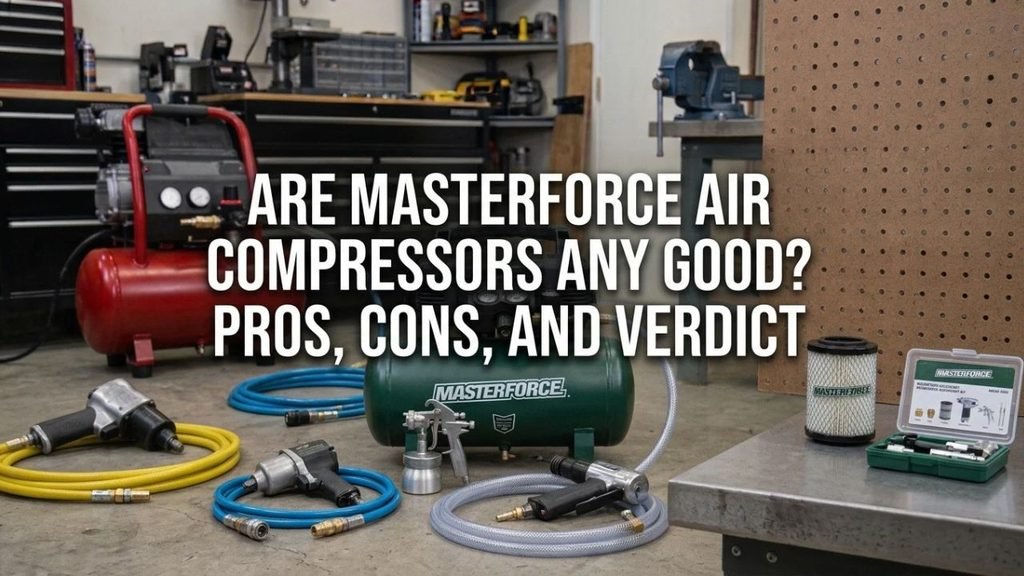
Are Masterforce Air Compressors Any Good? Pros, Cons, and Verdict
Masterforce air compressors are generally a good choice for homeowners, DIY users, and home garages that want solid air output without moving into premium industrial-compressor pricing. The better models offer useful CFM ratings, large tanks, oil-lubricated belt drives or quiet oil-free designs, and longer warranty coverage than many entry-level machines.
The answer changes by model. Masterforce sells compact oil-free units, ultra-quiet portable compressors, conventional belt-drive machines, and larger two-stage stationary compressors. A small quiet unit should not be judged by the same standard as a 60- or 80-gallon shop compressor.
The current Menards lineup shows this range clearly. It includes a 20-gallon two-stage unit rated to 200 PSI, a 29-gallon ultra-quiet model, a 30-gallon belt-drive compressor, 60-gallon single- and two-stage machines, and an 80-gallon two-stage model. Current listed prices stretch from a few hundred dollars to more than $2,000 for the largest machines.
Warranty coverage is another positive point. The current 20-gallon M20200Q documentation lists a 3-year limited warranty, and documentation for the 29-gallon ultra-quiet model lists the same three-year term for the original purchaser.
For are Masterforce air compressors any good, my verdict is yes for most home-garage and serious DIY work, provided you choose the model from its SCFM, duty cycle, voltage, tank size, and pump type rather than choosing by gallons alone.
The weaker point is that Masterforce is not the first brand I would choose for a production shop that needs continuous compressed air all day. Some of the larger models have good home-shop output, but heavy sandblasting, long die-grinder sessions, body-shop painting, or several users at once can demand more pump capacity and a higher duty-cycle rating.
The sections below break down build quality, current models, noise, airflow, owner feedback, durability, warranty, common drawbacks, and which Masterforce compressors make the most sense for different jobs.
Are Masterforce Air Compressors Any Good Overall?
Yes. They occupy a useful middle ground between very cheap portable compressors and much more expensive commercial shop equipment.
For a homeowner or hobby mechanic, that is often exactly the right place to shop.
The Specs Are Competitive for Home-Garage Work
Take the current 20-gallon M20200Q as an example.
Its published specifications include:
- 20-gallon tank
- 200 PSI maximum pressure
- 1.8 running HP
- 5.0 CFM at 90 PSI
- Two-stage pump
- 120-volt power
The manual also confirms a three-year limited warranty.
Five CFM at 90 PSI is enough for tire inflation, nailers, blow guns used in bursts, many pneumatic service tools, and some intermittent garage tasks.
It is not enough for every air sander or grinder to run continuously.
Larger Belt-Drive Models Offer More Shop Capacity
Masterforce also sells traditional oil-lubricated belt-drive compressors.
The 30-gallon MELA1683066 uses a 1.6-running-HP pump, a 30-gallon tank, 155 PSI cut-out pressure, and can operate from 120 or 240 volts according to its manual.
The current 60-gallon single-stage model is listed by Menards at $839 before its displayed rebate. Menards also currently lists a two-stage 60-gallon model at $1,829 and a two-stage 80-gallon model at $2,099. Prices can change, so treat those figures as current comparison points rather than permanent prices.
They Are Better Suited to DIY Than Industrial Production
The larger models can run serious pneumatic equipment.
One 60-gallon Masterforce specification discussed by Garage Journal users lists 11.5 CFM at 90 PSI, a 155 PSI maximum, and a 75% duty cycle. Forum users generally regarded that output as strong for home garages and intermittent die-grinder work, while cautioning against treating it as an unlimited continuous-air machine.
That is a fair way to think about the brand.
Masterforce is strong enough for a lot of real garage work without being positioned like a large industrial rotary-screw system or heavy commercial piston compressor.
Key Takeaway: Masterforce compressors offer strong home-shop value, but model selection matters more than the brand name. Match SCFM and duty cycle to the tool rather than buying only by tank size.
Masterforce Air Compressor Build Quality
Build quality differs across the lineup because Masterforce uses several compressor designs.
The oil-free quiet models and large belt-drive machines share little beyond the badge.
Oil-Free Models Favor Low Maintenance
Masterforce’s quiet portable models use oil-free pump designs.
The older 20-gallon ultra-quiet model, for example, is specified with a 1.8 HP induction motor, 20-gallon tank, 150 PSI maximum, 6.0 CFM at 40 PSI, and 5.0 CFM at 90 PSI.
Oil-free compressors remove pump-oil changes from the maintenance schedule.
That makes them attractive for a garage owner who mainly inflates tires, uses nailers, blows off parts, and runs tools intermittently.
The tradeoff is that many oil-free pump assemblies are less rebuild-friendly than traditional cast-iron belt-drive pumps.
Belt-Drive Models Use More Traditional Hardware
The 30- and 60-gallon belt-drive compressors use separate motors, belts, flywheels, and oil-lubricated pumps.
The 30-gallon manual calls for compressor oil maintenance, air-filter service, belt-tension checks, tank draining, and routine safety-valve checks.
That means more maintenance, but it also gives the machine a more traditional service layout.
For a garage where the compressor runs frequently, I generally prefer an oil-lubricated belt-drive pump over a small high-speed direct-drive pump.
Stationary Models Need Proper Installation
The 60-gallon manual calls for the compressor to sit level, have room for pump cooling, and be correctly secured. It also warns against modifying the air receiver and requires proper electrical installation for the model’s voltage and amperage.
A good stationary compressor can perform poorly if it is installed with inadequate wiring, blocked cooling airflow, severe voltage drop, or poor moisture drainage.
Key Takeaway: Masterforce’s belt-drive models use a more traditional serviceable layout, while the oil-free models trade some serviceability for simpler maintenance and lower noise.
Are Masterforce Ultra-Quiet Air Compressors Actually Quiet?
The ultra-quiet line is noticeably quieter than many conventional oil-free compressors, but “ultra-quiet” should not be interpreted as silent.
Owner reports support that distinction.
Owners Generally Notice a Noise Reduction
A 2026 Hobby-Machinist owner of the 20-gallon, 200 PSI Masterforce two-stage model reported that it was much quieter than the standard compressors he had used at home. He was using it for RV tires and sprinkler blowout work.
An older Reddit discussion about a Masterforce 20-gallon quiet compressor reached a similar conclusion: users described it as much quieter than a typical compressor while still clearly audible.
That is realistic.
A compressor containing pistons, valves, a motor, cooling fans, and pressurized airflow will still make noise.
Quiet Models Make More Sense Near Living Areas
A quieter pump is worth paying for if the compressor sits:
- In an attached garage
- In a basement workshop
- Close to neighbors
- Near a home office
- In a small workshop where you stand beside it
Noise matters less when a stationary compressor sits in a separate compressor room or detached outbuilding.
Key Takeaway: Masterforce’s quiet models do reduce noise compared with many conventional compressors, but they remain audible machines rather than near-silent equipment.
Masterforce Air Compressor Performance by Size
The right size depends on how quickly your tools consume air.
Tank gallons tell you reserve capacity. SCFM at working pressure tells you much more about how long the tool can keep running.
Small Portable Models
Small pancake and compact Masterforce compressors make sense for:
- Tire inflation
- Brad nailers
- Finish nailers
- Staplers
- Short blow-gun use
- Small maintenance jobs
They are easy to store and move, but they refill more often because the tanks hold little reserve air.
20-Gallon Models
A 20-gallon unit is one of the more practical sizes for a home garage.
The current 20-gallon two-stage Masterforce is rated at 5.0 CFM at 90 PSI and stores air at up to 200 PSI.
That gives it more stored air than a 5- or 6-gallon compressor and enough pump output for many intermittent pneumatic jobs.
It remains too small for some continuous sanders, grinders, or large spray guns.
30-Gallon Belt-Drive Models
A 30-gallon belt drive is a good step up for someone who wants a conventional oil-lubricated pump without installing a large stationary tank.
The current Menards listing prices the Masterforce 30-gallon belt-drive model at $699.99 before its displayed rebate.
Its 120/240V capability gives owners more installation flexibility than a 240V-only stationary machine.
60-Gallon Models
This is where Masterforce becomes much more attractive for automotive and fabrication work.
A 60-gallon tank paired with roughly 11.5 CFM at 90 PSI, as reported for the single-stage model, gives enough reserve and recovery for many impact wrenches, ratchets, die grinders used in cycles, air hammers, and moderate spray work.
Continuous sandblasting and large grinders can still outrun it.
Two-Stage 60- and 80-Gallon Models
Two-stage models are aimed at users needing higher pressures and more serious shop capacity.
Current Menards listings include 60- and 80-gallon Masterforce two-stage models rated to 175 PSI.
These make more sense for frequent shop work, though their cost moves closer to established commercial compressor brands.
Key Takeaway: Small Masterforce compressors fit inflation and nailers, 20- to 30-gallon models fit mixed DIY work, and 60- to 80-gallon units are the better picks for regular pneumatic automotive or fabrication use.
How Reliable Are Masterforce Air Compressors?
There is no single reliability answer across every Masterforce model.
The most useful owner feedback suggests that the brand is generally respectable for its price class.
Current Owner Feedback Is Mostly Positive for Home Use
A 2026 Menards Reddit discussion about the 60-gallon model included several users describing the machines as solid and holding up well. Some contributors said the units are produced alongside compressors sold under other labels.
Garage Journal users discussing the 60-gallon unit also viewed its price-to-output ratio favorably for a home shop.
Community comments are not controlled durability tests, but they are useful for spotting repeated complaints.
The discussions I found did not point to one widespread failure pattern across the current lineup.
Several Belt-Drive Models Are Commonly Linked to Sanborn/MAT
Owners and tool-forum contributors repeatedly identify Masterforce belt-drive compressors as Sanborn/MAT-built units or close relatives of compressors sold under other retail labels.
That claim comes mainly from community identification rather than a current Masterforce manufacturer statement, so I would not use it as the sole reason to buy.
It does suggest that the belt-drive design is not an unusual one-off platform with no relation to common compressor hardware.
Maintenance Still Decides a Lot
The 30-gallon manual calls for:
- Checking pump oil
- Regular oil changes
- Air-filter inspection
- Belt checks
- Daily tank draining
- Safety-valve checks
Neglect those items and even a good compressor can develop pump wear, corrosion, overheating, or poor air delivery.
Key Takeaway: Owner feedback is generally favorable for DIY and home-shop duty, while long service life still depends heavily on correct sizing, cooling, electrical supply, and maintenance.
Masterforce Air Compressor Warranty
Warranty coverage is one of the stronger reasons to consider the brand.
The current M20200Q 20-gallon manual states a 3-year limited warranty for the original purchaser. The 29-gallon documentation also states three years.
Older Masterforce compressor documentation also describes a Menards return-based warranty process that requires the original receipt.
Keep the receipt.
Warranty terms can differ by model, age, commercial use, and product generation, so read the exact warranty attached to the compressor you are buying.
Main Advantages of Masterforce Air Compressors
The brand has several practical strengths.
Good output for the price: The larger machines provide useful CFM figures without immediately moving into premium commercial prices.
Wide size range: Current offerings span small portable units through large two-stage stationary machines.
Quiet choices are available: The ultra-quiet range gives attached-garage and indoor-shop users a less harsh option.
Belt-drive choices remain available: Buyers who prefer an oil-lubricated pump are not limited to disposable-style direct-drive machines.
Three-year coverage on several models: Current documentation confirms three-year limited warranties on the 20- and 29-gallon examples.
120V choices exist: You do not need 240V service for every Masterforce compressor.
Higher-output stationary options exist: Users can move up to 60- and 80-gallon two-stage machines without changing brands.
Main Drawbacks of Masterforce Air Compressors
The lineup also has weaknesses worth considering.
Model quality varies: An oil-free quiet compressor and an oil-lubricated stationary belt drive have very different construction and expected use.
Not all units are meant for constant airflow: Large tanks can make a compressor look more capable than its actual pump output. Compare SCFM and duty cycle.
Retail availability centers on Menards: That may be convenient in Menards regions and less attractive elsewhere.
Some current models are not cheap: At roughly $1,829 for a two-stage 60-gallon and $2,099 for a two-stage 80-gallon before displayed rebates, buyers should compare other established compressor brands at the same price.
Oil-free pumps may be less attractive for long-term rebuildability: If you expect years of heavy use, a conventional oil-lubricated belt-drive design is the safer style to prioritize.
Published tank PSI can distract from airflow: A 200 PSI rating sounds impressive, but a high-demand air tool still needs enough SCFM.
Masterforce vs. Cheaper Air Compressors
Masterforce generally makes more sense when you want to move above the cheapest compressor in the store without paying commercial-shop prices.
A bargain compressor may work perfectly for occasional tires and nailers.
The Masterforce advantage becomes clearer when you care about:
- Larger tank choices
- More airflow
- Quiet pump designs
- Belt-drive construction
- Higher maximum pressure
- Longer stated warranty coverage
- 120/240V choices on certain units
If you only inflate four tires twice a month, you may not get much use from a 20- or 30-gallon Masterforce.
If you are building a home garage around pneumatic tools, stepping up makes more sense.
Who Should Buy a Masterforce Air Compressor?
I would consider Masterforce a good fit for:
- Homeowners
- DIY mechanics
- Woodworkers
- Home renovators
- Hobby fabricators
- Small farm shops
- Weekend automotive work
- Tire and inflation work
- Intermittent pneumatic-tool use
A 20- or 30-gallon unit covers a lot of home use.
A 60-gallon machine is the point I would start considering for regular die grinders, impact tools, larger spray jobs, and more demanding garage work.
For a production repair shop, body shop, commercial sandblasting operation, or several workers using air simultaneously, I would compare higher-output commercial machines with 100% duty-cycle capability before deciding.
What to Check Before Buying a Masterforce Compressor
Do not start with gallons.
Start with the air tools.
Check the highest-demand tool you expect to use and compare its SCFM rating at the specified PSI with the compressor’s output.
I prefer some airflow margin rather than matching the two numbers exactly.
Also check:
- 120V or 240V requirement
- Available electrical circuit
- SCFM at 90 PSI
- Maximum pressure
- Duty cycle
- Oil-free or oil-lubricated pump
- Noise rating
- Tank orientation
- Floor space
- Portability
- Warranty
- Replacement-parts availability
If continuous airflow is important, SCFM and duty cycle should carry more weight than tank size.
Conclusion
For are Masterforce air compressors any good, the answer is yes for many homeowners, DIY mechanics, and serious home-garage users. The brand offers a broad range, reasonable output, quiet models, conventional belt-drive choices, and three-year warranty coverage on several current compressors.
The 20-gallon two-stage model stands out for users who want 120V power, 200 PSI storage, and 5.0 CFM at 90 PSI in a quieter portable package. The 30-gallon belt drive suits buyers who prefer an oil-lubricated pump, while the 60-gallon models make more sense for frequent automotive and shop tools.
I would not buy one purely because it says 20, 30, or 60 gallons on the tank. Check the pump’s SCFM and duty cycle against the tool load. A properly sized Masterforce is far more likely to satisfy you than an oversized tank attached to a pump that cannot keep pace.
For casual to fairly serious home use, I would be comfortable putting Masterforce on the shortlist. For nonstop commercial work, I would compare it against heavier industrial equipment before spending the money.
FAQs About Masterforce Air Compressors
Who Makes Masterforce Air Compressors?
Masterforce is sold through Menards. Tool and compressor forums commonly identify several Masterforce belt-drive compressors as Sanborn/MAT-built or closely related to machines sold under other labels. That identification is based on owner and industry-community observations rather than a current public manufacturer statement from Menards.
Are Masterforce Air Compressors Reliable?
Owner feedback is generally favorable for home and hobby use. Reliability depends on the exact pump design, operating load, duty cycle, electrical supply, cooling, and maintenance. A compressor that constantly runs beyond its airflow capacity will age much faster than one properly sized for the work.
Are Masterforce Air Compressors Good for Automotive Work?
Yes, with the right size. A 20-gallon model works well for inflation, nailers, blow guns, and many intermittent tools. A 30- or 60-gallon model is a better match for impact tools, air hammers, die grinders, and more frequent garage work.
Are Masterforce Air Compressors Good for Painting Cars?
The larger models are more suitable than the small portable compressors, but check the spray gun’s continuous SCFM requirement. Full-car spraying can consume a lot of air, and a compressor that cannot maintain the required airflow can cause pressure drop during a paint session.
Is the Masterforce 20-Gallon Air Compressor Good?
The current M20200Q is a strong home-garage option on paper. It has a 20-gallon tank, 200 PSI maximum pressure, 1.8 running HP, 5.0 CFM at 90 PSI, and a three-year limited warranty.
Is the Masterforce 60-Gallon Air Compressor Good?
It is a good value-oriented home-shop compressor if its airflow matches your tools. The commonly listed single-stage model produces about 11.5 CFM at 90 PSI and is well suited to many automotive and fabrication tasks used intermittently. Continuous heavy grinding or sandblasting can call for more compressor capacity.
How Long Is the Masterforce Air Compressor Warranty?
Several Masterforce compressor manuals document a three-year limited warranty for the original purchaser, including current 20- and 29-gallon models. Keep the original receipt and check the warranty document for the exact model before purchase.
Are Masterforce Air Compressors Worth the Money?
They can be, especially for home garages where the buyer wants more capacity and warranty coverage than a basic entry-level compressor provides. Compare the specific Masterforce model’s SCFM, duty cycle, pump design, voltage, and current price against competing compressors rather than comparing brand names alone.