Do Air Compressors Come With Hoses? What Usually Comes Included
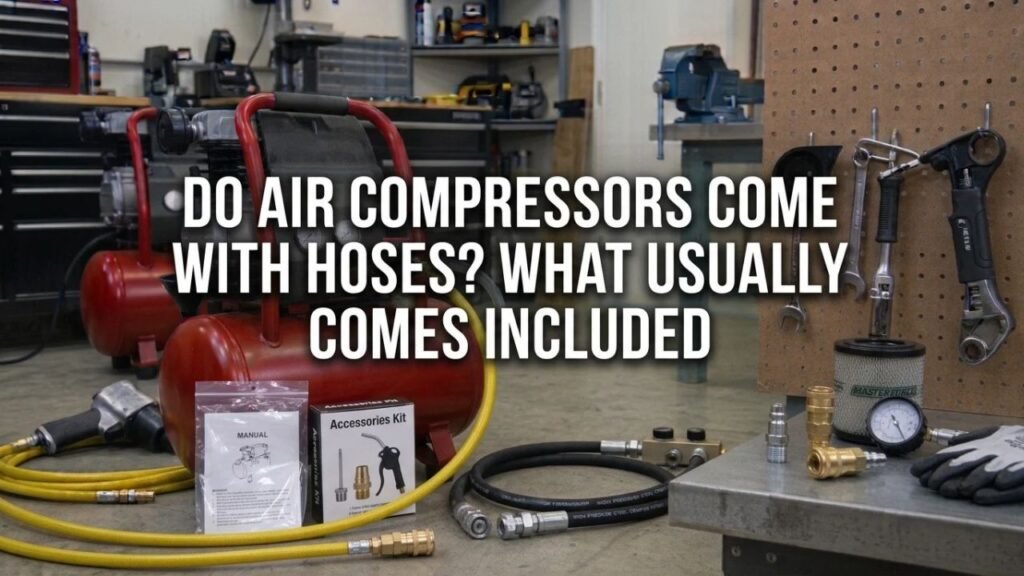
Some air compressors include an air hose, but many standalone compressors do not. Compressor kits and nailer combo packages are much more likely to include a hose, couplers, plugs, or inflation accessories. Always check the product’s “Includes” or package-contents list before buying so you know what else is needed.
The compressor itself can build and store compressed air without an external hose, but you need a suitable hose to connect most pneumatic tools, tire inflators, blow guns, and spray equipment. Buying a compressor without realizing the hose is sold separately can prevent you from using it immediately.
Current product lines show both approaches. PORTER-CABLE sells standalone compressors as well as combo kits, and its PCFP3KIT specifically includes a 25-foot, 1/4-inch air hose with a coupler and plug. CRAFTSMAN likewise lists a 6-gallon compressor as a 13-piece kit alongside larger standalone compressors.
So, do air compressors come with hoses as a standard rule? No. A portable compressor may arrive with only the compressor and built-in quick couplers, while another model may include a hose, tire chuck, inflator needles, or pneumatic nailer.
Small inflator-style compressors are another category. Some have the pressure hose permanently attached or stored on the unit, so you do not need a separate shop-style air hose for basic tire inflation.
The best approach is to identify what the package contains, then match any hose you buy to the compressor’s coupler size, working pressure, tool airflow, and jobsite conditions.
Do Air Compressors Normally Come With a Hose?
There is no industry-wide rule requiring an air compressor to include a hose.
Manufacturers commonly sell compressors in several package formats:
- Compressor only
- Compressor with accessory kit
- Compressor and air hose kit
- Compressor and nailer combo kit
- Inflator with built-in hose
- Compressor with multiple pneumatic tools and hose
This is why two compressors that look nearly identical can have very different box contents.
Standalone Compressors Often Do Not Include One
A standalone shop or pancake compressor is frequently sold as the compressor itself.
You may receive:
- Compressor
- Power cord
- Built-in regulator
- Pressure gauges
- Quick coupler
- Owner’s manual
The hose and tool fittings may need to be purchased separately.
DEWALT’s instructions for its DWFP55126 pancake compressor tell the operator to attach the hose and accessories before use and note that accessories are available separately.
Compressor Kits Are More Likely to Include a Hose
A package labeled kit, combo kit, or accessory kit is more likely to include the pieces needed for immediate use.
PORTER-CABLE’s current three-nailer combo kit includes:
- 6-gallon pancake compressor
- Finish nailer
- Brad nailer
- Pin nailer
- 25-foot 1/4-inch hose
- Coupler
- Plug
RIDGID also currently separates standalone compressor listings from pneumatic combo packages that specifically advertise a compressor, nailer, and hose.
Small Inflators May Have a Built-In Hose
Portable tire inflators are different from tank-style compressors.
For example, DEWALT’s cordless/corded inflator includes an onboard high-pressure rubber hose for tires and a separate high-volume hose for inflatables.
With this type of machine, the hose is part of the product rather than a removable 1/4-inch shop air hose.
Key Takeaway: Standalone tank compressors often require a separate hose, while kits, combo packages, and portable inflators are more likely to include one.
What Usually Comes With an Air Compressor?
The included equipment depends on the compressor category.
Portable Pancake Compressor
A basic pancake compressor often includes:
- Air tank
- Pump and motor
- Regulator
- Tank-pressure gauge
- Outlet-pressure gauge
- One or two quick couplers
- Power cord
- Drain valve
The hose may not be included.
These units are designed so buyers can choose the hose length and material that best fits their work.
Compressor Accessory Kit
An accessory bundle may add:
- Air hose
- Male plugs
- Female couplers
- Tire chuck
- Inflation needle
- Blow-gun nozzles
- Thread seal tape
- Adapters
PORTER-CABLE’s older CMB15 package, for example, listed an air hose, female tire chuck, and inflator accessory kit in the carton.
Nailer Combo Kit
Construction-focused packages may include:
- Compressor
- 18-gauge brad nailer
- Finish nailer
- Stapler
- Air hose
- Fasteners
- Couplers and plugs
These packages are useful if you are starting without pneumatic equipment.
Large Shop Compressor
A 20-, 30-, 60-, or 80-gallon compressor is more likely to be sold as the machine itself.
You may need to buy or install separately:
- Air hose
- Regulator
- Filter
- Moisture separator
- Hard air line
- Couplers
- Tool fittings
Larger stationary units may also require electrical installation before use.
Key Takeaway: Small kits can include several ready-to-use accessories, while larger shop compressors are more often sold as the core air source with hoses and fittings chosen separately.
How to Tell if a Compressor Includes a Hose Before Buying
Do not rely only on the product photo.
Retail images sometimes show tools or hoses for demonstration that are not actually included.
Read the “Includes” Section
Look for a heading such as:
- Includes
- Package Contents
- What’s in the Box
- Kit Contents
- Accessories Included
If the hose is supplied, the listing will often state its:
- Length
- Inside diameter
- Material
- Fitting size
For example, PORTER-CABLE explicitly lists a 25-foot, 1/4-inch air hose with coupler and plug in its PCFP3KIT package contents.
Check the Model Number Carefully
A manufacturer may sell several versions of one compressor.
One SKU may be:
Compressor only
while another may be:
Compressor kit
The machine itself can be identical, but the accessory package changes.
CRAFTSMAN’s current compressor range is a good example: it separately lists a 6-gallon 13-piece compressor kit and other compressor products.
Check the Manual
The owner’s manual may list carton contents.
This is useful if a retailer description is vague.
Do Not Assume “Ready to Use” Includes Everything
A compressor can be fully assembled and ready to build pressure while still needing a hose and tool fitting before it can run pneumatic equipment.
Key Takeaway: Confirm hose inclusion from the package-contents list or manual rather than relying on photos, product size, or the word “portable.”
What Hose Do You Need if the Compressor Does Not Include One?
The correct hose depends on airflow demand, pressure, distance, and working conditions.
1/4-Inch Air Hose
A 1/4-inch hose is common for portable compressors and intermittent tools.
It works well for:
- Brad nailers
- Finish nailers
- Staplers
- Tire inflation
- Light blow-gun use
Its smaller diameter also keeps the hose light and easy to carry.
3/8-Inch Air Hose
A 3/8-inch hose has more internal area and can reduce pressure loss when airflow demand increases.
It is often a better choice for:
- Impact wrenches
- Ratchets
- Grinders
- Sanders
- Higher-CFM shop tools
- Longer hose runs
A bigger hose does not make the compressor produce more CFM, but it can reduce restriction between the compressor and tool.
Hose Length Matters
Common lengths include:
- 15 feet
- 25 feet
- 50 feet
- 100 feet
A short hose is easier to manage and creates less pressure drop.
A long hose gives you more reach but can reduce delivered airflow, especially when the inside diameter is small.
For general portable compressor use, a 25-foot or 50-foot hose is a practical starting point.
Check Working Pressure
The hose’s rated working pressure must safely exceed the pressure the compressor can deliver.
Do not connect an old or unmarked hose simply because the couplers fit.
Inspect for:
- Cuts
- Cracks
- Bulges
- Exposed reinforcement
- Damaged fittings
Replace damaged hoses rather than attempting temporary repairs.
Key Takeaway: A 1/4-inch hose suits many nailers and inflation jobs, while 3/8-inch hose is often a better match for higher airflow and longer runs.
Which Air Hose Material Is Best?
Air hoses are available in several materials.
Polyurethane Hose
Polyurethane hose is lightweight and flexible.
It works well for:
- Trim work
- Nail guns
- Indoor projects
- Jobs where low hose weight matters
It can be especially convenient when dragging a hose around finished surfaces.
Hybrid Polymer Hose
Hybrid hoses are popular for general garage and shop use.
They typically offer:
- Good flexibility
- Moderate weight
- Easier coiling
- Useful cold-weather behavior
A hybrid 3/8-inch hose is a common all-purpose choice for larger portable compressors.
Rubber Hose
Rubber hose is heavier but can be very flexible and durable.
It works well in workshops and demanding environments where abrasion resistance matters.
The added weight can be noticeable on long hose runs.
PVC Hose
PVC hose is commonly inexpensive.
It can work for light tasks but may become stiff in cold conditions.
For occasional home use, it may be adequate if the pressure rating and fittings are correct.
Key Takeaway: Polyurethane is light, hybrid hose is a strong all-around choice, rubber is durable, and PVC is often the budget option.
Do Air Compressor Kits Include Fittings Too?
Many do, but not all.
A hose cannot connect to the compressor and tool unless the correct fittings are installed.
Common pneumatic fittings include:
- Quick coupler
- Male plug
- Female plug
- 1/4-inch NPT fittings
- Swivel fittings
- Threaded adapters
Coupler and Plug Must Match
Several quick-connect plug profiles are used in the U.S.
Common styles include:
- Industrial
- Automotive
- ARO
Some compressor couplers accept more than one plug style.
Check compatibility instead of forcing a plug into a coupler.
NPT Size Is Different From Hose Diameter
This causes confusion.
A hose may be described as 1/4-inch hose, while the threaded fitting also uses 1/4-inch NPT.
Those measurements describe different things.
The hose measurement refers to its internal air passage.
NPT refers to the threaded connection standard.
Thread Sealant May Be Needed
Threaded pneumatic fittings can leak if they are not sealed correctly.
Use an approved pneumatic thread sealant or thread tape according to the fitting instructions.
Keep excess sealant out of the air passage.
Key Takeaway: A kit may include the hose and connectors, but check the quick-connect profile and thread size before assuming every fitting will work with your tools.
Do Pancake Air Compressors Come With Hoses?
Some do, some do not.
Pancake compressors are commonly sold both ways because they are widely used by contractors, homeowners, and trim carpenters.
A buyer who already owns several hoses may prefer a compressor-only package.
A first-time pneumatic-tool buyer may get more value from a combo kit.
PORTER-CABLE currently sells both standalone 6-gallon pancake compressor models and compressor combo packages that include pneumatic tools and hose equipment.
Before buying a pancake compressor, check:
- Is a hose included?
- What length is it?
- Is it 1/4 or 3/8 inch?
- Are plugs included?
- Does it have a tire chuck?
- Is a nailer included?
- How many quick couplers does the compressor have?
Do 1-Gallon Air Compressors Come With Hoses?
There is no consistent rule.
Some compact 1-gallon compressors are sold alone.
Others are designed as complete light-duty packages.
A small compressor aimed at inflation may include:
- Hose
- Tire chuck
- Needle
- Inflator nozzles
A small compressor aimed at brad nailing may provide only a quick coupler, leaving you to choose your own hose.
The tank size does not determine what accessories come in the box.
Always check the exact SKU.
Do Large Air Compressors Come With Hoses?
Large compressors are less likely to include a general-purpose portable hose.
A 60- or 80-gallon compressor may become part of a permanent shop system.
The owner may install:
- Metal or polymer compressed-air piping
- Wall-mounted hose reels
- Water separators
- Filters
- Regulators
- Multiple drops
- 3/8- or 1/2-inch hoses
Including one short portable hose would not suit every installation.
For a larger compressor, plan the entire air-distribution system rather than assuming a hose is supplied.
What Else Do You Need With a New Air Compressor?
If the compressor arrives without accessories, the basic shopping list depends on the job.
For Nail Guns
You may need:
- 1/4-inch air hose
- Compressor-side plug
- Tool-side coupler
- Nailer plug
- Thread sealant
- Safety glasses
For Tire Inflation
You may need:
- Air hose
- Tire inflator
- Pressure gauge
- Tire chuck
- Appropriate couplers
A combined inflator gauge and chuck can simplify the setup.
For Impact Wrenches
You may need:
- 3/8-inch hose
- High-flow fittings if the tool needs them
- Inline lubricator or manual oiling if specified
- Correct regulator pressure
Check the wrench’s CFM demand first. A hose cannot compensate for a compressor that is too small.
For Spray Painting
The setup may require:
- Air hose
- Moisture separator
- Regulator
- Spray-gun fittings
- Filter
- Enough compressor CFM for the gun
Moisture control is much more important for painting than for basic tire inflation.
Key Takeaway: The accessories you need depend on the job; a hose, compatible couplers, and a tool-specific attachment are usually the minimum starting point.
Should You Buy a Compressor Kit or Buy the Hose Separately?
A kit is often the easier option for a first compressor.
A Kit Makes Sense If You Are Starting Fresh
A bundle can save time because the manufacturer has already grouped basic accessories.
It may include enough equipment for:
- Trim work
- Tire inflation
- Small repairs
- Household projects
PORTER-CABLE’s current three-nailer package is a clear example of a complete setup with compressor, three nailers, and a 25-foot hose.
Buying Separately Gives You More Control
Buying the hose separately lets you choose:
- Longer length
- Larger inside diameter
- Lighter material
- High-flow fittings
- Better cold-weather flexibility
- Higher pressure rating
This is often preferable for automotive or workshop use.
Do Not Buy a Kit Only Because It Has More Pieces
A 20-piece accessory kit may contain several fittings or nozzles you never use.
Focus on the pieces needed for your actual tasks.
Can You Run an Air Compressor Without a Hose?
Yes, the compressor itself can normally run and fill its tank without an external hose attached.
You may even want to perform the first startup with nothing connected so you can verify:
- Tank fills normally
- Motor stops at cut-out pressure
- No obvious leaks are present
- Drain valve is closed
- Gauges work
You cannot operate most external pneumatic tools without a hose or another air-delivery connection.
Do not leave the compressor running unattended simply because no hose is connected.
How to Connect a Hose to an Air Compressor
Most portable compressors use a quick-connect outlet.
A basic connection process is:
- Switch the compressor off.
- Reduce regulated outlet pressure.
- Check the hose and fittings for damage.
- Install the correct male plug on the hose if needed.
- Push the plug into the compressor’s quick coupler.
- Connect the opposite end to the air tool.
- Start the compressor.
- Let the tank fill.
- Set the regulator to the tool’s required PSI.
- Check for leaks.
DEWALT’s compressor instructions warn users to hold the air hose firmly during installation and disconnection to reduce the risk of hose whip.
Always disconnect pressure before changing threaded fittings.
Common Mistakes When Buying an Air Compressor Hose
Buying a Hose That Is Too Small
A narrow hose can restrict high-CFM tools.
A 1/4-inch hose is fine for many nailers but may not be the best choice for a demanding impact wrench or sander.
Buying Too Much Length
A 100-foot hose may seem convenient, but extra length adds bulk and pressure loss.
Use only as much hose as the work requires.
Ignoring Pressure Rating
The hose must be rated for the compressor’s pressure.
Do not rely on appearance.
Assuming All Quick Connectors Match
Two 1/4-inch fittings may use different plug profiles.
Check the coupler standard.
Choosing a Hose Without Considering Temperature
A stiff hose becomes frustrating in a cold garage.
Material choice matters if you work outdoors or in cold climates.
Key Takeaway: Choose hose diameter, length, pressure rating, material, and coupler style around the tool rather than buying the cheapest hose that physically connects.
Conclusion
Do air compressors come with hoses? Some do, but many standalone compressors do not. Compressor kits, nailer combos, and portable inflators are much more likely to include a hose and fittings, while larger shop compressors often leave those choices to the buyer.
Check the exact package contents before purchasing. The words “kit” or “combo” often signal extra accessories, but the included hose length, diameter, fittings, and tools still vary between models.
If you need to buy a hose separately, a 1/4-inch hose is a strong match for nailers and inflation, while 3/8-inch hose suits higher airflow and longer runs. Match the working-pressure rating and quick-connect fittings to the compressor and tool before pressurizing the system.
FAQs About Air Compressors and Hoses
Do New Air Compressors Usually Include a Hose?
Not always. Many new portable compressors are sold without an air hose, while kits and tool combo packages are more likely to include one. Check the manufacturer’s package-contents list for the exact model number.
Do Pancake Air Compressors Come With a Hose?
Some pancake compressors come with hoses, especially nailer or accessory kits. Standalone pancake models often require the buyer to purchase a hose and fittings separately.
What Size Hose Should I Buy for an Air Compressor?
A 1/4-inch hose works well for brad nailers, finish nailers, inflation, and other low-air-demand jobs. A 3/8-inch hose is usually better for high-CFM pneumatic tools and longer hose runs.
Can I Use Any Hose With an Air Compressor?
No. The hose needs a sufficient working-pressure rating, compatible fittings, and enough inside diameter for the tool’s airflow. Avoid damaged garden-style or unapproved tubing.
Do Air Compressors Come With Tire Inflator Hoses?
Some portable inflators and small compressor kits include a tire hose or chuck. Larger pancake and shop compressors often require a separate air hose and tire inflator attachment.
Do Air Compressor Kits Include Couplers and Plugs?
Many accessory and combo kits do. PORTER-CABLE, for example, lists a 25-foot hose with a coupler and plug in its current three-nailer compressor combo kit. Other packages may include only the hose, so check the contents.
Can I Use a 3/8-Inch Hose on a Small Air Compressor?
Yes, if the fittings are compatible and the hose pressure rating is suitable. The larger hose will not increase the compressor’s CFM, but it can reduce airflow restriction compared with a smaller hose.
Can an Air Compressor Run Without a Hose Attached?
Yes. A tank-style compressor can normally fill and cycle without an external hose connected. A hose is required when you want to carry compressed air from the compressor to most pneumatic tools or accessories.
v