
What Is a 3 Phase Air Compressor? Power, Uses, and Wiring
A three-phase air compressor is an air compressor powered by a three-phase AC electrical supply instead of ordinary single-phase household power. It uses three alternating electrical phases to run the motor, making this type of compressor common in factories, automotive shops, manufacturing facilities, and other locations that need larger motors and frequent compressed-air production.
Three-phase power supplies electrical energy through three alternating waveforms spaced 120 electrical degrees apart. That produces smoother motor torque than a comparable single-phase supply and works especially well with larger induction motors.
For anyone asking what is 3 phase air compressor, the compressor itself still performs the same basic job as any other unit: its pump draws in atmospheric air, compresses it, and sends the air into a receiver tank or distribution system. The major difference is the electrical system driving the motor.
The U.S. Department of Energy has estimated that compressed-air systems account for roughly 10% of electricity used in U.S. manufacturing, which helps explain why motor selection and electrical supply matter so much in industrial compressor installations.
Three-phase compressors are often found in 5 HP, 7.5 HP, 10 HP, 15 HP, and much larger sizes. Single-phase compressors are more common in residential garages because most U.S. homes do not have three-phase utility service.
Understanding three-phase operation also prevents a common mistake: a compressor marked 230V or 460V three-phase cannot normally be connected directly to a standard 120V or 240V single-phase residential circuit.
What Does 3 Phase Mean on an Air Compressor?
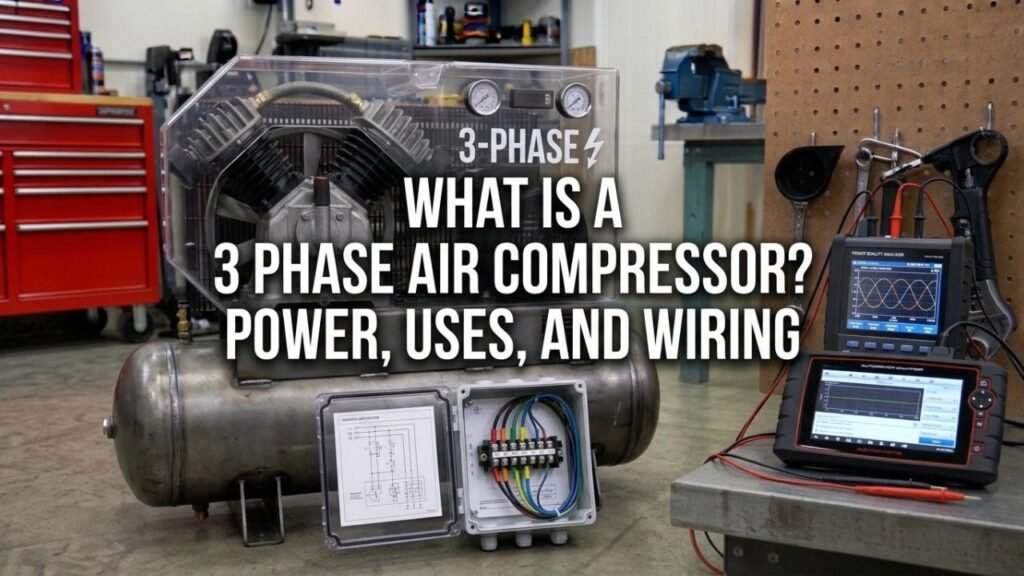
“Three phase” describes the electrical power supplied to the compressor motor.
It does not describe:
- Number of compressor cylinders
- Number of compression stages
- Number of air tanks
- Number of pistons
A compressor can be single-stage or two-stage and still use a three-phase motor.
Three Electrical Phases Supply the Motor
A three-phase system has three AC voltage waveforms.
Each waveform reaches its peak at a different point in time.
The three phases are separated by approximately 120 electrical degrees.
This arrangement creates a rotating magnetic field naturally inside a three-phase induction motor.
That rotating field turns the motor rotor, which drives the compressor pump.
Three-Phase Motors Do Not Normally Need Start Capacitors
Many single-phase compressor motors use components such as:
- Start capacitors
- Run capacitors
- Centrifugal switches
- Start relays
A standard three-phase induction motor creates its rotating magnetic field directly from the three incoming phases.
That generally makes the motor electrically simpler.
Phase Does Not Determine Compressor Pressure
A three-phase compressor does not automatically make higher PSI than a single-phase compressor.
Both can be designed for:
- 125 PSI
- 135 PSI
- 150 PSI
- 175 PSI
- Higher industrial pressures
Pressure depends on pump design, controls, and system specifications.
Key Takeaway: Three phase refers to the compressor motor’s electrical supply, not the pump stages, cylinders, tank size, or maximum pressure.
How Does a 3 Phase Air Compressor Work?
The compression process is similar to that of a single-phase compressor.
The electrical system mainly changes how the motor is powered.
The Motor Receives Three-Phase Power
Power enters the compressor through electrical protection and control equipment.
A typical installation can include:
- Disconnect switch
- Circuit breaker or fuses
- Motor starter
- Overload protection
- Contactor
- Pressure switch or compressor controller
The motor receives three line conductors commonly identified as L1, L2, and L3.
The Motor Drives the Compressor Pump
The motor may connect to the compressor pump through:
- Belt drive
- Direct drive
- Gear drive on some industrial systems
The pump draws outside air through an intake filter.
The Pump Compresses the Air
A reciprocating compressor uses pistons to reduce air volume and raise pressure.
A rotary screw compressor uses meshing rotors to compress air continuously.
Both pump types are available with three-phase motors.
Compressed Air Goes Into the Receiver or Air System
Depending on the compressor design, compressed air can flow into:
- Receiver tank
- Dryer
- Filter system
- Main shop air piping
- Industrial process equipment
A pressure control system starts and stops the compressor or loads and unloads it according to air demand.
Key Takeaway: A three-phase compressor works like other compressors mechanically; the main difference is the three-phase motor and electrical controls supplying the pump.
What Is the Difference Between Single Phase and 3 Phase Air Compressors?
The largest difference is the electrical power source.
| Feature | Single-Phase Compressor | Three-Phase Compressor |
| Electrical supply | 120V or 240V single phase | Commonly 208V, 230V, 460V three phase |
| Typical setting | Home garage, small shop | Commercial and industrial |
| Motor size | Usually smaller | Common across larger HP ranges |
| Starting system | May use capacitors/switches | Usually simpler induction starting |
| Motor torque | Pulsating more than 3-phase | Smoother torque delivery |
| Utility availability | Common in homes | Common in commercial buildings |
| Motor direction | Determined by wiring/design | Can usually reverse by swapping two phases |
| Typical large-compressor use | Less common | Very common |
Single-Phase Power Is Common in Homes
Most U.S. residential properties have single-phase electrical service.
A typical home provides:
- 120V loads
- 240V loads
A 240V single-phase compressor can therefore be installed in many residential garages with the correct circuit.
Three-Phase Power Is Common in Commercial Buildings
Industrial facilities often have three-phase utility service.
Common system voltages include:
- 208V
- 240V in some systems
- 480V
Motor nameplates may state values such as:
- 208-230/460V
- 230/460V
- 460V
The exact voltage connection must match the motor diagram.
Three-Phase Motors Suit Larger Loads
As compressor horsepower increases, three-phase motors become increasingly common.
Large commercial compressors may run for long periods and require substantial electrical power.
Three-phase distribution makes those motor loads easier to support than single-phase power.
Key Takeaway: Single-phase compressors dominate residential use, while three-phase compressors are common in larger commercial and industrial applications because three-phase power suits larger motors.
What Are the Advantages of a 3 Phase Air Compressor?
The benefits come mainly from the motor and electrical supply.
Smoother Motor Torque
Because the three phases overlap, the motor receives a more continuous rotating magnetic field.
This produces smoother torque than a comparable single-phase induction motor.
Good Choice for Larger Motors
Three-phase motors are commonly used in larger horsepower ranges.
This makes three-phase compressors suitable for applications such as:
- Auto repair shops
- Manufacturing plants
- Machine shops
- Body shops
- Woodworking factories
- Industrial maintenance
- Food-processing facilities
- Large tire shops
Simpler Motor Construction
Many standard three-phase motors do not require the capacitor-start hardware found on single-phase motors.
That can mean fewer starting-system components.
Lower Current Per Conductor for a Given Motor Output
For a given power level, a properly designed three-phase system can supply the motor with lower line current than a comparable single-phase setup.
This becomes increasingly useful as motor horsepower rises.
Easy Motor Reversal
On many three-phase induction motors, rotation direction can be reversed by swapping any two supply phases.
This is useful during installation, but compressor rotation must match the manufacturer’s arrow before operation.
Running a pump backward can cause lubrication or cooling problems on certain designs.
Key Takeaway: Three-phase compressors offer smooth motor torque, suit larger horsepower applications, use relatively simple induction motors, and are common where substantial compressed-air output is needed.
What Are the Disadvantages of a 3 Phase Air Compressor?
The main limitation is power availability.
Most Homes Do Not Have Three-Phase Service
A homeowner may find a used 5 HP or 10 HP three-phase compressor at an attractive price and then discover that the garage only has single-phase power.
You cannot normally connect all three motor terminals to an ordinary 240V residential circuit and expect it to operate correctly.
Electrical Conversion Can Add Cost
If three-phase utility power is unavailable, possible solutions can include:
- Variable frequency drive
- Rotary phase converter
- Static phase converter for certain applications
- Replacing the motor with a compatible single-phase motor
Each option has limitations.
The correct method depends on:
- Motor horsepower
- Voltage
- Starting load
- Compressor type
- Control system
- Duty requirements
Installation Is More Specialized
Three-phase compressor installation may involve:
- Motor starters
- Overload settings
- Phase sequence
- Transformer controls
- Disconnects
- Branch-circuit sizing
Commercial compressor installations are normally handled by an electrician familiar with motor circuits.
Used Industrial Compressors Can Be Physically Large
A low-priced used three-phase compressor may also require:
- Large floor area
- Hardwired power
- Heavy-duty air piping
- Forklift or rigging
- Proper ventilation
Electrical conversion is only one part of the installation.
Key Takeaway: The biggest drawback is that three-phase power is rarely available in ordinary homes, and converting single-phase power for a large compressor can add equipment and installation cost.
What Voltage Does a 3 Phase Air Compressor Use?
There is no single voltage for every three-phase compressor.
Common North American compressor motor voltages include:
- 208V
- 230V
- 460V
Large industrial systems may use other voltages.
Dual-Voltage Motors Are Common
A motor nameplate might show:
230/460V, 3 PH
That motor can often be wired internally for either supply voltage.
The winding connections must be changed according to the motor’s wiring diagram.
Do not simply apply 460V to a motor connected for 230V.
208V and 230V Are Not Identical
Many motors are designed to operate across a voltage range and may be marked:
208-230/460V
Read the motor nameplate carefully.
Current ratings usually differ according to supply voltage.
Check the Whole Compressor, Not Just the Motor
Some compressors contain controls operating at different voltages.
The electrical cabinet may include a control transformer.
Before changing motor voltage, confirm compatibility of:
- Motor
- Contactor
- Overload
- Transformer
- Control circuit
- Solenoid valves
- Cooling fan
Key Takeaway: Common three-phase compressor voltages include 208V, 230V, and 460V, and the motor must be connected exactly as shown on its nameplate diagram.
How Many Wires Does a 3 Phase Air Compressor Need?
A basic three-phase motor circuit has three phase conductors plus equipment grounding.
They are commonly called:
- L1
- L2
- L3
- Ground
A Neutral Is Often Not Needed
A compressor using only three-phase line-to-line loads may not require a neutral.
The motor receives power from the three phase conductors.
Some Compressors May Need a Neutral
A neutral may be required if the machine has line-to-neutral loads such as:
- 120V controls
- Convenience receptacles
- Lights
- Certain electronic accessories
Many industrial machines avoid this by using a control transformer.
Ground Is Still Required
Equipment grounding provides a fault-current path for safety.
Ground is not interchangeable with neutral.
The wiring diagram for the exact compressor decides the conductor arrangement.
How Is a 3 Phase Air Compressor Wired?
Three-phase compressor wiring normally includes more than connecting three motor wires.
A common arrangement is:
Utility Supply → Disconnect → Circuit Protection → Motor Starter/Contactor → Overload → Compressor Motor
The compressor pressure switch or electronic controller operates the contactor.
L1, L2, and L3 Feed the Motor Circuit
The three incoming phases pass through the contactor and overload device.
When the controller requests compressor operation, the contactor closes.
The motor starts.
Overload Protection Protects the Motor
The overload relay is selected and adjusted according to the motor rating and applicable electrical requirements.
It protects against sustained overcurrent conditions.
Breaker and Motor Overload Perform Different Jobs
The branch-circuit breaker or fuse primarily handles short-circuit and ground-fault protection.
The motor overload handles prolonged motor overload.
Motor circuits should not be sized from a general household breaker chart.
Rotation Must Be Checked
After initial installation, briefly bump the motor and compare rotation with the compressor’s marked direction.
If a standard three-phase motor turns backward, an electrician can usually reverse rotation by interchanging two phase conductors.
Disconnect and lock out electrical power before changing wiring.
Key Takeaway: Three-phase compressor wiring normally includes three supply phases, a disconnect, circuit protection, contactor, motor overload, and equipment ground.
Can You Run a 3 Phase Air Compressor on Single Phase Power?
Not directly in normal circumstances.
A standard three-phase induction motor needs a three-phase supply.
There are several ways to create three-phase power from single-phase electricity.
Variable Frequency Drive
A VFD can convert suitable single-phase input into three-phase output for some motors.
It also offers motor-speed control.
The drive must be sized for:
- Input type
- Motor current
- Horsepower
- Starting load
Many VFDs require derating when supplied with single-phase input.
The compressor’s control scheme also needs to be compatible.
Rotary Phase Converter
A rotary phase converter creates an additional phase using a rotating machine.
They are common in workshops that operate several pieces of used three-phase machinery.
Correct sizing matters because an air compressor can place a substantial starting load on the converter.
Static Phase Converter
Static converters may be used for some motor applications, but output horsepower can be reduced.
They are not always a good match for compressor loads.
Replace the Motor
For certain reciprocating compressors, replacing the three-phase motor with a single-phase motor can be possible.
The replacement must match:
- Horsepower
- RPM
- Frame size
- Shaft size
- Rotation
- Service factor
- Pulley requirements
A large single-phase motor can require significant starting current and heavy electrical wiring.
Key Takeaway: A three-phase compressor cannot normally run directly from single-phase service, but a properly sized VFD, rotary converter, or compatible motor replacement may provide a solution.
Can You Use a VFD on a 3 Phase Air Compressor?
Sometimes.
The answer depends on the compressor and control system.
VFDs Work Well With Many Three-Phase Motors
A VFD produces three-phase output and controls frequency.
Reducing frequency lowers motor speed.
Reciprocating Compressors Need Care
A piston compressor pump is usually designed around a particular RPM range.
Running it too slowly or too quickly can affect:
- Lubrication
- Cooling
- Airflow
- Pump life
Do not use a VFD simply to increase compressor speed.
Rotary Screw Compressors Commonly Use Variable Speed
Variable-speed rotary screw compressors intentionally vary motor speed according to air demand.
These systems use controls designed around VFD operation.
Adding a generic VFD to a fixed-speed compressor is a different situation.
What Size 3 Phase Air Compressors Are Common?
Three-phase motors become more common as compressor size increases.
Typical examples include:
- 5 HP
- 7.5 HP
- 10 HP
- 15 HP
- 20 HP
- 25 HP
- 30 HP
- 50 HP
- Much larger industrial systems
5 HP
A 5 HP compressor can be available in either single-phase or three-phase versions.
This size is common in repair shops and larger home workshops.
7.5 HP and Above
Three-phase versions become increasingly common.
At these sizes, the compressor can support more demanding pneumatic equipment and higher shop airflow.
Large Industrial Rotary Screw Compressors
Most large rotary screw systems use three-phase power.
They may feed an entire facility through a central compressed-air network.
Is a 3 Phase Compressor Better Than a Single Phase Compressor?
Neither is automatically better.
The correct choice depends on electrical service and air demand.
Choose Single Phase When
Single phase makes sense for:
- Residential garage
- Small workshop
- Occasional pneumatic use
- Sites without three-phase power
- Smaller compressor motors
Choose Three Phase When
Three phase makes sense for:
- Commercial shop
- Manufacturing
- Multiple pneumatic tools
- Large compressor motors
- Facilities already equipped with three-phase service
- Long daily operating hours
If three-phase service already exists, choosing a three-phase motor for a larger compressor is often the natural option.
If only residential single-phase electricity is available, buying a three-phase compressor can create unnecessary conversion work.
How Can You Tell If an Air Compressor Is 3 Phase?
Check the motor nameplate.
Look for markings such as:
- PH: 3
- 3 PH
- PHASE: 3
- 230/460V
- 208-230/460V
Check Motor Current
A motor nameplate also lists current for each voltage configuration.
Three-phase motors generally show different current values from comparable single-phase motors.
Look Inside the Electrical Cabinet
Commercial compressors may contain:
- Three-pole contactor
- Three-pole overload
- Three main incoming power terminals
Do not open energized electrical equipment simply to identify the supply type.
Do Not Judge From the Plug
Many larger compressors are hardwired.
A plug shape alone is not a reliable way to identify the motor.
Key Takeaway: The motor nameplate is the safest and most reliable place to determine if a compressor is single phase or three phase.
Do 3 Phase Air Compressors Use Less Electricity?
Three-phase motors can deliver large amounts of mechanical power with smooth torque and favorable electrical characteristics.
That does not mean every three-phase compressor automatically uses less total energy.
Compressor energy consumption also depends on:
- Pump design
- Motor loading
- Air leaks
- Operating pressure
- Compressor controls
- Air demand
- Maintenance
- Pressure drop
An oversized compressor that runs unloaded for long periods can waste substantial energy regardless of phase.
Reducing system leaks and excessive pressure can often make a bigger difference than changing the motor supply alone.
What Type of Compressor Uses Three Phase Power?
Almost every major compressor design can be built with a three-phase motor.
Reciprocating Air Compressor
Three-phase piston compressors are common in:
- Automotive shops
- Tire shops
- Maintenance facilities
- Woodworking shops
They often use large receiver tanks.
Rotary Screw Air Compressor
Three-phase motors are extremely common on rotary screw compressors.
These units suit applications requiring a steady supply of compressed air.
Scroll Compressor
Some larger scroll compressor systems use three-phase motors.
They are used in applications where low noise and cleaner air are desired.
Centrifugal Compressor
Large centrifugal compressors used in industrial plants normally operate from three-phase electrical systems.
Key Takeaway: Piston, rotary screw, scroll, and centrifugal compressors can all use three-phase motors, with three phase becoming especially common as compressor size grows.
What Happens If a 3 Phase Compressor Loses One Phase?
Loss of one phase is called single phasing.
This can seriously damage a three-phase motor.
Possible causes include:
- Blown fuse
- Loose connection
- Failed contactor pole
- Damaged wire
- Utility fault
The motor may:
- Fail to start
- Hum
- Run slowly
- Draw excessive current
- Overheat
- Trip overload protection
A compressor showing these symptoms should be switched off and inspected.
Phase-monitoring relays are often used on larger systems to protect motors from phase loss or voltage problems.
Conclusion
So, what is 3 phase air compressor? It is an air compressor whose electric motor runs from a three-phase AC power supply. The compressor pump still compresses air in the same basic way as other units, but its motor receives three alternating phases instead of ordinary residential single-phase power.
Three-phase compressors are common in commercial and industrial settings because three-phase electrical systems suit larger motors. They are widely used on reciprocating and rotary screw compressors ranging from around 5 HP to very large industrial installations.
A three-phase compressor may operate at 208V, 230V, 460V, or another industrial voltage. The motor nameplate and compressor wiring diagram tell you exactly what supply is required.
If your property only has single-phase service, do not connect a three-phase motor directly to it. A properly selected VFD, rotary phase converter, or motor replacement may be possible, but the complete compressor and electrical controls need to be considered before making that change.
FAQs About 3 Phase Air Compressors
What does 3 phase mean on an air compressor?
It means the compressor motor runs from three-phase AC electrical power. Three electrical phases supply the motor, creating a naturally rotating magnetic field that drives the compressor pump.
Is a 3 phase air compressor better than single phase?
Three phase is usually a good match for larger commercial compressors, while single phase is easier to install in homes and small garages. Airflow, pump design, duty requirements, and available electrical service matter more than phase alone.
Can I run a 3 phase compressor at home?
Only if you have a suitable three-phase supply or use properly selected conversion equipment. Most U.S. homes have single-phase service, so a three-phase compressor cannot normally be connected directly.
Does a 3 phase compressor need a neutral?
Many three-phase compressor motors use three phase conductors plus equipment ground and do not need a neutral. A neutral may be required if the compressor has line-to-neutral control or accessory loads.
How do I know if my air compressor is 3 phase?
Check the motor nameplate for markings such as “3 PH” or “PHASE 3.” Voltage combinations such as 230/460V are also common on three-phase industrial motors.
Can you convert a 3 phase air compressor to single phase?
Sometimes. Options include a VFD, rotary phase converter, or replacing the motor with a compatible single-phase unit. Motor horsepower, starting load, voltage, controls, and pump speed must all be matched correctly.
What voltage is a 3 phase air compressor?
Common U.S. three-phase compressor voltages include 208V, 230V, and 460V. The correct voltage is printed on the motor and compressor nameplates.
Why do industrial air compressors use 3 phase power?
Three-phase power works well with larger induction motors, provides smooth motor torque, and is widely available in commercial and industrial buildings where high-horsepower compressors are installed.