How to Connect Air Compressor to Garden Hose: Fittings and Steps
You can connect an air compressor to a garden-hose-thread connection with a 1/4-inch air quick-connect-to-3/4-inch garden hose thread adapter. Keep the compressor regulator turned down before connecting, confirm every hose and fitting is rated for the pressure you plan to use, then increase pressure slowly after checking the connections for leaks.
The exact adapter depends on which end of the garden hose or water system you need to connect. Standard U.S. garden hose fittings normally use 3/4-inch GHT, while portable air compressors commonly use a 1/4-inch industrial quick coupler or 1/4-inch NPT fitting.
Garden Hose Thread and National Pipe Thread are not interchangeable. A 3/4-inch GHT connection needs the matching garden-hose fitting rather than a 3/4-inch NPT fitting that happens to look similar.
For anyone asking how to connect air compressor to garden hose, there is another distinction to make: connecting compressed air to a garden-hose-thread water system is common for winterizing, but using an ordinary garden hose itself as a compressed-air hose is less desirable. A hose made for water may not have a compressed-air service rating.
Pressure also matters. In U.S. workplaces, OSHA limits compressed air used for cleaning to 30 PSI unless specific guarding and pressure-reduction provisions apply. Sprinkler systems, RV plumbing, irrigation components, hoses, and fittings can have their own lower or higher pressure limits, so the weakest component should set your maximum.
The safest setup uses a regulated compressor, a pressure-rated air hose, and a purpose-built garden-hose blowout adapter. The sections below show the fittings you need, connection steps, adapter orientation, pressure setup, common leaks, and mistakes to avoid.
What You Need to Connect an Air Compressor to a Garden Hose
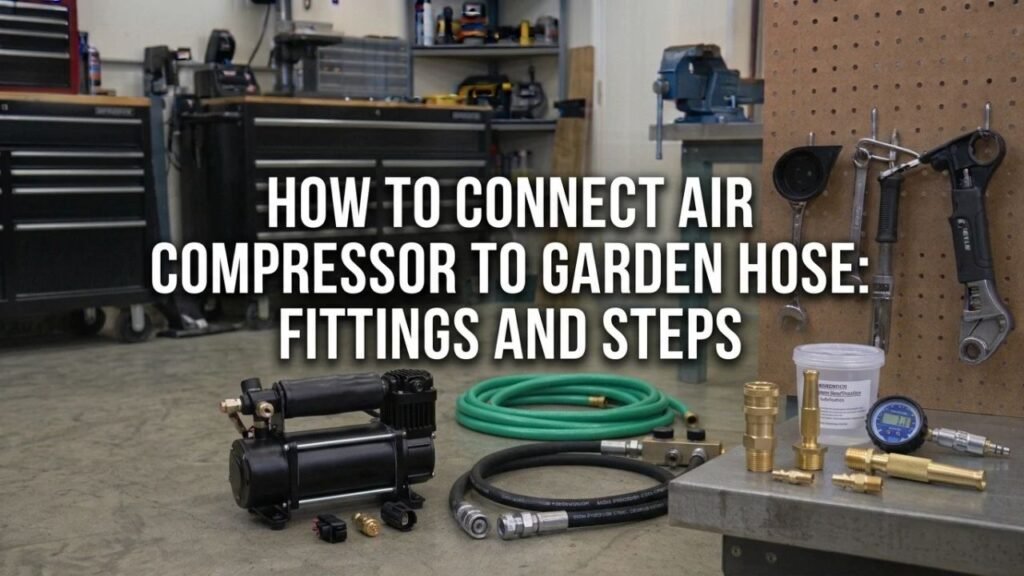
The parts depend on the type of connection already installed on your compressor and the gender of the garden-hose fitting.
Air Compressor Quick-Connect Fitting
Most portable U.S. compressors have a female quick coupler at the regulated outlet.
A common setup uses:
- 1/4-inch industrial air coupler on the compressor
- 1/4-inch male quick-connect plug on the adapter
- 3/4-inch GHT on the garden-hose side
The quick-connect plug snaps into the compressor coupler in the same manner as a normal pneumatic air hose.
Some compressors have threaded outlets instead. In that case, you may need a 1/4-inch NPT adapter before adding the garden-hose fitting.
3/4-Inch Garden Hose Adapter
Standard U.S. garden hoses commonly use 3/4-inch GHT connections.
The adapter needs the correct gender.
| Connection You Have | Adapter Side You Need |
| Female garden hose end | 3/4-inch male GHT |
| Male garden hose end | 3/4-inch female GHT |
| Female water inlet | 3/4-inch male GHT |
| Male hose bib or outlet | 3/4-inch female GHT |
Purpose-built winterizing adapters often combine a 1/4-inch air quick-connect plug with a 3/4-inch male garden-hose thread.
Others use a 3/4-inch female garden-hose thread.
Check the connection before buying the adapter.
Pressure Regulator
Use the compressor’s outlet regulator whenever compressed air is being introduced into a garden hose, irrigation system, RV plumbing, or another water system.
Tank pressure may be 125, 150, 175 PSI, or more.
That does not mean the connected system should receive the same pressure.
Set the regulated outlet much lower before opening airflow.
Garden Hose Washer
A female garden-hose fitting normally seals with a flat rubber washer.
If the connection leaks around the threads, check for a missing, cracked, flattened, or hardened washer.
GHT does not normally rely on thread sealant at the hose connection itself because the washer creates the seal.
Key Takeaway: A typical setup uses a 1/4-inch compressor quick plug, a 3/4-inch GHT adapter, a sound hose washer, and the compressor regulator to control outlet pressure.
How to Connect Air Compressor to Garden Hose Step by Step
Set up the connection with the compressor off or with its outlet pressure reduced before introducing air.
1. Identify the Compressor Outlet
Look at the regulated outlet on the compressor.
Most portable models have a female quick coupler that accepts a standard air-tool plug.
Check its size and style because several quick-coupler profiles exist.
A fitting that looks close may still fail to latch or seal correctly.
2. Identify the Garden Hose End
Look at the end you intend to connect.
A typical garden hose has:
- Female swivel fitting on one end
- Male threaded fitting on the other
If connecting to the female hose end, your adapter needs a male 3/4-inch GHT connection.
If connecting to the male hose end, use a female 3/4-inch GHT adapter.
3. Choose the Correct Adapter
For a common compressor-to-female-hose setup, use an adapter with:
1/4-inch male air quick plug → 3/4-inch male GHT
For a male garden-hose connection, you may need:
1/4-inch male air quick plug → 3/4-inch female GHT
Adapters with a small ball valve are useful because they let you shut off airflow at the connection point before disconnecting anything.
4. Turn the Regulator Down
Back the compressor’s outlet regulator down before connecting the system.
Do not rely on tank pressure as your working pressure.
A compressor may store air at 150 PSI while the connected plumbing or hose is intended to receive only a fraction of that amount.
5. Connect the Garden Hose Side
Thread the garden-hose fitting onto the adapter by hand.
Make sure the washer is installed inside the female GHT connection.
Start the threads carefully to avoid cross-threading.
Hand-tight is often enough for garden-hose connections. If a fitting requires a wrench, avoid crushing or cracking light-duty components.
6. Connect the Compressor Side
Pull back the sleeve on the compressor’s quick coupler.
Insert the adapter’s air plug completely, then release the sleeve.
Pull lightly on the fitting to confirm that it is locked.
If you are using a separate compressed-air hose, the layout can be:
Compressor → air hose → GHT adapter → water system
This arrangement is preferable to using a normal garden hose as the main compressed-air line.
7. Raise Pressure Slowly
Turn the regulator clockwise gradually while watching the outlet-pressure gauge.
Stop at the pressure required for the task or the maximum permitted by the lowest-rated component, whichever is lower.
Do not immediately set the regulator to full compressor pressure.
8. Check for Leaks
Listen for hissing around:
- Quick coupler
- Threaded NPT fitting
- GHT connection
- Hose ends
- Valve
- Adapter body
A small amount of soapy water can reveal bubbles at suspected threaded air connections.
Depressurize the setup before tightening or replacing fittings.
9. Open Airflow Gradually
If the adapter has a ball valve, crack it open slowly.
Sudden airflow can whip a loose hose or create a rapid pressure rise in a closed plumbing system.
Keep the hose controlled and make sure its discharge end cannot strike someone.
10. Shut Down and Depressurize Before Disconnecting
Close the air valve if equipped.
Turn the compressor off and release trapped pressure from the connected line.
Do not unscrew a pressurized garden-hose fitting.
Stored compressed air can cause the fitting or hose to move suddenly.
Key Takeaway: Match the fitting genders, reduce regulated pressure first, connect both sides securely, increase pressure slowly, check leaks, and depressurize before taking the setup apart.
Can You Use a Regular Garden Hose for Compressed Air?
I would not use an ordinary garden hose as a general-purpose compressed-air hose unless its manufacturer specifically rates it for compressed-air service at the planned pressure.
Water and compressed air store energy differently.
Garden Hoses Are Primarily Made for Water
A garden hose is normally designed around liquid-water service.
Its pressure rating may look high enough for a compressor, but that does not automatically mean the hose has been tested or approved for compressed gas.
A rupture under compressed air can release stored energy rapidly and make hose ends or damaged material move violently.
Use a Real Air Hose When Possible
For carrying compressed air over distance, use a hose specifically rated for compressed-air service.
Typical compressor hoses use:
- 1/4-inch or 3/8-inch air fittings
- Reinforced hose construction
- Published working-pressure ratings
- Pneumatic quick couplers
You can then place the garden-hose adapter at the far end.
This setup gives you:
Compressor → rated air hose → GHT adapter → garden-hose-thread system
A Garden-Hose-Thread Connection Is Different From a Garden Hose
Using a garden-hose-thread adapter to supply an RV inlet or irrigation blowout connection does not mean the actual hose carrying the compressed air needs to be a garden hose.
This distinction matters.
Use pneumatic hose for the compressed-air run whenever practical.
Key Takeaway: A GHT adapter is fine for connecting to a water-system fitting, but ordinary garden hose should not replace a pressure-rated compressed-air hose unless the hose maker approves compressed-air use.
GHT vs NPT: Why the Threads Matter
Garden hose and air-system fittings use different thread standards.
Trying to force them together can damage both fittings.
Garden Hose Thread
Standard garden hose fittings in the U.S. commonly use 3/4-inch GHT.
The connection seals with a washer inside the female swivel.
The threads primarily hold the connection together.
National Pipe Thread
Air compressor components commonly use 1/4-inch NPT threaded fittings.
NPT is a tapered pipe thread.
It normally seals on the threads with an appropriate pneumatic thread sealant or PTFE tape when permitted.
Do Not Force GHT Onto NPT
A 3/4-inch GHT fitting and 3/4-inch NPT fitting are not interchangeable.
They use different thread forms and pitches.
If the connection does not thread smoothly by hand, stop and verify the fitting types.
Key Takeaway: Compressor plumbing commonly uses NPT while garden hoses use GHT. Use a proper GHT-to-NPT or GHT-to-quick-connect adapter rather than forcing different threads together.
What PSI Should You Use With a Garden Hose Connection?
There is no single pressure setting that is correct for every job.
Use the limit specified for the system being pressurized.
Start Low
Set the compressor regulator at its lowest useful setting.
Increase pressure in small steps while monitoring the system.
A regulator protects downstream components from full tank pressure.
Sprinkler Blowout Pressure
Irrigation systems vary by pipe material, valves, heads, and manufacturer.
Some systems are designed for relatively low operating pressure even though individual components may carry higher ratings.
Use the irrigation manufacturer’s winterization limit.
Pressure is only one part of sprinkler blowout. Compressor airflow, measured in CFM, also determines how well water can be moved through long irrigation zones.
A tiny compressor may reach the target PSI but lack enough airflow to clear a large sprinkler system properly.
RV and Boat Water Systems
RV and marine plumbing components also have model-specific pressure limits.
Use the equipment manufacturer’s winterization procedure rather than applying the compressor’s full output.
A regulator and blowout adapter are the normal approach.
Compressed Air for Cleaning
If the garden-hose connection is part of a workplace cleaning setup, OSHA limits compressed air used for cleaning to 30 PSI unless specified guarding and pressure-reduction conditions are met.
Never use compressed air to clean your body or clothing.
Key Takeaway: Set pressure according to the connected system, not the compressor tank rating. Start low and use the regulator to prevent accidental overpressure.
How to Connect an Air Compressor to a Garden Hose for Winterizing
A garden-hose blowout adapter is commonly used for RVs, campers, boats, outdoor plumbing, and some irrigation connections.
Connect the Blowout Adapter
Thread the GHT end into or onto the water-system connection.
Make sure the washer is present where a female garden-hose fitting is used.
Connect the pneumatic side to a regulated compressor air hose.
Remove Water Pressure First
Turn off the normal water supply.
Drain as much water as the system allows before introducing compressed air.
Compressed air should move remaining water, not fight against a fully pressurized water supply.
Open the Correct Outlet or Zone
Do not pressurize a completely closed system.
Follow the winterization procedure for the plumbing or irrigation equipment.
For sprinkler systems, work through the zones according to the system design.
Apply Air Gradually
Bring up air pressure slowly.
Watch for abnormal hose swelling, leaks, or fittings moving.
Stop immediately if a hose, valve, or fitting begins deforming.
Avoid Running the Compressor Beyond Its Duty Cycle
Small portable compressors may struggle to supply enough CFM for a large irrigation system.
If the motor runs continuously and cannot maintain pressure, the compressor may be undersized for the task.
Allow cooling periods according to its duty-cycle rating.
Key Takeaway: Drain the system first, use a purpose-built blowout adapter, regulate the air supply, keep an outlet open, and stay within both the plumbing and compressor limits.
Why Does the Garden Hose Connection Leak Air?
Leaks usually come from the washer, incorrect threads, or pneumatic fittings.
Missing Garden Hose Washer
A female GHT fitting needs a good washer.
If the washer is missing, compressed air can escape around the threads.
Install a correctly sized garden-hose washer.
Damaged Washer
A washer can become:
- Cracked
- Hardened
- Flattened
- Cut
- Misaligned
Replace it if tightening does not stop the leak.
Wrong Thread Type
A GHT fitting forced onto an NPT fitting may seem to connect for a turn or two but will not seal correctly.
Use an actual GHT-to-NPT adapter.
Leaking NPT Connection
NPT connections may require appropriate thread sealant.
Apply sealant only to the pipe-thread side, following the fitting or compressor manufacturer’s instructions.
Do not place PTFE tape where fragments could enter sensitive pneumatic equipment.
Worn Quick Coupler
Air may also leak from the compressor coupler itself.
Inspect:
- Plug profile
- Coupler seals
- Locking sleeve
- Dirt or corrosion
- Physical damage
A plug from a different coupler standard may latch poorly or leak.
Key Takeaway: GHT leaks usually involve the washer, while compressor-side leaks often involve NPT sealing or an incompatible or worn quick coupler.
Can You Connect an Air Compressor Directly to a Hose Bib?
It is physically possible with the correct female GHT adapter, but the purpose of the connection needs to make sense.
A typical hose bib has male 3/4-inch garden-hose threads.
To connect a compressor, you would need a fitting such as:
Female 3/4-inch GHT → pneumatic adapter → air hose
Do not pressurize household water plumbing through an outdoor faucet without a defined service procedure.
Check valves, backflow devices, water heaters, appliances, and plumbing components can make the system unsuitable for random compressed-air pressurization.
For winterizing a building or irrigation system, use the designated blowout point and the procedure specified for that system.
Common Mistakes to Avoid
Several mistakes can turn a simple adapter job into a damaged hose or plumbing component.
Applying Full Tank Pressure
A tank containing 150 PSI does not mean the garden-hose system should receive 150 PSI.
Use the regulated outlet.
Using the Wrong Thread
GHT and NPT are different.
Do not force them together.
Using a Garden Hose With No Air Rating
Use a proper compressed-air hose between the compressor and adapter.
Do not assume a water-pressure rating automatically approves a hose for compressed gas.
Pressurizing a Closed System
Compressed air needs somewhere to go.
A closed valve or plugged outlet can expose parts to full regulator pressure very quickly.
Disconnecting While Pressurized
Release pressure before loosening threaded fittings.
A pressurized line can whip or eject a fitting unexpectedly.
Ignoring Compressor Airflow
Pressure alone does not guarantee enough air for winterizing.
Large sprinkler systems may require far more CFM than a small pancake or 3-gallon compressor can supply.
Key Takeaway: Regulate pressure, match the threads, use pressure-rated equipment, maintain an air outlet, and depressurize the system before disassembly.
Conclusion
The basic process for how to connect air compressor to garden hose is to use an adapter that matches the compressor’s pneumatic connection on one side and the standard 3/4-inch garden-hose thread on the other. A common setup uses a 1/4-inch industrial quick-connect plug and a 3/4-inch GHT fitting.
Match the adapter gender to the garden-hose connection. A female hose end needs a male GHT adapter, while a male hose connection needs a female GHT adapter. Make sure the hose washer is installed where required.
Use the compressor regulator and start with low outlet pressure. Never assume a garden hose, sprinkler system, RV water system, or other plumbing component can safely handle the compressor’s full tank pressure.
For carrying compressed air over any meaningful distance, I would use a real pneumatic hose and place the GHT adapter at the water-system end. That gives you a cleaner and safer setup than relying on an ordinary garden hose as the compressed-air line.
FAQs About Connecting an Air Compressor to a Garden Hose
What Adapter Connects an Air Compressor to a Garden Hose?
A common adapter has a 1/4-inch male air quick-connect plug on one end and a 3/4-inch GHT fitting on the other.
Choose male or female GHT according to the garden-hose fitting you need to connect.
Can I Use a Garden Hose as an Air Compressor Hose?
Use an ordinary garden hose for compressed air only if the hose manufacturer specifically rates it for compressed-air service at your planned pressure.
A pressure-rated pneumatic hose is the better choice for carrying compressed air.
Is Garden Hose Thread the Same as NPT?
No.
Standard garden hose fittings commonly use 3/4-inch GHT, while compressor fittings commonly use sizes such as 1/4-inch NPT. The two thread systems should be joined with a proper adapter.
How Much PSI Can I Put Through a Garden Hose?
Use the hose manufacturer’s rated working pressure and never exceed the lowest-rated component in the setup.
A water working-pressure rating does not automatically mean the hose is approved for compressed-air service.
Can I Connect an Air Compressor to a Garden Hose to Blow Out Sprinklers?
Yes, if the irrigation system has a suitable GHT blowout connection or you install the correct approved adapter.
Regulate pressure according to the irrigation system’s requirements. Large sprinkler zones may also require substantial CFM that a small compressor cannot supply.
Can I Connect My Compressor Directly to an RV Water Inlet?
A purpose-built RV blowout adapter can connect a regulated compressor air hose to a garden-hose-thread city-water inlet.
Follow the RV manufacturer’s winterization pressure limit and open the plumbing outlets in the proper sequence.
Why Won’t My Air Compressor Fitting Screw Into the Garden Hose?
The fittings probably use different thread standards.
A compressor fitting is commonly NPT, while the hose is GHT. Install a fitting specifically made to convert between the two rather than forcing the threads together.