
What Is a Rotary Air Compressor? How It Works, Types, and Uses
A rotary air compressor uses continuously moving internal rotors, vanes, or scroll elements to trap air and reduce its volume, which raises its pressure. Unlike a piston compressor that repeatedly moves pistons up and down, a rotary design creates compressed air through smooth rotational or orbiting motion and is commonly used where steady airflow is needed.
Rotary compressors are found in machine shops, factories, automotive facilities, food processing plants, construction operations, and many other places that need compressed air for long periods.
The term can describe several compressor designs. What is a rotary air compressor? In the broad sense, it is a positive-displacement compressor that compresses air using rotating or orbiting components rather than reciprocating pistons. Rotary screw is the most common industrial version, but rotary vane and scroll designs also exist.
Rotary screw compressors use two intermeshing helical rotors. Air enters the compressor, becomes trapped between the rotors and housing, and is squeezed into a smaller space as the rotors turn. This creates a smooth supply of compressed air with relatively low pulsation.
Rotary compressors matter heavily in U.S. industry because compressed air can consume a large amount of electricity. The U.S. Department of Energy has reported that generating compressed air accounts for about 10% of electricity use in a typical industrial facility, and the share can reach 30% or more in some plants.
Rotary compressors are often chosen for applications that need air for much of the workday rather than a few brief tool cycles. Their steady airflow, reduced vibration, and ability to operate for long periods make them very different from the small piston compressors commonly found in home garages.
What Is a Rotary Air Compressor?
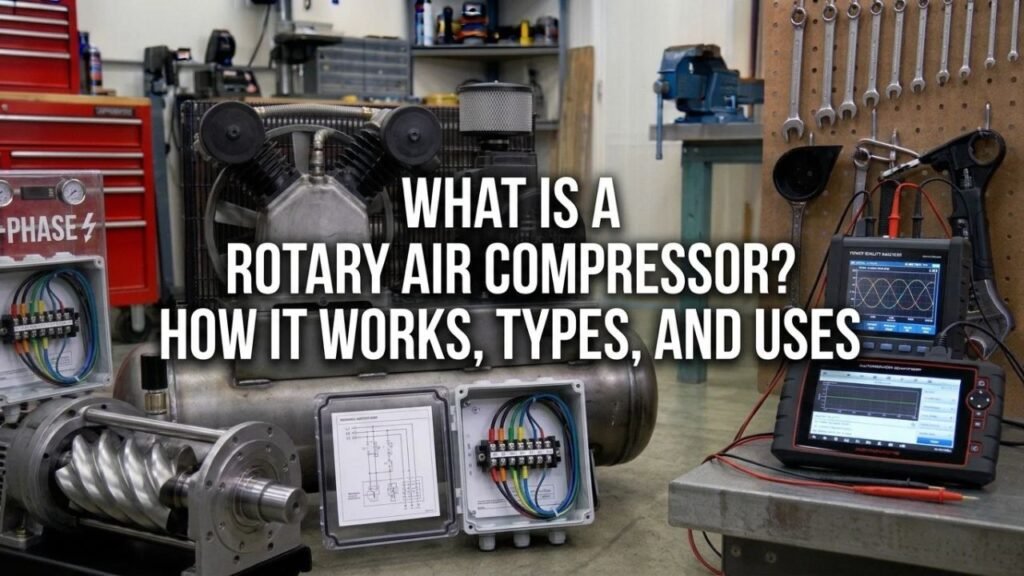
A rotary air compressor is a machine that raises air pressure by trapping air inside a chamber and progressively reducing the chamber’s volume with rotating or orbiting components.
Most rotary compressors fall under the positive-displacement category.
Positive-Displacement Compression
Positive-displacement compressors capture a fixed quantity of air and make the space containing that air smaller.
As volume decreases, pressure rises.
This differs from centrifugal compressors, which use rapidly moving impellers to increase air velocity and then convert that velocity into pressure.
Rotary screw and rotary vane compressors both use positive displacement.
Rotary Motion Instead of Pistons
A reciprocating compressor uses pistons moving back and forth inside cylinders.
A rotary compressor replaces that repeated stop-and-reverse motion with components that move continuously in one general rotational direction.
This produces smoother airflow and less pressure pulsation.
“Rotary Compressor” Often Means Rotary Screw
In everyday shop and industrial use, people often use the phrase “rotary air compressor” when they specifically mean a rotary screw air compressor.
Rotary screw is one of the most widely used rotary compressor technologies in manufacturing and commercial compressed-air systems.
Atlas Copco describes rotary screw compressors as machines that use two counter-rotating screws to provide a steady supply of compressed air and support long operating periods.
Key Takeaway: A rotary air compressor compresses air with continuously moving rotary components rather than reciprocating pistons, with rotary screw being the most common industrial design.
How Does a Rotary Air Compressor Work?
The exact process changes by compressor type, but the same basic steps occur: air enters, becomes trapped, is compressed into a smaller space, and leaves at higher pressure.
A rotary screw compressor provides a clear example.
Air Enters Through the Intake
Atmospheric air enters through an intake filter.
The filter removes dust and other particles before they reach the compression element.
Clean intake air helps protect close internal clearances and keeps deposits from forming inside the compressor.
Rotors Trap the Air
Inside a rotary screw airend are two specially shaped helical rotors commonly called the male and female rotors.
They rotate in opposite directions.
As their lobes and grooves move past the inlet, pockets of air become trapped between the rotor surfaces and compressor housing.
Gardner Denver describes this process as air becoming trapped in pockets formed between the male and female rotor profiles.
The Air Pocket Gets Smaller
As the rotors continue turning, the trapped air moves along the length of the screws.
The available space becomes progressively smaller.
Reducing volume raises the air pressure.
Unlike piston compression, this process happens continuously as long as the rotors are turning.
Compressed Air Leaves the Airend
When the trapped air reaches the discharge end of the rotors, it exits the compression chamber at a higher pressure.
The air then passes through other system components before reaching the receiver or plant air piping.
Depending on compressor design, these components may include:
- Aftercooler
- Moisture separator
- Oil separator
- Air receiver
- Dryer
- Filters
Oil-Injected Units Separate Oil From the Air
Many rotary screw compressors inject oil directly into the compression chamber.
The oil performs several jobs:
- Lubricates internal components
- Helps seal rotor clearances
- Removes compression heat
- Reduces wear
After compression, the oil-air mixture enters a separator system.
Most of the oil is removed, cooled, filtered, and returned to the compressor for reuse.
Ingersoll Rand describes oil-flooded rotary screw systems as using oil to seal, cool, and lubricate the airend before separating that oil from the compressed air.
Key Takeaway: A rotary screw compressor draws air in, traps it between rotating screws, reduces the trapped volume, and sends the resulting compressed air through the system for cooling, separation, storage, and use.
Main Types of Rotary Air Compressors
“Rotary” covers several designs.
The three types most people are likely to encounter are rotary screw, rotary vane, and rotary scroll.
Rotary Screw Air Compressor
A rotary screw compressor uses two intermeshing helical rotors.
This is the dominant rotary design in many industrial compressed-air systems.
Common characteristics include:
- Steady airflow
- Low pressure pulsation
- Long operating periods
- High CFM options
- Oil-injected and oil-free versions
- Fixed-speed and variable-speed models
The U.S. Department of Energy has described lubricant-injected rotary screw compressors as the dominant compressor type in many applications above 25 HP.
Rotary screw compressors are commonly found in factories, automotive shops, fabrication facilities, and production environments.
Rotary Vane Air Compressor
A rotary vane compressor uses a rotor mounted off-center inside a cylindrical housing.
Slots in the rotor contain sliding vanes.
As the rotor spins, centrifugal force or internal mechanisms keep the vanes in contact with the housing wall.
Air becomes trapped between neighboring vanes.
Because the rotor is offset, the spaces between those vanes become smaller as they travel around the housing, compressing the trapped air.
Gardner Denver lists automotive facilities, body shops, woodworking, dentistry, laundry, packaging, and machine-tool applications among uses for rotary vane compressors.
Rotary Scroll Air Compressor
A scroll compressor uses two spiral-shaped scrolls.
One remains stationary while the other moves in an orbit.
Air enters pockets formed between the scrolls and moves toward the center as those pockets become progressively smaller.
Many scroll compressors operate without oil inside the compression chamber.
That makes them common where clean compressed air is a priority.
Gardner Denver notes that scroll compressors are used in areas such as medical equipment, electronics manufacturing, and food and beverage production.
Key Takeaway: Rotary screw compressors use helical rotors, rotary vane compressors use sliding vanes, and scroll compressors use paired spiral elements to compress air.
Oil-Injected vs Oil-Free Rotary Air Compressors
Rotary compressors can also be grouped according to how lubrication interacts with the compression chamber.
Oil-Injected Rotary Screw Compressor
An oil-injected, oil-flooded, or oil-lubricated screw compressor sends oil into the compression chamber.
The oil helps:
- Cool the compressed air
- Seal rotor clearances
- Lubricate moving parts
- Reduce internal leakage
After compression, separators remove the oil from the air stream.
These compressors are widely used for:
- General manufacturing
- Automotive work
- Fabrication
- Pneumatic tools
- Industrial machinery
Downstream filtration can further reduce oil carryover when the process requires cleaner air.
Oil-Free Rotary Screw Compressor
In an oil-free screw compressor, oil is not injected into the compression chamber.
The rotors are kept from contacting each other through precise clearances and synchronization.
Oil may still be used elsewhere in the gearbox or bearings, so “oil-free” refers primarily to the compression process and delivered air.
Atlas Copco notes that oil-free rotary screw designs use timing gears to synchronize the rotors and prevent contact inside the compression chamber.
These compressors are often selected for processes where oil contamination could damage products or create quality problems.
Which Type Fits Different Jobs?
Oil-injected machines are common where a small amount of oil carryover can be removed with normal downstream treatment.
Oil-free compressors are often used for:
- Pharmaceuticals
- Food production
- Electronics
- Medical applications
- Sensitive manufacturing processes
Oil-free equipment usually comes with a higher purchase price because the airend requires very precise design and manufacturing.
Key Takeaway: Oil-injected compressors use oil inside the compression chamber for cooling, sealing, and lubrication, while oil-free designs keep lubricant out of the compressed-air path.
Rotary Air Compressor vs Piston Air Compressor
Rotary and piston compressors can both supply shop air, but they suit different operating patterns.
Compression Method
A piston compressor uses a crankshaft, connecting rod, piston, cylinder, and valves.
The piston repeatedly draws air in and compresses it.
A rotary screw compressor uses continuously turning rotors.
This creates a much smoother compression process.
Airflow
Piston compressors deliver air in pulses corresponding to piston strokes.
The receiver tank smooths those pulses before air reaches the tool.
Rotary screw compressors create a steadier discharge flow with lower pulsation.
Ingersoll Rand specifically notes lower pulsation as one characteristic of rotary screw compressors compared with reciprocating designs.
Duty Cycle
Small and medium piston compressors often work best in applications where the pump can run, stop, cool, and restart.
Many rotary screw compressors are designed for long operating periods and can support continuous-duty applications.
That makes rotary screw machines a natural fit for facilities that need air throughout an entire shift.
Noise and Vibration
Reciprocating pumps create noticeable vibration because pistons change direction rapidly.
Rotary screw units generally operate more smoothly.
Many are also enclosed in sound-reducing cabinets.
The actual noise level still depends on compressor size and construction.
Cost
Piston compressors are usually less expensive to buy for small workshops and intermittent tool use.
Rotary screw compressors become more attractive when:
- Air demand is high
- The compressor runs many hours
- Downtime is costly
- Multiple workers use compressed air
- Stable airflow matters
Key Takeaway: Piston compressors suit many start-stop jobs and lower budgets, while rotary screw compressors are better suited to long operating periods and steady air demand.
Fixed-Speed vs Variable-Speed Rotary Screw Compressors
Rotary screw compressors can also control output in different ways.
Two common choices are fixed speed and variable speed drive.
Fixed-Speed Compressor
A fixed-speed compressor runs its motor at a largely constant speed while loaded.
This design fits facilities where compressed-air demand remains fairly steady.
Advantages can include:
- Simpler controls
- Lower initial price
- Straightforward servicing
- Good fit for stable loads
The compressor may load and unload as system pressure changes.
Variable-Speed Drive Compressor
A variable-speed drive, or VSD, changes motor speed to better match compressed-air demand.
When the facility needs less air, motor speed can decrease.
When demand rises, the compressor speeds up within its operating range.
Atlas Copco and Gardner Denver both offer rotary screw systems with variable-speed technology for applications with changing air demand.
Match the Control Type to Demand
A VSD compressor makes the most sense where air consumption changes frequently throughout the day.
A fixed-speed machine can be a better fit where the compressor regularly operates near one stable load point.
Selection should be based on measured air demand rather than assuming one control method is always better.
Key Takeaway: Fixed-speed compressors suit steady air demand, while variable-speed compressors can reduce motor speed when demand falls and raise it as more air is needed.
Common Uses for Rotary Air Compressors
Rotary compressors are mainly associated with commercial and industrial air systems, though smaller models are also available.
Manufacturing
Factories use rotary compressors for:
- Pneumatic cylinders
- Assembly equipment
- Air tools
- Packaging machinery
- Material handling
- Controls
- Automated production lines
A steady supply is important when production equipment depends on compressed air for hours at a time.
Automotive and Body Shops
Rotary compressors can support:
- Impact tools
- Tire machines
- Air ratchets
- Lifts with pneumatic controls
- Paint booths
- Sanders
- Blow guns
A busy shop with several technicians can have air demand well above what a small piston compressor can supply.
Food, Pharmaceutical, and Electronics Plants
Processes that cannot tolerate oil contamination may use oil-free screw or scroll compressors.
Air treatment may also include dryers and high-grade filters to achieve the required air-quality class.
Woodworking and Fabrication
Woodworking facilities use compressed air for nailers, clamps, controls, spray finishing, and cleaning.
Fabrication shops may use grinders, plasma equipment, air tools, and production machinery.
Commercial Buildings and Specialty Applications
Rotary compressors also appear in:
- Dental facilities
- Dry-cleaning operations
- Packaging facilities
- Printing
- Laboratories
- Machine shops
Gardner Denver describes rotary compressor applications across automotive, woodworking, dentistry, packaging, and machine-tool environments.
Key Takeaway: Rotary compressors are commonly used anywhere compressed air is needed steadily for machinery, production equipment, tools, controls, or clean-air processes.
Advantages of a Rotary Air Compressor
A rotary compressor offers several strengths for high-use compressed-air systems.
Steady Air Delivery
Rotating compression elements produce a smoother stream of air than a single reciprocating piston.
This is useful for production machinery and processes that dislike pressure pulsation.
Long Operating Periods
Many rotary screw systems are designed around extended operation.
Atlas Copco states that rotary screw compressors can be built for continuous-duty operation in demanding production environments.
Lower Vibration
The rotating elements do not repeatedly reverse direction like pistons.
That reduces mechanical vibration.
High Airflow for Their Size
Rotary screw compressors can produce substantial CFM from a relatively compact package.
This makes them practical when floor space is limited.
Lower Noise in Many Installations
Smooth compression and sound enclosures can make rotary screw equipment quieter than large open piston compressors.
Noise still varies by machine.
Multiple Control Options
Rotary screw systems can be configured with:
- Fixed speed
- Variable speed
- Load/unload control
- Multiple-compressor sequencing
This gives commercial users several ways to match compressor operation to air demand.
Key Takeaway: Rotary compressors provide smooth airflow, high CFM, reduced vibration, and long operating capability, which suits facilities with steady compressed-air demand.**
Drawbacks of a Rotary Air Compressor
A rotary compressor is not automatically the best option for every garage or shop.
The main drawbacks include:
- Higher purchase price than many piston compressors
- More complex internal components
- Costly airend repairs
- Regular oil and filter service on lubricated models
- Oil-separator service on oil-injected screw compressors
- Poor economics if the unit is greatly oversized
- More specialized servicing for some models
A small home shop that uses a nail gun or impact wrench for a few minutes at a time may get better value from a conventional piston compressor.
Rotary screw machines make more sense when their high airflow and long-duty capability are actually being used.
How to Size a Rotary Air Compressor
Selecting the right compressor requires more than choosing horsepower.
Determine Required CFM
CFM tells you how much air the compressor can supply.
List every air-consuming device that may operate at the same time.
Include:
- Air tools
- Production machinery
- Pneumatic cylinders
- Blow guns
- Spray equipment
Add reasonable capacity for leakage and future additions.
The Department of Energy recommends treating compressed air as a complete system rather than sizing only the compressor itself.
Determine Required PSI
The compressor must also supply enough pressure.
Do not raise system pressure simply because the compressor can reach a higher number.
Higher pressure usually increases power use and air leakage.
Use the lowest pressure that safely meets equipment requirements.
Consider Operating Hours
A rotary screw compressor becomes more attractive when the system operates for long periods.
For short, occasional jobs, a piston compressor may be more economical.
Decide How Clean and Dry the Air Must Be
Compressed air can contain:
- Water
- Oil
- Dirt
- Rust
- Fine particles
Some processes require:
- Refrigerated dryer
- Desiccant dryer
- Coalescing filters
- Particulate filters
- Oil-free compression
Air-quality requirements can affect total system cost as much as the compressor itself.
Plan for Receiver Storage
An air receiver provides stored air and helps absorb short changes in demand.
The receiver does not replace compressor CFM, but it can improve pressure stability and reduce rapid control cycling.
Key Takeaway: Size a rotary compressor from actual CFM, PSI, operating hours, air-quality needs, and demand patterns rather than horsepower or tank size alone.**
Rotary Air Compressor Maintenance
Rotary compressors generally require scheduled preventive maintenance.
Skipping service can increase operating temperature, reduce airflow, and shorten airend life.
Intake Filter
The intake filter keeps airborne dirt away from the compression element.
A clogged filter restricts incoming air and makes the compressor work harder.
Replace or clean it at the interval specified by the manufacturer.
Compressor Oil
Oil-injected screw compressors require the correct lubricant.
The oil performs cooling, sealing, and lubrication duties inside the airend.
Using the wrong product or extending oil life too far can create deposits and accelerated wear.
Oil Filter and Separator
Lubricated rotary screw systems normally use:
- Oil filter
- Air/oil separator
The separator removes lubricant from compressed air before it leaves the compressor package.
A restricted separator can increase pressure drop and power demand.
Cooling System
Compression creates heat.
Keep:
- Coolers
- Fans
- Ventilation openings
- Radiators
clean and unobstructed.
High compressor temperature can cause shutdowns and shorten lubricant life.
Air Leaks
Leaks waste compressed air and force the compressor to run more than necessary.
The Department of Energy identifies leak reduction as one of the major opportunities for reducing compressed-air energy use.
Follow the Service Schedule
Maintenance intervals vary by compressor model and operating environment.
Track:
- Running hours
- Oil service
- Filter replacement
- Separator replacement
- Belt condition on belt-driven models
- Dryer maintenance
- Condensate drain operation
Key Takeaway: Routine filter, oil, separator, cooling-system, leak, and drain maintenance keeps a rotary compressor operating correctly and reduces unnecessary run time.**
Conclusion
What is a rotary air compressor? It is a compressor that uses rotating or orbiting compression elements instead of reciprocating pistons to trap air, reduce its volume, and raise its pressure.
Rotary screw is the most common industrial version. Two helical rotors turn continuously and squeeze air into progressively smaller spaces, producing a steady compressed-air supply with low pulsation.
Rotary vane and scroll machines use different internal mechanisms but follow the same broad idea of continuous positive-displacement compression.
A rotary compressor makes the most sense when a workshop, plant, or commercial operation needs substantial CFM for long periods. For occasional home-garage tasks, a smaller piston compressor can still be the simpler and less expensive choice.
Choose the compressor from actual airflow, pressure, operating hours, air quality, and service requirements rather than assuming rotary technology is automatically the right fit for every application.
FAQs About Rotary Air Compressors
Is a Rotary Air Compressor the Same as a Rotary Screw Compressor?
Not exactly.
Rotary air compressor is a broader term that can include rotary screw, rotary vane, and rotary scroll designs. In everyday industrial use, people often use “rotary compressor” to refer specifically to a rotary screw compressor.
What Does a Rotary Air Compressor Do?
It takes atmospheric air, traps it inside a compression chamber, reduces the available volume, and delivers the air at a higher pressure.
The compressed air can then operate tools, machinery, pneumatic controls, and production equipment.
Does a Rotary Air Compressor Have Pistons?
A rotary screw or rotary vane compressor does not use reciprocating pistons for compression.
Instead, it uses rotating screws, vanes, or another rotary mechanism.
Is a Rotary Air Compressor Better Than a Piston Compressor?
It depends on the workload.
Rotary screw compressors are well suited to steady or long-duration air demand. Piston compressors are often less expensive and work well for intermittent use in smaller garages and workshops.
Do Rotary Air Compressors Need a Tank?
They can operate as part of a system without a large receiver directly underneath the compressor, but most compressed-air installations benefit from air storage.
A receiver helps handle short demand peaks and reduces rapid pressure changes.
Are Rotary Air Compressors Oil-Free?
Some are and some are not.
Oil-injected rotary screw compressors use lubricant inside the compression chamber. Oil-free screw and scroll compressors keep oil out of the compression process and are used when cleaner air is required.
Can a Rotary Air Compressor Run Continuously?
Many rotary screw compressors are designed for long-duration or continuous-duty operation.
The exact duty rating still depends on the compressor model, operating temperature, ventilation, and maintenance schedule.
What Is the Main Advantage of a Rotary Screw Air Compressor?
Its main strength is the ability to supply a steady volume of compressed air for long periods with relatively low pulsation and vibration.
That makes rotary screw machines common in manufacturing, automotive, fabrication, and other high-use compressed-air systems.