
What Is Better Single Stage or 2 Stage Air Compressor? Comparison
A two-stage air compressor is generally better for higher pressure, long run times, and demanding shop work, while a single-stage compressor is usually better for lighter home-garage jobs, portability, and lower purchase cost. For most DIY users running nailers, inflation tools, and occasional air tools, a properly sized single-stage unit is often enough.
The main difference is the number of compression steps. A single-stage piston compressor compresses incoming air once before sending it to the receiver. A two-stage compressor compresses it once, cools it through an intercooler, then compresses it again in a second cylinder.
That extra stage allows many two-stage reciprocating compressors to reach around 175 PSI, while many single-stage models top out closer to 125-135 PSI. Ingersoll Rand lists its single-stage reciprocating applications around 70-90 PSI with maximum pressures up to about 135 PSI, while its two-stage models commonly work above 100 PSI and may reach about 175 PSI.
For what is better single stage or 2 stage air compressor, the answer comes from your tool pressure, CFM demand, runtime, and budget rather than stage count alone. A two-stage machine has clear advantages at higher pressure and heavier duty, but buying one for occasional tire inflation or brad nailing usually adds cost and size without much practical gain.
Home use also leans strongly toward single-stage equipment. Lowe’s describes single-stage piston compressors as the most common type for home use, while two-stage compressors are more commonly found in heavier commercial applications and shops running multiple tools.
Compressed air also uses a substantial amount of electricity in the United States. The U.S. Department of Energy’s Better Plants program reports around 90 billion kWh of annual U.S. electricity use from compressed-air systems, making correct compressor sizing especially important for equipment that runs many hours per day.
What Is Better Single Stage or 2 Stage Air Compressor?
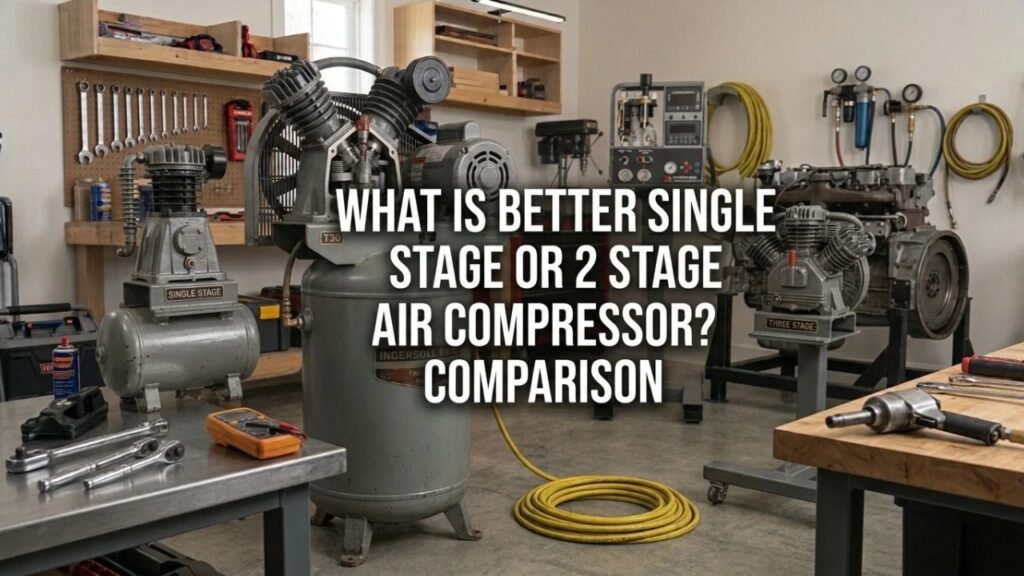
For light and moderate intermittent work, single-stage is usually the better value.
For higher pressure, frequent operation, several air tools, and heavier commercial work, two-stage is usually the stronger setup.
Choose Single Stage for Lighter Work
A single-stage compressor makes sense for jobs such as:
- Tire inflation
- Brad nailing
- Finish nailing
- Stapling
- Blow-gun use
- Occasional impact-wrench work
- Light automotive maintenance
- Small DIY projects
Quincy describes single-stage compressors as well suited to moderate-pressure, light-duty work, with many designs operating in roughly the 100-135 PSI range.
They also tend to cost less, weigh less, and have a simpler pump design.
Choose Two Stage for Demanding Work
Two-stage compressors are stronger candidates for:
- Auto repair shops
- Multiple air tools
- Long sanding sessions
- Grinding
- Higher-pressure equipment
- Production work
- Commercial garages
- Frequent daily compressor use
Lowe’s notes that two-stage compressors are commonly heavy-duty commercial machines and can supply higher pressure and greater air volume for continuous work or multiple tools.
Neither Stage Count Replaces CFM Sizing
A two-stage label does not automatically mean a compressor can run every tool.
Always compare:
- Tool CFM or SCFM
- Required PSI
- Compressor SCFM at that PSI
- Tank size
- Duty cycle
- Electrical supply
A large two-stage compressor producing inadequate CFM for a particular process is still undersized.
Key Takeaway: Single-stage compressors are usually the better fit for intermittent home and garage work, while two-stage compressors make more sense for higher pressure and heavier daily air demand.
How a Single-Stage Air Compressor Works
A single-stage reciprocating compressor completes compression in one cylinder stage.
Air Enters the Cylinder
As the piston moves down, atmospheric air enters through an intake valve.
When the piston moves upward, the inlet closes and the trapped air is compressed.
Air Goes Directly to the Receiver
Once the compressed air reaches the discharge side, it moves toward the storage tank.
There is no second compression cylinder in the airflow path.
Quincy describes single-stage compression as taking incoming air to final pressure in one compression step before it reaches the receiver.
A Single-Stage Compressor Can Have More Than One Cylinder
This point causes confusion.
Two cylinders do not automatically mean two stages.
A twin-cylinder single-stage compressor can have both cylinders taking in atmospheric air and compressing it to the same final pressure.
The Home Depot notes that single-stage compressors may have one or more cylinders operating at the same output pressure.
Key Takeaway: A single-stage compressor compresses atmospheric air to final pressure in one stage, even if the pump uses more than one cylinder.
How a Two-Stage Air Compressor Works
A two-stage reciprocating compressor splits the compression process into two steps.
The First Cylinder Starts Compression
Air enters a larger low-pressure cylinder.
That first piston raises the air to an intermediate pressure rather than immediately taking it to final receiver pressure.
An Intercooler Removes Heat
The partly compressed air travels through an intercooler between stages.
Compression raises air temperature, so removing some heat before the second compression step reduces the work required to reach a higher final pressure.
Atlas Copco states that intercooling between stages removes heat from partly compressed air, supporting higher-pressure operation with lower compression work than doing the same pressure increase in one stage.
The Second Cylinder Raises Pressure Again
The cooled air enters a smaller high-pressure cylinder.
That cylinder compresses it again before sending it to the receiver.
The Home Depot states that two-stage compressors commonly reach tank pressures around 175 PSI, giving more stored air in the same receiver volume than lower-pressure designs.
Key Takeaway: Two-stage compressors divide compression between two cylinders and cool the air between stages, allowing higher final pressure with less heat load at high compression ratios.
Single Stage vs Two Stage Air Compressor Comparison
A side-by-side comparison makes the differences easier to see.
| Feature | Single Stage | Two Stage |
| Compression steps | One | Two |
| Typical maximum pressure | Often 125-135 PSI | Often around 175 PSI |
| Intercooler between stages | No | Yes |
| Purchase cost | Lower | Higher |
| Pump complexity | Simpler | More complex |
| Size and weight | Often smaller | Often larger |
| Home DIY use | Strong fit | Often unnecessary |
| Commercial shop use | Light to moderate | Strong fit |
| High-pressure work | Limited | Better suited |
| Long daily runtime | Model dependent | Better suited in many piston applications |
| Maintenance cost | Usually lower | Usually higher |
| Air stored in same tank size | Less at lower pressure | More at higher pressure |
Pressure Is the Clearest Difference
Ingersoll Rand lists many single-stage piston compressors with maximum output near 135 PSI and two-stage machines near 175 PSI.
That extra pressure can matter for shops using equipment that needs more than 100-125 PSI.
Two Stage Can Store More Air in the Same Tank Volume
Consider two 60-gallon receivers.
One compressor reaches 125 PSI.
The other reaches 175 PSI.
The physical tanks may have the same volume, but the 175-PSI system stores more compressed air mass.
That gives more usable reserve after the regulator.
Single Stage Usually Costs Less
A single-stage pump has fewer compression components.
For a homeowner whose tools operate comfortably around 90 PSI, the extra cost of a two-stage system may bring little benefit.
Key Takeaway: The biggest practical differences are maximum pressure, heat control, purchase cost, size, and suitability for extended high-demand operation.
Is a Two-Stage Compressor More Powerful?
It can deliver higher final pressure, but the word “powerful” can be misleading.
Stage Count Does Not Tell You CFM
Compare these fictional compressors:
Compressor A
- Single stage
- 12 SCFM at 90 PSI
Compressor B
- Two stage
- 10 SCFM at 90 PSI
For a tool needing 11 SCFM at 90 PSI, Compressor A provides more airflow at that operating point.
Compressor B may still reach much higher maximum pressure.
CFM and PSI Need to Be Read Together
Quincy advises checking pressure and airflow separately when selecting a compressor. Its portable-compressor guidance explains that higher CFM lets a machine supply more air demand, while PSIG describes operating pressure.
Do not buy from the 175-PSI number alone.
Horsepower Does Not Settle the Question Either
Two compressors with the same horsepower may have different:
- Pump speeds
- CFM ratings
- Pressure ratings
- Tank sizes
- Duty ratings
Tool compatibility should come from delivered airflow at the required pressure.
Key Takeaway: Two-stage compressors usually reach higher pressure, but CFM at your tool’s PSI is the better measure of usable airflow.
Which Compressor Runs Cooler?
Two-stage compression has an advantage when high final pressure is required.
Compression Creates Heat
Squeezing air into a smaller volume raises its temperature.
Trying to make a large pressure increase in a single compression step creates more thermal stress.
Two Stage Adds Intercooling
A two-stage compressor removes some heat after the first stage.
The cooler, denser air then enters the second cylinder.
Quincy explains that intercooling reduces the temperature before the next compression stage and reduces the work needed to reach the final pressure.
Cooler Compression Can Reduce Component Stress
Lower temperature at high pressure can reduce thermal load on:
- Valves
- Piston rings
- Lubricant
- Cylinder components
Quincy also notes that splitting compression work between stages can reduce stress on components in higher-demand applications.
This does not mean every two-stage compressor always runs cooler than every single-stage model. Ambient temperature, pump speed, ventilation, duty cycle, maintenance, and pressure settings still matter.
Key Takeaway: Intercooling gives two-stage compressors an advantage when producing higher pressure because some heat is removed before the final compression step.
Which Is Better for a Home Garage?
For most home garages, a single-stage compressor is enough if its CFM meets the tools being used.
Tire Inflation
A single-stage compressor is more than adequate for passenger-car tire inflation.
You do not need 175-PSI two-stage equipment simply because tires use compressed air.
Nail Guns
Brad, finish, framing, and roofing nailers generally use air in short bursts.
The Home Depot states that small 2- to 6-gallon compressors can handle many intermittent nailer applications when airflow and pressure meet tool requirements.
A two-stage pump offers little advantage for basic trim work.
Impact Wrench
A properly sized single-stage compressor can operate many impact wrenches.
Look at the wrench’s SCFM requirement and expected trigger time.
Frequent tire-shop use with several technicians can justify moving to a larger two-stage system.
Sanding and Grinding
These tools change the calculation.
Air sanders and grinders can consume air continuously.
A high-CFM single-stage compressor may still work, but repeated long sessions can favor a larger two-stage shop machine with more airflow and stronger duty capability.
Key Takeaway: A home garage usually does well with a properly sized single-stage compressor unless long sanding, grinding, several simultaneous tools, or higher-pressure equipment create heavier demand.
Which Is Better for an Auto Repair Shop?
Two-stage compressors often make more sense in a busy professional shop.
Multiple Technicians Increase Air Demand
A commercial shop may have several air users operating at once:
- Impact wrenches
- Tire equipment
- Air ratchets
- Blow guns
- Grinders
- Sanders
- Pneumatic lifts
Lowe’s identifies two-stage machines as a strong choice for continuous shop use and multiple tools.
Higher Storage Pressure Gives More Reserve
A 175-PSI receiver can store more air than the same-size receiver charged to 125 PSI.
The regulator still supplies tools at their required pressure, but the higher storage pressure gives the system a larger reserve.
Daily Runtime Favors Heavier Equipment
A compressor running throughout an eight-hour workday faces a different workload from one used for an impact wrench a few times each weekend.
Two-stage piston compressors are commonly built for the heavier end of reciprocating-compressor service.
For very high and steady shop demand, a rotary screw compressor may become another option rather than moving indefinitely toward larger piston equipment.
Key Takeaway: Busy automotive shops often gain more from two-stage pressure, storage, and heavy-duty construction than occasional home users do.
Which Is Better for Painting?
Stage count is not the first specification to examine for spray painting.
Spray Guns Need Airflow
A spray gun may require a steady supply of air.
Check its stated CFM at the specified inlet pressure.
A compressor can reach 175 PSI and still fall short if its pump cannot supply enough continuous airflow.
Tank Size Helps Stabilize Supply
A larger tank gives a buffer during spraying.
Still, stored air eventually runs down if gun demand exceeds pump output.
Moisture Control Matters Too
Paint work is sensitive to water and oil in compressed air.
A good painting setup may need:
- Aftercooling
- Water separator
- Air dryer
- Fine filtration
- Correct hose size
Stage count by itself does not provide clean, dry painting air.
Key Takeaway: For painting, give CFM and moisture control more weight than single-stage versus two-stage labels.
Which Costs More to Buy and Maintain?
Two-stage equipment normally costs more.
Purchase Price
A two-stage reciprocating pump adds:
- Another compression cylinder
- Intercooling hardware
- More valves
- Larger pump components
- Often a larger motor and receiver
Single-stage machines dominate lower-cost portable and homeowner ranges.
Maintenance
Both types may require:
- Intake-filter service
- Oil changes on lubricated pumps
- Belt inspection
- Tank drainage
- Valve service
- Leak checks
A two-stage machine has extra compression hardware and may cost more when major pump repairs become necessary.
Energy Cost at Higher Pressure
Producing more pressure requires energy.
A two-stage compressor has an advantage when the application truly needs high pressure because dividing compression across stages and cooling between them lowers the work of high-ratio compression. Atlas Copco notes that this benefit becomes more relevant above roughly 100-125 PSI.
Do not raise system pressure simply because a compressor can reach 175 PSI. DOE advises operating compressed-air systems at the lowest pressure that still serves the process, since excessive pressure raises energy use.
Key Takeaway: Single-stage compressors usually cost less to purchase and service, while two-stage designs justify their extra cost when higher pressure and heavier operation are actually required.
Is Two Stage Always Better Than Single Stage?
No.
A two-stage compressor solves a particular set of problems.
It is not automatically the better machine for every user.
Two Stage Is Better When You Need
- Higher receiver pressure
- Frequent daily operation
- Several air tools
- Long high-demand jobs
- Commercial shop use
- More stored air in a given tank volume
Single Stage Is Better When You Want
- Lower purchase cost
- Less weight
- Greater portability
- Simpler maintenance
- Tire inflation
- Nail-gun use
- Intermittent garage work
- Moderate pressure
Atlas Copco notes that two-stage compression has its strongest energy-use advantage at higher pressure; below roughly 100-125 PSI, a correctly sized single-stage compressor may be the more sensible setup.
Key Takeaway: Two stage is stronger for high-pressure, high-demand service, while single stage remains the sensible option for many lower-pressure intermittent jobs.
How to Choose Between Single Stage and Two Stage
Start with the tools rather than the compressor.
Check Required PSI
Find the highest working pressure among the tools or machines you plan to operate.
If everything runs at roughly 90 PSI and no process calls for higher supply pressure, a 175-PSI machine may not be necessary.
Check Required SCFM
Find each tool’s airflow rating at its operating pressure.
For simultaneous tools, combine the realistic airflow demand of the equipment likely to run at the same time.
Consider Runtime
A compressor that powers a nailer for several seconds per minute faces very different demand from one supplying a grinder nearly nonstop.
Long, sustained use pushes the decision toward heavier equipment.
Consider Future Shop Growth
If a home garage may later become a larger fabrication or automotive workspace, extra pump output and receiver capacity can prevent another compressor purchase.
Do not buy far beyond realistic future demand simply for the largest specification.
Check Electrical Requirements
Many larger two-stage compressors require:
- 240V service
- Dedicated circuit
- Larger breaker
- Hardwired connection
Make sure the building can supply the compressor before purchase.
Key Takeaway: Match PSI and SCFM first, then consider runtime, future demand, electrical supply, purchase cost, and space.
Conclusion
For what is better single stage or 2 stage air compressor, a single-stage compressor is usually the better fit for home garages, DIY projects, tire inflation, nailers, and intermittent air-tool work. It costs less, has simpler construction, and can supply plenty of air when its CFM matches the tool.
A two-stage compressor becomes the stronger option for professional shops, long operating periods, several air tools, and applications requiring pressure above the normal range of many single-stage machines. Intercooling between compression stages also makes high-pressure compression less demanding on the pump.
Do not choose by stage count alone. Compare the compressor’s SCFM at your required PSI, duty rating, tank size, electrical requirements, and expected daily runtime. A correctly sized single-stage compressor beats an oversized two-stage machine for many home users, while a busy shop can quickly outgrow a light single-stage unit.
FAQs About Single-Stage vs Two-Stage Air Compressors
Is a two-stage air compressor better than a single-stage compressor?
A two-stage compressor is better for higher pressure, longer run times, and heavier commercial use. A single-stage compressor is often better for light and intermittent home use because it costs less, is simpler, and can still provide enough air for many common tools.
Does a two-stage compressor give more CFM?
Not automatically. Stage count describes how many times the air is compressed. CFM depends on the pump’s design, size, speed, motor, and operating pressure. Compare the actual SCFM rating at your tool’s required PSI.
Is a two-stage compressor better for air tools?
It can be for high-demand tools or several tools running at once. For brad nailers, tire inflation, and occasional impact-wrench use, a single-stage compressor with enough CFM may perform just as well for the job.
Why do two-stage compressors usually reach higher PSI?
The first cylinder partially compresses the air, an intercooler removes heat, and a second cylinder raises the pressure again. Splitting the compression process makes higher pressure easier to reach than doing the entire pressure increase in one stage.
Is a two-cylinder compressor always two stage?
No. A two-cylinder pump can still be single stage if both cylinders draw atmospheric air and compress it directly to the same discharge pressure. In a true two-stage system, air from the first stage feeds the second stage before entering the tank.
Is single stage enough for a home garage?
For many home garages, yes. A single-stage compressor with adequate SCFM can handle inflation, nailers, blow guns, many impact tools, and light automotive work. Continuous sanding, grinding, or multiple simultaneous tools may call for a larger system.
Is a two-stage compressor worth the extra money?
It is worth considering when the workload requires higher pressure, frequent daily operation, long run times, or several air tools. If the compressor will mainly inflate tires and operate intermittent tools, a good single-stage machine normally gives better value.