
What Is a 2 Stage Air Compressor? Single, Two, and Three Stages
A two-stage air compressor compresses incoming air twice before sending it to the receiver or final outlet. Air is compressed first to an intermediate pressure, cooled in an intercooler, then compressed again in a smaller high-pressure stage. This arrangement is well suited to higher-pressure and heavier-duty compressed-air applications.
The word “stage” refers to the number of sequential compression steps, not simply the number of cylinders. A compressor can have multiple cylinders operating at the same pressure level and still be considered single-stage. Quincy defines a stage by how many times the air is compressed before reaching its final pressure.
For what is a 2 stage air compressor, the biggest difference from a single-stage piston compressor is what happens after the first compression. Instead of sending the air directly to the receiver tank, the pump routes it through an intercooler and then into another compression stage.
Cooling between stages is an important part of the design. Compression raises air temperature. Removing part of that heat before the next compression step reduces the amount of work needed to reach a higher final pressure.
This matters in larger shops and industrial facilities because compressed air can consume a significant amount of electricity. A U.S. Department of Energy survey cited in its compressed-air guidance found that compressed-air generation accounted for about 10% of electricity use in a typical industrial facility, and 30% or more in some facilities.
Single-stage, two-stage, and three-stage compressors all follow the same basic idea—reduce the volume of air to raise its pressure—but they divide that compression work differently.
What Is a 2 Stage Air Compressor?
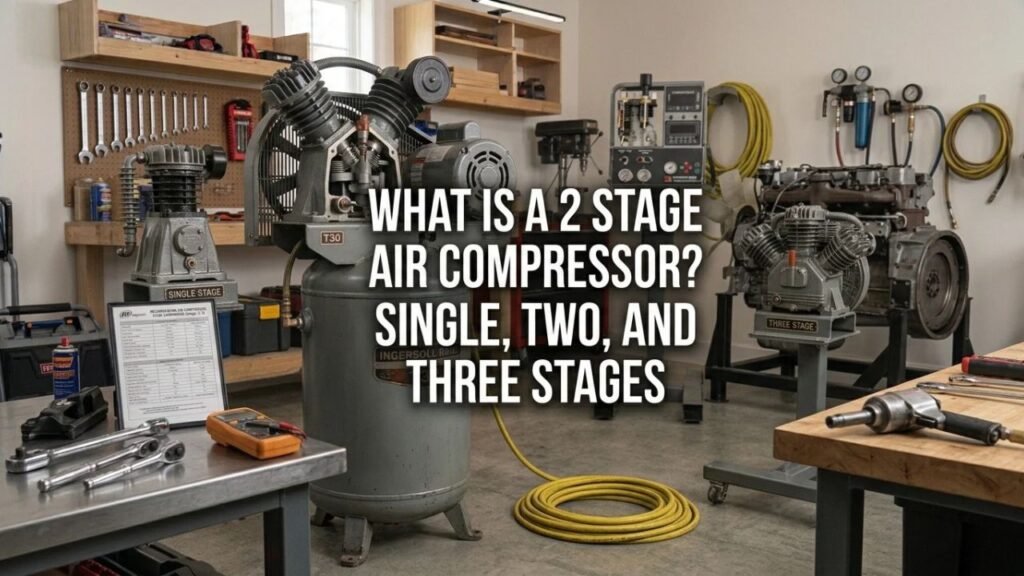
A two-stage air compressor is a compressor that raises air pressure through two sequential compression stages.
In a common reciprocating design, atmospheric air enters a larger low-pressure cylinder first. The piston compresses it to an intermediate pressure.
The air then travels through an intercooler, where some of the heat created during the first stage is removed.
From there, the cooler air enters a smaller high-pressure cylinder and is compressed again before being discharged to the receiver tank or downstream air system. Atlas Copco and Ingersoll Rand describe this same large-cylinder/intercooler/smaller-cylinder sequence in their two-stage reciprocating designs.
Common shop-oriented two-stage reciprocating compressors often operate at maximum pressures around 175 PSI, though exact pressure ratings vary widely by pump design and application.
A two-stage compressor is commonly used where the air system needs:
- Higher working pressure
- Longer operating periods
- Multiple air tools
- High-demand pneumatic equipment
- Better control of compression heat
Stage count alone does not determine compressor capacity. Horsepower, pump displacement, speed, cylinder size, duty rating, and delivered SCFM at the required PSI still matter.
How a 2 Stage Air Compressor Works
The two-stage cycle is easier to understand when viewed one step at a time.
1. Atmospheric Air Enters the First Cylinder
During the intake stroke, the low-pressure piston moves down.
Atmospheric air passes through the intake filter and inlet valve into the first-stage cylinder.
This cylinder is normally larger because it handles the full incoming volume of low-pressure air.
2. The First Stage Compresses the Air
The piston moves upward and reduces the volume inside the cylinder.
Pressure and temperature rise.
Instead of sending this partially compressed air directly into the receiver, a two-stage design routes it toward the intercooler.
3. The Intercooler Removes Heat
The partially compressed air passes through a heat exchanger between the two stages.
This component is called an intercooler because it cools the air between compression stages.
Atlas Copco notes that removing heat between stages lowers the air temperature and increases its density before the next compression stage.
Some moisture may also condense as the air cools. Larger systems can include interstage moisture separation to remove some of that condensate before the air continues.
4. Air Enters the High-Pressure Cylinder
The cooled, partially compressed air enters the second cylinder.
This cylinder is normally smaller than the first-stage cylinder because the air already occupies less volume.
5. The Second Stage Raises It to Final Pressure
The second piston compresses the air again.
This produces the final discharge pressure required by the compressor.
6. Compressed Air Goes to the Receiver
After the second stage, the air is discharged toward the receiver tank or air-treatment system.
An aftercooler may also be used downstream to remove more heat before the air enters the distribution system.
Key Takeaway: A two-stage compressor uses a low-pressure cylinder, intercooling, and a high-pressure cylinder to raise pressure in two separate steps rather than doing all the compression at once.
What Is a Single Stage Air Compressor?
A single-stage air compressor raises atmospheric air to its final discharge pressure in one compression stage.
The typical reciprocating cycle is simple:
Atmospheric air → cylinder → compression → receiver tank
Quincy describes its single-stage piston compressors as drawing air into the cylinder, compressing it, and then sending that air directly to the storage tank.
How a Single-Stage Compressor Works
During the intake stroke, the piston moves downward and draws atmospheric air through the inlet valve.
During the compression stroke, the piston moves upward and reduces the volume above it.
Once the cylinder pressure exceeds the discharge pressure, the discharge valve opens and air flows toward the receiver.
The process repeats until the tank reaches its pressure-switch cut-out setting.
Does Single-Stage Mean One Cylinder?
No.
This is an important distinction.
A single-stage compressor can have more than one cylinder if those cylinders compress atmospheric air directly to the same final pressure.
For example, two cylinders working in parallel can still form a single-stage pump.
Stage count describes sequential pressure steps, not simply piston count.
Typical Single-Stage Pressure
Ingersoll Rand states that its single-stage reciprocating designs are generally used around 70–90 PSI, with maximum pressure reaching about 135 PSI on the examples it describes. Quincy lists some current single-stage models with working pressures ranging from roughly 110 to 145 PSI.
That variation is why you should use the compressor’s actual nameplate rather than assuming a pressure based only on stage count.
Common Single-Stage Uses
Single-stage compressors are common for:
- Tire inflation
- Brad and finish nailers
- Blow guns
- Intermittent impact-wrench use
- Staplers
- Small shop air needs
- Home-garage work
They are generally simpler and less expensive than comparable multi-stage reciprocating systems.
Key Takeaway: A single-stage compressor compresses air from atmospheric pressure to final pressure in one step, even if the pump happens to use more than one cylinder.
What Is a Two Stage Air Compressor Compared With Single Stage?
The biggest difference is not tank size or motor horsepower.
It is the compression path.
| Feature | Single Stage | Two Stage |
| Compression steps | 1 | 2 |
| Intercooling between stages | No intermediate stage | Yes |
| Typical piston arrangement | One or more equal-stage cylinders | Low-pressure and high-pressure stages |
| Final pressure | Usually lower | Usually higher |
| Pump complexity | Lower | Higher |
| Heat management | All compression in one stage | Heat removed between stages |
| Common use | Home/shop, intermittent work | Shops, higher pressure, heavier duty |
| Typical max pressure examples | Around 135–145 PSI | Around 175 PSI |
These numbers are representative of common reciprocating shop compressors, not universal limits. Specialized compressors can fall outside them.
Two-Stage Compressors Handle High Pressure Better
Raising air from atmospheric pressure to a high final pressure creates substantial heat.
Dividing that pressure increase into stages and cooling the air between them reduces the compression work needed in the later stage.
That is why two-stage reciprocating pumps are commonly used above the pressure range handled by many single-stage shop compressors.
Two-Stage Does Not Automatically Mean More CFM
A two-stage compressor is not automatically a higher-CFM compressor than every single-stage model.
A large single-stage machine can deliver more airflow than a small two-stage machine.
When comparing compressors, check the rated SCFM at the PSI your tools require.
For example, a compressor rated at 15 SCFM at 90 PSI has more usable airflow at that pressure than a unit rated at 10 SCFM at 90 PSI, regardless of how many stages each pump uses.
Tank Size Does Not Determine the Stage Count
A 60-gallon compressor can be single-stage or two-stage.
An 80-gallon compressor can also use either pump design.
The tank stores compressed air. It does not determine how many times the pump compresses that air.
Key Takeaway: Single- versus two-stage describes the compression process, not tank size, horsepower, cylinder count, or CFM by itself.
What Is a 3 Stage Air Compressor?
A three-stage air compressor raises pressure through three sequential compression stages.
A simplified flow looks like this:
Atmospheric air → first compression → intercooling → second compression → intercooling → third compression → final discharge
Quincy describes a three-stage system as adding another compression and cooling cycle after the first two stages.
Why Add a Third Stage?
As final pressure requirements rise, trying to create the entire pressure increase in one or two steps produces more heat and places greater pressure ratios across individual stages.
A third stage divides the work again.
This allows designers to use:
- Additional intercooling
- Lower pressure ratios per stage
- Smaller high-pressure cylinders
- Better thermal control at very high discharge pressures
Where Are Three-Stage Compressors Used?
Three-stage compressors are much less common in normal home garages.
They are more likely to appear in specialized industrial applications requiring high-pressure compressed air or gas.
Quincy lists three- and four-stage compressors for specialized applications requiring very high-pressure, dry air. Atlas Copco also describes multi-stage reciprocating designs for much higher-pressure industrial service than ordinary shop compressors.
Possible applications can include:
- High-pressure industrial processes
- Gas compression
- Specialized testing
- Bottle or cylinder filling systems
- Process plants
- Other high-pressure pneumatic systems
The exact application depends heavily on the compressor design and gas being compressed.
Does Three Stage Mean Three Times the Pressure?
No.
A three-stage compressor does not simply produce three times the pressure of a single-stage model.
Designers select the pressure ratio across each stage according to:
- Final pressure requirement
- Gas properties
- Cooling
- Cylinder geometry
- Mechanical limits
- Motor power
Stage count only tells you how many sequential compression steps are used.
Key Takeaway: A three-stage compressor adds another compression and intercooling step and is mainly used where pressure requirements exceed the range of ordinary single- and two-stage shop compressors.
Single Stage vs Two Stage vs Three Stage Air Compressor
The table below shows the practical differences.
| Category | Single Stage | Two Stage | Three Stage |
| Number of compression steps | 1 | 2 | 3 |
| Intercoolers | None between stages | Usually 1 | Usually 2 |
| Typical pressure level | Low to moderate | Moderate to high | High to very high |
| Complexity | Lowest | Moderate | Highest |
| Purchase cost | Usually lowest | Higher | Usually much higher |
| Maintenance | Simpler | More components | More specialized |
| Common location | Home garage, jobsite | Repair shop, industrial shop | Specialized industrial systems |
| Typical tools/processes | Nailers, inflation, intermittent tools | Air tools, shop equipment, higher-pressure use | Specialized high-pressure processes |
Choose Single Stage for Moderate Shop Demand
A single-stage compressor often makes sense when your tools operate around normal shop pressures and air use is intermittent.
Do not buy more stages simply because they sound more industrial.
Choose Two Stage for Higher Pressure and Heavier Use
A two-stage unit becomes attractive when you need:
- Higher receiver pressure
- Sustained shop air
- High-demand pneumatic tools
- Several users
- Better thermal management at higher pressures
Atlas Copco notes that two-stage compression is particularly suited to higher operating pressures, while lower-pressure applications may be adequately served by other compressor designs.
Choose Three Stage for Specialized High-Pressure Work
Most home users will never need one.
Three-stage compressors belong mainly in applications where the pressure requirement itself makes additional compression stages worthwhile.
Key Takeaway: Single-stage suits moderate pressure and lighter use, two-stage suits higher-pressure shop service, and three-stage is mainly a specialized high-pressure design.
How to Tell if an Air Compressor Is Two Stage
You can often identify a conventional two-stage piston compressor visually.
Look for Different Cylinder Sizes
Many two-stage pumps have:
- One larger low-pressure cylinder
- One smaller high-pressure cylinder
The size difference reflects the smaller air volume after the first compression stage.
Look for an Intercooler Tube
A finned tube often runs from the first-stage cylinder to the second-stage cylinder.
That is the intercooler.
It removes heat before the partially compressed air enters the next cylinder.
Do Not Judge by Cylinder Count Alone
A two-cylinder compressor is not automatically two-stage.
If both cylinders draw atmospheric air and discharge at the same pressure, it may be a twin-cylinder single-stage pump.
The piping path is a better clue.
Check the Data Plate or Manual
This is the most reliable method.
Look for terms such as:
- Two stage
- 2-stage
- Dual stage
- LP cylinder
- HP cylinder
- Interstage pressure
Model documentation removes the uncertainty created by visual inspection.
Key Takeaway: Different-sized LP and HP cylinders connected by an intercooler often indicate a two-stage pump, but the model documentation provides the safest confirmation.
What Are the Benefits of a Two-Stage Air Compressor?
Two-stage compression offers real benefits when the application needs higher pressure.
Higher Final Pressure
Common two-stage shop compressors can reach around 175 PSI, compared with roughly 135–145 PSI for many single-stage units.
Higher tank pressure also stores more usable compressed air in a receiver of the same volume, though tool pressure must still be regulated to the required value.
Intercooling Reduces Compression Heat
The intercooler removes part of the heat before the second compression stage.
This lowers the temperature entering the high-pressure cylinder and reduces the compression work needed there.
Suited to Demanding Shop Use
Two-stage reciprocating compressors are common in:
- Auto repair shops
- Body shops
- Service businesses
- Manufacturing facilities
Ingersoll Rand specifically identifies single- and two-stage reciprocating machines as common in these environments.
Better Fit for Higher Working Pressures
If your process consistently requires pressure above what a normal single-stage compressor provides, staged compression is a much more appropriate design than pushing a lower-pressure compressor beyond its rated limit.
Key Takeaway: Two-stage compressors stand out for higher final pressure and better heat management, making them a strong fit for demanding shop and industrial air systems.
Do You Need a Two-Stage Compressor for Air Tools?
Not necessarily.
Most common air tools are rated around an operating pressure rather than a required compressor stage count.
Your decision should start with the tool’s:
- Required PSI
- Average or continuous SCFM
- Duty pattern
- Number of tools running simultaneously
Nail Guns and Inflation
These typically use air intermittently.
A properly sized single-stage compressor is often adequate.
Impact Wrenches
Intermittent automotive impact work can also run well from a single-stage unit if it has adequate SCFM and storage.
A busy repair shop running several air tools is a different situation.
DA Sanders and Grinders
Continuous-running tools can consume substantial airflow.
For these tools, delivered SCFM and compressor duty capability may matter more than maximum tank PSI.
Sandblasting and Larger Shop Equipment
These applications can demand high airflow for long periods.
A larger two-stage reciprocating compressor or a rotary compressor may be a better fit than a small portable unit.
Do not buy based only on PSI. A compressor can have high tank pressure yet still lack enough airflow for a continuous tool.
Intercooler vs Aftercooler on a Multi-Stage Compressor
These terms describe cooling equipment in different locations.
Intercooler
An intercooler sits between compression stages.
Its job is to cool partially compressed air before it enters the next stage.
Atlas Copco defines an air-compressor intercooler specifically as the cooler between the low-pressure and high-pressure stages.
Aftercooler
An aftercooler sits after the final compression stage.
It cools final discharge air before it reaches downstream equipment, dryers, or the distribution system.
Cooling final discharge air also causes water vapor to condense, allowing a separator or drain to remove part of the moisture load.
The two components therefore perform similar cooling functions but at different points in the system.
Key Takeaway: An intercooler cools air between compression stages, while an aftercooler cools air after the final compression stage.
Air Compressor Stage Safety and Maintenance
Higher-pressure compressors require careful maintenance.
Never Exceed Rated Pressure
Do not alter pressure-switch settings, relief valves, or other controls to force a compressor above its rated maximum.
Pressure ratings apply to the:
- Pump
- Receiver
- Valves
- Piping
- Fittings
Drain Condensate
Compression and cooling cause moisture to collect in the air system.
Drain the receiver according to the manufacturer’s instructions or use an approved automatic drain.
Keep the Intercooler Clean
Blocked cooling fins reduce heat transfer.
Inspect the intercooler for:
- Dirt
- Oil contamination
- Bent fins
- Restricted airflow
- Damage
Maintain Proper Pump Oil
Oil-lubricated reciprocating compressors require the lubricant specified by the manufacturer.
Do not assume automotive engine oil is acceptable.
Inspect Safety Valves and Belts
Follow the service schedule for:
- Relief valves
- Belt tension
- Air filters
- Valve assemblies
- Pump oil
- Fasteners
Disconnect electrical power and release stored pressure before maintenance where the service procedure calls for it.
Key Takeaway: Never increase pressure beyond the compressor’s rating, keep cooling and lubrication systems maintained, drain moisture, and service pressure-safety components as specified.
Conclusion
What is a 2 stage air compressor? It is a compressor that raises air pressure in two sequential steps, cooling the air between those steps before the second stage brings it to final discharge pressure.
A single-stage compressor performs the compression in one stage and is common for moderate-pressure home, jobsite, and light-shop work. Common reciprocating models often fall around the 135–145 PSI maximum-pressure range, though individual specifications vary.
A two-stage compressor adds an intercooler and second compression stage. Many shop models reach around 175 PSI and are better suited to higher-pressure or heavier-duty air systems.
A three-stage compressor adds another compression and cooling cycle. It is mainly found in specialized applications where pressure requirements go well beyond those of ordinary garage and shop equipment.
Before choosing any compressor, compare the pressure and SCFM requirements of your tools with the compressor’s actual rated output. Stage count explains how the pump creates pressure, but it does not replace proper compressor sizing.
FAQs About What Is a 2 Stage Air Compressor
What Is the Main Difference Between Single-Stage and Two-Stage Air Compressors?
A single-stage compressor compresses air once before sending it toward the receiver.
A two-stage compressor compresses it once, cools it through an intercooler, then compresses it again before final discharge.
Does a Two-Stage Air Compressor Have Two Pistons?
Many reciprocating two-stage compressors use a larger low-pressure piston and a smaller high-pressure piston.
The stage count refers to sequential compression steps, though, not simply the number of pistons.
How Much PSI Does a Two-Stage Air Compressor Produce?
Many common shop two-stage reciprocating compressors are rated around 175 PSI maximum.
The exact rating depends on the compressor, and specialized multi-stage designs can operate at very different pressures.
Is a Two-Stage Air Compressor Better Than a Single Stage?
It is better suited to higher-pressure and heavier-duty applications.
A single-stage compressor may be the more practical option for intermittent tools, inflation, nailers, and moderate home-shop air demand.
What Is a 3 Stage Air Compressor?
A three-stage compressor compresses air three times with cooling between stages.
It is mainly used in specialized high-pressure applications rather than ordinary home-garage work.
Is a Two-Cylinder Compressor Always Two Stage?
No.
A two-cylinder pump can still be single-stage if both cylinders compress atmospheric air directly to the same discharge pressure.
A true two-stage design sends air from a low-pressure stage through an intercooler and then into a high-pressure stage.
Does a Two-Stage Compressor Give More CFM?
Not automatically.
CFM depends on pump displacement, motor power, speed, pressure, and overall design. Compare SCFM at the required PSI rather than assuming a two-stage compressor always delivers more airflow.
Why Does a Two-Stage Compressor Have One Small Cylinder?
Air leaving the first stage has already been compressed and occupies less volume.
The second-stage high-pressure cylinder can therefore be smaller while raising that partially compressed air to its final pressure.