
What Is a Type 30 Air Compressor? T30 Design, Uses, and Specs
A Type 30 air compressor is generally an Ingersoll Rand reciprocating piston compressor from the company’s long-running Type 30, or T30, family. Most familiar shop versions are oil-lubricated, belt-driven, two-stage compressors built for commercial and industrial air service. “Type 30” is a product-family name, not a 30-gallon tank rating or pressure specification.
The Type 30 designation appears on many Ingersoll Rand compressor pumps and complete packages. Common models include the 2340, 2475, 2545, 7100, and 15T, although specifications differ substantially among models and configurations. Ingersoll Rand continues to publish service information and replacement components for several of these pumps.
For what is a Type 30 air compressor, the easiest way to understand it is as a family of piston compressors rather than one exact machine. A Type 30 might be mounted on a receiver tank, supplied as a base-mounted unit, driven by an electric motor, or configured for specialized high-pressure service.
Many standard two-stage Ingersoll Rand reciprocating models, including the 2340, 2475, 2545, and 7100, are designed around compression in two steps. Ingersoll Rand’s North American guidance lists 175 psi as the factory maximum pressure for several current two-stage reciprocating models.
The Type 30 family also extends well beyond ordinary 175-psi shop compressors. Ingersoll Rand currently offers Type 30 high-pressure reciprocating compressors capable of pressures as high as 5,000 psig (345 barg) for specialized applications such as engine starting, power generation, and refueling systems.
Compressed-air equipment can also represent a large industrial energy load. The U.S. Department of Energy’s Better Plants program states that more than 80% of compressor input energy can ultimately be lost as heat, making correct compressor selection, pressure control, and maintenance important in high-use facilities.
The exact horsepower, CFM, tank size, pressure, motor voltage, and duty requirements depend on the T30 model. Identifying the pump model and complete compressor nameplate is therefore more useful than simply knowing that a machine belongs to the Type 30 family.
What Does Type 30 Mean on an Air Compressor?
“Type 30” or “T30” is associated with Ingersoll Rand’s reciprocating compressor family.
It does not describe one universal compressor specification.
Type 30 Is a Product-Family Designation
A Type 30 compressor can have different:
- Horsepower
- Pump displacement
- CFM output
- Receiver size
- Motor voltage
- Number of cylinders
- Maximum pressure
- Mounting configuration
Ingersoll Rand currently groups models such as the 2340, 2475, 2545, 7100, and 15T within its reciprocating compressor service documentation.
That is why simply saying “I have a Type 30” may not provide enough information to order parts.
The 30 Does Not Mean 30 Gallons
A common misunderstanding is that Type 30 refers to tank capacity.
It does not.
Type 30 compressors can be installed on receivers of different sizes or supplied as base-mounted compressor packages without a receiver directly underneath them.
A 30-gallon compressor can belong to an entirely different product line, while a T30 can use a much larger receiver.
The 30 Does Not Mean 30 PSI
The number also does not represent discharge pressure.
Standard two-stage Type 30-related shop compressors can operate around the 175-psi class, while specialized high-pressure versions reach thousands of psi.
The 30 Does Not Mean 30 Horsepower
Horsepower varies by model.
Ingersoll Rand’s current air-cooled reciprocating range includes examples such as:
- 2340 around 3 HP in some markets
- 2475 in several 5–10 HP configurations
- 2545 in larger horsepower ranges
- 7100 in still larger configurations
- 15T for higher-capacity installations
Regional packages and specifications vary, so use the exact equipment nameplate rather than these ranges for service decisions.
Key Takeaway: Type 30 is an Ingersoll Rand compressor-family designation. It does not identify tank gallons, PSI, or horsepower by itself.**
How Does a Type 30 Air Compressor Work?
Most familiar Type 30 shop compressors use a reciprocating piston design.
The pump draws atmospheric air into cylinders, reduces its volume with moving pistons, and sends the compressed air toward the receiver.
First Stage Draws and Compresses Air
When the first-stage piston moves downward, an inlet valve opens and atmospheric air enters the cylinder.
As the piston moves upward, the inlet valve closes.
The trapped air is compressed.
On a two-stage compressor, this first stage does not normally raise the air directly to final receiver pressure.
Intercooler Removes Heat
Compression creates substantial heat.
Air leaving the first-stage cylinder passes through an intercooler before entering the second stage.
Cooling the air between stages reduces its temperature and improves the second-stage compression process.
This is one of the major differences between a two-stage T30 pump and a simple single-stage shop compressor.
Second Stage Raises Pressure Further
The second-stage cylinder receives the already compressed air.
Its piston compresses the air again to a higher final pressure.
The compressed air then moves through the discharge circuit and into the receiver tank.
Pressure Switch Controls Starting and Stopping
On many electric receiver-mounted compressors, a pressure switch monitors tank pressure.
When pressure falls to the cut-in point, the motor starts.
When pressure reaches cut-out, the motor stops.
Ingersoll Rand lists approximately 135 psi cut-in and 175 psi cut-out for several of its current North American two-stage reciprocating compressor models.
That setting is model-specific and should not be manually changed simply because the pump appears capable of more pressure.
Key Takeaway: A typical two-stage T30 first compresses air in a larger low-pressure cylinder, cools it through an intercooler, then compresses it again in a smaller high-pressure cylinder.**
Is a Type 30 Compressor Single Stage or Two Stage?
Most Type 30 compressors people encounter in industrial and garage applications are associated with Ingersoll Rand’s two-stage reciprocating range.
The exact pump still needs to be identified.
Two-Stage Type 30 Compressors
Current Ingersoll Rand documentation identifies the 2340, 2475, 2545, and 7100 among its two-stage reciprocating models.
Two-stage compression is useful when higher working pressure and sustained shop use are required.
Common applications include:
- Automotive service
- Body shops
- Machine shops
- Fleet maintenance
- Manufacturing
- Woodworking
- Farm shops
Ingersoll Rand lists those types of jobs for its current 2475 two-stage compressor packages.
Do Not Identify the Stage Count From Appearance Alone
Older Type 30 equipment has existed in many configurations.
If you are working on an older machine, use:
- Pump model
- Serial number
- Compressor nameplate
- Parts manual
That information is more reliable than guessing from tank size or motor horsepower.
Key Takeaway: Type 30 is strongly associated with two-stage reciprocating compressors, but the exact pump model and nameplate should determine its actual configuration.**
Common Ingersoll Rand Type 30 Models
Several model numbers appear repeatedly in current Ingersoll Rand documentation.
Ingersoll Rand 2340
The 2340 is one of the smaller two-stage reciprocating pumps in the family.
It appears in Ingersoll Rand’s current documentation, pressure guidance, lubricant charts, filter listings, and parts resources.
It is commonly associated with smaller commercial or shop installations.
Ingersoll Rand 2475
The 2475 is one of the best-known T30 pumps.
Current 2475 packages include 5- and 7.5-HP versions designed for heavy shop and industrial service.
Ingersoll Rand lists 175 psig maximum operating pressure and an 80-gallon receiver on its current 2475N7.5-P configuration.
Ingersoll Rand 2545
The 2545 is a larger reciprocating pump used where more air capacity is needed.
It uses different filters, valve components, lubricant capacities, and other service parts from smaller T30 models.
Ingersoll Rand 7100
The 7100 is another larger two-stage reciprocating model.
Ingersoll Rand currently lists specific filter elements, valve kits, pressure switches, and service documentation for the 7100.
Ingersoll Rand 15T
The 15T appears in current Ingersoll Rand reciprocating service information as a larger industrial model.
Its lubricant capacity and service parts differ from the smaller pumps, reinforcing why “Type 30” alone is not enough information when buying parts.
Key Takeaway: Common T30-family names include 2340, 2475, 2545, 7100, and 15T, but each has its own output, horsepower range, and replacement parts.**
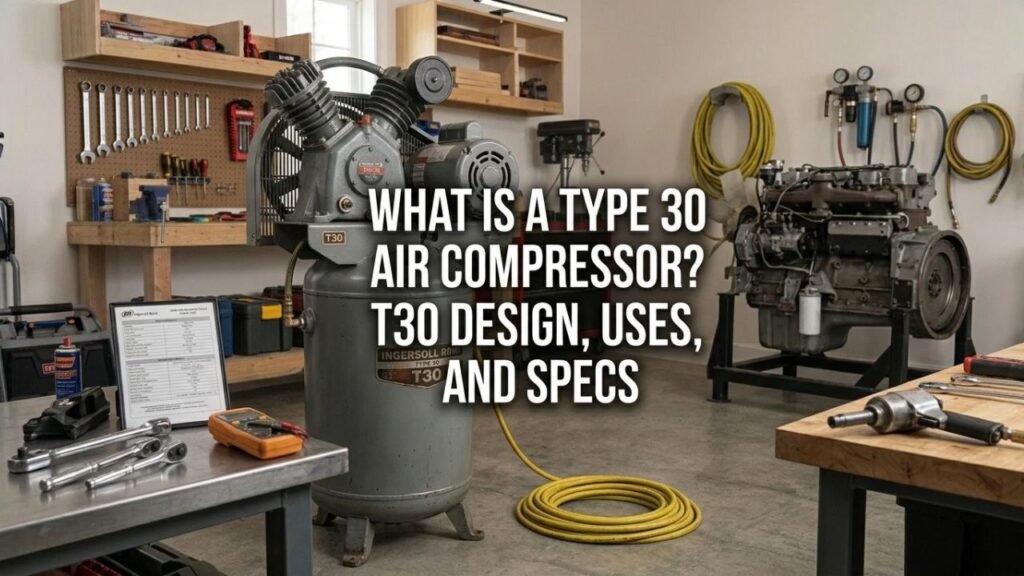
What Does a Type 30 Air Compressor Look Like?
A traditional Type 30 shop compressor usually has the appearance of a large stationary piston compressor.
Visible Pump Cylinders
The compressor pump has finned cast cylinders mounted above a crankcase.
On a two-stage unit, the low-pressure and high-pressure cylinders are different sizes.
The larger cylinder handles the first compression stage.
The smaller cylinder handles the second stage.
Intercooler Tube
A two-stage pump normally has a tube running from the first-stage discharge to the second-stage intake.
This is the intercooler.
Its job is to shed heat before the air enters the next compression stage.
Belt and Flywheel
Many Type 30 packages use an electric motor and V-belt drive.
The motor turns a smaller pulley, which drives the compressor flywheel.
The flywheel also helps move cooling air across the pump on many configurations.
Receiver Tank
Stationary shop models may be mounted on:
- Vertical receiver
- Horizontal receiver
Other Type 30 equipment can be base mounted without an integrated tank.
Heavy Cast Construction
Ingersoll Rand describes current two-stage reciprocating compressors such as the 2475 as using durable cast-iron construction and individually cast cylinders.
The overall appearance is very different from a compact pancake compressor or enclosed rotary screw machine.
Key Takeaway: A typical Type 30 has a visible cast-iron piston pump, differently sized cylinders on two-stage models, an intercooler tube, belt drive, and often a large stationary receiver.**
Is a Type 30 a Rotary Screw Compressor?
No.
The traditional Ingersoll Rand Type 30 is a reciprocating piston compressor.
Type 30 Uses Pistons
Inside the pump are parts such as:
- Pistons
- Piston rings
- Connecting rods
- Crankshaft
- Intake valves
- Discharge valves
- Cylinders
The crankshaft converts rotational motion from the motor into piston movement.
Rotary Screw Uses Rotors
A rotary screw compressor instead uses two helical rotors.
It produces compressed air through continuous rotary motion rather than pistons moving back and forth.
Why the Difference Matters
The two compressor types require different:
- Maintenance procedures
- Replacement parts
- Lubrication systems
- Controls
- Troubleshooting methods
If you are ordering a valve kit or piston rings for a T30, rotary screw parts are not interchangeable.
Key Takeaway: Type 30 compressors are reciprocating piston machines, not rotary screw compressors.**
Is a Type 30 Air Compressor Oil Lubricated?
Traditional Type 30 pumps are oil-lubricated reciprocating compressors.
Oil lubricates the crankcase and moving mechanical parts.
Compressor Oil Is Model Specific
Ingersoll Rand currently recommends All Season Select synthetic lubricant for its reciprocating compressors and publishes different oil capacities by pump model.
Examples include:
- 2340: about 1 L
- 2475: about 2 L
- 2545: about 2.5 L
- 7100: about 2.5 L
- 15T: about 5 L
These figures come from current Ingersoll Rand lubricant listings and should still be verified against the manual for the exact compressor.
Do Not Treat It Like an Oil-Free Compressor
A Type 30 pump requires crankcase lubrication.
Running it with too little oil can cause severe wear or pump damage.
Do Not Substitute Random Motor Oil
Use the lubricant grade stated for the specific compressor.
Automotive engine oil and compressor oil can have different additive packages and service requirements.
Key Takeaway: Traditional T30 pumps are oil lubricated, and the required lubricant quantity changes by model.**
What Pressure Does a Type 30 Compressor Produce?
The answer depends heavily on which Type 30 you have.
Standard Two-Stage Shop Compressors
Ingersoll Rand’s North American support information lists several two-stage reciprocating models at:
- 135 psi cut-in
- 175 psi cut-out
Models named include the 2340, 2475, 2545, and 7100.
That makes roughly 175 psi a familiar figure for many shop-based T30 systems.
High-Pressure Type 30 Compressors
Specialized Type 30 equipment operates in a completely different pressure class.
Ingersoll Rand currently advertises high-pressure Type 30 compressors reaching as high as 5,000 psig.
These are used for specialized industrial duties rather than ordinary 90-psi air tools.
Never Raise Pressure Based on Family Name
The receiver, pump, pressure switch, valves, motor, piping, and other components all have pressure ratings.
Do not change the pressure switch or safety valve because another T30 model has a higher rating.
Use the exact compressor specifications.
Key Takeaway: Many standard two-stage Type 30 shop compressors operate up to about 175 psi, while specialized Type 30 high-pressure models can reach thousands of psi.**
What Is a Type 30 Air Compressor Used For?
The T30 platform covers a wide range of commercial and industrial jobs.
Automotive Repair Shops
A correctly sized Type 30 can supply air for:
- Impact wrenches
- Air ratchets
- Tire changers
- Blow guns
- Pneumatic lifts
- Other garage tools
Ingersoll Rand specifically lists automotive service and body shops among applications for its current 2475 two-stage compressors.
Fleet Maintenance
Fleet facilities may require compressed air throughout the workday for truck and equipment servicing.
A larger two-stage piston system provides more airflow and storage than a small portable compressor.
Machine and Fabrication Shops
Compressed air may operate:
- Pneumatic fixtures
- Air tools
- Cleaning equipment
- Small machinery
- Controls
Woodworking
Woodworking shops can use compressed air for:
- Nailers
- Staplers
- Blow-off
- Pneumatic clamps
- Spray finishing
Farms and Maintenance Facilities
Large stationary piston compressors also fit equipment maintenance, tire work, and general repair jobs.
High-Pressure Industrial Applications
Current high-pressure Type 30 models are used in areas such as:
- Engine starting
- Power plants
- Refueling applications
- Beverage processing
These are very different from the common receiver-mounted garage versions.
Key Takeaway: Type 30 compressors are used in automotive, fleet, manufacturing, woodworking, maintenance, and specialized high-pressure applications.**
Type 30 vs Single-Stage Air Compressor
A two-stage T30 provides a different operating profile from a small single-stage compressor.
Compression Process
A single-stage compressor raises atmospheric air to final pressure in one cylinder stage.
A two-stage T30 compresses the air once, cools it, then compresses it again.
Maximum Pressure
Ingersoll Rand currently lists 135 psi maximum for several of its single-stage reciprocating models and 175 psi for several two-stage models.
Intended Workload
A small single-stage unit can be a good choice for:
- Tire inflation
- Nailers
- Blow guns
- Occasional impact wrench use
- DIY projects
A large two-stage Type 30 makes more sense for higher air demand and regular shop use.
Cost and Size
Type 30 equipment is generally larger, heavier, and more expensive than entry-level single-stage compressors.
The added capacity is worthwhile only when the workload needs it.
Key Takeaway: Two-stage T30 compressors generally provide higher pressure and suit heavier shop service than small single-stage machines.**
How to Identify Your Type 30 Compressor
Correct identification is important before buying parts or changing service settings.
Find the Compressor Nameplate
Look for a data plate or tag containing information such as:
- Model number
- Serial number
- Maximum pressure
- Motor information
- Electrical rating
Write the information down rather than relying on the appearance of the compressor.
Identify the Pump Model
The pump model is especially important for mechanical parts.
Ingersoll Rand publishes different filters and valve kits for models such as the 2340, 2475, 2545, 7100, and 15T.
Do Not Use Horsepower Alone
Two compressor packages can use motors with similar horsepower but different pump models.
Horsepower alone does not identify:
- Valve kit
- Gasket set
- Air filter
- Piston rings
- Lubricant capacity
Check the Serial Number for Older Equipment
Production changes can affect replacement parts.
For an older T30, use both model and serial number when searching for components.
Key Takeaway: Identify a T30 from its pump model, full compressor model, and serial number rather than tank size or motor horsepower alone.**
Type 30 Air Compressor Maintenance
A T30 can provide long service life, but it is not maintenance-free.
Check Compressor Oil
Keep the crankcase oil at the specified level.
Inspect it regularly for:
- Low level
- Darkening
- Contamination
- Milky appearance
- Burned odor
Follow the oil-change interval for the installed model and lubricant.
Service the Intake Filter
A dirty intake filter restricts airflow and can reduce compressor output.
Ingersoll Rand currently lists different replacement filter quantities and part numbers across the 2340, 2475, 2545, 7100, and 15T pumps.
Inspect Belts
For belt-driven models, check:
- Belt wear
- Cracks
- Tension
- Pulley alignment
Disconnect electrical power and prevent automatic restart before working near the belt system.
Drain the Receiver
Water condenses inside compressed-air tanks.
Drain the receiver according to the compressor instructions.
Do not allow excessive moisture to remain in the tank.
Keep Cooling Surfaces Clean
Dust on cylinder fins and intercoolers reduces heat transfer.
Keep ventilation areas clear and remove contamination using the approved maintenance procedure.
Inspect Valves and Gaskets as Needed
Loss of output, excessive heat, or unusual pumping behavior can result from worn valves or leakage.
Ingersoll Rand sells model-specific valve kits for several T30 pumps, showing why the exact pump model matters during repair.
Key Takeaway: T30 maintenance includes oil, intake filters, belts, receiver drainage, cooling surfaces, and model-specific valve or gasket service.**
Conclusion
What is a Type 30 air compressor? It is primarily an Ingersoll Rand reciprocating piston compressor belonging to the Type 30, or T30, product family.
The name does not mean 30 gallons, 30 PSI, or 30 horsepower. Different T30 models cover a wide range of outputs and configurations.
Many familiar Type 30 shop compressors use an oil-lubricated, belt-driven, two-stage design. Models such as the 2340, 2475, 2545, and 7100 are associated with Ingersoll Rand’s two-stage reciprocating range, with many North American configurations operating up to about 175 psi.
Specialized Type 30 high-pressure compressors are a separate class and can operate at pressures reaching thousands of psi.
If you own an older T30 and need oil, filters, valves, belts, gaskets, or other parts, identify the exact pump model and serial number first. The Type 30 name tells you the compressor family, but the model tells you which specifications and replacement parts actually fit.
FAQs About Type 30 Air Compressors
What Does Type 30 Mean on an Air Compressor?
Type 30, often shortened to T30, refers to an Ingersoll Rand reciprocating compressor family.
It is a product designation rather than a measurement of tank capacity, horsepower, CFM, or operating pressure.
Does Type 30 Mean a 30-Gallon Air Compressor?
No.
The number 30 does not indicate receiver capacity. Type 30 compressors can be mounted on different tank sizes or supplied as base-mounted units without an integrated receiver.
Is an Ingersoll Rand Type 30 a Two-Stage Compressor?
Many well-known Type 30 models are two-stage reciprocating compressors.
Ingersoll Rand identifies models such as the 2340, 2475, 2545, and 7100 within its current two-stage reciprocating pressure guidance.
What PSI Does an Ingersoll Rand Type 30 Make?
Many standard North American two-stage models operate with about 135 psi cut-in and 175 psi cut-out.
Specialized Type 30 high-pressure compressors can reach as high as 5,000 psig, so the exact model specification must be checked.
Is a Type 30 Air Compressor Belt Driven?
Many traditional Type 30 packages are belt driven, with an electric motor driving the pump through pulleys and V-belts.
Exact configurations vary, so check the specific model rather than treating belt drive as a universal specification.
Is a Type 30 a Rotary Screw Compressor?
No.
A traditional Type 30 is a reciprocating piston compressor. It uses pistons and cylinders rather than the intermeshing helical rotors used in rotary screw compressors.
What Are Common Ingersoll Rand T30 Models?
Common model numbers found in current Ingersoll Rand reciprocating documentation include the 2340, 2475, 2545, 7100, and 15T.
Each model requires its own service and parts information.
Is an Ingersoll Rand Type 30 Good for a Shop?
A correctly sized Type 30 can be well suited to automotive repair, fleet maintenance, machine shops, woodworking, farms, and other commercial work.
Choose the exact model from required CFM, PSI, duty cycle, electrical supply, and receiver capacity rather than buying solely because it carries the T30 name.