
How to Tell If an Air Compressor Is 2 Stage: Quick ID Checks
A two-stage reciprocating air compressor usually has a large low-pressure cylinder, a smaller high-pressure cylinder, and a tube or finned intercooler connecting the two. Air is compressed once in the large cylinder, cooled between stages, compressed again in the smaller cylinder, and then sent into the receiver tank.
The fastest confirmation is the compressor or pump model number. Check the data plate, manufacturer’s product page, parts diagram, or owner’s manual for wording such as two-stage, 2-stage, or two-stage reciprocating pump.
Pressure gives another clue. Ingersoll Rand describes single-stage reciprocating compressors as commonly reaching up to about 135 PSI, while its two-stage units commonly reach 175 PSI. Quincy lists many single-stage designs around 110–145 PSI and two-stage models up to about 175 PSI. Pressure alone does not prove the pump type.
For how to tell if an air compressor is 2 stage, inspect the cylinder sizes and trace the piping. A true two-stage pump sends partially compressed air from a larger first-stage cylinder through an intercooler to a smaller second-stage cylinder before the air reaches the tank.
Do not identify a compressor as two-stage just because it has two cylinders. Campbell Hausfeld states that the stage count describes the compression process, not simply the number of cylinders. A twin-cylinder compressor can still be single-stage.
The checks below show how to identify the pump visually, distinguish twin-cylinder single-stage designs, use PSI as supporting evidence, trace the airflow path, and confirm the answer from the model number.
How to Tell If an Air Compressor Is 2 Stage
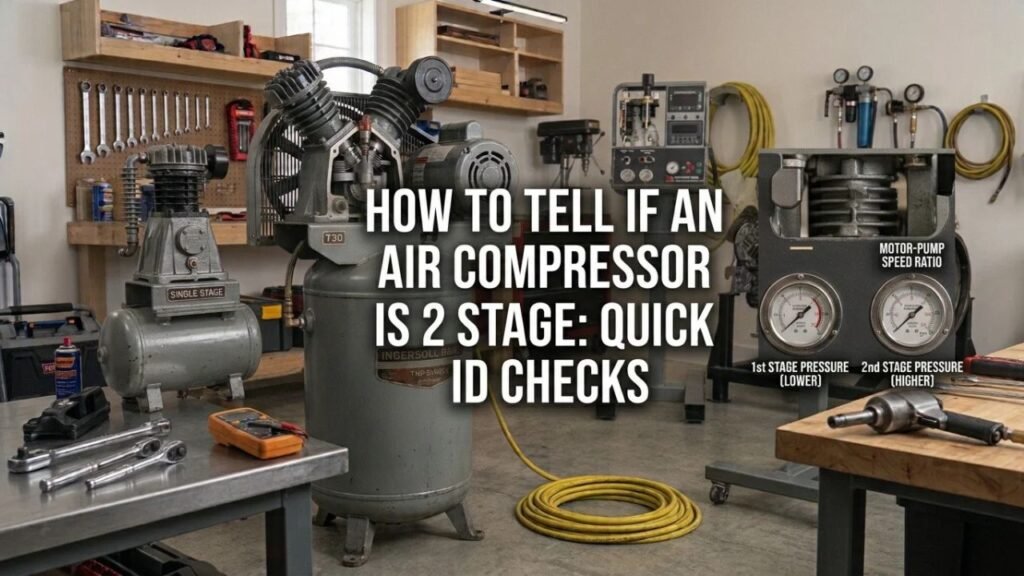
The most reliable identification combines the pump layout with the manufacturer’s specifications.
Check for One Large and One Small Cylinder
Look at the compressor pump rather than the receiver tank.
A common two-stage piston compressor has:
- One larger cylinder
- One noticeably smaller cylinder
- Separate cylinder heads
- A connecting tube between the stages
The larger cylinder is the low-pressure first stage.
It draws atmospheric air through the intake filter and compresses it to an intermediate pressure.
The smaller cylinder is the high-pressure second stage.
It receives the partially compressed air and compresses it again to the final receiver pressure.
Quincy describes this exact arrangement: a larger first-stage cylinder handles the initial compression, then the air moves through an intercooler before entering a smaller high-pressure cylinder.
If both cylinders appear identical in diameter, the compressor may instead be a twin-cylinder single-stage design.
Look for an Intercooler Tube Between the Cylinders
This is one of the strongest visual clues.
A two-stage compressor usually has a metal tube running from the discharge side of the large cylinder to the intake side of the smaller cylinder.
That tube may be:
- Finned
- Coiled
- Bent around the flywheel
- Positioned in the cooling airflow
Its job is to cool the air after the first compression stage.
Quincy explains that intercooling removes heat before the air enters the smaller second-stage cylinder. Cooler air is denser and requires less work during the next compression step.
Do not confuse the intercooler with the final discharge tube going from the pump to the receiver tank.
A two-stage unit normally has both.
Trace Where the Air Goes
A two-stage airflow path is generally:
Air filter → large cylinder → intercooler → small cylinder → discharge line → tank
A single-stage twin-cylinder pump usually follows a different path:
Air filters → cylinders → common discharge path → tank
The key difference is that a two-stage pump sends air from one compression cylinder into another compression cylinder.
A single-stage twin-cylinder pump compresses fresh intake air in both cylinders at approximately the same stage and then sends that air toward the receiver.
Key Takeaway: Unequal cylinder sizes plus an intercooler carrying air from the large cylinder into the smaller cylinder are the strongest visual signs of a two-stage reciprocating compressor.
Two Cylinders Do Not Always Mean Two Stage
This point causes much of the confusion.
A compressor may have two pistons and still compress air only once.
Twin-Cylinder Single-Stage Compressor
A twin-cylinder single-stage pump commonly has two similar-size cylinders.
Each cylinder draws atmospheric air and compresses it directly toward the receiver.
The extra cylinder can increase airflow without adding another compression stage.
You may see:
- Two similar cylinder diameters
- Two intake filters
- A shared discharge manifold
- No interstage line feeding one cylinder from the other
The pump has two cylinders but only one compression stage.
Two-Stage Twin-Cylinder Compressor
A common two-stage pump also has two cylinders, but their jobs are different.
The first cylinder is larger because it handles a large volume of low-pressure air.
The second is smaller because it receives air that has already been compressed.
Campbell Hausfeld explains that stage count refers to the compression sequence and notes that larger industrial two-stage compressors can even have three or four cylinders while still using only two compression stages.
That means:
Cylinder count ≠ stage count.
Three Cylinders Can Still Be Two Stage
Some larger pumps use two low-pressure cylinders feeding one high-pressure cylinder.
That configuration may look like a three-cylinder compressor, but the air is still compressed only twice:
- Low-pressure stage
- High-pressure stage
The additional cylinder simply divides the first-stage workload.
Key Takeaway: Count the compression steps, not the pistons. Two equal cylinders may be single-stage, while a two-stage industrial pump may contain more than two cylinders.
Does 175 PSI Mean an Air Compressor Is Two Stage?
A 175 PSI rating is a strong clue, but it should not be your only test.
Two-Stage Compressors Commonly Reach 175 PSI
Many current stationary two-stage compressors use 175 PSI as their upper operating pressure.
For example, Ingersoll Rand lists 5 HP two-stage reciprocating units with a 175 PSIG maximum operating pressure. Campbell Hausfeld’s current CE5002 60-gallon two-stage compressor is also rated at 175 PSI.
DEWALT’s 80-gallon DXCMV5048055 is another current two-stage model rated for airflow at 175 PSI.
Higher pressure is one reason two-stage compression is used.
Splitting the pressure increase between two cylinders reduces the work required from each stage and gives the air a chance to cool between them.
Single-Stage Compressors Can Also Have High Tank Ratings
Do not identify the pump solely from a sticker that says 150, 165, 175, or 200 PSI.
Compressor designs differ, and maximum receiver pressure does not directly describe the number of compression stages.
A product listing that explicitly says two-stage pump carries far more diagnostic weight than the maximum PSI number.
Use PSI as Supporting Evidence
Think of PSI this way:
- Around 110–135 PSI: commonly seen on many single-stage units
- Around 135–145 PSI: still common for single-stage compressors
- Around 175 PSI: common on two-stage shop compressors
- Higher industrial pressures: often point toward multi-stage compression
Those are patterns, not universal identification rules.
Key Takeaway: A 175 PSI rating supports the possibility of a two-stage pump, but the cylinder layout, intercooler, airflow path, and model specifications provide stronger proof.
What Does the Intercooler Look Like?
Finding the intercooler makes identification much easier.
It Connects the First and Second Stages
Follow the metal tubing coming from the larger cylinder head.
On a two-stage unit, one line should lead toward the smaller cylinder rather than directly into the receiver.
That is the interstage connection.
It May Have Cooling Fins
The air leaving the first cylinder is hot.
Some compressors use a finned metal tube so the flywheel fan can move cooling air across it.
Quincy describes intercooling as removing heat generated during the first stage before the air enters the second cylinder.
The tube may resemble a small radiator line.
Do Not Confuse It With the Tank Discharge Tube
The final discharge tube carries fully compressed air from the second-stage cylinder into the receiver.
A typical two-stage pump therefore has:
- Interstage/intercooler tubing between cylinders
- Final discharge tubing from the high-pressure cylinder toward the tank
Trace both lines before deciding what you are looking at.
Key Takeaway: The intercooler sits between compression stages. If a tube clearly routes compressed air from a large cylinder into a smaller one, the pump is very likely two-stage.
Check the Pump Model Number for a Definite Answer
Visual inspection is useful, but documentation is stronger.
Find the Compressor Data Plate
Look for a plate or sticker on:
- Receiver tank
- Pump crankcase
- Belt guard
- Motor frame
- Compressor base
Record the complete model and serial number.
The tank model and pump model may be different.
Search the Pump Model
The pump model is especially useful on older compressors that may have been assembled from separate components.
Look for specifications such as:
- Pump type
- Number of stages
- Maximum pressure
- CFM
- Cylinder bore
- Replacement valve assemblies
- Intercooler part number
A parts diagram showing a low-pressure cylinder, high-pressure cylinder, and intercooler confirms the design.
Check the Owner’s Manual
Manufacturers normally state the pump type plainly.
Current examples include:
- Campbell Hausfeld CE5002 — two-stage
- DEWALT DXCMV5048055 — two-stage reciprocating
- Ingersoll Rand 2475 series — two-stage reciprocating
The Ingersoll Rand 2475N5-V, for example, is listed as a 5 HP two-stage reciprocating compressor with a 175 PSI maximum rating.
Do Not Rely Only on the Tank Label
An air receiver can sometimes be paired with a replacement pump.
A used compressor may no longer have its original motor or pump.
If the machine has been modified, identify the pump itself rather than assuming the entire compressor still matches the original tank sticker.
Key Takeaway: The pump model number, parts diagram, or manufacturer’s specification is the best confirmation when the physical layout leaves any doubt.
Single-Stage vs Two-Stage Air Compressor Identification
The differences are easier to see side by side.
| Feature | Single-Stage | Two-Stage |
| Compression steps | One | Two |
| Common cylinder layout | One or multiple similar cylinders | Large low-pressure + small high-pressure cylinder |
| Intercooler between cylinders | No true interstage intercooler | Usually yes |
| Air path | Cylinder to receiver | First cylinder to intercooler to second cylinder to receiver |
| Common maximum pressure | Often about 110–145 PSI | Often around 175 PSI |
| Twin cylinders possible | Yes | Yes |
| Unequal cylinder sizes | Less typical | Very common |
| Shop/industrial high-pressure use | Lighter applications | Common |
| Best proof | Manufacturer specification | Manufacturer specification |
Quincy states that its single-stage compressors typically operate in the 110–145 PSI range, while two-stage designs can reach 175 PSI. Ingersoll Rand describes the same basic difference in compression sequence: one-stage units reach final pressure in one compression step, while two-stage units cool the air between the first and second compression stages.
How a Two-Stage Air Compressor Works
Tracing the compression cycle explains why the hardware looks different.
First Stage Draws in Atmospheric Air
The large low-pressure piston moves downward and pulls outside air through the intake filter.
On the compression stroke, it raises that air to an intermediate pressure.
The air is not sent to the receiver yet.
Air Passes Through the Intercooler
The first compression raises air temperature.
The hot compressed air travels through the intercooler tubing.
Airflow from the pump flywheel or another cooling arrangement removes part of that heat.
Quincy notes that the intercooling step reduces the compression load placed on the next stage.
Second Stage Raises the Pressure Again
The cooled, partially compressed air enters the smaller high-pressure cylinder.
That piston compresses the air a second time.
The cylinder is smaller because the incoming air already occupies less volume after its first compression.
Air Enters the Receiver Tank
After the second compression stage, air travels through the final discharge line and check valve into the receiver.
The pressure switch controls compressor operation according to the unit’s cut-in and cut-out settings.
Key Takeaway: Two-stage compression is a sequence: large cylinder, intercooler, small cylinder, receiver. That sequence is what defines the compressor as two-stage.
Why Are the Two Cylinders Different Sizes?
The size difference is intentional.
First Stage Handles More Air Volume
Atmospheric air enters the compressor at low pressure and occupies a relatively large volume.
The first-stage piston therefore needs a larger displacement.
Second Stage Receives Denser Air
After the first compression, the same mass of air occupies less space.
The high-pressure cylinder can therefore use a smaller bore.
Quincy states that multistage compressors use a larger first-stage cylinder for high-volume flow and a smaller second-stage cylinder for higher-pressure compression.
Cylinder Size Is a Strong Visual Clue
On many traditional two-cylinder, two-stage pumps, the difference is easy to see from several feet away.
If one cylinder is clearly larger and the other clearly smaller, inspect the connecting tubing next.
If the line runs from the large cylinder to the smaller cylinder, you have found the main visual pattern of a two-stage pump.
Key Takeaway: The first-stage cylinder is larger because it processes low-pressure air at greater volume; the smaller second-stage cylinder handles denser air at higher pressure.
Can You Tell From the Sound?
Not reliably.
Two-stage compressors may sound different because they often:
- Use larger pumps
- Run at lower pump RPM
- Have belt drives
- Operate with heavier cast-iron components
None of those characteristics proves how many compression stages the pump uses.
A twin-cylinder single-stage belt-drive compressor can sound very similar.
Use physical layout and model information instead.
Can You Tell From the Horsepower or Tank Size?
No.
A compressor does not become two-stage because it has:
- 5 HP motor
- 60-gallon tank
- 80-gallon tank
- Vertical receiver
- Horizontal receiver
Campbell Hausfeld currently sells a 60-gallon two-stage model, while Ingersoll Rand offers two-stage units with 60-, 80-, 120-, and larger receiver configurations.
Single-stage compressors are also sold with large receiver tanks.
Tank gallons describe storage.
Horsepower describes motor or engine output.
Neither specification directly tells you how many times the air is compressed.
Safety Before Inspecting Compressor Tubing
You usually do not need to remove any parts to identify the pump.
A visual inspection is enough in most cases.
If a guard or component must be removed for model identification or service:
- Turn the compressor off
- Disconnect electrical power
- Prevent accidental restart
- Release receiver and line pressure as required by the manual
- Let the pump and discharge tubing cool
- Do not loosen an intercooler or discharge fitting under pressure
Discharge tubing can become very hot during operation.
Never place fingers around a moving belt or flywheel while trying to trace the tubing.
The safest identification method is reading the model information with the compressor shut down.
Conclusion
For how to tell if an air compressor is 2 stage, first look for a large low-pressure cylinder and a smaller high-pressure cylinder. Then trace the tubing to see if compressed air moves from the large cylinder through an intercooler into the smaller cylinder before reaching the receiver.
Do not use cylinder count alone. A two-cylinder compressor may still be single-stage, and some larger two-stage pumps use more than two cylinders.
A 175 PSI rating is another clue because that pressure is common among current two-stage shop compressors from Ingersoll Rand, Campbell Hausfeld, and DEWALT. It is not proof by itself.
For a definite answer, find the pump model number and check the manufacturer’s specification or parts diagram. If the documentation says two-stage and the airflow path runs from a large cylinder through an intercooler into a smaller cylinder, the identification is settled.
FAQs About Identifying a Two-Stage Air Compressor
How can I visually tell if my compressor is two-stage?
Look for one large cylinder, one smaller cylinder, and an intercooler tube connecting them. The large cylinder performs the first compression, and the smaller cylinder performs the second. Confirm the layout by checking the pump model or owner’s manual.
Does a two-cylinder air compressor mean it is two-stage?
No. A two-cylinder compressor can be single-stage if both cylinders draw atmospheric air and discharge it toward the receiver after one compression step. Campbell Hausfeld specifically notes that stage count refers to the compression process rather than cylinder count.
Is every 175 PSI air compressor two-stage?
No. A 175 PSI rating is a common feature of many two-stage reciprocating compressors, but maximum PSI alone should not be used to identify the pump. Check cylinder sizes, intercooler routing, and manufacturer specifications.
What does the intercooler do on a two-stage compressor?
The intercooler removes part of the heat created during the first compression stage. The cooler, denser air then enters the smaller high-pressure cylinder for its second compression.
Why does a two-stage compressor have one small cylinder?
The small cylinder is the high-pressure stage. Air reaching it has already been partially compressed by the larger first-stage cylinder, so the air occupies less volume and can be compressed further in a smaller bore.
Can a three-cylinder compressor be two-stage?
Yes. Some two-stage compressors use more than two cylinders. For example, two larger low-pressure cylinders may feed one smaller high-pressure cylinder. The air still goes through only two compression stages.
Are two-stage compressors always 60 or 80 gallons?
No. Tank size does not determine pump stages. Two-stage compressors are sold with many receiver sizes, and single-stage compressors can also use large tanks. Inspect the pump and its specifications rather than identifying it from tank gallons.
What is the easiest way to confirm a compressor is two-stage?
Find the model number on the compressor or pump and check the manufacturer’s specification sheet or manual. Wording such as “two-stage reciprocating,” combined with unequal cylinder sizes and an interstage cooler, provides a clear confirmation.