
Why Does My Air Compressor Make So Much Water? Causes and Fixes
An air compressor can collect a surprising amount of water because every cubic foot of atmospheric air it pulls in contains water vapor. Compression heats and concentrates that moisture, then the air cools inside the receiver and piping. The cooling process turns much of the vapor into liquid condensate, especially during humid weather or heavy compressor use.
A small amount of water in a compressor tank is normal. Large amounts can also be normal when the compressor moves a lot of air, runs for long periods, or operates in a warm, humid garage or shop.
Air temperature has a major effect. Hot air can carry more water vapor than cooler air. Air leaving the compressor pump is hot, but it gradually cools inside the tank and air lines. Once it cools far enough, the extra moisture falls out as liquid water.
For why does my air compressor make so much water, the most common reasons are high humidity, long operating periods, high CFM output, large temperature changes, infrequent tank draining, and insufficient moisture separation.
The amount may seem even greater when you finally drain a tank that has not been emptied for several operating sessions. In that case, you may be seeing several days or weeks of condensate at once rather than water created during one short run.
Water inside a receiver should still be managed. U.S. workplace air-receiver rules require a drain at the lowest point so accumulated water and oil can be removed. Regular drainage also reduces internal tank corrosion and limits the amount of moisture that travels to tools.
Why Air Compressors Create Water
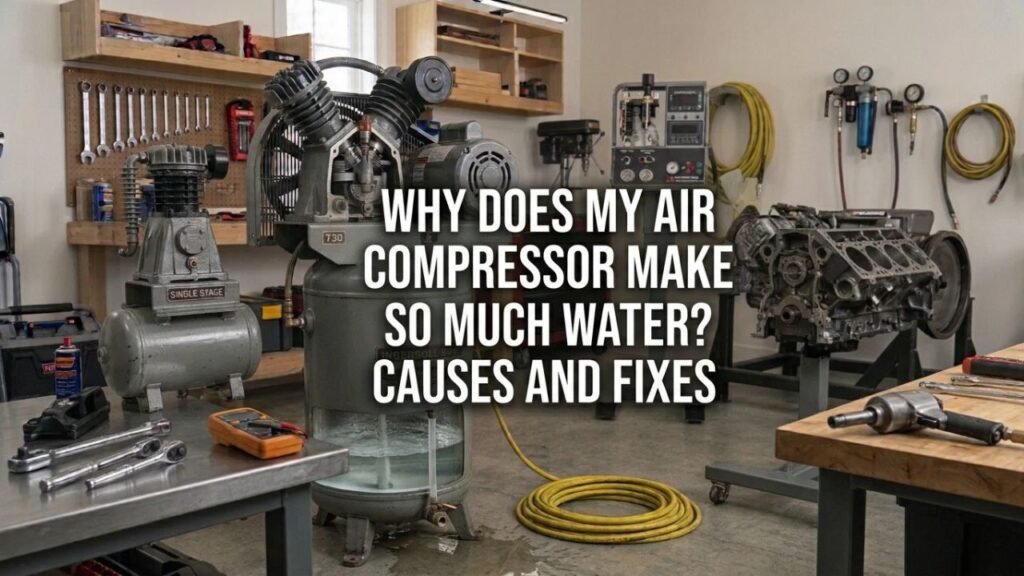
The compressor does not manufacture water. The moisture begins as invisible water vapor in the surrounding air.
Humid Air Enters the Compressor
Every time the pump takes an intake stroke, it pulls in a mixture of gases that includes water vapor.
The amount varies with relative humidity.
Air entering a compressor on a hot, humid summer day contains much more moisture than air entering the same machine on a cold, dry day.
That moisture travels through the compressor with the air.
Compression Heats and Concentrates the Air
The compressor forces a large volume of atmospheric air into a much smaller space.
Pressure rises, and so does temperature.
The hot compressed air leaving the pump can hold substantial water vapor. This is one reason the discharge tube and pump head become very hot during normal operation.
The compressed air then enters the receiver or downstream cooling system.
Cooling Causes Condensation
The hot air begins losing heat as soon as it leaves the compressor.
It cools through contact with:
- Discharge tubing
- Aftercooler
- Receiver walls
- Air piping
- Hose
- Surrounding shop air
Cooler air cannot retain as much water vapor.
The excess moisture condenses into droplets, much like water forming on the outside of a cold drink.
Those droplets eventually collect at low points in the compressed-air system.
Key Takeaway: Humid atmospheric air enters the pump, compression heats and concentrates it, and later cooling converts part of its water vapor into liquid condensate.
Why Is My Compressor Making So Much Water?
Several operating conditions can dramatically increase the amount of liquid you find in the tank.
The Weather Is Hot and Humid
High humidity is one of the biggest causes.
A compressor working in a humid garage may collect several times more water than it does during dry weather.
Summer conditions are especially noticeable because warm air can contain a large amount of moisture.
The compressor draws that moisture in every minute it runs.
The Compressor Is Running Longer
More run time means more atmospheric air passes through the pump.
More air means more water vapor.
A compressor that operates for ten minutes will normally collect less condensate than the same machine running for several hours.
Long run times are common with:
- Spray guns
- Sanders
- Grinders
- Sandblasters
- Blow guns
- High-air-demand equipment
If the connected tool uses nearly all the compressor’s available CFM, the pump may run almost continuously.
You Have a High-CFM Compressor
Large compressors process more air per minute.
That also means they process more moisture per minute.
A 60-gallon shop compressor producing 12 CFM can collect substantially more water than a small pancake compressor producing 2.5 CFM under the same atmospheric conditions.
The tank itself does not create extra water. The larger compressor pump simply moves much more humid air.
The Compressed Air Cools a Lot
A large temperature drop causes more moisture to condense.
For example, very hot discharge air entering a relatively cool steel receiver may release a noticeable amount of liquid.
Cool shop floors, long metal piping, cold outdoor temperatures, and aftercoolers can all increase condensation at specific points in the system.
This is not necessarily bad. Condensing moisture early can make it easier to remove before it reaches your tools.
The Tank Has Not Been Drained Recently
Condensate can accumulate over multiple operating cycles.
If you drain the tank infrequently, the amount coming out at one time may look alarming.
A few ounces collected repeatedly can eventually become a significant volume.
Follow the drain schedule stated by the compressor manufacturer. Heavy use or humid weather may call for more frequent draining.
Your Moisture Separator Is Too Small
A basic separator can remove liquid droplets, but it has airflow and temperature limits.
A separator may struggle if:
- Compressor CFM exceeds its rating
- Air entering it is still extremely hot
- Bowl is full
- Automatic drain is stuck
- Filter element is dirty
- Air velocity is too high
A tiny filter fitted to a large compressor may remove only part of the water.
Key Takeaway: High humidity, extended run time, high airflow, strong cooling, delayed tank drainage, and inadequate moisture separation are the main reasons a compressor appears to produce excessive water.
How Much Water in an Air Compressor Is Normal?
There is no single normal amount because moisture production changes with weather and operating conditions.
A compressor might produce very little visible water during a short winter job and a much larger amount during hours of summer operation.
The main factors are:
| Factor | Effect on Condensate |
| Higher humidity | More water |
| Higher intake temperature | Often more available moisture |
| More compressor CFM | More water |
| Longer run time | More water |
| Greater cooling after compression | More liquid condensation |
| Larger air demand | More water processed |
| Infrequent draining | More water found at one time |
A cup of water from a heavily used compressor is not automatically evidence of a mechanical fault.
Pay more attention to changes in operating conditions and where the water appears.
Water from the tank drain is expected.
Water pouring from tools or spray equipment means the air-treatment system needs attention.
Water seeping directly through a steel tank wall is not normal and can indicate severe internal corrosion.
Why Is Water Coming Out of the Air Hose?
Some moisture remains in vapor form after the air leaves the receiver.
It may condense farther downstream.
The Air Continues Cooling After the Tank
Compressed air may still be warm when it exits the receiver.
As it moves through 25, 50, or 100 feet of hose or metal piping, it cools further.
More water then falls out.
This is why a tank can be drained and you may still find moisture at the tool.
The Compressor Is Running Nearly Nonstop
Long compressor cycles send a continuous stream of hot compressed air into the system.
The air may move through the receiver too quickly to cool fully before reaching the outlet.
A separator placed immediately next to the compressor may therefore see mostly warm water vapor rather than liquid droplets.
More water can condense later in the hose.
The Air System Has No Low-Point Drains
Water naturally collects at low spots in piping.
Poor pipe layout can send this liquid directly toward tools.
A properly planned shop-air system often includes:
- Sloped piping
- Low-point drains
- Drop legs
- Moisture separators
These give condensed water places to collect away from the tool connection.
Key Takeaway: Water can continue forming after compressed air leaves the tank. Long hoses, cool piping, heavy compressor use, and poor drainage can carry that moisture all the way to your tool.
Why Does My Air Compressor Suddenly Have More Water?
A sudden increase does not always mean the compressor has developed a fault.
Start by looking for a change in conditions.
Weather Became More Humid
A humid day can dramatically increase condensate.
The compressor may be operating exactly as before while taking in air containing much more water vapor.
You Started Using a High-CFM Tool
Switching from occasional tire inflation to a DA sander changes how much air the compressor processes.
More pump run time means more moisture enters the system.
An Air Leak Is Making the Compressor Run More
Leaks waste compressed air.
The pressure drops, the motor cycles more frequently, and the compressor processes additional humid air just to maintain tank pressure.
Check for leaks around:
- Couplers
- Hoses
- Regulators
- Fittings
- Drain valves
- Check valves
- Pipe joints
Fixing an air leak can reduce both compressor run time and condensate production.
The Automatic Drain Has Stopped Working
An automatic drain can become clogged or stuck.
Water then builds up until it is noticed elsewhere in the system.
Check automatic drains according to their service instructions.
Your Dryer or Separator Needs Service
A separator bowl may be full, or a dryer may no longer be removing moisture properly.
Desiccant can also become saturated.
Inspect air-treatment equipment if the downstream air suddenly becomes much wetter without a clear weather or workload change.
Key Takeaway: A sudden moisture increase can come from humid weather, more demanding tools, air leaks, failed drains, or air-treatment equipment that needs service.
How to Reduce Water in an Air Compressor
You cannot stop the compressor from pulling moisture out of humid air, but you can control where that water condenses and remove it before it reaches the tool.
Drain the Tank Regularly
Tank drainage is the first step.
Use the procedure in the compressor manual.
Before servicing drain components, switch the machine off and handle stored tank pressure exactly as directed by the manufacturer.
Do not remove a drain valve or fitting from a pressurized receiver.
More frequent drainage may be needed during humid weather or extended compressor use.
Add a Moisture Separator
A separator removes liquid droplets carried in the air stream.
It works well for many:
- Impact tools
- Ratchets
- Nailers
- Blow guns
- General garage tools
Choose a separator rated for the compressor’s airflow and pressure.
Drain its bowl regularly.
Cool the Air Before the Separator
Separators remove liquid water better than invisible water vapor.
Cooling the compressed air before it reaches the separator forces more moisture to condense.
An aftercooler can perform this job.
A useful sequence can be:
Compressor → aftercooler → water separator → receiver or downstream air system
The exact layout depends on compressor design.
Install a Refrigerated Dryer
A refrigerated dryer cools compressed air and removes the resulting condensate.
It is a strong choice for:
- Larger shops
- Frequent painting
- CNC equipment
- Plasma cutting
- Long compressed-air lines
Select a dryer based on actual compressor CFM, inlet temperature, pressure, and required dew point.
Use a Desiccant Dryer When Very Dry Air Is Needed
Desiccant absorbs water vapor that remains after liquid moisture has been removed.
It is useful for applications that need drier air than a basic water separator can supply.
Examples include certain:
- Paint applications
- Instrument air
- Specialized pneumatic systems
Desiccant eventually becomes saturated and needs replacement or regeneration depending on the system.
Improve Piping Layout
For a permanent shop installation, pipe design can remove a large amount of condensate before it reaches the tool.
Helpful features include:
- Proper pipe slope
- Drain legs
- Water traps
- Tool drops taken from suitable pipe locations
- Automatic low-point drains
Avoid creating low sections where water can sit unnoticed.
Key Takeaway: Regular tank draining, air cooling, separators, dryers, and properly arranged piping are the main ways to keep compressor water away from downstream equipment.
Is Too Much Water Bad for an Air Compressor?
Water is expected, but leaving it uncontrolled can cause problems.
Tank Corrosion
A steel receiver holds condensate at its lowest point.
Long-term contact with water can promote internal rust.
Severe corrosion can reduce wall thickness and weaken the pressure vessel.
A tank with:
- Pinhole leaks
- Deep rust
- Bulging
- Cracks
- Damaged welds
should be taken out of service.
Do not patch a corroded pressure vessel as an ordinary DIY repair.
Rust Inside Air Tools
Water entering pneumatic tools can corrode steel internal parts.
Follow the tool manufacturer’s lubrication and moisture-control instructions.
Problems With Spray Painting
Water is particularly troublesome in compressed air used for painting.
It can contribute to:
- Surface contamination
- Poor finish
- Blushing
- Water spots
- Spray inconsistency
A small tank separator may not provide dry enough air for serious paint work.
Sandblasting Problems
Moisture can make blasting media clump.
Wet media may bridge inside the tank or clog lines and nozzles.
Sandblasting often benefits from aggressive moisture removal because the compressor typically runs for long periods and processes large volumes of humid air.
Key Takeaway: Uncontrolled condensate can corrode the receiver and tools, spoil paint work, and cause blasting-media problems. The goal is not to stop condensation but to drain and separate it safely.
How to Tell if the Water Amount Points to a Problem
Use a simple sequence before assuming something inside the compressor has failed.
- Check current humidity and temperature.
- Note how long the compressor has been running.
- Compare tool CFM demand with compressor output.
- Drain the receiver.
- Check for air leaks.
- Inspect separator and dryer drains.
- Check downstream lines for low-point water.
- Look for severe tank rust or pinhole leakage.
- Monitor the compressor’s run time after the system is drained.
If the compressor runs normally, reaches cut-out pressure, and the water exits through normal drains, heavy condensate is usually an air-moisture issue rather than a pump failure.
If run time has suddenly become much longer, check for leaks or reduced pump output.
If water or air comes through the receiver wall, stop using the compressor.
Conclusion
For why does my air compressor make so much water, the main answer is moisture in the surrounding air. The compressor pulls water vapor in with every intake stroke, concentrates it during compression, and then turns much of it into liquid as the hot compressed air cools.
Hot, humid weather and long compressor run times can dramatically increase the amount of condensate. Larger, higher-CFM compressors also process more atmospheric air, so they naturally collect more water during heavy use.
Drain the receiver regularly and add moisture separation when water begins reaching your hose or tools. An aftercooler, separator, refrigerated dryer, or desiccant dryer may be needed for paint work and other moisture-sensitive jobs.
Heavy water production is often normal. A corroded receiver that leaks through the tank wall is not. Stop using a compressor with structural tank leakage and replace the damaged pressure vessel or machine.
FAQs About Air Compressors Making Too Much Water
Why Does My Air Compressor Make More Water in Summer?
Summer air is often warmer and more humid, so the compressor pulls in more water vapor with every cubic foot of air.
As that hot compressed air cools in the tank and lines, a larger amount of moisture condenses into liquid.
Is It Normal to Get a Cup of Water From an Air Compressor?
It can be, especially after extended use in humid conditions or if the tank has not been drained recently.
The volume alone does not prove something is wrong. Compressor CFM, humidity, run time, tank temperature, and drain frequency all affect how much water collects.
Why Is My Air Compressor Tank Full of Water?
The receiver may not have been drained often enough.
A blocked or failed automatic drain can produce the same problem. Shut the compressor down and drain it using the manufacturer’s procedure, then inspect the drain if water continues accumulating unusually fast.
Why Does Water Come Out of My Air Tools?
The compressed air is likely cooling and condensing farther downstream.
Drain the receiver, check low points in the air lines, and add a properly sized separator or dryer before the tool.
Will a Bigger Air Tank Create More Water?
The larger tank does not create moisture.
It can cool a greater volume of stored compressed air and provide more surface area for condensation, so more liquid may collect inside the receiver instead of remaining as vapor downstream.
Does an Air Compressor Water Separator Remove All Moisture?
No.
A basic separator mainly removes liquid droplets. Water vapor can pass through and condense farther downstream.
A refrigerated or desiccant dryer is needed when much drier air is required.
Can I Prevent Water From Forming in My Compressor Tank?
You usually cannot eliminate condensation completely because atmospheric air contains moisture.
You can reduce the amount reaching the tank or tools by cooling the air, separating condensate, using dryers, and operating in a drier intake environment.
Is Rusty Water From My Air Compressor Dangerous?
Rust-colored condensate can occur in steel tanks, especially older ones.
Heavy rust flakes, deep exterior corrosion, bulging, cracks, or pinhole leaks are more serious. Stop using a receiver that is leaking through the tank wall.
Why Does My Compressor Make Water Even After I Drain the Tank?
New condensate begins forming as soon as the compressor processes more humid air.
Some water also forms later in hoses and piping as the compressed air continues cooling. A tank drain removes existing liquid but cannot prevent future condensation.
Does Running an Air Compressor Longer Produce More Water?
Yes.
Longer run time means the pump processes more atmospheric air. If that air contains moisture, more water vapor enters the system and more condensate can form as the compressed air cools.