What Size Air Compressor for CNC Machine? CFM, PSI, and Tank Size
For many single CNC machines, a compressor delivering roughly 4–6 CFM at 90–100 PSI is a practical starting point, but the exact requirement depends on the machine. A CNC using only an automatic tool changer may need much less air than one running continuous air blast, pneumatic clamps, mist coolant, or a plasma torch.
Tank size is secondary. A 20-gallon compressor with enough continuous airflow can be more suitable than a 60-gallon unit with a weak pump. The compressor must replace air as fast as the CNC consumes it during normal production.
If you are trying to determine what size air compressor for cnc machine, check the machine manufacturer’s minimum pressure and airflow first. Current Haas specifications for many mills list about 4 SCFM at 100 PSI, while some Tormach automatic tool changers require at least 2 CFM at 90 PSI for repeated tool changes.
Air quality matters almost as much as capacity. CNC pneumatic components often include small solenoid valves, tool-release cylinders, spindle-air systems, and regulators that can be damaged or disrupted by excessive water, oil, or dirt.
Compressed air can also become a meaningful operating expense. U.S. Department of Energy material notes that compressed air can account for roughly 10% of electricity use at a typical industrial facility, with some plants using substantially more.
The right compressor therefore needs enough CFM, PSI, duty cycle, tank capacity, and moisture control for the machine without being unnecessarily oversized.
What Size Air Compressor Does a CNC Machine Need?
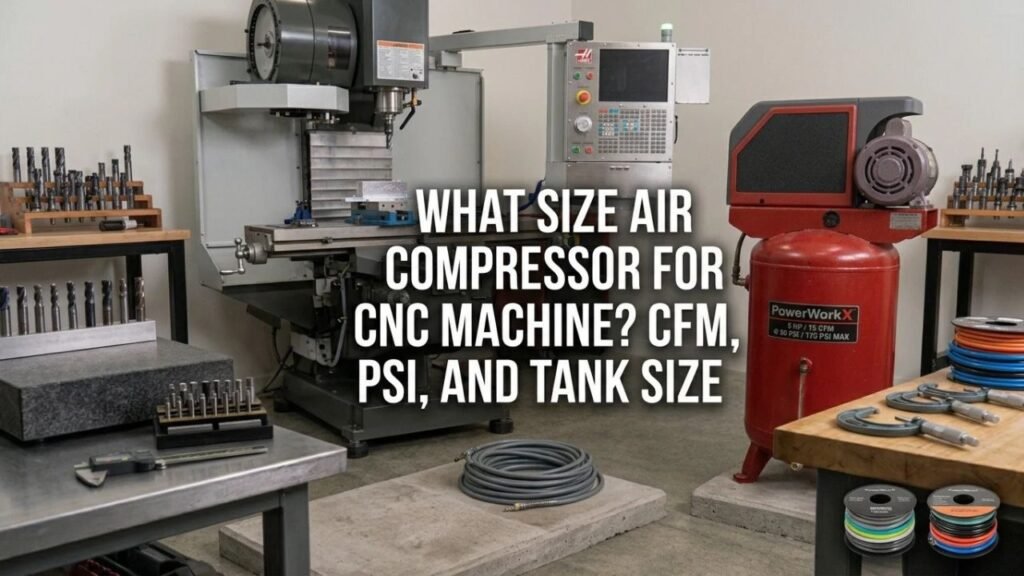
There is no single compressor size that fits every CNC machine.
A useful general starting range for one machine is:
| CNC Application | Approximate Compressor Starting Point | Typical Working Pressure |
| Small CNC with pneumatic drawbar | 2–4 CFM | 90–100 PSI |
| CNC mill with ATC | 4–6 CFM | 90–100 PSI |
| CNC router with ATC | 4–8 CFM | 90–120 PSI |
| CNC with intermittent air blast | 5–8 CFM | 90–100 PSI |
| CNC with continuous air blast | 8–15+ CFM | 90–100 PSI |
| CNC plasma system | 6+ CFM | Around 90 PSI, model dependent |
| Multiple CNC machines | Add simultaneous demand | Model dependent |
These are planning ranges rather than universal specifications.
Small CNC Machines
A benchtop CNC mill may use compressed air only for:
- Power drawbar
- Automatic tool changer
- Occasional air blast
- Pneumatic accessories
In this situation, airflow demand can be surprisingly low.
Tormach specifies at least 2 CFM at 90 PSI for successive back-to-back tool changes on several ATC systems, with a recommended air-pressure range of 90–120 PSI.
A small compressor capable of maintaining that pressure can work if the CNC does not have other major pneumatic loads.
Full-Size CNC Mills
Larger CNC mills usually consume more air.
Haas currently lists 4 SCFM at 100 PSI for machines such as the VM-3/50 and recommends a minimum 2 HP compressor with at least a 20-gallon tank designed for continuous duty.
This makes a 2–3 HP compressor producing at least 5–6 CFM at 90 PSI a reasonable starting point for many single-machine installations when no high-consumption accessories are added.
CNC Routers
A CNC router with no pneumatic equipment may need little or no compressed air.
Add an automatic tool changer and demand changes.
Air may be used for:
- Tool release
- Tool-holder cleaning
- Pneumatic clamps
- Dust-control actuators
- Air blast
- Vacuum-system controls
A router using repeated tool changes and continuous air blast may require considerably more compressor capacity than one that changes tools a few times per hour.
CNC Plasma Machines
Plasma cutting can have higher air demand because the plasma source itself may use compressed air continuously during cutting.
For example, Tormach’s 1300PL site requirements call for at least 6 CFM at 90 PSI, while also advising users to check the specific plasma-source requirement because it may be higher.
Key Takeaway: A small ATC-equipped CNC may operate on only 2–4 CFM, while full-size mills, routers with air blast, and plasma systems may need 4–15 CFM or more. Always start from the machine’s published air requirement.
How Much CFM Does a CNC Machine Need?
CFM is one of the most important compressor specifications for CNC use.
What CFM Means
CFM stands for cubic feet per minute.
It describes how much air the compressor can supply over time.
You may also see SCFM, or standard cubic feet per minute.
A compressor can reach 150 PSI yet still have insufficient CFM for a CNC machine.
Match CFM at the Correct Pressure
If the CNC requires 4 CFM at 100 PSI, do not compare that directly with a compressor advertised as:
- 8 CFM at 40 PSI
Look for the output near the CNC’s actual operating pressure.
Compressor output decreases as discharge pressure rises.
Add Airflow Margin
A compressor should not be selected with output exactly equal to the machine’s theoretical requirement.
If the CNC needs 4 CFM continuously, selecting a unit producing only 4 CFM leaves little room for:
- Air leaks
- Filter pressure loss
- Future accessories
- Hot operating conditions
- Normal compressor wear
- Simultaneous pneumatic actions
For a machine needing around 4 CFM, a compressor capable of roughly 5–6 CFM at the required pressure gives more operating margin.
Multiple Pneumatic Functions Can Add Up
A machine may use air for several operations at the same time.
Examples include:
- Tool release
- Spindle taper cleaning
- Air blast
- Pneumatic clamps
- Coolant mist
- Chip clearing
Continuous air blast can consume far more air than occasional ATC operation.
Key Takeaway: Size the compressor from CFM at the CNC’s working pressure, then leave additional airflow capacity so the compressor is not operating at its limit during every machine cycle.
What PSI Does a CNC Machine Need?
Many CNC pneumatic systems operate somewhere around 80–120 PSI.
The exact requirement comes from the machine manufacturer.
90 to 100 PSI Is Common
Tormach specifies 90–120 PSI for several current ATC systems.
Haas commonly lists an air requirement around 100 PSI for many machines.
That does not mean every CNC should receive 120 PSI.
Use a Regulator
If compressor tank pressure is higher than the CNC requires, install or use the machine’s proper regulator.
For example:
- Compressor tank: 150 PSI
- CNC inlet: 100 PSI
The tank can remain at 150 PSI while the regulator supplies the machine at its required inlet pressure.
Pressure Must Stay Stable During Air Demand
Static pressure can be misleading.
A system might show 100 PSI while the machine is idle, then fall to 75 PSI when:
- ATC activates
- Air blast starts
- Several cylinders move together
That points toward insufficient:
- Compressor CFM
- Hose diameter
- Regulator flow capacity
- Pipe size
- Storage capacity
Key Takeaway: Many CNC machines operate near 90–100 PSI, but pressure must remain within specification while the machine is actually consuming air, not just while idle.
What Tank Size Air Compressor Is Best for a CNC Machine?
Tank capacity determines stored air, not compressor output.
20-Gallon Tank
A 20-gallon receiver can work well for a single machine with intermittent air consumption.
This fits applications such as:
- Occasional ATC cycles
- Power drawbar
- Pneumatic clamps
- Short air blasts
Haas specifically recommends a minimum 20-gallon receiver for many of its machines, paired with a minimum 2 HP continuous-duty compressor.
30- to 60-Gallon Tank
This is a comfortable range for many small commercial shops.
A larger receiver gives:
- More stored air
- Fewer rapid pressure changes
- Longer compressor off-times
- Better support for brief high-flow events
It is especially useful when the CNC has an ATC and intermittent air blast.
60- to 80-Gallon Tank
A 60- or 80-gallon compressor makes sense when:
- Air demand is higher
- The machine runs for long shifts
- Multiple pneumatic tools share the compressor
- Air blast operates frequently
- Future equipment will be added
The pump still needs enough CFM.
An 80-gallon tank connected to a 4-CFM pump will eventually lose pressure if the CNC continuously consumes 8 CFM.
Key Takeaway: A 20-gallon tank can be enough for light CNC pneumatic demand, while 30–60 gallons gives more reserve for general shop use. Pump CFM remains more important than tank gallons.
How Much Horsepower Does a CNC Air Compressor Need?
Horsepower helps indicate compressor class, but CFM is more useful for final sizing.
1 to 2 HP
A small 1–2 HP compressor may suit:
- Benchtop CNC
- Pneumatic drawbar
- Light ATC use
- Occasional clamps
Check actual CFM rather than assuming HP guarantees performance.
2 to 3 HP
This range is common for a single CNC that needs moderate airflow.
Haas currently recommends at least 2 HP for many single-machine installations.
A good 2–3 HP compressor can often provide enough air for:
- ATC
- Pneumatic controls
- Periodic air blast
5 HP
A 5 HP compressor becomes attractive when the shop has:
- Larger CNC
- Continuous air use
- Multiple machines
- Additional pneumatic equipment
A typical 5 HP reciprocating compressor can produce substantially more airflow than many small portable units.
Larger Systems
Production facilities often use:
- 7.5 HP
- 10 HP
- 15 HP
- Larger compressors
At this level, rotary screw compressors become common because they suit sustained air demand.
Key Takeaway: Around 2–3 HP can suit many single-CNC installations, while 5 HP and larger systems make more sense for continuous air use or multiple machines. Use CFM as the final performance check.
Does a CNC Machine Need a Continuous-Duty Air Compressor?
A compressor rated for extended operation is preferable when the CNC runs for long production periods.
ATC-Only Demand Is Intermittent
If air is used only for tool changes, the compressor may run for relatively short periods.
The receiver supplies air during tool changes and the compressor restores pressure afterward.
Air Blast Can Be Continuous
Continuous chip-clearing air changes the calculation.
If an air nozzle consumes 6 CFM and the compressor produces only 4 CFM:
- Tank pressure falls steadily
- Compressor runs continuously
- Machine may eventually see low air pressure
This happens regardless of tank size.
Production CNC Machines Need Reliable Air
Loss of compressed air can interfere with:
- Tool changes
- Spindle taper cleaning
- Pneumatic brakes
- Clamps
- Doors
- Tool release systems
A compressor that is constantly at its duty-cycle limit leaves little reserve for production.
Key Takeaway: Intermittent ATC use may work with a smaller compressor, but continuous air blast or production operation calls for a compressor designed to maintain the required airflow for long periods.
Is a Reciprocating or Rotary Screw Compressor Better for CNC?
Both can work.
The better choice depends on operating hours and air demand.
Reciprocating Compressor
A piston compressor is often a good fit for:
- Small machine shop
- One CNC
- Intermittent operation
- Home CNC workshop
Advantages include:
- Lower purchase cost
- Simple maintenance
- Wide availability
- Large receiver options
Its drawbacks include:
- More noise
- More vibration
- Greater cycling
- Limited duty cycle on some models
Rotary Screw Compressor
A rotary screw compressor makes more sense when:
- CNC machines operate all day
- Several machines share one air system
- Air demand is relatively steady
- Noise matters
- Production downtime is expensive
Screw compressors supply air more continuously and are common in manufacturing facilities.
They generally cost more to buy and maintain.
Key Takeaway: A quality piston compressor is usually enough for one CNC with moderate air use, while a rotary screw compressor becomes attractive for multiple machines or long daily production schedules.
Does a CNC Machine Need Dry Compressed Air?
Yes. Clean, dry air is strongly preferred.
Tormach specifically recommends using a dryer, desiccator, or filter between the compressor and several ATC-equipped machines.
Why Water Is a Problem
Compressed air contains moisture.
As hot compressed air cools, water condenses in:
- Receiver tank
- Air lines
- Filters
- CNC pneumatic system
Water can contribute to:
- Corrosion
- Sticky pneumatic valves
- Damaged cylinders
- Tool-change problems
- Contamination
Install a Water Separator
A basic setup can be:
Compressor → Receiver → Water Separator → Dryer if needed → Filter → Regulator → CNC
The exact air-treatment system depends on the machine.
Drain the Receiver
Water collected in the compressor tank should be drained regularly.
An automatic tank drain is useful in production environments.
Air Dryer
A refrigerated or desiccant dryer may be worth adding when:
- Humidity is high
- CNC runs long hours
- Air lines are long
- Machine maker specifies dry air
- Pneumatic equipment is sensitive
Key Takeaway: CNC machines should receive clean, dry compressed air. A separator, filter, regular tank draining, and a dryer when needed protect pneumatic components from moisture and contamination.
What Size Air Hose Should You Use for a CNC Machine?
Air-line size affects pressure at the machine.
3/8-Inch Is Common
Haas lists a 3/8-inch inline hose and coupler for many machines requiring around 4 SCFM at 100 PSI.
This is a good reference point for moderate CNC airflow.
High-Air-Demand Machines May Need 1/2 Inch
Some larger machines need substantially more airflow.
A Haas EC-400, for example, lists 9 SCFM at 100 PSI and a 1/2-inch air line and coupler.
Long Runs Increase Pressure Drop
A line that works over 10 feet may create noticeable restriction over 100 feet.
Pressure loss increases with:
- Long tubing
- Small hose ID
- Small quick couplers
- Elbows
- Dirty filters
- Restricted regulators
Size the complete air path, not just the compressor.
Key Takeaway: 3/8-inch air lines are common for moderate CNC airflow, while higher-demand machines may need 1/2 inch or larger. Long runs and restrictive fittings can require upsizing.
How to Calculate Compressor Size for a CNC Machine
A simple sizing process avoids guessing.
1. Find the CNC Air Requirement
Look in:
- Installation manual
- Pre-installation guide
- Machine data plate
- Manufacturer specifications
Record:
- Minimum PSI
- CFM or SCFM
- Air quality requirements
2. Add Auxiliary Air Loads
Include anything connected to the same compressor:
- Air tools
- Blow guns
- Pneumatic vises
- Additional CNC machines
- Plasma cutter
- Air blast
- Mist systems
3. Determine Simultaneous Demand
Do not simply add every tool in the building if they will never operate together.
Estimate what can realistically run at the same time.
4. Add Capacity Margin
If total expected demand is 6 CFM, selecting a compressor producing only 6 CFM leaves very little reserve.
A compressor around 7.5–9 CFM at the required pressure provides more breathing room.
5. Check Duty Cycle
Make sure the compressor can sustain the expected run time.
6. Select Tank Capacity
Choose receiver size based on:
- Air-demand spikes
- Available space
- Compressor cycling
- Future expansion
7. Size the Air Line
Make sure hose, filters, regulators, and couplers can carry the required CFM without excessive pressure drop.
Key Takeaway: Add the CNC’s real airflow requirement to other simultaneous loads, include operating margin, then verify duty cycle, receiver volume, and air-line capacity.
Example Compressor Sizes for Common CNC Setups
These examples show how the sizing logic works.
Benchtop Mill With Power Drawbar
Assume:
- Drawbar and ATC demand: around 2 CFM
- Pressure: 90 PSI
- No continuous air blast
A compressor producing around:
- 3–4 CFM at 90 PSI
- 10–20 gallon tank
may be enough.
Full-Size CNC Mill
Assume:
- Machine requirement: 4 SCFM at 100 PSI
- Occasional pneumatic accessories
A practical compressor might provide:
- 5–7 CFM at 100 PSI
- 20–30+ gallon tank
- Continuous-duty capability
CNC Router With ATC and Air Blast
Assume:
- ATC demand: intermittent
- Air blast: 4–6 CFM during cutting
A compressor producing:
- 7–10 CFM at 90 PSI
- 30–60 gallon tank
can provide more suitable reserve.
Two CNC Machines
If both machines each need around 4 CFM and can operate simultaneously, total machine demand becomes roughly 8 CFM before accounting for leaks and accessories.
A compressor around:
- 10–12+ CFM at operating pressure
- 60-gallon or larger receiver
would provide more margin than an 8-CFM unit running constantly.
Common Mistakes When Sizing a CNC Air Compressor
Avoid selecting a compressor from one specification.
Choosing by Tank Gallons
A big tank does not produce air.
It only stores what the pump produces.
Choosing by Maximum PSI
A compressor labeled 175 PSI may still have low CFM.
The CNC may need only 100 PSI but require substantial airflow.
Ignoring Continuous Air Blast
A small compressor can handle brief ATC operation and then struggle after an air nozzle is added.
Ignoring Moisture
A compressor with enough CFM can still cause machine problems if it sends water into the pneumatic system.
Using Small Quick Couplers
A restricted fitting can create pressure drop even when the compressor itself is large enough.
Buying Exactly the Minimum CFM
Operating permanently at the compressor’s limit means long run times and little reserve.
Key Takeaway: Tank size and maximum PSI do not determine CNC compatibility by themselves. CFM, duty cycle, air quality, and pressure at the machine matter more.
Conclusion
For what size air compressor for cnc machine, many single-machine installations can start around 4–6 CFM at 90–100 PSI, paired with a 20- to 30-gallon or larger receiver. That range is suitable for many CNC mills and routers using pneumatic controls or an automatic tool changer.
Machines with continuous air blast, plasma cutting, pneumatic clamping, or several simultaneous air functions may need 8–15 CFM or more. Multiple CNC machines require the simultaneous airflow demand of all operating equipment to be added together.
Do not select the compressor from tank gallons alone. Check CFM at the CNC’s required PSI, choose a suitable duty cycle, provide clean and dry air, and make sure the hose, regulator, filters, and couplers can deliver the same airflow without excessive pressure loss.
FAQs About Air Compressor Size for CNC Machines
Is a 20 gallon air compressor enough for a CNC machine?
It can be. Haas recommends a minimum 20-gallon tank with a 2 HP continuous-duty compressor for many machines. The more important number is CFM at the required PSI. A 20-gallon compressor with enough airflow can outperform a larger tank with an undersized pump.
How many CFM does a CNC machine need?
Small ATC systems may need around 2 CFM at 90 PSI, while many full-size CNC mills need around 4 CFM or more. Continuous air blast, plasma cutting, and additional pneumatic functions can raise demand to 6–15 CFM or higher.
What PSI should an air compressor provide for a CNC?
Many CNC systems operate around 90–100 PSI, with some manufacturers allowing supply pressure up to about 120 PSI before additional regulation is required. Always use the pressure range specified for the exact CNC model.
Is a 6 gallon compressor big enough for CNC?
It may work for a small CNC using air only for occasional tool changes or a power drawbar. A 6-gallon unit can cycle frequently, so its CFM and duty-cycle ratings matter more than its tank volume.
Is a 60 gallon compressor good for a CNC machine?
Yes, a 60-gallon compressor can be a good shop choice if its pump supplies enough CFM. The larger receiver provides more stored air and reduces pressure swings, but tank size alone cannot compensate for insufficient compressor output.
Do CNC machines need an air dryer?
Many benefit from one, and some manufacturers specifically recommend dry compressed air. At minimum, use appropriate filtration and moisture separation. A refrigerated or desiccant dryer is a stronger option for humid environments or machines with sensitive pneumatic components.
Can one air compressor run two CNC machines?
Yes, if it can supply the combined simultaneous CFM demand at the required pressure. Add both machines’ airflow requirements, include other pneumatic loads, and leave additional compressor capacity instead of sizing exactly to the calculated minimum.
Is a rotary screw compressor better for CNC machines?
For several CNC machines or long production shifts, a rotary screw compressor can be a strong choice because it is suited to steady air demand. For one machine with intermittent pneumatic use, a properly sized reciprocating compressor is often sufficient.