
How Humidity Impacts Sanding Belts: Storage and Belt Life
Humidity changes sanding-belt behavior by changing the moisture content of the backing and bond. Damp air can promote curling, stretching, creasing, loading, tracking trouble, grit loss, and joint stress. Very dry air can make some backings stiff, brittle, curled, or more prone to static.
That matters because a belt can look usable yet run poorly after sitting in a damp garage, dry heated room, or warehouse with large seasonal swings. The result may be wandering on the rollers, uneven contact, early loading, a weak joint, or a finish that no longer matches what the same grit normally produces.
Stable storage gives the backing, adhesive system, and belt joint a better chance to stay in the shape and condition intended by the manufacturer. It also reduces wasted belts and makes troubleshooting easier because machine tension, tracking, and grit selection are not being confused with a storage problem.
For U.S. operators, Norton recommends storing coated abrasive belts at 40–50% relative humidity and 60–80°F. 3M lists 35–50% RH and 60–80°F for coated abrasive belts. Those ranges point to moderate indoor humidity rather than very dry air.
The clearest way to explain how humidity impacts sanding belts is to look at the belt as a layered product. Abrasive grain sits on a paper, cloth, fiber, or synthetic backing and is held by bonding materials. The backing and bond do not always absorb or release moisture at the same rate, so a humidity change can create distortion across the belt.
What stood out to me in the manufacturer guidance was the repeated focus on stable humidity, not simply keeping belts as dry as possible. Excessive dryness creates its own problems, while high humidity can soften or distort moisture-sensitive materials.
The sections below explain what high and low humidity do to sanding belts, which backings are more sensitive, what storage range makes sense, how to spot moisture-related belt problems, and what to do before mounting a belt that has been stored in a different climate.
How Humidity Impacts Sanding Belts During Use
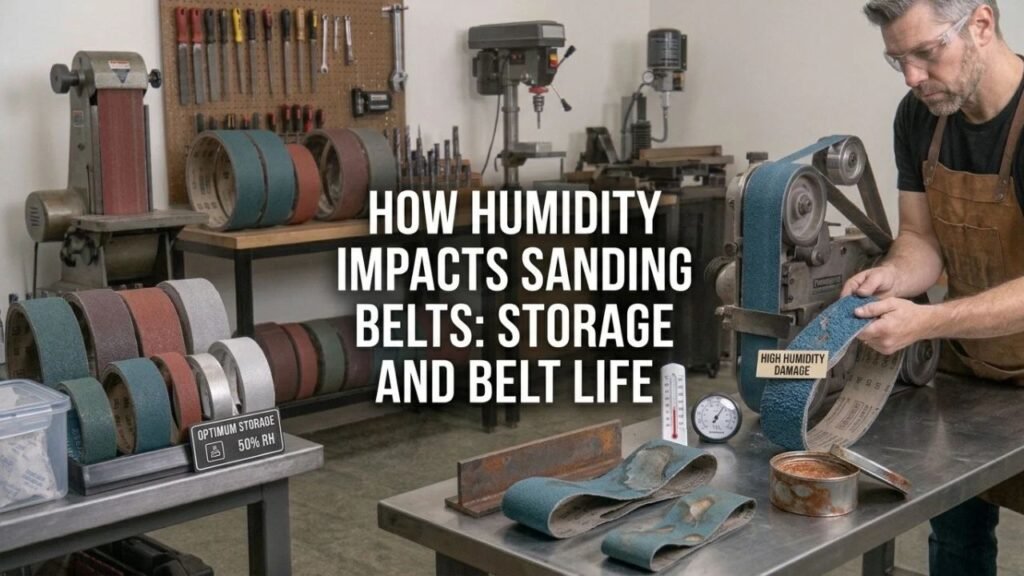
Relative humidity is the amount of water vapor in the air compared with the maximum amount the air can hold at that temperature. A sanding belt does not need to be splashed with water to take on moisture. Some backing and bonding materials exchange moisture with the surrounding air during storage and use.
High Humidity Can Change Belt Shape
Paper, cloth, and fiber backings can absorb moisture as surrounding humidity rises. If the backing changes dimension at a different rate from the bond layer, the belt may curl, cup, ripple, or develop uneven tension across its width.
Klingspor specifically links high humidity with cupping, tracking trouble, and creasing in coated abrasive products. Its troubleshooting information also lists a moisture imbalance across a belt as a possible cause of creasing.
Wide belts are more sensitive to uneven moisture across their width because one side can expand or relax differently from the other. A belt that is flat on the rack but wavy along one edge deserves inspection before it goes on the machine.
Damp Conditions Can Increase Loading and Grit Loss
High humidity can soften some backing treatments and bonding systems. Glue-bonded coated abrasives are more sensitive than many resin-bonded products, and damp backing can become looser and more likely to crease.
The cutting effect can change too. If the abrasive structure is no longer supported as intended, grains may shed early or press back into the backing instead of cutting cleanly. Klingspor also notes that damp conditions can promote premature loading and shorter abrasive life.
Moisture in the workpiece can create a separate loading problem. For wood sanding, Klingspor lists high wood moisture content as a possible cause of clogging. If a belt loads quickly on humid days, inspect both the belt storage conditions and the wood rather than blaming only one source.
Humidity Can Affect Tracking and Creasing
A belt tracks correctly when it stays centered and runs straight across the rollers or platen. Moisture imbalance can distort the backing enough to make the belt wander, wrinkle, or fold under load.
Before adjusting the machine, compare a suspect belt with one stored under stable conditions. If the known-good belt tracks correctly, storage distortion becomes a stronger possibility. If both belts wander, check roller alignment, tension, tracking sensors, dust buildup, and belt installation. Klingspor lists all of these as possible tracking causes, including humidity imbalance.
Low Humidity Can Make Some Belts Brittle
Very dry air pulls moisture from moisture-sensitive backings. The belt may lose flexibility, curl in the opposite direction from a damp belt, or become more prone to cracking at a crease or damaged edge.
Dry conditions can also raise static problems in some sanding setups. Klingspor lists low humidity as one factor associated with static-electricity streaking on a workpiece. Static can attract dust and make finish defects harder to diagnose.
Key Takeaway: High humidity tends to soften and distort moisture-sensitive belts; very low humidity can dry, curl, stiffen, and increase static problems.
Best Humidity Range for Sanding Belt Storage
There is no single storage number published by every abrasive manufacturer. The ranges overlap enough to give a clear practical target.
| Manufacturer guidance | Relative humidity | Temperature |
| 3M coated abrasive belts | 35–50% RH | 60–80°F |
| Norton coated abrasive belts | 40–50% RH | 60–80°F |
| Klingspor U.S. coated abrasives | 40–50% RH | 60–80°F |
| Mirka wide belts | 35–60% RH | 59–77°F |
A 40–50% RH Target Is a Safe Common Range
If several belt brands share the same storage room, 40–50% RH is a sensible target because it sits inside the published ranges above. A room temperature near normal indoor conditions also fits the manufacturer guidance.
The exact product instructions still take priority. Some synthetic-backed products tolerate moisture changes better than traditional paper or cloth constructions, and wide-belt makers may publish a broader humidity range.
Stability Matters as Much as the Number
A storage room that stays near 45% RH is easier on coated abrasives than a garage that moves from very dry winter air to damp summer conditions. Rapid swings make the backing and bond repeatedly absorb and release moisture.
Mirka also stresses that wide belts should have even moisture across the full width. Hanging a belt beside a cold exterior wall or heater can expose one area to different conditions from the rest.
Key Takeaway: Aim for roughly 40–50% RH when no product-specific instruction says otherwise, and avoid large temperature or humidity swings.
Which Sanding Belt Backings Are Most Sensitive to Humidity?
The abrasive grain itself is only one part of the belt. The backing and bonding system usually determine how strongly the product reacts to room moisture.
Paper Backings React Quickly to Moisture Changes
Paper is hygroscopic, meaning it takes on and releases moisture from the air. A paper-backed belt can change shape as humidity rises or falls, making paper a poor candidate for uncontrolled storage near concrete floors, exterior walls, open windows, or heaters.
Fine-grit paper belts can show curl before a heavy cloth belt stored beside them shows an obvious change. That does not mean every curled belt has failed, but abnormal curl is a reason to inspect the belt and follow the maker’s safety instructions.
Cloth and Fiber Backings Can Stretch or Distort
Cloth is tougher and more flexible than paper, yet many cloth constructions still react to humidity. Moisture can change the backing’s tension and shape, and an uneven change across a wide belt may show up as a tracking or creasing problem.
Klingspor explains that paper, cloth, and fiber backings can change shape at a different rate from resin or glue bond layers. That difference is one reason coated abrasives can curl under changing humidity.
Synthetic Backings Are Usually More Stable
Polyester and other synthetic backings are generally less moisture-sensitive than paper-based products. Norton notes that newer synthetic-backed belts are not affected by moisture in the same way as traditional backings, though cold conditions can still create a temporary set that should be allowed to return to room temperature before use.
I would still store synthetic belts within the maker’s stated range. The backing may be stable while the joint tape, adhesive, resin system, or other belt components still have storage limits.
Key Takeaway: Paper is usually the most humidity-sensitive backing, cloth can still distort, and synthetic backings tend to stay more dimensionally stable.
Signs Humidity Is Affecting a Sanding Belt
Humidity problems are easier to correct before the belt reaches full machine speed. A short inspection can separate obvious storage damage from a sander adjustment problem.
Curling, Cupping, or Wavy Edges
Lay a narrow belt in a relaxed loop or hang a wide belt as the manufacturer directs. Look for unusual curl, ripples, a wavy edge, or one side that appears longer or softer than the other.
A small amount of natural curl can occur with some belt constructions. Abnormal shape change, especially after damp or very dry storage, deserves more caution. 3M warns against using coated abrasive belts with an abnormally curled shape.
Wandering or Repeated Creasing
A belt that suddenly refuses to track after being stored in a damp area may have uneven moisture content. Creasing that begins near one edge can also point toward distortion, though machine faults remain common causes.
Check belt tension, roller condition, alignment, sensors, and dust before deciding humidity is the cause. If a different belt runs correctly without machine changes, the suspect belt becomes the stronger lead.
Fast Loading, Burning, or Weak Cutting
A moisture-affected belt may load sooner or cut less predictably. The operator may then press harder, which creates more frictional heat and can make loading or burning worse.
Before increasing pressure, inspect the belt face, the workpiece moisture level, dust extraction, grit choice, and storage history. This sequence avoids turning a storage problem into a heat problem.
Loose Grit or Joint Damage
Look closely at the splice and belt edges. Warning signs include lifted joint tape, separation at the seam, cracking, frayed edges, loose abrasive grain, or a kink that remains after the belt hangs.
Humidity is only one possible contributor to belt breakage. Excessive tension, poor tracking, wrong belt direction on a directional splice, edge damage, machine faults, and overload can also break a belt. A belt with visible joint or backing damage should not be used at speed.
Key Takeaway: Curl, wavy edges, wandering, creasing, early loading, loose grit, and splice damage are the main clues that storage conditions may have affected the belt.
How to Store Sanding Belts in Humid or Dry Conditions
Good storage is mostly about controlling swings, keeping belts away from moisture sources, and giving wide belts time to equalize before use.
1. Keep Unused Belts in Their Original Packaging
Manufacturer packaging reduces direct exposure to dust, sunlight, moisture swings, and physical damage. Open only the belts needed for near-term work.
Do not store cartons against a damp wall or directly on a concrete floor. Norton calls for coated abrasive belts to be kept at least 4 inches above concrete floors and away from open windows, direct sun, and heat sources.
2. Monitor the Storage Area With a Hygrometer
A small digital hygrometer shows if the room is drifting far outside the belt maker’s range. Check conditions over several days rather than relying on how the room feels.
In a humid shop, use air conditioning or a dehumidifier to hold the storage area near the target range. In a very dry heated room, controlled humidification may be needed. Avoid directing hot or damp air at belt racks.
3. Condition Wide Belts Before Running Them
A wide belt moved from one climate into another may need time to equalize. Klingspor recommends removing wide belts from the carton and hanging them on suitable pegs or bars for up to 24 hours before use, while Norton woodworking guidance says belts may need 1–2 days near the machine if the workshop atmosphere differs from the storage area.
Follow the specific belt maker’s conditioning instructions. The goal is even moisture and temperature across the belt, not leaving it exposed indefinitely.
4. Keep Belts Away From Local Hot and Cold Spots
Do not hang belts beside radiators, furnaces, hot-air ducts, cold exterior walls, open windows, or direct sunlight. A belt can develop uneven moisture if one side sits near a cold damp surface while the other faces warmer room air.
For wide belts, that unevenness can matter as much as the average room RH.
5. Inspect Before Mounting
Check the belt joint, edges, backing, and abrasive face. Look for cuts, tears, lifted tape, creases, abnormal curl, moisture stains, or loose grain.
Safety Tip: A belt that was directly soaked, has a damaged joint, or has abnormal curl should not be “fixed” by running it under tension. 3M and Norton both warn that storage condition and visible damage can affect belt safety.
Key Takeaway: Original packaging, controlled RH, off-floor storage, conditioning time, and a pre-use inspection prevent most humidity-related belt storage problems.
What to Do With a Sanding Belt That Got Damp or Too Dry
If a belt has only been exposed to a different room climate and has no visible damage, move it to the correct storage area and let it condition according to the manufacturer’s instructions. Wide belts should hang on the proper rack or support rather than being forced flat.
Do not use direct heat to dry a damp belt. A heater can create a steep moisture gradient and may age adhesives or distort the backing. A controlled room with moderate temperature and humidity is a better approach.
If the belt was soaked with water, shows joint separation, has a permanent crease, sheds grain, or remains abnormally curled after conditioning, replace it. The cost of one belt is small compared with damaged work, a broken belt, or machine downtime.
For a belt that feels unusually dry and stiff, return it to a controlled room rather than misting it with water. Adding liquid directly can create uneven swelling and can damage components that were meant to stay dry.
Humidity Problem or Machine Problem?
Humidity is easy to blame because the symptoms overlap with common sander faults. A belt that wanders may also have low tension, dirty tracking sensors, misaligned rollers, damaged edges, or poor installation. A belt that loads may be too fine, run with too much pressure, or be sanding wood with high moisture content.
I would start with a simple comparison: check room RH, inspect the suspect belt, and run a known-good belt of the same size and backing if it can be done safely. If the known-good belt behaves normally, storage becomes a stronger suspect. If both belts show the same fault, inspect the machine and workpiece conditions next.
This comparison is most useful after a seasonal weather change, a move to a new storage room, or a long period when belt cartons sat near a cold floor or wall.
Conclusion
How humidity impacts sanding belts comes down to moisture moving into or out of the backing and bonding system. Too much humidity can contribute to curl, stretch, creasing, tracking trouble, loading, grit loss, and joint stress, while very dry conditions can make some belts stiff, brittle, curled, or prone to static.
For mixed belt stock, a storage target around 40–50% RH fits the common overlap in guidance from major abrasive manufacturers. Keep belts at normal room temperature, in their original packaging, away from concrete floors and local heat or dampness, and condition wide belts before use when the shop climate differs from storage.
My preference is to treat unexplained belt behavior as a storage-and-machine diagnosis rather than replacing parts immediately. Check RH and belt shape first, then tension, tracking, rollers, extraction, and workpiece moisture. That order usually gives a clearer reason for the problem without wasting a fresh belt.
FAQs About Humidity and Sanding Belts
What humidity should sanding belts be stored at?
A practical target is 40–50% relative humidity unless the belt manufacturer states another range. Norton lists 40–50% RH, 3M lists 35–50% RH, and Mirka lists 35–60% RH for wide belts. Temperature guidance is commonly close to ordinary indoor room conditions.
Can high humidity make a sanding belt break?
Yes, high humidity can contribute to failure by changing backing dimensions, softening moisture-sensitive materials, disturbing tracking, or stressing the belt joint. It is rarely the only possible cause. Excessive tension, damaged edges, poor tracking, a bad splice, overload, and machine faults should also be checked before assigning the failure to humidity alone.
Can low humidity damage sanding belts?
Yes. Very dry air can pull moisture from paper, cloth, or fiber backings, making some products less flexible and more brittle. Low humidity can also change belt shape and raise static-related finish problems. Returning the belt to a controlled storage area is safer than applying water directly.
Is it okay to store sanding belts in a garage?
Only if the garage stays within the belt maker’s temperature and humidity range. Unconditioned garages often have large seasonal swings, damp concrete, cold walls, and summer heat. Store belt cartons off the floor and away from doors, windows, heaters, and exterior walls. A hygrometer gives a clearer answer than guessing from room comfort.
Should sanding belts be stored in plastic bags?
The original manufacturer packaging is the first choice. For opened narrow belts, a clean moisture-resistant container may reduce exposure to room swings, but do not seal a belt while it is damp. Wide belts often need specific hanging and conditioning practices, so follow the product instructions rather than packing them tightly into a small bag.
How long should sanding belts acclimate before use?
For wide belts, about 24 hours is a common starting point. Klingspor recommends up to 24 hours on suitable supports, while Norton says 1–2 days may be needed when the workshop atmosphere differs from the storage room. Product instructions should decide the final conditioning time.
Are polyester sanding belts less affected by humidity?
Generally, yes. Polyester and other synthetic backings tend to change dimension less with moisture than paper-based backings. The belt still contains a joint and bonding system, so storage limits should not be ignored. Norton notes that newer synthetic-backed belts are less affected by moisture than traditional constructions.
Can humidity cause a sanding belt to track poorly?
Yes. Uneven moisture across a belt can change its shape or tension and cause wandering or creasing, especially on wide-belt sanders. Humidity is only one possible cause, so also inspect belt tension, roller alignment, tracking sensors, dust buildup, belt edges, and installation before changing machine settings.