
Biscuit Joiner Biscuit Sizes: #0, #10 and #20 Explained
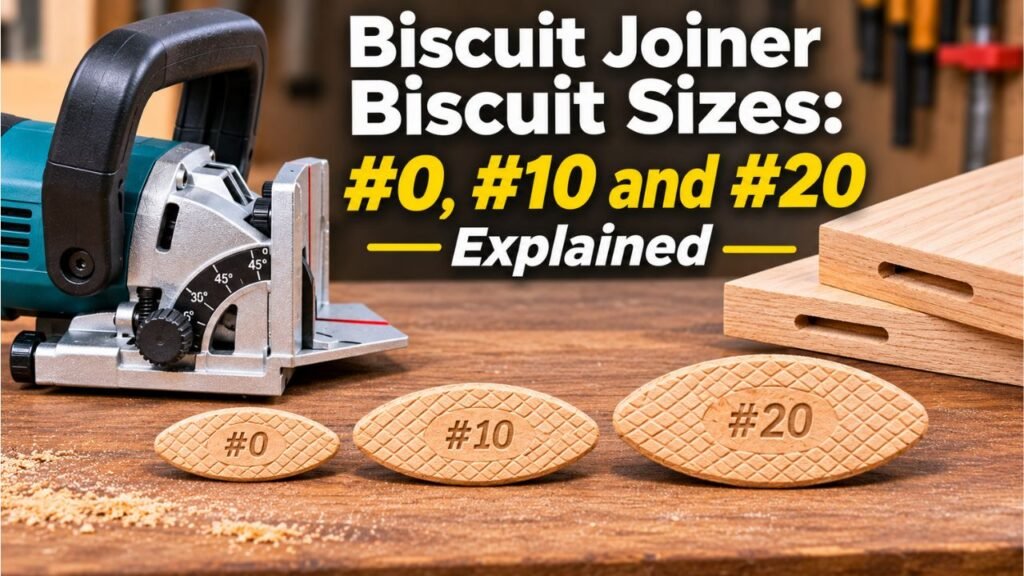
The three standard biscuit sizes are #0 (small), #10 (medium), and #20 (large). Choose #0 for narrow parts, #10 for medium-size pieces, and #20 for wider boards with enough room for the slot. All three are about 5/32 inch thick, so the main difference is their length and width.
These oval wooden pieces fit into matching slots cut by a biscuit joiner, also called a plate joiner. They help keep boards lined up while wood glue dries. Picking the wrong size can cause a slot to break through an edge, leave too little wood around the joint, or make assembly harder than it needs to be.
The number printed on a biscuit isn’t its length in millimeters or inches. It’s a size code that matches a cutting-depth setting on most standard joiners. That distinction matters when you’re choosing between a small frame and a wide tabletop.
This guide compares the actual dimensions, suitable projects, wood thickness, and cutting depths for each size. You’ll also learn how to avoid sizing mistakes before cutting into your finished boards.
Quick Answer
- #0: Smallest standard biscuit, best for narrow rails and small parts.
- #10: Medium biscuit, useful for smaller cabinet parts and medium-width joints.
- #20: Largest common biscuit, usually preferred for wider boards and panels.
- Use the largest size that fits safely without cutting through the wood.
What Are the Standard Biscuit Sizes and Dimensions?
Standard woodworking biscuits come in three common sizes: #0, #10, and #20. Their numbers identify the size, not a measurement or strength rating. Each is roughly 5/32 inch thick, but its length and width increase as the number increases, requiring a matching cutting-depth setting.
Biscuit Size Chart: #0 vs. #10 vs. #20
| Size | Approximate dimensions (inches) | Metric dimensions | Typical use |
|---|---|---|---|
| #0 | 1.85 × 0.59 × 0.16 | 47 × 15 × 4 mm | Narrow parts, small frames |
| #10 | 2.09 × 0.75 × 0.16 | 53 × 19 × 4 mm | Medium-width joints |
| #20 | 2.20 × 0.91 × 0.16 | 56 × 23 × 4 mm | Wide boards, panels, cabinet work |
Dimensions are length × width × thickness. These figures follow the specifications in Lamello’s original wood biscuit catalog. Dimensions from other manufacturers can vary slightly.
All three sizes are flat, oval pieces of compressed wood, commonly beech. They fit into curved slots made by the joiner’s rotating blade.
The main differences are straightforward:
- Length: Larger biscuits take up more room along the joint.
- Width: Larger biscuits extend farther into each joining piece.
- Thickness: Standard #0, #10, and #20 biscuits all use approximately 4 mm thick slots.
- Cutting depth: Larger biscuits require deeper slots.
That last point explains why a depth selector has separate settings even though the blade thickness stays the same.
Which Biscuit Size Should You Use for Different Projects?
Choose #0 for small or narrow pieces, #10 for medium-width parts, and #20 for wide boards where a deeper slot won’t damage the wood. Board thickness matters, but available space around the slot is just as important because the biscuit must stay completely hidden inside the finished joint.
#0 Biscuit: Best for Narrow Wood Pieces
The #0 is the smallest of the three standard sizes. It measures approximately 1.85 inches long and 0.59 inch wide, with a thickness close to 5/32 inch.
It’s a sensible choice when larger biscuits would remove too much material.
Typical uses include:
- Small picture frames with enough room for the slot.
- Narrow cabinet rails.
- Small decorative woodworking parts.
- Short joints in light-duty assemblies.
Picture a small wooden frame with rails about 2 inches wide. A #20 slot may leave very little room near the rail ends. A #0 offers a smaller cut, although you still need to check that the complete slot stays inside the wood.
Pro Tip: Don’t assume a #0 will fit every narrow frame. The blade may cut a longer opening than the biscuit itself. Check the joiner’s slot-length markings before cutting.
#10 Biscuit: Best for Medium-Width Joints
A #10 biscuit is approximately 2.09 inches long and 0.75 inch wide. It offers a middle option when a #0 seems small but a #20 leaves too little material around the joint.
Common applications include:
- Smaller cabinet panels.
- Medium-width frame parts.
- Some drawer and furniture assemblies.
- Wood joints with limited room for a larger slot.
Say you’re joining two pieces for a small cabinet section. The wood is wide enough to accept a #10, but a #20 cut would sit close to a nearby edge.
The #10 is the more practical option because it leaves more room around the slot.
You don’t need to choose a larger biscuit simply because the joiner can cut one. Keeping enough solid wood around the connection matters more than using the biggest available piece.
#20 Biscuit: Best for Wide Boards and Panels
The #20 is the largest standard size. It measures approximately 2.20 inches long and 0.91 inch wide, making it a common choice for broad wood joints.
It works well for:
- Edge-joining boards into tabletops.
- Wide cabinet panels.
- Shelves made from solid wood.
- Furniture components with broad mating surfaces.
- Panel glue-ups using 3/4-inch lumber.
For example, imagine joining several 3/4-inch-thick hardwood boards to make a tabletop. A #20 is often suitable because the boards provide enough room for the slot.
The biscuit helps hold the board faces level while clamps close the glue joints.
However, don’t treat #20 as the automatic choice for every piece of 3/4-inch stock. A narrow rail, short board, or angled joint may still need #10 or #0.
How Does Board Thickness Affect Biscuit Size Selection?
Board thickness affects how much wood remains above and below a biscuit slot. Although standard #0, #10, and #20 biscuits have the same thickness, the larger sizes require deeper and longer cuts. Always consider the entire slot shape, the distance from nearby edges, and the joint’s angle.
Biscuit Size Selection by Wood Thickness
| Board thickness | Practical starting choice | Important consideration |
|---|---|---|
| 1/4 inch | No standard size by default | Very little material remains around a typical slot |
| 1/2 inch | #0 or #10, if suitable | Check fence height and nearby edges |
| 5/8 inch | #0, #10, or sometimes #20 | Depends on joint shape and available room |
| 3/4 inch | #20 for broad joints | Smaller biscuits may suit narrow parts |
| 1 inch or thicker | Usually #20 for broad joints | Thickness alone doesn’t require a larger biscuit |
These are starting points, not universal manufacturer limits.
Can You Use #20 Biscuits in 1/2-Inch Wood?
Sometimes, yes. A standard #20 biscuit isn’t thicker than a #0 or #10 biscuit, so its 4 mm slot can fit within the thickness of some 1/2-inch boards.
The challenge is its greater cutting depth and overall slot length.
For a straight, centered edge cut in suitable stock, the depth may be acceptable. For a narrow part or miter joint, the blade could break through an outside surface.
Test the exact joint arrangement on scrap rather than deciding from thickness alone.
Why Fence Height Matters
The fence is the adjustable guide that rests against the wood and controls where the slot is cut.
If the fence places the slot too close to one face, the blade can leave a thin wall of wood. That wall may split or show damage when the joint is clamped.
For equal-thickness boards, centering the slot is often a good starting point.
When joining boards of different thicknesses, measure from the same reference face, meaning the surface you want lined up after assembly.
What Cutting Depth Matches Each Biscuit Size?
The cutting depth must match the biscuit number so the two mating slots provide enough room for the connector. A #0 needs a shallower cut than a #20. Most standard joiners have numbered stops, but the actual depth should be checked against the tool manufacturer’s instructions.
Biscuit Joiner Depth Settings Chart
| Biscuit | Makita PJ7000 depth setting | Approximate depth in inches |
|---|---|---|
| #0 | 8 mm | 0.31 inch |
| #10 | 10 mm | 0.39 inch |
| #20 | 12.3 mm | 0.48 inch |
These are the specified settings for the Makita PJ7000, as listed in the Makita PJ7000 instruction manual. Other models may use different settings or adjustment methods.
The figures describe how deeply the blade cuts into one piece of wood. They aren’t the biscuit’s total length or thickness.
For a simple edge joint, use this sequence:
- Disconnect the joiner from its power source.
- Choose the biscuit size that fits your wood.
- Set the depth selector to #0, #10, or #20.
- Adjust the fence to place the slot at the correct height.
- Clamp a scrap piece and make a test cut.
- Disconnect power, insert the biscuit, and check its fit.
A biscuit should enter the slot without heavy force. When both parts meet, the joint should close without a gap caused by the biscuit bottoming out.
If it doesn’t, check the actual depth and look for trapped sawdust before changing the adjustment.
Safety Note: Disconnect the plug or remove the battery before adjusting the cutter or clearing a jam. Secure the wood with clamps, wear eye and hearing protection, and use dust collection. Never put your fingers near the blade opening.
Is a #20 Biscuit Stronger Than #10 or #0?
A #20 biscuit has more bonding surface than a smaller biscuit of the same design, but that doesn’t mean every #20 joint is stronger. Joint strength depends on the wood, glue, fit, grain direction, and surrounding material. Using an oversized biscuit can weaken a narrow piece.
How Biscuit Size Affects Joint Strength
| Factor | How it affects the joint |
|---|---|
| Biscuit length and width | Larger biscuits offer more surface for glue bonding |
| Slot fit | Poor-fitting slots reduce alignment and bonding quality |
| Wood thickness | Thin remaining wood can crack or break |
| Glue coverage | Proper glue application supports a sound bond |
| Grain direction | Mating long-grain surfaces generally glue better than end grain |
| Joint design | The load direction and supporting material affect performance |
In a well-prepared edge-to-edge panel, the glue between the boards provides much of the joint’s holding strength. Biscuits are especially helpful for keeping the surfaces aligned during clamping.
A larger biscuit cannot make crooked edges fit together. It also won’t turn a light cabinet joint into a structural connection.
For ordinary furniture work, choose the largest suitable biscuit, but don’t sacrifice the wood around it.
Biscuits shouldn’t replace approved fasteners or structural joinery in framing, load-bearing assemblies, or other safety-related work.
How Many Biscuits Should You Use Along a Joint?
The number of biscuits depends on joint length, board width, and how much alignment help you need. For many straight panel glue-ups, placing biscuits roughly 6 to 10 inches apart is a useful starting point. Adjust the layout to keep full slots inside the wood.
Typical Biscuit Spacing
| Joint length | Possible starting layout |
|---|---|
| 12 inches | 2 biscuits |
| 24 inches | 3 to 4 biscuits |
| 36 inches | 4 to 6 biscuits |
| 48 inches | 5 to 8 biscuits |
These are approximate layout examples, not fixed rules. Short or narrow parts may need fewer biscuits, while some joints don’t need them at all.
Keep the center of each slot far enough from the board end to prevent the blade from cutting through. About 2 to 3 inches from the ends is a common starting point for broad boards, subject to the slot size and your tool’s layout marks.
Mark both mating boards at the same time so the slots line up.
Remember that adding more biscuits doesn’t always improve strength. Too many closely spaced slots can remove unnecessary wood and make glue-up harder.
What Are the Most Common Biscuit Size Mistakes?
The most frequent sizing mistakes are choosing a biscuit too large for the wood, using the wrong depth setting, and failing to test the complete slot before cutting. These problems can leave visible openings, prevent the joint from closing, or reduce the amount of sound wood surrounding the connection.
| Mistake | What happens | Better approach |
|---|---|---|
| Using #20 in a very narrow rail | Slot may break through an edge | Try #0 or #10 after checking clearance |
| Cutting #20 slots at the #0 setting | Biscuit may bottom out | Match the selector to the biscuit |
| Cutting different depths in mating parts | Joint may not close | Use matching depth settings |
| Assuming #0 is thinner than #20 | Wrong choice for thin material | Remember all three are about 4 mm thick |
| Using swollen biscuits | Biscuit may bind in the slot | Store biscuits dry and test the fit |
| Skipping a dry-fit | Glue-up problems appear too late | Assemble the joint without glue first |
Keep Wooden Biscuits Dry
Wooden biscuits absorb moisture. That is useful during gluing because the biscuit can expand slightly and grip the slot walls.
However, humidity can make loose biscuits swell before you use them.
Store them in a sealed container in a dry workshop. Don’t leave an open bag near a damp floor or sink.
If a biscuit is visibly swollen, warped, or damaged, replace it instead of forcing it into the wood.
Test With the Actual Biscuit You’ll Use
Make a practice cut using the chosen size and the same wood thickness as your project.
Insert the biscuit without glue and check that both pieces close cleanly. There may be slight room to adjust alignment along the slot, but the faces should not wobble noticeably.
If the fit is poor, inspect the biscuit, blade condition, depth adjustment, and slot cleanliness.
Can Different Biscuit Sizes Work With the Same Joiner?
Most standard biscuit joiners can cut slots for #0, #10, and #20 biscuits using the same blade, with different depth settings. The common blade cuts a slot about 4 mm wide. Always confirm that your joiner supports all three sizes before relying on its numbered stops.
For example, standard plate joiners from manufacturers such as Makita and DeWalt commonly support the numbered settings.
You normally don’t need to replace the blade just to move between these three sizes. You change the plunge depth instead.
A plunge cut is the forward movement that pushes the spinning blade into the wood. The depth stop limits that movement.
Other woodworking connectors may need different cutters or machines.
Lamello’s smaller H9 biscuit, for instance, uses a 3 mm slot and a different cutter. It isn’t interchangeable with the standard 4 mm biscuit system.
Likewise, Festool DOMINO connectors are designed for a different joining system and shouldn’t be treated as standard wooden biscuits.
Check the cutter width, manufacturer instructions, and connector specifications before using unfamiliar accessories.
Frequently Asked Questions About Biscuit Sizes
The main questions about wooden biscuits concern their numbers, thickness, compatibility, and strength. The key rule is that #0, #10, and #20 indicate different connector dimensions, while all three standard sizes share roughly the same thickness. The right choice depends on available wood around the finished slot.
What Is the Difference Between #0, #10, and #20 Biscuits?
A #0 is the smallest standard wooden biscuit, #10 is medium-sized, and #20 is the largest. Their approximate lengths are 1.85, 2.09, and 2.20 inches, respectively. All are about 5/32 inch thick. Larger biscuits require deeper and longer slots, so choose according to the available wood and joint design.
What Is the Most Common Biscuit Size for Woodworking?
The #20 is commonly used for joining wide boards and furniture panels, especially with 3/4-inch stock. Its larger surface area and suitable depth make it practical for many panel glue-ups. However, #10 and #0 remain useful for smaller parts where a #20 slot would remove too much material.
Can I Use Different Biscuit Sizes in the Same Joint?
Yes, different positions along a joint can use different biscuit sizes when needed. However, each pair of matching slots must fit the same biscuit size. Mixing sizes requires changing the joiner’s depth setting, which increases the chance of mistakes. Using one suitable size throughout a simple panel is usually easier.
Are #0 Biscuits Weaker Than #20 Biscuits?
A #0 biscuit has less bonding surface than a #20, but the smaller biscuit isn’t automatically the wrong or weaker choice. Joint strength also depends on glue, wood quality, and surrounding material. In narrow parts, a #0 may be more suitable because it leaves more wood intact around the cut.
Do All Biscuit Joiners Use the Same Biscuit Sizes?
Most standard plate joiners support #0, #10, and #20 wooden biscuits, but you should confirm compatibility with your model. These sizes typically use a 4 mm slot. Smaller specialty connectors, larger connectors, and other joining systems can require different blades, cutting depths, or machines.
Choosing the Right Biscuit Size for Your Next Woodworking Project
The best choice among standard biscuit sizes is the one that fits the joint while leaving enough solid wood around the slot. A #0 works well for smaller parts, #10 offers a middle option, and #20 is usually preferred for wider panels and broad furniture joints.
Remember that all three are about 5/32 inch thick. The main changes are their length, width, and required cutting depth. Choosing a bigger biscuit doesn’t automatically produce a better connection, especially when the wood is narrow or the slot sits close to an edge.
For your next project, measure the boards and select the largest biscuit that fits safely. Make one test joint before cutting the finished pieces. Once you’ve chosen the size, follow this step-by-step guide to using a biscuit joiner to mark matching slots, set the fence, check alignment, and complete the glue-up with fewer fitting problems.