
How Long Can You Leave Air in an Air Compressor? Storage Guide
You can leave compressed air in a healthy receiver for a short period, but draining the tank after use is the safer practice for most portable compressors. The bigger concern is not the air itself—it is the water that condenses inside the tank. Repeatedly storing a wet, pressurized tank can promote internal corrosion.
Several compressor manufacturers tell owners to drain condensation daily or after each use. DEWALT, for example, instructs users to drain its compressor tanks daily or after every use because retained water can rust and thin the steel receiver.
California Air Tools gives a typical drain interval of every one to two days, adjusted for operating time and environmental conditions. It states that removing accumulated water protects the receiver from rust and corrosion.
For how long can you leave air in an air compressor, there is no universal number of hours that makes stored compressed air suddenly unsafe. A few hours between jobs is very different from leaving a portable compressor fully pressurized and wet for weeks or months.
The safest storage procedure comes from the manual for your exact model. Many portable compressor manuals call for switching the unit off, disconnecting the hose, draining moisture and pressure from the receiver, and then storing the compressor in a dry location.
OSHA also treats receiver drainage as an important safety issue in workplace compressed-air systems. Its air-receiver standard requires accumulated oil and water to be drained frequently enough to prevent excessive liquid buildup.
How Long Can You Leave Air in an Air Compressor?
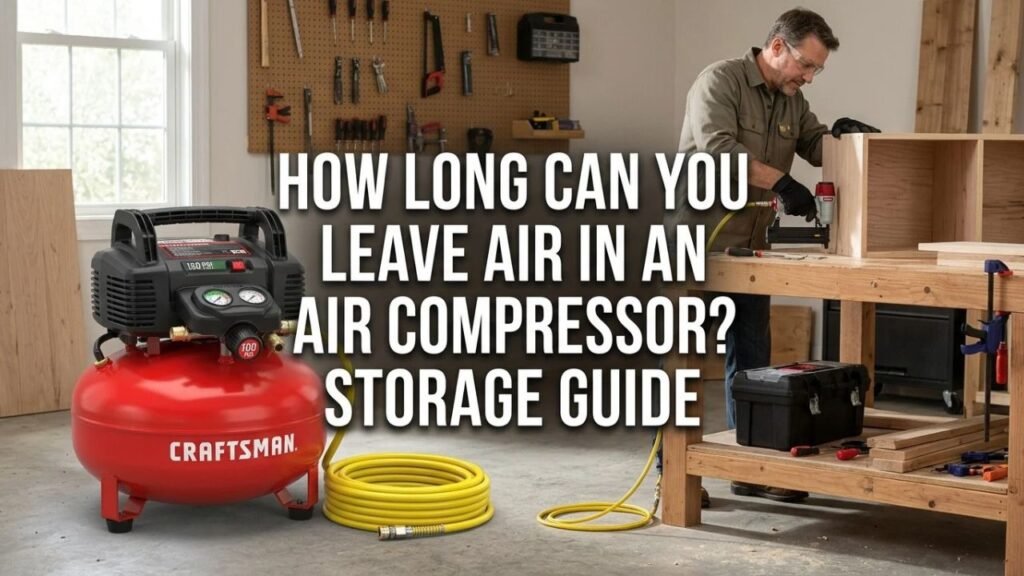
For a typical portable home or garage compressor, leaving air in the tank for several hours between tasks is usually not the main concern.
Long-term storage under full pressure is a different matter.
Leaving Air in the Tank for a Few Hours
If you finish one task and expect to use the compressor again later the same day, there is normally little reason to panic about the air remaining in a sound receiver.
Keep the compressor switched off so it cannot restart unexpectedly.
The tank may slowly lose some pressure through:
- Couplers
- Regulator
- Hose connections
- Drain valve
- Check valve
- Small fitting leaks
If pressure drops rapidly, inspect the system for leaks rather than assuming that pressure loss is normal.
Leaving Air Overnight
A single night is unlikely to ruin a healthy receiver.
Still, many manufacturers tell owners to drain the tank when work is finished.
Campbell Hausfeld recommends draining liquid from certain tanks daily and warns that moisture left inside can lead to corrosion and possible tank damage.
If the compressor is used every day, a routine of draining it at the end of the work period is easy to maintain.
Leaving Air for Several Days
Leaving a portable compressor fully pressurized for several days gives condensed water more time to sit against the steel tank.
The amount of water depends on:
- Humidity
- Compressor runtime
- Ambient temperature
- Tank temperature
- Tank size
- Air consumption
In a humid garage, considerably more water may collect than in a dry indoor shop.
Leaving Air for Weeks or Months
For long-term storage, drain the receiver rather than leaving it charged.
DEWALT’s shutdown procedure for one portable compressor calls for draining the tank until its gauge reads 0 PSI before storage.
California Air Tools also notes that leaving air pressure in a tank for prolonged periods can affect the check-valve spring on some of its compressors.
Key Takeaway: A few hours of stored air is usually less concerning than repeated long-term storage, but draining the receiver after use is the safest routine for many portable compressors.
Why You Should Not Leave an Air Compressor Pressurized for Long Periods
Compressed air itself is not what rusts a steel receiver.
Condensed moisture is the larger problem.
Compression Creates Condensation
Atmospheric air always contains some water vapor.
When the compressor draws air in and compresses it, the air temperature rises.
As that compressed air later cools inside the receiver, some water vapor condenses into liquid.
The water settles near the bottom of the tank.
Water Can Cause Internal Rust
The outside of a compressor tank is easy to inspect.
The inside is not.
Water sitting at the lowest part of a steel receiver can promote corrosion from the inside outward.
DEWALT warns that failing to drain condensed water can cause rust and thinning of the air tank.
Campbell Hausfeld gives similar guidance and recommends daily moisture drainage on applicable models.
Internal Corrosion Can Weaken the Receiver
A pressure vessel relies on its steel wall to contain compressed air.
If corrosion removes enough metal over time, the safety margin falls.
That is why a badly rusted, leaking, bulging, or damaged tank should not simply be patched and returned to service.
Follow the compressor manufacturer’s replacement procedure.
Pressure Can Remain Even When the Compressor Is Off
Turning the motor off does not empty the tank.
A receiver sitting at 125, 150, or 175 PSI still stores energy.
That matters if someone removes a fitting, hose, regulator, valve, or other pressure-side component.
Always verify tank pressure before performing service.
Key Takeaway: Moisture and stored energy are the main reasons not to treat a pressurized compressor tank as harmless during long storage.
Should You Drain an Air Compressor After Every Use?
For many portable compressors, yes.
The strongest answer comes from the manual for the exact machine.
DEWALT Guidance
DEWALT tells owners of certain portable compressors to drain the air tank daily or after each use.
Its manual connects this maintenance step directly to avoiding internal rust and tank-wall thinning.
Campbell Hausfeld Guidance
Campbell Hausfeld states on its DIY guidance that tanks should be drained after each use because moisture collects at the bottom of the receiver.
It also publishes manuals calling for daily draining on specific compressors.
California Air Tools Guidance
California Air Tools gives an average drain frequency of about every one to two days on one current model, noting that actual frequency depends on environment and operating hours.
This difference is why model-specific instructions matter.
Daily Use vs Occasional Use
If the compressor runs throughout the day, daily drainage makes sense.
If it is used only once every few weeks, draining it after each session prevents moisture from sitting in the receiver during storage.
Key Takeaway: “After each use” or “daily” is a common manufacturer recommendation, though the exact interval should come from the compressor manual.
How to Drain an Air Compressor Tank Safely
Draining removes condensed water and, depending on the procedure, stored pressure.
1. Turn the Compressor Off
Move the switch to OFF.
Unplug an electric portable compressor if the owner’s manual directs you to do so.
This prevents an automatic restart while you are draining or handling the machine.
2. Let the Compressor Cool if Needed
The pump, discharge tube, and nearby fittings can become extremely hot.
Give them time to cool before working around those parts.
3. Reduce Tank Pressure as Directed
Different drain valves have different procedures.
Some manufacturers want a small amount of pressure remaining so the air pushes water out.
Campbell Hausfeld, for example, instructs users of one design to drain condensation with roughly 10-40 PSI in the receiver.
Another Campbell Hausfeld design specifies 20-60 PSI for its drain system.
Do not assume one pressure applies to every compressor.
4. Open the Tank Drain
The drain is normally found at or near the lowest point of the receiver.
Position the tank as directed so water reaches the valve.
Open the drain slowly.
Expect a mixture of:
- Air
- Water
- Small amounts of oil residue on some compressors
Keep your face and eyes away from the discharge path.
5. Let the Moisture Escape
Continue draining until water stops coming out.
For end-of-day storage on compressors whose manuals call for full depressurization, continue until the tank gauge reaches 0 PSI.
DEWALT specifies 0 PSI during the shutdown and storage procedure for one of its portable models.
6. Close the Drain Before the Next Use
Do not forget to close the drain valve before starting the compressor again.
A wide-open drain prevents the receiver from building pressure.
Key Takeaway: Follow the model-specific drain procedure because some drain designs use low residual pressure to expel water, while storage procedures may call for reducing the tank to 0 PSI.
Is It Bad to Leave an Air Compressor Full Overnight?
One night is unlikely to destroy a healthy receiver.
Still, routinely storing a portable compressor full of air and condensation provides little advantage.
The more practical end-of-day routine is:
- Switch the compressor off.
- Disconnect the tool.
- Drain condensation.
- Release tank pressure if the manual calls for it.
- Store the unit dry.
If you use a large stationary shop compressor every day, its maintenance procedure may differ.
Some stationary systems remain pressurized as part of normal operation and use:
- Automatic drains
- Refrigerated dryers
- Moisture separators
- Scheduled receiver drainage
Do not apply portable pancake-compressor storage instructions blindly to an industrial compressed-air plant.
Can You Leave a Stationary Air Compressor Pressurized?
Many stationary compressed-air systems remain pressurized between operating periods.
That can be normal if the system was designed for it and its maintenance procedures are followed.
Stationary Systems Are Built Differently
A shop or industrial compressor may include:
- Large ASME receiver
- Automatic condensate drain
- Aftercooler
- Air dryer
- Main shutoff valve
- Pressure monitoring
- Scheduled inspections
Campbell Hausfeld’s stationary compressor manual calls for condensate to be drained from the tank daily.
Keeping the receiver pressurized does not eliminate that maintenance requirement.
Shut the Compressor Off When Unattended if Required
A compressor left in AUTO can restart when pressure falls to its cut-in setting.
Campbell Hausfeld notes that a compressor left in AUTO can start automatically when tank pressure drops.
If the machine is not intended for unattended operation, switch it off rather than relying on the pressure switch.
Automatic Drains Change the Routine
An automatic drain can remove condensate at scheduled intervals without manually opening the receiver every time.
OSHA permits suitable automatic traps in addition to receiver drains in covered workplace installations.
The drain still needs inspection and maintenance.
Key Takeaway: Stationary systems may remain pressurized by design, but moisture drainage, pressure-vessel maintenance, and unattended-operation instructions still apply.
Does Leaving Air in the Tank Damage the Compressor?
Stored air does not normally damage a sound receiver simply because it is compressed.
Problems come from the conditions surrounding that stored air.
Moisture Can Damage the Tank
This is the largest long-term concern for steel receivers.
Internal water encourages corrosion.
Leaks Can Make the Compressor Restart
If a compressor is left switched to AUTO, a small leak can lower receiver pressure until the pressure switch commands the motor to start.
That can lead to unexpected operation.
Turn the compressor off when you are finished unless its installation was specifically designed for unattended operation.
Check-Valve Components May Stay Loaded
California Air Tools notes that leaving pressure in its tanks for prolonged periods can compress the check-valve spring, which may contribute to check-valve trouble on its equipment.
This is manufacturer-specific rather than a rule for every compressor.
Hoses and Accessories May Stay Pressurized
A closed tank may still leave downstream equipment under pressure.
Before storage, disconnect tools and release line pressure according to the compressor instructions.
Key Takeaway: Long storage pressure can contribute to moisture-related tank corrosion, unexpected restart from leaks, and model-specific valve issues.
How Often Should You Drain Water From an Air Compressor?
The correct interval depends on use and humidity.
Humid Conditions
Hot, humid air contains more moisture.
A compressor operating in humid summer weather may produce noticeable water during every session.
Drain more often when water accumulation is heavy.
Long Compressor Run Time
A compressor that runs for hours moves much more atmospheric air through its receiver than one used for five minutes.
More air processed generally means more moisture entering the system.
Current Manufacturer Examples
Current or published manufacturer guidance includes:
- DEWALT: daily or after each use on specific models
- Campbell Hausfeld: daily on multiple models
- California Air Tools: average every 1-2 days on one current model
These intervals are examples, not one schedule for every compressor.
Key Takeaway: Drain frequency rises with humidity and operating time; many portable-compressor makers call for drainage daily or after each use.
Should You Store an Air Compressor With the Drain Valve Open?
Follow the manual for your machine.
Some users leave a manual drain slightly open during long storage so moisture cannot remain trapped.
Other manufacturers instruct owners to drain the receiver, then close the drain before storage.
Leaving the valve open has possible drawbacks:
- Dirt can enter the opening.
- Insects or debris can reach the port.
- The valve can be forgotten before startup.
- Certain valve designs are not intended to stay open.
If your manual does not call for an open drain during storage, drain the tank fully and return the valve to its stated storage position.
Can You Leave Air in an Aluminum Air Compressor Tank?
Aluminum does not rust in the same way as carbon steel, but that does not mean moisture can be ignored.
Water in an aluminum receiver can still:
- Contaminate downstream air
- Affect valves and fittings
- Increase water reaching tools
- Contribute to corrosion of other metal parts
California Air Tools sells aluminum-tank compressors yet still instructs owners to drain accumulated water at regular intervals.
Tank material changes the corrosion mechanism, not the need for condensate management.
Signs an Air Compressor Tank Should Not Remain in Service
Do not keep using a receiver that shows signs of structural trouble.
Watch for:
- Air leaking directly from the tank wall
- Severe exterior rust
- Deep pitting
- Bulging
- Cracks
- Damaged welds
- Heavy corrosion around the drain
- Tank deformation
DEWALT instructs owners to replace a leaking air tank immediately rather than attempt unauthorized repairs.
Never:
- Weld a leaking receiver
- Drill new holes into it
- Patch rust perforations
- Raise pressure-switch settings beyond the design pressure
A pressure vessel is not an ordinary sheet-metal container.
Is It Better to Leave Some Pressure in the Tank?
During draining, some manufacturers specifically call for a small amount of pressure to push condensate out.
That is different from storing the compressor pressurized.
For example, Campbell Hausfeld gives drain-pressure ranges on certain models so water exits the receiver properly.
Once drainage is complete, follow the machine’s shutdown procedure.
If it says the tank gauge should read 0 PSI before storage, reduce it to zero.
Safe Air Compressor Storage Checklist
Before storing a portable compressor for more than a brief break:
- Switch the compressor OFF.
- Disconnect it from power if instructed.
- Disconnect the air tool and hose as directed.
- Drain condensate from the receiver.
- Release stored tank pressure when the manual calls for 0 PSI.
- Check the drain for blockage.
- Inspect the tank for visible damage or corrosion.
- Store the compressor somewhere dry and protected from freezing temperatures.
- Keep the unit in its approved storage orientation.
DEWALT’s portable-compressor procedure includes draining the receiver to 0 PSI, allowing the machine to cool, cleaning it, and placing it in a safe, non-freezing storage location.
Conclusion
For how long can you leave air in an air compressor, there is no single countdown that applies to every tank. A healthy compressor can remain pressurized for a short time, but repeated long-term storage with condensed water inside the receiver is poor practice.
Many portable-compressor manufacturers recommend draining the receiver daily or after each use. The main reason is moisture: compressed air cools inside the tank, water collects at the bottom, and a steel receiver can corrode internally if that water remains there.
If you are finished for the day or putting the compressor away for days, weeks, or months, follow the shutdown procedure in its manual. For many portable units that means draining the condensate and releasing tank pressure before storage.
FAQs About Leaving Air in an Air Compressor
Can I leave my air compressor full overnight?
A healthy tank will normally tolerate being pressurized overnight, but many manufacturers still recommend draining portable compressors after use. Doing so removes condensed water that can contribute to internal corrosion over time.
Is it okay to leave air in a compressor for a week?
It is better to drain a portable compressor before leaving it unused for a week. The concern is less about seven days of pressure and more about moisture sitting inside the receiver and the system remaining under stored pressure while unattended.
Should I empty my air compressor after every use?
Many manufacturers say yes. DEWALT specifies draining some compressor tanks daily or after every use, while Campbell Hausfeld also recommends daily or after-use drainage for various models.
Does leaving air in an air compressor cause rust?
Air pressure alone does not cause tank rust. Water that condenses from compressed air can collect at the bottom of a steel receiver and promote corrosion. Regular drainage removes that water.
Can an air compressor explode if you leave air in it?
A sound, correctly rated receiver is designed to hold compressed air within its operating limits. Risk rises if the tank becomes severely corroded, damaged, modified, or overpressurized. OSHA requires workplace receivers to have pressure gauges, safety valves, and drainage provisions.
Should an air compressor tank be stored at 0 PSI?
Many portable-compressor manuals call for a fully drained tank before storage. DEWALT’s shutdown procedure for one model specifically instructs users to drain the receiver until the tank gauge reads 0 PSI. Check the manual for your model.
Why does water come out when I drain my air compressor?
Atmospheric air contains water vapor. Compression heats the air, and as that air later cools inside the tank, part of the vapor condenses into liquid water. The drain valve removes the collected condensate before it can remain in the receiver.