
How to Dispose of Cordless Drill Batteries Safely in the USA
Cordless drills are convenient because their rechargeable battery packs can power the tool almost anywhere. Eventually, however, every battery reaches the end of its useful life. It may stop holding a charge, run for only a few minutes, become physically damaged, or simply become obsolete when you replace the drill.
Knowing how to dispose of cordless drill batteries correctly matters because most modern drill batteries should not be tossed into a household trash can or curbside recycling bin.
Rechargeable batteries can retain electrical energy even when they appear completely dead. Some battery chemistries also contain materials that should be recovered through specialized recycling rather than sent through normal municipal waste systems.
Lithium-ion batteries deserve particular attention. They can create a fire hazard if their terminals contact metal or if the battery is crushed or damaged during trash collection and processing.
The U.S. Environmental Protection Agency recommends taking lithium-ion batteries to a dedicated recycling or household hazardous waste collection point rather than putting them in household garbage or municipal recycling.
Fortunately, recycling a cordless drill battery is usually straightforward. Many battery recycling programs, participating retailers, local household hazardous waste facilities, and community collection events accept rechargeable power-tool batteries.
Before dropping one off, you should identify the battery type, protect its terminals, check for physical damage, and confirm that your chosen collection location accepts that battery.
This guide explains how to handle common cordless drill batteries safely, where they can usually be recycled in the United States, what to do with damaged or swollen batteries, and which disposal mistakes you should avoid.
Read More: how to charge a cordless drill without a charger
How to Dispose of Cordless Drill Batteries Properly
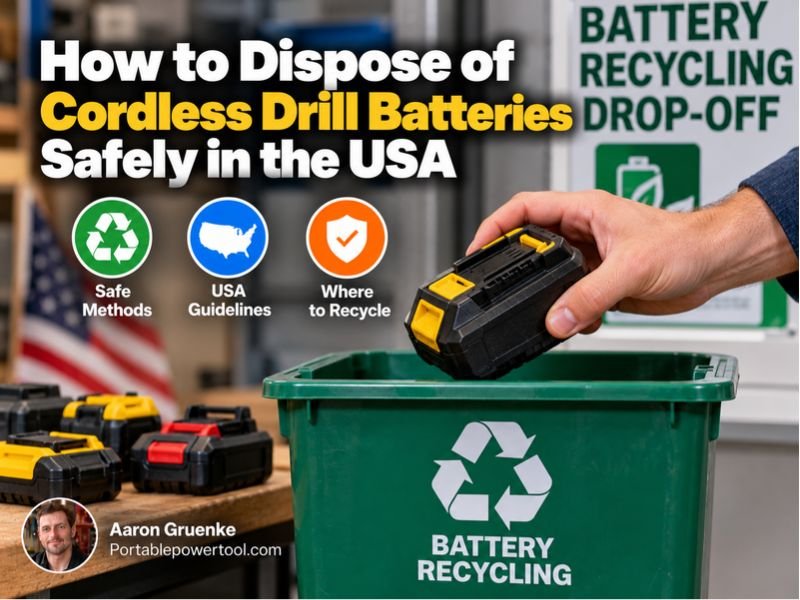
The safest general way to dispose of cordless drill batteries is to remove the battery from the drill, protect its exposed terminals with nonconductive tape or an individual plastic bag, and take it to an approved rechargeable-battery recycling or household hazardous waste collection location.
A basic process is:
- Remove the battery from the cordless drill.
- Check the battery for swelling, cracks, leaking, corrosion, or other damage.
- Identify the battery chemistry from its label if possible.
- Cover exposed terminals with nonconductive tape, such as electrical tape.
- Keep individual batteries separated during storage and transportation.
- Find a participating battery recycler, retailer, or local hazardous waste program.
- Confirm that the location accepts your battery type.
- Transport the battery carefully and follow the collection site’s instructions.
Do not place rechargeable cordless drill batteries loose in a standard recycling bin.
Curbside recycling programs are generally designed for materials such as cardboard, metal cans, glass, and certain plastics—not loose rechargeable batteries.
Why Cordless Drill Batteries Need Special Disposal
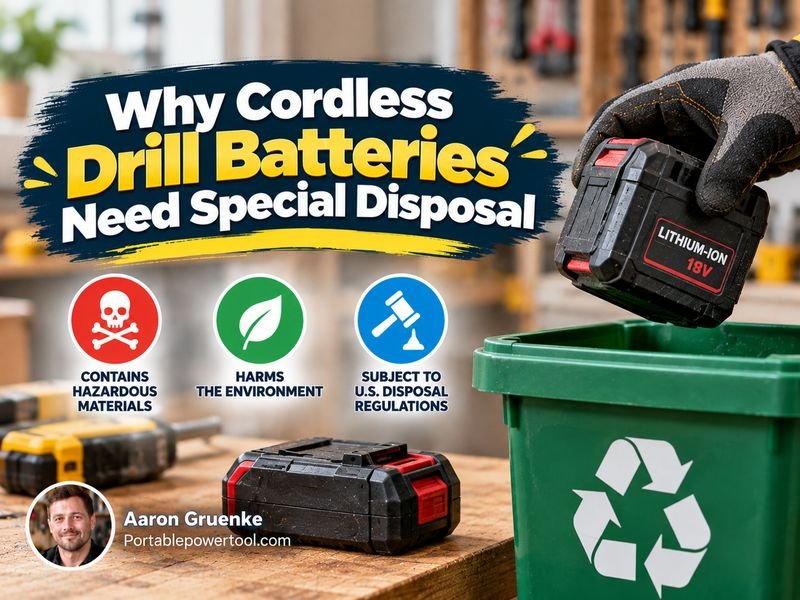
Rechargeable power-tool batteries are different from ordinary household waste.
Even an old battery that will no longer operate a drill can still contain stored electrical energy. If exposed terminals contact keys, screws, metal containers, or another battery, they can create a short circuit.
Lithium-ion batteries can become especially hazardous if they are:
- Crushed
- Punctured
- Bent
- Overheated
- Short-circuited
- Physically damaged
A battery entering a garbage truck or recycling sorting facility may be compressed by machinery. Damaged lithium-ion cells can generate intense heat and potentially start a fire.
Battery recycling also allows useful materials to be recovered rather than discarded.
Rechargeable batteries may contain materials such as lithium, nickel, cobalt, cadmium, lead, graphite, copper, and steel, depending on their chemistry and construction.
The EPA recommends keeping rechargeable batteries such as lithium-ion, nickel-cadmium, and nickel-metal-hydride batteries out of household trash and municipal recycling bins.
Identify Your Cordless Drill Battery Type
Before recycling a drill battery, check its label.
Most cordless power-tool batteries fall into one of three main categories.
Lithium-Ion Batteries
Lithium-ion, often abbreviated as Li-ion, is the dominant battery chemistry in modern cordless drills and other power tools.
You may see markings such as:
- Li-ion
- Lithium-ion
- 18V Li-ion
- 20V MAX Li-ion
- 40V Li-ion
Lithium-ion batteries offer high energy density, relatively low weight, and good power output.
They should not be placed in ordinary trash or curbside recycling.
Take them to an appropriate battery recycling or household hazardous waste collection location.
Nickel-Cadmium Batteries
Older cordless drills commonly used nickel-cadmium batteries, usually identified as:
- Ni-Cd
- NiCd
- Nickel-cadmium
Ni-Cd batteries tend to be larger and heavier than modern lithium-ion packs.
Cadmium is a toxic heavy metal, so nickel-cadmium batteries should be handled through an appropriate rechargeable battery recycling program rather than discarded with household waste.
Nickel-Metal Hydride Batteries
Some cordless tools use nickel-metal hydride, abbreviated:
- Ni-MH
- NiMH
These batteries became an alternative to nickel-cadmium before lithium-ion became common in power tools.
Ni-MH drill batteries are also rechargeable batteries and should be taken to an appropriate recycling location.
Cordless Drill Battery Disposal at a Glance
| Battery Type | Typical Marking | Common in Cordless Tools? | Recommended End-of-Life Method |
| Lithium-ion | Li-ion | Very common today | Dedicated battery recycling or household hazardous waste program |
| Nickel-cadmium | Ni-Cd | Common in older tools | Rechargeable battery recycling |
| Nickel-metal hydride | Ni-MH | Found in some older tools | Rechargeable battery recycling |
| Small sealed lead acid | Pb or SLA | Uncommon in typical drills | Battery retailer or hazardous waste program |
If you cannot determine the battery chemistry, do not guess and throw it away.
Take the battery to a qualified battery collection facility or contact your local waste authority for instructions.
Where Can You Recycle Cordless Drill Batteries?
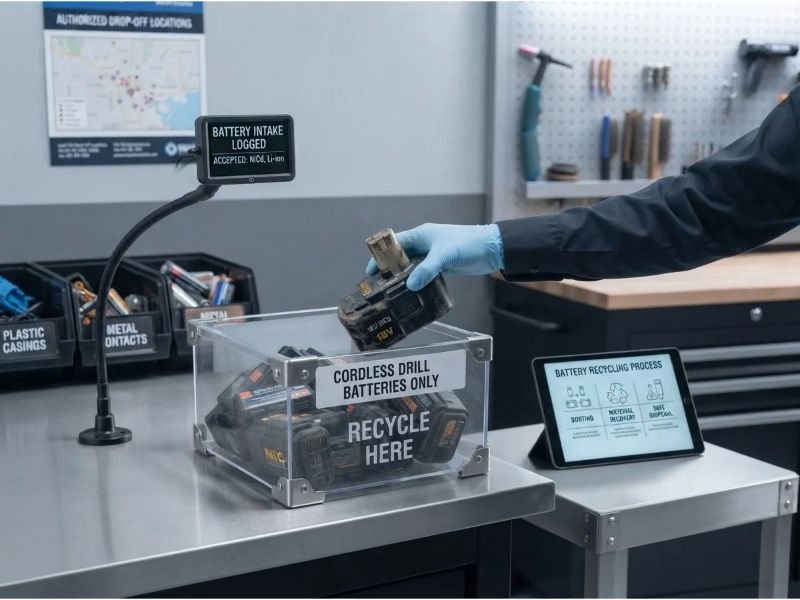
Several options are available to U.S. consumers.
Availability varies by location, so always verify acceptance before making a special trip.
Battery Recycling Drop-Off Locations
Dedicated battery recycling programs collect rechargeable batteries and send them into specialized recycling systems.
Programs may accept:
- Lithium-ion batteries
- Nickel-cadmium batteries
- Nickel-metal-hydride batteries
- Nickel-zinc batteries
- Some small sealed lead-acid batteries
Some programs place collection boxes inside participating stores and public facilities.
Home Improvement Stores
Some major home improvement retailers participate in rechargeable battery collection programs.
For example, Home Depot states that it participates in the Call2Recycle program and accepts qualifying rechargeable batteries through participating collection locations. Acceptance limits and conditions apply, so checking current store requirements before visiting is sensible.
Other hardware, electronics, or home improvement stores may offer similar programs depending on location.
Do not assume every store automatically accepts every battery.
Household Hazardous Waste Facilities
Many cities, counties, and waste districts operate household hazardous waste, or HHW, collection programs.
These facilities may accept rechargeable tool batteries along with other materials that should not enter the normal waste stream.
Depending on your community, collection may be available through:
- Permanent drop-off facilities
- Scheduled collection days
- Community recycling events
- Appointment-based programs
Your city, county, or municipal waste department can tell you which options are available locally.
Community Recycling Events
Local governments, universities, businesses, and environmental organizations sometimes organize battery or electronics recycling events.
These can be useful when your area does not have a permanent battery collection center nearby.
Check exactly which battery types the event accepts before attending.
Manufacturer Programs
Some power-tool manufacturers provide battery recycling information or participate in industry recycling programs.
Check the manufacturer’s instructions if you are uncertain what to do with an unusual, damaged, or specialized battery pack.
Should You Put Drill Batteries in Household Trash?
Generally, rechargeable cordless drill batteries should not go into household garbage.
This is particularly important for lithium-ion batteries.
Trash collection involves handling, transportation, compacting, and processing. A lithium-ion battery can become damaged during these operations.
Instead, keep the battery separate and take it to an appropriate recycling or household hazardous waste collection location.
State and local battery-disposal requirements may also be stricter than general federal guidance, so local rules should always be checked when you are unsure.
Can Cordless Drill Batteries Go in the Recycling Bin?
No. Do not put loose rechargeable drill batteries into a normal curbside recycling bin unless your local recycling authority specifically operates a battery program designed for them.
A standard recycling bin is not the same as a dedicated battery recycling collection point.
Lithium-ion batteries mixed with cardboard, plastic, aluminum cans, or other recyclables can become damaged by recycling equipment.
Instead, take the battery directly to a battery collection location.
How to Prepare a Drill Battery for Recycling
Proper preparation reduces the chance of accidental short circuits during storage and transportation.
Remove the Battery From the Drill
If the battery is removable, detach it from the power tool.
Do not attempt to dismantle the battery pack itself.
Cordless tool battery packs may contain multiple individual cells, wiring, protective circuits, temperature sensors, and other components.
Opening the pack can expose electrical connections and damaged cells.
Cover the Battery Terminals
One of the most important steps is protecting the electrical contacts.
Cover exposed terminals using nonconductive tape, such as electrical tape.
Make sure metal contacts cannot touch another battery or loose metal object.
The EPA also recommends individually bagging batteries as another method of keeping terminals isolated.
Keep Batteries Separate
Do not throw several uncovered batteries together into a metal bucket, toolbox, or drawer.
A terminal from one battery may contact another battery or metal object.
Store batteries so their contacts remain protected and separated.
Use a Suitable Container
For transportation, place normal, undamaged batteries in a stable container that prevents them from moving around excessively.
Avoid placing heavy objects on top of battery packs.
Follow any additional packaging requirements from the recycling location.
What Should You Do With a Damaged Lithium-Ion Drill Battery?
A damaged lithium-ion battery requires more caution than an ordinary worn-out battery.
Signs of damage can include:
- Swelling
- Bulging
- Cracks
- Severe dents
- Melted plastic
- Burn marks
- Unusual heat
- Strong chemical odor
- Visible leakage
- Evidence that the battery was crushed or punctured
Do not recharge a visibly damaged battery simply to see whether it still works.
Do not intentionally puncture, flatten, crush, disassemble, or burn it.
Do Not Place a Damaged Battery in an Ordinary Retail Collection Bin
Some normal retail battery collection programs have special restrictions for damaged, defective, or recalled lithium-ion batteries.
Contact the recycler, manufacturer, local household hazardous waste facility, or local fire/waste authority for appropriate instructions before transporting the battery.
If a lithium-ion battery is actively smoking, rapidly heating, hissing, or burning, treat the situation as an immediate fire emergency rather than a routine recycling task.
Move away from the hazard and contact emergency services when appropriate.
What About a Swollen Drill Battery?
Swelling is a sign that a lithium-ion battery has experienced internal deterioration or damage.
Stop using and charging a swollen battery.
Do not:
- Squeeze it
- Puncture it
- Try to flatten it
- Open the battery case
- Leave it connected to a charger
- Put it into household trash
Keep it away from combustible materials and contact an appropriate battery recycling or hazardous waste facility for instructions.
Tell the facility that the battery is swollen before arriving because damaged batteries may require special handling.
Can You Fully Discharge a Drill Battery Before Recycling It?
You do not normally need to deliberately run a battery completely flat before taking it to a consumer battery recycling program unless the collection service specifically tells you to do so.
Trying to force a damaged battery through additional charge and discharge cycles can create unnecessary risk.
Instead, leave the battery in its current state, protect its terminals, and follow the recycler’s handling instructions.
Can You Throw Away a Completely Dead Drill Battery?
A battery that can no longer run your drill is not necessarily electrically empty.
The battery management system may stop delivering usable power while individual cells still contain energy.
That is one reason a “dead” rechargeable battery should still be handled as a battery.
Recycle it rather than assuming it is safe for ordinary garbage.
Can You Take a Cordless Drill Battery Apart Before Recycling?
You generally should not disassemble a cordless drill battery pack for disposal.
Battery packs are designed as assembled electrical systems.
Taking one apart may:
- Expose energized terminals
- Short-circuit cells
- Damage lithium-ion cells
- Release chemicals from damaged cells
- Increase fire risk
- Make the battery harder for a normal consumer collection site to accept
Leave the battery pack intact unless you are a qualified person working under an appropriate battery-repair or recycling procedure.
What If the Battery Is Stuck in the Drill?
Do not forcefully pry apart a swollen battery and drill.
If an undamaged battery simply has a stuck release mechanism, consult the manufacturer’s instructions.
If the battery appears swollen, melted, or damaged and cannot be removed safely, contact the manufacturer, an authorized service center, or an appropriate hazardous waste program.
A collection service may prefer to receive the complete tool rather than have you attempt to remove a hazardous battery.
Can You Recycle the Entire Cordless Drill?
Yes, but the drill and battery may need to enter different recycling streams.
The drill itself contains materials such as:
- Electric motors
- Copper wiring
- Circuit boards
- Steel
- Aluminum
- Plastic
Some electronics or power-tool recycling programs accept complete tools.
If possible, remove an undamaged rechargeable battery and recycle it through an appropriate battery program.
If the battery is built into the tool or cannot be safely removed, tell the recycler that the device contains a rechargeable battery.
How to Store Old Drill Batteries Before Recycling
You may need to keep a battery for several days before reaching a recycling center.
Store an undamaged battery:
- In a cool, dry place
- Away from direct sunlight
- Away from heaters and open flames
- Away from children and pets
- With terminals protected
- Away from loose metal objects
- Where the battery will not be crushed or dropped
Do not leave old lithium-ion batteries indefinitely in a hot vehicle, near a furnace, or in another high-temperature environment.
Arrange recycling reasonably soon instead of building up a large collection of old batteries.
Why Recycling Cordless Drill Batteries Is Better Than Throwing Them Away
Battery recycling has two major benefits: reducing waste-management hazards and recovering useful materials.
Rechargeable battery packs contain metals and other materials that can potentially return to manufacturing supply chains after specialized processing.
Proper collection also keeps batteries away from ordinary trash and curbside recycling equipment where lithium-ion packs can create fire hazards.
You do not need to dismantle or process the battery yourself. Your role as a homeowner or DIYer is simply to store it safely and deliver it to the correct collection system.
Common Cordless Drill Battery Disposal Mistakes
Most battery disposal mistakes are easy to avoid.
Putting Batteries in Curbside Recycling
The recycling symbol on a battery does not mean you should put it into the same recycling cart as cans and cardboard.
Rechargeable batteries generally require a dedicated battery collection system.
Throwing Lithium-Ion Batteries in the Trash
A lithium-ion battery can retain energy even when it appears dead.
Sending it through a garbage collection and compaction system creates unnecessary risk.
Leaving the Terminals Exposed
Loose batteries can short-circuit if the electrical contacts touch metal.
Cover the terminals or isolate each battery according to the recycler’s instructions.
Keeping Damaged Batteries With Normal Batteries
A swollen, punctured, leaking, or overheated battery needs special handling.
Contact an appropriate recycler before transporting it.
Disassembling Battery Packs
Opening a battery pack can expose live connections and individual cells.
Recycle the complete pack whenever possible.
Assuming Every Collection Site Accepts Every Battery
Programs may have limits involving:
- Battery chemistry
- Physical condition
- Battery weight
- Watt-hours
- Battery size
Verify the requirements before visiting.
How to Make Cordless Drill Batteries Last Longer
Eventually every rechargeable battery wears out, but good habits can reduce unnecessary battery replacement.
Use chargers designed or approved for your battery system.
Protect battery packs from severe impacts and extreme temperatures.
Do not continue using a battery that is visibly damaged.
For lithium-ion batteries, avoid unnecessarily storing the pack in extremely hot environments such as a vehicle sitting in direct summer sunlight.
Keep battery contacts clean and dry.
If you own several batteries, rotating them can also prevent one pack from receiving all the use.
FAQs About how to dispose of cordless drill batteries
Where can I dispose of an old cordless drill battery?
Take it to a dedicated rechargeable battery collection location, participating retailer, electronics recycler, or local household hazardous waste facility.
Call or check the program’s requirements before visiting, especially if the battery is damaged.
Can I throw an 18V drill battery in the garbage?
If the 18V battery is rechargeable, particularly lithium-ion, it should not be placed in household garbage.
Recycle it through an appropriate battery collection program.
Can I recycle a 20V lithium drill battery?
Yes. Rechargeable 20V lithium-ion power-tool batteries can generally be recycled through programs that accept portable lithium-ion batteries.
Acceptance limits vary, so verify that the collection location accepts your particular battery.
Does a dead lithium drill battery still pose a fire risk?
Potentially, yes.
A battery that no longer operates a drill can still contain electrical energy. Damage or a short circuit can create heat even when the battery seems dead.
Should I put tape over drill battery terminals before recycling?
Yes, protecting exposed terminals is a good safety measure.
Use nonconductive tape such as electrical tape, or follow the recycler’s specific packaging instructions.
What should I do if my drill battery is swollen?
Stop using and charging it.
Do not puncture, crush, or place the swollen battery in ordinary trash. Contact a battery recycler, manufacturer, or household hazardous waste facility and explain that the battery is damaged.
Are old Ni-Cd drill batteries recyclable?
Yes.
Nickel-cadmium cordless-tool batteries should be sent through an appropriate rechargeable battery recycling program rather than household trash.
Can I leave the battery attached to the drill when recycling it?
It depends on the collection program.
When the battery is safely removable, battery recyclers commonly accept the battery separately. If the battery is built in, stuck, or unsafe to remove, look for an electronics or tool recycling program that accepts the complete device.
Conclusion
Understanding how to dispose of cordless drill batteries mainly comes down to keeping rechargeable batteries out of ordinary trash and curbside recycling, protecting the terminals, and taking the battery to an appropriate collection program.
Modern cordless drills typically use lithium-ion batteries, while older tools may contain nickel-cadmium or nickel-metal-hydride packs. All should be handled through suitable rechargeable battery recycling channels rather than casually discarded.
Before recycling, identify the battery if possible, keep its terminals isolated, and inspect it for physical damage. If the battery is swollen, leaking, punctured, overheated, or otherwise damaged, contact a qualified collection facility before transporting it.
With a few simple precautions, an old cordless drill battery can be removed from service safely while allowing valuable battery materials to enter a proper recycling system instead of the household waste stream.