What Is Air Compressor? Types, Parts, Sizes, CFM, PSI & More
An air compressor is one of the most versatile pieces of equipment you can have in a home garage, workshop, construction site, auto shop, or industrial facility. It can inflate tires, power nail guns, operate impact wrenches, run spray equipment, clean machinery, and supply compressed air to large manufacturing systems.
If you are trying to understand what is air compressor, the basic idea is simple: an air compressor takes air from the surrounding environment, compresses it into a smaller space, and delivers that air at higher pressure. Depending on the compressor, the pressurized air may be stored in a tank or supplied continuously to equipment.
However, choosing an air compressor becomes confusing once terms such as CFM, SCFM, PSI, horsepower, gallon size, duty cycle, oil-free, oil-lubricated, single-stage, two-stage, reciprocating, rotary screw, and scroll compressor start appearing.
A larger tank does not automatically mean a more powerful compressor. Higher PSI does not automatically mean more airflow. Horsepower alone does not tell you what tools a compressor can run. To understand compressor performance, you need to look at several specifications together.
This pillar guide provides an A-to-Z overview of air compressors without going unnecessarily deep into engineering. You will learn the major compressor types, important parts, tank sizes, CFM and PSI ratings, common uses, maintenance requirements, safety considerations, and how to choose the right size for your needs.
What Is Air Compressor and How Does It Work?
An air compressor is a machine that converts mechanical or electrical energy into potential energy stored in compressed air.
The compressor pulls atmospheric air into a compression mechanism, reduces the volume of that air, and increases its pressure.
The basic process is:
- Air enters through an intake.
- The compressor compresses the air.
- Compressed air moves into a storage tank or distribution system.
- Pressure builds until the compressor reaches its cutoff setting.
- When air is used and tank pressure drops, the compressor starts again.
This simple process can be performed in several different ways depending on the compressor design.
Why Does Compressing Air Increase Pressure?
Air is made of molecules that move around freely.
When you force the same amount of air into a smaller space, those molecules collide more frequently with the walls of the container.
That creates greater air pressure.
An air compressor uses this principle to create pressurized air that can perform useful work.
What Is Compressed Air?
Compressed air is atmospheric air stored or delivered at a pressure higher than the surrounding atmosphere.
Compressed air acts as an energy source.
It can:
- Move pneumatic cylinders
- Rotate air tools
- Spray paint
- Inflate tires
- Blow away debris
- Operate production machinery
Because compressed air is easy to distribute through hoses and piping, it is widely used in both small workshops and large industrial facilities.
What Are Air Compressors Used For?
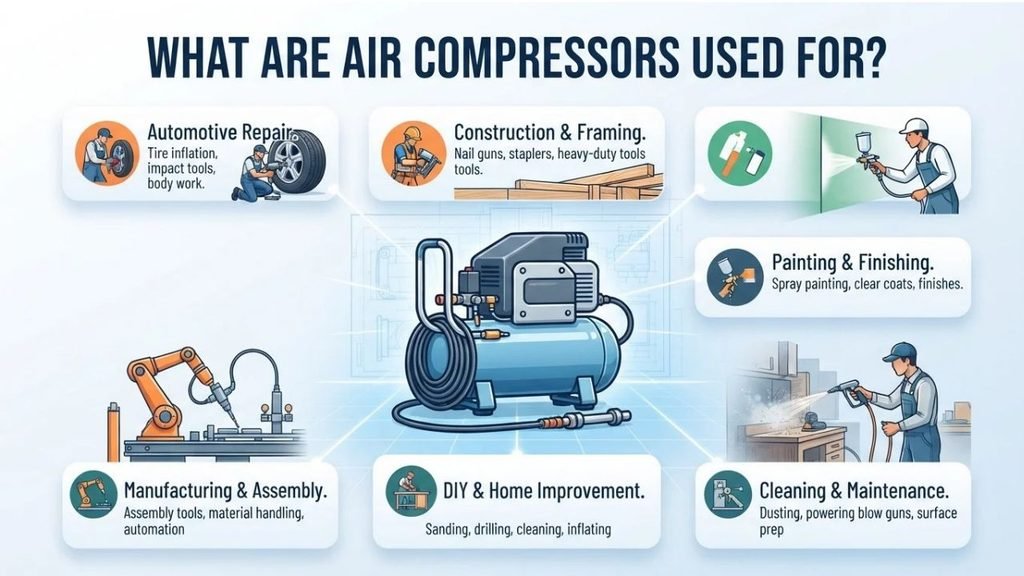
Air compressors have an enormous number of applications.
Common home and shop uses include:
- Inflating car tires
- Inflating bicycle tires
- Running nail guns
- Using impact wrenches
- Operating air ratchets
- Running die grinders
- Spray painting
- Blowing dust from equipment
- Stapling
- Sandblasting
- Cleaning parts
Industrial compressors may power:
- Automated manufacturing equipment
- Pneumatic actuators
- Food processing systems
- Packaging machinery
- CNC equipment
- Medical and dental systems
- Instrumentation
- Large production lines
The compressor required for each task can be very different.
Type of Air Compressor
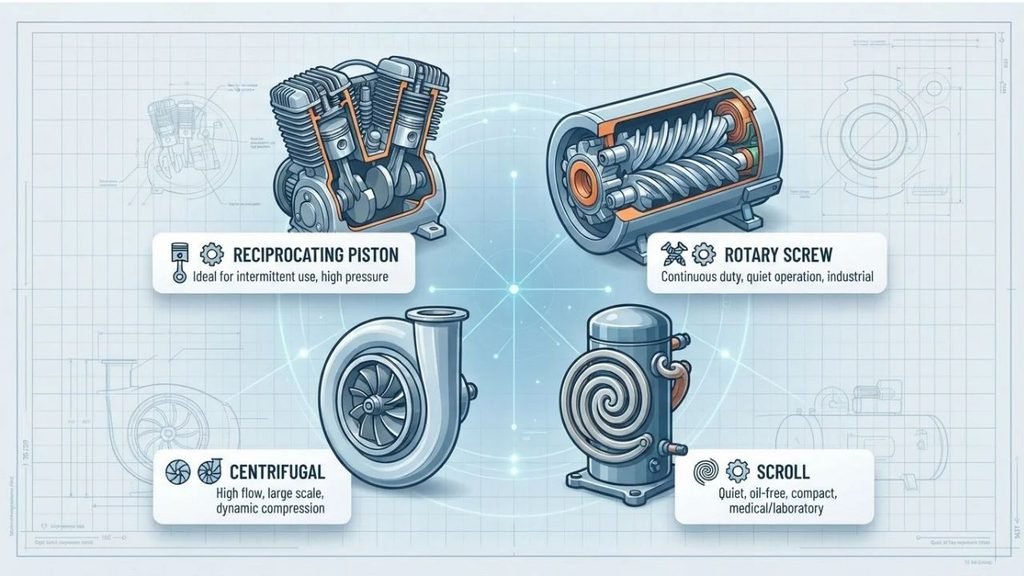
There are several major type of air compressor designs.
The most important categories include:
- Reciprocating piston compressors
- Rotary screw compressors
- Scroll compressors
- Centrifugal compressors
- Diaphragm compressors
Each compresses air differently.
Reciprocating Piston Air Compressor
A reciprocating compressor uses one or more pistons moving inside cylinders.
It works similarly to a piston inside an engine.
As the piston moves down, air enters the cylinder.
As the piston moves up, the air is compressed and pushed into the receiver tank.
These compressors are extremely common in:
- Home garages
- Small workshops
- Construction
- Automotive repair
- Portable applications
They are available in both oil-free and oil-lubricated designs.
Advantages of Piston Compressors
They are generally:
- Affordable
- Widely available
- Easy to understand
- Suitable for intermittent tools
- Available in many tank sizes
Limitations
They can be:
- Noisy
- Hot during operation
- Less efficient for continuous industrial use
- Limited by duty cycle on smaller models
Single-Stage Air Compressor
A single-stage compressor compresses air once before sending it into the tank.
One or more pistons may be present, but the air is compressed to its final pressure in a single compression stage.
Single-stage compressors are common for:
- Home garages
- Nail guns
- Tire inflation
- Light automotive work
- General DIY use
They are typically sufficient for moderate pressure requirements.
Two-Stage Air Compressor
A two-stage compressor compresses air in two steps.
First, a larger low-pressure cylinder compresses the air partially.
The air then passes to a smaller high-pressure cylinder for additional compression.
Two-stage compressors are common in:
- Automotive shops
- Commercial workshops
- Manufacturing
- Heavy pneumatic-tool applications
They often provide higher pressure and better performance for demanding workloads.
Rotary Screw Air Compressor
A rotary screw compressor uses two intermeshing helical rotors.
As the rotors turn, air becomes trapped between them and is progressively compressed.
Rotary screw compressors are common in facilities that need compressed air for long periods.
Typical applications include:
- Manufacturing
- Automotive service facilities
- Industrial production
- Large workshops
They are well suited for high-duty-cycle operation.
Oil-Injected Rotary Screw Compressor
Many rotary screw compressors inject oil into the compression chamber.
The oil helps:
- Lubricate
- Seal
- Cool
The compressed air then passes through an oil separation system.
Oil-Free Rotary Screw Compressor
Oil-free screw compressors keep lubricating oil out of the compression chamber.
They are used when air purity is especially important.
Scroll Air Compressor
A scroll compressor uses two spiral-shaped scrolls.
One remains stationary while the other moves in an orbital pattern.
Air becomes trapped between the scrolls and moves inward through progressively smaller pockets.
Scroll compressors are known for:
- Low noise
- Smooth operation
- Low vibration
- Clean compressed air in oil-free designs
They are frequently used in:
- Dental offices
- Laboratories
- Medical facilities
- Electronics
- Light industry
Centrifugal Air Compressor
A centrifugal compressor uses high-speed rotating impellers.
Instead of trapping and squeezing a fixed amount of air, it accelerates air and converts that velocity into pressure.
Centrifugal compressors are generally designed for:
- Large industrial facilities
- Very high airflow
- Continuous-duty systems
They are uncommon in ordinary home garages.
Diaphragm Air Compressor
A diaphragm compressor uses a flexible membrane to compress air or gas.
Because the compressed gas can remain isolated from lubricated mechanical components, diaphragm compressors are useful in applications requiring high gas purity.
They are generally used for specialized industrial, laboratory, or medical applications rather than general pneumatic tools.
Oil-Free vs. Oil-Lubricated Air Compressor
One of the most common air compressor comparisons is oil-free versus oil-lubricated.
Oil-Free Air Compressor
An oil-free compressor does not inject lubricating oil into the compression chamber.
Small oil-free piston compressors often use:
- Composite piston rings
- PTFE-based materials
- Coated cylinders
- Permanently lubricated bearings
They are popular because they require less routine pump maintenance.
Oil-Lubricated Air Compressor
An oil-lubricated compressor contains oil in the pump or compression mechanism.
Oil can help:
- Reduce friction
- Reduce wear
- Remove heat
- Improve sealing
These compressors are common in larger workshop and industrial applications.
Which Is Better?
Oil-free is convenient for:
- Homeowners
- Portable jobs
- Nail guns
- Occasional use
- Applications where oil contamination should be minimized
Oil-lubricated may be preferable for:
- Heavy shop use
- Long operating periods
- Larger piston compressors
- Commercial applications
Neither type is universally better.
Air Compressor Parts
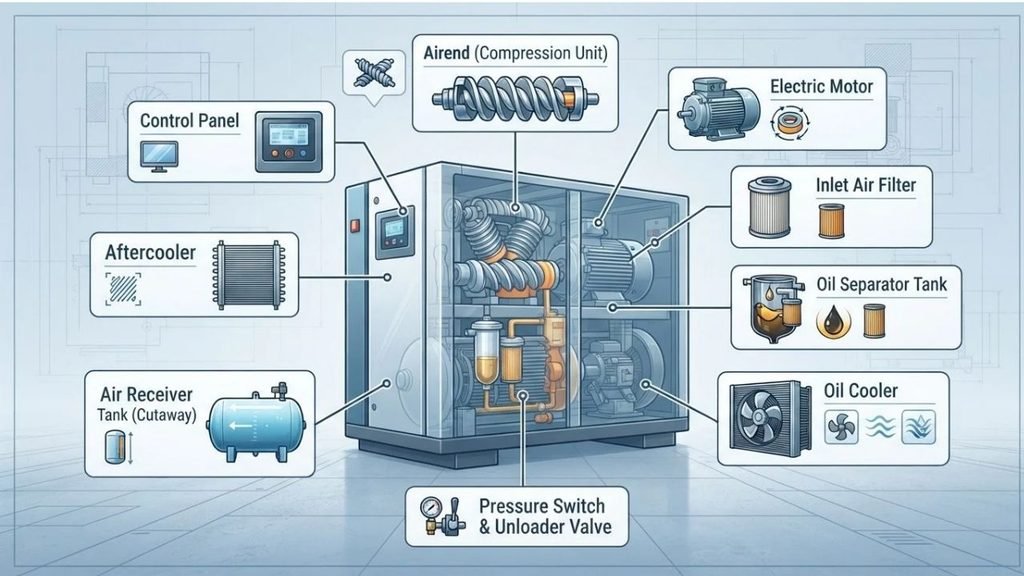
Understanding the basic air compressor parts makes it easier to operate and maintain the machine.
Not every compressor has all of the following parts, but these are among the most common.
Compressor Pump
The compressor pump is the component that actually compresses the air.
Depending on the compressor design, the pump may contain:
- Pistons
- Cylinders
- Rotors
- Scrolls
- Valves
The pump is essentially the heart of the compressor.
Electric Motor
Most home and shop compressors use an electric motor.
The motor provides the mechanical power needed to operate the compressor pump.
Compressors may use:
- 120V motors
- 240V motors
- Single-phase motors
- Three-phase industrial motors
Portable compressors are often designed for standard 120V household circuits.
Air Receiver Tank
The receiver tank stores compressed air.
Tank capacity is commonly measured in gallons in the United States.
The tank allows compressed air to be stored so the compressor does not need to run every moment air is being used.
Pressure Switch
The pressure switch automatically turns the compressor motor on and off.
A typical cycle looks like this:
- Tank pressure drops to the cut-in pressure.
- Compressor starts.
- Tank pressure increases.
- Compressor reaches the cut-out pressure.
- Compressor stops.
This process repeats as compressed air is used.
Pressure Gauge
Many compressors have two gauges.
Tank Pressure Gauge
Shows the pressure inside the receiver tank.
Regulated Outlet Pressure Gauge
Shows the pressure being delivered to your tool.
These values may be different.
Pressure Regulator
The regulator controls the pressure supplied to the tool.
For example, the tank might contain 150 PSI while the regulator is set to supply 90 PSI to an air tool.
Never confuse tank pressure with tool operating pressure.
Safety Relief Valve
The safety valve protects the tank against excessive pressure.
If internal pressure rises beyond a safe limit, the valve is designed to release air.
Do not:
- Remove it
- Plug it
- Modify it
- Bypass it
It is a critical safety component.
Check Valve
A check valve allows compressed air to enter the tank while helping prevent tank air from flowing backward into the compressor pump.
A faulty check valve can contribute to:
- Difficult restarting
- Air leakage
- Pressure problems
Unloader Valve
An unloader valve releases trapped pressure from the compressor pump discharge area when the motor stops.
This reduces the load on the motor during the next startup.
A failed unloader can make the compressor difficult to restart.
Intake Filter
The intake filter prevents dust and debris from entering the compressor.
A clogged filter can:
- Reduce airflow
- Make the compressor work harder
- Increase fill time
Filters should be cleaned or replaced according to the manufacturer’s instructions.
Drain Valve
The tank drain valve is located near the lowest part of the receiver.
It allows condensate to be removed from the tank.
Drain types include:
- Manual petcock
- Ball valve
- Automatic drain
- Timed drain
Regular draining helps control moisture and internal tank corrosion.
Air Compressor Size
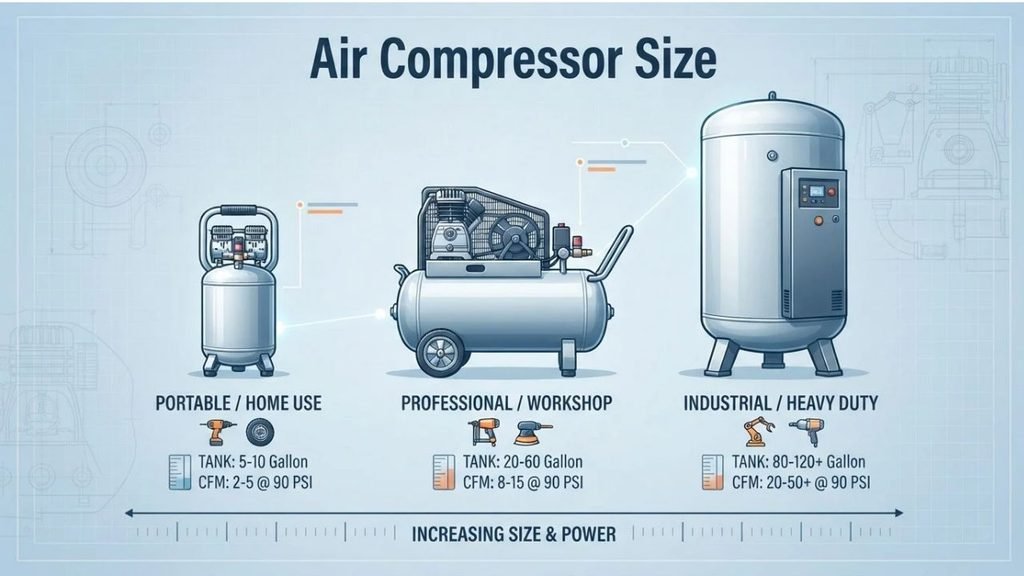
The phrase air compressor size can mean several different things.
People may be referring to:
- Tank gallon size
- CFM output
- PSI
- Horsepower
- Physical dimensions
- Electrical requirements
The most important size for tool performance is often CFM, not tank capacity alone.
Air Compressor Gallon Size
Air compressor gallon size refers to the volume of the receiver tank.
Common sizes include:
- 1 gallon
- 2 gallon
- 3 gallon
- 6 gallon
- 10 gallon
- 20 gallon
- 30 gallon
- 60 gallon
- 80 gallon
Larger tanks store more compressed air.
However, a larger tank does not necessarily mean the compressor pump produces more airflow.
1- to 3-Gallon Air Compressors
These are very compact and portable.
They work well for:
- Tire inflation
- Pin nailers
- Brad nailers
- Small staplers
- Light blowing
They are generally not ideal for continuous high-CFM tools.
6-Gallon Air Compressors
Six-gallon pancake compressors are extremely popular.
They are useful for:
- Framing nailers
- Finish nailers
- Brad nailers
- Roofing nailers
- Staplers
- Tire inflation
Because nailers use short bursts of air, a 6-gallon compressor can work well even when its CFM output is relatively modest.
10- to 20-Gallon Air Compressors
These compressors provide more stored air and are suitable for many garage applications.
They may run:
- Impact wrenches
- Air ratchets
- Inflators
- Small spray equipment
- General shop tools
Continuous tools still require sufficient CFM from the pump.
30-Gallon Air Compressors
Thirty-gallon compressors provide a useful middle ground between portable and stationary equipment.
They may be suitable for:
- Automotive work
- Impact tools
- Light painting
- General workshop use
Performance still depends heavily on CFM and motor size.
60-Gallon Air Compressors
A 60-gallon compressor is common in larger home garages and professional shops.
Many are:
- Stationary
- Belt-driven
- Oil-lubricated
- 240V powered
They can support a wider range of pneumatic tools when the pump provides adequate CFM.
80-Gallon Air Compressors
Eighty-gallon units are commonly designed for higher-demand workshop and commercial use.
Applications may include:
- Automotive repair
- Painting
- Fabrication
- Sanding
- Grinding
- Multiple air tools
Again, tank size is only one part of the equation.
Does Air Compressor Tank Size Matter?
Yes, but not in the way many beginners assume.
A larger tank provides:
- More stored compressed air
- Longer tool operation before pump restart
- Less frequent cycling in some applications
- Better support for intermittent high-demand bursts
A larger tank does not increase the compressor’s actual pump CFM.
Once the stored air is used, the pump must still keep up with the tool.
Air Compressor CFM
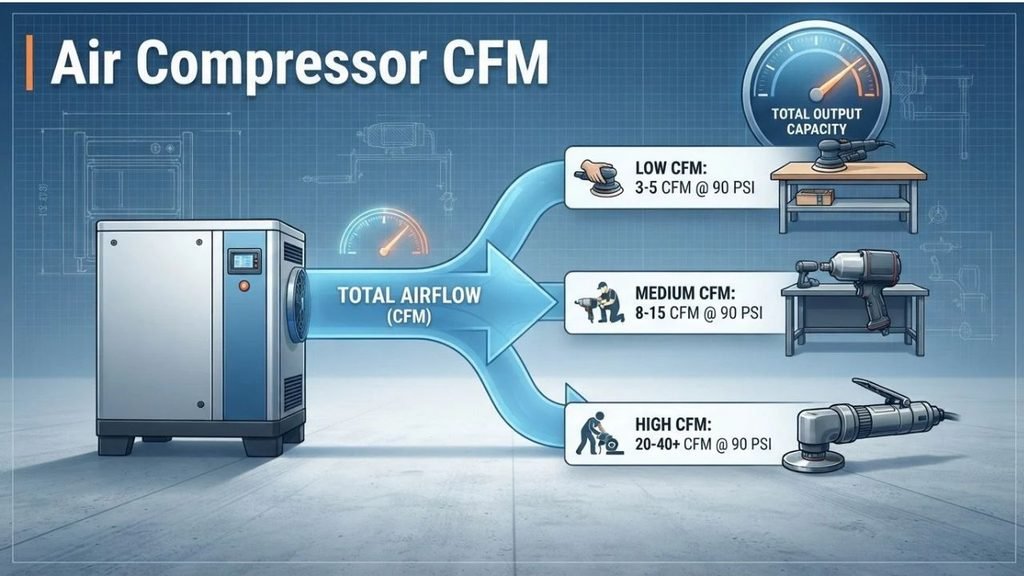
Air compressor CFM stands for cubic feet per minute.
It tells you how much air the compressor can supply over time.
CFM is one of the most important specifications when matching a compressor to pneumatic tools.
For example:
- A nailer may need relatively little average airflow.
- An impact wrench may need moderate airflow.
- An air sander may require high continuous airflow.
If your tool consumes more CFM than the compressor can produce, tank pressure will continue falling while you use the tool.
What Is SCFM?
SCFM means standard cubic feet per minute.
It is an airflow measurement referenced to standardized atmospheric conditions.
Manufacturers frequently publish SCFM rather than simple CFM so performance can be compared more consistently.
You may see ratings such as:
- 2.6 SCFM @ 90 PSI
- 5.0 SCFM @ 90 PSI
- 11.5 SCFM @ 90 PSI
Always compare compressor output and tool requirements at similar pressure ratings.
Why CFM Is More Important Than Tank Size
Imagine two 20-gallon compressors.
One produces 4 CFM at 90 PSI.
The other produces 8 CFM at 90 PSI.
Even though both have the same tank capacity, the second compressor can replenish air roughly twice as quickly under comparable rating conditions.
That can make a major difference when using continuous pneumatic tools.
How Much CFM Do I Need?
The correct CFM depends on your tools.
A general approach is:
- Find the highest-CFM tool you plan to use.
- Check its required CFM at the specified pressure.
- Choose a compressor that can deliver more than that requirement.
Providing some extra airflow capacity helps prevent the compressor from constantly operating at its maximum.
Air Compressor PSI
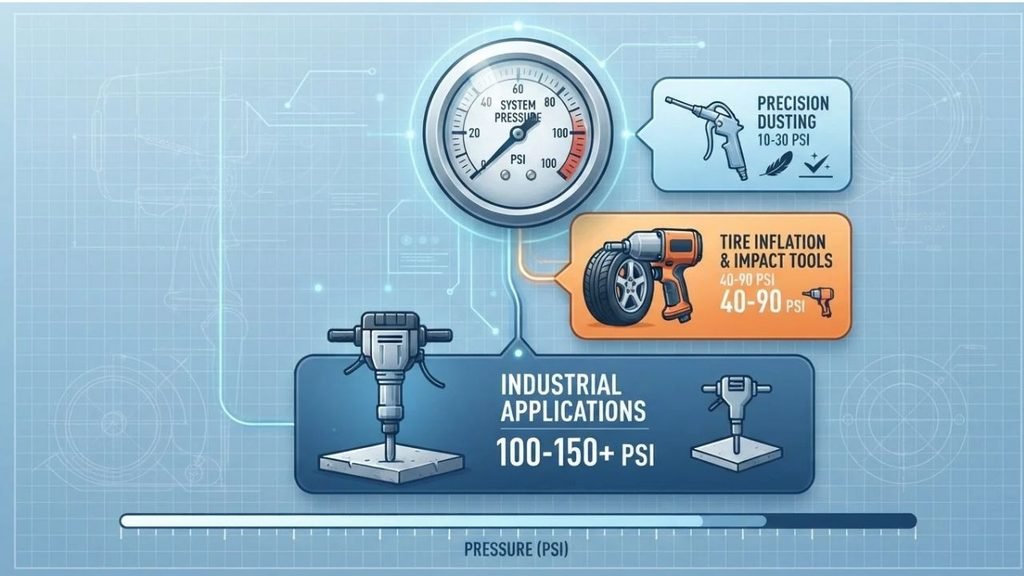
Air compressor PSI means pounds per square inch.
It represents air pressure.
A compressor might have a maximum tank pressure such as:
- 125 PSI
- 135 PSI
- 150 PSI
- 175 PSI
Pneumatic tools usually operate at a lower regulated pressure.
Many common air tools are rated around 90 PSI, although requirements vary.
PSI vs. CFM
PSI and CFM describe different things.
PSI = pressure
CFM = airflow volume
A simple way to think about it:
- PSI tells you how hard the air pushes.
- CFM tells you how much air flows.
You need enough of both.
A compressor advertising 200 PSI but supplying very low CFM may still be unsuitable for a high-air-demand sander.
Air Compressor Horsepower
Horsepower describes the power available to drive the compressor pump.
You may see ratings such as:
- 0.5 HP
- 1 HP
- 1.5 HP
- 2 HP
- 5 HP
Horsepower can provide useful information, but it should not be the primary specification used to choose a compressor.
CFM output at the required PSI is usually more directly related to tool performance.
What Is Air Compressor Duty Cycle?
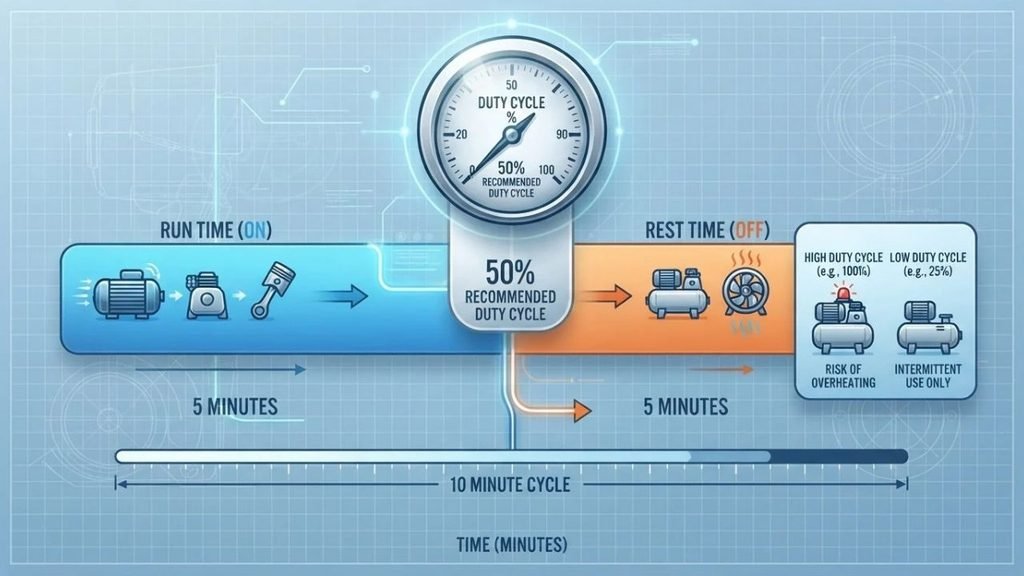
Duty cycle describes how much of a given period the compressor is designed to spend running.
For example, an intermittent-duty portable compressor may require regular cooling periods.
A compressor intended for continuous operation can run much longer.
Duty cycle matters because compressing air creates heat.
Exceeding the intended duty cycle can cause:
- Overheating
- Faster wear
- Motor thermal shutdown
- Shorter compressor life
Portable vs. Stationary Air Compressor
Portable Compressor
Portable compressors are designed to move easily.
They may have:
- Handles
- Wheels
- Small tanks
- 120V motors
Good applications include:
- Construction
- Tire inflation
- Nail guns
- DIY work
Stationary Compressor
Stationary compressors are larger and normally remain permanently installed.
They may have:
- 60- or 80-gallon tanks
- 240V electrical supply
- Belt-driven pumps
- Higher airflow
They are suitable for larger workshops and commercial applications.
Electric vs. Gas Air Compressor
Electric Air Compressor
Electric compressors are common because they are:
- Convenient
- Relatively quiet
- Suitable for indoor use when properly installed
- Easy to start
They require access to suitable electrical power.
Gas-Powered Air Compressor
Gas-powered compressors use a gasoline engine.
They are useful:
- On construction sites
- In remote areas
- Where electricity is unavailable
Combustion-engine compressors produce exhaust and must not be operated in enclosed areas where carbon monoxide can accumulate.
Direct-Drive vs. Belt-Drive Air Compressor
Direct Drive
The motor directly drives the compressor pump.
Advantages include:
- Compact design
- Fewer components
- Lower cost on many models
Small portable compressors often use direct drive.
Belt Drive
A belt connects the motor and compressor pump.
This allows different motor and pump speeds and is common on larger workshop compressors.
Belt-driven machines can be easier to service in some designs.
What Size Air Compressor Do I Need?
Choosing the correct compressor starts with the tools you intend to run.
Do not choose based only on tank gallons.
Consider:
- Required CFM
- Required PSI
- Duty cycle
- Tank size
- Number of tools
- Electrical supply
- Portability
- Noise
Air Compressor for Nail Guns
Nail guns use air in short bursts, so they generally do not require huge compressors.
A 2- to 6-gallon portable compressor is often suitable for:
- Brad nailers
- Finish nailers
- Pin nailers
- Many framing nailers
Check the nailer manufacturer’s air requirements.
Air Compressor for Impact Wrench
Impact wrenches require more airflow.
A small compressor may run one for short bursts, but repeated automotive work benefits from greater CFM and tank capacity.
A 20-gallon or larger compressor is often more practical for regular use, depending on the impact wrench’s requirements.
Air Compressor for Spray Painting
Spray guns can require substantial continuous airflow.
For painting, pay close attention to:
- CFM
- Air quality
- Moisture control
- Pressure regulation
A large tank alone cannot compensate for inadequate pump output.
Air Compressor for Air Sanders and Grinders
Tools such as:
- DA sanders
- Die grinders
- Angle grinders
can consume air continuously.
These tools often require considerably more CFM than nail guns or inflators.
A larger compressor with strong continuous airflow is usually required.
Air Compressor for Car Tires
You do not need a large compressor simply to inflate passenger vehicle tires.
Even a small portable compressor can handle tire inflation if it can reach the necessary pressure.
Tank size mainly affects how long you can inflate before the pump needs to run.
Air Compressor for Home Garage
For a general home garage, common options include:
6 Gallon
Good for:
- Nailers
- Inflation
- Light DIY
20 Gallon
Better for:
- Automotive work
- Impact tools
- General shop tasks
30 Gallon
Provides more reserve capacity for frequent garage work.
60 Gallon
Suitable for serious hobbyists and larger shops using higher-CFM tools.
The right choice depends more on airflow demand than on gallons alone.
Air Compressor Noise
Air compressors can be loud.
Noise is commonly measured in decibels (dB).
Small direct-drive piston compressors can be particularly noisy.
Quiet compressor designs may use:
- Lower-speed motors
- Larger pumps
- Sound insulation
- Scroll technology
- Vibration isolation
If the compressor will be used indoors, noise can be an important buying factor.
Air Compressor Moisture
Every compressor must deal with moisture.
Atmospheric air contains water vapor.
When air is compressed and cooled, some of that vapor turns into liquid.
Condensate can collect in:
- Tank
- Air lines
- Filters
- Tools
Regular draining is essential.
How Often Should You Drain an Air Compressor?
For a compressor used regularly, draining after substantial use or at the end of the workday is a practical general routine.
Heavy use and humid weather may require more frequent draining.
Always follow the manufacturer’s instructions.
Water Separator
A water separator removes liquid moisture from compressed air.
It can help protect:
- Air tools
- Spray equipment
- Regulators
- Piping
A separator works best after the compressed air has had enough time to cool for water vapor to condense.
Air Dryer
An air dryer removes additional moisture.
Common dryer types include:
- Refrigerated dryers
- Desiccant dryers
Dryers are particularly useful for:
- Painting
- Industrial air systems
- Instrumentation
- Moisture-sensitive equipment
Air Compressor Filters
Compressed-air systems may use several filters.
Intake Filter
Protects the compressor pump.
Particulate Filter
Removes solid contaminants.
Coalescing Filter
Helps remove fine liquid aerosols.
Activated Carbon Filter
Can reduce certain vapors and odors in specialized systems.
Filter selection depends on required air quality.
Air Compressor Regulators
A regulator allows you to reduce downstream air pressure.
If your tank holds 150 PSI but your tool requires 90 PSI, set the regulator according to the tool manufacturer’s specification.
Do not assume maximum tank pressure should be sent directly to every tool.
Air Compressor Hose Size
Hose diameter affects airflow.
Common air hose inside diameters include:
- 1/4 inch
- 3/8 inch
- 1/2 inch
Long, narrow hoses create greater pressure drop.
For high-CFM tools or longer hose runs, a larger hose diameter may improve performance.
Air Compressor Fittings
Quick-connect fittings allow tools and hoses to be connected easily.
Common components include:
- Couplers
- Plugs
- Tees
- Elbows
- Swivels
Not every fitting profile is interchangeable.
Matching couplers and plugs helps prevent leaks and poor connections.
Air Compressor Electrical Requirements
Electrical requirements vary widely.
Small compressors may operate from:
- 120V household outlets
Larger stationary compressors may require:
- 240V circuits
- Dedicated breakers
- Heavier wiring
Large industrial machines may use three-phase power.
Always follow the compressor’s electrical nameplate and installation instructions.
Can You Use an Extension Cord With an Air Compressor?
You can use one only if the manufacturer permits it and the cord is correctly sized.
An undersized extension cord can cause voltage drop.
That may lead to:
- Hard starting
- Motor overheating
- Breaker trips
- Reduced performance
For portable work, manufacturers often prefer using a longer air hose rather than an unnecessarily long electrical cord.
Air Compressor Maintenance
Maintenance varies by design.
Basic maintenance may include:
- Draining the tank
- Cleaning intake filters
- Checking air leaks
- Inspecting hoses
- Checking safety valve
- Cleaning cooling surfaces
- Inspecting belts
- Checking oil if applicable
Oil-Lubricated Compressor Maintenance
An oil-lubricated compressor also requires:
- Oil-level checks
- Scheduled oil changes
- Correct compressor lubricant
Running the pump low on oil can cause severe damage.
Oil-Free Compressor Maintenance
Oil-free does not mean maintenance-free.
You may still need to:
- Drain moisture
- Replace filters
- Inspect seals
- Replace worn piston components
- Keep cooling areas clean
Common Air Compressor Problems
Several problems occur frequently.
Compressor Won’t Start
Possible causes include:
- No electrical power
- Tripped breaker
- Thermal overload
- Failed pressure switch
- Failed capacitor
- High residual head pressure
Compressor Runs but Won’t Build Pressure
Possible causes include:
- Air leak
- Worn piston ring
- Damaged valve plate
- Blown gasket
- Open drain valve
Compressor Runs Constantly
Possible causes include:
- Compressor too small for demand
- Air leaks
- Worn pump
- High airflow consumption
Compressor Overheats
Potential causes include:
- Excessive duty cycle
- Poor ventilation
- Low oil
- Dirty cooling surfaces
- High ambient temperature
Compressor Is Very Noisy
Possible causes include:
- Loose parts
- Worn bearings
- Mechanical damage
- Normal characteristics of a high-speed compressor
A sudden change in noise should be investigated.
Air Compressor Safety
Compressed air stores significant energy.
Basic safety practices include:
- Never exceed rated tank pressure.
- Never modify the safety valve.
- Inspect the tank for corrosion.
- Drain moisture regularly.
- Use rated hoses and fittings.
- Wear eye protection when appropriate.
- Disconnect power before servicing.
- Depressurize before removing pressure-containing fittings.
Never Direct Compressed Air at People
Compressed air can injure:
- Eyes
- Skin
- Ears
Do not use high-pressure compressed air to clean your body or clothing.
Use appropriate OSHA-compliant workplace practices where applicable.
Never Use a Damaged Air Receiver
Do not continue using a tank showing:
- Severe rust
- Cracks
- Bulging
- Significant physical damage
A compressed-air receiver is a pressure vessel.
Do not weld, drill, or modify it casually.
Air Compressor Buying Checklist
Before buying, answer these questions:
- What tools will I run?
- What is the highest tool CFM requirement?
- What pressure do my tools require?
- Do I need continuous airflow?
- How portable should the compressor be?
- How much noise is acceptable?
- Do I have 120V or 240V power?
- Do I need oil-free air?
- How much tank capacity would be useful?
- Will I use more than one tool at once?
Once these are clear, selecting the correct compressor becomes much easier.
CFM vs. PSI vs. Gallons vs. Horsepower
These four specifications often confuse beginners.
| Specification | What It Tells You | Why It Matters |
| CFM/SCFM | Airflow volume | Determines whether compressor can keep up with tools |
| PSI | Air pressure | Determines pressure available to operate equipment |
| Gallons | Tank capacity | Determines stored air reserve |
| Horsepower | Motor/pump power | Helps describe compressor power but not tool compatibility alone |
For most pneumatic tools, start with CFM and PSI.
Then consider tank size.
Do You Need the Highest PSI Compressor?
Not necessarily.
If all your tools operate at around 90 PSI, having extremely high maximum tank pressure does not automatically improve tool performance.
Higher tank pressure can store more usable compressed air in a given tank, but actual performance still depends on pump airflow and regulator setup.
Is a Bigger Air Compressor Always Better?
No.
A larger compressor can provide more airflow and storage, but it may also be:
- More expensive
- Heavier
- Louder
- More difficult to move
- More demanding electrically
Buy enough compressor for your intended tools with some reasonable reserve capacity.
Oversizing excessively may provide little benefit for simple tasks.
FAQs About What Is Air Compressor
What is air compressor used for?
An air compressor converts energy into compressed air that can inflate tires, operate pneumatic tools, spray coatings, clean equipment, and power industrial machinery.
What type of air compressor is best for home use?
For general home use, a small oil-free piston compressor is often the simplest option.
The ideal size depends on the tools you want to run.
What are the main air compressor parts?
Common components include the compressor pump, electric motor, receiver tank, pressure switch, regulator, gauges, check valve, safety valve, intake filter, and drain valve.
What air compressor size do I need?
Start with the highest CFM and PSI requirement of the tools you plan to use.
Then choose a compressor that can comfortably exceed that airflow requirement.
What air compressor gallon size should I buy?
Small 1- to 6-gallon tanks are suitable for inflation and nailers, while 20- to 30-gallon compressors are useful for general garage work. Sixty- to 80-gallon compressors are common for higher-demand shop applications.
Tank size should not be chosen without considering CFM.
What does air compressor CFM mean?
CFM means cubic feet per minute.
It measures how much compressed air the compressor can deliver.
Higher-CFM tools require compressors capable of supplying more airflow.
What does air compressor PSI mean?
PSI means pounds per square inch.
It measures air pressure.
A compressor must provide enough PSI for the tool, but it also needs enough CFM to maintain that pressure while the tool operates.
What is the difference between CFM and PSI?
CFM measures airflow volume, while PSI measures air pressure.
Both specifications matter when matching a compressor to an air tool.
Conclusion
The practical answer to what is air compressor is that it is a machine that takes atmospheric air, compresses it to a higher pressure, and stores or supplies that compressed air for useful work. Everything else—tank size, CFM, PSI, horsepower, lubrication method, and compressor type—helps determine how much work that machine can realistically perform.
For beginners, the most important lesson is not to judge an air compressor by gallon size or maximum PSI alone. Air compressor CFM tells you whether the pump can keep up with your tools, air compressor PSI tells you whether enough pressure is available, and air compressor gallon size tells you how much compressed-air reserve the tank provides. All three specifications work together.
The right type of air compressor depends on the job. Small oil-free piston compressors are excellent for inflation, nailers, and occasional DIY work. Larger piston compressors suit garages and automotive work. Rotary screw, scroll, and centrifugal compressors serve commercial and industrial applications where higher airflow, cleaner air, quieter operation, or continuous duty may be required.
Understanding basic air compressor parts such as the pump, receiver tank, motor, pressure switch, regulator, safety valve, check valve, intake filter, and drain also makes operating and maintaining the machine much easier.
The overall verdict is simple: choose an air compressor based first on your tools’ required CFM and PSI, then select an appropriate tank size, duty cycle, electrical supply, and compressor design. If you understand those fundamentals, you can evaluate almost any compressor specification without being misled by one large number on the label.